We, Conservatives, were a coalition from the very beginning, in Canada. We were, of course, the Liberal-Conservative Party under Sir John A, reflecting the alliances formed between Ontario and Atlantic Canadian Tories and Louis Hippolyte Lafontaine’s moderate Parti bleu in Quebec. This was in contrast to the Liberals who were formed by the Clear Grits from Upper Canada and the Papineau’s radical Parti rouge in Quebec.
(So Quebec has always been central to both Conservative and Liberal political success in Canada and it was Quebec that gave us our modern Conservative blue and Liberal red icons ~ which are opposite to the Democratic blue and Republican red in the USA.)
Ted Campbell, “Our Conservative Roots”, Ted Campbell’s Point of View, 2017-03-05.
January 18, 2019
QotD: Political colours in the US and Canada
January 2, 2019
In violation of Betteridge’s law of headlines, this question can clearly be answered “yes!”
A few days back, Ted Campbell posted under the title “Is it time to get rid of the CBC? Should we?” Betteridge’s law says the answer should be “no”, but in this case the answer is more like “Why haven’t we sold that thing off already?”:
OK, the source of this cringeworthy video clip, Rebel Media, may be suspect to many ~ I do not follow them ~ but it does bring up a question: is this what we expect for the $1 Billion plus we pay for the CBC?
The complete interview, which I watched. looks, as someone else said, more like an advertisement for one of those online dating sites than news. It certainly caused a small storm about the CBC’s bias … which, in this case, especially when compared to CBC journalists’ question and comments directed to e.g. Andrew Scheer and Maxime Bernier, seems over the top, even by the CBC’s standards. And that begs the question: is the CBC living up to its mandate? The Broadcasting Act says (§3(1)(d)(i), inter alia, that “The Canadian broadcasting system should serve to safeguard, enrich and strengthen the cultural, political, social and economic fabric of Canada.” I suspect that someone will want to make a case that the CBC, as a network, at least in it’s English language ‘news’ services, has crossed a line and looks too much like a 24 hour a day informercial for the Laurentian Consensus as represented by the Liberal Party of Canada.
[…]
What does the CBC do? Basically it provides, in both English and French, three services:
- Radio Canada International ~ this is Canada’s voice to the world, it is, today, entirely on the internet. In 2012 the Harper government imposed a 10% cut on CBC/Radio Canada ~ then CBC/Radio Canada decide that RCI, which is little known, would have its budget cut by 80% from $12+ Million to just over $2 Million. That ended the era of RCI‘s shortwave, world wide service. It was a criminally stupid decision that, in my considered, professional opinion, should have caused the government of the day to summarily dismiss the entire CBC/Radio Canada Board and all of the most senior managers for cause. Every country needs a “voice,” RCI was ours … the gold standard for international broadcasting is found in the BBC World Service and Deutsche Welle, both still provides near global coverage using nearly jam-proof shortwave and satellite radio stations. Both, of course, make extensive and intensive use of the internet;
- CBC Radio ~ CBC Radio has a big, integrated network of stations covering most of Canada. You can see a list of transmitters on their web site. If you live in Arctic Bay, in Nunavut, population 850±, you are served by radio station CKAB-FM which is a community-owned CBC North rebroadcaster that gets its programming from CFFB in Iqaluit; if you live in Prince Rupert, BC, your are served by CBC Radio 1 (a national network which has a mix of local, regonal and national programmes) broadcasting on 860 KHz and if you live in Shilo, MB you are also served by CBC Radio 1 on FM from Brandon, the people in Twillingate, NL are served, again by Radio 1 from Grand Falls which is rebroadcast on 90.7 MHz from a transmitter in Botswood. In short, CBC Radio is doing a first rate job of serving most Canadians, even if you find some of the content banal and biased. I think it is, by and large, money well spent because in many, many, many communities the CBC provides the only news and weather; but
- CBC Television is, in my opinion, a near total waste of taxpayer’s money. As you can see from this list (you have to select the province you want) the CBC has only 14 English language TV broadcast stations which serve about 25 urban ‘markets’ and serves less than 10% of the Canadian market in prime time. (Rex Murphy, in a talk to the Manning Centre, quipped about the low audience levels of the CBC at about the 2’50” mark.) It used to have hundreds of transmitters providing near national coverage but in 2012, when Canada converted to digital TV, it closed all but 14 because only a tiny number (certainly less than 5%, likely less than 2%) of Canadians want to watch CBC and do not have cable or internet access. Electing to not serve Canadians with many, many local TV stations was a smart business decision because, as you can see from this listing, Canadians from Kamloops, through Kenora and on to Halifax and St. John’s are served by other networks.
I think that Radio Canada International should be upgraded; CBC Radio should remain about the same, government funded and commercial free, and CBC TV should be closed, completely and the money saved should be used to directly subsidize TV, film and radio production in Canada based on Canadian content rules: n% for the production company being Canadians and using Canadian studios, x% for using Canadian talent ~ on screen and in in the studio, y% for using Canadian locations and so on.
Some, at least half, I suspect, of the CBC’s 14 television licences will sell, at auction, for a tidy sum, making room for new, innovative, probably ethnic, services in larger cities ~ Vancouver, Calgary, Toronto and Montreal and a couple of others. The CBC”s excellent production facilities will also sell for a good sum to private entrepreneurs who will then host dozens of independent radio and TV programme producers. There’s nothing wrong with Canadian production values and in a more open market I suspect that Canadian drama, public affairs, education and political commentary programmes can survive and even thrive, each on its own merits.
October 3, 2018
Quebec election results – Coalition Avenir Québec (CAQ) majority
Global News rounds up the final poll results from Monday’s Quebec election:
After a 39-day election campaign, voters in Quebec headed to the polls Monday and elected the Coalition Avenir Québec (CAQ) to power.
The CAQ, headed by François Legault, won a majority of seats delivering a crushing blow to the Quebec Liberal Party, who had held power for 13 of the last 15 years.
The CAQ was elected in 74 of the province’s 125 ridings, compared to 32 for the Liberals.
The Parti Québécois (PQ) suffered a double blow going from 28 seats to 9 and is once again without a leader, after Jean-François Lisée announced he was stepping down after losing his riding of Rosemont.
I really haven’t been following Quebec politics at all, so I didn’t know much about the CAQ’s stance on the issues. Here, cribbed from the Wikipedia page are some of their issues gleaned from the party platform (selective emphasis mine):
- CAQ Leader François Legault has promised to reduce the tax burden of Quebecers. A CAQ government, he says, will further harmonize school taxes across the province, a tax cut valued at $700 million.
- A long-standing party proposal is to create a Quebec version of Silicon Valley, which they’ve dubbed “The Saint-Laurent Project”. It envisions turning the Saint-Lawrence Valley into a hub of innovation and entrepreneurship, with the collaboration of universities.
- Hoping to eliminate tens of thousands of jobs from the province’s civil service.
- As premier, Legault says he would temporarily reduce the number of immigrants Quebec accepts annually from 50,000 to 40,000.
- To qualify for a Quebec selection certificate, the CAQ wants immigrants to pass a values and language test. Immigrants would also have to prove they have been looking for employment. Some experts have questioned the legality of the plan.
- The party favours decentralizing health-care administration, while maintaining a universal free public health care system, Legault was quoted saying “The important thing is the universality of care. … I do not want more private. Our public [health care] is a jewel of Quebec.”
- Like the PQ, the CAQ also vowed to renegotiate with the Quebec’s medical specialists in order to cut their compensation by an average of $80,000 per year. Legault believes the specialists will be open to striking a new deal.
- Would overhaul the province’s longterm care system (CHSLDs) with a new network of smaller, more “humane” homes at an initial cost of $1 billion.
- Wants to abolish school boards and replace them with service centres that would provide administrative support to schools. The party believes this would give schools greater autonomy and make the education system cheaper to run.
- Wants to increase the mandatory age of staying in school to 18, to reduce the drop out rate.
- Wants added homework help, extracurricular activities (sport and culture), additional funding for career guidance and tutors assigned to more vulnerable students.
- The CAQ is also proposing to do away with progressive daycare pricing, though over a period of four years. All Quebec parents would be charged the same daily rate, regardless of their annual income.
- Opposes the wearing of religious symbols, including the hijab, by police officers and others who wield coercive state power. The party would also ban school teachers from wearing religious symbols.
- Would pass a “Secularism Charter” to reduce the scope of religious accommodations available to civil servants.
- Calls itself nationalist. It wants more power for Quebec, but within Canada. Legault, a former PQ cabinet minister, has promised a CAQ government will never hold a referendum on Quebec sovereignty.
- Legault wants to seek additional powers for Quebec, including control over immigration, increased fiscal capacity and a say in the nomination of Supreme Court justices. Some of these measures would require re-opening the Constitution.
- Supports international greenhouse gas reduction targets and would promote “technological innovations to ensure their achievement”.
October 1, 2018
The rebirth of Quebec separatism?
Conrad Black wants to provoke clinical depression in anyone who was around for the last round of Quebec separatism, and warns that we’ve been ignoring the issue while it’s been reviving in La Belle Province:
Canada is very late and very laconically beginning to consider the implications of the Quebec election on Oct. 1. If, on Monday night, as polls indicate, 40 per cent of Quebecers have voted for overtly separatist parties (Québec solidaire and the Parti Québécois) and 30 per cent for a party that declines to say separation is undesirable, only that it will not hold a referendum (Coalition Avenir Québec, or CAQ), no one should imagine that this is not a threat to this country. I have written here before that Canada would regret the refusal of Stephen Harper and Justin Trudeau to discuss methods of reintegrating Quebec into the Constitution, which would not have solved the problem permanently, but would have greatly strengthened federalism.
The issue of separatism appeared to die, but that is the nature of Quebec nationalism: it never dies, it just becomes comatose for a time. And though almost no one yet describes this Quebec election in these terms, the governing Liberals of Premier Philippe Couillard seem to be about even at 30 per cent with François Legault’s moderate left, constitutionally ambiguous CAQ. Legault was long an explicit separatist, and has not renounced that view (and his wife, Isabelle Brais, thinks English Canada has no culture and should have no status in Quebec). The Quebec Liberal party, like the British Columbia Liberal party, is really a Liberal-Conservative coalition. It governed very efficiently these past four years, but became an ecologically obsessed and eccentric regime. While it retains the support of most of the non-French, it is now pulling only a very unfeasible 17 per cent of the French Quebec vote.
Though the CAQ has been slipping, it has been losing ground to Québec solidaire, a rabidly separatist party that proposes immediate, unconditional secession. It is led by a declared Marxist who opposes the right of the State of Israel to exist, and, astonishingly, it may hold the balance of power in the National Assembly. It threatens to pass the original separatist PQ of former premiers René Lévesque, Jacques Parizeau and Lucien Bouchard, which hasn’t changed its tune but is whistling it more softly. The independence of Quebec has not been much raised in the campaign, but the implications of the emerging voting patterns assure that it will re-emerge.
And no discussion of the separatism question is complete without at least a nod in the direction of the Charlatan Accord:
The Charlottetown agreement on a substantial decentralization, put to a countrywide referendum in 1992, was defeated by 54 per cent of Canadians, though it had been approved by the federal parliament and all the provincial legislatures. Bouchard, Mulroney’s most prominent Quebec MP, deserted the government, founded the separatist Bloc Québécois, and led the 1995 referendum campaign in Quebec after Parizeau was elected premier. It was a slightly more explicit separatist question than Lévesque had posed 15 years before. Chrétien was over-confident, mishandled the campaign, and gave a slightly panic-stricken appeal to Quebec voters on referendum-eve. It was 50.6 to 49.4 per cent for the federalists, a clear separatist victory for the French Quebecers, and the turnout was 93.4 per cent.
Chrétien somewhat redeemed himself with the Clarity Act of 1999, based on the results of a Supreme Court referral, which held that any secession had to be on the basis of a substantial majority supporting a clear referendum question to secede. (I was one of those who urged that the Act also provide that any county in a seceding province that had voted not to secede and was contiguous to another province, should secede from the province and remain in Canada. My precedents, though I never got to cite them, were West Virginia and Ulster.) Lucien Bouchard lost interest in the idea of independence, and the Liberal party has governed in Quebec for 13 of the past 15 years. The present premier, Couillard, is the most unambiguously federalist Quebec premier since Jean-Jacques Bertrand in 1970, and it will not be long before he is missed by those in Ottawa who declined to discuss these issues with him. If he is out on Monday night, Couillard’s successors will blow a cold wind on Ottawa and across Canada just as the Trudeau government appears to be set to break up the relationship with the United States, and our automobile industry prepares to repatriate to the U.S. Justin might do better as the next leader of the Quebec Liberals.
May 11, 2018
Imagine Ontario’s election
Andrew Coyne on the fantasy campaign that is just kicking off in Ontario:
The first NDP ad of the 2018 Ontario election campaign invites viewers to “imagine a place” where hydro is cheap, drugs are free, and dental care is on the house — all at no cost to anyone except the “very rich” who will be “asked” to “pay a little more,” which I gather is NDPese for “taxed within an inch of their lives.”
That word — “imagine” — might be the theme of the coming election. The three major parties appear to be living in a world of the imagination, with platforms full of imaginary promises paid for with imaginary dollars. The province is sinking ever deeper in debt, notwithstanding the Liberal government’s desperate efforts to conceal it, its debt-to-GDP ratio headed for 45 per cent even after a decade or more of uninterrupted economic growth. A recession of any length or severity would blow that number skyward.
Beyond that the picture only grows darker, with the first of the baby boomers just into their 70s and the costs of health care projected to rise, relentlessly, as they grow into their dotage. And yet all three parties are merrily racking up new spending promises — daycare, pharmacare, dentacare, the works — with money they wouldn’t have even if the official budget numbers were genuine, and not, as the province’s auditor general has lately warned, a swindle and a fraud (I paraphrase). It’s an election in la-la land.
Oddly, this does not seem to be the conventional view. The advance word on the election, rather, is that Ontario is facing a choice of unprecedented starkness, a polarizing election with no one seeming to occupy the middle ground.
“It’s hard to remember a provincial campaign that’s featured two leaders so diametrically opposed to each other,” broadcaster Steve Paikin wrote recently, of the Liberals’ Kathleen Wynne and the Conservatives’ Doug Ford. “The political centre,” agrees the Globe and Mail’s Marcus Gee, “has vanished like a puddle in the sun.”
It’s true that the Liberals and the NDP are in something of a bidding war for the left-of-centre vote. If the March budget signalled a retreat from the Liberals’ not-overly-stringent devotion to fiscal restraint, the NDP platform goes further in every direction: about $4 billion a year further, in fact.
March 11, 2018
Polls begin to reflect public disillusionment with Trudeau after gaffe-filled India trip
After all the PR blunders, it’s amazing that the Liberals are still riding as high in public opinion polls as they are:
By now it is clear the federal Liberals are in some difficulty with the public. Much excitement attended that Ipsos poll earlier this week showing them trailing the Conservatives for the first time, and by a not inconsequential margin: 38 to 33. But it’s not just Ipsos.
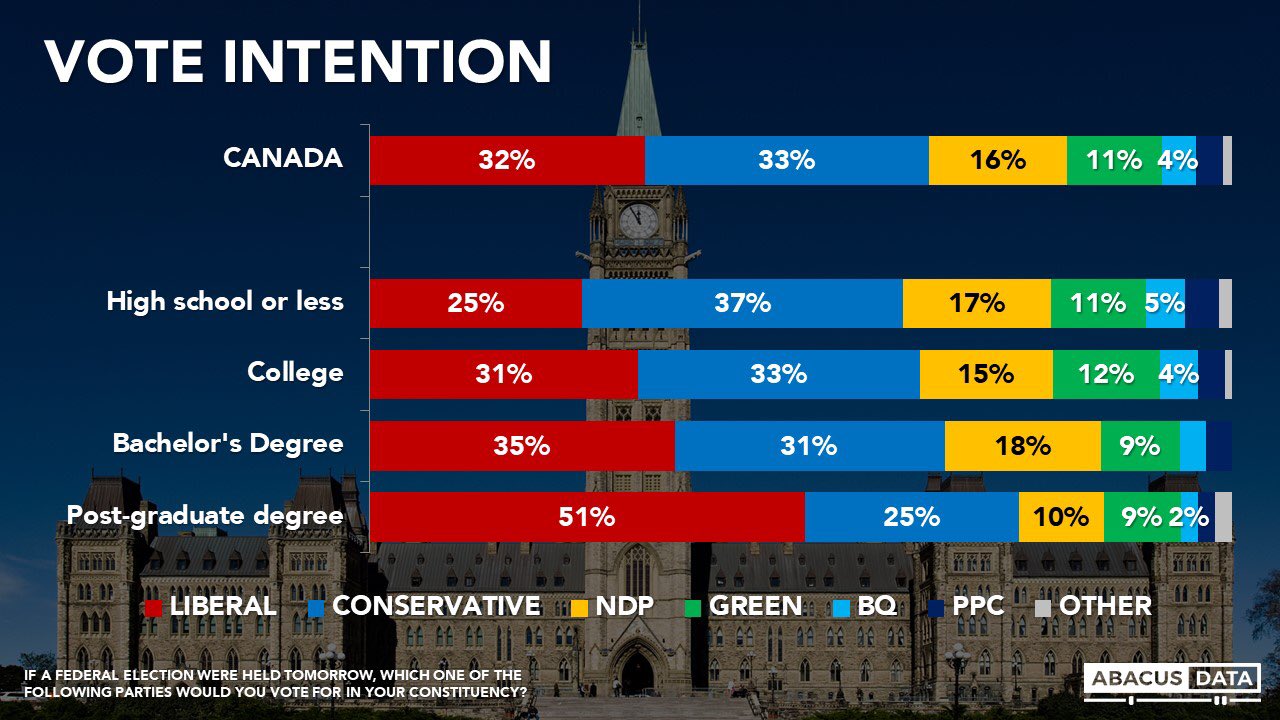
Forum Research, which gives the Tories a 12-point lead, may be an outlier, but Nanos’s latest four-week rolling poll shows the Liberal lead has shrunk to less than four points from eight points in December; Abacus Data, similarly, now has them just three points ahead, the narrowest margin they have found since the election.
Overall, the CBC’s Poll Tracker website now puts the two parties more or less level, based on a weighted average of the polls, at 36 per cent. Contrast that with the Liberals’ first year in office, when they maintained a lead of as much as 20 points, or even their second, when they led by eight to 10. Something is clearly up.
The reason is not hard to find, nor is it unusual: the prime minister’s personal approval rating has declined markedly. To be sure, he remains the Liberals’ chief asset: Nanos still shows 40 per cent of Canadians put Justin Trudeau as their preferred prime minister. Sixty per cent say he “has the qualities of a good political leader.”
[…]
The immediate explanation for the prime minister’s cratering appeal is the recent official visit to India, conceded on all sides to have been a disaster. There’s no doubt this has taken its toll — Ipsos finds more than twice as many Canadians of the view that the visit was “negative for Canada-India relations” than the contrary.
But if the India visit accelerated the decline, it is also true that the prime minister’s appeal has been fading for some time. The India trip may have crystallized certain perceptions of him, but the ingredients have been evident for a while. People do not form impressions of a leader’s character and abilities instantaneously, but only as the result of an accumulation of incidents and impressions.
The Tories’ pre-election attempts to discredit Trudeau as “just not ready” failed in the light of a long campaign in which he persuaded increasing numbers of Canadians that he was. I don’t imagine many would have said he was much of a deep thinker — his worst moments are almost always when he tries to pretend he is — but people gave him credit for sincerity, personal decency, idealism, and a native political ability that seemed to grow throughout the campaign.
But now? Asked to name the first quality that came to mind, I suspect increasing numbers might be more inclined to mention his cynicism.
October 26, 2017
So what was the point in the Sudbury byelection trial?
I admit I didn’t follow this case in any detail, but what little I did read left me scratching my head over what the actual crime was supposed to have been. I certainly don’t have any partiality for the defendants, but there really didn’t seem to be any “there” there in any “breaking the law” way. Chris Selley (who actually did have to pay attention to the trial) seems to have felt much the same way:
Justice Howard Borenstein kicked the living daylights out of the Crown’s case in the Sudbury byelection trial on Tuesday, acquitting Liberal operatives Gerry Lougheed and Pat Sorbara of bribery without the defence calling evidence. The “directed verdict” means he didn’t think any Crown evidence would result in a conviction even if a jury believed it entirely — not a great look for the prosecution. Defence lawyers Brian Greenspan (for Sorbara) and Michael Lacy (for Lougheed) didn’t say whether their clients would pursue the Crown for costs, but they were otherwise inclined to orate. Both called it a “vindication.”
“This is as close in law as you can have to saying, ‘she’s innocent,’ ” said Greenspan.
“Nothing changed during this case. The evidence that was presented was the evidence that was available from the very beginning,” said Lacy. “And yet here we are, however many days later, with no case to answer for. (It) raises questions about why they prosecuted this matter to begin with.”
No kidding. I wouldn’t trust the lawyers the Crown came up with to wash my car, but they can’t have come cheap.
Under the circumstances, it’d be quite reasonable for them to attempt to recoup their legal costs.
So that was that. Two Liberals, three charges, three acquittals — and rightly so, says I. As I’ve said before, the Crown’s desultory shambles of a case managed to shift me from thinking Lougheed and Sorbara behaved greasily, if not illegally, to thinking they had barely done anything noteworthy. Both claimed to have no regrets on Tuesday; moments after the acquittal, the Liberals welcomed Sorbara back into the fold on Twitter. The opposition’s rote angry press releases ring rather hollow — especially in the Tories’ case, considering all the recent allegations of riding-level skullduggery.
On the bright side, we have some precedent at least. This is the first time anyone has ever been charged under the bribery provision of the Ontario Election Act, which dates from 1998. Seven other provinces have similar bribery provisions in their election acts; so far as I can tell no one has ever been charged under them either. The only mentions made of the new provision in debates at the Ontario legislature were about how everyone would surely agree it was a great idea. The next time politicians decide to tinker with the Election Act, they should get their intentions on the record. Had Borenstein sided with the Crown, he would nearly have outlawed politics altogether.
October 24, 2017
More on Quebec’s niqab ban
Ted Campbell is emphatically against Quebec’s attempt to ban facial coverings for Islamic women:
These laws are stupid … but they are worse than stupid, they are an assault on individual liberty by a bunch of political nincompoops.
Now, there are a number of variants of head and face coverings, they are especially common among some Muslim women …
… and some restrictions on some of them in some situations are, pretty clearly, justified on common sense or security-identification grounds. We, most of us, can probably agree that a lady should not wear a burqa or chador or even a niqab when she’s driving a car (it might restrict her vision) or when she is applying for a driving licence, which is a pretty common form of recognized identification … and it seems pretty clear that airport security should insist that a burqa or chador must be removed for security screening (to permit positive facial recognition).
But, why the hell does the state ~ the BIG, collective, state ~ care what any individual wears when (s)he boards a bus. It ought to care that she deposits the correct fare, of course, or taps her card to pay, but why does the state care if her face is covered? It’s arrant nonsense, and it is an infringement on a fundamental right.
Reminder: you (and I, and Muslim women, too) have lots of rights but four of them are quite fundamental: life, liberty and property as defined by John Locke in 17th century England and privacy, as defined by Brandies and Warren in 19th century America. These rights all accrue to all individuals, only, and they, those individuals, need to have their fundamental rights protected against constant threats from collectives including religions, societies and states, themselves. These new laws, passed by big, collectivist states, are threats to individual liberties and must be challenged and overturned. Liberals, like Justin Trudeau, will not do it because they are progressives, not liberals, and because people like Justin Trudeau cannot think about fundamental rights … only about partisan, short term, political advantage.
Let me be clear about my own position:
- Women may wear whatever they want for their own (good or not so good) reasons; but
- It is wrong for anyone (including any father or husband or rabbi or provincial premier) to force women to dress in some certain way for social (including political) or religious reasons.
Your religion is a wholly private matter between you and your gods … you may never try to impose your beliefs on others, including your wife and children.
October 20, 2017
Justin Trudeau’s government at the two-year mark
Paul Wells nicely lists all the good things the Trudeau government has managed to do during the first two years of its mandate, then gets down to the other side of the balance sheet:
The worse continues to pile up. I see no way the rushed and timid legalization of cannabis will drain the black market and, in hardening more penalties than it relaxes, it seems certain to provide busywork for police who have been asking only to be freed up to tackle more serious problems. (An internal Ontario government memo reaches the same conclusions.)
Since it’s impossible to find anyone in the government who’s conspicuous for saying no to any proposed spending spree, it’s a near dead-lock certainty that Canada will become a nursery for white elephants — and, unless this generation of public administrators is luckier than any previous generation, for corruption, somewhere in the system.
The government’s appointments system is, as one former staffer told me this week, “just a little f–ked,” with backlogs as far as the eye can see. There’s a serious bottleneck for important decisions, with the choke point in the Prime Minister’s Office. Rookie ministers, which is most of them, are held close. Those who don’t perform are sent new staffers from the PMO: career growth comes from the centre, not the bottom.
A cabinet full of political neophytes — and there is nothing Trudeau could have done to avoid that, given how few seats he had before 2015 — has been trained to cling for dear life to talking points. The result is unsettling: most of the cabinet simply ignores any specific question and charges ahead with the day’s message, conveying the unmistakable impression they are not as bright as — given their achievements before politics — they must surely be. Or that they think their audience isn’t. I doubt this is what anyone intends, but by now it’s deeply baked into the learned reflexes of this government.
Then there is this tax mess. I’m agnostic on the policy question: in my own life I’ve been spectacularly unimaginative in organizing my finances for minimal taxation. I put all the book money into RRSPs, called my condo an office for the two years I used it as one, and that was the end of that. But the summer tax adventure has left the Liberals with their hair on fire, for two broad reasons. One is that Bill Morneau’s personal financial arrangements are becoming surreal. The other is the way the project — and especially the life stories of its stewards, Trudeau and Morneau — undermined the Liberals’ claim to be champions of the middle class.
Wells very kindly doesn’t mention the ongoing flustercluck that is our military procurement “system” (which to be fair, the Liberals did inherit from the Harper Conservatives), which has gotten worse rather than better — and only part of that is due to Trudeau’s trumpeted “No F-35s” election pledge. The Royal Canadian Navy seem no closer to getting the new ships they so desperately need (aside from the Project Resolve supply ship, which the government had to be arm-twisted into accepting), and the government hasn’t yet narrowed down the surface combatant requirements enough to select a design.
Quebec’s niqab ban
Chris Selley on the Quebec provincial government’s latest anti-Muslim legislation:
It’s mostly about the Quiet Revolution. That’s what we’ve been assured by wise owl pundits about all this intolerant-looking rigmarole in Quebec. When polls show far more Quebecers than other Canadians hesitant to vote for a turban-wearing Sikh like NDP Leader Jagmeet Singh, the owls exhort us to contextualize: Quebecers’ rejection of the Catholic Church’s outsized role in their society left them suspicious of all public displays of religiosity (except Catholic ones, weirdly). This explains higher levels of antipathy toward other religious symbols as well, we are told: kippas, kirpans and hijabs. Hijabs specifically are antithetical to a uniquely French brand of feminism, the owls explain. We must understand that French Canadians, like the French, simply do not believe in multiculturalism; other cultures must adapt to and exist within the dominant one. Without understanding all this, we cannot comprehend what’s really happening.
Well, here’s what really happened Wednesday: after years of dithering, the Liberal government in Quebec City made it illegal to provide or receive government services with one’s face covered — which is to say no niqabs on university campuses, no niqabs at the police station, no niqabs on the bus or on the Métro. Not even the Parti Québécois’ much-loathed values charter proposed the latter. So what are we to make of this, owls? Was the Quiet Revolution, this proud rejection of church influence over the state, really about bestowing upon the state the power to tell religious people what they can and cannot wear on buses and trains? Shall we sing Gens du Pays?
How stupid do the Liberals think people are? How stupid do they think Canadian judges are? Stupid enough, apparently, to believe that this isn’t really about niqabs, but about a general outbreak of people riding public transit without their faces showing. Justice Minister Stéphanie Vallée said the rule applied equally to niqabs, balaclavas, dark sunglasses and anything else that might obscure all or part of the face. It’s a simple matter of “security, communication and identification.”
October 9, 2017
QotD: The fall and rise of the “liberal” label in Canada
The word “liberal” began to encounter a well-known crisis starting in about 1980. Liberalism had become equated with feeble criminal justice, Cold War slackness, large public deficits, high taxes, squirrelly currency … the mix of outrages varied from place to place and from time to time, but the common theme was weakness. To be a liberal was to be spongy and soft-headed about Darwinian imperatives of life, foreign policy and economics.
Our federal Liberal party has, given time, addressed some of these perceptions head-on and simply outlasted others. The capital-L Liberal brand has benefited from a whole range of phenomena, from Paul Martin’s curtailment of the federal public service to Justin Trudeau beating the crap out of a Conservative senator on television and looking good doing it. Trudeau took pains to stress the presence of “liberty” in the name “Liberal,” which had become almost a forgotten secret, a coincidence of etymology. That deprived the Conservatives of some of the energy that socially liberal and libertarian fellow-travellers might have brought to the contest.
Perhaps the secret of recent history in the provinces is that conservatives are not addressing psycho-semantic problems with the term “conservative.” How many times have you heard someone say, “I’m a social liberal but a conservative on economics”? This is the default political position of most adults now, is it not? Liberalism, which is to say pluralism, has won the argument in the “social” realm of government. What once was liberalism in economics, the dirigisme that my generation was taught to think of as the “mixed economy,” has largely lost; but the people who call themselves Liberals have succeeded at extricating themselves from the reputational burden.
Colby Cosh, “Is conservatism on the way out?”, National Post, 2015-11-10.
May 10, 2017
BC Greens the biggest winners in provincial election
Jay Currie explains why, even though they didn’t “win” the election, the BC Green Party is the biggest winner from yesterday’s general election in the province:
There are two losers tonight: the Liberals and the NDP. And there is one winner: the Greens. They managed to split the NDP vote and likely cost the NDP a majority government.
However, where the NDP and the Liberals have no obvious room to grow their electorate, the Greens have a very good shot at expanding theirs. The fact is that the people who shop at Whole Foods, send their kids to “French Immersion” if they can’t afford private (not for racist reasons of course) and think recycling is an act of benediction are legion. They used to vote NDP, now they have an alternative.
Andrew Weaver may be a lousy climate scientist but he is not an unintelligent man. He can count (so long as it does not involve climate change time series) and there are six ridings where the Greens came second. A rational, non-coalition, support of the Liberals would let him pass legislation of greater consequence than a ban on mandatory high heels for women in serving jobs. The Liberals, who will likely be reduced to a rural rump despite having likely won the most seats, are basically being elected by BC’s version of “deplorables”. Nice people think they are a bit, well, common.
Dr. Weaver, well educated, Oak Bay resident and articulate guy that he is should be able to target those nice, white, very liberal people and peel them away from both the Liberals and the NDP. Plus, Weaver has the children who have grown up on Green ideology masquerading as education.
One winner tonight: the Greens.
March 24, 2017
Kathleen Wynne … the Ontario Liberal Party’s saviour?
Chris Selley tries to position Ontario Premier Kathleen Wynne as being the greatest asset of the Liberal Party:
The question of Kathleen Wynne’s future as leader of the Ontario Liberal Party made its way to the public airwaves this week in the form a panel discussion on TVO’s The Agenda. Host Steve Paikin asked former Liberal MP Greg Sorbara what advice he would offer the premier, and his response caused a bit of a stir.
“It is extremely unlikely that you’ll win the next election. The facts are the facts,” he said he would tell her. “I have not seen a party in the last year of its mandate turn (poll) numbers around when they are as bad as (the Liberals’) are.” And he noted the numbers are “particularly bad” for Wynne personally.
The latest Mainstreet Research/Postmedia poll, released last week, had the Liberals at 22-per-cent support, 10 points behind the Tories. Forum Research last measured Wynne’s approval rating at 11 per cent, and her disapproval rating at 77 per cent. Just nine per cent said she would make the best premier of the three party leaders.
Okay, so where does Wynn come off as the Liberals’ best hope?
If Liberals are worried “it’s all over,” as Sorbara put it, I would submit it’s in large part because, on election day 2018, they’ll have been in power for 15 and a half not very impressive years. That’s the longest streak in Ontario in three decades. No party has managed it federally since St. Laurent took over from Mackenzie King.
Stuff builds up.
Stuff like, you know, Dalton McGuinty promising in writing not to raise taxes, then instituting a “health premium,” which he claimed wasn’t a tax, and then admitting under duress that it was a tax; like lottery retailers defrauding players to the tune of $100 million, and casinos managing to lose money; like allowing Ornge to spin out of control into corruption, mismanagement and overspending; like the electronic health records debacle; like turning a blind eye while native protesters illegally occupied Caledonia; like flushing a billion dollars or so down the john to cancel gas plants sooner than risk voters’ ire, then claiming there’s “no wrong time to make the right decision;” like various apparatchiks winding up arrested for little things like bribery and conspiring to delete government emails; like taking hundreds of thousands of dollars from companies that benefit from government largesse, shamelessly demanding cash for access to ministers, and only changing the rules when it finally became politically untenable; like a debt-to-GDP ratio that grew 40 per cent, from third-lowest among the provinces to fourth-highest; and like astronomical hydro bills born to a significant degree of bad political decisions.
All of that, and yet Wynne somehow managed to get a majority government last time around. Ontario’s masochistic voters clearly do deserve to get it, as Mencken said, “good and hard”.
February 4, 2017
Trudeau’s promise to reform the election system: “It had ‘face-melting political blowback’ written all over it”
My headline distorts Chris Selley‘s message a bit, but he does correctly point out that Justin Trudeau’s promise was a cynical ploy to attact NDP votes to Liberal candidates, not a genuine commitment to move away from FPTP in our federal election system:
So far as I can tell, the publicly stated evidence that senior members of the Liberal party had any interest in changing the electoral system amounted to Justin Trudeau’s single expression of interest in ranked ballots. There was no evidence at all to suggest any senior party members thought FPTP was the worst electoral system imaginable for Canada — the only interpretation of the platform promise. That being the case, the promise was far too conveniently enticing to New Democrat voters to take at face value.
As to referendums: ample Canadian precedent holds that electoral reform is contingent upon them. And a cursory glance at public opinion made plain that nothing justified breaking that precedent. An Abacus Data poll for the Broadbent Institute, published shortly after the 2015 election, asked respondents to rank their preferences among the current system, mixed-member PR (MMP), pure PR and ranked ballots. The most popular first choice by far, at 43 per cent, was the current system; it was also the second-most popular second choice. The most popular alternative, MMP, was the first choice of only 27 per cent.
No consultative process could fashion a referendum-free consensus from that. It had “face-melting political blowback” written all over it.
December 19, 2016
Justin Trudeau’s actual role in the Trudeau Foundation
Ted Campbell finds an oddly charitable way to describe the Prime Minister’s efforts on behalf of the Trudeau Foundation, and a contrast with Hillary Clinton’s role in the Clinton Foundation’s work:
Let me be very, very clear: I do not doubt Prime Minister Trudeau’s personal honesty; nor so I actually think he is smart enough, devious enough to manage a “cash for access” scheme. The “cash for access” scandal is, as Professor Tom Flanagan says, something that all parties, Conservatives, too, both nationally and provincially, have always done. Prime Minister Trudeau is, rightfully, being hammered not for schmoozing with the wealthy, but, rather, for his own person hypocrisy about the issue. But the Trudeau foundation is a bit different and a bit more dangerous. I think the Trudeau Foundation was set up, using $125 Million of Canadian public (taxpayers’) money “donated” by then Prime Minister Jean Chrétien, as a mechanism to perpetuate a Liberal icon and to provide a sinecure for Justin Trudeau and, thereby, to help him shelter some of his substantial family wealth from zealous tax collectors; and he is rather like an employee … something akin to a Disneyland Princess who gets trotted out to pose with the paying customers. But the warnings from Candice Malcolm and Tony Keller are valid and Prime Minister Trudeau should pay heed. Americans forgave Donald Trump for his great wealth and tax evasion and a hundred other faults because he spoke to them about their own fears. They did not forgive Mrs Clinton because, I think, she talked at them, not with them, and she talked about people and issues that working class Americans thought had already received enough attention and even special treatment.
Justin Trudeau is perceived, already, as a pampered, privileged “trust fund kid” who, despite the rhetoric, doesn’t really understand middle class, much less working class Canadians. Prime Minister Trudeau won, in 2015, in large measure because Canadian were tired of Prime Minister Harper, and because he is genuinely “nice,” but not because Canadians think he is, in any way, “one of them.” He could lose, as Hillary Clinton lost, if Canadians decide that he is using his high office to feather his own already substantial nest with “dirty” foreign money while he sells out Canadians’ interests. It may be unfair but the media have this bit between their teeth and they are not likely to just let it go away.