
January 11, 2012
January 6, 2012
Ten years later: Ron Paul’s 2002 predictions
September 14, 2011
The risk of terrorism doesn’t justify current US military spending
September 3, 2011
US troops allegedly handcuffed and executed children in 2006
Wikileaks may have been sitting on a particularly disturbing report:
A U.S. diplomatic cable made public by WikiLeaks suggests that U.S. troops executed at least 10 Iraqi civilians, including a woman in her 70s and a 5-month-old infant, then called in an airstrike to destroy the evidence, during a controversial 2006 incident in the central Iraqi town of Ishaqi.
The unclassified cable, which was posted on WikiLeaks’ website last week, contained questions from a United Nations investigator about the incident, which had angered local Iraqi officials, who demanded some kind of action from their government. U.S. officials denied at the time that anything inappropriate had occurred.
But Philip Alston, the UN’s special rapporteur on extrajudicial, summary or arbitrary executions, said in a communication to American officials dated 12 days after the March 15, 2006, incident that autopsies performed in the Iraqi city of Tikrit showed that all the dead had been handcuffed and shot in the head. Among the dead were four women and five children. The children were all 5 years old or younger.
Claims of American troops committing atrocities were very common, but few of them appear to have been anything other than Al Qaeda propaganda exercises. This may well be another case of this, but the initial investigation implied otherwise:
The original incident report was signed by an Iraqi police colonel and made even more noteworthy because U.S.-trained Iraqi police, including Brig. Gen. Issa al Juboori, who led the coordination centre, were willing to speak about the investigation on the record even though it was critical of American forces.
Throughout the early investigation, U.S. military spokesmen said that an Al Qaeda in Iraq suspect had been seized from a first-floor room after a fierce fight that had left the house he was hiding in a pile of rubble.
But the diplomatic cable provides a different sequence of events and lends credence to townspeople’s claims that American forces destroyed the house after its residents had been shot.
August 27, 2011
QotD: Consistency
We are all glad that the Gadhafi regime is purportedly on its last legs. When I visited Libya in 2006, tragedy was what I saw—and a friendly population under the yoke of a psychopath. But I don’t think we have had much idea of what we were doing in Libya—a sort of diplomatic pastime secondary to presidential jet-setting and golfing. Moreover, I don’t see any hypocrisy in critiquing our confusion over Libya, as a supporter of the removal of Saddam Hussein. Wanting to use American power and influence to its fullest extent when going to war is preferable to not wanting to use all our power and influence when going to war. The hypocrisy is rather on the Left, which once damned the principle of intervention against an Arab Middle East oil-exporting nation that had not recently attacked us, only to support intervention against an Arab Middle East oil exporting nation that had not recently attacked us. In the Left’s defense, one could argue their consistency is that it’s OK if you have a UN vote, but irrelevant whether you have consent of the U.S. Congress.
Saddam Hussein’s Iraq was the object of 23 different Congressional authorizations (one should go back and read that October 2002 long list of “whereas”es), had been in hot and cold wars with us since 1991, attacked four neighbors, and in the heart of the ancient caliphate was hosting all sorts of terrorists. In a post-911 climate it made sense to reckon with him. Indeed, I think one of the great untold stories of Iraq was the carnage of Islamic terrorists who by volition promised that Iraq would be the central theater in jihad, flocked there, were killed and wounded in droves, and lost—and vastly weakened their cause. But in contrast, the West was apparently in the middle of a weird charm offensive with Gadhafi (one advanced by bought-and-paid-for American academics, European oil companies, and multicultural elites), and the result by 2010 was that Libya was considered no longer the 1986 Libya that Reagan had bombed.
Victor Davis Hanson, “The Middle East Mess”, Works and Days, 2011-08-24
May 2, 2011
Radley Balko: “He won”
A distressing round-up of the lifetime achievements of the late Osama Bin Laden:
We have also fundamentally altered who we are. A partial, off-the-top-of-my-head list of how we’ve changed since September 11 . . .
- We’ve sent terrorist suspects to “black sites” to be detained without trial and tortured.
- We’ve turned terrorist suspects over to other regimes, knowing that they’d be tortured.
- In those cases when our government later learned it got the wrong guy, federal officials not only refused to apologize or compensate him, they went to court to argue he should be barred from using our courts to seek justice, and that the details of his abduction, torture, and detainment should be kept secret.
- We’ve abducted and imprisoned dozens, perhaps hundreds of men in Guantanamo who turned out to have been innocent. Again, the government felt no obligation to do right by them.
- The government launched a multimillion dollar ad campaign implying that people who smoke marijuana are complicit in the murder of nearly 3,000 of their fellow citizens.
- The government illegally spied and eavesdropped on thousands of American citizens.
- Presidents from both of the two major political parties have claimed the power to detain suspected terrorists and hold them indefinitely without trial, based solely on the president’s designation of them as an “enemy combatant,” essentially making the president prosecutor, judge, and jury. (I’d also argue that the treatment of someone like Bradley Manning wouldn’t have been tolerated before September 11.)
The list, unfortunately goes on.
Yes, bin Laden the man is dead. But he achieved all he set out to achieve, and a hell of a lot more. He forever changed who we are as a country, and for the worse. Mostly because we let him. That isn’t something a special ops team can fix.
March 18, 2011
Tim Harford: The management lessons from the war in Iraq
February 19, 2011
When “hacker army” is not an exaggeration
Strategy Page counts noses of the various semi-organized hacker armies out in the wild:
Despite spending over a billion dollars a year defending their government networks, Britain recently complained openly of hackers getting into the communications network of the Foreign Office. The government also warned of increasing attacks on British companies. The recent attacks government and corporations were all targeting specific people and data. While China was not mentioned in these official announcements, British officials have often discussed how investigations of recent hacking efforts tended to lead back to China. There is also a strong suspicion, backed up by hacker chatter, that governments are offering large bounties for information from foreign governments. Not information from China, but from everyone else.
China one of many nations taking advantage of the Internet to encourage, or even organize, patriotic Internet users to obtain hacking services. This enables the government to use (often informally) these thousands of hackers to attack targets (foreign or domestic.) These government organizations arrange training and mentoring to improve the skills of group members. Turkey has over 45,000 of hackers organized this way, Saudi Arabia has over 100,000, Iraq has over 40,000, Russia over 100,000 and China, over 400,000. While many of these Cyber Warriors are rank amateurs, even the least skilled can be given simple tasks. And out of their ranks will emerge more skilled hackers, who can do some real damage. These hacker militias have also led to the use of mercenary hacker groups, who will go looking for specific secrets, for a price. Chinese companies are apparently major users of such services, judging from the pattern of recent hacking activity, and the fact that Chinese firms don’t have to fear prosecution for using such methods.
It was China that really pioneered the militia activity. It all began in the late 1990s, when the Chinese Defense Ministry established the “NET Force.” This was initially a research organization, which was to measure China’s vulnerability to attacks via the Internet. Soon this led to examining the vulnerability of other countries, especially the United States, Japan and South Korea (all nations that were heavy Internet users). NET Force has continued to grow. NET Force was soon joined by an irregular civilian militia; the “Red Hackers Union” (RHU). These are nearly half a million patriotic Chinese programmers, Internet engineers and users who wished to assist the motherland, and put the hurt, via the Internet, on those who threaten or insult China. The RHU began spontaneously in 1999 (after the U.S. accidentally bombed the Chinese embassy in Serbia), but the government has assumed some control, without turning the voluntary organization into another bureaucracy. The literal name of the group is “Red Honkers Union,” with Honker meaning “guest” in Chinese. But these were all Internet nerds out to avenge insults to the motherland.
You have to wonder how many script kiddies ever thought they’d end up being government operatives.
February 15, 2011
Defector’s lies may have been the key to convincing White House to invade Iraq
The Guardian has a fascinating story about Rafid Ahmed Alwan al-Janabi, an Iraqi whose made-up tales of bioweapons may have tipped the scales on the decision to attack Saddam Hussein’s regime:
The defector who convinced the White House that Iraq had a secret biological weapons programme has admitted for the first time that he lied about his story, then watched in shock as it was used to justify the war.
Rafid Ahmed Alwan al-Janabi, codenamed Curveball by German and American intelligence officials who dealt with his claims, has told the Guardian that he fabricated tales of mobile bioweapons trucks and clandestine factories in an attempt to bring down the Saddam Hussein regime, from which he had fled in 1995.
“Maybe I was right, maybe I was not right,” he said. “They gave me this chance. I had the chance to fabricate something to topple the regime. I and my sons are proud of that and we are proud that we were the reason to give Iraq the margin of democracy.”
The admission comes just after the eighth anniversary of Colin Powell’s speech to the United Nations in which the then-US secretary of state relied heavily on lies that Janabi had told the German secret service, the BND. It also follows the release of former defence secretary Donald Rumsfeld’s memoirs, in which he admitted Iraq had no weapons of mass destruction programme.
Update: Ace points out that the Guardian is trying to push the idea that “Curveball” was a proven liar long before western intelligence agencies depended on his information:
The Guardian, in reporting this, is of course invested in proving that Curveball had “already” been “proven a liar” when Colin Powell referenced mobile WMD trucks in his United Nations speech. Their evidence? Well, Curveball claimed that the son of an Iraqi official in the Military Industries Commission was abroad for the purposes of procuring WMD. That official said that Curveball was lying. Case closed, the Guardian claims triumphantly.
What? One source says Iraq had mobile weapons lab and the man in the Military Industries Commission accused of facilitating WMD procurement says Oh no we don’t and the Guardian thinks that the case has been proven and this should have been oh so obvious to the world’s intelligence services?
While knocking Western intelligence for being credulous and not understanding that people might have motive to lie they credulously accept the word of a high military/industrial official in Saddam’s regime as the definitive statement on the matter.
Um, doesn’t he have a motive to lie, too?
If the Guardian and the left generally wants to demonstrate it’s more wordly, savvy, and wise than the dummy-dumb-dumbs in the intelligence bureaus, shouldn’t their conclusion be something far more modest like “The evidence was conflicting and scant, and should have given decision-makers pause” rather than “Oh gee, Saddam’s accused of something but one of his Top Henchmen says Nuh-uhhh so obviously the case for war was a lie”?
February 13, 2011
Egypt’s long road to reform
Strategy Page lists some of the many difficulties facing Egypt:
Although deposed dictator Mubarak officially maintained the 1979 peace treaty with Israel, Mubarak also had the state controlled media constantly criticize Israel for real and (mostly) imagined crimes against Moslems. Mubarak allowed Hamas to bring in Iranian weapons and cash (for an eventual attack on Israel). Mubarak did what any dictator does, he found an external enemy to blame things on. But all of Egypt’s problems are internal, mostly in the form of corrupt government officials and most of the economy controlled by a few hundred families. It’s as the Russian czar said once, when asked about his great power, “I do not run Russia, 10,000 clerks do.” It’s the same in Egypt (or any other country). Replacing enough of the several hundred thousand officials (government and business), to really be in power, will be difficult for any reform politicians. Replacing all the current “clerks” with honest ones will be impossible. Eliminating corruption takes a generation or more, assuming you really try. There are centuries of history with that sort of thing, but Arabs tend to consult their own special history book, one found in the fiction section, and full of tales of imaginary Arab accomplishments, and a long list of self-inflicted injuries blamed on others. The fact is that Egypt, like most Arab nations, has long neglected education and economic opportunity. Literacy is only 71 percent, and corrupt officials make it impossible to start a legal business. Economic activity is monopolized by the several hundred families who see nothing wrong with crippling the economy for their own gain. The wealthy have not hesitated to use thugs and death squads to maintain their power. While often at each other’s throats over business or personal matters, the several hundred thousand officials and business leaders will largely unite at any attempts to dismantle their economic arrangements. Bribes, threats and all sorts of enticements will be offered cripple the reform efforts. While most Egyptians demand reform, those benefitting from the current arrangements know that they have thousands of years of Egyptian history on their side. Occasionally, foreigners would take advantage of this culture of corruption, which extended to the army, and invade. But the Egyptian ruling class would soon absorb the invaders, and the business of running Egypt would return to its normal ways.
Israel knows well how corrupt the Egyptian armed forces are. Except for a few years before the 1973 war, when a highly efficient Anwar Sadat was running the army, the Egyptian armed forces have been allowed to wallow in their usual incompetent self-delusion. Peacetime armies have long been seen as perfect sources of wealth for corrupt politicians. Thus, in the last three decades, the Egyptian forces have done their job in this department. A new Egyptian government, seeking to gain domestic and foreign popularity by cancelling the peace treaty with Israel, would restore the threat of Egypt foolishly starting another war they would lose. Israel would have to redeploy its forces to deal with this. That would cost money, and weaken the edge Israel has in the north against Hezbollah and Syria. All this would not really change the balance of power. What might do that is reforms in the Egyptian military, to eliminate corruption and raise standards. Good luck with that.
Egypt may achieve reform, to include a sharp reduction in corruption and true rule of law. What is less certain is dealing with the effects of three decades of anti-Israeli and anti-Semitic propaganda in the state controlled media. But the biggest problems are internal, and solving those are a long shot.
Many Egyptians have doubts that democracy will work in Egypt. They point to Lebanon and Iraq as examples of what happens when you allow Arabs to use democracy to rule themselves. The 22 year old Lebanese democracy fell apart in 1975, followed by fifteen years of civil war, then a peace deal that left the country divided into the “democratic” north, with the south ruled by a Shia religious dictatorship (Hezbollah) financed by Iran. Iraq has a barely functioning democracy that many Arabs despise because it was facilitated by an American/British invasion to remove an Arab dictator. What Arabs really find discouraging about Iraq’s democracy is that it reveals how difficult it is to run such a government. But as Westerners constantly point out, freedom isn’t free and democracy isn’t easy. If you want the goodies, you have to make the effort.
Update: Lawrence Solomon thinks that the path to democracy is even harder, and less likely to succeed:
In Egypt, the ends that democracy would bring are more likely death, submission and the pursuit of jihad, as defined by the country’s Muslim Brotherhood. “The Koran is our constitution, the Jihad is our way, and the Death for Allah is our most exalted wish,” it proclaims. The word Islam does mean “submission.”
Most Egyptians — three-quarters of its overwhelmingly Muslim population, public opinion polls say — want “strict imposition of Sharia law” and a larger proportion wants policies that most in the West would view as human rights abuses — 82% would stone adulterers and 84% want the death penalty for Muslims who leave their faith.
While most of the urban generation in Cairo’s Tahrir Square desires a modern Egyptian state of some kind, the Egyptian majority does not: 91% of Muslims want to keep “Western values out of Islamic countries.” For the vast majority outside the main cities, the outrages perpetrated by Mubarak lie mostly in his suppression of Islamic fundamentalist values, such as his ban on female genital mutilation and his moves to phase out polygamy and child brides. Most Muslim Egyptians not only oppose a modern Egyptian state, they would dismantle the existing Egyptian state, two-thirds wanting instead “to unify all Islamic countries into a single Islamic state or caliphate.”
But even with all of that said, he points out that things are not totally hopeless:
But traditional Egypt need not forever prevail. A poll just released by the Washington Institute for Near East Policy, taken between Feb. 5 and Feb. 8 of residents of Cairo and Alexandria, the two centres of protest, shows both how different the major cities are from the rest of the country, and how much hope there is for a modern Egypt in the future.
The protest was mostly driven by the economy, with 37% citing either “poor economic conditions” or “Unemployment/Job conditions.” Corruption came in next, at 22%, followed by “poor delivery of services like electricity and water” at 5%. The social causes touted by the Western media were all but non-existent: Just 3% cited “political repression/no democracy” and another 3% cited “abuses by security services/arrests/torture etc.” Neither are the populations in these urban centres motivated by fundamentalism. Only 4% complained of a “Regime not Islamic enough,” only 4% of a “Regime Too Connected to the U.S.,” and just 3% of a “Regime Too Supportive of Israel.” In a hypothetical election for president, one-third of the residents of these cities favoured either Mubarak (16%) or his vice-president, Omar Suleiman (17%), compared to 26% for Amr Musa, a prominent diplomat.
Mohammed ElBaradei, a diplomat endorsed by the Muslim Brotherhood, would receive just 3% of the vote.
January 31, 2011
US Army to keep MRAP, speed up development of JLTV
For your morning dose of military acronyms, here’s a report from Strategy Page on a recent change in US Army planning caused by field experience in Iraq and Afghanistan:
The U.S. Army has decided that the MRAP (Mine Resistant Ambush Protected) should be a permanent part of their vehicle fleet. It wasn’t supposed to be this way. Four years ago, the U.S. Army and Marine Corps were in the midst of spending $20 billion to buy over 20,000 MRAP (Mine Resistant Ambush Protected) vehicles. Shortly thereafter, the terrorist resistance in Iraq collapsed, and so did the need for MRAPs. This resulted in about a quarter of the MRAP orders being cancelled, and others changed to designs more suitable for use in Afghanistan, which had far fewer roads to use them on.
While the troops appreciated the MRAPs, some of the generals saw serious problems in the future. In Iraq and Afghanistan, people in these bomb resistant vehicles were much less likely to be killed or injured if they encountered a roadside bomb. But MRAPs are basically armored trucks (weighing 8-23 tons) that are hardened to survive bombs and mines, and cost about five to ten times more than an armored hummer.
As you can see, the MRAP isn’t a dainty sort of vehicle (this one has the recent overhead wire kit attached):
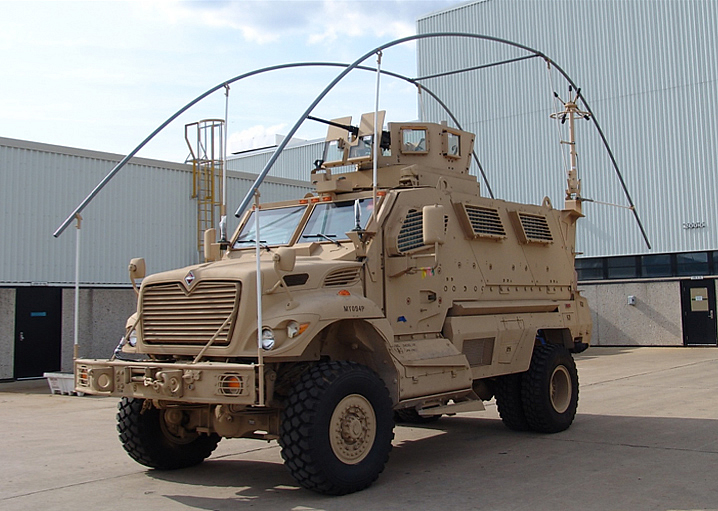
But now, thousands of those MRAPs will stay in service after the war in Afghanistan has ended. They will be considered armored combat vehicles, not transport, like the hummer and army trucks, and not used on a daily basis. This will keep down the operating expenses, as MRAPs consume a lot of fuel.
In addition to keeping thousands of the MRAPS, the army is developing a heavier replacement for the hummer, using a design with lots of MRAP features. This is the JLTV(Joint Light Tactical Vehicle), which is arriving a little ahead of schedule, as part of a program to massively upgrade army vehicles every few decades.
The JLTV competition is still underway, with three vehicles being tested:

Image from Wikipedia.
In addition to being built to better survive mines and roadside bombs, the JLTV will be able to generate 30 KW of electricity (for operating all the new electronic gear, and recharging batteries), have an automatic fire extinguishing system and jam-resistant doors. Like the hummer, JLTV will be easy to reconfigure, for everything from a four seat, armed scout vehicle, to an ambulance, command vehicle or cargo or troop transport. The hummer will continue to be used outside of the combat zone, where most troops spend most of their time. But the JLTV will be built to better handle the beating vehicles take in the combat zone, including a design that enables troops to quickly slide in armor and Kevlar panels to make the vehicles bullet and blast proof.
January 27, 2011
UK government officials implicated in ADE-651 bomb detector scam
Remember the ADE-651? The bomb detector that could “detect elephants, humans and 100 dollar bills”? It now appears that British army personnel and civil servants were involved in the effort to sell the bogus device:
The government has admitted that the Army and UK civil servants helped market so-called “bomb detectors”, which did not work, around the world.
Export of the “magic wand” detectors to Iraq and Afghanistan was banned on 27 January 2010 because of the threat they posed to British and allied troops.
The move followed a BBC Newsnight investigation showing they could not detect explosives — or anything else.
Now Newsnight has learned that they are still being sold around the globe.
You can understand the attraction to potential scammers, as the things cost £11 to make (at most) and can be sold for £15,000 to unsuspecting dupes (or willing accomplices, splitting the profits) representing foreign governments.
January 18, 2011
Simple solution to aggravating problem
Here’s an example of a US Army MRAP with a useful modification installed:
Two years ago, the U.S. Army began using the MRAP Overhead Wire Mitigation Kit (OWMK) system that uses two curved lengths of metal to safely get tall armored vehicles past low hanging power or telephone wires. For several years, troops had improvised similar systems to prevent vehicles from coming into contact with power cables, causing injury to the troops and their equipment. A more common problem was turret gunners getting snagged by low hanging wires, often electrical ones. The improvised solution usually involved just putting plastic pipe, at an angle, in front, to deal with the wire. Finally, the army took notice and developed a simple kit that could be fitted to an MRAP. The OWMK also prevents making the locals angry, because passing military vehicles tore down their power wires. The MWMK can handle wires as low as 2.6 meters (8 feet) from the ground. MRAPS are tall vehicles, and the top of the turret (if installed) is usually over three meters.
January 14, 2011
Last year’s biggest military developments
Strategy Page lists some of the most significant military developments of 2010:
* Infantry. Here we saw more evolution, not revolution, in infantry gear. But at least the trends continued to move in the right direction. The biggest change is the equipment that must be carried. Until the 1980s, you could strip down (for actual fighting) to your helmet, weapon (assault rifle and knife), ammo (hanging from webbing on your chest, along with grenades), canteen and first aid kit (on your belt) and your combat uniform. Total load was 13-14 kg (about 30 pounds). You could move freely, and quickly, like this, and you quickly found that speed and agility was a lifesaver in combat. But now the minimum load carried is twice as much (27 kg), and, worse yet, more restrictive. Over the last seven years, this has translated into some dramatic changes in training. In Iraq, troops found they were not in the best condition to run around with all that weight. This was worse in Afghanistan, with all those hills. Plus, the vest constricted movement, and that took time to adjust to. Commanders complained about troops not being properly trained, and that led to a series of changes in basic and unit training. The big change in basic was to condition troops to handle the heavy weights they would be carrying, for extended periods of time. This was particularly critical for non-combat troops (especially those operating convoys) outside of camps (where you usually didn’t have to wear armor and combat gear.) New exercises were developed. Infantry troops got several months of additional training after basic, and had plenty of opportunity to adjust to moving around wearing 14 kg or more of gear. The heavier weight included better armor and equipment (night vision, personal radio, weapon sights), which reduced combat deaths, and made the troops more lethal. But now the troops accept the fact that a lot of essential training takes place in the gym, particularly the weight room. The army and marines have been developing lighter and more comfortable versions of essential gear, but there’s still a need for muscle. This decade of infantry innovation has been noted by other armies around the world, and they are all hustling to emulate this American revolution. Not just to get the gadgets, but to implement the new training methods as well.
* Support. Few pay attention to support functions, especially no one in the media. But here is where big things happen. One of things has been how video games joined the army. Over the last eight years, billions of dollars has been spent on creating several generations of increasingly accurate combat simulators for training troops to deal with roadside bombs, hostile civilians, flying UAVs and new enemy tactics. These sims are taken for granted inside the army and marines, but still seem out of place to ill informed outsiders.
[. . .]
* Naval Power. The U.S. Navy has accepted the fact that is has gotten smaller, and that this process will continue. The navy shrunk by 20 percent in the last decade, to a force of 280 ships. The main reason is the high cost of new ships, to replace those that are wearing out and being retired. In the next decade, the fleet is expected to shrink another 20 percent, again because Congress refuses to provide enough money to replace older ships (only about $14 billion a year, at most, is provided for new ships, and this is expected to shrink.) New ships cost, on average, $2.5 billion each. This is made possible because of six billion dollar destroyers, seven billion dollar subs and eleven billion dollar carriers. This is offset somewhat by $1.7 billion amphibious ships and half billion dollar LCS (a compact, controversial, ship design). The big news is that the admirals are actively brainstorming how to live with a high cost/low income future, not try to magically make it go away.
December 18, 2010
Man bites dog story, military style
In Afghanistan and Iraq, they are finding uses for manned aircraft to supplement Predator UAV patrols:
The U.S. Air Force MC-12 “manned UAV replacement” has been in Afghanistan for a year, and has proved successful. This despite the fact that it can only stay in action for seven hours per sortie, versus more than twice the hours for a UAV. But the military needs more UAV capabilities (vidcams overhead for hours at a time), and doesn’t care if the pilots are in the air or on the ground.
[. . .]
The MC-12 is basically a militarized version of the Beech King Air. The army began using the Beech aircraft as the RC-12 in the 1970s, and has been seeking a replacement for the last few years. But then it was realized that the RC-12 was suitable for use as a Predator substitute.
The King Air 350 is a 5.6 ton, twin engine aircraft. The MC-12 can stay in the air for up to eight hours per sortie. Not quite what the Predator can do (over 20 hours per sortie), but good enough to help meet the demand. The MC-12 has advantages over UAVs. It can carry over a ton of sensors, several times what a Predator can haul. The MC-12 can fly higher (11 kilometers/35,000 feet) and is faster (over 500 kilometers an hour, versus 215 for the Predator.) The MC-12s cost about $20 million each, more than twice what a Predator goes for. The MC-12’s crew consists of two pilots and two equipment operators. Some of the sensors are operated from the ground.


