Quotulatiousness

August 7, 2020

From Medieval Letters Patent to our modern patents, by way of Venice

Filed under: Britain, Europe, History, Law, Technology — Tags: , , , , , — Nicholas @ 05:00

In the latest Age of Invention newsletter, Anton Howes traces the lines of descent from the Letters patent of the Middle Ages, through Venetian legal innovations, to what began to resemble our modern patent system:

Letters Patent Issued by Queen Victoria, 1839
On 15 June 1839 Captain William Hobson was officially appointed by Queen Victoria to be Lieutenant Governor General of New Zealand. Hobson (1792 – 1842) was thus the first Governor of New Zealand. This position was renamed in 1907 as “Governor General”. Hobson arrived in New Zealand in late January 1840, and oversaw the signing of te Tiriti o Waitangi only a few days later. By the end of 1840, New Zealand became a colony in its own right and Hobson moved the capital of the colony from the Bay of Islands to Auckland. He served as Governor until his death in 1842 after he suffered a stroke at the age of 49.
Constitutional Records group of Archives NZ via Wikimedia Commons.

Patents for invention — temporary monopolies on the use of new technologies — are frequently cited as a key contributor to the British Industrial Revolution. But where did they come from? We typically talk about them as formal institutions, imposed from above by supposedly wise rulers. But their origins, or at least their introduction to England, tell a very different story.

England’s monarchs had long used their prerogative powers to grant special dispensations by letters patent — that is, orders from the monarch that were open for all the public to see (think of the word patently, from the same root, which means openly or clearly). For the most part, such public proclamations had been used to grant titles of nobility, or to appoint people to positions in various official hierarchies — legal, religious, and governmental. And, of course, letters patent could be used to promote the introduction of new technologies.

[…]

Monopolies in general, of course, over particular trades or industries had been granted for centuries, by rulers all across Europe. They granted such privileges to groups of merchants, artisans, and city-dwellers, giving them rights to organise and regulate their own activities as guilds or as city corporations. Inherent to all such charters was the ability of the in-group to restrict competition from outsiders, at least within the confines of their city. And the ruler, in exchange for granting such privileges, typically received a share of the guild’s or corporation’s revenues. But such monopolies were very rarely given to individuals. When they were, it was often so unpopular as to be almost immediately overturned. And they were rarely used to encourage innovation.

With one exception: Italy. Throughout the fifteenth century, some Italian city guilds had begun to forbid their members from copying newly-invented patterns for silk and woollen cloth, effectively granting a monopoly over those patterns to the individual inventors. In Venice, a 50-year monopoly was granted in 1416 to one Franciscus Petri, of Rhodes, to introduce superior fulling mills. In Florence, the famous architect and engineer Filippo Brunelleschi was granted a monopoly in 1421 for a vessel he designed for transporting heavy loads of marble, in exchange for revealing the secrets of his design. The printing press was also introduced to Venice using such a privilege, with a 5-year monopoly granted in 1469 to Johannes of Speyer, though he died only a few months after receiving it. And these ad hoc grants were made with increasing frequency, such that in 1474 Venice legislated to make them more systematic, declaring that 10-year monopolies could be obtained for all new technologies, either invented or imported (though it continued to also grant ad hoc patents, with the terms and durations decided on a case-by-case basis as before). Under the 1474 law, Venice was soon granting patent monopolies to the introducers of various mills, pumps, dredges, textile machines, printing techniques, and even special kinds of lasagna. It granted over a hundred patents in the first half of the sixteenth century, with many more thereafter.

From Venice, the use of patent monopolies as an instrument of policy spread abroad, with the initiative coming from the would-be introducers of novelties themselves. In the mid-fifteenth century, for example, a French inventor who had acquired patents in Venice was also successfully lobbying for similar privileges from the archbishop of Salzburg, the duke of Ferrara, and the Hapsburg Holy Roman Emperor. The use of patent monopolies thus soon diffused to the rest of Italy, to Germany, and to the various dominions of the Spanish emperor — including Spain itself, its American colonies, and the Low Countries.

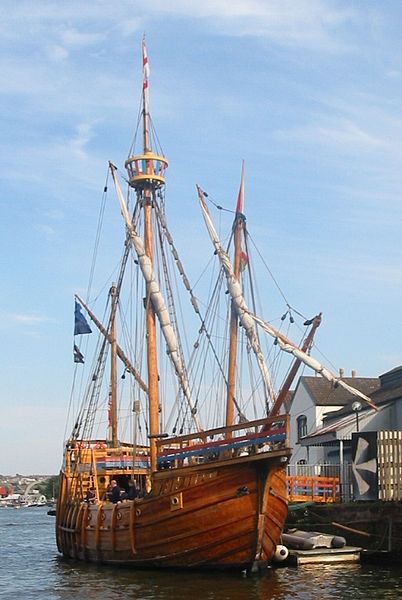
And, eventually, to England. But not in the way we might expect. In 1496, the Venetian explorer Zuan Chabotto (aka John Cabot) acquired a patent monopoly from Henry VII over the trade and products of any lands he was to discover — a legal procedure unlike anything that earlier English explorers had attempted (they had merely been granted licenses). Cabot’s grant even differed from the agreements made by Christopher Columbus with the Spanish crown, or by earlier explorers for the Portuguese. Columbus, for example, was effectively granted a patent of nobility — the hereditary titles of viceroy, admiral, and governor. He and the Portuguese explorers were direct agents of the crown, with military and justice-dispensing responsibilities over any newly conquered lands — a model derived from the Christian conquests of Muslim Iberia. Columbus effectively became a marcher lord, a custodian and defender of Spain’s new borderlands.

August 1, 2020

Secret Briefing: The Pedersen Device

Filed under: History, Military, USA, Weapons, WW1 — Tags: , , , , , — Nicholas @ 02:00

Forgotten Weapons
Published 8 Aug 2016

http://www.patreon.com/ForgottenWeapons

Welcome to your briefing on the new equipment we are issuing for the Spring Offensive of 1919. With this new secret weapon, we can finally push the Germans out of France and end the war!

July 29, 2020

America’s First Assault Rifle: Burton 1917 LMR

Filed under: History, Military, USA, Weapons, WW1 — Tags: , , , , , — Nicholas @ 02:00

Forgotten Weapons
Published 4 Jul 2016

http://www.patreon.com/ForgottenWeapons
https://centerofthewest.org/explore/f…

America’s first assault rifle? Well, it does meet all the requirements — select-fire, intermediate cartridge, and shoulder-fired. It was never actually fielded, though.

The Burton Light Machine Rifle was developed during World War One, with the firing model completed in 1917. It was intended as an aircraft observer’s weapon for attacking balloons — a role which required incendiary ammunition. With this in mind, Winchester’s Frank Burton adapted the .351 WSL cartridge from his 1905 and 1907 self-loading rifles into the .345 WSL, with a spitzer bullet. He designed an open-bolt, select-fire shoulder rifle to fire it, which became known as the Light Machine Rifle.

Burton’s rifle was to be usable both in an aircraft where it could be fixed to a Scarff mount for a wide field of fire or used by an individual on the ground, fired from the shoulder. It weighed in at just about 10 pounds (4.5kg) and had a pistol grip and straight-line design to bring the recoil impulse directly into the shooter’s shoulder and minimize rise during automatic fire. The barrel was finned for better cooling, and infantry barrels were equipped with bayonet lugs.

The most distinctive elements of the design, of course, are the dual top-mounted magazines. Each one holds 20 rounds, and each has a pair of locking catches. One position locks the magazine into a feeding position, and the other holds it up above the cycling of the bolt. The idea here was to keep a second loaded magazine easily accessible for an aerial observer, so they could reload without having to find another magazine somewhere in the aircraft. Contrary to some speculation, there is no automatic transition between magazines. When one is empty, the shooter must pull it back to the second locking position (or out of the gun entirely) and then push the second magazine down into feeding position.

Despite Burton’s work — which was well ahead of its time — the LMR had been rendered obsolete for its primary role by the time it was ready. Synchronized, forward-mounted Vickers machine guns firing 11mm incendiary ammunition were being mounted on aircraft, and were more effective on balloons and airplanes than Burton’s weapon would have been. Only this single example was ever made, and it was not presented for infantry consideration as far as I can tell. It was lost for many years before being discovered in a Winchester building, and eventually ending up in the Cody Firearms Museum with the rest of the Winchester factory collection.

July 25, 2020

Did Jerónimo de Ayanz y Beaumont invent the steam engine a century before Newcomen?

Filed under: Britain, Europe — Tags: , , , , — Nicholas @ 05:00

In his latest Age of Invention newsletter, Anton Howes investigates Spanish claims that Jerónimo de Ayanz y Beaumont beat Newcomen by a hundred years in the quest to harness steam power:

Screenshot from “Savery’s Miners Friend – 1698”, a YouTube video by Guy Janssen (https://www.youtube.com/watch?v=Dt5VvrEIj8w)

The Spanish claimant in question is one Jerónimo de Ayanz y Beaumont, a late-sixteenth-century aristocrat and military engineer from Navarre, who from 1597 served as the administrator of the royal mines, and who invented a whole host of devices, from diving equipment and mine ventilation systems, to various improvements to mills, pumps, and furnaces. Thanks to the work of historian and engineer Nicolás García Tapia, whose biography of Ayanz came out in 2010, we now know quite a bit about this interesting inventor. The work was published in Spanish, and quite understandably was widely covered in the Spanish press. So although Ayanz has not quite become a household name in Spain just yet, he does now seem to be fairly well-known by the local “well actually” brigade (a shadowy international movement of which I am, to most people’s annoyance, a long-serving member). “Thomas Newcomen/Thomas Savery invented the steam engine you say? Well actually, I think you’ll find it was Ayanz a century earlier” — I had a quick google and discovered there were hundreds of comments to this effect.

But, actually, the story is a bit more complicated than that. The devil, as always, is in the detail, and unfortunately the press claims about the technology have become widely and erroneously repeated, apparently ignoring Tapia’s careful historical work. I even spotted a recently-published encyclopaedia of inventions that repeated the errors.

So what, exactly, did Ayanz invent? The key fact is that in 1606 he obtained a 20-year monopoly from the king of Spain for the use of over fifty different inventions, including two steam-related devices. One of these was related to getting rid of deadly mine gases, which had killed one of his friends and collaborators, and had almost killed Ayanz too. His solution was a steam injector — essentially, a steam boiler with a narrowing pipe sticking out of it, which would inject the steam into a larger air pipe. The pressurised steam, upon flowing up into the air pipe, created a powerful sucking effect behind it, thus rapidly drawing deadly gases out of the mine. (A bit like at the start of this video).

It was the second steam-powered device, however, that has become famous as Ayanz’s steam engine. Just like the inventions of Thomas Savery and Thomas Newcomen about a century later, it was designed to pump the water out of mines. Ayanz formed a partnership in 1608-11 to reopen the silver mines of Guadalcanal in Spain, which had been abandoned due to flooding, and seems to have tried to implement the engine there: he obtained rights to cut down nearby trees for firewood, for example, and exploited nearby copper, which would have been essential for making boilers and pipes. As for whether he actually got it to work, we don’t know for sure. Sadly, he died only a few years after starting the project.

But the devilish detail is in how his engine worked. Specifically, all the multiplying errors seem to have arisen from a misinterpretation, by the press, of Tapia’s statement that the engine was “very similar” to that of Thomas Savery. There are, certainly, some important similarities. Both engines, for example, exploited the expansionary force of steam. In both, steam from a boiler was piped into a water tank, forcing that water up a narrow pipe — what we might call a pushing effect. And both engines used two tanks, which alternated so that the engine would pump continuously. While one tank and was being refilled with mine water, the other would be have the steam pushing the water out, and then vice versa. So far so good. Indeed, due to the two water tanks, drawings of Ayanz’s and Savery’s devices look very similar side by side.

July 17, 2020

L96A1: The Green Meanie – the First Modern Sniper Rifle

Filed under: Britain, Military, Weapons — Tags: , , , — Nicholas @ 02:00

Forgotten Weapons
Published 16 Feb 2019

http://www.patreon.com/ForgottenWeapons

Cool Forgotten Weapons merch! http://shop.bbtv.com/collections/forg…

The Accuracy International Precision Marksman rifle was the winner of the British MoD’s competition to replace the L42A1 as the standard British sniper rifle, and was accordingly adopted as the L96A1. It was the vanguard of the modern sniper rifle, with a highly modular chassis design, and it revolutionized British sniping performance. Thanks to Steve Houghton, was have access today to one of a tiny number of original L96A1 rifles in private hands. If you are interested in learning more, I highly recommend checking out Steve’s newly released book, The British Sniper: A Century of Evolution. It can be found at:

https://www.swiftandboldpublishing.co…

Contact:
Forgotten Weapons
PO Box 87647
Tucson, AZ 85754

July 14, 2020

British EM-2: The Best Cold War Battle Rifle that Never Was

Filed under: Britain, History, Military, Weapons — Tags: , , , , , — Nicholas @ 02:00

Forgotten Weapons
Published 12 Jul 2017

Armament Research Services (ARES) is a specialist technical intelligence consultancy, offering expertise and analysis to a range of government and non-government entities in the arms and munitions field. For detailed photos of the guns in this video, don’t miss the ARES companion blog post:

http://armamentresearch.com/british-j…

The EM-2 was the rifle that the British pushed for NATO trials in 1950. It was a rifle well ahead of its time in several areas — as a select-fire bullpup rifle, it was intended to replace both the infantry rifle and the submachine gun. Its .280 caliber cartridge was designed with combat ranges of 600 yards and less, acknowledging the reality that engagements beyond even 300 yards were extremely rare, and not important enough to base rifle design on. It was also designed to use primarily optical sights, long before this concept would be embraced elsewhere. Unfortunately, the potential of the EM-2 was lost to the political decision that compatibility with American ordnance choices was a more significant benefit than an improved infantry rifle.

Mechanically, the EM-2 is heavily based on the German G43 flapper-locking system. It uses a long stroke gas piston in place of the G43’s short stroke one, though. To help account for the slower handling of a bullpup configuration, the EM-2 would both lock open when its magazine was empty and also automatically close the bolt and chamber a round when a fresh magazine was inserted. The safety was much like that of the M1 Garand, and the selector lever was of the push-through type like on the German Sturmgewehr.

The optic on the EM-2 is quite tiny, and offers no magnification. Its purpose is to reduce the two-element sight picture of traditional iron sights to a single plane that can be more quickly and easily placed on the target.

In total, only 55 EM-2 rifles were manufactured, including the paratrooper model in this video and a number of 7.62mm NATO examples made as a last ditch effort to remain competitive in NATO trials. Where most failed prototype rifles were rejected for very legitimate technical shortcomings, the EM-2 is (I believe) a prime example of an outstanding weapon that fell victim to politics unrelated to its actually qualities.

http://www.patreon.com/ForgottenWeapons

Cool Forgotten Weapons merch! http://shop.bbtv.com/collections/forg…

If you enjoy Forgotten Weapons, check out its sister channel, InRangeTV! http://www.youtube.com/InRangeTVShow

July 4, 2020

The birth of the steam age

Filed under: Britain, Economics, History, Science, Technology — Tags: , , , , — Nicholas @ 03:00

In the latest installment of his Age of Invention newsletter, Anton Howes explores the very early steam age in England:

Why was the steam engine invented in England? An awful lot hinges on this question, because the answer often depends on our broader theories of what caused the British Industrial Revolution as a whole. And while I never tire of saying that Britain’s acceleration of innovation was about much, much more than just the “poster boy” industries of cotton, iron, and coal, the economy’s transition to burning fossil fuels was still an unprecedented and remarkable event. Before the rise of coal, land traditionally had to be devoted to either fuel, food, or clothing: typically forest for firewood, fields for grain, and pastures for wool-bearing sheep. By 1800, however, English coal was providing fuel each year equivalent to 11 million acres of forest — an area that would have taken up a third of the country’s entire surface area, and which was many times larger than its actual forest. By digging downward for coal, Britain effectively increased its breadth.

And coal found new uses, too. It had traditionally just been one among many different fuels that could be used to heat homes, alongside turf, gorse, firewood, charcoal, and even cow dung. When such fuels were used for industry, they were generally confined to the direct application of heat, such as in baking bricks, evaporating seawater to extract salt, firing the forges for blacksmiths, and heating the furnaces for glass-makers. Over the course of the seventeenth century, however, coal had increasingly become the fuel of choice for both heating homes and for industry. Despite its drawbacks — it was sooty, smelly, and unhealthy — in places like London it remained cheap while the price of other fuels like firewood steadily increased. More and more industries were adapted to burning it. It took decades of tinkering and experimentation, for example, to reliable use coal in the smelting of iron.

3D animation of an aeolipile or Hero’s engine.
Animation by Michael Frey via Wikimedia Commons.

Yet with the invention of the steam engine, the industrial uses of coal multiplied further. Although the earliest steam engines generally just sucked the water out of flooded mines, by the 1780s they were turning machinery too. By the 1830s, steam engines were having a noticeable impact on British economic growth, and had been applied to locomotion. Steam boats, steam carriages, steam trains, and steam ships proliferated and began to shrink the world. Rather than just a source of heat, coal became a substitute for the motive power of water, wind, and muscle.

So where did this revolutionary invention come from? There were, of course, ancient forms of steam-powered devices, such as the “aeolipile”. Described by Hero of Alexandria in the 1st century, the aeolipile consisted of a hollow ball with nozzles, configured in such a way that the steam passing into the ball and exiting through the nozzles would cause the ball to spin. But this was more like a steam turbine than a steam engine. It could not do a whole lot of lifting. The key breakthroughs came later, in the late seventeenth and early eighteenth centuries, and instead exploited vacuums. In a steam engine the main force was applied, not by the steam itself pushing a piston, but by the steam within the cylinder being doused in cold water, causing it to rapidly condense. The resulting partial vacuum meant that the weight of the air — the atmospheric pressure — did the real lifting work. The steam was not there to push, but to be condensed and thus pull. It saw its first practical applications in the 1700s thanks to the work of a Devon ironmonger, Thomas Newcomen.

Science was important here. Newcomen’s engine could never have been conceived had it not been for the basic and not at all obvious observation that the air weighed something. It then required decades of experimentation with air pumps, barometers, and even gunpowder, before it was realised that a vacuum could rapidly be created through the condensation of steam rather than by trying to suck the air out with a pump. And it was still more decades before this observation was reliably applied to exerting force. An important factor in the creation of the steam engine was thus that there was a sufficiently large and well-organised group of people experimenting with the very nature of air, sharing their observations with one another and publishing — a group of people who, in England, formalised their socialising and correspondence in the early 1660s with the creation of the Royal Society.

Newcomen’s Atmospheric Steam Engine. The steam was generated in the boiler A. The piston P moved in a cylinder B. When the valve V was opened, the steam pushed up the piston. At the top of the stroke, the valve was closed, the valve V’ was opened, and a jet of cold water from the tank C was injected into the cylinder, thus condensing the steam and reducing the pressure under the piston. The atmospheric pressure above then pushed the piston down again.
Original illustration from Practical Physics for Secondary Schools. Fundamental principles and applications to daily life, by Newton Henry Black and Harvey Nathaniel Davis, 1913, via Wikimedia Commons.

July 3, 2020

Birth, rapid growth, profitable stasis, bureausclerosis, decline, death – typical tech firm lifecycle

Filed under: Bureaucracy, Business, Technology — Tags: , , , — Nicholas @ 03:00

In the Continental Telegraph, what looks to be a pretty solid characterization of the corporate life-cycle for technology firms:

There are generally, 6 stages in the life of a tech company:

  1. Inception. A couple of smart kids start something in a garage. Massive innovation.
  2. Fast growth. The business moves to some good offices, number of staff increases. They take on smart, fast moving people who are innovating big. A few people know them.
  3. Steady growth. The business is now something of a household name. They get their own small head office. Staff are more like normal business. Innovation continues, but the bureaucracy starts to grow.
  4. Bureaucracy. The business is a household name. They have multiple offices, or something designed by a smart-ass architect. There’s still staff coming in, but they’re mostly seeing it as a nice warm place to sit and be bureaucrats. The innovators start leaving as it’s just not interesting. They might even be making lots of money, but it’s mostly just living off what was built in earlier phases, or large dumb wasteful projects that go nowhere for years.
  5. Decline. A new disruptor arrives on the scene. They innovate in a field you’re involved in. You can’t keep up because in the previous phase, you replaced the innovators with bureaucrats. You’re outsmarted.
  6. Terminal decline and death. You slowly or quickly disappear, maybe holding onto a few customers who habitually use you.

I think there might also be something about when government starts taking an interest in you, and I think it’s quite some time into stage 4. Google are already there. Firing James Damore is very much bureaucracy state behaviour. They wouldn’t have cared when it was a tiny number of staff in an office. And how much have they really innovated in the last decade?

The History of: The British 1942 Battle Jerkin & Skeleton Battle Jerkin | Uniform History

Filed under: Britain, Cancon, History, Military, WW2 — Tags: , , , , , — Nicholas @ 02:00

Uniform History
Published 24 Mar 2020

The start of another two parter, in this one we cover the British Battle Jerkin family as it helped inspire the US Normandy Assault Vest’s creation.

Music by: https://www.juliancrowhurst.com/

July 2, 2020

Early Automatic Pistol Cartridges – What, When & Why?

Filed under: Europe, History, Military, USA, Weapons — Tags: , , , , — Nicholas @ 02:00

Forgotten Weapons
Published 12 Oct 2016

http://www.patreon.com/ForgottenWeapons

Cool Forgotten Weapons Merch! http://shop.bbtv.com/collections/forg…

In discussion with a friend recently, the topic of early automatic pistol cartridges came up. Specifically, looking at the context of which cartridges were actually available at which times, and how this might provide helpful context for understanding why particular cartridges were adopted (or commercially successful) or were not.

I decided to see if I could put together a useful video on the subject, and this is the result. We will look at the cartridges available prior to 1900, the ones developed or introduced between 1900 and 1904, and then a few followups which appeared between 1905 and 1910.

Some cartridges became popular because of their ballistic characteristics — like the 7.63mm Mauser and the C96 “Broomhandle” — while others became popular because of the handgun much more than the cartridge itself — like the Browning 1900 and the .32ACP / 7.65mm Browning.

June 15, 2020

QotD: The very first “road trip”

Filed under: Germany, History, Quotations, Technology — Tags: , , — Nicholas @ 01:00

Germany’s love for the automobile began with a road trip from nearby Mannheim to the town of Pforzheim, less than 30 miles from Stuttgart. In 1885, Karl Benz had invented his first Motorwagen, a three-wheeled vehicle with a gas-powered engine of his own design. One of the first times he managed to get it started, he drove it straight into his laboratory wall.

By 1888, he had a working prototype, which had successfully driven down a road. The now-patented Motorwagen had no gears and could not go up hills, but it worked. One morning, Benz’s wife Bertha decided to take the car on its first extended road trip. With her two sons, she pushed the car out of the garage, until it was far enough from the house that they could get it started without waking her husband.

Bertha Benz had a destination in mind — her parents’ house in Pforzheim, about 65 miles from her home. Following roads meant for wagons, she and her sons started the drive — the first recorded road trip in a car.

There were challenges. A pipe clogged; Benz cleaned it with her hat pin. A wire shorted; she insulated it with her garter. They needed more fuel; she convinced a pharmacist to sell her an unusually large amount of the gas the car used. When the brakes started wearing out, she had them shod with leather at a cobbler. When she reached a hill, she had the boys push (along with local help).

By the end of the day, the Benzes had reached Pforzheim, where Bertha telegraphed her husband that they were safe. After a few days’ visit, they drove back home to Mannheim.

Ten years ago, Germany created an official Bertha Benz Memorial Route, marking her historic road trip. Part of Bertha Benz’s motivation was to sell potential customers on the advantage of automobiles; although it took another decade or so, people eventually bought into this transportation revolution.

Sarah Laskow, “An 1888 Road Trip Sparked Germany’s Romance With Cars”, Atlas Obscura, 2018-02-28.

May 21, 2020

The Great Exhibition of 1851 also served (for some) as the 19th century equivalent of the “Missile Gap” controversy

In the latest edition of his Age of Invention newsletter, Anton Howes discusses the changing role of the British government and how the Great Exhibition was also useful as subtle domestic propaganda for a more active role for government in the British economy:

The Crystal Palace from the northeast during the Great Exhibition of 1851, image from the 1852 book Dickinsons’ comprehensive pictures of the Great Exhibition of 1851
Wikimedia Commons.

… a whole new opportunity for reform was provided by the Great Exhibition of 1851. As I explained in the previous newsletter, an international exhibition of industry functioned as an audit of the world’s industries. It, and its successors, the world’s fairs, gave some indication of how Britain stood relative to rival nations, especially France, Prussia, and the United States. And whereas some people saw the Great Exhibition as a clear mark of Britain’s superiority, for would-be reformers it was a chance to expose worrying weaknesses. Thus, Henry Cole and the other original organisers of the exhibition at the Society of Arts exacerbated fears of Britain’s impending decline, giving them an excuse to create the systems they desired.

They identified two areas of worry: science and design. Britain of course had many eminent scientists and artists — some of the best in the world — but other countries seemed to have become better at diffusing scientific training and superior taste throughout the workforce as a whole. Design skills were an issue because France appeared to be catching up with Britain when it came to the mechanisation of industry; if it caught up on machinery while maintaining its lead in fashion, then Britain would not be able to compete. And scientific training appeared more useful than ever, with the latest scientific advances “influencing production to an extent never before dreamt of”. Visitors to the Great Exhibition had marvelled at the recent inventions of artificial dyes, a method of processing beetroot sugar, and the latest improvements to photography and the electric telegraph. Thus, for Britain to maintain its lead, it would need to improve the education of its workers.

The reformers’ scare tactics worked. The aftermath of the Great Exhibition saw the creation of a government Department of Science and Art under the direction of Henry Cole, who in turn oversaw the agglomeration of various museums, design schools, and other cultural institutions to what is now the “Museum Mile” in South Kensington. (Curiously, the area was originally called Brompton, but when Cole opened a museum of design and industry there, he named it the South Kensington Museum. Kensington was a much more aristocratic area nearby, though it had no “south” at the time. The museum evolved, rather complicatedly, into what is now the Victoria & Albert Museum. But unlike so many top-down area re-brands, the name South Kensington stuck.)

And that was just the beginning. Cole and his allies then oversaw a dramatic expansion of the state into education, largely through the use of examinations. Although state-funding for education had initially centred on building new schools, getting any more involved was a highly contentious issue. Most schools were controlled and funded by religious organisations, but were split between the established Anglican church and dissenters. When the government first became involved in schools, it was thus bitterly opposed by many dissenters as they feared that their children might become indoctrinated to Anglicanism. And naturally, the government could not teach dissenting religions. Yet the proposed compromise of teaching no religion at all was unacceptable to both sides. Schools were crucial, the groups believed, to keeping religion alive.

So the utilitarians came up with a workaround. Rather than getting the state too involved directly in managing the schools themselves, it would instead influence the curriculum. By holding examinations, and then paying teachers based on the outcomes of the tests, they could incentivise the teaching of certain subjects and leave the schools free to teach whatever religious beliefs they pleased. Indeed, by diverting more and more time towards teaching particular subjects, the reformers saw it as a secularising blow “against parsonic influence”. The tactic was initially applied to adult education. The Society of Arts would first trial out examinations without payments, to test their viability. Then Cole would have his department take over the examinations, first for drawing, and later for science, using his budget to fund payment-by-results. The effects were dramatic. The Society’s relatively popular examinations in chemistry, for example, rarely had more than a hundred candidates a year. But when the department instituted its payments, it soon drew in thousands. By 1862, when the government wanted to improve the teaching of reading, writing, and arithmetic in schools, they adopted Cole’s suggestion that they also use payment-by-results.

May 9, 2020

The Battle of Trafalgar – Admiral Nelson’s Moment

Filed under: Britain, France, History, Military — Tags: , , , — Nicholas @ 02:00

IT’S HISTORY
Published 13 May 2015

It was the defining moment of the British naval history and let the groundwork for their naval superiority over the next century. Horatio Nelson’s brilliant battle tactics let to a decisive victory over Napoleon’s French Navy. Find out all about the famous Battle of Trafalgar with Indy on IT’S HISTORY.

» The Complete Piracy-PLAYLIST: http://bit.ly/PiratePlaylist

» ALL EPISODES of Battlefields: http://bit.ly/BattlefieldsOfHistory

» JOIN OUR COMMUNITY FOR MORE HISTORY KNOWLEDGE!
Follow us on Twitter: http://twitter.com/thehistoryshow
Your photos on Instagram: https://instagram.com/itshistorychannel

» SOURCES
Videos: British Pathé (https://www.youtube.com/user/britishp…)
Pictures: mainly Picture Alliance

» ABOUT US
IT’S HISTORY is a ride through history – Join us discovering the world’s most important eras in IN TIME, BIOGRAPHIES of the GREATEST MINDS and the most important INVENTIONS.

» HOW CAN I SUPPORT YOUR CHANNEL?
You can support us by sharing our videos with your friends and spreading the word about our work.

» CAN I EMBED YOUR VIDEOS ON MY WEBSITE?
Of course, you can embed our videos on your website. We are happy if you show our channel to your friends, fellow students, classmates, professors, teachers or neighbors. Or just share our videos on Facebook, Twitter, Reddit etc. Subscribe to our channel and like our videos with a thumbs up.

» CAN I SHOW YOUR VIDEOS IN CLASS?
Of course! Tell your teachers or professors about our channel and our videos. We’re happy if we can contribute with our videos.

» CREDITS
Presented by: Indy Neidell
Based on the script by: Daniel Hungerford
Directed By: Daniel Czepelczauer
Director of Photography: Markus Kretzschmar
Music: Markus Kretzschmar and Daniel Czepelczauer
Sound Design: Bojan Novic
Editing: Markus Kretzschmar

A Mediakraft Networks original channel
Based on a concept by Florian Wittig and Daniel Czepelczauer
Executive Producers: Astrid Deinhard-Olsson, Spartacus Olsson
Head of Production: Michael Wendt
Producer: Daniel Czepelczauer
Social Media Producer: Hendrik Sontheim
Social Media Manager: Florian Wittig and Laura Pagan

Contains material licensed from British Pathé
All rights reserved – © Mediakraft Networks GmbH, 2015

May 5, 2020

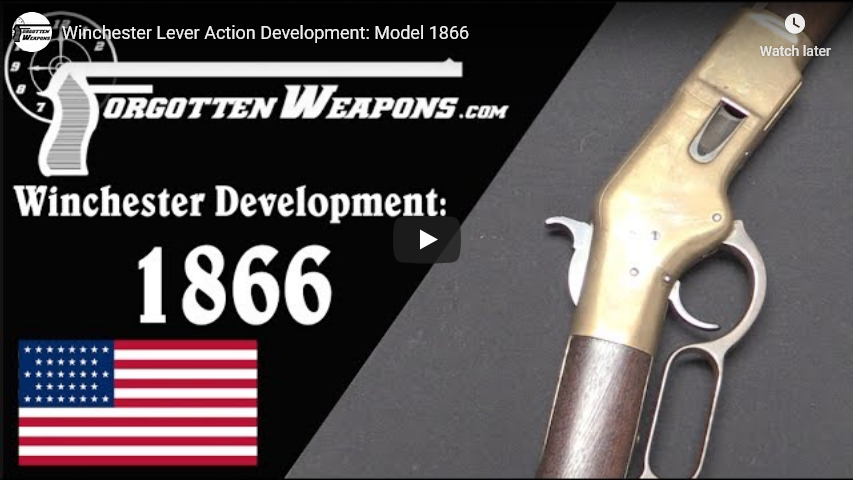
Early Lever-Action Rifles: Volcanic, Henry, Winchester

Filed under: History, USA, Weapons — Tags: , , , — Nicholas @ 02:00

Forgotten Weapons
Published 6 Feb 2016

Hammer prices:
Volcanic – $19,550
1860 Henry – $15,960
1866 Winchester – $8,625

We’ve all seen lever action rifles galore in movies about the old west, and most of us have handled and shot a bunch of them as well. But do you know where they came from?

Today we will take a look at the first American lever-action rifle put into successful (more or less) production, the Volcanic. We will then continue to examine the 1860 Henry and the 1866 Winchester to get a foundational understanding of the development of these guns, and the interesting group of people involved with them.

http://www.patreon.com/ForgottenWeapons

May 3, 2020

The Great Exhibition of 1851

In the latest Age of Invention newsletter, Anton Howes looks at one of the biggest popular events of Queen Victoria’s reign, the Great Exhibition:

The Crystal Palace from the northeast during the Great Exhibition of 1851, image from the 1852 book Dickinsons’ comprehensive pictures of the Great Exhibition of 1851
Wikimedia Commons.

On this day, in 1851, Londoners were finally allowed to enter one of the most spectacular edifices to grace their city. Over the previous months they had watched it spring up in Hyde Park — the largest enclosed structure that had ever been built, and made with three hundred thousand of the largest panes of glass ever produced. Set against the blackened, soot-stained buildings of London, the massive glass edifice gleamed. It soon became known as the Crystal Palace.

Although it no longer exists — it was rebuilt in Sydenham, but the new version burnt down in the 1930s — the fame of the Crystal Palace endures. The same goes for the event that it was originally built for, the Great Exhibition of 1851. But, despite that name-recognition, I’ve found that most people don’t really know what the Great Exhibition was for. Yes, it attracted six million visitors in the space of just a few months — an estimated two million people, almost a tenth of the entire population of Great Britain, most of them returning again and again. But why? I must admit, despite having mentioned the event before in some of my work, I’d never really considered it properly before I started researching the history of the Society of Arts.

The idea of such an exhibition in Britain originated with the Society’s secretary in the 1840s, the civil engineer Francis Whishaw. He had seen the use of industrial exhibitions in France, as a means of catching up with Britain in terms of technology. Every few years since 1798, the French government had held an exhibition of its national industries in Paris. The state paid for everything — a grand temporary building, as well as the expenses of the exhibitors — and the head of state himself awarded medals and cash prizes for the bet works on display. Some of the very best exhibitors were even admitted to the Légion d’honneur, France’s highest order of merit. The benefits to exhibitors were so high that essentially every manufacturer wished to take part. In the days before GDP statistics, the exhibitions were thus an effective means of getting a detailed snapshot of the nation’s manufacturing capabilities. An exhibition served as the nation’s industrial audit.

[…]

Although there had been a few local exhibitions of industry in Britain in the late 1830s and early 1840s, there had been nothing on a national scale to rival the French ones. So Francis Whishaw began the work of getting the Society to organise such an event — a national exhibition of industry for Britain. His initial plan came to nothing, partly as he left the Society to take another job, but in the late 1840s the project was resurrected by a new member of the Society, a civil servant named Henry Cole. In fact, Cole almost entirely took over the Society in the late 1840s, turning it into an exhibition-holding organisation. It held exhibitions devoted to particular living artists, on ancient and medieval art, on inventions, and especially on industrial design — what Cole liked to call “art-manufactures”. And, at the 1849 national exhibition in Paris, he adopted an idea that had already been floated for some years by French officials: an international exhibition, to show the industry of all nations.

This was the crucial step. The idea of an international exhibition of industry appealed to the free trade movement in Britain, which had achieved success in the 1840s with the abolition of the Corn Laws. By displaying the products of other nations, the argument went, British consumers would demand that they be able to buy them more cheaply. And free trade would hopefully bring an end to war, too. Free trade campaigners argued that the productive classes of rival nations competed peacefully, simply by trying to outdo one another in the quality and quantity of what they produced. It was the landed aristocracy, they argued, who let the competition become violent, feeding their pride by causing destruction. Thus, a grand exhibition of the products of all nations — the Great Exhibition — would be a physical manifestation of free trade and international harmony: a “competition of arts, and not of arms”.

The Great Exhibition thus had many roles. It was partly born of national paranoia, about French industrial catch-up, as well as about Britain being the first to hold such an event. It was also about exciting competitive emulation between manufacturers, showing consumers what they did not know they wanted, and achieving world peace and free trade. It certainly spurred on dozens of examples of international cooperation. In fact, just the other day I discovered that the first international chess tournament was held in London to coincide with the exhibition. And it served as an audit of the world’s industries, allowing people to judge who was ahead and who was behind. It thereby gave domestic reformers the ammunition to push for changes in areas where Britain seemed to be falling behind, in areas like education, intellectual property, and design. But more on those another time.

« Newer PostsOlder Posts »

Powered by WordPress