
Forgotten Weapons
Published 21 Aug 2014The 1875 Lee Vertical Action was an experimental rifle designed by James Paris Lee (of Lee Enfield and Lee Navy fame) as an idea to increase the rate of fire from single-shot Army rifles. He touted an impressive 30 rounds in 45 seconds with the rifle, thanks to several design elements that combined to make a very fast manual of arms. In total only 143 of these guns were made at Springfield Armory, and this example is the only known carbine variant.
(more…)
May 27, 2023
Lee 1875 Vertical Action Carbine
Comments Off on Lee 1875 Vertical Action Carbine
May 25, 2023
The greatest economic moment of the 20th Century was when Thomas Edison invented the chicken
What’s that, you say? Edison didn’t invent the chicken? Yes, yes, okay. Technically it wasn’t Edison and technically the chicken already existed long before then, but Robert Graboyes explains why it’s kinda true:
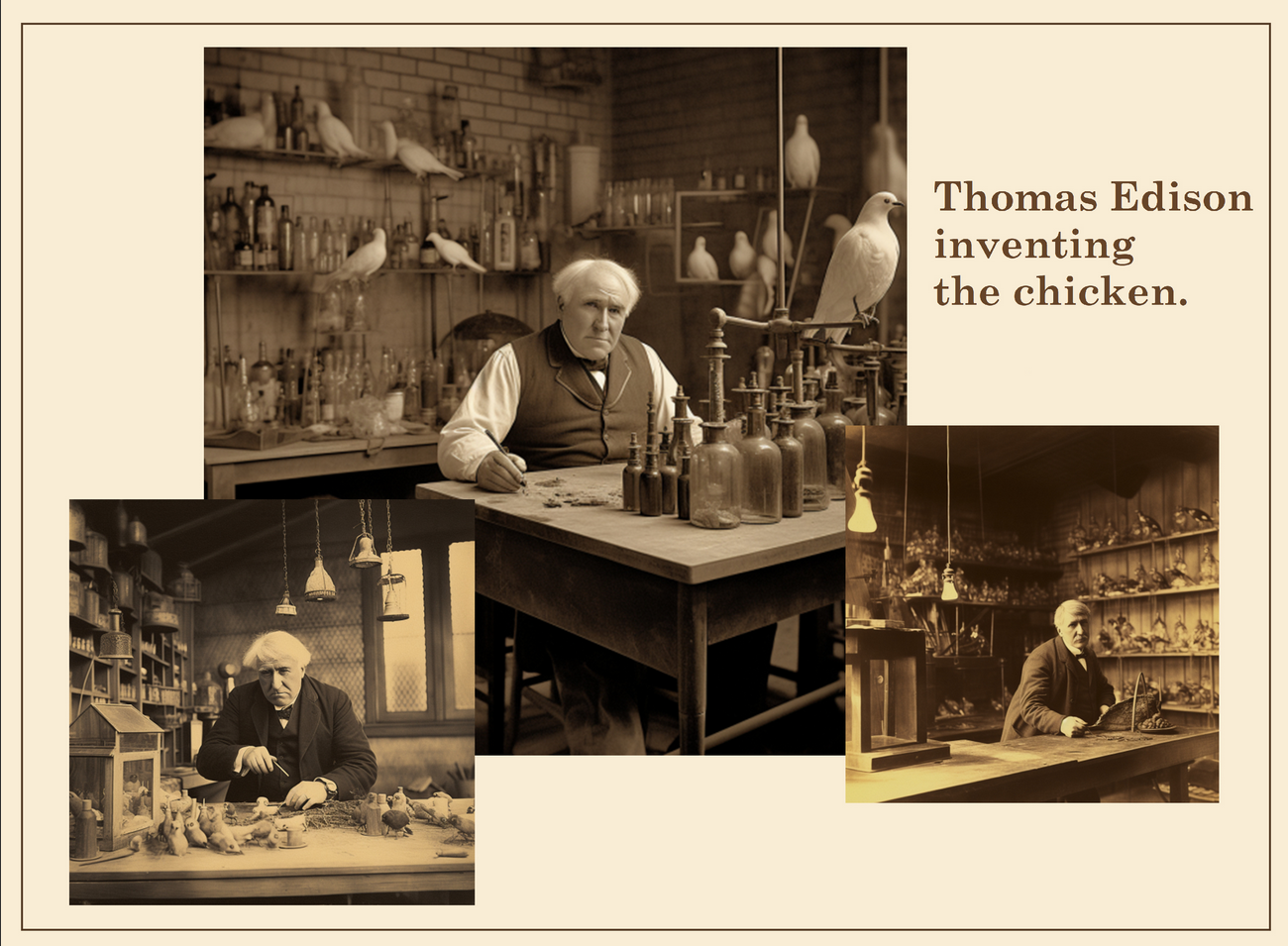
No, Thomas Edison didn’t invent the chicken, despite my fake, AI-generated photographs above. But around the time of the Apollo moon landings, a future Nobel laureate allegedly declared that the most important invention of the 20th century was the chicken. This cryptic statement offers profound wisdom about possible paths of healthcare innovation in the 21st century. The chicken quote was attributed to Robert Mundell, 1999 Nobel economist, by Dick Zecher, who was my boss at Chase Manhattan Bank and, before that, Mundell’s colleague at the University of Chicago.
How is the chicken — first domesticated more than 5,000 years ago — a 20th-century invention at all? And how was the chicken more important than the airplane, computer, atomic bomb, television, interplanetary rocket — or the countless works of Edison and his crew?
Dick told me that the comment, delivered during an Economics Department seminar, attracted the blank stares that often met Mundell’s odd, enigmatic, and always-profound observations. After a prolonged silence, the befuddled seminar speaker asked what Mundell meant.
His insight was that in the 20th century, modern production methods so drastically reduced the price of chicken that the bird became, for all practical purposes, an entirely new good. According to W. Michael Cox and Richard Alm (“Myths Of Rich And Poor: Why We’re Better Off Than We Think“), a typical American in 1900 worked 160 minutes to earn enough money for a 3-pound chicken. An equivalent worker in 2000 needed only 14 minutes of wages to buy that chicken. Pre-1950s, consumers generally had to eviscerate a commercially bought bird or have a butcher do it. (My mother used to shudder when she recalled the itinerant butcher who would slaughter chickens for my grandmother in their kitchen sink.) Herbert Hoover’s promise of “a chicken in every pot” rings dull to our ears, but in 1928, the phrase sounded like “a flying car in every garage” sounds to ours.
Revolutionary production, distribution and storage methods changed chicken from a Sunday luxury item to the everyman’s protein. Our concept of chicken bears little resemblance to our great-grandparents’ image. Massive reductions in food prices explain why rates of malnutrition and starvation have plummeted worldwide since the mid-20th century.
Comments Off on The greatest economic moment of the 20th Century was when Thomas Edison invented the chicken
May 24, 2023
The Original PB&J from 1901
Tasting History with Max Miller
Published 23 May 2023
(more…)
Comments Off on The Original PB&J from 1901
May 23, 2023
Mustard: A Spicy History
The History Guy: History Deserves to be Remembered
Published 15 Feb 2023In 2018 The Atlantic observed “For some Americans, a trip to the ballpark isn’t complete without the bright-yellow squiggle of French’s mustard atop a hot dog … Yet few realize that this condiment has been equally essential — maybe more so — for the past 6,000 years.”
(more…)
Comments Off on Mustard: A Spicy History
May 16, 2023
See inside Little Willie | The Tank Museum
The Tank Museum
Published 3 Feb 2023In this episode of Tank Chats Reloaded, David Willey revisits the iconic Little Willie, the world’s first tank. David delves into the historical significance of this revolutionary invention, and we also get an exclusive look inside what’s left of Little Willie.
(more…)
Comments Off on See inside Little Willie | The Tank Museum
May 13, 2023
What was the First Modern War?
Real Time History
Published 12 May 2023The question about the first modern war has caused lively debates among historians and YouTube comment sections alike. In this video we take a look at a few candidates and some arguments why they are or aren’t modern wars.
(more…)
Comments Off on What was the First Modern War?
May 8, 2023
Inkunzi Strike 20mm Grenade MG
Forgotten Weapons
Published 20 Jan 2023Tony Neophytou developed this for Denel Land Systems, which has completely fallen apart as a company and left it now as his own independent design, with no manufacturer. I filmed this video in 2018, to show the prototype version of the Strike, which has since been improved and further developed. Perhaps some day it can find a manufacturer?
(more…)
Comments Off on Inkunzi Strike 20mm Grenade MG
May 7, 2023
Tank Chats Reloaded | S-Tank | The Tank Museum
The Tank Museum
Published 27 Jan 2023In this episode of Tank Chats Reloaded, we are delighted to be joined by Stefan Karlsson, the director and curator of The Swedish Tank Museum. He shares his remarkable journey with the S-Tank, from his first experience driving it at the age of nine, to his later service in the Swedish Army. Stefan’s passion for the S-Tank is evident, and his story is sure to captivate and inspire.
(more…)
Comments Off on Tank Chats Reloaded | S-Tank | The Tank Museum
May 6, 2023
History Summarized: Chicago’s Tribune Tower
Overly Sarcastic Productions
Published 20 Jan 2023It’s not a Dome, but it’s still pretty darn good.
(more…)
Comments Off on History Summarized: Chicago’s Tribune Tower
April 27, 2023
M1908 Mondragon Semiauto Rifle
Forgotten Weapons
Published 24 Nov 2014The M1908 Mondragon is widely acknowledged to have been the first self-loading rifle adopted as a standard infantry arm by a national military force. There are a couple of earlier designs used by military forces, but the Mondragon was the first really mass-produced example and deserves its place in firearms history.
Designed by Mexican general Manuel Mondragon (who had a number of other arms development successes under his belt by this time), the rifles were manufactured by SIG in Switzerland. They are very high quality guns, if a bit clunky in their handling.
The design used a long-action gas piston and a rotating bolt to lock. Interestingly, the bolt had two full sets of locking lugs; one at the front and one at the rear as well as two set of cams for the operating rod and bolt handle to rotate the bolt with. The standard rifle used a 10-round internal magazine fed by stripper clips, but they were also adapted for larger detachable magazines and drums.
Unfortunately, the rifle required relatively high-quality ammunition to function reliably, and Mexico’s domestic production was not up to par. This led to the rifles having many problems in Mexican service, and Mexico refused to pay for them after the first thousand of their 4,000-unit order arrived. The remaining guns were kept by SIG, and ultimately sold to Germany for use as aircraft observer weapons.
(more…)
Comments Off on M1908 Mondragon Semiauto Rifle
QotD: The unexpected sources of musical innovation
First, I need to provide some background on the sources of musical innovation. Over the course of three decades of research into this matter, I kept encountering new styles of song emerging in unexpected places — but these locations always had something in common.
These epicenters of musical innovation are always densely populated cities where different cultures meet and mingle, sharing their distinctive songs and ways of life. This intermixing results in surprising hybrids — new ways of making music that nobody can foresee until it actually happens in this hothouse environment.
New Orleans provides a great example. Around the time jazz originated in New Orleans, it was the most diverse city in the world — an intense intermixing of French, Spanish, African, Caribbean, Latin American, and other cultures. And the mixture was enhanced by the huge number of travelers and traders who came to the region because of the prominence of the Mississippi River as a business and distribution hub.
Here’s how I described this process in the appendix to my book Music: A Subversive History, where I shared 40 precepts on the evolution of human songs.
I wish I had time to defend these assertions here with empirical evidence. But we don’t have the space to do that. Let me say, however, that these statements are amply documented and supported with dozens of examples and case studies in the course of that book.
Ted Gioia, “The Most Important City in the History of Music Isn’t What You Think It Is”, The Honest Broker, 2023-01-26.

Comments Off on QotD: The unexpected sources of musical innovation
April 11, 2023
The amplifier may have been the key technological innovation that let vocalists and guitarists become stars
Chris Dalla Riva, guest-posting at Ted Gioia’s Honest Broker, considers how instrumental hits used to be far more popular before (among other factors) microphone technology let vocalists compete with orchestras and guitar amplifiers let the strings dominate the pop music market:
Clarinet players aren’t sex symbols. I say this with no disrespect for those that play the single-reeded woodwind. But if you asked a random person on the street to name a clarinet player, I suspect most people couldn’t come up with one, let alone one known for their good looks. Then again, this isn’t a particular indictment of clarinetists. If you asked that same person to name a sexy musician, I’d bet a large sum of money they’d name a vocalist.
This wasn’t always the case, though. In Kelly Schrum’s book Some Wore Bobby Sox: The Emergence of Teenage Girls’ Culture, 1920-1945, she notes that in high school yearbooks in the 1930s some students expressed a passion for “Benny Goodman while other girls had a ‘weakness’ for Artie Shaw or were classified as Glenn Miller ‘fanatics’, faithful fans of Tommy Dorsey, or ‘Happy while listening to Kay Kyser’. Cab Calloway, Xavier Cugat, and Harry James were also popular favorites.” Of those musicians, only Calloway was a singer. Goodman, Shaw, and Kyser played the clarinet. Miller and Dorsey played the trombone. Cugat played violin. James played trumpet.
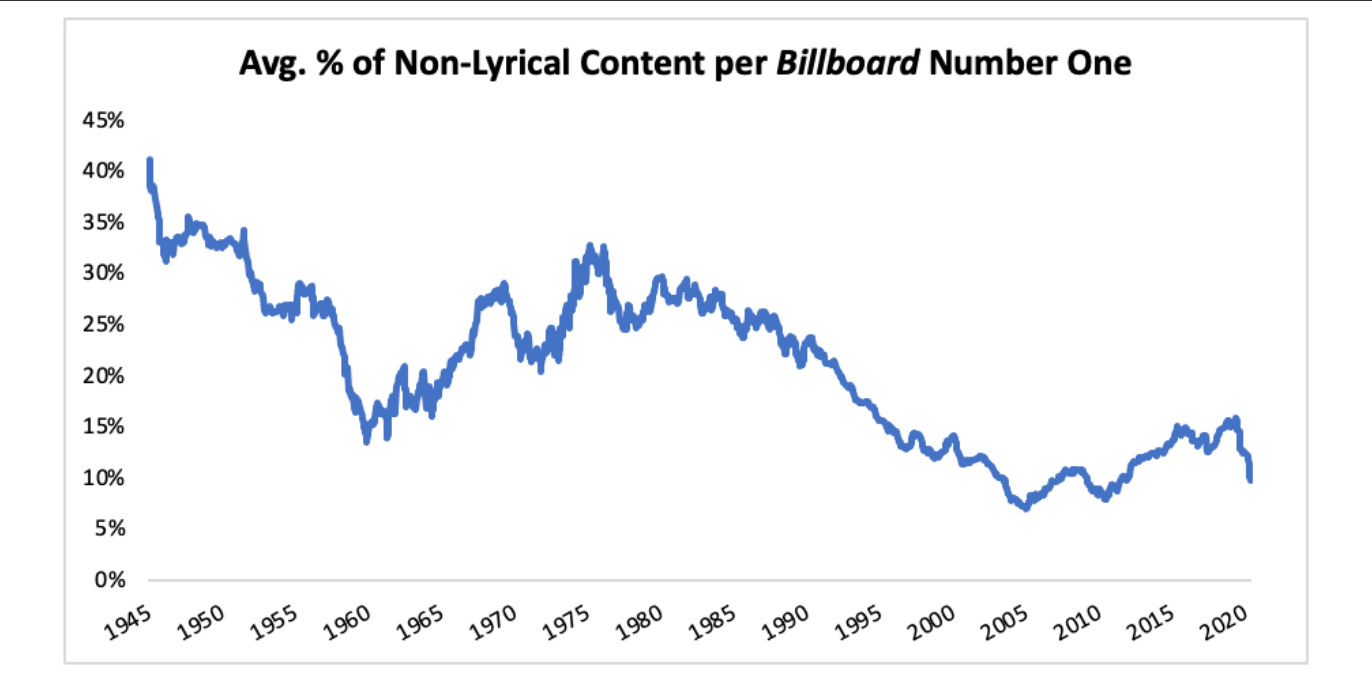
Given that our contemporary musical world is dominated by vocalists, this seems bizarre. It feels like if you have a musical group it must be centered around the vocalist. If we measure the average percent of instrumental content per Billboard number hit between 1940 and 2021, we see demonstrable evidence for not just the decline of the instrumental superstar but the instrumentalist generally, with the sharpest declines beginning in the 1950s and the 1990s.
NOTE: Data from July 1940 to August 1958 comes from Billboard‘s Best Sellers in Stores chart. After August 1958, Billboard deprecated that chart in favor of the Hot 100, which initially aggregated sales, jukebox, and radio data. The Hot 100 remains the premiere pop chart, though it has come to include many more sources, like streams and digital downloads. The above displays a 50-song rolling average.
What’s going on here? How could throngs of high schoolers long for the clarinet-wielding Artie Shaw 80 years ago when most teenagers today would struggle to name a musician who isn’t also a singer. I believe it comes down to four factors: improved technology, the 1942 musicians’ strike, WWII, television, and hip-hop.
Improved Technology
In the VH1-produced documentary The Brian Setzer Orchestra Story, Dave Kaplan, Setzer’s manager, recounts a conversation he had with Setzer before assembling a guitar-fronted big band in the 1990s: “Nobody had ever fronted a big band with an electric guitar … I asked Brian, ‘Why wouldn’t somebody have tried it?’ [Setzer replied,] ‘Well there weren’t amps.'” Albeit a simplification, Setzer’s quip is pretty accurate.
While there were some famous guitar players among the big bands of the first half of the 20th century, we don’t see the guitar become a driving force in popular music until amplification improved. This was not only a boon for the guitarists but also vocalists. Unlike brass and wind instruments, you can sing while you play the guitar. Thus, it’s not shocking that the rise of the guitar coincided with the rise of the vocalist.
But it wasn’t just guitar amplification technology that was vital. It was also microphone technology. Again, microphones had to improve so vocalists could compete with the cacophony of a loud band. On top of this, recording had to change to capture more subtlety in the human voice.
Comments Off on The amplifier may have been the key technological innovation that let vocalists and guitarists become stars
LeMat Centerfire Pistol and Carbine
Forgotten Weapons
Published 27 Nov 2014Colonel LeMat is best known for his 9-shot muzzleloading .42 caliber revolver with its 20 gauge shot barrel acting as cylinder axis pin — several thousand of these revolvers were imported and used in the field by Confederate officers during the US Civil War (and modern reproductions are available as well). What are less well-known are the pinfire and centerfire versions of LeMat’s revolver, and the carbine variants as well.
In this video I’m taking a look at a centerfire LeMat revolver and a centerfire LeMat carbine, both extremely rare guns. They use the same basic principles as the early muzzleloading guns, but look quite different. In these guns, the shotgun remains 20 gauge but uses a self-contained shell loaded from the rear, and the 9 rifles shots are designed for an 11mm (.44 caliber) cartridge very similar to that used in the French 1873 service revolver.
(more…)
Comments Off on LeMat Centerfire Pistol and Carbine
April 8, 2023
Błyskawica: The Polish Home Army’s Clandestine SMG
Forgotten Weapons
Published 23 Dec 2022The Błyskawica (“Lightning”) is an SMG developed in occupied Poland to be issued out to Home Army units during Operation Tempest: the liberation uprisings planned for the advance of the Red Army into Poland.
The gun was developed starting in September 1942 by two engineers, Wacław Zawrotny and Seweryn Wielanier. Both were smart and talented, but neither had previous experience in arms design. The design they created is both innovative in some areas and inferior in others as a result, with major inspiration coming from the Sten and the MP40. Production was undertaken in the harshest conditions of occupied Warsaw, where just possession of cutting tools required German military permission.* It is a credit to the skill and dedication of the Home Army team that some 750 Błyskawica guns were made; the largest mass production of any underground weapon that I am aware of.
Ultimately, Operation Tempest did not come to full fruition, as the NKVD’s treatment of Polish fighters as collaborators destroyed Home Army interest in cooperation. The Błyskawica guns were never issued as planned, with only the few dozen last made being used in the Warsaw Uprising. The remaining 700-odd examples have never been found — perhaps they remain in long-forgotten caches still to this day?
For the full story of the Błyskawica, see Leszek Erenfeicht’s excellent article:
https://www.forgottenweapons.com/subm…Many thanks to the Polish Army Museum for giving me access to film this exceptionally rare item for you! Check them out at: http://www.muzeumwp.pl/?language=EN
* This created some interesting situations in which a shop might take a contract to make material for the Wehrmacht as a way to get access to the tools needed for Błyskawica component production. To those who did not know the whole story, such a shop was collaborationist.
Comments Off on Błyskawica: The Polish Home Army’s Clandestine SMG
QotD: Rome’s “excess labour” problem
The thing is — as old-school historians would tell you if any were still alive — technology is all about saving labor. Physical labor, mental labor, same deal. Consider the abacus, for instance. It’s a childishly simple device — it’s literally a child’s toy now — but think about actually doing math with it, when the only alternative is scratch paper. How much time do you save, not having to jot things down (remember where you put the jottings, etc.)?
I’m sure you see where this is going. The Romans did NOT lack for labor. They had, in fact, the exact opposite problem: Far, far too much labor. It’s almost a cliché to say that a particular group in the ancient world didn’t qualify as a “civilization” until they started putting up as ginormous a monument as they could figure out. They raised monuments for lots of reasons, of course, but not least among them was the excess-labor problem. What else are you supposed to do with the tribe you just conquered? Unless you want to wipe them out, to the last old man, woman, and child, slavery is the only humane solution.
If that’s true, then the opposite should also hold — technological innovation starts with a labor shortage. Survey says … yep. There’s a reason the Scientific Revolution dates to the Renaissance: The massive labor shortage following the Black Death. That this is also the start of the great age of exploration is also no accident. While the labor (over-)supply was fairly constant in the ancient world, once technological innovation really got going, the labor-supply pendulum started swinging wildly. The under-supply after the Black Death led to over-supply once technological work-arounds were discovered; that over-supply was exported to the colonies, which were grossly under-supplied, etc.
In short: If you want to know what kind of society you’re going to have, look at labor mobility.
Severian, “Excess Labor”, Rotten Chestnuts, 2020-07-28.
Comments Off on QotD: Rome’s “excess labour” problem


