
World War Two
Published 4 Nov 2021As the war intensifies on all fronts, the occupied world is aflame with resistance and reprisals. From Paris to Papua New Guinea, Humanity is under attack — but it is also fighting back.
(more…)
November 5, 2021
A United Front Against Nazi Atrocities – WAH 045 – October 1942, Pt. 2
Comments Off on A United Front Against Nazi Atrocities – WAH 045 – October 1942, Pt. 2
November 3, 2021
Casablanca had a small but significant historical error
And it’s not Captain Renault’s throwaway line about the Americans marching into Berlin (which, of course, did not happen in 1918). The error that Michael Curtis points out is very easy to miss:
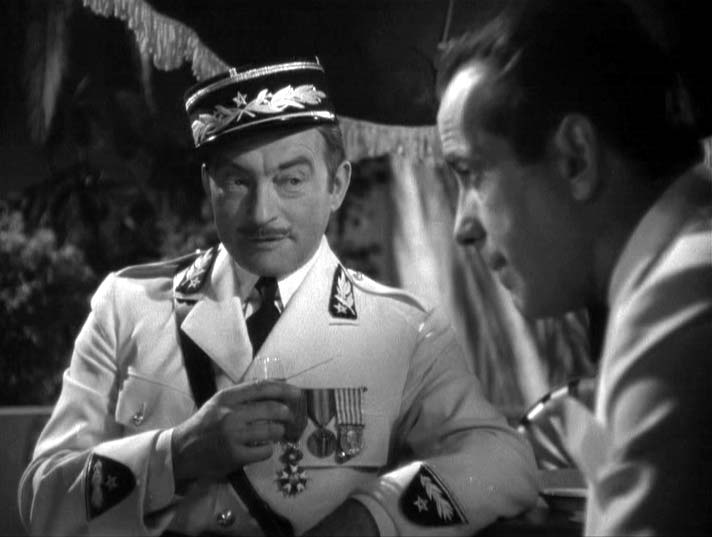
Still from Casablanca (1942), with Captain Renault (Claude Rains) asking Rick Blaine (Humphrey Bogart) why he came to Casablanca.
As time goes by, there is a consensus that Casablanca, the story of the cynical hard drinking American expatriate night club owner choosing between his love for a woman or helping her and her husband, a resistance hero escape from the town of Casablanca, a complex town controlled by the Vichy state under Nazi occupation, is one of the greatest films of all time. Its characters, dialogue, theme song, have become iconic. We’ll always have Casablanca. It is a film of moral ambiguity, that can be seen either as a theme of love and sacrifice, or as a political allegory about resistance against Nazism.
However, this brilliant film has a flaw. In one scene the camera focuses on the prefecture of the corrupt chief of police on the wall of which is the motto of the French Third Republic, “liberty, equality, fraternity”, inherited from the 1789 French revolution. But the Third Republic had been ended in May 1940, and its motto had been officially replaced by the slogan, “work, family, homeland”, of the new French State, popularly known as Vichy. The differences between the two mottos are still pertinent in French politics and culture today.
Some political and cultural problems are easy to solve, even if costly. Scotland recently spent seven months of research and $162,000 to create a new slogan that would increase tourism. It finally came up with a banal slogan, “Welcome to Scotland”. There is no easy solution for France which has been and remains a sharply divided society still confronting its history of the World War II years, the defeat of the French army by the Germans in June 1940, the end of the Third Republic and its replacement by the French State headed by 84 year old Marshall Philippe Petain, regarded as a hero of Verdun in World War I, located in Vichy, a spa in the Auvergne.
The Vichy régime participated in persecution and discrimination of the Jewish population, by aryanisation of property, propaganda, antisemitic ideology, anti-Jewish legislation, roundups, deportation to death and concentration camps. In view of this antisemitic attitude, it is a paradox that after the War, 75% of the Jewish population in France remained alive, the result of complex religious, cultural, and international factors. This can be compared to extermination of 80% of Jews in the Netherlands, and 45% in Belgium.
Nevertheless, 75,721 Jews were deported from France, and fewer than 2,000 survived. Persecution was extensive. Jews were banned from professions, civil service, journalism, business, entertainment, refugee Jews were held in concentration camps under French control, antisemitic legislation affected all Jews, and the tragedy of Vel d’Hiv occurred. French police carried out the first mass arrests of Jews in Paris in May 1941, and the first French deportation train left on March 12, 1942. The most infamous event, the roundup by French gendarmes, using batons and hoses, of 13,000 Jews took place on July 16-17, 1942 when the victims were taken to the Vel d’Hiv indoor bi-cycling stadium in Paris before being deported to Nazi camps. They included 7916 women, 1129 men and 4115 children.
By the so-called National Revolution, France would be rescued from the decadent Third Republic, and returned to purer values. The controversy continues. Was France guilty of contributing to the Holocaust, and who was responsible? First, were collaborators and sympathizers with the Nazis only a minority of the population and was Petain the “shield”, protecting France and the French people as much as it could within the country, while General de Gaulle abroad was the “sword”. A second defense was that Vichy could do little while the Germans occupiers were responsible. A third point is that Vichy tried to protect French national Jews by collaborating in the persecution, the deportation and ultimately extermination of foreign Jews in France.
Comments Off on Casablanca had a small but significant historical error
October 15, 2021
Nazis “Restore” Law and Order – WAH 044 – October 1942, Pt. 1
World War Two
Published 14 Oct 2021Resistance against occupation starts rising in the Autumn of 1942. It faces opposition not only from the occupiers, but also from collaborators killing their own countrymen.
(more…)
Comments Off on Nazis “Restore” Law and Order – WAH 044 – October 1942, Pt. 1
October 3, 2021
This is Russia, The Soviet Thermopylae – WW2 – 162 – October 2, 1942
World War Two
Published 2 Oct 2021The fighting for Stalingrad continues, but the Soviets forces are split and the Volga is on fire. In the Caucasus, the Axis forces for the most part are being held in check — at one point a single Soviet battalion holds off an entire Army Corps — but they’re being pushed back on the Kokoda Trail in the South Seas.
(more…)
Comments Off on This is Russia, The Soviet Thermopylae – WW2 – 162 – October 2, 1942
September 24, 2021
Kill The Nazis – WAH 042 – September 1942, Pt. 1
World War Two
Published 23 Sep 2021The Nazi German occupiers have kept increasing their pressure in occupied territory, and fooled their victims to still have hope, but at some point when the oppression gets unbearable, or all hope is lost, people will resist.
(more…)
Comments Off on Kill The Nazis – WAH 042 – September 1942, Pt. 1
September 10, 2021
The German Slave Economy – WW2 Special
World War Two
Published 9 Sep 2021To fuel the German war economy, the Nazis force millions of Prisoners of War, Concentration Camp inmates and civilians from all over Europe to work for in their factories and on their farms as slave laborers under harsh circumstances.
(more…)
Comments Off on The German Slave Economy – WW2 Special
September 3, 2021
Why Don’t the French Resist? – WAH 041 – August 1942, pt. 2
World War Two
Published 2 Sep 2021Citizens in Stalingrad face German bombs as Soviet officials refuse to evacuate. The German counter-insurgency effort increases, but people continue to resist against all odds. The Treblinka camp breaks down under the ambitions of its commandant, Irmfried Eberl.
(more…)
Comments Off on Why Don’t the French Resist? – WAH 041 – August 1942, pt. 2
August 11, 2021
The Symphony That Defeated the Wehrmacht – WAH 040 – August 1942, Pt .1
World War Two
Pubished 10 Aug 2021The Big Action at the Warsaw Ghetto continues, while The Japanese carry out retaliations against the Chinese for aiding American airmen. Dmitri Shostakovich’s “Symphony no. 7” premieres in the besieged city of Leningrad.
(more…)
Comments Off on The Symphony That Defeated the Wehrmacht – WAH 040 – August 1942, Pt .1
August 7, 2021
The Black Markets of World War Two – WW2 – On the Homefront 012
World War Two
Published 6 Aug 2021With the scarce food supply brought about by war, many turn to the black market and its astronomic prices as supplements. It is a place for opportunists and patriotic protesters, but mainly it’s a means to survive.
(more…)
Comments Off on The Black Markets of World War Two – WW2 – On the Homefront 012
July 30, 2021
The 100 Deadliest Days of the Holocaust Begin… – WAH 039 – July 1942, Pt .2
World War Two
Published 29 Jul 2021The extermination camps of Operation Reinhard are ready to start killing hundreds of thousands of inhabitants of the Warsaw Ghetto, starting the deadliest 100 days of the Holocaust.
(more…)
Comments Off on The 100 Deadliest Days of the Holocaust Begin… – WAH 039 – July 1942, Pt .2
July 16, 2021
Forced Sterilization Experiments Begin at Auschwitz – WAH 038 – July 1942, Pt. 1
World War Two
Published 15 Jul 2021Operation Millennium is discontinued, while in Poland the Auschwitz Birkenau camp starts to systematically gas thousands of people a week. Some who aren’t murdered on arrival are subjected to horrific medical and sterilization experiments.
(more…)
Comments Off on Forced Sterilization Experiments Begin at Auschwitz – WAH 038 – July 1942, Pt. 1
July 2, 2021
Japan’s Institutionalization of Rape – WAH 037 – June 1942, Pt. 2
World War Two
Published 1 Jul 2021During the occupation of South-East Asia, Japan builds a large system of institutionalised rape to “keep their soldiers happy”. Meanwhile, Allied refugees from Burma find a safe haven in India, but for some, hardship continues.
(more…)
Comments Off on Japan’s Institutionalization of Rape – WAH 037 – June 1942, Pt. 2
June 18, 2021
Heydrich, Architect of the Holocaust, Dies – WAH 036 – June 1942, Pt. 1
World War Two
Published 17 Jun 2021Reinhard Heydrich is fighting for his life, as the hunt of his assassins continues. Meanwhile, news of the Nazi atrocities starts to reach the Allied countries.
(more…)
Comments Off on Heydrich, Architect of the Holocaust, Dies – WAH 036 – June 1942, Pt. 1
June 7, 2021
Germany to Strike Strongest Fortress in the World – WW2 – 145b – June 6, 1942
World War Two
Published 6 Jun 2021Midway isn’t the only fight right now. Germany is trying to crack the mighty fortress of Sevastopol and take the whole Crimea. In North Africa, Rommel is routing the Allies, but in Malta the arrival of ever more fighter planes bodes well for the Allies.
(more…)
Comments Off on Germany to Strike Strongest Fortress in the World – WW2 – 145b – June 6, 1942
June 5, 2021
The morality of collective intergenerational responsibility
Arthur Chrenkoff believes that the responsibility to compensate people for historical wrongs ends when the individuals who were harmed have died:
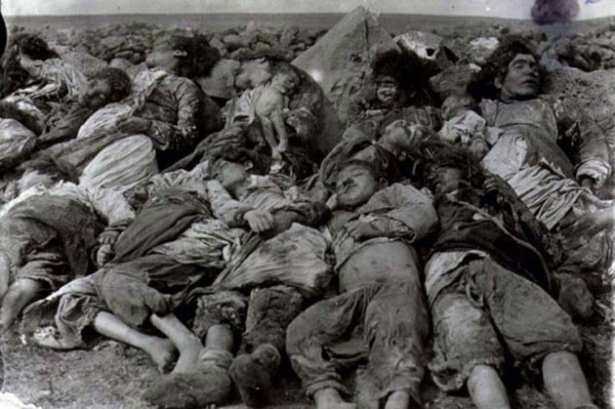
Victims of genocide
Photo by Cantetik2 via Wikimedia Commons.
What I was querying was the practicality and the morality of reparations being paid today: “If great-great-grandchildren of perpetrators have to pay great-great-grandchildren of survivors, is there any limit on historical liability? 200 years? 500 years?”
Before we get any further into the discussion, let me restate here my position, which has not changed at all in light of the subsequent online exchanges and name-calling: I do not believe in collective intergenerational responsibility. Far from modern and enlightened, it strikes me as a primitive, ancient principle, in line with the Old Testament’s “an eye for an eye” mentality. Thought to call it Old Testament might be unkind to Old Testament, since already by the time the Book of Ezekiel was being compiled during the Babylonian Exile, mid-first millennium BC, the Judaic theology had morally evolved beyond the belief that the sins of the fathers are visited on their children. We are each a moral agent, enjoying free will and exercising own judgments and actions, and for all that we are rightly held responsible and accountable. But it is unjust to blame (and, at the other end of the spectrum, absurd to praise) us for what our literal and metaphorical ancestors had done or failed to do at one point or another in the past, or what they have collectively achieved.
And so, to the comment that genocide has no statute of limitation, I say: it should, and it should be right about the time that all those who were alive at the time and affected by it have passed away.
The concept of reparations for historical wrongs is increasingly in the news. In the United States, the question revolves around the evil of slavery, but it’s hardly an American-centric debate. In many Western European countries there is talk of reparations for colonialism. Then there is the agitation in Poland, long supported by the ruling Law and Justice party, that Germany should pay Poland reparations for death and destruction caused during the Second World War. While the quantum has sometimes been calculated upward of US$15 trillion, the official suggestions have hovered around the more “modest” €850 billion (1947 estimates in today’s currency).
[…]
Not just genocide – everything that has ever happened, both bad and good, ripples across time and shapes the present. This is what history is about. Each event has an infinite number of causes and an infinite number of consequences. Hence, conceptual problems start popping up once you try to unscramble the egg and make simple adjudications about complex past situations. It’s one thing to make moral judgments about what had happened, it’s another to apply judicial standards used in disputes between contemporaries to met out sanctions and punishment in relations to historical wrongs, which might have occurred centuries ago. For starters, the collective approach to situations where each individual was affected it their own unique way might simplify things but it surely does not paint an accurate picture or deliver real justice. This goes for both the victims and the perpetrators. (At the extreme, for example, potentially forcing the descendants of German pacifists to compensate the descendants of Polish collaborators. In fairness, there were few of either at the time, but most other historical events are significantly more complicated than the black and white story of Nazi aggression and crimes against humanity.)
Which brings me to the second problem: the supposed intergenerational nature of responsibility and punishment. Not only are we talking about entire nations or ethnic (or social or religious or other) groups as monoliths for legal purposes, somewhat akin to a corporation, but also monoliths in time, across an unlimited number of generations. I find it morally odious, but you may well say “well, it’s not about moral blame per se, but whether you have, intentionally or not, benefitted at the expense of past others as a consequence of the evil actions of your ancestors” – in other words, it’s not a punitive but a restorative justice. Putting aside, again, the fact that no two individuals are ever affected in exactly the same way, the past is much more complex than your simplistic unicausal, zero-sum calculations allow and so, consequently, simple justice in theory is simply unjust in practice. Take Germany for example; if you think that Germany and Germans as a collective had benefitted from their rapacious actions during the war, you clearly have little idea what happened to them between, say, 1943 and 1946. You might think, as many did particularly in the immediate aftermath of the war, that this was still not a (collective) punishment enough considering the extent and the gravity of crimes committed (including the Holocaust) but if there was a time to tip the scales even more it was contemporaneously. The point I’m making is that any short-term German gains have been wiped out by the deliberate actions (military or otherwise) of the Allies, who in so doing destroyed much of the native German wealth as well as the wealth stolen by Germany from the occupied territories. That Germany is rich today is despite, not because of the Second World War. And while it’s true that Poland, for example, and at least some of its people are poorer today than they would have been had there been no war, I return back to my original position: how is it just and fair for a 25-year old from Bremen to compensate Poland as a whole (or the Polish government to be exact) for the “ripples” set off six decades before they were even born?


