Quotulatiousness

December 7, 2019

Biggest Revolver Yet? A 10-Gauge Colt 1855…

Filed under: History, USA, Weapons — Tags: , , — Nicholas @ 02:00

Forgotten Weapons
Published 17 Oct 2019

http://www.patreon.com/ForgottenWeapons

Cool Forgotten Weapons merch! http://shop.bbtv.com/collections/forg…

This ludicrously huge handgun is actually a 10-gauge Colt 1855 Revolving Shotgun with a cut-down barrel and a newly made grip frame. The backstop and trigger guard of the shotgun were handily reshaped into a grip frame, and the finished product actually looks nicely proportional — until you try to actually pick it up, of course. The grip is filled with brass inlay, about a third of which are missing (possibly from the recoil of actually firing?). Despite the rather poor finish condition, the gun cycles smoothly, and appears to be fully functional. Just the thing for someone who wants to make the Colt Walker look puny!

Contact:
Forgotten Weapons
6281 N. Oracle #36270
Tucson, AZ 85704

December 5, 2019

Tippman’s Half-Scale .22 Rimfire Browning 1917 Machine Gun

Filed under: History, USA, Weapons — Tags: , , , , — Nicholas @ 04:00

Forgotten Weapons
Published 4 Dec 2019

https://www.instagram.com/rockislanda…

https://www.youtube.com/user/RockIsla…

This is Lot 1578 in the upcoming RIA December 2019 Premier auction.

In 1983, Dennis Tippman formed a company to manufacture half-scale functional replicas of Browning machine guns — the 1919 and 1917 specifically. He built these as both fully automatic and semiautomatic (the semiauto design being approved by ATF in 1984) as new machine guns could still be registered in 1983. They were chambered for .22 LR rimfire ammunition, making then cheap and easy to shoot. In 1985, he added an M2HB replica, also in half scale, chambered for the .22 Magnum cartridge.

Tippman’s guns were excellent replicas of the originals, including accessories like tripods and even a few .22 caliber belt-loading machines. However, when the machine gun registry was closed in 1986, he left the business, selling it to FJ Vollmer. Tippman would move into paintball markers, and the company name is much better know for those today outside of a small community of machine gun enthusiasts.

Vollmer would eventually sell the company in 2001 to Eric Graetz and Lakeside Machine, who continued production of the semiauto versions, as well as offering post-sample automatics ones. This example is one of Graetz’ production, serial number 001 from when the company moved to New Haven Indiana.

http://www.patreon.com/ForgottenWeapons

Cool Forgotten Weapons merch! http://shop.bbtv.com/collections/forg…

Contact:
Forgotten Weapons
6281 N. Oracle #36270
Tucson, AZ 85704

December 3, 2019

Turkish Conehammer “Broomhandle” C96 Mauser

Filed under: Europe, Germany, History, Military, Weapons — Tags: , , , — Nicholas @ 02:00

Forgotten Weapons
Published 13 Oct 2019

This is Lot 2493 in the upcoming October Morphy Extraordinary auction.

The “cone hammer” was the first commercial version of the Mauser C96, so named for the stepped conical sides of its hammer. The C96 did not sell particularly well in the first few years after its introduction, and the only major bulk sale was to Sultan Abdul Hamid II of the Ottoman Empire, who bought 1,000 of the guns for his palace guard. These guns were numbered in Farsi in their own range from 1 to 1000, and were all sold with matching shoulder stocks. The order was signed in December of 1897 and the guns were shipped a few months later, in May of 1898.

Under the Sultan’s rule, there was significant concern over potential military coups, and most arms were locked away in armories, including many of the C96 pistols. After the revolution in 1908/9, guns were more liberally distributed to the military and police, and these C96 pistols were issued out to both groups for service use. Some were used in combat in World War One, and after the war they were considered surplus, available for purchase inexpensively by Army or police officers. This meant that they saw a lot of use, and as a result few survive today, with many of them in rather rough condition.

http://www.patreon.com/ForgottenWeapons

Cool Forgotten Weapons merch! http://shop.bbtv.com/collections/forg…

Contact:
Forgotten Weapons
6281 N. Oracle #36270
Tucson, AZ 85704

November 22, 2019

QotD: Politicians, like scorpions, cannot change their nature

Filed under: Media, Politics, Quotations — Tags: , , — Nicholas @ 01:00

Whatever you think of current immigration policy (too lax, too tight, just right) and whatever you think of current policies controlling Americans’ access to guns (too lax, too tight, just right), surely you must be amused – if only wistfully – by those who complain, whenever some tragedy occurs, that politicians “politicize” that tragedy. Feigning surprise about politicians politicizing tragedies makes no more sense than feigning surprise that dogs bark at mailmen: it’s in the nature of the beasts. (I don’t mean by this comparison to insult man’s best friend. Dogs’ instinct to bark is typically beneficial to humanity; politicians’ instinct to politicize anything that moves is typically harmful to humanity.)

Don Boudreaux, “Dogs Bark!”, Café Hayek, 2017-11-02.

November 21, 2019

Battle of Sedan: How did Prussia Win The Franco-Prussian War? | Animated History

Filed under: France, Germany, History, Military, Weapons — Tags: , , , — Nicholas @ 06:00

The Armchair Historian
Published 16 Feb 2018

The Battle of Sedan. How did Prussia Win the Franco-Prussian War?

Our Website: https://www.thearmchairhistorian.com/

Our Twitter:
@ArmchairHist

Our Discord:
https://discord.gg/Ppb2cUd

Sources:
http://1.bp.blogspot.com/-Q9vpKOSgFHs…
https://www.britannica.com/event/Batt…
https://www.thoughtco.com/franco-prus…
https://www.warhistoryonline.com/hist…
https://www.military-history.us/2011/…

100 Decisive Battles by: Paul K. Davis
50 Battles That Changed the World by: William Weir

Music: “Danse Macabre” by Kevin MacLeod is licensed under a Creative Commons Attribution license (https://creativecommons.org/licenses/…)
Source: http://incompetech.com/music/royalty-…
Artist: http://incompetech.com/

November 20, 2019

Sterling Meets Owen: The Australian F1 Submachine Gun

Filed under: Australia, History, Weapons — Tags: , , , , — Nicholas @ 02:00

Forgotten Weapons
Published on 20 Sep 2019

http://www.patreon.com/ForgottenWeapons

Cool Forgotten Weapons merch! http://shop.bbtv.com/collections/forg…

The Australian Owen submachine gun was once of the best overall SMG designs of the Second World War, and when Australia decided to replace them in the 1960s, the new F1 design had big shoes to fill. The basic configuration of the top-mounted magazine remained, but coupled with elements of the Sterling SMG. The F1 used a simple sheet metal tube receiver with elements welded on, and a typical open bolt, blowback operating system. The unique rear system of separating the recoil spring from the main receiver body in the Owen was not included, instead using a basic open tube and large diameter mainspring. The sights are curiously still mounted to the right side of the gun, with a thin folding rear sight and a front sight affixed to the magazine well. These simplifications did have the effect of lightening the F1 compared to the Owen, which is a nice improvement. The F1 was manufactured from 1962 until 1973, with a total of about 25,000 made. It served in Vietnam and through the 1990s, when replaced by a variant of the F88 Austeyr. All reports are that it was a perfectly adequate submachine gun, but it did not earn the affection of troops like the Owen had.

Contact:
Forgotten Weapons
6281 N. Oracle #36270
Tucson, AZ 85704

November 17, 2019

Book Review: Arms & Accoutrements of the Mounted Police 1873-1973

Filed under: Books, Cancon, History, Weapons — Tags: , , — Nicholas @ 02:00

Forgotten Weapons
Published on 15 Sep 2019

http://www.patreon.com/ForgottenWeapons

Cool Forgotten Weapons merch! http://shop.bbtv.com/collections/forg…

The Royal North West Mounted Police (later merged with the Dominion Police to become the RCMP — Royal Canadian Mounted Police) are an interesting and often overlooked element of the western frontier. We Americans tend to only think about the Old West up to northern Montana and Idaho, but of course things were not that much different on the other side of the border in Alberta, Saskatchewan, Yukon, and the other western provinces. Starting with their founding in 1873, law enforcement in western Canada was the domain of the RNWMP, and they used an interesting mixture of British Empire arms and American arms – Colts and Adams; Winchesters and Sniders.

Arms and Accoutrements of the Mounted Police, 1873-1973 covers the whole range or arms and accessories used by the Mounties. Handguns, rifles, shotguns, machine guns, swords, lances, and even artillery (yes, they had some artillery). This is a great book for any Canadian collector, and quite interesting for the rest of us as well — a window into a police agency we don’t often think about.

The book is generally out of print, but as of this writing still in stock for $35 at JoeSalter.com:

https://www.joesalter.com/category/pr…

Contact:
Forgotten Weapons
6281 N. Oracle #36270
Tucson, AZ 85704

November 14, 2019

Shooting the Mle 1866 Chassepot

Filed under: France, History, Military, Weapons — Tags: , , — Nicholas @ 02:00

Forgotten Weapons
Published on 14 Sep 2019

http://www.patreon.com/ForgottenWeapons

Cool Forgotten Weapons merch! http://shop.bbtv.com/collections/forg…

A while back, I visited @CanadianGunLover, and we did a bit of shooting with an 1866 Chassepot. I lost track of the footage and only just now found where I had put it – so today is some Chassepot shooting! A couple things to note; the rifle sounds very quiet because my microphone was clipping it off, sorry. And yes, we are on a very short range bay – it’s what was available at the time. The ammo we are using was made by CGL, and was a bit longer than military spec, which led to the bolt getting tight to close more quickly that would have originally been the case. But even with that, the rapidity of fire offered by the Chassepot completely outclassed all the muzzleloaders still in service.

Want a whole lot more information on the Chassepot? Well, it’s covered in the first chapter of my book, Chassepot to FAMAS: French Military Rifles: https://www.headstamppublishing.com/f…

Contact:
Forgotten Weapons
6281 N. Oracle #36270
Tucson, AZ 85704

November 11, 2019

Too Late and Not Much Better: the Austen Mk II SMG

Filed under: Australia, History, Military, Weapons, WW2 — Tags: , , — Nicholas @ 02:00

Forgotten Weapons
Published on 12 Sep 2019

http://www.patreon.com/ForgottenWeapons

Cool Forgotten Weapons merch! http://shop.bbtv.com/collections/forg…

The story of the Austen submachine gun did not end when the Mk I guns were pulled from combat service in 1944. The manufacturer continued to work on an improved version, which would be ready in 1946, after the end of World War Two. Only 200 were made total, and they were both adopted and declared obsolete in August of 1946.

The changes made to the MkII Austen mostly involved increasing the use of die cast components, which fit the manufacturer’s tooling and experience. The front grip and magazine well casting was enlarged, and the whole rear assembly was made into a second cast part integrating the rear sight, stock mounting and latch, and fire control group. The one significant internal change was to remove the firing pin from the telescoping recoil spring assembly and make it an integral feature of the bolt face.

Many thanks to the Royal Armouries for allowing me to film this very rare artifact! The NFC collection there – perhaps the best military small arms collection in Western Europe – is available by appointment to researchers:

https://royalarmouries.org/research/n…

You can browse the various Armouries collections online here:

https://royalarmouries.org/collection/

Contact:
Forgotten Weapons
PO Box 87647
Tucson, AZ 85754

November 10, 2019

The Diggers’ Dismay: Austen Mk I SMG

Filed under: Australia, Britain, History, Military, Weapons, WW2 — Tags: , , — Nicholas @ 02:00

Forgotten Weapons
Published on 11 Sep 2019

http://www.patreon.com/ForgottenWeapons

Cool Forgotten Weapons merch! http://shop.bbtv.com/collections/forg…

When World War Two began, Australia saw little threat of invasion from Germany (obviously), and sent a substantial number of firearms to Britain to help arm the Home Guard there, which was seriously concerned about the possibility of a German invasion. When Japan and Australia declared war in December 1941, the situation immediately became much more serious for Australia, and the government began looking for arms.

At the start of the war, there were effectively no submachine guns at all on the continent — just a couple examples. These included an MP38 somehow confiscated by Australian customs, which would take on a significant role. Australia looked to Britain for arms, and they were sent a technical data package to produce the Sten MkII — but found the design pretty underwhelming. Australian manufacturers decided to make their own improvements to it, using elements of the MP38 — specifically the sealed telescoping recoil spring system and underflowing stock. They also gave the gun a pair of pistol grips for improved handling.

The Owen SMG was going into production at this time, and had been in development for a while under private civilian supervision. The Australian Sten, called the Austen, lacked that developmental track record and it went into production without passing proper trials. It faced significant manufacturing delays and reliability problems, and was not well liked by troops — in contrast to the excellent Owen. The Austen was ultimately made in smaller numbers than the Owen (19,914 of the MkI guns) and pulled from combat use in August of 1944.

Many thanks to the Royal Armouries for allowing me to film this rare artifact! The NFC collection there — perhaps the best military small arms collection in Western Europe — is available by appointment to researchers:

https://royalarmouries.org/research/n…

You can browse the various Armouries collections online here:

https://royalarmouries.org/collection/

Contact:
Forgotten Weapons
PO Box 87647
Tucson, AZ 85754

QotD: Dunning-Kruger Club

Filed under: Humour, Quotations — Tags: , , , — Nicholas @ 01:00

So, someone in a Facebook discussion brought up the usual “wOrKs fOr mE” nonsense to rationalize his love for an objectively awful pistol and when called on it, used every gun forum bubba trope you can think of to double down.

A friend mentioned that it was ignorant bro stuff like this that was causing him to seek out other hobbies, to which I ruefully commented that every hobby has its equivalent; guns and shooting aren’t unique.

And then someone else dropped the bomb:

    “[Name Redacted], if you don’t recognize this behavior in other hobbies, it’s because you’re the one doing it.”

Ouch.

But the First Rule of Dunning-Kruger Club is “You don’t know that you’re in Dunning-Kruger Club.”

Tamara “Tam Slick” Keel, “The First Rule of Dunning-Kruger Club…”, View from the porch, 2019-09-30.

November 8, 2019

Cooey: The Unassuming Canadian Workhorse

Filed under: Cancon, History, Weapons — Tags: , , — Nicholas @ 04:00

Forgotten Weapons
Published 6 Nov 2019

http://www.patreon.com/ForgottenWeapons

Cool Forgotten Weapons merch! http://shop.bbtv.com/collections/forg…

Cooey is a brand name that will be immediately recognized by Canadians, but pretty much unknown everywhere else. Founded in 1903 by Herbert Cooey, the company would produce a series of simple and practical firearms that became hugely popular and common in Canada. The basic models were the single-shot .22 Model 39, the bolt action magazine-fed .22 Model 60, and the break action single-shot Model 84 shotgun (and the Model 64 semiautomatic .22, made after the company was sold out of the Cooey family). These are not particularly exciting firearms, but they are ubiquitous across Canada, having served Canadian families reliably for a
century now.

Contact:
Forgotten Weapons
6281 N. Oracle #36270
Tucson, AZ 85704

November 7, 2019

Boer Lee-Speed Rifle from the Jameson Raid

Filed under: Africa, Britain, History, Military, Weapons — Tags: , , , — Nicholas @ 02:00

Forgotten Weapons
Published on 29 Aug 2019

The Jameson Raid in December 1895 was one of the key events in the lead to the second Boer War. Leander Jameson took a force of about 600 men on December 1895 to make a surprise attach on Johannesburg, incite support for the multitude of British miners who felt oppressed by the Boer government, and ultimately bring in British forces to take over. The plan failed in a complete and public manner, though, as Boer forces knew about it from the very beginning. The raiding party was ambushed at Doornkop outside Johannesburg and forced to surrender. It was a tremendous public relations setback for supporters of British intervention.

In addition, the Boers captured a nice selection of very modern arms, including half a dozen artillery pieces, a dozen Maxim machine guns, and about 500 Lee rifles. This Lee-Speed is one of them, given to a Boer burgher who used it in the war that eventually broke out in 1899. He carved his name into the stock, as was common for the Boers. This is one of only two known and documented surviving rifles from the Jameson Raid, and it is both a very cool piece of history for that reason as well as a great time capsule of the Lee-Metford MkI pattern of rifle. Most of the early Lees in British military service were updated and repurposed over the decades, and finding them in original configuration is quite difficult today.

http://www.patreon.com/ForgottenWeapons

Cool Forgotten Weapons merch! http://shop.bbtv.com/collections/forg…
Contact:
Forgotten Weapons
PO Box 87647
Tucson, AZ 85754

November 4, 2019

A Tale of Swords and Gunpowder – Weapons in Ancient China l HISTORY OF CHINA

Filed under: China, History, Military, Science, Technology, Weapons — Tags: , , , — Nicholas @ 04:00

IT’S HISTORY
Published 12 Aug 2015

Dao, Gun, Jian and Quiang are the four main traditional fighting weapons of China. Even though, the Chinese had already invented gunpowder by the end of the tenth century. So besides of having an arsenal of swords, spears, sabres, crossbows and bow and arrows, the Chinese military could also choose from cannons, rockets, mines and even handheld firearms. Still, close combat would remain the favoured means of battle for a long time. All about the history of Chinas weaponry now on IT’S HISTORY!

» SOURCES
Videos: British Pathé (https://www.youtube.com/user/britishp…)
Pictures: mainly Picture Alliance
Content:
Lu Gwei-Djen, Joseph Needham and Phan Chi-Hsing (1988): “The Oldest Representation of a Bombard”. In:
Technology and Culture 29 (3), pp. 594-605
Needham, Joseph (1986): Science and Civilization in China. Volume 5, Chemistry and Chemical Technology, Part 7, Military Technology; the Gunpowder Epic. Taipei
Tittmann, Wilfried/ Nibler, Ferdinand & John, Wolfgang ()
“Salpeter und Salpetergewinnung im Übergang vom Mittelalter zur Neuzeit”: http://www.ruhr-uni-bochum.de/technik…
Wang Ling (1947): “On the Invention and Use of Gunpowder and Firearms in China”. In: Isis 37 (3/4), 160-178

» ABOUT US
IT’S HISTORY is a ride through history – Join us discovering the world’s most important eras in IN TIME, BIOGRAPHIES of the GREATEST MINDS and the most important INVENTIONS.

» HOW CAN I SUPPORT YOUR CHANNEL?
You can support us by sharing our videos with your friends and spreading the word about our work.

» CAN I EMBED YOUR VIDEOS ON MY WEBSITE?
Of course, you can embed our videos on your website. We are happy if you show our channel to your friends, fellow students, classmates, professors, teachers or neighbors. Or just share our videos on Facebook, Twitter, Reddit etc. Subscribe to our channel and like our videos with a thumbs up.

» CAN I SHOW YOUR VIDEOS IN CLASS?
Of course! Tell your teachers or professors about our channel and our videos. We’re happy if we can contribute with our videos.

» CREDITS
Presented by: Guy Kiddey
Script by: Martin Haldenmair
Directed by: Daniel Czepelczauer
Director of Photography: Markus Kretzschmar
Music: Markus Kretzschmar
Sound Design: Bojan Novic
Editing: Franz Jänich

A Mediakraft Networks original channel
Based on a concept by Florian Wittig and Daniel Czepelczauer
Executive Producers: Astrid Deinhard-Olsson, Spartacus Olsson
Head of Production: Michael Wendt
Producer: Daniel Czepelczauer
Social Media Manager: Laura Pagan and Florian Wittig

Contains material licensed from British Pathé
All rights reserved – © Mediakraft Networks GmbH, 2015

The Ross in the Great War: The Mk III (and MkIIIB)

Filed under: Cancon, History, Military, Weapons, WW1 — Tags: , , , , , — Nicholas @ 02:00

Forgotten Weapons
Published 1 Nov 2019

http://www.patreon.com/ForgottenWeapons

Cool Forgotten Weapons merch! http://shop.bbtv.com/collections/forg…

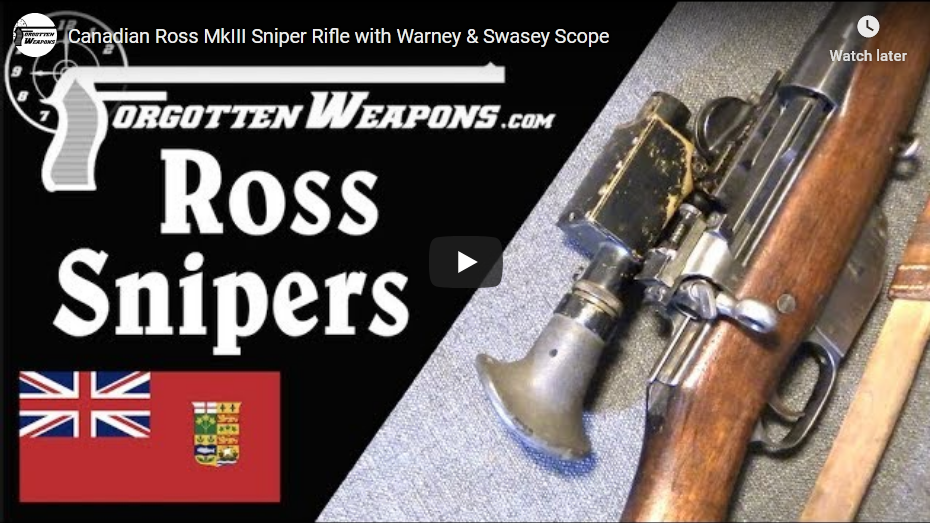
While the MkII (1905) iteration of the Ross rifle had resolved most of the major mechanical problems from the MkI, it retained a number of characteristics that the Canadian (and British) military was not fond of. In particular, it was not suited to the use of stripper clips. Starting with experimentation on sporting rifles, Ross substantially redesigned the action for the final 1910 pattern – aka the MkIII.

The MkIII used a rotating bolt as before, but with six locking lugs in two rows of three, instead of two large lugs as the MkI and II. The magazine was replaced by a conventional single-stack design, with a stripper clip guide built into the receiver, and with a nicely adjustable rear aperture sight. This would be the model to equip the Canadian infantry who went to Europe to fight in 1914 and 1915 – and it is there that a new set of problems would begin to plague the Ross.

In keeping with its sporting legacy and reputation for outstanding accuracy, the MkIII Ross was made with a rather tight chamber, optimized for the excellent-quality Canadian production .303 ammunition. Britain had been forced to massively increase ammunition supply as the war lengthened, and British standards had widened to accept ammunition that was really of rather questionable quality. The SMLE rifles used by British forces had chambers made to accommodate this, but the Rosses did not. Canadian ammunition was supposed to follow the Canadian troops, but it was usually diverted to other services because of its high quality, and the Canadians left with ammo that was difficult to chamber or extract in the Ross.

This led to men having to beat open rifle bolts, which led to damage to locking lugs, in a viscous circle of escalating problems. By the time of the German gas attack at Ypres, Canadians were ditching their Rosses for Lee Enfields by the thousands, despite specific orders to the contrary. General Haig finally had enough of the issues, and ordered the Ross removed from combat in 1916, to be replaced by the SMLE (which was finally available in sufficient numbers to arm the Canadian troops).

Contact:
Forgotten Weapons
6281 N. Oracle #36270
Tucson, AZ 85704

« Newer PostsOlder Posts »

Powered by WordPress