The bureaucrat who commands an army of over forty-nine thousand armed men and women (the largest police force in the world, slightly more than three Army divisions) in its century-old struggle against the Bill of Rights, has loftily decreed on 60 Minutes, the famous CBS newsish show, that it is “insanity” to “allow” national concealed carry reciprocity for law-abiding citizens. This according to an article that appeared this week on the Breitbart website, written by their distinguished Second Amendment specialist, A.W.R. Hawkins.
The bureaucrat in question is New York Police Department Commissioner James O’Neill, an individual who clearly believes that his thirty-five years spent plodding unspectacularly up the NYPD chain of command equips him better to tell you what your rights are, and what they are not, than the Founding Fathers of this country and the Framers of its unique social contract.
Well I’ve got news for you, Jimmy, there is no “allow”.
“Every man, woman, and responsible child has an unalienable individual, civil, Constitutional, and human right to obtain, own, and carry, openly or concealed, any weapon — rifle, shotgun, handgun, machine-gun, anything — any time, any place, without asking anyone’s permission.”* That’s the essential freight of the Second Amendment to the United States Constitution, the highest law of the land, which you and yours have been illegally suppressing since passage of the 1911 Sullivan Act, named for Tammany Hall’s Timothy Sullivan, perhaps the most corrupt, bigoted politician ever to occupy office in New York.
Since the ability to own and carry weapons unmolested by the State is a fundamental right, there can be no thought of any unit of that state “allowing” it or not “allowing” it. Any government employee who attempts to interfere with that right deserves a long stay in prison among those whose rights he’s violated. Note that I am not saying that peace and civil order are a bad thing, just that it has to be achieved within Constitutional parameters. The Founders put them there for a reason; they had seen the rule of law abused too often by arrogant and brutish British authorities.
* “The Atlanta Declaration”, L. Neil Smith, 1987
L Neil Smith, “There Is No ‘Allow’, Jimmy”, Libertarian Enterprise, 2018-02-18.
June 1, 2020
QotD: The right to keep and bear arms
May 30, 2020
Some of Ian’s Gun Collection, on a Matrix Armory Display Wall
Forgotten Weapons
Published 12 Apr 2017Matrix Armory is a new gun display system developed by Jeff High (a long-time Forgotten Weapons supporter, incidentally) who wanted something that would really do justice to guns that you want to display and appreciate. The other sorts of display/racking systems out there are much more industrial in style, primarily to store guns. Matrix Armory was designed to make your guns look their best, because nothing is quite as sad as a great gun collection squashed into a safe and never actually seen (assuming one has a secure room for display, naturally).
I have gotten a lot of people asking to see my own personal collection, and so I figured this would be a cool way to do that; showing you some of the highlights of my collection in conjunction with the Matrix Armory wall we installed in my office. I have no financial stake in the product — I think the years of work Jeff has put into it have led to a really nice product that I think will be of interest to some of the folks who read Forgotten Weapons.

May 27, 2020
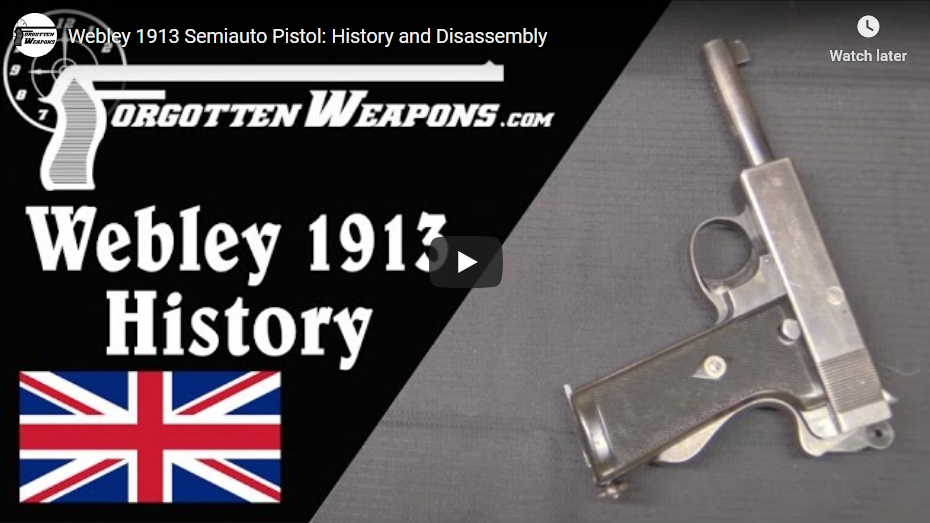
Webley 1913 Semiauto Pistol: History and Disassembly
Forgotten Weapons
Published 25 May 2017William Whiting and the Webley company had high hopes for their self-loading pistols being adopted by the British military — but they never got the success they were hoping for.
After the poor performance of the Webley 1904 (https://www.youtube.com/watch?v=-hT38…) at trials, William Whiting decided to make sure his next attempt would be fully developed before he put it in the hands of the military. He did very well at that too, as the gun which would become the Model 1913 Webley did very well from its very first military tests. The Royal Navy was, in fact, quite enthusiastic about it, although the Army was not. The Navy would ultimately adopt the gun and purchase about 8,000 of them during World War One, while the Army acquired just a couple hundred and preferred to stick to its revolvers.
Thanks to Mike Carrick of Arms Heritage magazine for loaning me these pistols to bring to you!
Cool Forgotten Weapons merchandise! http://shop.bbtv.com/collections/forg...
http://www.patreon.com/ForgottenWeapons
If you enjoy Forgotten Weapons, check out its sister channel, InRangeTV! http://www.youtube.com/InRangeTVShow
May 23, 2020
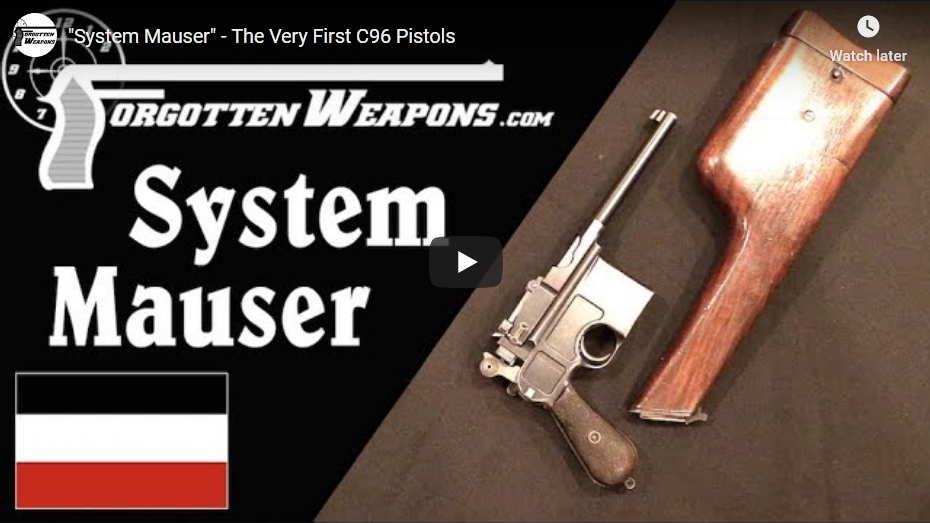
“System Mauser” – The Very First C96 Pistols
Forgotten Weapons
Published 12 Feb 2020http://www.patreon.com/ForgottenWeapons
https://www.floatplane.com/channel/Fo…
Cool Forgotten Weapons merch! http://shop.bbtv.com/collections/forg…
The very first group of C96 pistols made — about 200 in total — are called “System Mauser” pistols. They have this hand-engraved on the top of the barrel, and have a number of other very early features that would quickly change. Most of these changes involve lightening the gun, but they also have a distinctive stepped barrel and a holster/stock that opened to the left; the opposite of all the later standard holsters.
Contact:
Forgotten Weapons
6281 N. Oracle #36270
Tucson, AZ 85740
May 20, 2020
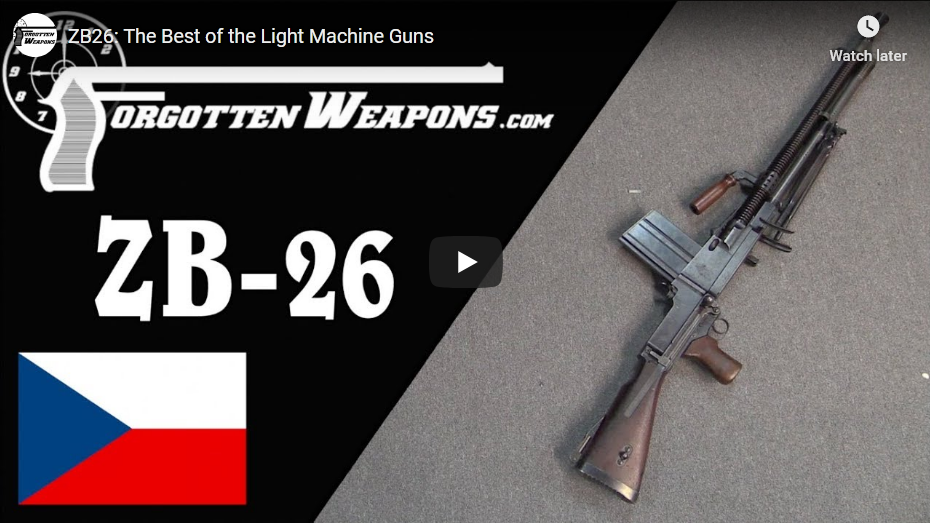
ZB26: The Best of the Light Machine Guns
Forgotten Weapons
Published 26 Oct 2017Sold for $34,500 (transferrable).
The ZB-26 stands as one of the best magazine-fed light machine guns developed during the 1920s and 30s – it was a very popular gun for small military forces and many countries which did not directly buy it were strongly influenced by it. The Japanese Nambu Type 96 and 99 were heavily based on the ZB, and the British Bren was a direct evolution licensed from Brno.
The design dates back to 1921, when the Czech government began searching for a modern light machine gun. They tested pretty much all the guns available on the market at the time, and also solicited guns from Czechoslovak designers. Brothers Vaclav and Emmanuel Holek submitted their I-23 light machine gun, which would become the ZB-26 (LK vizor 26 in Czech terminology) and become the official Czechoslovak light machine gun as well as a popular commercial export for the ZB factory. More than 120,000 were made in several different calibers and sold to 24 countries between 1926 and 1939.
When the Germans occupied Czechoslovakia, they seized a huge number of these guns both from the military and guns still in the factory. This particular one was part of a Spanish purchase contract, but was completed under the oversight of Heinrich Krieghoff and supplied to German forces.
Mechanically, the ZB-26 uses a tilting bolt and a long stroke gas piston, in a combination that would be copied in many later designs. It is robust, accurate, controllable, and handy – a truly excellent all-around light machine gun.
http://www.patreon.com/ForgottenWeapons
Cool Forgotten Weapons merch! http://shop.bbtv.com/collections/forg…
If you enjoy Forgotten Weapons, check out its sister channel, InRangeTV! http://www.youtube.com/InRangeTVShow
May 17, 2020
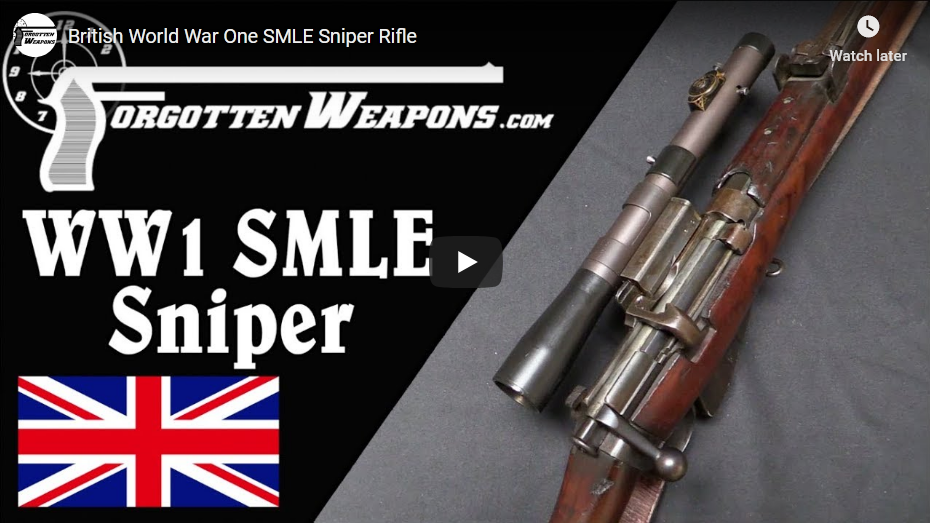
British World War One SMLE Sniper Rifle
Forgotten Weapons
Published 17 Nov 2018https://www.forgottenweapons.com/brit…
http://www.patreon.com/ForgottenWeapons
Cool Forgotten Weapons merch! http://shop.bbtv.com/collections/forg…
The British started World War One without a sniper program, but were quick to develop one once faced with the threat of well-trained German snipers. The initial equipment used by the British was a motley collection of commercial hunting rifles, but by 1915 the government was issuing contract to mount mostly 3x and 4x telescopes on SMLE and Pattern 1914 rifles. About 10,000 scoped sniper rifles were issued in total during the war using a variety of scopes and mount types (a standardized pattern would not be adopted until 1918). The example we have here today is the most common type; an SMLE with an offset Periscopic Prism Company scope using a 5-screw mount assembled by the same company. Later in the war the offset mounts would slowly fall out of favor to the center-mounted scopes, which allowed better shooting at the cost of being able to use stripper clips.
Contact:
Forgotten Weapons
PO Box 87647
Tucson, AZ 85754
May 14, 2020
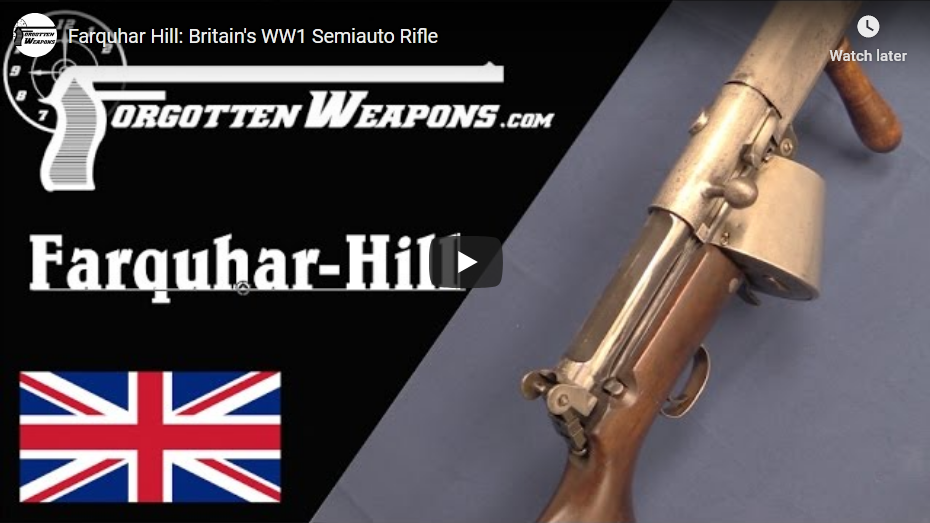
Farquhar Hill: Britain’s WW1 Semiauto Rifle
Forgotten Weapons
Published 20 Feb 2017The Farquhar-Hill was a semiauto rifle developed in Britain prior to World War 1. It was the idea of Birmingham gunsmith Arthur Hill, and financed by Aberdeen industrialist Mowbray Farquhar. The design began as a long-recoil system, but that was replaced with a unique spring-buffered gas operated mechanism before production began.
Basically, a gas port in the barrel taps gas off to a piston, which moved about 3 inches rearward and was then caught and held by a latch. At that point, the other end of the spring would be released to move backward, pushing on the bolt and bolt carrier, unlocking and cycling the action. This gave the rifle a very light felt recoil impulse, and also buffered the bolt from potential over-pressure cartridges.
The Farquhar-Hill was chambered for the .303 British cartridge, and in its military form fed from 19-round drum magazines. A large order for 100,000 rifles was placed by the British military, but cancelled when WW1 ended. A small number of the rifles were sold in the military pattern as well as in box magazine-fed sporting patterns, but Farquhar was more interested in pursuing military contracts, and would continue to work with machine gun designs going into the 1920s.
Thanks to the Institute of Military Technology for giving me access to these two rifles: http://www.instmiltech.com
http://www.patreon.com/ForgottenWeaponsCool Forgotten Weapons merch! http://shop.bbtv.com/collections/forg…
If you enjoy Forgotten Weapons, check out its sister channel, InRangeTV! http://www.youtube.com/InRangeTVShow
May 13, 2020
“Why are you so upset at the gun ban? You don’t even have handguns or assault rifles”
In BC Outdoors Magazine, Steve Hamilton explains why he’s so upset about the Trudeau government’s rush to punish law-abiding gun owners for the actions of criminals:
There are a few reasons – some that should upset non-gun owners, and some that should upset Canadians as a whole. Let us take a walk, shall we?
First, it is directed at the wrong people. Gun owners know that this will not address the real issues. There is a lack of severe punishment for criminals, and an unfortunate mental health crisis. We need to fix those first and foremost – direct the money there. No more revolving door. Lock repeat criminals up and throw away the key and dramatically increase programs and support mechanisms to help those affected with mental illness.
Multiple premiers and police chiefs have said the same thing. This ban will do nothing to lower gun crime. Gun owners know the statistics and that criminals will continue to run rampant. Criminals will not turn in their guns, we know that. This new law means nothing to them.
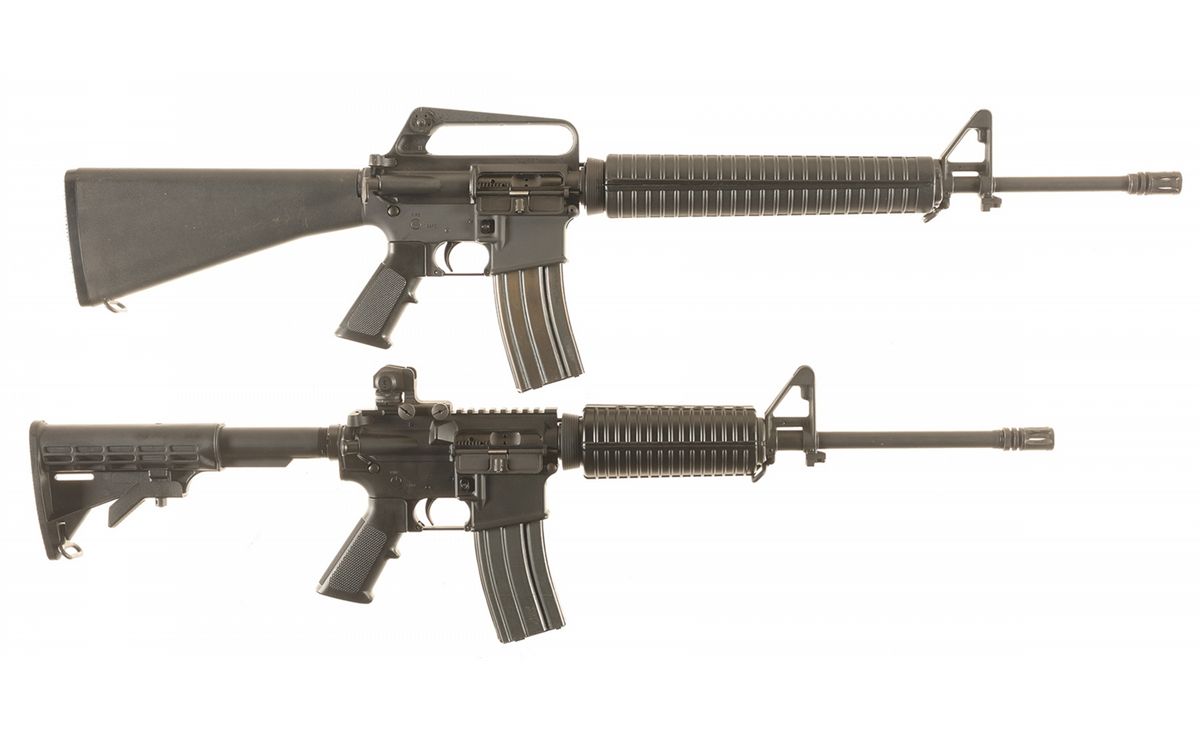
This ban will not take illegal guns off the street, just legal ones out of the hands of lawful owners. The sound bite of, “No one needs an AR-15 to take down a deer,” is truthful. However, the part they left out is that it has been illegal to do so in Canada since 1977 when the AR became restricted class, which means it is only allowed on approved ranges. Strictly to and from, and for nothing except target shooting. It was designed as a deer rifle in the 1960s and has never been used in a military application in its current configuration, as it was found unsuitable.
[…]
“Assault rifle.” That very term makes me cringe. Select-fire and military capable is the definition of assault rifle. To have a rifle approved for sale and imported, it needs to be verified by the RCMP, who confirms that converting it to select fire or automatic is impossible. So, by definition, every single one in Canada is not capable by any means of being turned into the class of firearm they have banned.
Let us toss the firearm argument aside for a second. Every Canadian citizen should be outraged at how this was done. It was pushed through on the heels of a tragedy. The very foundation of our government is supposed to be about democratic debate and input. There was none. Your opposition had zero say against this, and no matter if you are for or against the ban, when your side cannot be heard, that goes against what we should stand for as Canadians. They also used an Order in Council to change the class of a firearm, something that is normally used to change ministerial appointments or expenses. This should not have been done without debate in the House.
Now on to how it is written. That is what is scary about this “assault rifle” situation. There is so much ambiguous wording in this order. Clearly it was rushed through and poorly considered. It is very unclear to the point multiple firearms expert lawyers have said that some shotguns are banned. Minister Blair issued a statement saying that was not the intent; however, the law is written already. A defense in court of, “The minister said on social media that this wasn’t the intent,” will obviously not stand up. Good luck if you try that. Please let us know how that goes.
May 11, 2020
Imperial Gewehr 71
Forgotten Weapons
Published 30 Jan 2016Sold for $575.
The Gewehr 1871 was the first rifle adopted by the newly-formed German state after its unification at the end of the Franco-Prussian War. It replaced the decades-old Dreyse needle rifles, and fired an 11x60mm black powder cartridge. It was the first significant rifle designed by the Mauser brothers, and would evolve into the iconic and ubiquitous Mauser 98 design over the years.

May 10, 2020
Justin Trudeau’s allergy to scary black fully semi-automatic “military style” rifles gets even less coherent
Chris Selley on the federal government’s purely virtue signalling gun ban:
In a recent column, I questioned whether the Liberals’ new “ban” on certain kinds of semiautomatic rifles — “ban” in quotation marks, inasmuch as current owners can keep them — constituted the sort of good public-health policy we’re demanding nowadays in the face of COVID-19. I concluded it did not. Even if you support the idea of banning such weapons, you can’t really support this endeavour except in the way a starving man might welcome his least favourite meal. Indeed, gun control advocates are nearly as annoyed by it as gun rights advocates, and rightly so.
The Liberal “ban” targets certain semiautomatic rifles falling under the undefined term “military-style,” while leaving other semi-automatics alone. It focuses on rifles, which collectively are the least lethal form of previously legal weapons, while leaving handguns — which are used in 65 per cent of firearm homicides — alone. “You don’t need an AR-15 to bring down a deer,” Prime Minister Justin Trudeau says, yet the “ban” exempts current owners of these weapons who use them to hunt for the purposes of sustenance.” Upon its unveiling, it was very nearly perfectly incoherent. And it’s nearer still now.
In recent days the Liberals have touted the “ban” as a way of protecting women and girls in particular. “These guns make it easier to commit mass murder,” Trudeau added. “And the culture around their fetishization makes our country inherently more dangerous for the people most vulnerable. And that is women and girls.” Trudeau cited reports about increasing domestic violence during the pandemic, and grim statistics about the number of Canadians killed by their spouses.
There is very little evidence to support this case for the “ban.” And when you go looking for it, you wind up only with more questions.
To be fair, there is very little evidence to support any position on gun control. Nobody comprehensively keeps track of how many Canadians are killed using currently restricted weapons, or by the weapons the Liberals are “banning,” or even by rifles as opposed to shotguns — so we certainly don’t know how many men and women are killed by these various kinds of firearms.
May 8, 2020
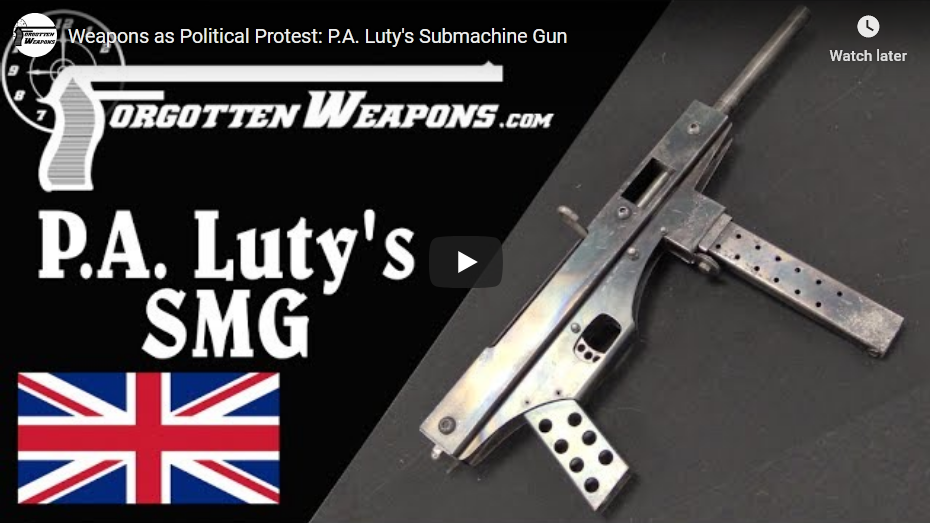
Weapons as Political Protest: P.A. Luty’s Submachine Gun
Forgotten Weapons
Published 2 Aug 2017Armament Research Services (ARES) is a specialist technical intelligence consultancy, offering expertise and analysis to a range of government and non-government entities in the arms and munitions field. For detailed photos of the guns in this video, don’t miss the ARES companion blog post:
http://armamentresearch.com/pa-luty-9…
Phillip A. Luty was a Briton who took a hard philosophical line against gun control legislation in the UK in the 1990s. In response to more restrictive gun control laws, he set out to prove that all such laws were ultimately futile by showing that one could manufacture a functional firearm from hardware store goods, without using any purpose-made firearms parts.
Luty succeeded in this task, designing a 9mm submachine gun made completely from scratch with a minimum of tools. In 1998, he published the plans for his gun as the book Expedient Homemade Firearms. Luty was not particularly discreet about his activities (actually, he was quite outspoken…) and was eventually caught by the police while out to test fire one of his guns, and arrested. He was convicted, and spent several years in prison. He continued to pursue a gun rights agenda after being released, and was facing legal trouble again when he passed away from cancer in 2011.
Several of Luty’s submachine guns are still held in the collection of the Royal Armouries’ National Firearms Centre, including the one that led to his original conviction. Many thanks to the NFC for allowing me to bring that weapon to you!
http://www.patreon.com/ForgottenWeapons
Cool Forgotten Weapons merch! http://shop.bbtv.com/collections/forg…
If you enjoy Forgotten Weapons, check out its sister channel, InRangeTV! http://www.youtube.com/InRangeTVShow
May 5, 2020
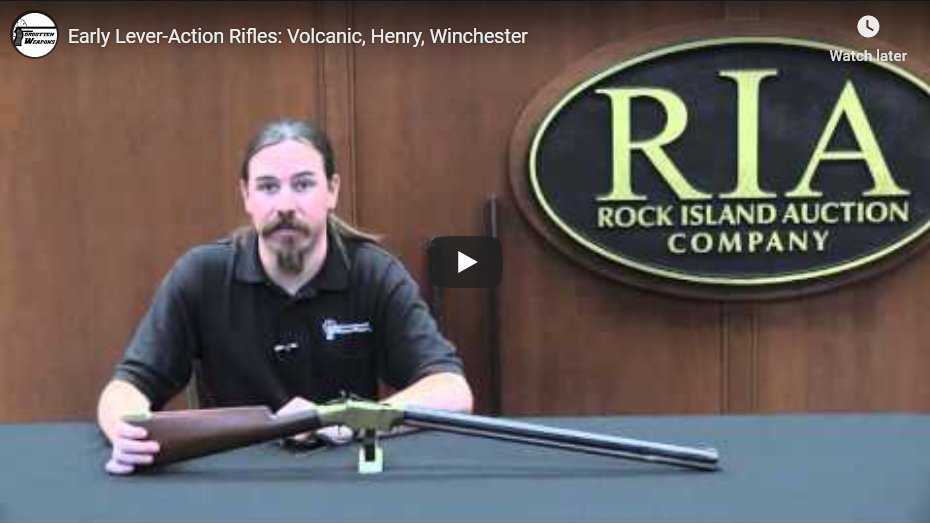
Early Lever-Action Rifles: Volcanic, Henry, Winchester
Forgotten Weapons
Published 6 Feb 2016Hammer prices:
Volcanic – $19,550
1860 Henry – $15,960
1866 Winchester – $8,625We’ve all seen lever action rifles galore in movies about the old west, and most of us have handled and shot a bunch of them as well. But do you know where they came from?
Today we will take a look at the first American lever-action rifle put into successful (more or less) production, the Volcanic. We will then continue to examine the 1860 Henry and the 1866 Winchester to get a foundational understanding of the development of these guns, and the interesting group of people involved with them.
May 4, 2020
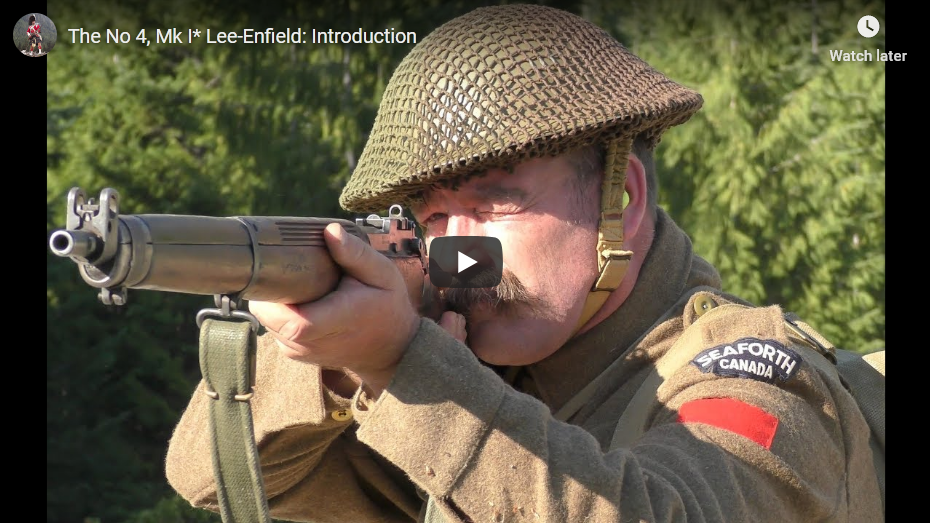
The No 4, Mk I* Lee-Enfield: Introduction
britishmuzzleloaders
Published 21 Aug 2018If you would like to support the Channel you can do so through our Patreon Page.
https://www.patreon.com/britishmuzzle…Errata –
The labelling of the “wrongly stamped” Mk III sight should be better described as “confusingly stamped” … the designation refers to the leaf …It should be clarified that the rifle has at some point spent time in India with resultant modifications and maintenance…
Also, as of the 1937 Manual, the safety catch should be applied with the forefinger of the right hand.
For your Martini and Snider needs email Martyn at xringservices@yahoo.com
And for further reading on all British Victorian (and earlier) arms stop by the British Militaria Forum and say hello. http://britishmilitariaforums.yuku.com
April 30, 2020
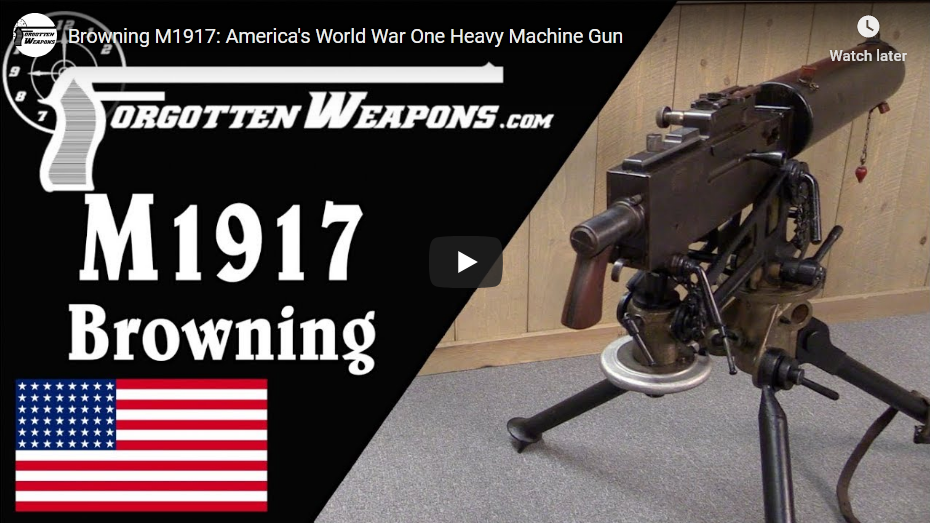
Browning M1917: America’s World War One Heavy Machine Gun
Forgotten Weapons
Published 14 Mar 2018When the United States entered World War One, its military has a relatively tiny handful of machine guns, and they were divided between four different types, as the military budget was small and machine guns were not given much priority. However, since the failure of his gas-operated 1895 machine gun design to become a popular military item, John Browning had been working on a recoil-operated machine gun to replace it. This work became serious in 1910, and by 1915 Browning had met with Colt and agreed to give them exclusive license to his new design — and they began to work with him to refine and perfect it.
When the United States realized that it would be fighting in Europe and would need machine guns in 1917, it held an open trial for designs which Colt and Browning entered. The Browning gun was the undisputed star of the show, firing 40,000 rounds with only one parts breakage and no malfunctions that were not the fault of ammunition or belts. The gun was almost immediately adopted and pushed into production. Ultimately, Colt would allow the manufacture of its guns by Remington and New England Westinghouse, and Browning himself would accept a lump-sum royalty payment from the government for its use, which was about 3.5 million dollars less than he was contractually entitled to — out of patriotism and a desire not to profit too much from the war.
Browning 1917 machine guns would see only brief combat use in World War One, first tasting action in September of 1918. They would remain a staple of US military armament through World War Two, however, improved after the Armistice to the M1917A1 pattern. The gun we are looking at today is an original WW1 M1917, mounted on an equally rare M1917 original tripod.
http://www.patreon.com/ForgottenWeapons
Cool Forgotten Weapons merch! http://shop.bbtv.com/collections/forg…
If you enjoy Forgotten Weapons, check out its sister channel, InRangeTV! http://www.youtube.com/InRangeTVShow
April 24, 2020
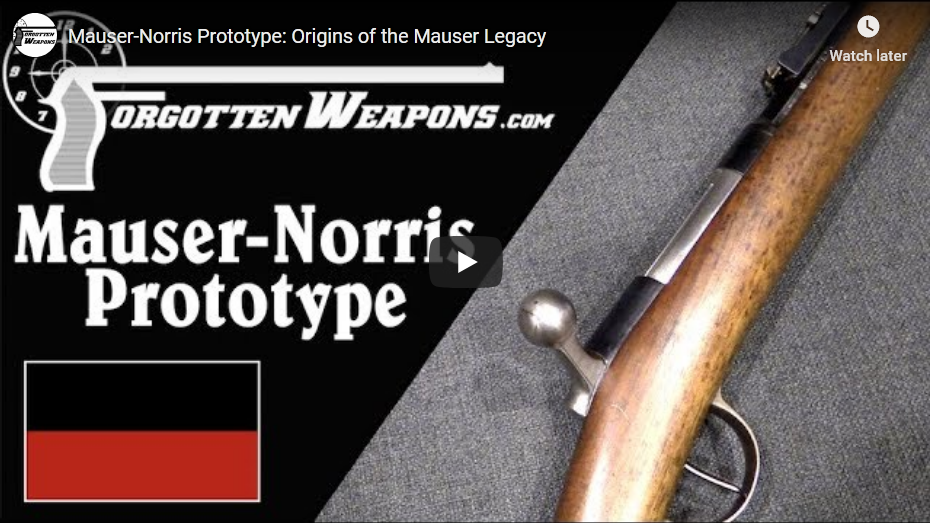
Mauser-Norris Prototype: Origins of the Mauser Legacy
Forgotten Weapons
Published 10 Jan 2020http://www.patreon.com/ForgottenWeapons
https://www.floatplane.com/channel/Fo…
Cool Forgotten Weapons merch! http://shop.bbtv.com/collections/forg…
Today we are looking at one of the rarest and earliest rifles built by Paul and Wilhelm Mauser, a design which would set in motion all the events that led to the Mauser company becoming one of the great world leaders in small arms. The Mauser brothers were born in Oberndorf am Necker in the Kingdom of Württemberg, sons of a gunsmith. They would take up their father’s trade and were creative and intelligent boys, but opportunities were limited in the small, rural town of Oberndorf. In 1865 they presented a rifle to the Austrian Army in Vienna for trials, where it was rejected. However, it was noticed by an American sales rep for the Remington Company, a man named Samuel Norris. Norris saw the potential in the Mauser brothers’ design to convert needlefire rifles to metallic cartridges, and he signed a deal with the brothers to further develop the system.
The Mausers moved to Liege Belgium to do their work, and within just a few years they were making rifles for Norris. This example is based on a Chassepot, as Norris hoped to sell the conversion system to the French Army. That deal was rejected, however (the French were happy sticking with paper cartridges as of 1868), and Norris’ plans began to unravel when the Remington company discovered that he was making dealings in his own name instead of for them. The Mauser brothers ended up walking away from the deal with ownership of the patents they had filed with Norris, and when they submitted the design to the Prussians a process began which would result in the Mauser Model 1871 being adopted. From there, their talents would lead to the whole line of Mauser repeating rifles culminating in the Model 1898, arguably the pinnacle of the bolt action military rifle.
Thanks to the Liege Arms Museum for access to film this for you! If you are in Belgium, definitely plan to stop into the museum, part of the Grand Curtius. They have a very good selection of interesting and unusual arms on display. Further thanks to the Paul Mauser Archive for helping to arrange this filming!
http://www.paul-mauser-archive.com
Contact:
Forgotten Weapons
6281 N. Oracle #36270
Tucson, AZ 85740