Quotulatiousness

February 28, 2020

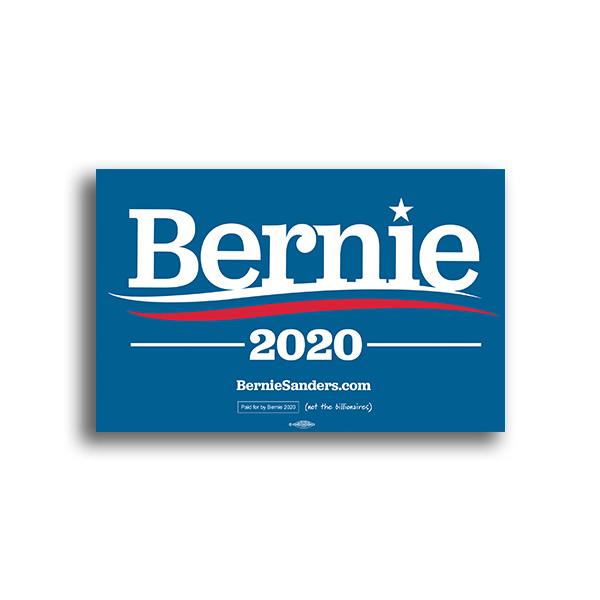
Is the world ready for Trump versus Bernie?

Filed under: Politics, USA — Tags: , , , , — Nicholas @ 05:00

At Rotten Chestnuts, Severian considers the strong possibility that Bernie Sanders will capture the Democratic presidential nomination and face Donald Trump in the general election:

Before we get into it, can we all just pause for a second to savor the delicious irony of the Democrats suddenly discovering, after all these many many many years, that Socialism is bad? I almost feel sorry for poor ol’ Bernie. For going on four decades now, the Dems have treated him like the little kid at the grown-ups’ table. Who hasn’t been there on Thanksgiving? “Mommy, Uncle Henry’s breath smells really bad.” We’re all thinking it, kiddo, but you can’t say it. They’ve been silently agreeing with him about the need to turn America into the USSA all these years, and now they’re gonna take him behind the woodshed for it? Really?

This is point #1 in the argument, increasingly common out here in the political badlands, that Bernie Sanders is Bizarro World Donald Trump. Back in 2016, the weirdest thing for those of us not wedded to Team Republican — for that vanishingly rare breed, that is, who regard politics as politics, not sportsball in neckties — was how normal Trump sounded. This guy is supposed to be the ultimate anti-Establishment candidate, right? So why is he saying stuff that has been GOP orthodoxy since the 1970s? And why are they hammering him for it?

[…]

This is where he’s most dangerous. Like Trump was in 2016, Bernie 2020 can be seen as a pure protest candidate, a giant “fuck you” to The System. Hell, in my increasingly frequent black-pill moments, I contemplate voting for the guy — we’re not voting our way out of what’s coming, as Z Man always says, so we might as well get started. A few years of life under the Septuagenarian Stalin will give us some valuable prep for when things get really interesting under La Presidenta por Vida Alexandria Ocasio-Cortez.

Moreover, there can be great power in being the only guy in the room who’s willing to state the obvious. In this case, it has been obvious for a long time that the Democratic Party are a bunch of godless commies. Literally commies, or at least Bolshie-curious. Obvious, but always verboten to say … until now. Sanders has a rabid base that, even if you assume the “official” numbers are all lies, can’t be much less than 20% of the entire Party. Those hardcore Bernie Bros can’t possibly have any illusions about who he is and what he wants. That’s what they want, too, and again: twenty percent. The Media paints anyone to the Right of Rachel Maddow as a “white supremacist,” but can you imagine how different American politics would be if 20% of the GOP were open, avowed Klansmen?

Those are the “positives,” for lack of a better term, of Bernie being the Democratic nominee. If this is what The People really, really want — and it’s crystal clear that a lot of them do — then we should at least have a good, long, hard “national conversation” about giving it to them. Cuba, as Bernie keeps informing us, does after all have 100% literacy and free health care, and the Chinese are great at lifting people out of poverty. Let’s talk about that, live on national television, and see where it takes us.

February 7, 2020

Modern day Kremlinology and show trials

Filed under: Government, History, Politics, Russia, USA — Tags: , , , , , — Nicholas @ 03:00

At Rotten Chestnuts, Severian explains why the Soviet Union’s Moscow Trials were so important well outside the borders of the USSR:

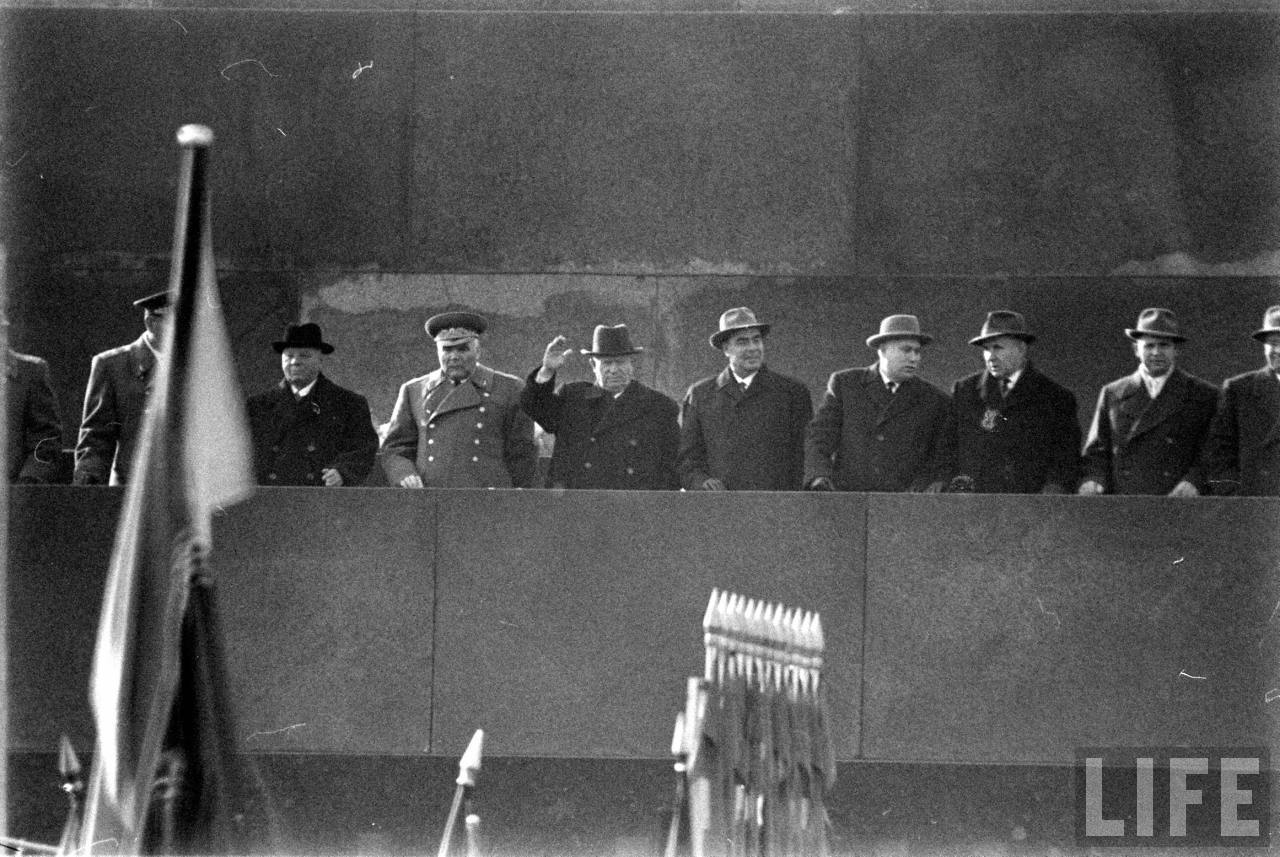
Krushchev, Brezhnev and other Soviet leaders review the Revolution parade in Red Square, 1962.
LIFE magazine photo by Stan Wayman.

It’s not much of an exaggeration to say that the Moscow Trials set the course of 20th century history. If you want to be a dictator in peacetime, this is pretty much how you have to do it — see e.g. every other Communist regime ever. The downside, though, is that you cost yourself a lot of irreplaceable technical expertise. I’m not saying Hitler would’ve called Barbarossa off if Stalin hadn’t purged all his generals — Hitler was, of course, crazy — but he surely would’ve thought twice about it, the plan relying as it did on the utter incompetence of the now-leaderless Red Army.

The show trials also gave birth to “Kremlinology”, the art and science of reading Soviet tea leaves to find out who’s really in charge. Stalin didn’t invent “elimination by promotion”, but he was a master of it. In Stalin’s USSR, being “promoted” to some big, important-sounding position was an all-but-guarantee that you’re going to get shot. Seemingly minor functionaries, on the other hand, really ran things in the countryside. E.g. Khrushchev, a Red Army commissar — not an unimportant position by any means, but hardly a glory post either. Stalin’s generals knew who he was, but few outside the Red Army’s high command did. And since Stalin liked to signal major policy shifts with articles in obscure publications — he once wrote an article on lingustics that previewed some huge change — you had to be very wired in to figure out who was really a comer.

Let’s imagine, then, that somehow the Moscow Show Trials failed. That Zinoviev, say, was acquitted, because (take your pick) he’d obviously been tortured, the charges were ludicrous, there was zero hard evidence against him, or any combination of the above. Stalin staked his entire position on the outcome of the Trials. What if he’d lost? How long do you think the Boss would’ve remained Boss? A few weeks? A few days? Hours, maybe?

Nancy Pelosi is no Stalin, of course, but whoever survives November’s electoral bloodbath had better start working on Secret Speech 2.0 the very second the last vote is counted. I was doubtful about the 2020 presidential election until they actually decided to show-trial Donald Trump. Since there’s no way in hell they’re going to get a 2/3 majority to vote to convict, the whole thing looks like not just a witch hunt, but a botched witch hunt. No one, not even Koba the Dread, is politically strong enough to survive one of those.

February 4, 2020

Andrew Sullivan – “Our fate was almost certainly cast as long ago as 1964 and 1965”

Filed under: Books, History, Politics, USA — Tags: , , , , , , — Nicholas @ 05:00

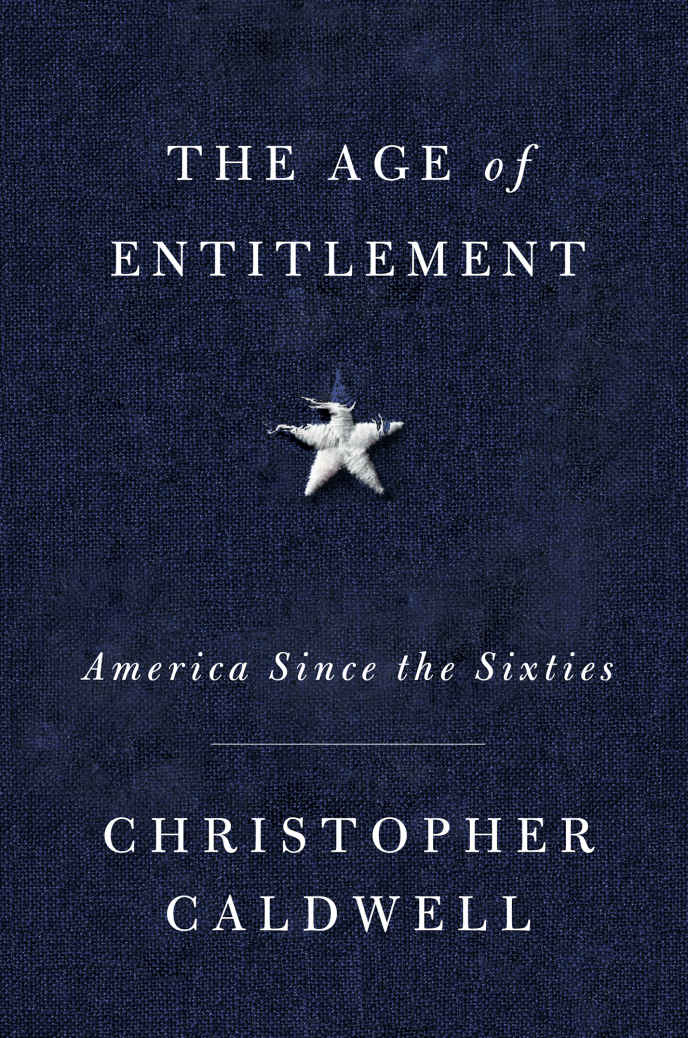
In his most recent New York magazine column, Andrew Sullivan reviews two new books on the same issues from different perspectives: Ezra Klein’s Why We’re Polarized and Christopher Caldwell’s The Age of Entitlement.

… both books agree on one central thing: Our fate was almost certainly cast as long ago as 1964 and 1965. Those years, in the wake of the Kennedy assassination, saw the Civil Rights Act upend the Constitution of a uniquely liberal country in order to tackle the legacy of slavery and racism, and the Immigration and Nationality Act set in motion the creation of a far more racially and ethnically diverse and integrated society than anyone in human history had previously thought possible. Still, at the time, few believed that either shift would have huge, deep consequences in the long term. They were merely a modernization of American ideals: inclusivity, expansiveness, hope.

As someone who was born just before these two changes were instigated, I regarded those tectonic shifts as simply part of the landscape — something that seemed always to have been here. And what could be questioned about either? One was reversing a profound moral evil; the other was banishing racism from the immigration laws. No-brainers. The strongest resistance to civil rights came from former segregationists or obvious racists, and there was little resistance to the Immigration Act, because most in the congressional debate seemed to think it wouldn’t change anything much at all. (The House sponsor of the Immigration Act, as Caldwell notes, promised that “quota immigration under the bill is likely to be more than 80 percent European,” while Ted Kennedy insisted: “The ethnic mix of this country will not be upset.”) There were a few dissenters to the 1964 Act, such as Robert Bork, who identified a significant erosion in the freedom of association. And there were southern senators who worried about immigrants from the developing world. But the resisters were easily dismissed on both counts, in the wake of LBJ’s 1964 landslide.

In fact, as Klein shows, a pivotal moment had arrived. The civil-rights movement quickly broke apart the old Democratic party, which had for decades combined the interests of blacks and southern whites into a single multiracial coalition. The result was a sorting of the two political parties into much purer vessels for their diverging ideologies, and into groupings that were also increasingly racially distinct. The GOP became whiter and whiter; the Democrats more and more became the party of the marginalized nonwhites as the years rolled by. Blacks and southern whites ceased to communicate directly within a single party, where compromises could be hammered out through internal wrangling. In the aggregate this was, as Klein emphasizes, a good thing — because blacks kept coming out the losers in those intraparty conversations, and with civil rights, they had a chance of winning in a clearer, less rigged, debate.

But it was also problematic because human beings are tribal, psychologically primed to recognize in-group and out-group before the frontal cortex gets a look-in. And so the whiter the GOP became, the whiter it got, and the more diverse the Democrats got. Simultaneously, the economy took a brutal toll on the very whites who were alienated by the culture’s shift toward racial equality, and then racial equity. Klein recognizes that this racial polarization, is, objectively, a problem for liberal democracy: “Our brains reflect deep evolutionary time, while our lives, for better and worse, are lived right now, in this moment.” So he can see the depth of the problem of tribalism — and its merging with partisanship, which goes on to create a megatribalism.

If humans simply cannot help their tribal instincts, then a truly multicultural democracy has a big challenge ahead of it. The emotions triggered are so primal, that conflict, rather than any form of common ground, can spiral into a grinding cold civil war. And you can’t legislate or educate this away. One fascinating study Klein quotes found that “priming white college students to think about the concept of white privilege led them to express more racial resentment in subsequent surveys.” Anti-racist indoctrination actually feeds racism. So tribalism deepens.

Klein sees this spiral more clearly than most on the left. He acknowledges the truth that in a period of extraordinary demographic and racial change — the U.S. is the first majority-white nation that will become majority nonwhite in human history — every group begins to feel like an oppressed minority. Including whites: “To the extent that it’s true that a loss of privilege feels like oppression, that feeling needs to be taken seriously, both because it’s real, and because, left to fester, it can be weaponized by demagogues and reactionaries.” And the truth is: It was left to fester. Whenever whites resisted ever-expanding concepts of civil rights or mass illegal and legal immigration, they were cast outside the arena of permissible disagreement, deemed racists, and stigmatized. Even the GOP scorned them. Eventually, Hillary Clinton named them: the deplorables. By 2016, plenty of Americans decided to embrace the label, and voted for Trump.

February 3, 2020

Yet another attempted settlement of the Arab-Israeli conflict that will go nowhere

Filed under: History, Middle East, Politics, Religion, USA — Tags: , , , , , — Nicholas @ 03:00

Ted Campbell on the recent peace plan proposed by US president Donald Trump:

On the subject of the Trump Mideast Peace Plan, I agree with both The Economist which says, “as a blueprint for a two-state solution it was dead on arrival,” and with the Globe and Mail‘s Mark MacKinnon who writes that “President Donald Trump’s Middle East peace plan … aims to resolve the Israeli-Palestinian conflict almost completely on Israel’s terms [and, while] Mr. Trump’s allegiances came as no surprise [to the Palestinian leaders, but] some of [their] bitterness was reserved for the leaders of Arab states that Palestinians see as quietly going along with the designs of the U.S. President and Israeli Prime Minister Benjamin Netanyahu.”

I think that is because President Trump, and much of the world, has lost patience with the Palestinians who still demand a right of return that, if ever seriously considered by anyone, would destroy Israel. Only Iran really wants that.

The strategic situation in the region, indeed in the entire Islamic Crescent which stretches from Mauritania and Morocco on the Atlantic coast of West Africa to Indonesia in East Asia, has changed in the past 70 years. There is no longer a unified Muslim “world” that opposes the very existence of a Jewish state in the Middle East. Indeed, a few Arab and Islamic states have correct, even friendly relations with Israel and others trade with the Jewish state (without having diplomatic relations) to their mutual advantage. The current problems in the region are centred on a power struggle between the Shia Islamic community, centred in Iran and the larger but socially and politically fragmented Sunni Islamic community …

… the differences are more than just religious. Iran, backed by China and Russia, and Saudi Arabia, backed by the USA, are engaged in something close to a real shooting war while Egypt and Turkey egg them both on. All four have some claim to dominance in the region and none is a real “friend” to any of the others and none gives a damn about Palestine or the Palestinian people.

[…]

President Trump has done a big political favour for Benjamin Netanyahu … but, ultimately it is probably pointless, and he and his successor and her (or his) successor, too, will likely still be seized with this issue in 2025 and 2030 and beyond.

Eventually, a solution will be found … it will, I suspect, involve Israel ceding a bit of territory to a new Palestinians state and, perhaps, establishing some sort of controlled, limited access corridor from the West Bank, possibly across the Northern Negev Desert. More importantly, it will involve Israel and Jordan, working in tandem, helping the new state to grow and prosper and live in peace with its neighbours. It’s a dream, of course, but it’s better, better for everyone, than is another war.

January 24, 2020

From a Canadian perspective, “NORAD … is more important than NATO”

Filed under: Americas, Cancon, History, Military, Space, USA — Tags: , , , , , , — Nicholas @ 05:00

The American government has once again expressed a strong desire to update the 1957 North American Air Defence Commmand arrangement between the US and Canada for defence of the North American continent. It’s a Cold War relic to some (particularly some in the Prime Minister’s Office and cabinet), but it has a very real value to Canada, as Ted Campbell explains:

In 1957 Canada and the USA agreed to create the North American Air Defense Command. It is a “combined” command, American and Canadian people, civilian and military, work together, in combined headquarters, to conduct an active aerospace defence effort over the continent we share. Americans and Canadians work side-by-side managing the airspace, detecting intruders and identifying and intercepting them and so on.

NORAD, I would argue, is more important than NATO.

First, it is about defending our own homeland.

Second, it is about defending the US strategic deterrent, which has, arguably, done more to keep global peace than all the efforts of the United Nations, combined.

NORAD modernization and expansion should be at the top of Canada’s defence policy agenda. Specifically:

  • First, billions of dollars, likely tens of billions of dollars are going to be needed to upgrade the surveillance and warning system. We need new radars, terrestrial and space-based, and upgraded control systems to do the job properly;
  • Second, Canada needs to buy enough (85+ is just the very barest of bare minimums) of the right new fighter jet; and
  • Third, Canada needs to join the American ballistic missile defence system.

I believe that this issue: the shared defence of our, shared, continent and, therefore, the defence of the American heartland and of America’s strategic deterrent is a key, perhaps even the key element in our most important foreign relationship. […] The knowledge that Canada is doing a full and fair share of defending our shared continent, of defending America, is not lost on admirals and generals, diplomats and senior civil servants, representatives and senators in the US Congress, pundits and political leaders in waiting in the think-tanks and senior staff in the White House, even if Donald J Trump is not impressed … IF we are doing a full and fair share.

Right now, we are not.

An orbital analyst tracks the Kosmos 1402 spy satellite in orbit in the Space Defense Operations Computation Center, North American Aerospace Defense Command (NORAD) on 18 February, 1983.
NORAD photo by Master Sergeant Hiyashi via Wikimedia Commons.

January 9, 2020

The “Ostrich” school of Canadian foreign policy

Filed under: Cancon, Government, Politics — Tags: , , , , — Nicholas @ 03:00

Ted Campbell on what former Canadian diplomat David Mulroney calls the “Ostrich” school:

John Ibitson, writing in the Globe and Mail, suggests that Justin Trudeau might want to try what former diplomat, national strategic planner in the Privy Council Office, and commentator David Mulroney refers to (on social media) as …

… “the ‘Ostrich’ school of Canadian foreign policy.” It has, he says, two pillars:

    First, “Canada has no interests/allies“; and

    Second, “The best way to deal with bad regimes, bad people is to pretend they’re nice.”

Mr Ibbitson himself says that it may be impossible to work “with European and Asian allies, including Japan, to forge a coherent response that provokes neither the Americans nor the Iranians.”

The situation in the Middle East is, as I have explained several times, hideously complex. President Trump may have made it worse … although it’s hard for me to see how any added complications really matter all that much. The socio-cultural and religious hatreds that bedevil the region are likely beyond making “worse.”

In fact, there may be an argument that a nice, all-out, albeit contained, Middle East war might be useful. Perhaps the Iranians and Saudis and Iraqis and Syrians and Yemenis and so on need to sort one another out in the way that tends to produce lasting results: on a bloody battlefield … it worked for Europe, more than once, in 1648, in 1815 and again in 1945.

John Ibbitson says that “Iran’s rage over the U.S. assassination of Qassem Soleimani risks dragging Canada and the rest of the Western alliance into a new confrontation in the Middle East, courtesy of Donald Trump … [that true, as far as it goes, and he adds] … Most Canadians would want no part of such a conflict, especially since the U.S. President might simply be seeking to distract attention from his impending impeachment trial in the Senate … [and that, the first part about Canadians wanting no part of any conflict, is also true, but President Trump’s motives are irrelvant]. The fact is that he has ignored many Iranian provocations while he attempts, vainly, in my opinion, to disengage America from the wider world. The attack on a US embassy seems to have crossed a “red line.”

[…]

But, John Ibbitson says, “Mr. Trump’s high stakes gamble – that killing one of the most senior figures in the Iranian regime will deter rather than provoke further acts of aggression from Iran – could lead to some kind of asymmetrical war, with the U.S. military attacking Iranian targets, and Iran responding through militias and proxies in Iraq and possibly in North America and Europe … [true enough, and he asks] … What would Mr. Trump expect from Canada in such a conflict?” That’s the key question.

My guesstimate is that President Trump will ask little or nothing, militarily, because his military chiefs of staff will not even have mentioned Canada when they proffer lists of nations that might help or hinder US efforts. Canada is not on any of their lists of countries that matter. Diplomatically, however, I think we do matter to the USA and I would not be surprised if the phone lines have been busy all weekend as US officials tell (rather than ask) Canadian officials to get our government “onside” with the USA. The Americans hold ALL the high cards in the game of power.

I’m sure that Prime Minister Trudeau will follow John Ibbitson’s advice and adopt the “Ostrich” strategy … head buried in the sand, pretending that Canada has neither interests nor allies and pretending that evil people are good.

Perhaps co-incidentally with the “revenge” Iranian missile attacks on Iraqi airbases known to have US troops in the area, a Ukraine International Airlines Boeing 737-800 passenger jet crashed shortly after take-off from Tehran airport. Officially, the Iranian authorities are saying it was due to catastrophic mechanical breakdown, but they have refused to hand over the aircraft’s “black box” flight recorders for analysis. All of the 176 passengers and crew died in the crash, including 63 Canadians. It has been suggested by many that the timing was not a co-incidence and that the plane was likely hit by an Iranian surface-to-air missile due to the heightened state of tension in Iranian airspace during and after the missile launches against Iraq. Colby Cosh has more:

Some of the wreckage of Ukraine International flight 752 near Tehran, Iran.
Photo from MOJ Newsagency via Wikimedia Commons.

I am writing these words at a strange moment Wednesday morning. The president of the United States has just been on television, reassuring the American public that the crisis inspired by the assassination of Iranian general Qassem Soleimani has reached a satisfactory equilibrium. Iran made a demonstrative show of force against U.S. installations in the Middle East that killed nobody. Honour has been satisfied. Relief, among American observers, is general.

Meanwhile, Canada is mourning the deaths of dozens of its citizens in a passenger jet crash on Iranian soil. Perhaps it is a terrible coincidence. Stranger things have happened. But if you are old enough to remember the shooting down of Iran Air Flight 655 by the U.S. Navy missile cruiser USS Vincennes in 1988, you are old enough to doubt it.

The Vincennes incident is part of the historical litany that has made news consumers innately distrustful of the first draft of history. The ship was in the Persian Gulf, which at the time was swarming with Iranian gunboats trying to squeeze off the supply of arms to its enemy Iraq. The U.S. Navy had rushed to the area to keep one of the world’s economic arteries open to neutrals. But this had foreseeable consequences — plenty of confusing penny-ante firefights, and some notable accidents, including a puzzling Iraqi attack with air-launched Exocet missiles on an American frigate, USS Stark.

January 8, 2020

Trump versus Iran (and significant parts of the US and western media)

Filed under: Middle East, Military, USA — Tags: , , , , — Nicholas @ 03:00

Kurt Schlicter‘s take on the way President Trump has been breaking recent US habits in their dealings with Iran:

A burning vehicle at Baghdad International Airport following an American airstrike, early Friday, Jan. 3, 2020. The Pentagon said Thursday that the U.S. military has killed Gen. Qassem Soleimani, the head of Iran’s elite Quds Force, at the direction of President Donald Trump.
Photo from the Iraqi Prime Minister’s Press Office via Wikimedia Commons.

The Iranians had been getting uppity for a while, but then their punks killed an American contractor in a rocket attack on a U.S. base – and let’s not get distracted about whether we should still be there. They killed an American. We are there, and you don’t get a pass on murdering U.S. citizens because we may or may not have a good reason for them still being there. You get dead.

See, for too long we were asking the wrong question when tinpot dictators dared hurt Americans. We asked, “What would a gender-fluid Oppression Studies major at Yale do?” As I have observed before, the correct question is “WWJC do?” – “What would Julius Caesar do?

Trump ordered hard hits at five Shiite militia weapon sites, and not with any warnings either. They got one of ours, we got about two dozen of theirs. Like the old joke about 1,000 lawyers at the bottom of the sea, that’s a good start.

The Iranians, whose Islamic Revolutionary Guard Corps is the ultimate source of most of the Shiite terror in the world, decided to respond in what they thought was a clever way: send a few thousand of their camo-clad dummies to attack the embassy and hope and pray a bunch of them got mowed down on camera. In the meantime, wave a lot of banners, burn some stuff, and pound on the reinforced glass for the press’s benefit.

But apparently, no one told the “mourners,” as the austere scholars at the endlessly useless New York Times dubbed the members of Islamic Antifa, that they were supposed to get smoked. They went home with the embassy unseized. Getting martyred en masse is not that much fun when you’re just one sucker out of dozens – heck, they may run of virgins.

See, Trump made it clear he was not playing. There would be no Benghazi II: Bagdad Boogaloo on his watch, and he acted well before 13 hours ran on the clock. Rejecting the elite’s preferred model of craven submission to every Third World cretin with a grievance and a camera, the Trump administration flew some Apache gunships over the crowd of unwashed morons, kicking off some flares, and generally sending the unequivocal message that if those SOBs had a problem, the AH-64s had a 30mm solution.

And then the administration sent in 100 Marines, about a company, on Ospreys as a quick reaction force and alerted the ready brigade at Ft. Bragg to start shutting 82nd Airborne Division paratroopers into theater.

Whatever the opposite of “stand down” is, Trump ordered that.

January 1, 2020

Communist jokes through the ages

Filed under: History, Humour, Politics, Russia — Tags: , , , — Nicholas @ 03:00

At Catallaxy Files, Steve Kates recently read Hammer and Tickle: A History of Communism Told Through Communist Jokes by Ben Lewis:

It looks at the jokes themselves; the evolution of these jokes as communism aged and new leaders took over; it looks at the different kinds of jokes told in different communist countries; it examines the fate of those who told such jokes and the difference in the fate of those who made such jokes depending on who was the leader of the Party; it asks whether such jokes helped the communists consolidate power or whether they helped bring communism down; it looks into the difference between telling anti-Nazi jokes in Nazi Germany versus telling anti-communist jokes in communist countries; it asks about the psychology of those who told such jokes and whether they helped relieve tensions; and much else. But I will say this, some of I found really funny. This is my favourite.

    Khrushchev is walking through the Kremlin, getting worked up about the Soviet Union’s problems, and spits on the carpet in a gesture of disgust.

    “Behave yourself, Nikita Sergeyevich,” admonishes the aide. “Remember that the great Lenin walked through these halls!”

    “Shut up,” responds Khrushchev. “I can spit all I like here; the Queen of England gave me permission!”

    “The Queen of England?”

    “Yes! I spat on her carpet in Buckingham Palace too, and she said, ‘Mr Khrushchev, you can do that all you like in the Kremlin if you wish, but you can’t behave like this here …'”

Easy to see this one added to the Donald Trump canon and now that I have pointed it out, I expect it to be.

I therefore thought I might have a look at what passes for Donald Trump jokes. And google all you like, there really is not much although there was this: Donald Trump Jokes. None were funny but I did like this:

    Where’s Donald Trump’s favorite place to shop?

    Wall-mart!

Mere pun though it is, it seems appropriate. At least it’s policy-related and almost entirely a joke that could only be told about Trump. The rest are re-treads, never specifically about anything related to Trump himself and his policies, but are almost entirely forms of insult than anything with any associated wit or insight. The most interesting part to me about the communist jokes was that the ones that became acceptable were those directed at the failures of communism relative to the promises that had originally been made. Lots like that. The way to end up in the gulag was to tell jokes about actual party leaders, especially Lenin and Stalin. Very few like that.

I rather liked the one from the Amazon page for the Kindle edition: “Q: Why, despite all the shortages, was the toilet paper in East Germany always 2-ply? A: Because they had to send a copy of everything they did to Moscow.”

December 26, 2019

“Make Gas Cans Great Again”

Filed under: Bureaucracy, Environment, Government, USA — Tags: , , — Nicholas @ 03:00

At Ace of Spades H.Q., Buck Throckmorton offers a simple, yet fiendishly clever policy for Donald Trump to secure millions of votes in the next election:

If Donald Trump wants to ensure he recaptures the 2020 electoral votes in the Great Lakes states he won in 2016 — and possibly add Minnesota, New Hampshire, and Maine — there is one simple thing he could do that would make him a hero to every snow-blowing American — issue an executive order to restore functioning gas cans.

To be clear, this would also make him a hero to tens of millions of other Americans throughout the country who use lawn mowers, power tools, etc around their homes or in their jobs. In 2009 the EPA banned the sale of gas cans that functionally pour gas. To be specific, the scientifically illiterate bureaucrats at the EPA outlawed gas cans with vents, mandating that all new gas cans must have crazy contraptions that require three hands to operate. Unlike the old gas cans, the new ones spill gas all over the user and onto the ground. The result of the EPA’s incompetence is a new gas can that is much worse for the environment than the one it replaced. The incompetent regulators at the EPA are so scientifically illiterate that they honestly believed that the vents on gas cans were there to allow gas fumes to escape, rather than the actual purpose of allowing air to flow in to the can so that gas can be poured out. Having received their “science” education in Oppression Studies classes at Grievance State University, these morons making rules for how we gas up our power tools have likely never handled a tool more powerful than their own personal groomers.

The government-mandated non-functioning gas can may be the most unpopular government-imposed regulatory rule since the 55 mile per hour speed limit. If you don’t know someone who mocks and despises these stupid red canisters, then you are living a very sheltered urban or upscale lifestyle. Most all working-class and middle-class Americans deal with these awful containers, and they mock the government for imposing them on us.

December 9, 2019

Nikki Haley, 2024?

Filed under: Cancon, Politics, USA — Tags: , , , — Nicholas @ 03:00

Ted Campbell looks at the US political scene and wonders if Nikki Haley will be the President after the 2024 federal election:

President Donald Trump and Ambassador Nikki Haley at the United Nations Headquarters in New York City, 24 September, 2018.
Official White House photograph by Shealah Craighead via Wikimedia Commons.

Following on from my previous post, I suspect that former Governor (South Carolina) and US Ambassador (to the United Nations) Nikki Haley might be President-elect of the United States five years from now. She is, right now, I think, the wholly unofficial but very clear voice of the post-Trump Republicans. She shares many of the Trumpian aims but she will campaign with a much different mixture of grit and grace, as the title of her recent book (campaign manifesto?) suggests.

It also seems pretty obvious to me, and to some other observers, that Justin Trudeau and the Liberal Party of Canada have decided that they can win a majority in (probably) 2021 by appealing even more strongly to the Laurentian Elites and thereby securing a half dozen more seats in each of Greater Vancouver and in urban Quebec and another dozen in (mainly) South-Western Ontario.

[…]

I think that Ambassador Haley’s comments are a shot across Canada’s bows made on behalf of the American establishment, not just Donald Trump. I suspect her remarks were very carefully crafted and even blessed by influential leaders in government, academe and in the huge array of think tanks in which America’s “government in waiting” resides. She is not speaking for Donald Trump; he can (likely will) speak for himself in his own, inimitable, bullying style. She is speaking for a larger, more permanent establishment, the “deep” administrative state that guards America’s permanent, vital interests.

Canadians need to pay attention. Nikki Haley matters; she (or someone very like her) is the future and she (or that similar someone) is the future to which we must accommodate ourselves for the 2020s and into the 2030s. We must remain a steadfast, trusted member of the US-led West. We, under Mackenzie-King and Louis St Laurent and John Diefenbaker, helped to build the US-led West, we even helped to lead it. Pierre Trudeau wanted to change Canada; he did, but not as much as he wished. His own Liberal ministers would not follow him all the way. Justin Trudeau is following in his father’s deeply flawed strategic footsteps which aim to make Canada irrelevant. He has a much tamer (weaker) cabinet allowing him and Chrystia Freeland to push Canada towards a strategic place where our country will be politically isolated, largely friendless and poor.

Liberals, by which, in the 2020s, I mean Conservatives, must speak out and offer Canadians a better, principled strategic vision which aims to secure our sovereignty, our prosperity and a respectable, responsible, leadership role ~ what Paul Martin called a role of pride and influence ~ in the world. Otherwise, Canada’s very sovereignty is in peril. If, as I expect, Donald Trump is re-elected next year and is then followed in 2024 by another, albeit “kinder, gentler” Trumpian, (which I believe is very likely because I think the Democratic Party in the USA will shatter after the 2020 election and will not be a real force again for a decade or more) then Canada must adapt. The importance of our bilateral relationship with America is to all other things as ten is to one.

December 8, 2019

Political evolution in action – “The predator approaching is a Donald Trumptruck”

Filed under: Humour, Media, Politics, Science, USA — Tags: , , , — Nicholas @ 05:00

At Essays in Idleness, David Warren explores the notion of a “no-brainer”:

The definition of a “no-brainer,” is a decision that requires no brains. Gentle reader will imagine what happens when decisions are made in that way. Or maybe he can’t, in which case I will imagine it for him. The results will be unforeseeable, if prompt; except by those using their brains to foresee them.

This is a problem with the zombie, or collective method of governing a country, or governing anything. It relies on luck. Sometimes, very rarely, it will get lucky. But the luck never lasts.

Perhaps one might observe there is no such thing as a “no-brainer,” even among fish swimming in a school. It is physiologically impossible, even for a human, to act without engaging his grey matter.

Let us take a decision that might be made by either — say, fish in the ocean, or a school of liberal-progressives. It is the principle, “Whenever encountering an obstacle, turn Left.” (Or the alternative no-brainer is possible: “Turn Right.”) No turning signal is necessary, for the rest of the school has been programmed the same way. Still, they must see the obstacle, and turn. This involves a dim intellectual process. It need not be applauded, however.

Let us posit our obstacle is a whale; and that we are its diet. It is large, so we can see it from a distance, or were equipped to detect it in some other way. Instinct kicks in, and we turn. “Left, left!” goes the collective signal. The whale’s advantage is that, with even less thought, he can make his own adjustment of course. It’s easy, because experience has taught him which way we will turn. We do so, and in a moment, we are all gobbled down.

The life of a sprat may be hard, perhaps; but it is mercifully brief.

Or let’s say we are Democrats, in caucus. The predator approaching is a Donald Trumptruck. We can see it coming a mile away; there is no subtlety at all in the creature. And yet we always get run over.

December 6, 2019

“‘The world needs more Canada’, some of us love to boast. Just not if it costs money”

Filed under: Cancon, Military, Politics, USA — Tags: , , , — Nicholas @ 03:00

In hindsight, President Trump let Justin Trudeau off rather lightly for his blatant disrespect on the world stage. Trump has all the cards in our bilateral trade relationship, and the Canadian economy isn’t in a healthy state at the moment. It’s not a risk any Canadian PM should be running when we are so “delinquent” on our NATO commitments, as Chris Selley points out:

Canadian soldiers set a perimeter position after disembarking a U.S. Navy landing craft during a simulated amphibious landing, 24 April 2009. The training exercise was part of the 50th iteration of UNITAS, a multi-national exercise intended to increase interoperability among participating navies. Other participating nations include Brazil, Peru, Mexico, Germany, Ecuador, Argentina and Chile.
U.S. Coast Guard photo by Petty Officer Seth Johnson via Wikimedia Commons.

The unfortunate thing is that the precipitating event for this little spat could have been useful: An American president publicly calling out Canada, in effect, as a deadbeat brother. At their media availability-cum-fireside chat, Trump accused Canada — again in remarkably diplomatic language, by his standards — of being “slightly delinquent” when it comes to military spending, particularly as it relates to our NATO obligations. The unofficial target for NATO countries is two per cent of GDP. In 2018, the World Bank pegged Canada at 1.25.

This is far from a unique state of affairs. “The world needs more Canada,” some of us love to boast. Just not if it costs money. As a percentage of gross national income, Canada’s foreign aid spending is 0.26 per cent — below the OECD average of 0.31 and a pale shadow of countries like Sweden and Norway, which spend quadruple that. During the last election campaign, no doubt having extensively focus grouped the idea, the Conservatives promised to cut aid spending by 25 per cent.

Canada routinely lobbies for a seat on the UN Security Council for reasons no one can quite articulate — I suspect because it’s a relatively inexpensive thing that we can then boast about. Trudeau’s Liberals orated furiously about Canada’s alleged peacekeeping imperative during the 2015 election, dithered for an eon about how to fulfil it, sent 200 soldiers and eight helicopters to Mali for a year, and then brought them home. Peace kept! Conservatives spent the previous decade talking up Canada’s hard-power credentials even as military spending fell, as a percentage of GDP, for five out of the nine years Stephen Harper was prime minister.

No Canadian government of any stripe can procure a new fighter jet, icebreaker or frigate to save its life — because at the end of the day, we can’t use them to save our lives. If things really go pear-shaped we’re basically begging at Uncle Sam’s feet anyway, so military procurement has become about buying votes and very little else. Military spending has risen under Trudeau’s Liberals, but it’s still less than the 2009 high point under Harper — 1.4 per cent of GDP, in 2009. It was above two per cent as recently as 1987.

Justin Trudeau meets with President Donald Trump at the White House, 13 February, 2017.
Photo from the Office of the President of the United States via Wikimedia Commons.

November 28, 2019

“The chickens are coming home to roost … but they are, actually, Pierre Trudeau’s chickens”

Filed under: Cancon, Government, Military, Politics, USA — Tags: , , , , — Nicholas @ 03:00

Ted Campbell looks at Justin Trudeau’s plight — needing to focus on policies that will increase his party’s chances of winning more seats in Quebec — with increasing demands from south of the border to get the Canadian commitment to higher military spending moved from “aspirational goal” to actual policy:

Justin Trudeau meets with President Donald Trump at the White House, 13 February, 2017.
Photo from the Office of the President of the United States via Wikimedia Commons.

Many in the media are saying, and I agree, that Justin Trudeau’s agenda for the next couple of years is about 99.9% domestic and focused, mainly, gaining seats in on Québec and holding on, at least, in Atlantic Canada and in urban and suburban Ontario and British Columbia. The overarching aim ~ the ONLY aim ~ of this government is to be re-elected with a majority.

As I mentioned a week or so ago, Donald J Trump is about to rain all over Justin Trudeau’s parade.

As Murray Brewster reports, for CBC News,

    The Liberal government is facing renewed political pressure from the administration of U.S. President Donald Trump to increase defence spending to meet the benchmark established by NATO [… and …] Robert O’Brien, the new U.S. national security adviser, said it is an “urgent priority” to get allies across the board to set aside military budgets that are equal to two per cent of the individual country’s gross domestic product [… while …] Speaking with journalists at the Halifax International Security Forum on Saturday, O’Brien rattled off a list of the world’s flashpoints, including Iran and Venezuela, as well as traditional adversaries such as Russia and China [… saying …] “There are very serious threats to our freedom and our security [… and adding that …] Canada made a pledge at [the 2014 NATO Summit in] Wales to spend two per cent. We expect our friends and our colleagues to live up to their commitments, and Canada is an honourable country; it’s a great country.”

Note the choice of words by Mr O’Brien, who is “a lawyer and former U.S. State Department hostage negotiator.” He doesn’t say that President Trump and the USA “asks” Canada to keep its word (although the Harper government said that spending 2% of GDP on defence was an “aspirational goal,” rather than a firm commitment) nor did he say something like “the US hopes Canada will change its ways and spend more on defence.” He said that Donald Trump’s America “expects” Canada to live up to its “pledge.” As I mentioned before, when President Trump negotiates with friends and allies he usually has both fists in the air and his knuckles are often reinforced with unfair trade tariffs and the like. Right now he is, for example, asking Japan and South Korea to pay much, much more to support American forces in their countries because, in his mind, he (America) is providing a “service” which is all for the Asians and is not, in any way, in America’s self-interest and, therefore, he wants to be reimbursed. It’s a very Trumpian notion. I am sure he sees NATO and NORAD in very much the same light.

[…]

The issue that worries some analysts is that while Canada is, in the final analysis, protected by the US because it is in America’s best interests to protect us, NATO provides a useful counter-balance and, in effect, helps us to at least pretend to be a little less than just another American colony. And that, having the status of being little better than a US colony, is what Pierre Trudeau willed upon Canada in the late 1960s and early 1970s when he wanted to leave NATO, entirely and saddled Canada with his, juvenile, nonsensical, neo-isolationist “Foreign Policy For Canadians” white paper in 1970. Although Brian Mulroney wanted Canada to be independent – think standing up to President Reagan and Prime Minister Thatcher on South Africa – and Stephen Harper did, too, the cumulative impact of Trudeau-Chrétien-Trudeau for 30 of the last 50 years has been too much to change. When our political leaders don’t care about Canada being a leader amongst the nations and don’t, in fact, even care about Canada being a truly sovereign state then we will sink, inevitably, into the status of an American colony.

November 27, 2019

The Deep State versus the President

Filed under: Bureaucracy, Government, Politics, USA — Tags: , — Nicholas @ 03:00

David P. Goldman reviews a new book by Andrew McCarthy on the ongoing conflict between the elected President of the United States and the permanent bureaucracy:

Donald Trump addresses a rally in Nashville, TN in March 2017.
Photo released by the Office of the President of the United States via Wikimedia Commons.

America’s Central Intelligence Agency in concert with foreign intelligence services manufactured the myth of Donald Trump’s alleged collusion with Russia, argues Andrew McCarthy, a distinguished federal prosecutor turned public intellectual.

A contributor to Fox News and a prolific writer for The National Review and other conservative media, McCarthy well knows how to build a case and argue it before a jury. His latest book Ball of Collusion should be read carefully by everyone with an interest in American politics. It is exhaustively documented and brilliantly argued, and brings a wealth of evidence to bear on behalf of his thesis that an insular, self-perpetuating Establishment conspired to sandbag an outsider who threatened its perspectives and perquisites.

From my vantage point as an American, the constitutional issue is paramount: The American people elected Donald Trump, and it is horrifying to consider the possibility that a cabal of unelected civil servants supported by the mainstream media might nullify a presidential election. That is why I support the president unequivocally and without hesitation against his detractors.

But this sordid business has deep implications for America’s allies as well as her rivals. Trump is not a popular president overseas, except in Poland, Hungary, and Israel. In the eyes of polite opinion, McCarthy writes, “Donald Trump was anathema: a know-nothing narcissist – as uncouth as Queens – riding a populist-nationalist wave of fellow yahoos that threatened their tidy, multilateral post-World War II order.” China (and not only China) views Trump as a bully who presses American advantage at the risk of disruption to the global economy.

Donald Trump has one quality for which the rest of the world should be grateful: He really does not care how China, Russia, or any other country manages its affairs. By “America First,” he simply means that he cares about what happens in America, and is incurious about what happens outside America unless it affects his country directly. That stands in sharp contrast to view of all the wings of America’s political Establishment – progressive, “realist” and neoconservative – who believe that America should bring about the millenarian End of History by bringing democracy to Iraq and Afghanistan, by expanding NATO into a giant social-engineering project, by pressing China to transform itself into a Western-style democracy, and so forth.

McCarthy reports in persuasive detail how the spooks set up the president. There is more to be said, though, about why they did it. I will summarize McCarthy’s findings, and afterward discuss the motivation.

November 19, 2019

No matter who you vote for the (permanent) government always gets in

Filed under: Bureaucracy, Government, Politics — Tags: , — Nicholas @ 05:00

Arthur Chrenkoff on the differences between the theoretical role of civil servants and what they actually do:

The western front of the United States Capitol. The Neoclassical style building is located in Washington, D.C., on top of Capitol Hill at the east end of the National Mall. The Capitol was designated a National Historic Landmark in 1960.
Photo via Wikimedia Commons.

Public servants consider themselves more intelligent and expert in their areas of competence than politicians. In many cases they are right. This only adds to the frustration. Because it’s not the job of public servants to make policy but to give advice to elected officials and to implement their decisions. And it certainly is not their job, if elected officials choose not to accept and act on that advice, to sabotage their efforts or even try to engineer the downfall of their political masters.

If you are a public servants who disagrees with the direction the politicians are taking, you have a simple, binary choice: you can clench your teeth, stay in your job and implement the politicians’ will or you can resign – at which stage you have every right as a concerned citizen to publicly campaign against people and policies you disagree with. There are more legitimate avenues of dissent and opposition outside than inside the system.

The ideal of the public service is a completely apolitical and impartial workforce, which faithfully assists government of the day in implementing its agenda, whatever that agenda might be. The reality is that while many bureaucrats are able to separate their personal beliefs from their professional duty, some can’t and won’t. For the reasons that are both obvious and unnecessary to go into detail here, public sector attracts those on the left, the way private sector attracts those on the right. Thus, left wing governments rarely encounter the problem of bureaucratic dissent, unless they really act out of the traditional left-wing box. The right wing governments, by contrast, face at best dutiful but unenthusiastic and sullen cooperation. There are no vast and organised conspiracies; this is a systemic phenomenon where organisations are required to do things that go against the conventional institutional wisdom and against the individual beliefs of the majority of members who shape the informal internal culture. This is the Shallow State. Bureaucracy will always cheer on the expansion of its numbers and powers and shriek at the prospect of shrinking the state. It will embrace and run with the policies it approves and stumble with the policies it doesn’t.

Forgetting the rank and file of the public service, which is unmovable and unchangeable, the reason why new governments enjoy the power of key appointments, including diplomatic ones, is not simply the patronage of rewarding supporters and the faithful but more importantly ensuring that the key administrative positions in bureaucracy are occupied by people who share their vision and can therefore be counted on to enthusiastically pursue the government’s agenda within the particular organisation. This, of course, only kicks the basic problem down the line, in that the top government appointees then have to struggle with the “permanent” employees on the levels below. The lower ranks might still succeed in frustrating their superiors, or worse, in “capturing” the political appointees by converting them to the institutional consensus. But for the government, having its own people in top positions is better than having no support at all. In an ideal world, of course, none of this would be necessary and happening because the impartial public service would be working well with whoever is in power. This is not an ideal world; certainly not for right wing governments. The Shallow State is always the reality. The Deep State is nothing more and nothing less than the Shallow State going well beyond the usual sullen uncooperativeness and taking a particularly strong stance against the government they disagree with. It’s a difference between passive resistance and active resistance.

It is not the job of bureaucracy to resist the government. Hence the current vogue for insubordination and sabotage is necessitating a rather radical redefinition of public service. Recently, we seem to have finally crossed the threshold from years of obfuscation (“The Deep State is a right wing conspiracy theory”) to acknowledging the reality (“The Deep State are patriots trying to protect America and the American people from the president”). But for all the talk about the supposed collusion, treason, crimes and corruption of the Trump administration, which could thus justify the resistance, the only thing that the endless agitation and investigation has succeeded in showing over the past three years is policy differences. Quite simply, the public service is vehemently opposed to the president’s views on a whole range of matters, and they are outraged that he has not followed their conventional wisdom.

« Newer PostsOlder Posts »

Powered by WordPress