Quotulatiousness

August 20, 2020

The attractive nuisance of conspiracy theories

Filed under: Politics, USA — Tags: , , , , — Nicholas @ 03:00

In The Critic, Michael Coren pours scorn on the fans of QAnon and other conspiracy theories:

QAnon alleged clues about the NYC bombing, 10 December 2017.
Wikimedia Commons.

For those outside of the increasingly bizarre and surreal loop, something called QAnon is a pretty big thing in the United States, with increasing influence internationally. It’s a far-right conspiracy theory claiming that a secret deep state plot is at work against Donald Trump, who is the only person capable of smashing the power of a Satan-worshipping cabal of pedophiles composed of liberal and Democrat politicians, Hollywood celebrities, and high-profile mainstream media figures. There, nothing at all odd or bonkers about that. It goes on to allege that a planned coup by Hilary Clinton, Barack Obama, and – as always – George Soros was only prevented when President Trump hired former FBI director Robert Mueller to investigate.

The people who embrace all of this, and there are a large and increasing number of them, roar all sorts of quasi-religious language in their tweets and posts, speak of “The Storm” and “The Great Awakening” and are convinced that once they’re victorious, thousands of their enemies will be detained, incarcerated, likely sent to Guantanamo Bay, and the military will the take over the nation. Everyone loves a happy ending.

There’s plenty more involved, and every conspiracy theory one can imagine generally comes into play. Dive into social media and you’ll find the Q zealots, but look around a Trump campaign event and their posters and slogans will be just as common. Indeed, Republican candidate Marjorie Taylor Greene, a proud believer in QAnon, recently won the congressional nomination in Georgia’s 14th district. In that this area gave its last Republican candidate 76% of the vote it’s virtually impossible that Greene will not be a member of Congress. Many in her party were appalled but Donald Trump tweeted, “Congratulations to future Republican Star Marjorie Taylor Greene on a big Congressional primary win in Georgia against a very tough and smart opponent. Marjorie is strong on everything and never gives up — a real WINNER!” In other words, this is a serious concern.

Outside of democratic politics, the so-called Pizzagate scandal was part of the QAnon maze of lunacy. False claims were made that hacked personal e-mail accounts had revealed the existence of a child-sex ring involving several leading Democrat politicians. The whole thing was, it was alleged, based in a pizzeria in Washington DC. A North Carolina conspiracy believer then travelled to DC and opened fire in the restaurant with a high-powered weapon.

It’s likely that the people behind the entire Q madness are making a great deal of money and it could be that they’re not even directly politically motivated. Whatever their motives, it’s all gone well beyond its origins and was pushed into high gear when the apparently genuine case of the Jeffrey Epstein scandal came to light. His alleged links to senior lawyers, Democrats, and a member of the royal family, plus a bewildering suicide, were meat and drink to every conspiracy theorist with a mum’s basement worth the name.

Wikipedia says:

QAnon[a] (/kjuːəˈnɒn/) is a far-right conspiracy theory detailing a supposed secret plot by an alleged “deep state” against President Donald Trump and his supporters. The theory began with an October 2017 post on the anonymous imageboard 4chan by “Q”, who was presumably an American individual, but probably became a group of people. Q claimed to have access to classified information involving the Trump administration and its opponents in the United States. NBC News found that three people took the original Q post and expanded it across multiple media platforms to build internet followings for profit. QAnon was preceded by several similar anonymous 4chan posters, such as FBIAnon, HLIAnon (High-Level Insider), CIAAnon, and WH Insider Anon.

Q has accused many liberal Hollywood actors, Democratic politicians, and high-ranking officials of being members of an international child sex trafficking ring. Q also claimed that Trump feigned collusion with Russians to enlist Robert Mueller to join him in exposing the ring and preventing a coup d’état by Barack Obama, Hillary Clinton, and George Soros. “Q” is a reference to the Q clearance used by the U.S. Department of Energy. QAnon believers commonly tag their social media posts with the hashtag #WWG1WGA, signifying the motto “Where We Go One, We Go All”.

August 6, 2020

Congress legislating on high tech is like your Grampa telling you how to play your favourite online game

Brad Polumbo on the notion that the politicians in Washington (or Ottawa, or London, or Canberra, …) are in any way capable of sensibly regulating the high tech sector:

While many principled small-government conservatives, such as Sen. Rand Paul, still back a free-market approach to tech policy issues, Hawley is not an outlier by any means.

Indeed, President Trump has also backed the regulation of social media companies to combat perceived anti-conservative bias. And the most popular conservative media personality in the country, Fox News host Tucker Carlson, regularly rails against Big Tech — even agreeing with progressive proposals to use the heavy hand of government antitrust regulation to break up companies such as Facebook and Google.

So, if major figures from both parties can agree on regulating Big Tech, it must be a good idea, right? Not so fast.

From left to right, the intentions behind these regulatory proposals are often good. After all, most reasonable people would likely share Democrats’ desire to see Big Tech better handle misinformation, “fake news,” and foreign election interference, while conservative Republicans’ calls for political neutrality online are no doubt appealing in the abstract.

Unfortunately, in their haphazard rush to score political points through government action, would-be regulators from both parties are forgetting the inevitable “knowledge problem” that plagues any central planners who try to dictate the minutiae of complicated industries from the halls of Washington, DC.

Economic philosopher Friedrich A. Hayek diagnosed this fatal flaw of government control in his seminal work “The Use of Knowledge in Society.”

    If we can agree that the economic problem of society is mainly one of rapid adaptation to changes in the particular circumstances of time and place,” Hayek wrote. “It would seem to follow that the ultimate decisions must be left to the people who are familiar with these circumstances, who know directly of the relevant changes and of the resources immediately available to meet them.”

    We cannot expect that this problem will be solved by first communicating all this knowledge to a central board which, after integrating all knowledge, issues its orders,” he continued. “We must solve it by some form of decentralization. But this answers only part of our problem. We need decentralization because only thus can we insure that the knowledge of the particular circumstances of time and place will be promptly used.

July 28, 2020

A rosy hypothetical about the US 2020 elections

Filed under: Media, Politics, USA — Tags: , , , — Nicholas @ 03:00

David Warren‘s not committed to this scenario being accurate, although elements of it are clearly based in reality:

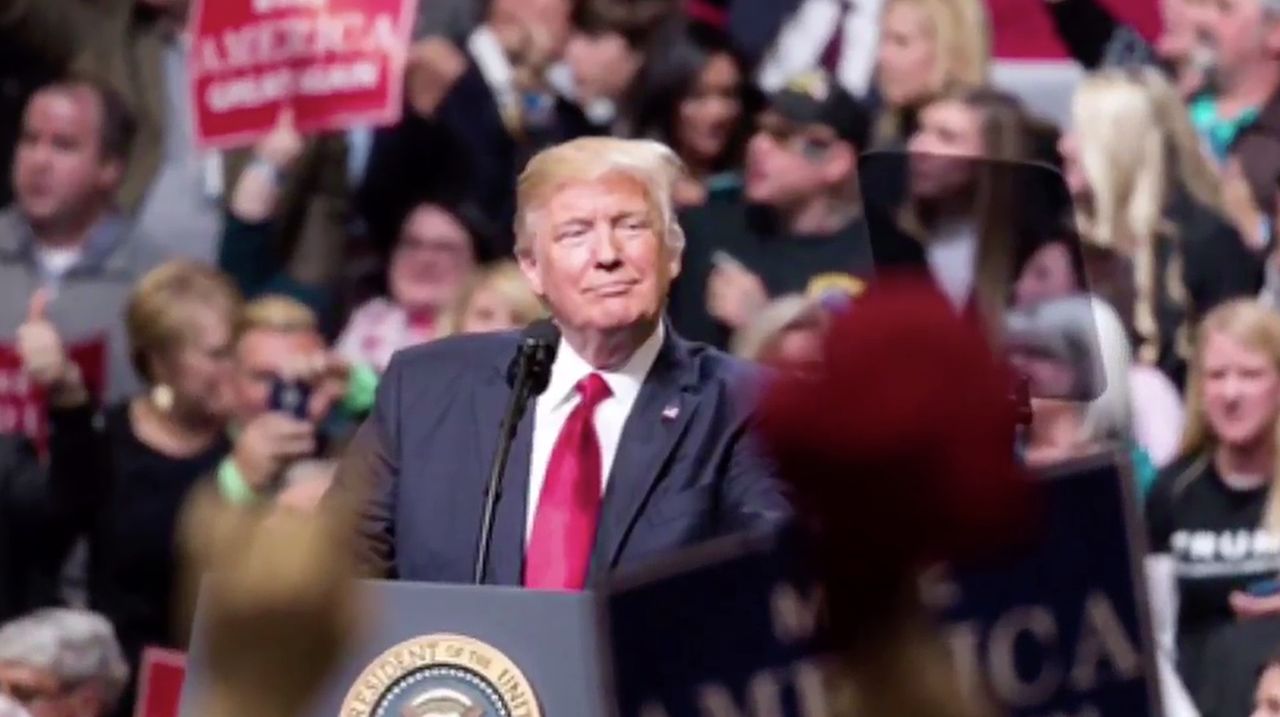
Donald Trump addresses a rally in Nashville, TN in March 2017.
Photo released by the Office of the President of the United States via Wikimedia Commons.

Arguably, the American people have a handle on this. Their strategy is to support Biden and the Democrats publicly, to save their jobs, discourage doxing, and avoid vicious attacks from “friends” on Facebook. Then come November, they vote for a Republican supermajority, including a Trump sweep of the Electoral College, and a GOP landslide in the House of Representatives. Thanks to the secret ballot, they can say they voted for Biden afterwards, if he is still alive. (Has anyone checked on the dear old guy in his basement?)

That Trump will lose badly will be obvious to everyone until the election results come in. The younger constituency has been thoroughly indoctrinated by the radicals who captured schools and universities, but will, as usual, rarely turn up to vote. There will be a huge volume of fraudulent mail-in ballots — nine-tenths of them Democrat — but the Natted States Postal Service will fail to deliver them on time. Desperate efforts by Antifa and BLM to keep the riots going will substantially reduce the urban leftie vote. The meltdown of the meejah talking heads, on the night of November 3rd, will be even more amusing than their meltdown in 2016. Many will succumb to the Covid virus, by morning.

Not to be political, because I never am — but I did have a long history of correctly guessing election results when I was myself practising the demonic art. (Journalism.) I was, for instance, a polite “never Trumper” even after I’d been deleted by my newspaper employers (who felt they didn’t need “token conservatives” any more). But I did think, against all the odds, that Trump would win. This was because I try not to let my own prejudices interfere with my observations. My reasoning was simple. There were lots of people who loved Trump, and very few who loved Hillary Clinton. Therefore, the latter would lose. (This also explains how I predicted Obama’s victories.)

July 6, 2020

Cold War Two is upon us, but it’s not all Trump’s fault (believe it or not)

Niall Ferguson on the rapid drop in temperature in US/Chinese relations in the last eight years:

President Donald Trump and PRC President Xi Jinping at the G20 Japan Summit in Osaka, 29 June, 2019.
Cropped from an official White House photo by Shealah Craighead via Wikimedia Commons.

“We are in the foothills of a Cold War.” Those were the words of Henry Kissinger when I interviewed him at the Bloomberg New Economy Forum in Beijing last November.

The observation in itself was not wholly startling. It had seemed obvious to me since early last year that a new Cold War — between the U.S. and China — had begun. This insight wasn’t just based on interviews with elder statesmen. Counterintuitive as it may seem, I had picked up the idea from binge-reading Chinese science fiction.

First, the history. What had started out in early 2018 as a trade war over tariffs and intellectual property theft had by the end of the year metamorphosed into a technology war over the global dominance of the Chinese company Huawei Technologies Co. in 5G network telecommunications; an ideological confrontation in response to Beijing’s treatment of the Uighur minority in China’s Xinjiang region and the pro-democracy protesters in Hong Kong; and an escalation of old frictions over Taiwan and the South China Sea.

Nevertheless, for Kissinger, of all people, to acknowledge that we were in the opening phase of Cold War II was remarkable.

Since his first secret visit to Beijing in 1971, Kissinger has been the master-builder of that policy of U.S.-Chinese engagement which, for 45 years, was a leitmotif of U.S. foreign policy. It fundamentally altered the balance of power at the mid-point of the Cold War, to the disadvantage of the Soviet Union. It created the geopolitical conditions for China’s industrial revolution, the biggest and fastest in history. And it led, after China’s accession to the World Trade Organization, to that extraordinary financial symbiosis which Moritz Schularick and I christened “Chimerica” in 2007.

How did relations between Beijing and Washington sour so quickly that even Kissinger now speaks of Cold War?

The conventional answer to that question is that President Donald Trump has swung like a wrecking ball into the “liberal international order” and that Cold War II is only one of the adverse consequences of his “America First” strategy.

Yet that view attaches too much importance to the change in U.S. foreign policy since 2016, and not enough to the change in Chinese foreign policy that came four years earlier, when Xi Jinping became general secretary of the Chinese Communist Party. Future historians will discern that the decline and fall of Chimerica began in the wake of the global financial crisis, as a new Chinese leader drew the conclusion that there was no longer any need to hide the light of China’s ambition under the bushel that Deng Xiaoping had famously recommended.

Time to end US military deployments to Afghanistan?

Filed under: Asia, Military, Politics, USA — Tags: , , , , — Nicholas @ 03:00

Brad Polumbo reports on the split between Republican voters and Republican Senators on ending the US military involvement in Afghanistan:

Leopard 2A6M in Afghanistan

Applied to the Middle East, the America First framework is intuitive — our military misadventures in countries like Iraq, Libya, and Afghanistan have cost the U.S. tremendously yet failed to further our interests. Once the party of hawks and idealists, Republican voters are now firmly in the America First camp. According to The Intercept, 81% of 2016 Trump voters support removing troops from Afghanistan.

Unfortunately, this shift in views has not been represented in Congress. Most Senate Republicans just explicitly voted against ending the war in Afghanistan.

On Wednesday evening, Sen. Rand Paul, a libertarian-leaning Kentucky Republican, introduced an amendment to the National Defense Authorization Act that would have brought our troops home from Afghanistan, given those soldiers who served a bonus, and repealed the authorization of force Congress passed in 2001. But in a 60 to 33 vote, the Senate shot it down, with only three Republicans in addition to Paul — Sens. Mike Lee, Mike Braun, and Steve Daines — backing the amendment.

“Our amendment [would] finally and completely end the War in Afghanistan,” Paul said on the Senate floor. “Over 4,000 Americans have died in Afghanistan and over 20,000 have been wounded. It’s time to bring our soldiers home.”

“It is not sustainable to keep fighting in Afghanistan generation after generation,” he continued. “In fact, we now have soldiers who were born after 9/11 serving in Afghanistan.”

“We’ve been there for 20 years,” the senator said. “How can we characterize withdrawal after 20 years, after we defeated the enemy, as ‘precipitous’? It’s crazy. The American people say, ‘Come home,’ and this is your chance.”

“Afghanistan 2010 43” by david_axe is licensed under CC BY-NC 2.0

June 14, 2020

The cat’s in the bag … once. Twice is a different matter altogether

Filed under: Economics, Government, History, Politics, USA — Tags: , , , , — Nicholas @ 05:00

David Warren discusses some specific cats and bags:

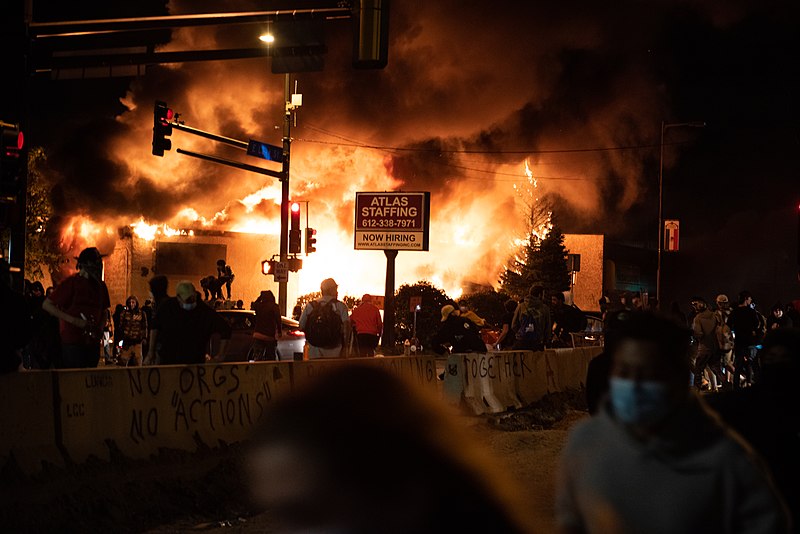
A building burning in Minneapolis following the death of George Floyd.
Photo by Hungryogrephotos via Wikipedia.

You can get a cat into a bag twice, as someone said (I think it was me); but the second time it has to be dead. This would be the reasoning behind my prediction that a second general lockdown will not even be attempted; but it must be qualified. For many of the people who imposed the first one were demonstrably insane, and they haven’t yet been removed from public office.

The same could be said about our impending “summer of love,” or hot season of race riots, already endured a half-century ago. That cat has been put into that bag before. This time is bound to be a different story.

It is fairly strictly a party question, now. The “theory” behind the lockdowns — to avoid overloading the hospitals in Manhattan — proved a crock, but there is a more cogent alternative theory. The Democrats in Natted States Merica guessed that destroying the “Trump economy,” and encouraging “peaceful” riots in the cities, was the only way they could defeat Trump, having tried other methods to remove him. And for a party of convinced abortionists, defeating Trump takes priority over mere human lives. We’ll see in November whether their Caracas strategy is the final winner.

To be fair, as they say at Instapundit, the Repubs have historically played along with this, and agreed to take responsibility and blame for almost purely Democrat measures. A good example is race, where the party of slavery, the Ku Klux Klan, eugenic birth control to reduce the black population, and Jim Crow laws, presents itself to captive media as the champion of the black man against “systemic racism”; while the party of Lincoln apologizes for itself. That the devil is at large in American politics is, to my mind, an irresistible hypothesis.

The refusal of this Trump fellow to play this game, as his predecessors did, drives Democrats berserk. He actually fights back, to their consternation. It didn’t help that they were so proximate to berserk already.

QotD: The seen gains and unseen losses of high tariffs

Filed under: Economics, Politics, Quotations, USA — Tags: , , , — Nicholas @ 01:00

Sure, there are gains to the workers and firms protected by tariff walls from their fellow Americans’ ability to trade freely with foreigners. But these protected firms’ resulting higher outputs are produced with resources from elsewhere in the economy. Output and opportunity in other parts of the economy shrink. American firms diverted by tariff walls into producing, say, more steel, rejoice. But this rejoicing ignores the jobs that these tariff walls destroy elsewhere in America and the loss of output from other domestic industries.

It’s easy to rejoice when a wall, literal or figurative, enriches you. And it’s even easier when the destruction wrought elsewhere by that wall is invisible. When a tariff wall causes people in Louisiana and Oregon to pay higher prices for steel made in Pittsburgh, no one can know how they would otherwise have used the extra funds they now pay to Pennsylvania steel producers. But those funds must be diverted from somewhere.

Yet because those somewheres are many, no one domestic industry suffers any great loss from higher steel tariffs. The destruction wrought by tariff walls is dispersed and, hence, invisible. But the sum of the losses is greater than the gain to domestic steel producers.

Americans on the whole are made poorer.

Don Boudreaux, “Mr. Trump, don’t build those walls!”, Pittsburgh Tribune-Review, 2016-11-22.

June 4, 2020

Trudeauvian “performative sanctimony” on display … again

Filed under: Cancon, Government, Media, Politics — Tags: , , , , — Nicholas @ 03:00

Chris Selley on the Prime Minstrel’s latest attempt to virtue signal on racial issues:

Justin Trudeau with dark makeup on his face, neck and hands at a 2001 “Arabian Nights”-themed party at the West Point Grey Academy, the private school where he taught.
Photo from the West Point Grey Academy yearbook, via Time

In agonizing for 21 seconds before answering a question about President Donald Trump’s threat to send the military after civilian protesters in American cities, Prime Minister Justin Trudeau likely risked causing as much trouble as he was hoping to avoid. Those who would like to see him denounce the president in full throat might be as annoyed as those who think he should accept there’s nothing Canada can really do to help and look out for our own best interests while the socio-political nightmare plays out.

Trudeau’s response wasn’t anything inspiring or novel or revolutionary. “It is a time for us as Canadians to recognize that we too have our challenges — that black Canadians and racialized Canadians face discrimination as a lived reality every single day,” he said. “There is systemic discrimination in Canada, which means our systems treat Canadians of colour, Canadians who are racialized, differently than they do others.”

He continued: “We need to see that, not just as a government and take action, but we need to see that as Canadians. We need to be allies in the fight against discrimination. We need to listen, we need to learn and we need to work hard to figure out how we can be part of the solution on fixing things.”

But here, at least, he was getting to the nub of the issue: To the extent the federal government can make things better for marginalized Canadians, Trudeau is the guy driving the boat. To read some of his ministers’ pensées, you would think they were just regular folks.

[…]

In the meantime, however, you can bet the farm we will soon learn that the Liberals’ changes to impaired driving laws — allowing police to stop and breathalyze drivers without any suspicion of impairment — have disproportionately affected black and Indigenous drivers in particular. Literally everybody saw it coming except Trudeau and his ministers.

OK, I’m kidding — they saw it coming too. They might want to log off, dial down the performative sanctimony and think on that a while.

June 2, 2020

Antifa

Filed under: Government, Law, Politics, USA — Tags: , , , , , — Nicholas @ 03:00

Arthur Chrenkoff welcomes the move to designate the Antifa movement as domestic terrorists:

“antifa 8973ag” by cantfightthetendies is licensed under CC BY 2.0

President Trump’s decision to designate Antifa as a terrorist organisation is long overdue.

Whether you call them a terrorist organisation or a criminal organisation – or both – the underlying facts are the same: Antifa is a network of groups committed to a violent revolution to overthrow the democratic system of government and replace it with some sort of a communist “dictatorship of proletariat”, whoever the current proletariat is supposed to be (which does not in the end matter very much, because it’s all about the party organisation rather than “the masses”). To effect such revolution, Antifa uses tactics of violence against people it considers enemies as well as destruction of property. Remember, these people are not Scandinavian social democrats or even Bernie and AOC-style “democratic socialists” who advocate and follow a democratic and peaceful path of transformation to achieve their objectives of building what they consider a better and more just society. Antifa are thugs who desire to tear down and destroy the current political and economic order and erect their utopia on its ashes. They want to abolish democracy, capitalism, liberalism and all the other existing institutions in favour of a Marxist-Leninist state — or just for the fun of it if they are more of an anarchist rather than communist frame of mind. Groups whose the entire modus operandi is based on breaking law and criminal activity have no legitimate place in a democratic society. Antifa are the political organised crime.

The label Antifa has been used and abused too long to muddy the waters and confuse people — many of whom, granted, want to be confused. Because fascism is objectively bad (and considers so by an overwhelming majority of people), calling themselves “anti-fascist”, Antifa seeks to claim the moral high ground and the role of the good guys who stand up to white supremacists, neo-Nazis and other extreme element. But you cannot simply judge people by who their enemies are, or who they say their enemies are — you also have to judge them by their intentions, actions and aims. In the Second World War, the United States and the United Kingdom and their Western allies were anti-fascist, but so was the Soviet Union. Stalin hated fascists (except for a period of two years in 1939-41 when he collaborated with them). This did not make him a good guy, even if for the Allies at the time it made him the lesser of the two evils. Coincidentally, for Stalin the label “fascist” was a very broad one, applying not just to German Nazis and their sympathisers but to anyone opposed to communism and the Soviet Union and so in turn opposed by them, including at times even social democrats and other non-revolutionary socialists {“social fascists” in the Stalinist nomenclature). And so it is for Antifa — we are all fascists, from the few skinheads at the political fringes to all the mainstream parties and ideologies of both the right and the left. Just as in Russia in 1917 onward and all the other communist countries in history, your position on the democratic political spectrum can never give you an ultimate immunity, it only determines the order in which you will be shot (left-wingers and anarchists last, because they can be used the longest by the forces of revolution).

April 29, 2020

“The war on ultraviolet radiation because it might help Trump is an educational moment”

Arthur Chrenkoff on the sudden decision that the World Health Organization is the ultimate arbiter of what we’re allowed to say on social media platforms like Twitter and YouTube:

There is of course no evidence that the video represents any disinformation. It relates to legitimate scientific research by a medical company conducted in association with a respected hospital to develop a novel treatment of possibly crucial importance in the current conditions and into the future. The only problem with the video is that is indirectly supports Trump’s flight of fancy speculation about using light and chemicals to “disinfect” the body. Ergo, according to a NYT journalist it represents a problem and YouTube agrees. YouTube now has a standing policy of removing COVID information that goes against the World Health Organisation’s guidelines. Putting aside the question of the WHO’s credibility in the wake of the pandemic, we are not talking here about some guy in a tinfoil hat talking about 5G towers spreading the virus; this is a video relating to ongoing, respectable scientific research. Will it work? Probably not. But perhaps neither will any of the 150 or so COVID-19 vaccines being currently developed around the world. We won’t know until we know. But in the meantime, scientific news should not be censored, period.

[…]

Goldsmith and Woods are correct in pointing out not only the greater role that governments have been playing in regulating speech but more importantly how much of that effort has been embraced and driven by the big tech — and by the private individuals enabled and encouraged by the big tech — what I have previously called the “democratised censorship”. The difference is that people like Goldsmith and Woods think that’s a good thing.

The dirty little secret is that a great number of leftists, progressives and even centrist technocrats and activists look at China, with its authoritarian government, social credit score system, ubiquitous surveillance, and the ability to “get things done” and done quickly and supposedly efficiently (in China, bullet trains run on time, I hear), and pine for such a system to be applied in their own countries — as long as, of course, they are the ones in power and decide what is right, important and valuable. The left’s objections are rarely against authoritarianism and its means and methods per se, just with the possibility that someone else — like Trump — is the one behind the wheel, implementing their, not the left’s, agenda.

The war on ultraviolet radiation because it might help Trump is an educational moment. One could say, first they came for crazy conspiracy theorists and I said nothing because I’m not an anti-vaxxer or anti-5G activist — and so on. The problem with censorship is that it keeps creeping up on everyone else. And those who do the censoring — who decide what the ignorant masses should and shouldn’t be allowed to read — are not some detached and impartial spiritual beings but people with political agendas. People who think that ideas and beliefs of one half of the society are harmful and offensive. People who will censor news that doesn’t fit the agenda and support the narrative.

And then they came for ultraviolet radiation… You have been warned.

April 27, 2020

Entrepreneurs beyond the atmosphere

Filed under: Government, Law, Liberty, Space, USA — Tags: , , , , — Nicholas @ 03:00

Doug Bandow reacts to Donald Trump’s executive order that begins to clear the way for private enterprise in space:

Taken by Apollo 8 crewmember Bill Anders on December 24, 1968, at mission time 075:49:07 (16:40 UTC), while in orbit around the Moon, showing the Earth rising above the lunar horizon.

Despite the current chaos caused by the coronavirus, Washington still must consider the future. Which explains the president’s new executive order that would allow private resource development on the moon and asteroids. It clearly rejects the “common heritage of mankind” rhetoric deployed by the United Nations on behalf of the Law of the Sea Treaty, which four decades ago created a special UN body to seize control of seabed resources.

The Future of Space Exploration

The EO issued earlier this month explained that

    Successful long-term exploration and scientific discovery of the Moon, Mars, and other celestial bodies will require partnership with commercial entities to recover and use resources, including water and certain minerals, in outer space.

The measure began the process of revising an uncertain legal regime which currently discourages private sector development.

The administration pointed to the 1979 Agreement Governing the Activities of States on the Moon and Other Celestial Bodies (known as the Moon treaty) and the 1967 Treaty on Principles Governing the Activities of State in the Exploration and Use of Outer Space, including the Moon and Other Celestial Bodies (typically called the Outer Space Treaty). Neither is friendly to entrepreneurs or explorers with a commercial bent.

In response, the president announced that

    Americans should have the right to engage in commercial exploration, recovery, and use of resources in outer space, consistent with applicable law. Outer space is a legally and physically unique domain of human activity, and the United States does not view it as a global commons. Accordingly, it shall be the policy of the United States to encourage international support for the public and private recovery and use of resources in outer space, consistent with applicable law.

Space is a Long-Term Prospect

The document’s main directive is for the Secretary of State, in cooperation with other agencies, to “take all appropriate actions to encourage international support for the public and private recovery and use of resources in outer space.” The secretary is to “negotiate joint statements and bilateral and multilateral arrangements with foreign states regarding safe and sustainable operations for the public and private recovery and use of space resources.”

Obviously, the administration’s attention is directed elsewhere at the moment. However, the potential benefits of turning to space are significant. The value of scientific research is obvious and continues to drive government agencies such as NASA. Launch services and space tourism have caught the interest of private operators. Such activities offer fewer legal and practical difficulties than attempting to establish some sort of long-term presence in the great beyond.

More complex development of space is a longer-term prospect. However, that makes it even more imperative to encourage innovation by creating institutions and incentives that encourage responsible development of what truly is the “final frontier.”

April 5, 2020

Ontario premier Doug Ford surprises many observers – “Wasn’t this guy supposed to be Canada’s Donald Trump?”

Filed under: Cancon, Government, Media, Politics — Tags: , , , , , — Nicholas @ 03:00

Chris Selley on the surprisingly solid performance of Ontario premier Doug Ford during the Wuhan Coronavirus epidemic response:

Ontario premier Doug Ford as new Progressive Conservative leader at the 2014 Good Friday procession in East York, Canada.
Photo via Wikimedia.

The premier has attracted much praise for his performance during this crisis, and it is deserved. His last misstep was advising families to head off on March Break as planned, viruses be damned, but that might as well have been 100 years ago. We were all clutching at optimism. Former premier Kathleen Wynne, who clearly understands Ford, graciously said she heard a man “trying to calm the waters … out of the goodness of his heart.”

Since then Ford has struck the right tone: often visibly alarmed, but calm, scripted and plain of speech. He has been gracious to everyone on the right side of the fight, from doctors and nurses to supermarket clerks and frantic, unemployed people stuck at home, to Prime Minister Justin Trudeau, to his fellow premiers of all political stripes, and even to journalists. And he has been galvanizingly withering to those on the wrong side, most notably a few price-gouging businesses who have been helpful enough to offer themselves up as common enemies.

More than a few people have remarked: “Wasn’t this guy supposed to be Canada’s Donald Trump?”

Indeed, once upon a time, those comparisons flew thick and fast. But they were always absurd — a toxic by-product of the Canadian media’s mortifying obsession with all things American. No First World politician is remotely like Donald Trump. I have filed many thousands of words over the past decade on what I view as Doug Ford’s inadequacies as a politician, and it would never have occurred to me to compare him to such a transparently awful president.

Ford, too, has levelled many vastly over-the-top accusations against his opponents. But he has basically set them all aside now. While federal Conservatives continue battling federal Liberals on the carbon tax file, Ford has refused to discuss it and happily applauds the feds’ anti-coronavirus efforts. Where once Ford railed at his media critics, now he praises their efforts covering the crisis and informing Ontarians. His relatively plain talk is noticeably more reassuring than the messaging some other Canadian heads of government, who fancy themselves far more polished, are dishing out — Trudeau in particular.

April 4, 2020

The media’s grasp of modern logistics

Kurt Schlicter — who, spoiler, isn’t a fan of our news media in general — on the demands by newsbeings for the impossible to be done immediately:

We Americans are truly blessed by having a mainstream media full of brilliant renaissance men, women, and gender non-specific entities who are masters of so many varied and intermittently useful skills and who are eager to share their knowledge with us benighted souls. The pandemic has revealed that every urban Twitter blue check scribbler, MSNBCNN panelist, NYT/WaPo doofus, and barely legal “senior editor” of a website you never heard of, is a Nobel Prize-winning epidemiologist, a master logistician, and a diversity consultant to boot.

[…]

Another hitherto unknown skill that the media believes it possesses is logistics. “Why hasn’t Trump commanded a million ventilators to appear?!” the reporters demand. It’s pretty easy to see where they might have gotten the idea that the moment one articulates a desire to possess something that it magically appears. Capitalism has pretty much made that a reality. If you want something, you can go to a store and get it 24/7, or you can go on Amazon and it’ll be at your Manhattan apartment in 48 hours. Since they have never built anything or transported anything or distributed anything, only benefited from the labor of the unhip people who do those things, it’s only natural that the delayed adolescents who make up our media class imagine that material goods can be simply wished into being. After all, for all practical purposes during normal times, because of the efforts of Americans they look down upon, material goods pretty much can be simply wished into being. But prosperity takes work, not that the media would know.

[…]

Apparently, the media class thinks there are giant warehouses with an endless supply of goods just sitting there, somewhere, waiting. They have no idea about how logistics work, how goods flow quickly from producer to market and how expected resupply levels need a few days to adjust from a 10 percent daily turnover to a 30 percent daily turnover. They have zero appreciation for inventory management because no one they know does unglamorous stuff like that.

It’s all much easier in a socialist command economy. You get nothing and like it. Or don’t like it. Whatever. Here’s your weekly bean allowance. Workers of the world unite. You have nothing to lose but access to toothpaste and toilet paper.

The best part is when the media – the same media that was collectively soiling its Dockers because that mean old Trump was barring direct flights from China because of racism and stuff – demands to know why, back in December, Trump was not commanding a zillion Wuhan Flu tests, a zillion masks, and a zillion ventilators be created, while locking down all of America. Leaving aside the whole lack of an enumerated power to do that thing, in what world would have Trump have convinced anyone – least of all the media that was slobbering over his bogus impeachment at the time – that some bat soup-derived pathogen in BumFoo, China, was going to black swan all over America’s economy? The lack of seriousness by the people who presume to be reporting the news to us is more breathtaking than the damn ChiCom grippe.

March 16, 2020

Cognitive dissonance, family style

Severian has some fun discussing current events with a nephew:

Image from Castle of Chaos – https://castleofchaos.com/blog/5-tips-for-surviving-a-zombie-apocalypse/

Just recently I had some fun with one of my nephews, who’s unexpectedly home for “Spring Break.”

Let’s take this Wuhan Flu thing seriously, I said. But since that hits a little too close to home, let’s pretend it’s a zombie outbreak. I want you to take it 100% seriously. The zombie virus has made it to our shores. It’s not too bad yet, but there’s definitely a walking dead situation. So … what do you want the government to do?

Nephew of course starts rattling off all the Chuck Norris fantasies young college guys have. Close the ports, call out the army, firebomb the streets wherever infected are sighted, yadda yadda. All of this is translated from the teenager, but you get the gist of it:

Me: Ok. Now, since we’ve stipulated that we’re taking this 100% seriously: Do you really want to give the government the power to do all that?

Nephew: Of course!

Me: Ok. Well then, do you really want to give Donald Trump the power to do that?

Nephew: Oh my god no!!! Orange Man bad!!!

Me: Now wait a minute, Nephew. You just said you’re taking this 100% seriously. You just said you want the government to have the power to set up flamethrower checkpoints on all major roads. Well, who is the current head of the government?

Nephew: But … but … but … Orange Man BAD!!!!

Me: Remember, Nephew, you promised to take this 100% seriously. So are you seriously telling me that the first thing you’d do, in the event of the zombie outbreak, is call an emergency presidential election, in the hopes that someone — Joe Biden, Bernie Sanders, Tulsi Gabbard, somebody — would win, so that the right kind of person could take all those measures you said were so very, very, very immediately necessary?

Nephew: Uhhhh … no, I guess not.

Me: So you do want to give Donald Trump that power, since he is, in fact, the current head of the United States government?

Nephew: Oh my god no! Orange Man BAAAAAAADDDD!!!!

Me: Well then I guess you’re just not serious about this zombie outbreak, are you?

March 5, 2020

“Maybe … Trump’s victory caused an unusual number of spontaneous abortions in Ontario”

Filed under: Cancon, Health, Politics, USA — Tags: , , , , , — Nicholas @ 05:00

Colby Cosh on the recently published findings of a p-hacking conspiracy study on how the election of President Donald Trump was reflected in the birth ratio of liberals in Ontario:

Front view of Toronto General Hospital in 2005. The new wing, as shown in the photograph, was completed in 2002.
Photo via Wikimedia Commons.

On Monday there came a surprising piece of science news from BMJ Open, an open-access title affiliated with the British Medical Journal. It seems two researchers from Mount Sinai Hospital in Toronto, an endocrinologist and a statistician, have convinced themselves that the election of Donald Trump to the American presidency in November 2016 had a nerve-shattering effect on Ontario. The province of Ontario, that is, not the Los Angeles suburb.

Trump’s victory, according to the researchers, was so awful that, like a war or a disaster, it briefly altered the sex ratio in live births in the province. This is, I should say, a fairly well-established effect of extreme social traumas. When mothers experience physiological stress, the uterine environment becomes less hospitable, and male fetuses, more vulnerable to such changes, become less likely to survive pregnancy. (This makes sense from a Darwinian standpoint, because girls are more valuable than boys in replacing population after a calamity.)

In 2020 nobody should need me to say that a cute, counterintuitive scientific “result” like this, appearing in the newspapers on literally the day of its publication, should be greeted with extreme skepticism. The sex ratio at birth, always expressed in medical literature as a ratio of boys to girls, tends to hover around 1.06 under natural circumstances. (Even in an advanced civilization, things even out within the age cohort over the next 20 years as the lads explore dirt bikes, rock fights, and roofs.)

The Mount Sinai researchers, Ravi Retnakaran and Chang Ye, had records of the sexes of all children born in Ontario from April 2010 to October 2017. Even in a place as large as Ontario, the ratio naturally bounces around randomly between 1.1 and 1.0, and there are seasonal effects that the duo corrected for.

There is no obvious signature of a Trump effect in a scatterplot of the adjusted data, which serves as a warning that the effect being claimed may be an artifact of analysis. But when you apply “segmented regression” using the same parameters as Retnakaran and Ye, you find that the (unadjusted) ratio dipped to 1.03 in March 2017, the fifth month after Trump’s win, and then climbed to 1.08 in June and July before reverting to the long-term norm.

« Newer PostsOlder Posts »

Powered by WordPress