Quotulatiousness

November 19, 2019

QotD: [Trump | Obama | Bush | Clinton] Derangement Syndrome

If Trump – or Obama or Scott Morrison or Hillary Clinton – saying that 2 + 2 = 4 makes you automatically deny the math because your bête noire simply cannot be correct, you might want to take a deep breath or two and reflect on your approach to life. You’re broken. Don’t be that person.

Arthur Chrenkoff, “Denying the sky is blue because Orange Man Bad”, The Daily Chrenk, 2019-10-18.

November 15, 2019

“In a functioning system, the head of the government sets foreign policy and the diplomats enact it. So naturally there’s not a chance of that in Washington”

Filed under: Bureaucracy, Government, Politics, Russia, USA — Tags: , , , — Nicholas @ 03:00

Mark Steyn on the foggiest of Foggy Bottom diplomatic bafflegab on the first day of the :

Yesterday I caught a bit of the impeachment theatre en route to a lunchtime speaking engagement. To be honest, if they’d come round and performed it live in my hotel room, I’d still have fled. If universally respected eminent lifelong career foreign-service bigshots Bill Taylor and George Kent are Adam Schiff’s star witnesses, their chief purpose seems to be to get Democrats pining for the charisma of Bill de Blasio and the self-effacement of John Kerry.

In a functioning system, the head of the government sets foreign policy and the diplomats enact it. So naturally there’s not a chance of that in Washington. When Taylor and Kent whine that there seemed to be a “shadow foreign policy”, the shadow is theirs; they spent a day testifying that everything had been going ticketty-boo for decades just as they’d always done things – and then Trump came along and took a different view. Oh, my! Anyone would think that, as Barack Obama once proposed, “elections have consequences”.

First up was George Kent, the “Deputy Assistant Secretary of State for Eastern Europe and the Caucasus”. He warmed up the crowd with some extensive biographical material about the “nearly sixty years” of George Kents (I believe he’s George III or some such) who have “chosen” to endow America with the blessings of their “public service”. It didn’t help that he wore a bow tie. Eventually he stopped talking about himself and started talking about Ukraine:

    Our strategic aim for the entirety of my foreign service career is not possible without a Ukraine whole, free, and at peace, including Crimea and Donbas, territories currently occupied by Russia.

Crimea is, of course, familiar to anyone who’s read “The Charge of the Light Brigade”:

    Theirs not to reason why
    Theirs but to do or die…

Or, in the case of low-level diplomats who’ve never had a single conversation with the President, theirs not to reason why, theirs but to do or tender their resignations after first ensuring that their pensions won’t be affected. Instead:

    Into the valley of the SCIF
    Rode the six hundred hearsay witnesses…

As I said, any Tom, Dick or Harry can bandy Crimea, but it takes a career striped-pants Foggy Bottom public servant to toss in “Donbas” with gay abandon. It would have been interesting to see whether Adam Schiff or anyone else in the room could have found Donbas on a map. The odds of pinning the tail on the Donbas blindfolded are better. It’s bordered to the north, east and south-east by Russia, so it’s akin to the Russian foreign ministry regarding northern Mexico as a vital national-security interest of Moscow’s.

In fact, northern Mexico is a vital national-security interest of America’s, but, under the mass wankerization of public policy, Perma-Beltway cares more about the borders of Ukraine than it does about the borders of the United States.

November 11, 2019

Addressing the real extinction-level environmental threat

Filed under: Science, Space, USA — Tags: , , , , — Nicholas @ 05:00

In the latest edition of the Libertarian Enterprise, L. Neil Smith points to what he thinks will be Donald Trump’s signature achievement: the United States Space Force.

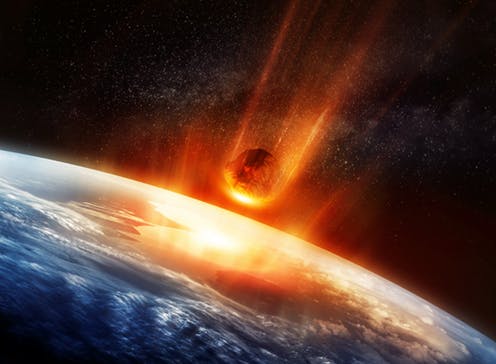
The biggest nuclear weapon ever detonated on Earth, Tsar Bomba, was 50MT. The Chicxulub impact was, at these numbers, 2 million times as powerful as Tsar Bomba.
Image and caption from Stephanie Osborn’s “Incoming: The Chicxulub Impactor, Part 3 — The Impactor & Effects” at https://accordingtohoyt.com/2019/10/31/incoming-the-chicxulub-impactor-part-3-%e2%80%95-the-impactor-effects-by-stephanie-osborn/

Many thoughtful observers believe that the most significant thing that Donald Trump has accomplished so far is his appointment of dozens of federal judges who share his philosophy of governance and I, amateur historian that I am, am inclined to agree with them — with one exception, that is, a little item that just might prove to be a thousand times, a million times, a billion times more important than anything else the Donald — or anybody else, for that matter — has ever done.

Most of us have become aware of the way that a relatively small piece of rock — an asteroid approximately the size of Manhattan Island or the Matterhorn — changed the course of life-history on this planet. It struck the Earth at 40,000 miles and hour, hitting what is now the northern coast of the Yucatan, generating a titanic explosion that ignited every plant standing above the ground, raising a tidal wave that swept over most of North America, and opening a chain of deadly volcanoes on the other side of the world, near India. The esteemed Bob Bakker to the contrary, the late, lamented dinosaurs, I believe, died from smoke inhalation.

Three quarters of all life on this planet, plant and animal, land and sea, was brutally exterminated by this “Cretaceous-Tertiary Event”, and apparently not for the first time. There was a much worse die-off between the Permian and the Triassic eras. The important fact, for you and me, is that there are thousands, if not millions of other lethal asteroids still out there, with which our vulnerable little blue marble is still playing a murderous game of roulette. It is only a matter of time before another “extinction-level event” occurs, possibly wiping out every last living entity on Earth. We can see plenty of evidence of that kind of phenomenon, that magnitude of destruction, elsewhere in the Solar System.

Take your precious carbon footprints and stuff them where the sun don’t shine, Greta. It is Donald Trump who has made the historic first move to prevent this very real cataclysm, and probably to extend the life of the human species indefinitely (an idea environmentalists hate), by calling for the organization of a United States Space Force. At this moment it still isn’t clear exactly what methods will work best to destroy or divert asteroids that threaten our home-world (I mention possibilities in my 2010 Ngu Family Saga novel Ceres), but it is something that must be done, sooner or later, probably by manned spacecraft.

The other important task for which we need a Space Force is to clean up the tens of millions of items of orbital debris that NASA and other agencies have very sloppily left circling over our heads. Remember when the Gemini astronauts simply threw those expensive Hasselblad cameras out the door? These objects range in size from particles of dust to cast-off booster stages which endanger satellites and spacecraft. A hunk of junk the size and shape of a small screw can damage solar panels, pressurized living and working spaces, as well as helmeted individuals in spacesuits, to whom that flying screw would be like a bullet through the head.

October 6, 2019

Finally a reason to climb on the impeachment bandwagon

Filed under: Economics, Government, Humour, Politics, USA — Tags: , , , , — Nicholas @ 05:00

Andrew Heaton, in his latest newsletter, explains why he’s finally come down on the side of impeaching President Trump:

Okay, here’s the main thing I wanted to talk to you about: America is about to slap a TWENTY-FIVE PERCENT tariff on scotch. The underlying story involves the WTO and Airbus, but I think I can save everybody a lot of time by pointing out that our president is a mouthbreathing protectionist who’s too lazy to read Adam Smith’s wikipedia page.

Here are a few things to consider:

  • Tariffs are just taxes, designed to punish you for having the gall to buy something from a foreigner.
  • This will hurt Scottish distillers, and potentially price out distillers with low profit margins.
  • I might have to switch to wine on dates.
  • We have now spent more money needlessly bailing out farmers from a trade war with China than we did bailing out banks under Bush.
  • We’ve known about the idiocy of tariffs since The Wealth of Nations came out in 1776.
  • Trump, a man lacking an ideological core, for reasons which boggle the mind, seems to genuinely believe tariffs and protectionism are good things, as he has maintained since the 80s.

Chances are if you subscribe to this newsletter you’re not a teetotaler, but on the off chance you are, allow me to make a case against whisky taxes even if you are not personally apoplectic about a tax hike on Laphroaig. (A concoction personally invented by Almighty God. It’s like you’re drinking a campfire. Try it.)

There’s an old saying: when goods don’t cross borders, armies do. I concur with this. In fact my largest contribution to the field of economics (Nobel Prize forthcoming) is Heaton’s Peace Through International Mistresses Theory.

My groundbreaking idea is that we want to have an interconnected, global economy with lots of transnational trade, because businessmen will be less supportive of bombing cities their mistresses live in. When trade wars happen, international trade collapses, and suddenly businessmen are flying to Berlin and Paris a lot less. Pretty soon we’re firebombing Tokyo.

It would probably be more appropriate of me to dedicate my political analysis to the forthcoming Ukraine/Trump/Biden/Impeachment circus which will dominate our lives for the next few months. However in my case I don’t need to. The president has messed with my scotch. Now it’s personal. I’m all in.

Impeach the guy.

#FreeTrade

You can subscribe to Andrew’s email newsletter here.

September 28, 2019

American politics as reality TV … maybe “reality” is a bit generous

Filed under: Humour, Media, Politics, USA — Tags: , , , — Nicholas @ 03:00

At Catallaxy Files, John Comnenus guest-posts on The Trumpman Show of US politics:

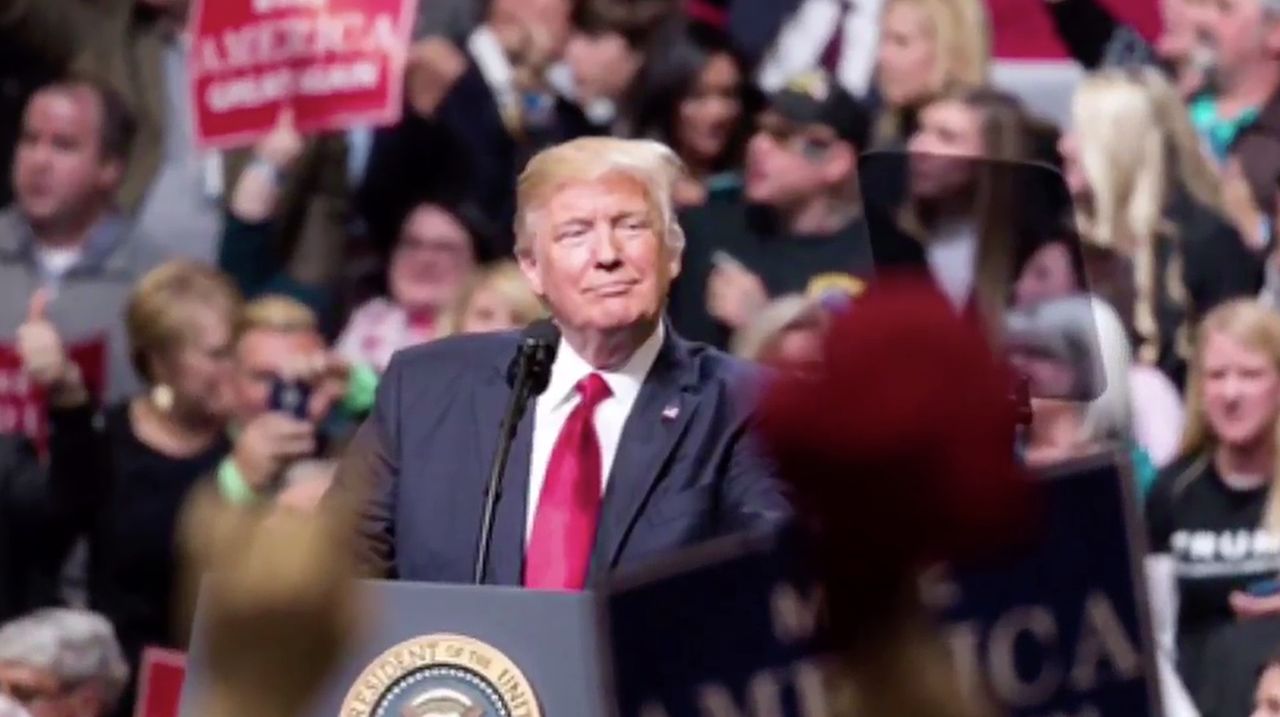
Donald Trump addresses a rally in Nashville, TN in March 2017.
Photo released by the Office of the President of the United States via Wikimedia Commons.

Politics is reality television, especially American politics where a cast of a dozen contest the primaries. Like a good reality television show, there are set events and episodes, such as debates and primaries, where the weaker contestants are gradually knocked out until one emerges to fight the other side for the ultimate prize – the Presidency.

Reality television shows typically assemble a cast of mismatched characters who bond together and feud amongst each other over tasks that are assigned by the script writers and star. They inject challenges into the cast to create tension and drama that changes the cast’s allegiances and relationships in a way that engages the audience and leads to a cast member(s) being removed from the show.

Donald Trump produced and starred in the highly successful reality television show, The Apprentice, for 11 years. I believe Donald Trump is the first politician to conduct politics as if it were a reality television show. Rudolph Guliani claims the Ukraine story, which blew up this week, was a trap laid for the Democrats who walked straight into it. Trump knew the cast of Democrat Congressmen and Presidential candidates couldn’t resist the challenge Trump injected into the cast.

Succeeding in reality television is about timing that creates the drama that engages the audience and gradually removes cast members. So why inject this Ukraine story now? I suspect Trump injected this script item into the Democrat Party cast now to ensure that he dramatically realigns the cast’s relationships and allegiances as they go into primary season. He wants to do this by removing the front runner. If I am right, Trump wants a viciously divided Democratic Party Convention that can barely stand the nominee the Party selects as the Democratic challenger to Donald Trump.

The Ukraine trap effectively knocks Biden out of the race – he can’t go to a debate with highly credible and growing allegations of corruption swirling around him. The Democrat establishment will ensure he retires for “health reasons” to avoid Democrat corruption dominating the next debate. So the 20%-25% of Democrats who previously supported Biden will need to cast their lot with another candidate. But who?

August 23, 2019

Reasons to expect an even weirder (and scarier) US election in 2020 than in 2016

Filed under: Media, Politics, USA — Tags: , , , , , , — Nicholas @ 05:00

At Rotten Chestnuts, Severian explains why the First World War was inevitable (because of the fecklessness of all the world leaders at the time) and then points out that the same sort of inevitability seems to be playing out in the run-up to the 2020 US elections:

Donald Trump addresses a rally in Nashville, TN in March 2017.
Photo released by the Office of the President of the United States via Wikimedia Commons.

In short, World War 1 was a massive, indescribably bloody dick-measuring contest between a few inbred yokels. To anyone who has met the Sons of Privilege,* or who is passingly familiar with the Peter Principle, this comes as no surprise. Hell, Lenin saw it, and a guy with his egg head further up his own ass you’ll never find.** All you have to do is look at the people, not the paper.

That’s where the modern political landscape gets so terrifying. Looking at the paper from the establishment Democrats’ point of view, their course of action seems obvious. And credit where it’s due, even Slow Joe Biden and Fauxcahontas are smart enough (or, more likely, have hired people who are smart enough) to see the obvious once it gets rubbed in their faces a few dozen times — Slow Joe is playing the above-it-all unifier, while Dances with Socialism has gone on a Hillary-esque “listening tour” for The Media’s benefit. Should they choose, The Media can now memory hole all the “fake Indian” stuff, and yell “racist!” at anyone who tries to dredge it back up …

… but I don’t think they’ll choose to. The human factor always wins, and the humans (using the term in its strictest biological sense) in The Media are fed up close to bursting. The mask is completely off “The Squad,” and The Media couldn’t be happier. I’m sure that, in their heart of hearts, Nancy Pelosi et al don’t have a problem with BDS, or the Green New Deal, or any of the rest of it. But flying to Israel on the taxpayer’s dime to support Palestinian terrorism just doesn’t play in Peoria, and the Establishment Dems know it. The Media, however, do not — just look at the coverage.

I’m also quite confident that Nancy et al are even, in their heart of hearts, ok with “Antifa” shooting at cops and firebombing ICE offices. Nancy, after all, came up in the heyday of Jim Jones’s San Francisco, so she’s no stranger to political violence. But The Media absolutely cream themselves over “revolutionaries.” They’ve kept this stuff under wraps so far — Nancy et al have convinced them it’ll hurt Donald Trump more than it will hurt them if they keep it bottled up — but every single person in The Media had xhzhyr first wet dream about Che Guevara. I doubt they can keep it in their pants too much longer, especially if — as seems all but certain — “Antifa” commits some gaudy, gross atrocity in the 2020 campaign season.

Nor can we discount the human factor regarding Normals. Every day brings a new insult — Twitter colluding with China to suppress democratic protests in Hong Kong while all-but-openly banning anyone to the right of Mao; gender-and-race-swapping comic book characters; anything and everything to throw sand in Normals’ faces. If Trump’s victory in 2016 was The Great Fuck You, I can’t even imagine what it’ll look like in 2020, after four more years of this stuff ramped up way past 11.

It’s not looking good, but since the idiots in charge have never even thought about looking up from the paper, the whole thing is going to catch them completely unprepared. Forget “that’s how you got Trump;” this is how you get the Somme.

* they’re like the Sons of Anarchy, but effete and usually gay.
** though he basically just stole the idea from Hobson, who, though a goofy love-the-worlder, was actually a pretty smart guy.

August 11, 2019

“Saying ‘Donald Trump is not my president’ is like saying that your stepfather isn’t your real dad and slamming your bedroom door”

Filed under: Britain, Cancon, Politics, USA — Tags: , , , , , — Nicholas @ 03:00

Colby Cosh looks at the oddly immature and childish meme of “Not my President”/”Not my Prime Minister” declarations that seem to be ubiquitous these days:

If you sent me back to grad school I would love to do some proper research into the history of the “Not My President”/”Not My Prime Minister”-type statements that are everywhere now. They do seem especially popular with liberals, although they are not exclusive to them. A strong memetic influence was obviously the multi-city “Not My Presidents Day” protests that followed Donald Trump’s inauguration. But the indignant, huffy insistence that Trump is “not my president” obviously had to gain traction in the first place.

The theme has been taken up internationally: if you Google “not my prime minister” most of the top hits are Boris Johnson-related (no doubt the “Theresa May: not my prime minister” T-shirts and buttons will sell in the online shops at a significant discount now), and the theme has become a formal slogan of street protest in the U.K. Adding “Trudeau” to the search string reveals a few comment threads. The Canadian politician who gets the most “Not my X” action is certainly Doug Ford. In Alberta, Rachel Notley and Jason Kenney have been getting roughly equal helpings of “Not my premier!”, presumably not from the same people. Who knows, maybe there’s someone out there who feels that his real premier is still Harry E. Strom.

In analyzing this emerging cliché, I suppose one could interpret it as a small act of libertarian or even anarchist rebellion. Is anybody really deserving of being “my” prime minister? Should we not all, in the glorious Utopia, be the prime ministers of ourselves? But the psychological force and intention of the statement that Joe Blow is not “my prime minister” or “my president” is not really anarchistic. The implication of the assertion is always that someone else might really deserve the title, or that there existed past statesmen nobody was ashamed to follow and identify completely with. Saying “Donald Trump is not my president” is like saying that your stepfather isn’t your real dad and slamming your bedroom door.

Meanwhile, of course, your stepfather is probably covering the mortgage and cleaning the eavestrough. “Not my X!” is a defection from democracy more than it is a challenge to the idea of the state. Donald Trump is definitely the lawful, constitutional president of the United States of America, and anyway possesses the powers thereof; those who say it ain’t so are making an incantation, trying to will a state of affairs into existence. If enough people say it, maybe it sorta automatically comes true. There is a lot of this kind of attempted magic going around these days.

August 10, 2019

Trump as the American Commodus

Filed under: Government, History, Media, Politics, USA — Tags: , , , , — Nicholas @ 05:00

In the New York Review of Books, Tom Holland explains that America isn’t Rome, even if the current President does rather remind him of the Emperor Commodus:

The Course of Empire – Destruction by Thomas Cole, 1836.
From the New York Historical Society collection via Wikimedia Commons.

When Edward Gibbon embarked on his great history of the decline and fall of the Roman Empire, he began his narrative with the accession of Commodus. Marcus Aurelius, the father of the new emperor, was a man who, in the noblest traditions of the Roman people, had combined the attributes of a warrior, a statesman, and a philosopher; Commodus was none of these.

“The influence of a polite age, and the labour of an attentive education,” Gibbon wrote sternly, “had never been able to infuse into his rude and brutish mind, the least tincture of learning; and he was the first of the Roman emperors totally devoid of taste for the pleasures of the understanding.” Instead, Commodus delighted in trampling on the standards by which the Roman political class had traditionally comported themselves. Most shockingly of all — as everyone who has seen Gladiator will remember — he appeared in the arena. His reward for this spectacular breach of etiquette was the cheers of the plebs and the pursed-lipped horror of the senatorial elite. To fight before the gaze of the stinking masses was regarded by all decent upholders of Roman morality as the most scandalous thing that a citizen could possibly do — but Commodus reveled in it. So it was, as Gibbon put it, that he “attained the summit of vice and infamy.”

Today, when conservatives contemplate a leader who, far from being merely an enthusiast for World Wrestling Entertainment, has long been an active and flamboyant participant in it, they may experience a similar shudder. Donald Trump, the only president of the United States ever to have been inducted into the WWE Hall of Fame, boasted that he had won “the highest ratings, the highest pay-per-view in the history of wrestling of any kind.” The Battle of the Billionaires — a proxy wrestling match fought in 2007 between Trump and Vince McMahon, the owner of WWE — had culminated in a victorious Trump strapping McMahon to a barber’s chair and shaving him bald. A decade later, Trump made clear just how much of an influence the theatrical violence of WWE had had on his approach to politics when he tweeted a video of himself body-slamming and repeatedly punching McMahon.

It was in a similar spirit, perhaps, that Commodus might have posed after decapitating an ostrich. Trump, smacking home his point, made sure before he tweeted the video to specify who his real target was. Clumsily superimposed over McMahon’s face was the CNN logo. “FraudNewsCNN” ran the hashtag. “The speed with which we’re recapitulating the decline and fall of Rome is impressive,” the conservative intellectual and former editor of the Weekly Standard Bill Kristol tweeted in response. “What took Rome centuries we’re achieving in months.”

The conviction that Trump is single-handedly tipping the United States into a crisis worthy of the Roman Empire at its most decadent has been a staple of jeremiads ever since his election, but fretting whether it is the fate of the United States in the twenty-first century to ape Rome by subsiding into terminal decay did not begin with his presidency. A year before Trump’s election, the distinguished Harvard political scientist Joseph Nye was already glancing nervously over his shoulder at the vanished empire of the Caesars: “Rome rotted from within when people lost confidence in their culture and institutions, elites battled for control, corruption increased and the economy failed to grow adequately.” Doom-laden prophecies such as these, of decline and fall, are the somber counterpoint to the optimism of the American Dream.

H/T to Niall Ferguson for this and the preceding Roman-related link.

July 18, 2019

Andrew Coyne interviews NATO Secretary General Jens Stoltenberg

Filed under: Cancon, Europe, Military, Russia, USA — Tags: , , , , , — Nicholas @ 05:00

In the National Post, Andrew Coyne discusses NATO, Donald Trump, and Russia with the current Secretary General of NATO, Jens Stoltenberg:

General Hastings “Pug” Ismay, later the first Secretary General of NATO during his military service as Winston Churchill’s chief military assistant in 1941.
Official British government photograph via Wikimedia Commons.

Throughout their term in government — and especially since Donald Trump’s victory in America’s 2016 election — Prime Minister Justin Trudeau’s Liberals have taken every opportunity to pay tribute to the “rules-based international order,” the consensus among countries that everyone’s interests are best served by following a set of rules and guiding principles that have evolved through the decades, expressed through things such as trade agreements and international alliances like the United Nations. If this consensus has a face it may be that of Jens Stoltenberg. The urbane former prime minister of Norway has been Secretary General of the North Atlantic Treaty Organization (NATO) since 2014, and through tough times for the international consensus he’s been one of the loudest voices defending it. This week he was in Canada to meet with Trudeau, to tour the Canadian Forces’ Garrison Petawawa and to discuss Canada’s NATO deployments in Latvia and Iraq. He sat down for an interview with the National Post‘s Andrew Coyne.

Q. Lord Ismay, NATO’s first secretary-general, famously defined the alliance’s mission as “keeping the Soviet Union out, the Americans in, and the Germans down.” When you hear some of the things Donald Trump says about NATO, about Article 5 (the collective defence provision) — are the Americans still in?

A. Yes. And they are more in now than they have been for a long time — meaning that they are actually increasing their NATO presence in Europe. After the end of the Cold War, Canada and the United States, for natural reasons, reduced their military presence in Europe. Because tensions went down, there was less need… Now tensions are increasing again, and both Canada and the United States are now increasing their military presence in Europe: Canada with a Canadian-led battle group in Latvia, and the United States with a battle group in Poland and also with a new armoured brigade. So what we see is that the United States is actually investing more in NATO, more military presence in Europe, more U.S. investments in infrastructure, in pre-positioned equipment, more exercises. So the message from the United States is that they are committed to NATO and we see that not only in words but also in deeds.

Q. But when you see Trump questioning the value of multilateral institutions, asserting “America First,” his chumminess with Putin, does it risk sending a signal that, if push came to shove — if Russia got up to no good in the Baltics or what have you — that America’s resolution to resist that would be less than certain?

A. For me the strongest possible signal to send is the presence of U.S. forces in Europe. The fact that we now, for the first time in the history of NATO, have U.S. troops in the eastern part of the alliance, in Poland and the Baltic countries. There is no way to send a clearer signal than that. And the Canadian troops because they are part of the picture. To have American troops in the Baltic countries sends a very clear signal that if a Baltic country is attacked it will trigger a response from the whole alliance… It’s not possible to imagine a stronger and clearer signal than that.

July 9, 2019

QotD: Tariffs

Filed under: Business, Economics, Government, Quotations — Tags: , , , — Nicholas @ 01:00

The entire aim of having trade is so that we can go buy those lovely things made by foreigners. We only export so as to be able to swap something for those foreign made goods. Thus tariffs are a bad idea to begin with — why should we tax ourselves for gaining access to the very point of our having trade in the first place? Sadly all too many don’t grasp this point. Too many of them being in the current Trump Administration.

Over and above the general point that we don’t want to limit trade nor imports there’s another worry with tariffs and trade wars. Which is what the International Monetary Fund is complaining about. The imposition of more tariffs is a disruption to that global economy. One that is going to reduce growth, the very thing we all desire.

Tim Worstall, “IMF Says The U.S. And China Trade Tariffs Are A Major Risk To World Growth”, Seeking Alpha, 2019-06-07.

June 29, 2019

Canada’s inability to deal with Chinese hard ball tactics

Filed under: Business, Cancon, China, Law, USA — Tags: , , , — Nicholas @ 05:00

The Canadian government complied with a request from the United States government to detain a Chinese national for possible extradition to the US. But this was no ordinary Chinese citizen: it was Meng Wanzhou, the Chief Financial Officer for Huawei, a very big and very well-connected Chinese conglomerate. Ms. Wanzhou is not just a high-ranking executive, but also the daughter of the founder of the company. The Chinese government is more than miffed at Canada’s legal presumption and has been piling on the means of persuasion to get Canada’s notoriously pliable government to just pretend this never happened and to let Ms. Wanzhou proceed on her way. Under normal circumstances, this might well happen, but the US government is now under the control of a man who reputedly makes our Prime Minister lose control of his bladder, so we can’t just be seen to knuckle under to the bullying of the Bad Orange Man, nor can we be seen to knuckle under to the bullying of the PRC, leaving poor Justin Trudeau looking weak and powerless (and, to be fair, he is weak and powerless).

Andrew Coyne suggests that the best way to help a couple of poor Canadians who have been caught up in the inter-governmental shenanigans is to stop talking about some sort of “deal”:

U.S. Department of Justice among others announced 23 criminal charges (Financial Fraud, Money Laundering, Conspiracy to Defraud the United States, Theft of Trade Secret Technology and Sanctions Violations, etc.) against Huawei & its CFO Wanzhou Meng
Image via Wikimedia Commons.

I don’t doubt that behind the scenes government officials are doing everything they can, or think they are. But the pressure to bring the Canadians home is surely less for the conspicuous failure of other Canadians to give a damn.

Indeed, what is striking throughout this standoff is that most of the pressure has come from the other side. It is China, not Canada, that has used trade as a weapon, blocking imports of Canadian meat and canola. It was the Chinese air force that buzzed a Canadian warship in the East China Sea.

It is the departing Chinese ambassador to Canada who has launched one incendiary attack after another on this country, while Canada’s now-former ambassador to China was floating trial balloons about getting the Americans to drop the charges against Meng. It is China’s leaders who refuse to meet ours.

And yet for all of China’s lawlessness, for all its bestial mistreatment of our citizens and baseless attacks on our interests, the most common response in this country is not to demand that China repair its relationship with Canada, but to ask how Canada can mollify China.

June 22, 2019

The African Continental Free Trade Area (AfCFTA)

Filed under: Africa, Business, Economics, Government, USA — Tags: , , , — Nicholas @ 05:00

Alexander Hammond explains why a free trade deal among many African nations is good news for the United States and other non-African nations:

2018 map showing the African countries involved in the African Continental Free Trade Agreement.
Dark green indicates ratification, medium green are countries that signed in March 2018, and light green are countries that signed in July 2018 but did not ratify the agreement immediately.
Map by Themightyquill at Wikimedia Commons.

The poorest continent in the world is about to lend a hand to the United States. Last week, Africa implemented the world’s largest free-trade area, and that’s great news for American foreign policy. Back in December, U.S. National Security Advisor John Bolton unveiled a plan for the Trump administration’s titled the “Africa Strategy.”

The plan is simple — the United States will give less aid to Africa, instead prioritizing enhancing America’s “economic ties with the region.” Now that many African nations have unified under a single market, trading with the continent will become far easier — and a trade deal between the United States and Africa would help out everyone involved.

Streamlining Trade

The African Continental Free Trade Area (AfCFTA) trade deal officially came into force on May 30, a month after it reached the twenty-two-nation threshold needed to do so. Now, tariffs on 90 percent of the goods traded among AfCFTA member states will be removed — a move that, according to the UN, will boost intra-African trade by 52 percent in only a few years.

Given the United States’ new plans for the continent, the AfCFTA’s member states aren’t the only economies that will reap the benefits of an African single market.

A key component of the Trump administration’s Africa Strategy is to advance “U.S. trade and commercial ties” with Africa by creating “modern comprehensive trade agreements.” A single African market will be a far simpler trade partner for America. Now, only one set of trade deals will need to be negotiated with the AfCFTA — as opposed to fifty-five intricately-crafted trade deals with each small African economy. The U.S. Trade Representative has even released a report noting how time-consuming and costly it is to negotiate trade deals with each African nation. Because trade deals are long and expensive processes, creating a solitary trade deal with the AfCFTA will keep more money in the U.S. government’s purse.

June 19, 2019

Avoiding a hot war with Iran

Filed under: Economics, Middle East, Military, USA — Tags: , , , , — Nicholas @ 05:00

Jay Currie responds to a recent article at ZeroHedge, on the US-Iran situation:

The game map for Gulf Strike, an early 1980s board wargame by Victory Games.
Image from https://pbem.brainiac.com/vg.htm

The article outlines all the ways that this approach to war with Iran would be folly and while I don’t necessarily agree with all the points made, the general point that massive force however strategically deployed will almost certainly produce results that the US and the rest of the world will not like one little bit. While you can bomb the Hell out of Iran, Iran has a number of retaliatory options ranging from the possibility of an EMP hit (they may have a rudimentary nuke) to closing the Strait of Hormuz to using Hezbollah sleeper cells in the US to hit critical infrastructure. While I have no doubt the US could beat Iran in a straight war, it would be long, bloody, politically suicidal for Trump and nasty for ordinary Americans.

Worse, it would be a strategic error. If the US leaves its current sanctions in place the Iranian economy will grind to something of a halt. Support for the current Iranian regime, already shakey, will decline. Yes, the current regime will continue with its provocations – I have no doubt it was Iranians who put holes in the sides of two tankers. But, so what?

Exciting as a hot war with Iran would be for assorted policy wonks, it would be an expensive exercise in futility compared to a longer term cold war with some clever extras.

First off, the Americans should make it very clear to the Iranians and the world that while they are committed to freedom of navigation, they are not interested in massive responses to minor incidents. If there is to be any response at all to the tanker mines (if that is what they were) it should be very local indeed. Find the boat in the video and sink it (or one very much like it – no need to be too picky).

Second, using US cyber assets – such as they are – it is time to see just how effectively infrastructure can be disrupted rather than destroyed. A sense of humour would be a huge asset here. Being able to cut into TV broadcasts is one thing, telling jokes at the Ayatollah’s expense is another.

Third, the Israelis did a very good business in the selective assasination of Iran’s nuclear scientists. A similar tactic against Iranian civil and military officials engaged in terrorism or attacks on shipping would be throughly demoralizing for the Iranian regime.

On point two, I’m reminded of a key scene in Robert Heinlein’s “If This Goes On—” (later published in expanded form in Revolt in 2100), where the United States has fallen under the control of religious fanatics (vaguely Christian, but carefully not identified with any then-current sect) so that “The Prophet” occupies the role of head of state and unquestioned all-powerful religious leader. The current Prophet performs a televised annual “miracle” where he is seen on-camera to transform into Nehemiah Scudder, the First Prophet, and give blessings and advice to the current Prophet and to the American people. The conspirators manage to take over the central TV feed and replace the “genuine” Prophet’s message with a skilled actor’s portrayal of Scudder calling America to arms to overthrow the false Prophet. This is the start of the armed rebellion against the Prophet. In the technology of the story, this required a strike team to attack and occupy the physical studio where the broadcast originated — literally a suicide mission. In our digital world, the “strike team” might never need to leave Fort Meade (or wherever the data centre might be)…

June 14, 2019

Eliminating the trade deficit

Filed under: Economics, Government, USA — Tags: , — Nicholas @ 05:00

A few weeks back, Robert Higgs explained why President Trump’s concerns about the trade deficit are, at best, misplaced and how “fixing” it would lead to a much worse situation:

Donald Trump addresses a rally in Nashville, TN in March 2017.
Photo released by the Office of the President of the United States via Wikimedia Commons.

So, let’s consider the president’s trade policy in, as it were, its very best light. Suppose, then, that the government succeeded in eliminating the trade deficit entirely. Residents of the USA would continue to sell huge quantities of goods to foreigners but buy nothing at all from foreign sellers. The trade deficit would be not only diminished but wiped out and replaced by a huge trade surplus. Trumpian triumph!

Note, however, that such an outcome would be impossible to sustain for long even if it could be attained (which in fact it could not). Foreigners would be spending huge quantities of dollars to purchase goods from Americans, but they would have no means of earning dollars because Americans would not be buying anything from them. Foreigners could continue to make such purchases only if they received dollar credits from foreigners. But lenders would have no incentive to lend dollars to the Chinese, say, when they knew that the Chinese would have no ability to repay the loans because they would have no means of earning dollars in the future by sales to Americans. So a big U.S. trade surplus requires that totally implausible assumptions be made about international transactions in general and international lending in particular.

But apart from such practical difficulties and impossibilities, a Trumpian trade triumph, even if it could be achieved, would be a horrible objective to attain. Americans would be employing labor services, natural resources, and other productive inputs to produce goods and shipping them to foreign buyers. In exchange, they would receive nothing but bank account balances. Such a deal! Surrendering huge volumes of valuable goods and receiving in return larger numerals in people’s bank account statements, more dollars that could not be used to purchase anything, no matter how important or desirable, from abroad — all such purchases having somehow been stopped by a harebrained government and the economic ignoramus in charge of it.

June 12, 2019

The fantastic notion that Donald Trump is “at heart really a free trader”

Filed under: Economics, Government, Politics, USA — Tags: , , , , — Nicholas @ 03:00

Guest-posting at Catallaxy Files, Don Boudreaux explodes the farcical notion that President Trump is using protectionist tools with an eventual free trade goal:

Donald Trump addresses a rally in Nashville, TN in March 2017.
Photo released by the Office of the President of the United States via Wikimedia Commons.

In the case of Donald Trump, the claim that he is at heart really a free trader who raises tariffs today with the aim of bringing about lower tariffs tomorrow — and all because he is committed to achieving free traders’ ideal goal of maximum possible expansion of the international division of labor — is especially preposterous.

Trump has pontificated on trade for decades, and every word out of his mouth clearly reveals a man who knows nothing about the economics of trade and who is as clichéd an economic nationalist as can be imagined.

Behold this line from a 1990 interview he did in Playboy: “The Japanese double-screw the US, a real trick: First they take all our money with their consumer goods, then they put it back in buying all of Manhattan. So either way, we lose.”

Let’s examine this unalloyed gem of economic witlessness.

Overlooking Trump’s outrageous exaggerations, such as his claim that the Japanese buy up “all” of Manhattan, we start by stating an obvious truth: the voluntary purchase of a good is not a transaction in which the buyer is “screwed” or has his or her money “taken.” Instead, the buyer’s money is voluntarily spent. While every person of good sense sees a foreign seller who makes attractive offers to domestic buyers as someone who improves the well-being of each buyer who accepts the offer, Trump sees this seller as a con artist or thief.

And so Trump ignores the value to Americans of the imports we purchase. In typical mercantilist fashion, he believes that the ultimate purpose of trade is to send out as many exports as possible in exchange for as much money as possible — money that in Trump’s ideal world is never spent on imports. His view on this matter is even more bizarre than that of ordinary mercantilists. For Trump, imports are not merely costs that we endure in order to export, they are actual losses. (Although it goes without saying, I’ll say it nevertheless: Trump does not understand that imports are benefits and that exports are costs.)

Furthermore, by describing the money spent on imports as “our money,” Trump reveals his belief that money earned by each American does not belong to that individual but, instead, to the collective.

Also in the fashion of the typical mercantilist, the presumption is that the nation is akin to a gigantic household whose members all share in and collectively own its money. And just as Dad justly superintends little Emma’s and Bobby’s spending to ensure that they don’t dissipate the family’s wealth, Uncle Sam must superintend his subjects’ spending in order to ensure that we don’t dissipate the nation’s wealth.

One other flaw in the above quotation from Trump’s Playboy interview is notable: he believes that foreign investments in America inflict losses on us. He doesn’t pause to consider that when we Americans sell assets to foreigners we regain ownership of some of the dollars that Trump, in his previous sentence, lamented are lost to Americans when we bought imports.

Nor does he ask what the American sellers of these assets do with the sales proceeds. Perhaps we invest some or even all of them. And if so, perhaps these new American investments will prove to be more profitable than are the investments made in America by foreigners. (By the way, contrary to another mercantilist myth, Americans are not made better off when foreigners’ investments in America fail. Quite the contrary.)

An even deeper error infects Trump’s “understanding” of foreign investment: he implicitly — and, once again, like all mercantilists — assumes that the amount of capital in the world is fixed. Only then would it be true that each American sale of assets to foreigners necessarily reduces Americans’ net financial worth (which is presumably what Trump means when he says that “we lose” when the Japanese purchase Manhattan real estate).

« Newer PostsOlder Posts »

Powered by WordPress