
Quotulatiousness

December 9, 2011

Praise for Britain’s MI6

Filed under: Britain, Military — Tags: , , , , , — Nicholas @ 08:55

It’s the rough equivalent to the US Central Intelligence Agency, but it rarely gets public attention. Strategy Page has a thumbnail sketch of the organization as it gets a brief mention in the British press for its operations against Libya:

MI6 is less than one tenth the size of the CIA (in manpower) and has a budget that’s even smaller. But the CIA is by no means ten times as effective as MI6. For all its size and resources, the CIA cannot, or often will not, do things that MI6 will. Part of this has to do with MI6s greater experience and need to make do with less. But a lot of it has to do with different styles of operation. Both organizations are in the overseas espionage business, but both go about their business in quite different ways, and with often quite different results.

A large part of the difference can be traced to the fact that MI6 has always had a healthier relationship with its diplomats. CIA agents operating overseas often operate out of the local US embassy. Their cover is a diplomatic passport indicating they work for the State Department. But from the beginning, the diplomats were hostile to this sort of thing (British diplomats were not.) So CIA people were forced to use diplomatic passports indicating they were part of the Foreign Service Reserve instead of just Foreign Service. For those in the know, and that means just about everyone, it was easy to find out who the CIA guys were.

MI6 has a degree of legal cover for its operations that the CIA could only envy. Under the Intelligence Services Act of 1994, MI6 officers have immunity from prosecution for crimes committed outside Great Britain. The Criminal Justice Bill of 1998 makes it illegal for any organization in Great Britain to conspire to commit offenses abroad, but Crown agents have immunity. Which means, in effect, that yes, Her Majesty’s Secret Intelligence Service really is licensed to kill.

[. . .]

Another advantage of MI6 is that they have a number of SAS commandos trained to work with MI6 and are always available for any MI6 needs. This commando organization is called Increment and is used for assassinations, sabotage or other dangerous jobs (like arresting war criminals in the Balkans.) In addition, every station chief has a direct line to SAS headquarters and a good working relationship with the commandos.

December 7, 2011

Beijing’s “smog blog” at the US Embassy

Filed under: China, Environment, Media, USA — Tags: , , , , — Nicholas @ 12:04

The official line is that the smog in Beijing is merely inconvenient, while the US Embassy’s Twitter account sends out regular readings that conflict with the official story:

It was a contest over smog that was being fought across two social networks in two completely different languages between two contenders separated by the world’s biggest firewall. At stake was the authority to define “unhealthy air” and, as a result, to shape public perceptions and expectations.

On one side was an automated air quality monitoring station set up by the US embassy in Beijing that issues hourly updates via Twitter on the @beijingair account. It states the date, time, pollutions readings for ozone and PM2.5 and a terse English summary of the health implications. At 8am, it read “very unhealthy” — an improvement on the “hazardous” level of the previous day and the alarming “beyond index” of last Friday.

On the other side was the personal microblog of Du Shaozhong, the deputy director of the Beijing Municipal Environmental Protection Administration, who has taken his passionate defence of the city’s policies onto China’s most influential website, Sina Weibo. One of his most recent posts read: “It is understandable if people hate bad weather, but venting your emotions is not helpful.”

November 4, 2011

Opening moments of the G20 in Cannes

Filed under: France, Government, Greece, Italy, Media, Politics — Tags: , — Nicholas @ 09:01

From the tone of the article, even the Guardian is finding it hard to take the politicians seriously this time:

The red carpet was drenched and sodden, the palm trees battered by a storm and even the trumpet fanfares of the French Republican Guard were muffled by the wind.

Nicolas Sarkozy’s glittering G20 summit at Cannes was supposed to be a showcase for his skill as the caped crusader: Super Sarko, fighting his way through the markets and eurozone crisis to rescue his personal damsel in distress, France’s endangered AAA-credit rating.

Instead, the opening hours on the French Riviera seemed more like a muted crisis-gathering of head-scratching politicians, some staring into the jaws of political death, fearing being punished at the ballot box or hung out to dry by their own governments.

Even without the specially summoned whipping boy, the Greek prime minister George Papandreou — who had a constantly furrowed brow and clasped hands, as pressure was heaped on him over his resignation-referendum ping-ping — the red-carpet arrivals ceremony often looked like a roll call of doom.

Silvio Berlusconi arrived in the rain with a huge black overcoat perched on his shoulders, shoulder pads visible from space, likened by his own press corps to a mafia boss from the Sopranos.

October 21, 2011

Pakistan’s conspiracy theories inhibit real world action

Filed under: Asia, Government, India, Military — Tags: , , , — Nicholas @ 08:34

Strategy Page looks at one of the big problems in getting Pakistan’s co-operation on security issues:

American leaders are dismayed as they keep encountering Pakistani politicians and military officials who believe all their troubles are caused by Indian, American and Israeli conspiracies. Pakistan is full of this stuff, and those who believe it are not eager to consider alternatives. While the Pakistani fears are largely based on fiction, the growing number of Indians killed by Pakistani sponsored (and based) terrorism is very real. There are Pakistanis who understand the reality of all this and some of them are diplomats. But as long as most Pakistani leaders, and most of the Pakistani media, embrace the conspiracy theories, real peace is not likely. But at least the diplomats from each nation can discuss possibilities.

The U.S. constantly points to the continuing presence of Islamic terror groups in Pakistani sanctuaries. That is difficult for the Pakistanis to deny. The major danger here is that if a big attack is made in the United States, and tracked back to a Pakistani sanctuary, this could trigger a public call for war with Pakistan. Even many senior Pakistanis recognize this danger and try to control the terrorists they host. This precarious situation won’t go away as long as the terrorist sanctuaries (mainly North Waziristan and Quetta) are openly protected by Pakistani leaders. But without admitting anything to the Americans, Pakistan has apparently ordered some Haqqani personnel and bases out of North Waziristan. This might just be Haqqani fleeing an area that American intelligence knew too well, and that might have been under the advice of Pakistani intelligence. The movement of Haqqani personnel, to Afghanistan or elsewhere in the tribal territories, is making life difficult for the many foreign terrorists who find sanctuary (and work) with Haqqani. The desire to impose greater security on the new Haqqani bases means foreign recruits will take a lot longer to be led in.

September 10, 2011

How much damage to personal liberty will the new US/Canadian security deal inflict?

Filed under: Cancon, Economics, Liberty, USA — Tags: , , , — Nicholas @ 11:35

An article in the Globe and Mail discusses — in very general terms — the new security deal negotiated between the US and Canadian governments:

U.S. and Canadian negotiators have successfully concluded talks on a new deal to integrate continental security and erase obstacles to cross-border trade.

Negotiators have reached agreement on almost all of the three dozen separate initiatives in the Beyond the Border action plan, said sources who cannot be named because they are not authorized to speak publicly on the matter. The few remaining items mostly involve questions of wording and should be settled in time for an announcement in late September.

[. . .]

Opponents have raised alarms that an agreement would cost Canadians both sovereignty and personal privacy. But failure to implement the agreements could further impair the world’s most extensive trading relationship, and put manufacturing jobs across the country at risk.

Details of the agreement are closely held. But goals outlined earlier include specific proposals to co-ordinate and align such things as biometrics on passports, watch lists, inspection of containers at overseas ports and other security measures.

[. . .]

Canadians who believe that the United States has sold its liberty because of fears for its security, or who resist any further economic integration with the troubled economic giant, are likely to oppose the Beyond the Border proposals.

I don’t oppose trade with the US — far from it — but I do feel very strongly that the US has reduced the liberties of its citizens in pursuit of security (check the topic SecurityTheatre for lots of examples). I don’t want to see that trend exported to Canada in exchange for better economic access to their markets.

July 26, 2011

The implied relationship between traffic tickets and corruption

Filed under: Economics, Law, Liberty — Tags: , , , — Nicholas @ 09:11

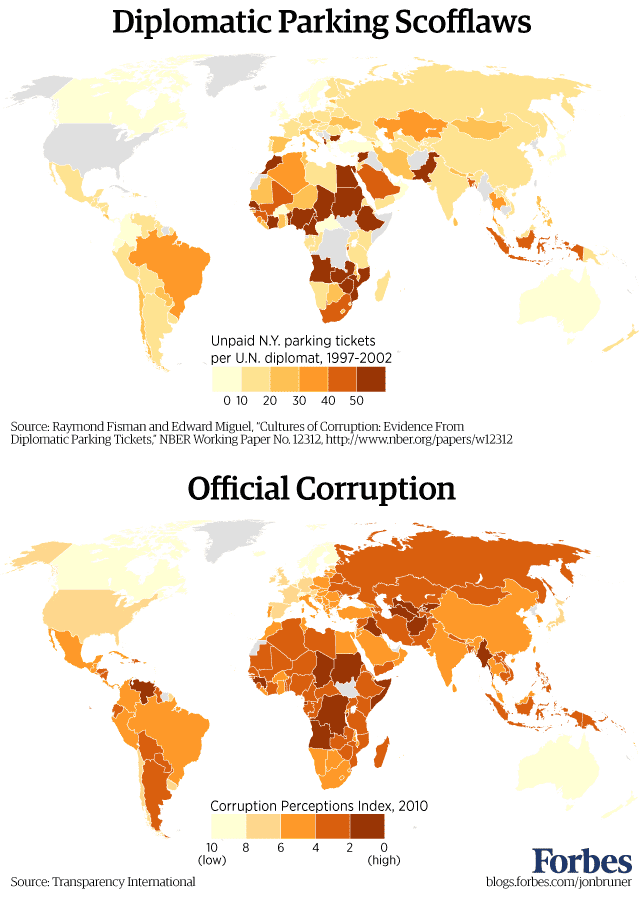
Tim Harford linked to this Forbes graphic showing an interesting correlation:

This nicely illustrates what he wrote in 2006:

An alternative view, popular among the common-sense crowd, is that corruption is a problem in Indonesia because Indonesians are crooks by nature; poor countries are poor because they are full of people who are lazy or stupid or dishonest. I disagree out of faith, rather than because the evidence is compelling. But then, what evidence could there be? You would need to take people from every culture, put them somewhere where they could ignore the law with impunity, and see who cheated and who was honest.

That sounds like a tall order for any research strategy, but the economists Ray Fisman and Edward Miguel have realised that diplomats in New York city were, in fact, the perfect guinea pigs. Diplomatic immunity meant that parking tickets issued to diplomats could not be enforced, and so parking legally was essentially a matter of personal ethics.

Fisman and Miguel found support for the common-sense view. Countries with corrupt systems, as measured by Transparency International, also sent diplomats who parked illegally. From 1997-2005, the Scandinavians committed only 12 unpaid parking violations, and most of them were by a single criminal mastermind from Finland. Chad and Bangladesh, regularly at the top of corruption tables, produced more than 2,500 violations between them. Perhaps poor countries are poor because they are full of corrupt people, after all.

July 23, 2011

Today’s drive-by smear courtesy of the Globe & Mail

Filed under: Asia, Cancon — Tags: , , — Nicholas @ 09:50

The Globe‘s Steve Rennie must think he’s blown the lid off a dark, sordid conspiracy, the way he reports on the booze tab of the Canadian embassy in Kabul:

Canada’s diplomatic corps in Kabul did not go thirsty.

Hospitality forms show embassy staff and dignitaries drank plenty of booze while posted to Afghanistan, an Islamic country where imbibing is not just taboo, it’s against the law.

But aren’t the grounds of an official embassy are considered to be part of the country whose embassy it is? If so, then the embassy grounds are under Canadian jurisdiction, where alcohol is quite legal.

The embassy consumed close to 3,000 bottles of alcoholic beverages from mid-2007 to last November. The tab for the beer, wine and hard liquor was at least $20,000.

Unfortunately, no numbers of people are provided — we’re invited to imagine all this booze being consumed by a few red-nosed diplomats with livers the size of Etobicoke. No, later in the article, he mentions that it was more than just a couple of soused embassy officials keeping the bar open:

There were sendoffs for departing staffers and shindigs to welcome new ones. The embassy entertained visiting generals, diplomats, journalists and politicians.

At about this point, after sneering at the diplomat’s choices of beer, Rennie realizes perhaps he needs to heighten the contrast, by showing that the soldiers and civilians operating in Kandahar had it tougher:

It was not the same for Canadians serving in the country’s restive south. Booze was banned at Kandahar Airfield and at Camp Nathan Smith in Kandahar City. Soldiers, diplomats and civilians stationed there had to wait until holidays or special events for a cold one. And there was little danger of getting tipsy with a strict two-beer limit.

But as Rennie had already pointed out, the Kandahar installations were in the middle of an Islamic country that formally prohibits booze. Even if it’s a Canadian Armed Forces base, it has to observe the laws of the country in which it’s situation — it’s not Canadian soil in the way the embassy is. Not to mention that Kandahar was a fricking war zone: armies that drink booze while on active operations against an enemy are less effective armies.

Oh, but then we’re back to those awful alcoholics in the diplomatic corps, who were drinking in “an Islamic country where imbibing is not just taboo, it’s against the law”. Rennie must have forgotten writing that in the first few paragraphs, as it doesn’t mesh well with this later assertion:

Beyond the fortified walls of the embassy, there is no shortage of watering holes around Kabul for the many diplomats, aid workers and journalists who call the city home.

At one time, some popular hang outs included the Tex-Mex restaurant La Cantina and the Gandamak Lodge, a guest house with a British pub in the basement set up by a BBC journalist a decade ago after the Taliban regime fell.

Under Afghan law, anyone caught drinking alcohol can be fined, jailed or whipped. But these punishments are rarely handed down.

Didn’t you just trump your own ace there?

H/T to Chris Myrick for posting the link to this article on Google+, saying “I don’t blame them at all. I imagine Kabul would be intolerable otherwise.”

July 17, 2011

Nick Gillespie and Matt Welch on a libertarian foreign policy

Filed under: Government, Military, Politics, USA — Tags: , , , , , — Nicholas @ 12:31

The third part of an interview with Gillespie and Welch, covering libertarian foreign policy ideas:

June 13, 2011

QotD: Canadian foreign policy

Filed under: Cancon, Government, Media, Politics, Quotations — Tags: , — Nicholas @ 12:03

Further proof of the Americanization of our politics: the journalistic elevation of the drunkard’s walk known as Stephen Harper’s foreign policy to the level of a “doctrine.” We spent the post-Gulf War nineties hearing about “the Powell doctrine”, and in 2001, Charles Krauthammer gave George W. Bush a doctrine of his own as a post 9/11 present. Today, the Globe and Mail’s John Ibbitson gifts our prime minister with his very own “Harper Doctrine,” spelled out as follows:

     “We know where our interests lie and who our friends are,” he declared, “and we take strong, principled positions in our dealings with other nations, whether popular or not.”

I’m no foreign policy guy, and John Ibbitson has taught me more about how Canada works over the years than I like to admit. But apart from supporting Israel “four-square, without reservation” — which Harper does seem keen on — I don’t see the evidence for the rest of it. “No foreign aid funding for abortion” doesn’t seem like much of a doctrine to me. As for “aggressively asserting our sovereignty in the North” … how so?

Andrew Potter, “Canada’s foreign policy, in black and white and orange”, Maclean’s, 2011-06-13

May 13, 2011

Will China’s rise eclipse the United States?

Filed under: China, Economics, History, USA — Tags: , — Nicholas @ 09:49

Jon sent me this link, suggesting that it was good “hobby horse bedding”. It starts with the notion that the pattern (and method) of China’s rise to economic superpower status actually follows that of the United States:

The last time a rising power came bursting onto the international scene and successfully supplanted the existing dominant power was when the United States was a boisterous upstart with a stampeding economy. Back then, America employed its own ruthless political machinations to advantage economic production — slavery and Andrew Jackson’s Indian removal policies made cotton king, while the three-fifths compromise ensured southern political control of Congress.

Meanwhile, we stole designs of British factories for replication here, jump-starting our own industrial revolution. And we forced Britain into a two-front war in the midst of its cataclysmic fight with Napoleon. To outside appearances, America orchestrated political, military, and economic power in ways that shrewdly upended existing rules to our advantage.

Just enough historical parallels to make an interesting story. But the Chinese are not (yet) in a position to actually supplant the Americans, and much of the reason for that isn’t so much economic as it is political:

America is the democracy that those people living under authoritarian regimes choose whenever they get the opportunity. It is a democracy often mistaken in the short run, with the best means of correcting itself, and by its sheer existence, a reminder to others of what they might make for and of themselves. The international order is genuinely different because of the rise of an economically and politically liberal American polity. The Chinese model doesn’t have the kind of advantages that make for success competing against the American one. There’s no reason to believe Chinese citizens aren’t yearning for what Americans get to take for granted. To the contrary, there are many signs that the Chinese are increasingly agitating for it.

American power is robust and enduring because it is built on the strength of ideals that foster our advantage. China is banking on prosperity reducing the desire for political rights, on centralized control by elites that will make “better” choices than individuals would make for themselves, on nationalism and grievance to trump the appeal of values we claim to be universal, on mercantilist foreign policies and the threat of force making them preferred allies. It didn’t work for Palmerston in a much more conducive age and it is unlikely to work for China’s leaders.

A quick search of the blog will come up with lots of posts on China and its economy. This is what Jon refers to as my “hobby horse”.

March 8, 2011

“El Neil” goes to town on the United Nations

Filed under: Bureaucracy, Government, Liberty — Tags: , , , — Nicholas @ 09:07

L. Neil Smith isn’t fond of the UN. I mean really not fond of them:

The UN was conceived in 1939, a brain-child of Franklin Delano Roosevelt and his buddies, who had failed to understand the lesson to be learned from the collapse of its ludicrous predecessor, the League of Nations, that the people of a war-weary planet, fed up to here with self-important bloviating cretins in funny hats ordering them around, were not interested in a world government, or anything even resembling one.

Instead, all the really important people — the equivalents, in 1945, of Barack and Michelle Obama, Bill and Hillary Clinton, Harry Reid, Nancy Pelosi, Barney Frank — got together in one meeting after another, and without so much as a nod at voters and taxpayers forced at gunpoint to support this gaggle of worthless preening parasites, established the UN in its now-crumbling headquarters on the Hudson River.

Its single all-important mission? To succeed where Alexander the Great, Julius Caesar, Napoleon Bonaparte, Vladimir Lenin, Joseph Stalin, and Adolf Hitler had all failed: at the involuntary expense of individuals who actually worked for a living, try to take over the world.

Since the ignominious collapse of the Soviet Union, the new world nerve center for socialism is the UN, which is no less an enemy of everything worthwhile in the western world than Hitler and Stalin were. The UN has been at the very hub of the global warming hoax since the conspiracy began. It has done everything it can to limit American industrial technology and reduce us all to a prehistoric standard of living. It demands the authority to reach into otherwise sovereign countries and extract and punish those who fail to comply with its edicts. The UN admits openly that it wishes to obliterate the American Constitution — especially the Bill of Rights — with an hysterical emphasis on the Second Amendment. And now we’re beginning to have a clearer idea what it wants to substitute in place of those ideas and institutions.

[. . .]

The nearest equivalent to what the UN has in mind for all of us is the infamous Highland Clearances” of the 18th and 19th centuries, when English “landowners” evicted the Scots they had conquered, by the hundreds of thousands, burning whole villages and forcing the Scots to leave their crops rotting in the ground, compelling a people who had been cattlemen for generations to harvest seaweed on the cold and rocky coast — or emigrate to the Americas — so aristocrats could “ride to hounds” and replace their displaced victims on the land with sheep.

February 10, 2011

Workplace diplomacy

Filed under: Bureaucracy, Randomness — Tags: , , — Nicholas @ 12:42

An aside to an email discussion we were having provoked DarkWaterMuse to post his thoughts on the matter:

Diplomacy is a major cause of workplace inefficiency. Mostly, it doesn’t actually matter how things get said.

dwm tends to say whatever is rattling around at the top of his head. Too often what rattles around up there then manages to roll down mysterious passageways carved throughout his brain before it tumbles off the tip of his tongue.

Sometimes the words that escape just lay there, stunned and motionless on the floor, as other people in earshot simply glare at them.

Even worse though is when dwm doesn’t say anything at all. That probably means either there’s a log jam of words building up pressure inside his head, a clear sign of imminent unbounded and unpredictable cranial flatulence, or he’s mentally undressing one of the women who happens to be trapped in the same meeting room.

dwm has never really appreciated the need for diplomacy. Especially when there’s clearly work to be done. He subscribes to the notion that people like to be part of success, however it manages to manifest.

As it turns out, diplomacy isn’t necessary for success. It’s just necessary to manage the people who aren’t focused on it.

I’m not convinced, as I’ve found diplomacy to be one of the most frequently used “tools” in my arsenal. I suspect DarkWaterMuse, as primarily a “producer” of essentially original content has less functional need for the social lubricant of careful wording than someone like me (a “consumer” if you will), who generally requires the active co-operation of others to provide me with the raw material I happen to need to accomplish my tasks.

His point about diplomacy being “a major cause of workplace inefficiency” would more closely hit the mark if he were using it to describe weasel wording rather than diplomacy. As Sir Humphrey Appleby says “A good Civil Servant must be able to use language not as a window into the mind but as a curtain to draw across it.” What is ideal for a civil servant is toxic for good working relationships in non-bureaucratic environments.

February 4, 2011

As expected, BBC offers apology for Top Gear anti-Mexican remarks

Filed under: Americas, Britain, Media — Tags: , , , , , — Nicholas @ 08:26

It still won’t change anything:

The BBC has now obliged, with a statement which concedes that while the remarks were “rude” and “mischievous”, there was “no vindictiveness” behind them.

The Corporation continues: “Our own comedians make jokes about the British being terrible cooks and terrible romantics, and we in turn make jokes about the Italians being disorganised and over dramatic, the French being arrogant and the Germans being over-organised.”

It adds that “stereotype-based comedy was allowed within BBC guidelines in programmes where the audience knew they could expect it, as was the case with Top Gear“.

The apology concludes: “Whilst it may appear offensive to those who have not watched the programme or who are unfamiliar with its humour, the executive producer has made it clear to the ambassador that that was absolutely not the show’s intention.”

Indeed, said executive producer apologised personally to señor Medina-Mora Icaza, and we look forward to seeing that meeting on Top Gear in due course, complete with witty commentary from Clarkson, Hammond and May.

February 2, 2011

BBC’s Top Gear team spark hostile response from Mexico

Filed under: Americas, Britain, Media — Tags: , , , , , , , — Nicholas @ 09:25

I guess that diplomats must do things like this, but anyone who’s watched more than five minutes of Top Gear would not take them seriously as political commentators. Hilariously funny, yes, but not particularly representative of British or British government views. Mexico, however, has chosen to take offense and has sent a demand to the BBC for a formal apology:

The irreverent British motoring show “Top Gear” has driven into diplomatic hot water after a host branded a Mexican car “lazy, feckless and flatulent” and said it mirrored Mexico’s national characteristics.

Mexico’s ambassador to Britain fired off a letter to the state broadcaster protesting the show’s “outrageous, vulgar and inexcusable insults” and demanding an apology.

In the episode, host Richard Hammond likened a Mexican sports car to “a lazy, feckless and flatulent oaf with a mustache, leaning against a fence asleep, looking at a cactus with a blanket with a hole in the middle on as a coat.”

Co-host James May went on to describe Mexican food as “like sick with cheese on it,” or “refried sick,” while Jeremy Clarkson predicted they would not get any complaints about the show because “the ambassador is going to be sitting there with a remote control, snoring.”

I’m sure the BBC will provide the requested apology, but I doubt that it will change anything. Top Gear without the over-the-top commentary would be just another bloody car show.

January 26, 2011

Nostalgia for the Dreadnought era?

Filed under: China, Economics, Germany, History, WW1 — Tags: — Nicholas @ 09:03

Ambrose Evans-Pritchard finds the parallels between the rise of Imperial Germany in the years leading up to the first world war and attitudes toward China today:

And we all learned how the Kaiser overplayed his hand. That much was obvious.

Yet it is difficult to pin-point exactly when the normal pattern of great power jostling began to metamorphose into something more dangerous, leading to two rival, entrenched, and heavily armed alliance structures unable or unwilling to avert the drift towards conflict. The Long Peace died by a thousand cuts, a snub here, a Dreadnought there, the race for oil.

[. . .]

Is China now where Germany was in 1900? Possibly. There are certainly hints of menace from some quarters in Beijing. Defence minister Liang Guanglie said over New Year that China’s armed forces are “pushing forward preparations for military conflict in every strategic direction”.

Professor Huang Jing from Singapore’s Lee Kwan Yew School and a former adviser to China’s Army, said Beijing is losing its grip on the colonels.

“The young officers are taking control of strategy and it is like young officers in Japan in the 1930s. This is very dangerous. They are on a collision course with a US-dominated system,” he said.

The problem with drawing parallels from history is that it’s never as neat and clean-cut as you’d expect. First, China is supposed to be like Kaiser Wilhelm’s Germany, then more like Japan after WW1. I have to say I’m not totally following this line of thought. But, getting back to today’s situation:

There is a new edge to Chinese naval policy in the South China Sea, causing Japan, Vietnam, Indonesia, and the Philippines to cleave closer to the US alliance. Has Beijing studied how German naval ambitions upset the careful diplomatic legacy of Bismarck and pushed an ambivalent Britain towards the Entente, even to the point of accepting alliance with Tsarist autocracy?

Factions in Beijing appear to think that China will win a trade war if Washington ever imposes sanctions to counter Chinese mercantilism. That is a fatal misjudgement. The lesson of Smoot-Hawley and the 1930s is that surplus states suffer crippling depressions when the guillotine comes down on free trade; while deficit states can muddle through, reviving their industries behind barriers. Demand is the most precious commodity of all in a world of excess supply.

H/T to Jon, my former virtual landlord, for the link.

« Newer PostsOlder Posts »

Powered by WordPress

