Quotulatiousness

June 27, 2020

Canada’s “Gang of 19” urges abject surrender and hostage exchange with China

Filed under: Cancon, China, Government, Law, Politics — Tags: , , , , — Nicholas @ 03:00

As Canadian political life continues to revolve more and more around the Chinese model, we now have our very own political “gang”, just like China did!
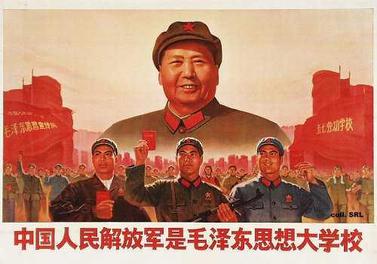
“The Chinese People’s Liberation Army is the great school of Mao Zedong Thought”, 1969.
A poster from the Cultural Revolution, featuring an image of Chairman Mao.
Image via Wikimedia Commons.

A former leader of the New Democratic Party of Canada. A former Conservative foreign minister. Two former Liberal foreign ministers. Four former Canadian ambassadors to the United Nations, under Liberal and Tory governments. Two former Canadian ambassadors to the United States, under Liberal and Tory governments. A former Supreme Court justice. A former Liberal justice minister. A former Conservative senator. A flock of name-brand diplomats. Former CBC host Don Newman, for some reason.

This is the panoply of 19 elite opinion-makers that gathered in the Laurentian Boardroom at an online hotel and drafted a letter, released Wednesday, calling on Prime Minister Justin Trudeau to intervene in the extradition process, set Huawei CFO Meng Wangzhou free, and thereby secure the release of Canadians Michael Kovrig and Michael Spavor.

China, last seen denying the two men’s detention had anything to do with Meng, had changed its tune just hours earlier on Wednesday: Freeing her might “open up space for resolution to the situation of the two Canadians,” foreign ministry spokesman Zhao Lijian said.

And who stands in the way? A prime minister who was perfectly happy to stick his thumb on the scales of justice to save a cherished member of Quebec Inc. from the indignity of prosecution for rather flamboyant alleged corporate malfeasance in and concerning Gaddafi-era Libya (or to “save jobs,” if you prefer, although it emerged no one in Justin Trudeau’s government had bothered to inquire how many jobs might actually be lost if SNC-Lavalin were convicted).

You can hardly blame China for noting the precedent. And it’s sorely fitting that the Gang of 19 addressed their letter to Trudeau rather than to the fellow who would actually have to give the order: Justice Minister David Lametti. We all know who calls the shots in that particular relationship. Perhaps it’s best we just admit it.

Colby Cosh also finds the advice proffered to the Prime Minister to be … less than admirable:
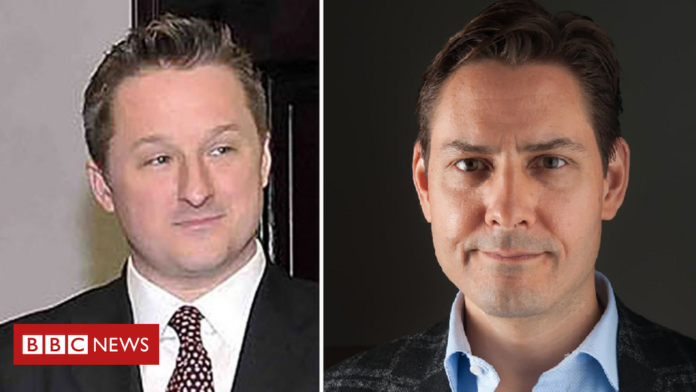
Screen capture of a BBC News report on Canadians Michael Kovrig and Michael Spavor facing espionage charges in China.

I wanted to discuss the letter written by the 19 geriatric Canadian worthies who encouraged the Prime Minister to trade Huawei executive Meng Wanzhou, in Canadian custody fighting extradition to the U.S., for the “two (Canadian) Michaels” detained on ill-defined espionage charges in China. Colleague Chris Selley has gone over the ground, but that’s show biz for you. Selley concluded his overview by pointing out that the letter argues perversely for “surrender, then victory.” With the Meng-Michaels standoff out of the way, the various ex-diplomats and superannuated politicians argued, Canada could use the opportunity for a fresh foreign-policy start, deciding what “tough steps” ought to be taken against China. If any.

The letter, part of a campaign on the two Michaels’ behalf led by ex-Supreme Court Justice Louise Arbour and ex-justice minister Allan Rock, is self-refuting in parts. Yielding “to bullying or blackmail” is “repugnant,” the authors admit, while advising just that. But “resisting China’s pressure is no guarantee that it will never be applied again in the future … China might well decide that next time it will need to escalate by detaining more than two Canadians.”

The implication, if this argument is to have any force, is that actively rewarding China’s abduction of our citizens is a jim-dandy way of making sure it never happens again. The problem with this reasoning is obvious, but the authors are also careful not to define victory too precisely. They say that letting Meng go and getting Michael Kovrig and Michael Spavor back would permit Canada to “declare its position on Huawei’s involvement in the deployment of 5G technology in Canada,” a decision “that has been postponed time and again.”

Sooo … the authors think we should slam the door on Huawei, whose CEO is Meng’s father? They don’t say so! They only say that settling this quarrel would make it easier for us to decide. And they are only slightly clearer on issues of human rights in China and Hong Kong, which our current government and foreign service are allegedly being shy about “so as not to make the situation worse for the Canadian prisoners.”
June 14, 2020

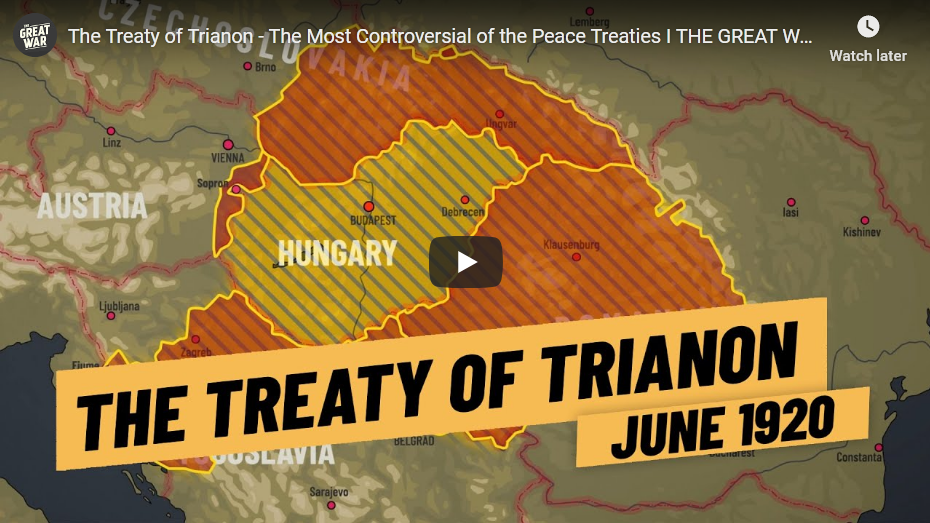
The Treaty of Trianon – The Most Controversial of the Peace Treaties I THE GREAT WAR 1920

The Great War
Published 13 Jun 2020

Sign up for Curiosity Stream and get Nebula bundled in: https://curiositystream.com/thegreatwar

The last of the big peace treaties signed in Paris that finalized the borders in Europe was the Treaty of Trianon. Even at the time, Hungarians considered it a historic injustice while nations such as Czechoslovakia, Romania and Yugoslavia were quite happy with the result. We examine how the treaty was signed and negotiated.

» SUPPORT THE CHANNEL
Patreon: https://www.patreon.com/thegreatwar
Merchandise: https://shop.spreadshirt.de/thegreatwar/

» SOURCES
Isaiah Bowman, The New World-Problems in Political Geography, (Yonkers-on-Hudson: World Book Company, 1921)

Francis Deák & Dezsó Ujváry, Paper and Documents Relating to the Foreign Relations of Hungary, Volume 1; 1919-1920, (Budapest: Royal Hungarian Ministry of Foreign Affairs, 1939)

Conan Fischer, Europe between democracy and dictatorship, 1900-1945, (Chichester: Malden, MA: Wiley-Blackwell, 2011)

Mike Gyula (ed.), Magyar Statisztikai Zsebkönyv, 1940 [Hungarian Statistical Pocket Book 1940], (Központi Statisztikai Hivatal: Budapest, 1940)

Róbert Győri & Charles W.J. Withers, “Trianon and its aftermath: British geography and
the ‘dismemberment’ of Hungary, c.1915-c.1922”, Scottish Geographical Journal, 135:1-2 (2019)

Michael Károlyi, Memoirs of Michael Károlyi: Faith Without Illusion (London: Jonathan Cape, 1956)

Jörn Leonhard, Der überforderte Frieden: Versailles und die Welt 1918-1923, (Bonn: bpp, Bundeszentrale für Politische Bildung, 2019)

C.A. Macartney, Hungary and her successors: the treaty of Trianon and its consequences 1919-1937, (London: Oxford University Press, 1937)

Margaret MacMillan, Paris 1919: Six Months That Changed the World, (London: Macmillan, 2019)

Arnold Suppan, The Imperialist Peace Order in Central Europe: Saint-Germain and Trianon, 1919–1920, (Vienna: Austrian Academy of Sciences Press, 2019)

Miklós Zeidler; Thomas J. DeKornfeld; Helen DeKornfeld, “Ideas on Territorial Revision in Hungary, 1920-1945”, East European Monographs, 717, (2010)
Miklós Zeidler, Trianon, (Budapest, Osiris, 2003.)

» SOCIAL MEDIA
Instagram: https://instagram.com/the_great_war
Twitter: https://twitter.com/WW1_Series
Reddit: https://reddit.com/r/TheGreatWarChannel

»CREDITS
Presented by: Jesse Alexander
Written by: Jesse Alexander
Director: Toni Steller & Florian Wittig
Director of Photography: Toni Steller
Sound: Toni Steller
Editing: Toni Steller
Mixing, Mastering & Sound Design: http://above-zero.com
Maps: Daniel Kogosov (https://www.patreon.com/Zalezsky)
Research by: Jesse Alexander
Fact checking: Florian Wittig

Channel Design: Alexander Clark
Original Logo: David van Stephold

A Mediakraft Networks Original Channel

Contains licensed material by getty images
All rights reserved – Real Time History GmbH 2020

June 2, 2020

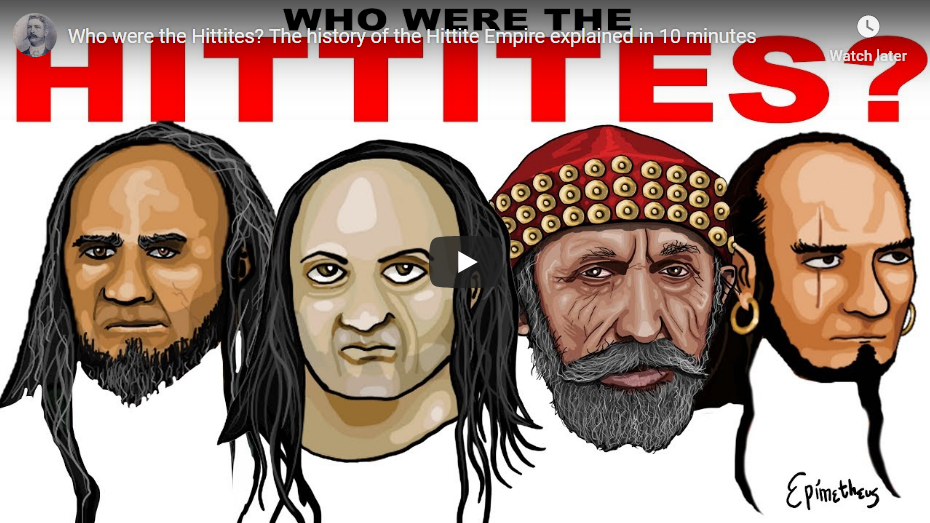
Who were the Hittites? The history of the Hittite Empire explained in 10 minutes

Filed under: History, Middle East — Tags: , , , , , , , — Nicholas @ 06:00

Epimetheus
Published 30 Nov 2018

Who were the Hittites? (The Hittite Empire explained in 10 minutes) Animated history

Support new videos from Epimetheus on Patreon! 😀
https://www.patreon.com/Epimetheus1776

May 30, 2020

The Spanish Flu Influenza Pandemic 1918 – 1920 I THE GREAT WAR 1920

The Great War
Published 29 May 2020

Sign up for Curiosity Stream and get Nebula bundled in: https://curiositystream.com/thegreatwar

It was far deadlier than even the global war that had preceded it: The Influenza pandemic or Spanish Flu that hit the world between 1918 and 1920 in multiple waves.

» SUPPORT THE CHANNEL
Patreon: https://www.patreon.com/thegreatwar
Merchandise: https://shop.spreadshirt.de/thegreatwar/

» SOURCES
Barry, John M. The Great Influenza: The Story of the Deadliest Pandemic in History, (New York : Penguin Books, 2018)
Byerly, Carol R. ‘The U.S. Military and the Influenza Pandemic of 1918–1919’ Public Health Reports; 125 Supplement 3 (Apr. 2010)
Crosby, Alfred W, America’s forgotten pandemic : the influenza of 1918, (Cambridge : Cambridge University Press, 2003)
Hoover, Irwin Hood, Forty-two years in the White House, (New York : Houghton Mifflin Co., 1934)
Killingray, David & Phillips, Howard, (eds.) The Spanish Influenza Pandemic of 1918-19: New Perspectives, (London : Routledge, 2011)
Johnson, NP & Mueller J, ‘Updating the accounts: global mortality of the 1918-1920 “Spanish” influenza pandemic’ Bulletin of the History of Medicine. 76(1) (Spring 2002)
Dock, Lavinia et al., History of American Red Cross Nursing (1922)
Macdonald L. The Roses of No Man’s Land. (London : Penguin Books, 1993)
Robertson, John Dill, ‘Spanish Influenza — The Flu’ The Public Health Journal Vol. 9, No. 10 (Oct 1918)
Rosner, David, ‘”Spanish flu, or whatever it is…”: The paradox of public health in a time of crisis’ Public Health Reports, 125 Supplement 3, (Apr. 2010)
Stanford University, ‘The Influenza Pandemic of 1918’ https://virus.stanford.edu/uda/
“Surgeon General’s Advice to Avoid Influenza”: Washington Evening Star, (Sept. 22, 1918)
Wever, Peter C & van Bergen, Leo, ‘Death from 1918 pandemic influenza during the First World War: a perspective from personal and anecdotal evidence’ Influenza Other Respiratory Viruses, 8(5), (Sept 2014)
https://www.lefigaro.fr/livres/2008/1…

» SOCIAL MEDIA
Instagram: https://instagram.com/the_great_war
Twitter: https://twitter.com/WW1_Series
Reddit: https://reddit.com/r/TheGreatWarChannel

»CREDITS
Presented by: Jesse Alexander
Written by: Jesse Alexander
Director: Toni Steller & Florian Wittig
Director of Photography: Toni Steller
Sound: Toni Steller
Editing: Toni Steller
Mixing, Mastering & Sound Design: http://above-zero.com
Maps: Daniel Kogosov (https://www.patreon.com/Zalezsky)
Research by: Jesse Alexander
Fact checking: Florian Wittig

Channel Design: Alexander Clark
Original Logo: David van Stephold

A Mediakraft Networks Original Channel

Contains licensed material by getty images
All rights reserved – Real Time History GmbH 2020

May 1, 2020

Why Pearl Harbor? Peaceful Portugal, and the poor Kriegsmarine – WW2 – OOTF 011

Filed under: Britain, Europe, Germany, History, Japan, Military, WW2 — Tags: , , , — Nicholas @ 06:00

World War Two
Published 30 Apr 2020

How were relations between Japan and the United States at the beginning of the war? What were both sides doing to try and make Portugal enter the war? And to what extent did the Kriegsmarine match the Royal Navy? Find out as we answer these questions in this Out of the Foxholes episode!

Links to the Between 2 Wars videos mentioned in the episode:
Japan, the Bureaucratic War Machine | BETWEEN 2 WARS I 1931 Part 2 of 3: https://youtu.be/vVgCy6iwrHQ
The World Takes Advantage of American Isolationism | BETWEEN 2 WARS | 1933 part 3 of 3: https://youtu.be/-iuQcxXAdfw
Did WW2 Start in 1937? – The Rape of China | BETWEEN 2 WARS I 1937 Part 1 of 2: https://youtu.be/_3vPGpamtDI

Join us on Patreon: https://www.patreon.com/TimeGhostHistory
Or join The TimeGhost Army directly at https://timeghost.tv

Follow WW2 day by day on Instagram @World_war_two_realtime https://www.instagram.com/world_war_t…
Between 2 Wars: https://www.youtube.com/playlist?list…
Source list: http://bit.ly/WW2sources

Hosted by: Indy Neidell
Written by: Rune Væver Hartvig
Director: Astrid Deinhard
Producers: Astrid Deinhard and Spartacus Olsson
Executive Producers: Astrid Deinhard, Indy Neidell, Spartacus Olsson, Bodo Rittenauer
Creative Producer: Joram Appel
Post-Production Director: Wieke Kapteijns
Research by: Rune Væver Hartvig
Edited by: Mikołaj Cackowski
Sound design: Marek Kamiński
Map animations: Eastory (https://www.youtube.com/c/eastory)

Colorizations by:
Carlos Ortega Pereira, BlauColorizations, https://www.instagram.com/blaucoloriz…
Dememorabilia – https://www.instagram.com/dememorabilia/

Sources:
BIBLIOTECA DE ARTE DA FUNDAÇÃO CALOUSTE GULBENKIAN
Bundesarchiv

Soundtracks from the Epidemic Sound:
Reynard Seidel – “Deflection”
Fabien Tell – “Last Point of Safe Return”
Johannes Bornlof – “Deviation In Time”

Archive by Screenocean/Reuters https://www.screenocean.com.

A TimeGhost chronological documentary produced by OnLion Entertainment GmbH.

April 27, 2020

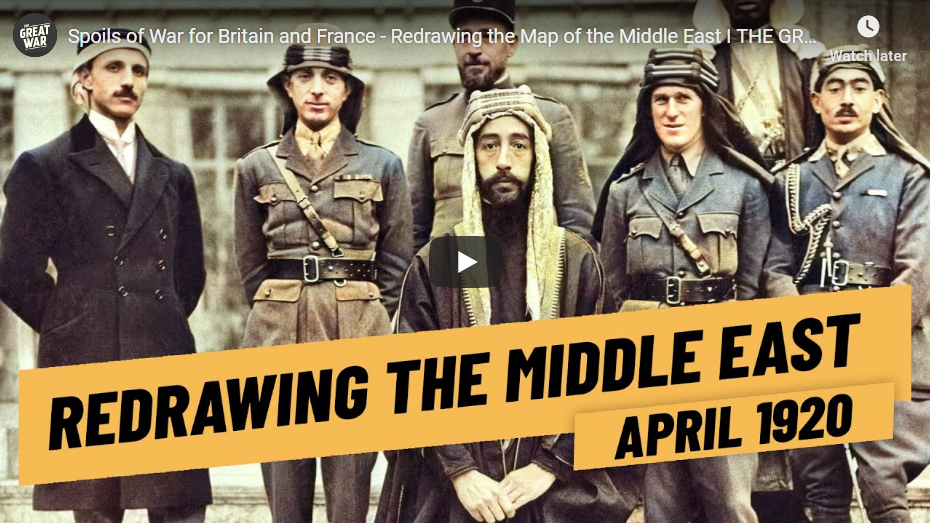
Spoils of War for Britain and France – Redrawing the Map of the Middle East I THE GREAT WAR 1920

The Great War
Published 25 Apr 2020

Sign up for Curiosity Stream and Nebula – and get 40% off annual plans right now: https://curiositystream.com/thegreatwar

100 years ago at the conference of San Remo, one thing became clear: Great Britain and France wanted control over the Middle East. Justified by the fighting in the previous years and painted as “liberators” of the Middle Eastern minorities, the new map of the Middle East emerged – under the cover of the League of Nations Mandate system.

» SUPPORT THE CHANNEL
Patreon: https://www.patreon.com/thegreatwar
Merchandise: https://shop.spreadshirt.de/thegreatwar/

» SOURCES
Karsh, Efraim & Karsh, Inari, Empires of the Sand: The Struggle for Mastery in the Middle East 1789-1923, (Cambridge, MA : Harvard University Press, 1999)

“Dans Le Levant” Le Temps, August 31, 1919 issue, https://gallica.bnf.fr/ark:/12148/bpt…

Lloyd George, David, Memoirs of the Peace Conference, (New Haven : Yale University Press, 1939) vol. 2

“Mounted Rifles Units” New Zealand History, https://nzhistory.govt.nz/war/aucklan…

Paris, Timothy J. Britain, The Hashemites and Arab Rule 1920-1925, (London : Frank Cass, 2003)

Provence, Michael, The Last Ottoman Generation and the Making of the Modern Middle East, (Cambridge : Cambridge University Press, 2017)

O’Neill, Robert, Official History of Australia in the War of 1914–1918, Volume VII – The Australian Imperial Force in Sinai and Palestine, 1914–1918, (Australian War Memorial, 1941)

“King-Crane Commission Digital Collection” Oberlin College Library. http://dcollections.oberlin.edu/cdm/s…

» SOCIAL MEDIA
Instagram: https://instagram.com/the_great_war
Twitter: https://twitter.com/WW1_Series
Reddit: https://reddit.com/r/TheGreatWarChannel

»CREDITS
Presented by: Jesse Alexander
Written by: Jesse Alexander
Director: Toni Steller & Florian Wittig
Director of Photography: Toni Steller
Sound: Toni Steller
Editing: Toni Steller
Mixing, Mastering & Sound Design: http://above-zero.com
Maps: Daniel Kogosov (https://www.patreon.com/Zalezsky)
Research by: Jesse Alexander
Fact checking: Florian Wittig

Channel Design: Alexander Clark
Original Logo: David van Stephold

A Mediakraft Networks Original Channel

Contains licensed material by getty images
All rights reserved – Real Time History GmbH 2020

April 12, 2020

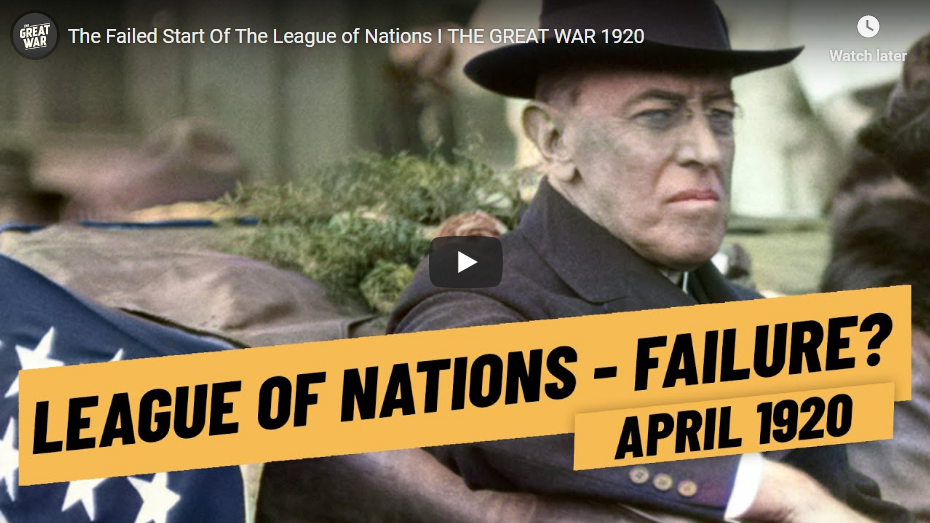
The Failed Start Of The League of Nations I THE GREAT WAR 1920

Filed under: Europe, History, Military, USA, WW1 — Tags: , , , , — Nicholas @ 04:00

The Great War
Published 10 Apr 2020

Sign up for Curiosity Stream and Nebula – and get 40% off annual plans right now: https://curiositystream.com/thegreatwar

The League of Nations was US President Woodrow Wilson’s tool for a new and peaceful world after the war of 1914-1918 — and the US should have been their most important member. But the United States never joined and today the League of Nations is often seen as a failure. Was it doomed from the start?

» SUPPORT THE CHANNEL
Patreon: https://www.patreon.com/thegreatwar
Merchandise: https://shop.spreadshirt.de/thegreatwar/

» SOURCES
“The Treaty of Peace with Germany (The Treaty of Versailles),” June 28, 1919, United States Statutes at Large, art. 1-440.

Walters, F.P. A History of the League of Nations. (Oxford, UK: Oxford University Press, 1952)

Link, Arthur et al., eds., The Papers of Woodrow Wilson, vol. 45 (1984)

Ray S. Baker and William E. Dodd, eds, The Public Papers of Woodrow Wilson: Authorized Edition, Vol. 1, (New York, 1924)

Matz, Nele, “Civilization and the Mandate System under the League of Nations as Origin of Trusteeship” in von Bogdandy, A and Wolfrum, R (eds.), Max Planck Yearbook of United Nations Law, Volume 9, 2005

Braumoeller, Bear F. “The Myth of American Isolationism”, Foreign Policy Analysis Vol. 6, No. 4 (OCTOBER 2010), pp. 349-371

“March 19, 1920: Senate Rejects Treaty of Versailles for Second and Final Time” New York Times, https://learning.blogs.nytimes.com/20… /march-19-1920-senate- rejects-treaty-of-versailles-for-second-and-final-time/

Egerton, George W, “The Lloyd George Government and the Creation of the League of Nations”, The American Historical Review, Vol. 79, No. 2 (Apr., 1974), pp. 419-444

Burkman, Thomas W. “Japan and the League of Nations: AN ASIAN POWER ENCOUNTERS THE ‘EUROPEAN CLUB'”, World Affairs, Vol. 158, No. 1, Woodrow Wilson and the League of Nations: Part Two (SUMMER 1995), pp. 45-57

Rappart, William E. “Small States in the League of Nations”, Political Science Quarterly Vol. 49, No. 4 (Dec., 1934), pp. 544-575

Cox, James Middleston, Journey Through My Years, (Simon & Schuster: New York, 1946)

“THE BRITISH EMPIRE, THE LEAGUE OF NATIONS, AND THE UNITED STATES”, Advocate of Peace through Justice, Vol. 82, No. 7 (JULY, 1920), pp. 229-231

Dorsey, Leeroy G, “Woodrow Wilson’s Fight for the League of Nations: A Reexamination”, Rhetoric and Public Affairs, Vol. 2, No. 1 (Spring 1999), pp. 107-135

“The Covenant of the League of Nations” AVALON PROJECT, Yale Law School, https://avalon.law.yale.edu/20th_cent…

“Woodrow Wilson’s 14 Points”, AVALON PROJECT, Yale Law School, https://avalon.law.yale.edu/20th_cent…

Riddell, George Allardice, The Riddell diaries, 1908-1923, (London ; Dover, N.H. : Athlone Press, 1986)

» SOCIAL MEDIA
Instagram: https://instagram.com/the_great_war
Twitter: https://twitter.com/WW1_Series
Reddit: https://reddit.com/r/TheGreatWarChannel

»CREDITS
Presented by: Jesse Alexander
Written by: Mark Newton, Jesse Alexander
Director: Toni Steller & Florian Wittig
Director of Photography: Toni Steller
Sound: Toni Steller
Editing: Toni Steller
Mixing, Mastering & Sound Design: http://above-zero.com
Maps: Daniel Kogosov (https://www.patreon.com/Zalezsky)
Research by: Jesse Alexander
Fact checking: Florian Wittig

Channel Design: Alexander Clark
Original Logo: David van Stephold

A Mediakraft Networks Original Channel

Contains licensed material by getty images
All rights reserved – Real Time History GmbH 2020

April 11, 2020

QotD: Zhou Enlai’s famous “too early to say” comment on the French Revolution

Filed under: China, France, History, Media, Quotations, USA — Tags: , , , , — Nicholas @ 01:00

When Chinese premier Zhou Enlai famously said it was “too early” to assess the implications of the French revolution, he was referring to turmoil in France in 1968 and not — as is commonly thought — to the more distant political upheaval of 1789.

So says a retired American diplomat, Charles W. (Chas) Freeman Jr., who was present when Zhou made the comment during President Richard Nixon’s visit to China in February 1972.

Freeman, who was Nixon’s interpreter during the historic, weeklong trip, made the disclosure last week during a panel discussion in Washington about On China, the latest book by former Secretary of State Henry Kissinger.

The discussion was moderated by Richard McGregor, a journalist and China expert who wrote about Freeman’s comments for the Financial Times of London.

In an interview yesterday, Freeman elaborated on his recollection about Zhou’s comment, the conventional interpretation of which is frequently offered as evidence of China’s sage, patient, and far-sighted ways. Foreign Policy magazine, for example, referred last month to that interpretation, saying the comment was “a cautionary warning of the perils of judgments made in real time.”

The Washington Post‘s recent review of Kissinger’s book likewise referred to the conventional understanding of Zhou’s remark.

Freeman described Zhou’s misconstrued comment as “one of those convenient misunderstandings that never gets corrected.”

He said Zhou’s remark probably was made over lunch or dinner, during a discussion about revolutions that had succeeded and failed. They included, Freeman said, the Prague Spring of 1968 and the Hungarian uprising of 1956, both of which the Soviet Union crushed.

He said it was clear from the context and content of Zhou’s comment that in saying it was “too early to say” the Chinese leader was speaking about the events in France in May 1968, not the years of upheaval that began in 1789.

Freeman acknowledged that the conventional interpretation makes for a better story but added that it was “absolutely clear” from the context of the discussion that Zhou was speaking about 1968.

W. Joseph Campbell, “‘Too early to say’: Zhou was speaking about 1968, not 1789”, Media Myth Alert, 2011-06-14.

April 9, 2020

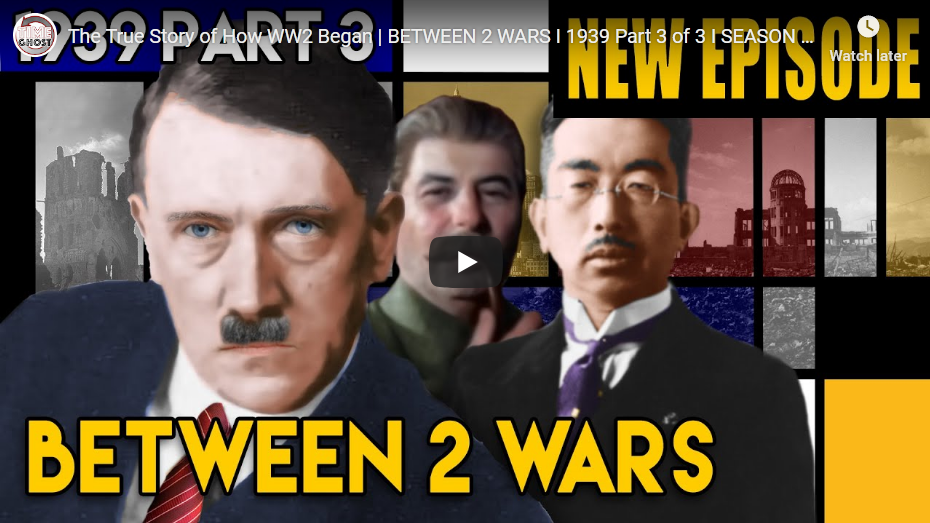
The True Story of How WW2 Began | BETWEEN 2 WARS I 1939 Part 3 of 3 I SEASON FINALE

Filed under: China, Europe, Germany, History, Japan, Military, Russia, WW2 — Tags: , , , , , — Nicholas @ 04:00

TimeGhost History
Published 8 Apr 2020

In this final episode of Season 1 of Between Two Wars we examine what caused the world to stand on the brink of total war in just two decades after the War to End All Wars. Events that end with three words through a phone line: “Grandmother is dead,” words that launch World War II.

Join us on Patreon: https://www.patreon.com/TimeGhostHistory

Hosted by: Indy Neidell
Written by: Spartacus Olsson
Directed by: Spartacus Olsson and Astrid Deinhard
Executive Producers: Bodo Rittenauer, Astrid Deinhard, Indy Neidell, Spartacus Olsson
Creative Producer: Joram Appel
Post-Production Director: Wieke Kapteijns
Research by: Spartacus Olsson
Edited by: Daniel Weiss
Sound design: Marek Kamiński

Sources:
From the Noun Project:
soldier By Wonmo Kang
coin stacks By emilegraphics

Colorizations by:
– Dememorabilia – https://www.instagram.com/dememorabilia/
– Olga Shirnina
– Spartacus Olsson
– Daniel Weiss

Soundtracks from Epidemic Sound:
– “Sophisticated Gentlemen” – Golden Age Radio
– “First Responders” – Skrya
– “Easy Target” – Rannar Sillard
– “The Inspector 4” – Johannes Bornlöf
– “Last Point of Safe Return” – Fabien Tell
– “Death And Glory 3” – Johannes Bornlöf
– “Split Decision” – Rannar Sillard
– “March Of The Brave 9” – Rannar Sillard
– “Mystery Minutes STEMS INSTRUMENTS” – Farrell Wooten
– “The Charleston 3” – Håkan Eriksson

Archive by Reuters/Screenocean http://www.screenocean.com

A TimeGhost chronological documentary produced by OnLion Entertainment GmbH.

From the comments:

TimeGhost History
1 day ago
Dear friends, this is the 58th and final episode of the first season of Between 2 Wars. Almost exactly two years ago, when the first episode went live, on April 14, 2018 we were three people. We had not started the WW2 channel yet. The TimeGhost Army had less than 100 members, and we had no idea where we would end up. As it turned out, it has been a magnificent journey through twenty years of history.

We are now a team of around sixteen individuals working on three channels and publishing more than five historical videos per week. And this is thanks to all of you who have graced us by watching, liking, commenting, and joining the TimeGhost Army. And it is especially thanks to the now over 4,000 members of the TimeGhost Army and their faithful contributions that we are able to do this at all. Thanks to you all, we can add a little bit of knowledge, a little bit of perspective, and hopefully a little bit of sanity (and also a measure healthy insanity) to the world.

It’s especially in times like these that we feel blessed by your support, so that we can continue our mission of remembrance and education. So it is with humble gratitude and some pride that we deliver this season finale. With your participation we will keep marching on, and try to do even more, even better, and exciting historical content.

Thank you all!

Let’s make history!

Spartacus

Definition note: when we use the term Socialist we always use the academic and dictionary definition: an ideology that aims to abolish private ownership of capital, goods, and enterprise to transfer it to the collective for use rather than profit. The means to achieve that being a violent revolution. We do not use the popular US redefinition of the word that makes it mean something vaguely like “anything the government does.”

April 8, 2020

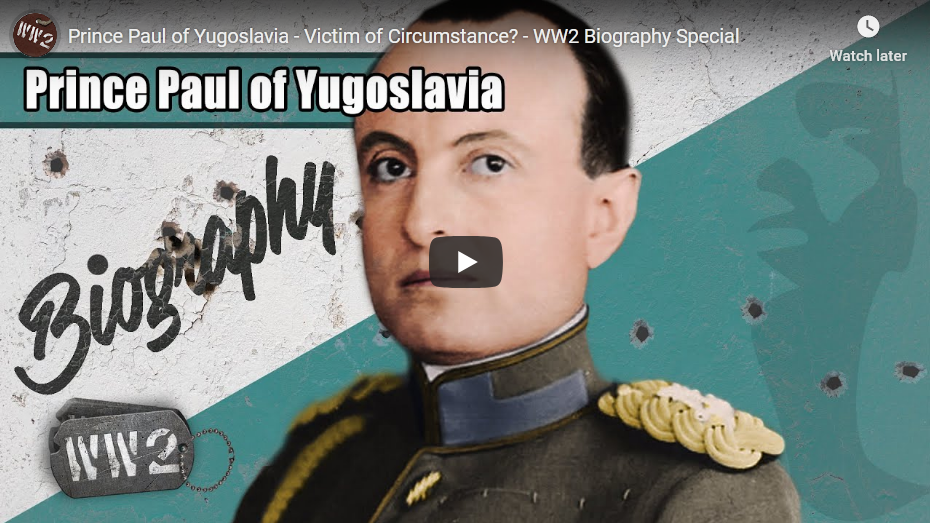
Prince Paul of Yugoslavia – Victim of Circumstance? – WW2 Biography Special

Filed under: Europe, Germany, Greece, History, Italy, Military, WW2 — Tags: , , , , , — Nicholas @ 04:00

World War Two
Published 7 Apr 2020

A Serb royal with an English heart sounds pretty romantic, but the story of Prince Paul of Yugoslavia is far from it. Trapped by circumstance, he is forced to make decisions that go against his own personal beliefs and leave him condemned as a traitor.

Join us on Patreon: https://www.patreon.com/TimeGhostHistory
Or join The TimeGhost Army directly at: https://timeghost.tv

Follow WW2 day by day on Instagram @World_war_two_realtime https://www.instagram.com/world_war_t…
Between 2 Wars: https://www.youtube.com/playlist?list…
Source list: http://bit.ly/WW2sources

Hosted by: Indy Neidell
Written by: Francis van Berkel
Produced and Directed by: Spartacus Olsson and Astrid Deinhard
Executive Producers: Bodo Rittenauer, Astrid Deinhard, Indy Neidell, Spartacus Olsson
Creative Producer: Joram Appel
Post-Production Director: Wieke Kapteijns
Research by: Tom Meaden
Edited by: Mikołaj Cackowski
Map animations: Eastory (https://www.youtube.com/c/eastory)

Colorizations by:
Dememorabilia – https://www.instagram.com/dememorabilia/
Carlos Ortega Pereira, BlauColorizations
Adrien Fillon – https://www.instagram.com/adrien.colo…

Sources:
Narodowe Archiwum Cyfrowe
USHMM
IWM MH 26392

Soundtracks from the Epidemic Sound:
Howard Harper-Barnes – “London”
Farell Wooten – “Blunt Object”
Philip Ayers – “Trapped in a Maze”
Johannes Bornlof – “The Inspector 4”
Gunnar Johnsen – “Not Safe Yet”
Andreas Jamsheree – “Guilty Shadows 4”

Archive by Screenocean/Reuters https://www.screenocean.com.

A TimeGhost chronological documentary produced by OnLion Entertainment GmbH.

April 2, 2020

A Soviet-Nazi Alliance – The Molotov-Ribbentrop Pact | BETWEEN 2 WARS I 1939 Part 2 of 3

Filed under: Europe, Germany, History, Military, Russia — Tags: , , , , , , — Nicholas @ 04:00

TimeGhost History
Published 1 Apr 2020

In 1939, two bitter rivals sign a non-aggression pact. But the treaty is something more than just a simple pledge of neutrality. Nazi Germany and the Soviet Union have also secretly agreed on how they will carve up Eastern Europe between them.

Join us on Patreon: https://www.patreon.com/TimeGhostHistory

Hosted by: Indy Neidell
Written by: Francis van Berkel
Directed by: Spartacus Olsson and Astrid Deinhard
Executive Producers: Bodo Rittenauer, Astrid Deinhard, Indy Neidell, Spartacus Olsson
Creative Producer: Joram Appel
Post-Production Director: Wieke Kapteijns
Research by: Francis van Berkel
Edited by: Daniel Weiss
Sound design: Marek Kamiński

Sources:
Bundesarchiv_Bild:
102-14436, 146-1977-159-11, 146-1982-159-22A,
146-1997-060-33A, 183-2006-1010-502, 183-H27337,
183-H28422, 183-R09876, 183-R14433, 183-S52480, RH 2/2292,
Novosti archive, image #409024 / Vladimir Grebnev

From the Noun Project:
killer with a gun By Arthur Shlain
guns by By Cards Against Humanity,
Shield By Laili Hidayati,

Photos from color by klimbim.

Colorizations by:
– Owen Robinson – https://www.instagram.com/owen.colori…
– Dememorabilia – https://www.instagram.com/dememorabilia/

Soundtracks from Epidemic Sound:
– “Last Point of Safe Return” – Fabien Tell
– “The Inspector 4” – Johannes Bornlöf
– “Easy Target” – Rannar Sillard
– “Split Decision” – Rannar Sillard
– “Death And Glory 1” – Johannes Bornlöf
– “First Responders” – Skrya
– “Disciples of Sun Tzu” – Christian Andersen
– “Mystery Minutes” – Farrell Wooten
– “Split Decision” – Rannar Sillard
– “Death And Glory 3” – Johannes Bornlöf
– “The Charleston 3” – Håkan Eriksson

A TimeGhost chronological documentary produced by OnLion Entertainment GmbH.

From the comments:

TimeGhost History
1 day ago (edited)
If you didn’t think this topic is controversial enough already, we have an even more contentious question for you: Is the Soviet Union basically an Axis Power between 1939 and 1941?

Technically the answer is a definite “no” because the USSR will never sign the Tripartite Pact, but it’s still worth thinking about. The USSR and Nazi Germany will cultivate a pretty productive relationship after they sign the Non-Aggression Treaty, not only prompting a joint occupation of Poland but also allowing Hitler to invade Western Europe without having to worry about his eastern borders. So when you look at it like that, the USSR directly supported the Nazi war machine. On the other hand, it is probably a bit of a leap to blame the USSR for Nazi expansionism, and Stalin is forced by circumstances to enter into the Pact. The USSR is not ready to fight a war at this point, and the treaty buys not only time but also space, creating a virtual buffer zone between Germany and the Motherland in the form of Poland. Cynical and calculated, yes, but that’s diplomacy for you. Stalin will obviously offer a very extreme interpretation of this second argument after the war, casting Soviet actions as a necessary defensive measure against the imperialism of the Western Powers and their supposed encouragement of Nazi Germany. Stalinist myth-making aside, the argument that defensive considerations is a significant factor in the Soviets signing of the Pact does have some merit.

This question is more than just an academic exercise. The USSR rightfully gets credit for bearing the brunt of the Nazi onslaught, but would we think differently about it as an Allied power if we also understood as a former Axis power? Let us know what you think below. Stay safe out there.

Cheers, Francis.

March 6, 2020

August von Mackensen in WW2, Stolen Wine, and America – WW2 – Out of the Foxholes 007

Filed under: France, Germany, History, Japan, Military, USA, Wine, WW2 — Tags: , , , , — Nicholas @ 06:00

World War Two
Published 5 Mar 2020

In this episode of Out of the Foxholes, we answer some community questions on what August von Mackensen did in World War Two, if there was a shortage on French wines and what the Axis’ perception of the Monroe Doctrine was.

Ask your own question for Out of the Foxholes here: https://community.timeghost.tv/c/Out-…

Join us on Patreon: https://www.patreon.com/TimeGhostHistory
Or join The TimeGhost Army directly at: https://timeghost.tv

Follow WW2 day by day on Instagram @World_war_two_realtime https://www.instagram.com/world_war_t…
Join our Discord Server: https://discord.gg/D6D2aYN.
Source list: http://bit.ly/WW2sources

Hosted by: Indy Neidell
Written by: Rune Væver Hartvig
Produced and Directed by: Spartacus Olsson and Astrid Deinhard
Executive Producers: Bodo Rittenauer, Astrid Deinhard, Indy Neidell, Spartacus Olsson
Creative Producer: Joram Appel
Post-Production Director: Wieke Kapteijns
Research by: Rune Væver Hartvig
Edited by: Mikołaj Cackowski
Map animations: Eastory (https://www.youtube.com/c/eastory)

Colorizations by:
Julius Jääskeläinen – https://www.facebook.com/JJcolorization/
Ruffneck88 – https://commons.wikimedia.org/wiki/Fi…

Sources:
Narodowe Archiwum Cyfrowe
IWM F 3551
Library of Congress
Wine Bottles by Ivan from the Noun Project
Spider by Sneha from the Noun Project
Spider Web by Valerie Lamm from the Noun Project

Soundtracks from the Epidemic Sound:
Trabant 33 – “When in Bavaria”
Philip Ayers – “Trapped in Maze”
Johannes Bornlof – “The Inspector”

Archive by Screenocean/Reuters https://www.screenocean.com.

A TimeGhost chronological documentary produced by OnLion Entertainment GmbH.

March 2, 2020

Downfall of the Superpower China – Ming and Qing Dynasty l HISTORY OF CHINA

Filed under: China, Economics, History — Tags: , , , — Nicholas @ 02:00

IT’S HISTORY
Published 17 Aug 2015

With the dynasties of the Ming and the Qing came social security and flourishing international trade. The White Lotus Movement advocated progressive thinking in the time of the conservative Ming dynasty. In 1616 the Qing dynasty came to power. Also known as the Manchu dynasty, the Qing refused to open their borders to limitless trade which led to frustrated European merchants. This caused hostility and mistrust of the “barbaric Chinese”. Shortly thereafter China’s economy lost its race against European Colonialism and would lose military influence after gunpowder reached Europe. All about the fall of the former Chinese superpower in this episode on IT’S HISTORY!

» SOURCES
Videos: British Pathé (https://www.youtube.com/user/britishp…)
Pictures: mainly Picture Alliance
Content:
Twitchett, Denis and Loewe, Michael. The Cambridge History of China. Cambridge University Press.
Wilkinson, Endymion, Chinese History: A New Manual. Harvard University, Asia Center
Loewe, Michael; Shaughnessy, Edward L. The Cambridge History of Ancient China. Cambridge University Press
John M. Roberts A Short History of the World. Oxford University Press
Xu, Pingfang The Formation of Chinese Civilization: An Archaeological Perspective. Yale University Press.
Fairbank, J. K.; Goldman, M. China: A New History. Harvard University Press. ”

» ABOUT US
IT’S HISTORY is a ride through history – Join us discovering the world’s most important eras in IN TIME, BIOGRAPHIES of the GREATEST MINDS and the most important INVENTIONS.

» HOW CAN I SUPPORT YOUR CHANNEL?
You can support us by sharing our videos with your friends and spreading the word about our work.

» CAN I EMBED YOUR VIDEOS ON MY WEBSITE?
Of course, you can embed our videos on your website. We are happy if you show our channel to your friends, fellow students, classmates, professors, teachers or neighbors. Or just share our videos on Facebook, Twitter, Reddit etc. Subscribe to our channel and like our videos with a thumbs up.

» CAN I SHOW YOUR VIDEOS IN CLASS?
Of course! Tell your teachers or professors about our channel and our videos. We’re happy if we can contribute with our videos.

» CREDITS
Presented by: Guy Kiddey
Script by: Guy Kiddey
Directed by: Daniel Czepelczauer
Director of Photography: Markus Kretzschmar
Music: Markus Kretzschmar
Sound Design: Bojan Novic
Editing: Markus Kretzschmar

A Mediakraft Networks original channel
Based on a concept by Florian Wittig and Daniel Czepelczauer
Executive Producers: Astrid Deinhard-Olsson, Spartacus Olsson
Head of Production: Michael Wendt
Producer: Daniel Czepelczauer
Social Media Manager: Laura Pagan and Florian Wittig

Contains material licensed from British Pathé
All rights reserved – © Mediakraft Networks GmbH, 2015

February 27, 2020

Appeasement – How the West Helped Hitler Start WW2 | BETWEEN 2 WARS I 1938 Part 1 of 4

TimeGhost History
Published 26 Feb 2020

With the increasing aggression of Italy, Japan, and Germany in the 1930s, the League of Nations is becoming increasingly ineffective in regulating international disputes. Britain and France adopt a diplomatic strategy of appeasement to hold off all-out war and buy some crucial time. But will it work, and can Adolf Hitler’s territorial ambitions be contained?

Join us on Patreon: https://www.patreon.com/TimeGhostHistory

Hosted by: Indy Neidell
Written by: Francis van Berkel and Spartacus Olsson
Directed by: Spartacus Olsson and Astrid Deinhard
Executive Producers: Bodo Rittenauer, Astrid Deinhard, Indy Neidell, Spartacus Olsson
Creative Producer: Joram Appel
Post-Production Director: Wieke Kapteijns
Research by: Tom Meaden, Izzy Wilson, and Francis van Berkel
Edited by: Daniel Weiss
Sound design: Marek Kamiński

Sources:
Bundesarchiv_Bild:
102-08806, 102-08810, 102-09042,
119-5243, 146-1970-052-24, 146-1985-108-27A,
183-1987-0922-500, 183-R03618,
Photo from color by klimbim.

Colorizations by:
– Daniel Weiss
– Norman Stewart
– Julius Jääskeläinen – https://www.facebook.com/JJcolorization/

Soundtracks from Epidemic Sound:
– “The Inspector 4” – Johannes Bornlöf
– “Last Point of Safe Return” – Fabien Tell
– “Split Decision” – Rannar Sillard
– “Death And Glory 1” – Johannes Bornlöf
– “Guilty Shadows 4” – Andreas Jamsheree
– “Disciples of Sun Tzu” – Christian Andersen
– “First Responders” – Skrya
– “Easy Target” – Rannar Sillard
– “Death And Glory 3” – Johannes Bornlöf
– “The Charleston 3” – Håkan Eriksson

A TimeGhost chronological documentary produced by OnLion Entertainment GmbH.

From the comments:

TimeGhost History
2 days ago (edited)
Hindsight is 20/20. It’s easy to look back at Anglo-French foreign policy in the 1930s and be shocked at how many mistakes politicians like Neville Chamberlain could make. This video will probably only add to that judgement, it more or less charts all the times Hitler could have been stopped but wasn’t. But put yourself in the context of the time. Memories of the Great War are only twenty years ago old, and the public has no appetite for another massive conflict. The global economy is only just showing signs of recovery after the Great Depression, and Britain and France barely have the industrial capacity to fight a modern war. So, imagine you’re Chamberlain (or any other politician of the time), are you really going to commit your country to war over a territorial disagreement between Germany and Czechoslovakia? The invasion of Poland in September 1939 shows that appeasement was a mistake. But maybe it was an understandable one? Let us know what you think in the comments.

Cheers,
Francis.

February 24, 2020

Canadian-American relations (and Canadian foreign relations in general) in the 21st century

Filed under: Cancon, China, Government, USA — Tags: , — Nicholas @ 05:00

Ted Campbell looks at the undisputable fact that Canada barely matters in Washington DC, and that this has been true since the end of the first Bush administration. He discusses a recent Globe and Mail article by David Mulroney which examines the need for the Canadian government to formally rethink “Canada’s role in the world” in that light:

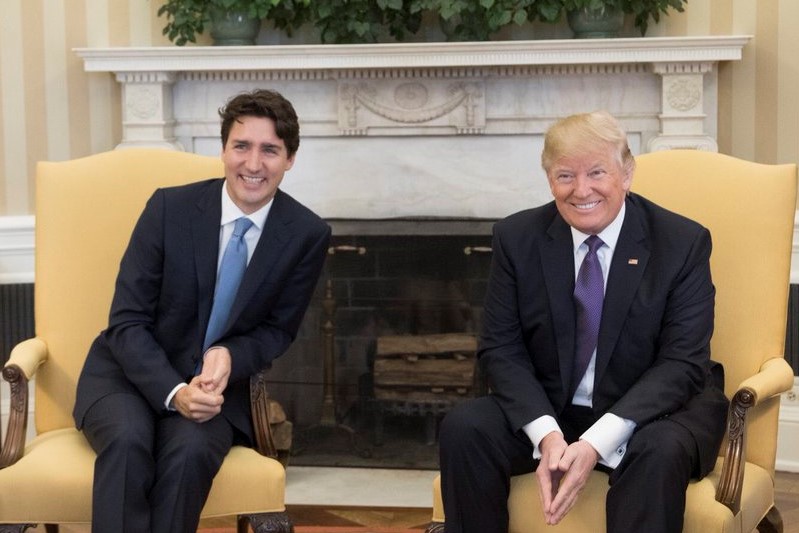
Justin Trudeau meets with President Donald Trump at the White House, 13 February, 2017.
Photo from the Office of the President of the United States via Wikimedia Commons.

Mr Mulroney sees two major problems that confront Canada fifty years after A Foreign Policy for Canadians was published:

  • First, he says, “Canada is again dealing with a threat to our autonomy from a major power, but this time, it comes not from the United States, but from the new world that was coming into being 50 years ago. The threat is now China, which is using its economic power to influence and silence us, is undermining our national security, and is challenging the rules-based international system that the review itself championed;” and
  • Second, “we again need to face up to the consequences of our diminished status, but this time much closer to home. Fifty years on, the problem isn’t that the United States wants to dominate us, but that it has largely forgotten us. While it is tempting to blame this on the chaos of the Trump era, the painful reality is that the relationship has been in decline for some time, something that was manifestly evident in the cool detachment that marked Barack Obama’s management of relations with Canada.”

I think that second is, actually, more serious than the first. I believe we can wrap our collective mind around the fact that China doesn’t like us, that it regards us as an irritant and that it is using us as a whipping boy to send a message to its other, more important, trading partners. What has been harder to grasp is that Ameria no longer cares. It isn’t just Donald Trump, it was even just Barack Obama. George W Bush didn’t care either. Despite the great debates in Canada, it seems clear that President Bush never even asked for our help in either Afghanistan or Iraq, the “pressure” to do something to stand with the USA was entirely self-generated within Canada’s own foreign affairs and defence establishments. Bush, Chaney, Rumsfeld and Myers (the latter was Chairman of the Joint Chiefs of Staff from 2001 to 2005) were, possibly, grateful for the help on the ground, when they noticed it at all, but quite uninterested in Canada’s views on any of the issues concerned. Nor did Bill Clinton care about our views on or our actions in e.g. the Balkans. We, as a country, and our leaders, Jean Chrétien, Paul Martin, Stephen Harper and Justin Trudeau, did not and do not count for anything in Washington. Neither Chrystia Freeland nor Erin O’Toole nor any other Canadian prime minister, Conservative or Liberal, will fare any better. The last time Canada mattered was when Brian Mulroney and George H W Bush renegotiated the Canada-US Free Trade deal, making it into NAFTA, over a quarter-century ago. And the end of the halcyon days of Canada-US relations came a full decade before that, in the Mulroney-Reagan years. That can only change if Canada makes itself matter.

[…]

We, Canadians, must accept ~ and millions will not want to accept this ~ that, as Mr Mulroney says, “International influence … [and that includes influence where it counts most, with the USA] … is enabled by a strong economy, robust national infrastructure and institutions, and the willingness to invest in national defence and security.” One of the impacts of Pierre Trudeau’s policies was to divert spending from National Defence to social spending. That was immensely popular with many, actually with most Canadians … something for (a perceived) nothing always is. None of Brian Mulroney, Paul Martin or Stephen Harper, all of whom, it seemed to me, wanted to reverse course and act responsibly were able to change what Pierre Trudeau had put in place. The political price was suicide. But it has been fifty years and Canada is at risk of being totally irrelevant in an increasingly complex and dangerous world.

David Mulroney’s second challenge ~ recovering “the confident elaboration of national identity,” is, I suspect, much more difficult, especially given the “post-national state” quasi-intellectual rubbish that Justin Trudeau says was part of “his father’s vision.” It’s lunacy, of course, but it’s the sort of lunacy that appealed to many in the 1960s and appeals, again, a half-century later.

While I don’t disagree with Mr. Campbell’s analysis (and that of David Mulroney), I think getting our domestic house in order is the top priority, and the current Trudeau government does not appear to be doing much constructive on that sheaf of issues. With the very rule of law threatened at home, there’s little to no point in casting our eyes across the 49th parallel or overseas: we need to address the breakdown of internal governance first.

« Newer PostsOlder Posts »

Powered by WordPress