Quotulatiousness

June 6, 2021

Decoding NPR’s revised approach to reporting in a social justice age

Filed under: Media, Politics, USA — Tags: , , , , — Nicholas @ 03:00

At Ace of Spades H.Q., K.T. listens to some NPR broadcasts (so you don’t have to) including an insight into how NPR and probably other media organizations are changing how they report the news:

We Hold These Truths: How Newsroom Leaders Wrestled With Covering A Tumultuous Year

This was sort of a panel discussion (light on the “discussion”), with commentary on things like how social media pressured newsrooms, for example, to say that “police murdered George Floyd” rather than “George Floyd died”.

But I kind of homed in on an academic phrase that bothers me. Sara Just from PBS:

    Yeah, I think that you’re absolutely right. There’s been a deeper understanding and deeper conversation about how much our lived experiences play into the reporting that we do. And there’s no question that it does for each and every one of us in different ways. And I think that lived experience we especially highlight now is valuable, whether it’s race or gender or the challenges. I don’t think people with those lived experiences have to carry the burden, though, of being the only ones to report on it by any means. And so that’s something that we are always balancing. (emphases mine)

So, are they balancing whether or not people without “lived experiences” can report on issues involving “lived experiences”? Like Lori Lightfoot deciding she would only do one-on-one interviews with journalists of color? Will white people be allowed to report on stories involving black people? Will men be allowed to report on stories involving women?

This is partly about local sources, but it is largely about people thought of as being in “oppressed groups”. This panel is informing us that news reporting will now be filtered through the language and perspective of Critical Social Justice, whether we realize it or not.

The indispensable Translations from the Woke at New Discourses provides the following information on Lived Experience:

    In the Theory of Critical Social Justice, for what turn out to be surprisingly deep and philosophically (almost) sophisticated reasons, lived experience is the overwhelmingly primary way in which knowledge can be obtained. This should not be mistaken to mean one’s firsthand experience, which most of us already recognize to provide a rather weak claim upon knowledge, though it is both implied and claimed that this is what “lived experience” refers to in Critical Social Justice. Lived experience, as Critical Social Justice uses the term, refers more specifically to one’s life experiences in allegedly systemic power dynamics of dominance and oppression that shape society structurally as understood with a critical consciousness and interpreted through Theory. That is, one’s “lived experience” refers to the interpretation that Critical Social Justice Theory gives for the anecdotal accounts of experiences one has had.

    Because “lived experience” refers to an interpretation through Theory, it is only the “lived experience of oppression,” as Theory will have it, that counts …

It appears that you can’t really understand the reporting on PBS, and probably NPR, now unless you have studied Critical Social Justice.

    Certainly, the claimed “lived experience” of members of dominant groups cannot be in any way used to challenge or dispute the assertions of Theory or those claiming to speak from it …

    This restriction extends to members of “minoritized” groups who disagree with Theory as well — Theory cannot be authentically disagreed with. One might think that the lived experience of a member of oppressed groups would be admissible as a valid challenge to the claims of Theory, but this not so. They may be talking about their own experiences in life, but they aren’t appealing to lived experience, which must comport with Theory …

    This is all very confusing and appears to be exactly what it is — a form of manipulating knowledge and epistemology as a means of asserting power and rigging the system such that those assertions of power cannot be challenged. Nevertheless, it isn’t merely an application of power and has a rather interesting and deep philosophical explanation that must be understood to understand why “lived experience” holds the status that it does and why it must comport with Theory to be granted veridical status and epistemic weight. This has everything to do with the fact that the roots of Critical Social Justice are in critical theories and, especially, postmodern philosophy.

There is much more, but it is way too deep to include here.

The NPR panel goes on to discuss new understandings of “balance” and “objectivity”. They do not intend to be objective. “Balance” will mean something different than what it has meant in the past in the news business.

Many people have found the way that TV news shows report on events since 2016 to be rather different than what they’d been used to before that. Some changes are subtle and others are quite blatant and hard to ignore unless you already agree with the viewpoint of the presenter. TV news used to at least pretend to present the news objectively but from the start of the Trump presidency most media outlets abruptly changed from a pseudo-objective (but leaning progressive) to an outright full-on progressive stance from start to finish with little or no attempt to provide other points of view for balance.

May 12, 2021

Looking at a highly influential document among progressive groups

Filed under: Education, Media, Politics, USA — Tags: , , , — Nicholas @ 03:00

Matthew Yglesias on Tema Okun’s “The Characteristics of White Supremacy Culture” and its role in furthering progressive emotions over what they consider to be the most racist society in human history (that is, the modern west but especially the United States):

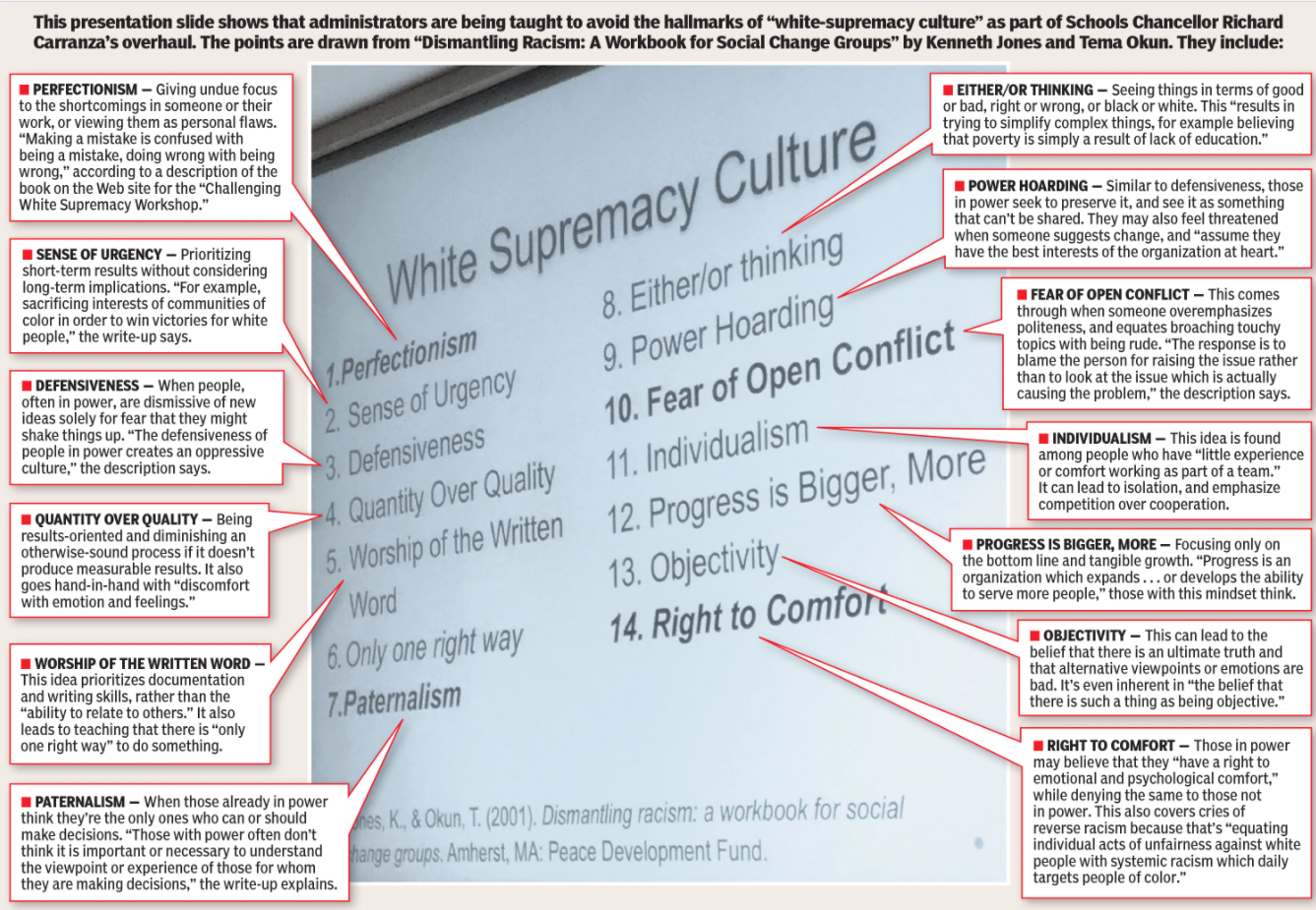
Click to see full-size image.

Debating abstractions is difficult and frustrating, and the discourse about “wokeness” and “cancel culture” has become a snakepit of semantic debates, bad-faith actors, and people of goodwill talking past each other.

So I want to talk instead about one specific document, not because I think it’s the most important document in the world, but because I don’t really see anyone who I read and respect talking about it even though I’ve seen it arise multiple times in real life.

I’m talking about “The Characteristics of White Supremacy Culture” by Tema Okun, which I first heard of this year from the leader of a progressive nonprofit group whose mission I strongly support. He told me that some people on the staff had started wielding this document in internal disputes and it was causing big headaches. Once I had that on my radar, I heard about it from a couple of other nonprofit workers. And I saw it come up at the Parent Teacher Association for my kid’s school.

It’s an excerpt from a longer book called Dismantling Racism: A Workbook for Social Change Groups that was developed as a tool for Okun’s consulting and training gigs.

But today, even though it’s not what I would call a particularly intellectually influential work in highbrow circles — even ones that are very “woke” or left-wing — it does seem to be incredibly widely circulated. You see it everywhere from the National Resource Center on Domestic Violence to the Sierra Club of Wisconsin to an organization of West Coast Quakers.

Which is to say it’s sloshing around quite broadly in progressive circles even though I’ve never heard a major writer, scholar, or political leader praise or recommend it. And to put it bluntly, it’s really dumb. In my more conspiratorial moments, I wonder if it’s not a psyop devised by some modern-day version of COINTELPRO to try to destroy progressive politics in the United States by making it impossible to run effective organizations. Even if not, I think the document is worth discussing on its own terms because it is broadly influential enough that if everyone actually agrees with me that it’s bad, we should stop citing it and object when other people do. And alternatively, if there are people who think it’s good, it would be nice to hear them say so, and then we could have a specific argument about that. But while I don’t think this document is exactly typical, I do think it’s emblematic of some broader, unfortunate cultural trends.

H/T to Colby Cosh for the link.

April 25, 2021

They don’t call it “neo-Marxism”, but that’s what Critical Race Theory really is

Filed under: Politics, USA — Tags: , , , — Nicholas @ 05:00

In City Journal, Christopher Rufo explains why Critical Race Theory is a natural child of orthodox Marxist thought:

Critical race theory is an academic discipline, formulated in the 1990s and built on the intellectual framework of identity-based Marxism. Relegated for many years to universities and obscure academic journals, it has increasingly become the default ideology in our public institutions over the past decade. It has been injected into government agencies, public school systems, teacher training programs, and corporate human-resources departments, in the form of diversity-training programs, human-resources modules, public-policy frameworks, and school curricula.

Its supporters deploy a series of euphemisms to describe critical race theory, including “equity,” “social justice,” “diversity and inclusion,” and “culturally responsive teaching.” Critical race theorists, masters of language construction, realize that “neo-Marxism” would be a hard sell. Equity, on the other hand, sounds non-threatening and is easily confused with the American principle of equality. But the distinction is vast and important. Indeed, critical race theorists explicitly reject equality — the principle proclaimed in the Declaration of Independence, defended in the Civil War, and codified into law with the Fourteenth and Fifteenth Amendments, the Civil Rights Act of 1964, and the Voting Rights Act of 1965. To them, equality represents “mere nondiscrimination” and provides “camouflage” for white supremacy, patriarchy, and oppression.

In contrast to equality, equity as defined and promoted by critical race theorists is little more than reformulated Marxism. In the name of equity, UCLA law professor and critical race theorist Cheryl Harris has proposed suspending private property rights, seizing land and wealth, and redistributing them along racial lines. Critical race guru Ibram X. Kendi, who directs the Center for Antiracist Research at Boston University, has proposed the creation of a federal Department of Antiracism. This department would be independent of (i.e., unaccountable to) the elected branches of government, and would have the power to nullify, veto, or abolish any law at any level of government and curtail the speech of political leaders and others deemed insufficiently “antiracist.”

One practical result of the creation of such a department would be the overthrow of capitalism, since, according to Kendi, “In order to truly be antiracist, you also have to truly be anti-capitalist.” In other words, identity is the means; Marxism is the end.

An equity-based form of government would mean the end not only of private property but also of individual rights, equality under the law, federalism, and freedom of speech. These would be replaced by race-based redistribution of wealth, group-based rights, active discrimination, and omnipotent bureaucratic authority. Historically, the accusation of “anti-Americanism” has been overused. But in this case, it’s not a matter of interpretation: critical race theory prescribes a revolutionary program that would overturn the principles of the Declaration and destroy the remaining structure of the Constitution.

April 24, 2021

[“white” evil is] “not only objectivity, individualism, and writing, but linear thinking, quantitative reasoning, the Protestant work ethic, planning for the future, and being on time”

Filed under: Education, Media, Politics, USA — Tags: , , — Nicholas @ 03:00

The latest post by John McWhorter at It Bears Mentioning discusses the “white” behaviours and thought patterns that many activists believe are as harmful to American blacks as outright white supremacism:

John McWhorter’s Twitter thumbnail image

The organization 1776Unites, founded by my mentor and model Bob Woodson, has tweeted out a video where various black people decry a now fashionable idea that “whiteness” includes being smart. As in, precise, objective, fond of the written word, oriented towards dispassion, on time.

Those things are all manifestations of intelligence, vigilance, discipline. But according to our Elect folk, we black people are best off channeling our Crazy Badass Mothafucka. Because that’s more “authentic.” And, I get the feeling, fun to watch.

Because so many think that the battle that I and others are waging against Critical Race Theory’s transmogrification into education for children is an obsession with something that isn’t a real problem, I want to explore a bit. Someone I deeply respect not long ago surmised to me that the idea that black kids should be exempt from real standards is something being promulgated via mere paper “handouts,” and that the real problem is censorship from the right. I just don’t think so.

First, watch this, the 1776Unites video. Just a few minutes.

And now, as to what we are referring to, it starts actually before last summer. I knew something was really wrong when in 2019 at a conference in New York City for the city’s principals and superintendents, participants were presented with an idea that to teach with sensitivity to race issues meant keeping certain issues in mind.

These included ways of looking at things that are “white” rather than correct: namely, objectivity, individualism, and valuing the written word. Schools Chancellor Richard Carranza was fine with this, happily telling the media that it’s white people’s job to do the “work” of identifying the racist assumptions in how they go about their business.

So: to stand outside of matters and analyze them with one’s own private mind, and perhaps couch one’s conclusions with the considered artifice of writing rather than the spontaneity of speaking, is inauthentic for black and Latino people. It is racist to impose such things on black and Latino (and Native American?) kids. Or at best, brown kids should be taught this uptight “white” business only as a gloomy alternative to the realness of just hanging out sharing passing personal impressions via chatting.

[…]

This view of precision and detachment as white is a view about, more economically, reason. The idea is that to master close reasoning is suspect. It is exactly the roots of the “Math is Racist” notion, and if you want a whiff of how religiously people can glom on to such ideas, take a look at my Twitter feed in the week after I posted about that here.

Yet, seeing this educational philosophy laid out in the sunlight, The Elect cannot dismiss it as fringe “kookiness” — unless they want to insult the curators of a national museum devoted to celebrating the very black people The Elect live to liberate. At the African-American History Museum in Washington, D.C., for a hot minute or two in 2020 you could see a variation on the Jones-Okun business, an expanded presentation of what we must reject as “white” evil. An educational poster was displayed that slammed not only objectivity, individualism, and writing, but linear thinking, quantitative reasoning, the Protestant work ethic, planning for the future, and being on time.

March 5, 2021

Schools told they need to “identify and challenge the ways that math is used to uphold capitalist, imperialist, and racist views”

Filed under: Education, Politics, USA — Tags: , , , , — Nicholas @ 09:15

No wonder I had trouble with math back in grade school: Math is a racist tool of White Supremacists!

“Math Class” by attercop311 is licensed under CC BY 2.0

Mandatory teaching standards that focus on critical theory and identity politics to the detriment of liberalism and individualism are already working their way through state legislatures.

Now, math education itself has been deemed “racist.” A group of educators just released a document calling for a transformation of math education that focuses on “dismantling white supremacy in math classrooms by visibilizing the toxic characteristics of white supremacy culture with respect to math.”

Among the educators’ recommendations, which officials in some states are promoting, are calls to “identify and challenge the ways that math is used to uphold capitalist, imperialist, and racist views,” “provide learning opportunities that use math as resistance,” and “encourage them to disrupt the disproportionate push-out of people of color in [STEM] fields.”

Beyond activism, these recommendations also argue that traditional approaches to math education promote racism and white supremacy, such as requiring students to show their work or prioritizing correct answers to math problems. The document claims that current math teaching is problematic because it focuses on “reinforcing objectivity and the idea that there is only one right way” while it “also reinforces paternalism.”

November 6, 2020

QotD: When you use a racist lens, everything looks like racism

Filed under: Books, Media, Politics, Quotations, USA — Tags: , , , , — Nicholas @ 01:00

[White Fragility author Robin] DiAngelo uses similar techniques to support her second core theory that all white people are racist. For example, DiAngelo lays another trap that makes it impossible for white people to speak ill of any neighborhood with high crime rates in which many people of color reside. When DiAngelo’s friends warned her not to buy a home in neighborhoods with relatively high crime rates and poorly rated schools, DiAngelo later discovered that the neighborhoods had a high percentage of black and brown residents. From this, she concluded that her friends’ warnings were racially motivated and that “my fellow whites had communicated the racial boundaries to me.” Did you spot the trap?

If DiAngelo’s friends had told her not to live in the neighborhoods because they had black and brown residents, she could call them out for overt racism. But even when her friends made no mention of race whatsoever, DiAngelo attributed their warnings to racism as well. There was no way for her friends to mention the neighborhood’s high crime rates without DiAngelo finding them guilty of racism.

DiAngelo also supports her theory that all white people are racist by interpreting ambiguous events to support her conclusions, despite other plausible explanations. In one anecdote, DiAngelo describes an incident in which a white female teacher had two black students at her desk. The teacher prefaced something she said with the word “girl.” One student felt that the use of the word “girl” was racist. The other student disagreed, saying that the teacher called all her students “girl” regardless of their race.

Any reasonable person would conclude that if the teacher called every student — white, black, Asian, Latinx — “girl,” the teacher’s use of the word resides somewhere between “not racist” and “open to interpretation.” But DiAngelo reached a different conclusion, demonizing the teacher’s lack of concern for the offended student’s feelings, and calling the teacher arrogant for thinking the use of “girl” was not racist. To be clear, while teachers should listen to their students’ concerns, there is no proof this teacher’s word choice was racially motivated. And ironically, DiAngelo is guilty of everything she criticizes the teacher for because DiAngelo arrogantly ignores the other black student who did not think the comment was racist.

David Edward Burke, “The Intellectual Fraud of Robin DiAngelo’s White Fragility“, The Logical Liberal, 2020-06-13.

November 2, 2020

In the University of Michigan’s Sexual Health Certificate Program, “mainstream sexual health issues that affect wide swaths of the population, such as marriage, reproduction, and family life, were treated as niche topics”

Filed under: Education, Health, Politics, USA — Tags: , , , , , , — Nicholas @ 05:00

In Quillette, Tim Courtois explains what the University of Michigan’s Sexual Health Certificate Program is actually intended to teach:

When I signed up for the University of Michigan’s unique, year-long “Sexual Health Certificate Program” (SHCP), however, I truly did believe the experience would be both professionally and intellectually rewarding. I care about sexuality. I know that it is a fundamental component of the human search for joy and meaning. As a Michigan-based psychotherapist and licensed professional counselor, I wanted to deepen my understanding of sexuality, and become better equipped to provide care for the many clients who come to me with issues related to sexual health. The American Association of Sexuality Educators, Counselors, and Therapists sounded like the perfect fit for me, and the idea of becoming an AASECT-certified sex therapist appealed to me. I applied and was accepted for the 2019-2020 cohort. When I showed up, my class included participants from around the world — including Iceland, Egypt, Lebanon, and China — just as you’d expect at the kind of high-value, authoritative program that we all believed we’d signed up for.
The doubts started to creep in early, though — on day one, to be exact. Our first classroom module was titled “Sexual Attitude Reassessment.” I amused myself with the thought that this sounded like an unsettling euphemism for a brainwashing session. Sadly, that’s what it was.

It quickly became clear that the issue of sexuality — the ostensible subject — often would serve merely as a pretext for more general harangues about society, and the urgent need to remake it according to AASECT’s ideological blueprint. In a keynote lecture entitled “Why Fetishism Matters,” the speaker argued that the world we inhabit is socially constructed, and told us (with what now seems like admirable candor), “I’m not neutral. I’m here to recruit you to a particular point of view about how kink should be valued.” The same speaker said that he’d been accused of teaching students that any form of sexual behavior is acceptable as long as there is consent from all parties. “Yes, that’s exactly right,” he said. Clearly, our attitude “reassessment” was well underway.
From the get-go, the scientific content was mostly superficial, and was often undercut by claims that the very idea of truth is a harmful (and even oppressive) construct. The teaching was not so much impartial and informative as it was evangelistic. Yet it was also self-contradictory: Declarations that there are no real “correct” moral values were uttered (without irony) alongside absolutist proclamations about the correct way to understand sex — and morality.

As I learned, “Sexual Attitude Reassessment” (SAR) is an established term in the field, one that is often used to describe curriculum content that serves to educate sexual-health professionals about the wide range of sexual experiences that they may encounter among clients. The object is to ensure they won’t be shocked when such encounters occur, and to invite them to reassess their judgments and assumptions about various expressions of sexuality. These are valid and important goals. Unfortunately, the SAR in the SHCP descended into an exercise in overstimulation and desensitization — specifically, two full days of pornographic videos and interviews. At times, it felt like the famous brainwashing scene from A Clockwork Orange. There was a series of videos of people masturbating (one of which involved a strange interaction with a cat), a woman with “objectiphilia” who had a sexual attraction to her church pipe organ, various sadomasochistic acts, and a presentation on polyamory designed to make it clear that the polyamorous lifestyle is healthy, wholesome, and problem-free.

The focus on BDSM was a particular fixation throughout the program. In the SAR, we were shown videos of a woman meticulously applying genital clamps to the scrotum of a willing man, and a dominatrix teaching a class how to properly beat people while demonstrating on an eager participant. We also watched an interview with a sex-dungeon “dom” (the male equivalent of a dominatrix) who described one of his experiences: His client had instructed him, as the dom recounted it, “I want you to bind me and then beat me until I scream. And no matter how much I scream or beg you to stop, I want you to keep beating me.” The dom did as he was told, continuing the beatings through the customer’s begging and pleading, until the client went totally limp and silent, seeming to dissociate. At this point, the dom unbound the man, who then began to weep uncontrollably in the dom’s arms.

BDSM is a real and active sexual subculture, and I don’t object to its inclusion in the course materials. But I was shocked to see how much further the professors in the program took things, insisting that BDSM behaviors — up to and including the sexual “Fight Club” style of behavior described above — must be uncritically viewed as wholesome and beautiful. Students learned to sing from the same psalm book, with one memorably exclaiming “I’m so inspired by the wisdom and beauty in the BDSM community!” and insisting that the behavioral codes observed among BDSM participants can help us create a similar climate of safety and respect “in all our relationships.”

The program was focused on an agenda of “centering” the experience of minorities — in this case, sexual minorities. This meant that huge portions of time in class after class were spent focusing on BDSM, LGBTQIA+ issues, and polyamory, not to mention the obligatory discussions of oppression and privilege that were shoehorned into every discussion. Meanwhile, mainstream sexual health issues that affect wide swaths of the population, such as marriage, reproduction, and family life, were treated as niche topics. Further, while many Americans view sexuality through the prism of faith, religion hardly came up at all. And when it did, it was typically so that religious values could be denigrated. Even the few religious people in the program got the message: Whenever any made passing reference to their own observant religiosity, it was usually in a spirit of shame or penance.

In a few brief web searches to find a public domain or Creative Commons image to use for this post, I realized that web search engines offer “safe” options for a reason…

October 21, 2020

“[A]ll white people are racists … because they participate in a system that secures their own structural advantages”

Filed under: Cancon, Politics, USA — Tags: , , , , — Nicholas @ 05:00

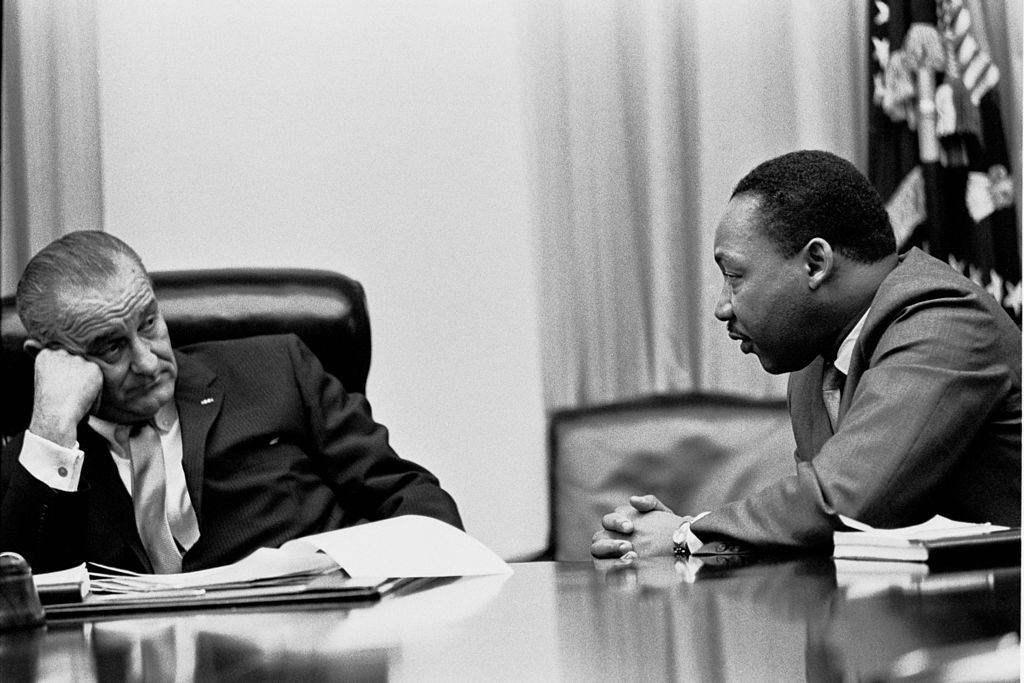
In The Line, Meaghie Champion commits some sort of thought crime by quoting Martin Luther King’s famous words (which I have been assured more than once are now “forbidden” to non-POC speakers because reasons):

President Lyndon B. Johnson meets with Martin Luther King, Jr. in the White House Cabinet Room, 18 March 1966.
Photo by Yoichi Okamoto via Wikimedia Commons.

Most of us have been committed to the ideals of anti-racism since Martin Luther King famously delivered his “I Have a Dream Speech.” This was a masterclass of persuasion and rhetoric; one that convinced generations to re-frame their positions on racial inequity.

King said that he hoped that one day his children would grow up to be judged, not by the colour of their skin, but by the content of their character. That’s the ethos [BC NDP leader John] Horgan channelled when he said: “I don’t pay attention to skin colour or ethnicity.”

But this is not good enough for those who promote Critical Race Theory, an emerging ideology that tips these values on their head. CRT presupposes that the world is dominated by white supremacists. Further, that all white people are racists — regardless of their individual actions — simply because they participate in a system that secures their own structural advantages. CRT redefines what “racism” has traditionally meant: bigotry or discrimination based on skin colour.

Under this new ethos, only white people are capable of racism, because racism is systemic and works towards keeping all power vested in the hands of the white supremacists. I’m simplifying this, of course, because CRT is a rabbit hole best tackled by people with a lot more patience than me. One of the laziest rebuttals that CRT’s adherents use to deflect criticism is that its critics simply don’t understand it well enough, and therefore need to spend endless hours of their lives “doing the work,” integrating key academic texts, and absorbing their meaning until they fully accept the unerring truth of the ideology. If this tactic sounds indistinguishable from a deeply manipulative religious movement, well …

I’m a “person of colour” and I have spent my whole life trying to be anti-racist. I agree with the idea that there are systemic problems involving racism in many institutions within society. Some of those systemic problems are destroying Indigenous nations, including my own. Where I disagree with the Critical Race Theory crowd is in their depiction of everyone who is not a person of colour as being inherently racist. I don’t agree with their solutions for solving the racism problems we have to confront as a society. I don’t believe that they are the only ones working against racism, or coming up with viable strategies for how to do so. We can have differing views about racism and how to combat it; failing to adhere to one single philosophy, or parrot a specific set of terminology, does not mean a person is racist.

Horgan has worked for decades to do what he thought best for all the people. He’s been on our side in the struggle against racism all his life. The fact that he wasn’t up-to-date on the latest acceptable phrases to speak on the matter doesn’t negate that.

October 17, 2020

Andrew Sullivan on the pervasiveness of Critical Race Theory in academia

Filed under: Education, Media, Politics, USA — Tags: , , , , — Nicholas @ 05:00

In his latest Weekly Dish, Andrew Sullivan discusses how deeply embedded Critical Race Theory has become in the academic, journalistic and cultural realms controlled by the left:

… the CRT advocates have brilliantly managed to construct a crude moral binary to pressure liberals into submission. Where liberalism allows neutrality or doubt or indifference, CRT demands an absolute and immediate choice between racism and anti-racism (defined by CRT) — and no one wants to be a racist, do they? Legitimate anguish about racial inequality and the sheer terror of being publicly labeled a bigot have led liberals to surrender their core values to the far left.

The second reason for CRT’s triumph is that it’s super-easy. Social inequalities are extremely complicated things. A huge variety of factors may be in play: class, family structure, education, neighborhood, sex, biology, genetics and culture are some of them. Untangling this empirically in order to figure out what might actually work to improve things is hard work. But when you can simply dismiss all of these factors and cite “structural racism” as the only reason for any racial inequality, and also cover yourself in moral righteousness, you’re home-free. Those who raise objections or complications or cite nuances can be dismissed by the same easy method.

Then there’s the deep relationship between CRT and one of the most powerful human drives: tribalism. What antiracism brilliantly does is adopt all the instincts of racism and sexism — seeing someone and instantly judging them by the color of their skin, or sex — and drape them with a veil of virtue. You don’t have to correct yourself when your tribal psyche makes you more cognizant of someone’s visible racial differences, and pre-judges them. You don’t have to resist this any more. You can give in to your core nature, and feel pride, rather than shame. You get to have all the feels of judging people entirely by their involuntary characteristics, while actually dismantling racism and sexism! What’s not to like?

Social aspiration also plays a part. The etiquette of wokery is increasingly indispensable for high society. They mark you as someone high up in the American social hierarchy. The right words and phrases signal your ease in this elite; the wrong ones — “sexual preference”! — expose you as a rube, a bigot or, worse, a middle class provincial. Rob Henderson argues that this aspiration to be in the upper classes helps explain why Asian-Americans, who are targeted for direct race discrimination under CRT, nonetheless often support it: “While money and education are tickets to the middle class, prizing diversity is a requirement to join the upper class. It’s part of what the sociologist Pierre Bourdieu referred to as cultural capital — tastes, vocabulary, awareness and mannerisms which give social advantages to those higher in the social hierarchy.” Reihan Salam has also written brilliantly about this.

There’s little doubt, either, it seems to me that there is a religious component to wokeness. A generation of nones can feel bereft of transcendence and meaning, and “becoming woke”, like being “born again,” fills that spiritual hole. In an atomized and lonely age, feeling as if you are on “the right side of history”, banishing doubt, joining with countless of your fellow converts in marches and seminars, can abate the isolation and emptiness of it all. Many moderns want the experience of religion without God. With CRT, as in the past with communism, they can have it.

But what also make CRT so successful is ruthlessness. Those who hold a view of the world in which only power, and the struggle for power, matters, have few qualms in exercising it. After all, under CRT, power is always on the side of the white cis-heteropatriarchy, so payback is always fair play. Discriminating against the unwoke or whites or males or the cis-gendered or Asian-American, is not just fair, but vital. Shutting down speech protects the oppressed; bullying on social media and in the workplace becomes a form of virtue; mercy and forgiveness are mere buttresses for white supremacy; HR departments diligently identify dissidents, and discipline them. Once you set up this system of censorship and fear, persecute a few prominent sinners pour décourager les autres, and encourage snitches, dissidents will increasingly self-censor, and dissent peter out, until the new orthodoxy is the only one.

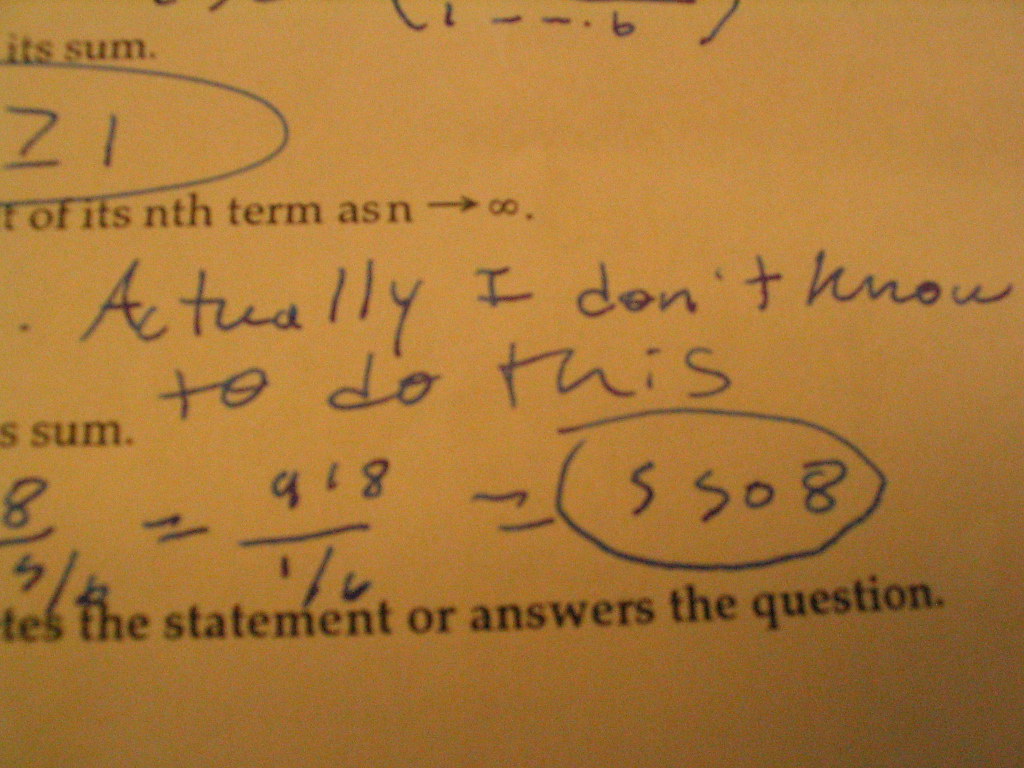
In the past, a new set of ideas could be engaged in a clash of argument and debate. But you’ll notice that the advocates of what Wes Yang has called “the successor ideology” never debate any serious opponents of their position. This is because debate in a liberal society implies equal standing for both sides, and uses reason to determine who’s right or wrong. But there can be no “both sides” within CRT, no equation of “racists” and “antiracists”, and debates are inherently oppressive. Logic, evidence, and reason are, in this worldview, mere products of white supremacy, forms of violence against the oppressed. In CRT, remember, there is no truth or objectivity; there are merely narratives. So, yes, 2 + 2 = 5, and math is inherently a function of whiteness. And what racist is going to deny this?

October 5, 2020

QotD: Language changes to accord with critical studies theory

A Canadian Broadcasting [Corporation] program also debuted a new term this past week: “non-straight cisgender people.” This is the newly approved newspeak for gay people, parsed through the language of critical queer studies. The proponents of this new language seem eager to retire familiar terms like “gay men” or “lesbians” — perhaps because they suggest that the homosexual experience is rooted in basic human nature and can exist outside the parameters of structural oppression. So they find ways to define us in terms of queer theory, insisting there are only oppressed LGBTQ+ people. That’s also why, for example, so many on the left insist that gay white men had very little to do with Stonewall, which was led, we’re told, by trans women of color, subsequently betrayed by white men, who stole the movement from them. That this is untrue is irrelevant. It’s a narrative which serves to dismantle structures of oppression. And that’s all that matters.

Leading progressive maternity and doula organizations now deploy and encourage a whole array of “gender-neutral language” with respect to sex, birth, labor, and parenting. And so we now have the terms “chest-feeding,” “persons who menstruate,” “persons who produce sperm,” and “birthing person” for breastfeeding, women, men, and mothers, respectively. And instead of a butthole, we have a “back-hole”; instead of a vagina, we have a “front hole.” “Ovaries” and “uterus” are now rendered as “internal organs,” which may strike you as somewhat vague. These may sound completely absurd now, but given the choke hold critical gender theory has on almost all elite organizations, you can be sure you’ll hear them soon enough. They’ll likely be mandatory if you want to prove you’re not a transphobe. It was an objection to one of these terms — “people who menstruate” — that got J.K. Rowling tarred again as a bigot.

Those of us who oppose this abuse of the English language, who try to abide by Orwell’s dictum to use the simplest, clearest Anglo-Saxon words to describe reality, are now instantly suspect. Given the fear of losing your job for resisting this madness, most people will submit to this linguistic distortion. As you can see everywhere, the stigma of being called a bigot sweeps away all objects before it. But the further this goes — and there is no limiting principle in critical theory at all — the less able we are to describe reality. Which is, of course, the point. Narratives, only narratives, exist. And power, only power, matters.

Andrew Sullivan, “China Is a Genocidal Menace”, New York, 2020-07-03.

September 29, 2020

QotD: Robin DiAngelo’s theory of “White Fragility”

Filed under: Books, Media, Politics, Quotations, USA — Tags: , , , , — Nicholas @ 01:00

Throughout White Fragility DiAngelo tries to convince readers of two things. First, DiAngelo argues that white people are inescapably racist, writing, “All white people are invested in and collude with racism,” and that “The white collective fundamentally hates blackness for what it reminds us of: that we are capable and guilty of perpetrating immeasurable harm and that our gains come through the subjugation of others.”

Second, DiAngelo argues that any white person who does not admit to their own racism is blinded by their “white fragility.” In DiAngelo’s words, because white people are, “Socialized into a deeply internalized sense of superiority that we either are unaware of or can never admit to ourselves, we become highly fragile in conversations about race.” This fragility purportedly explains why, “people who identify as white are so difficult in conversations regarding race.”

It’s not difficult to see why the theory of white fragility might catch on. Race is a sensitive subject that many people of all races are uncomfortable discussing. Furthermore, white people publicly accused of racism risk social ostracization and professional ruin. The idea that some white people may be defensive when accused of racism is not surprising. But though some white people may exhibit a degree of what DiAngelo calls fragility, her grandiose theory as applied to all or even most white people has two fatal flaws.

First, DiAngelo’s theory of white fragility is unfalsifiable. It is impossible for someone to prove that they are not fragile, just as it is impossible for someone to prove they are not possessed by a demon. One could play mad libs with racial groups and nouns — “Asian Insecurity,” “Black Hostility,” etc. — and there would be no way for members of those groups to prove they are not insecure or hostile.

More insidiously, DiAngelo frames her theory of white fragility such that any conceivable reaction a white person has when discussing race is purportedly evidence of fragility, and any denial of her theory is interpreted as proof of its validity. For example, DiAngelo writes that,

    The mere suggestion that being white has meaning often triggers a range of defensive responses. These include emotions such as anger, fear, guilt, and behaviors such as argumentation, silence, and withdrawal from the stress-inducing situation. These responses work to reinstate white equilibrium as they repel the challenge, return our racial comfort, and maintain our dominance within the racial hierarchy. I conceptualize this process as white fragility. Though white fragility is triggered by discomfort and anxiety, it is born of superiority and entitlement.

In other words, if DiAngelo accuses you of racism or fragility and you disagree with her in any way — through argument, silence, or withdrawal — your reaction is considered proof of your fragility. DiAngelo leaves white readers with only two options. Either acknowledge your fragility, which proves DiAngelo’s theory, or deny your fragility, which according to DiAngelo, also proves her theory. This is a logical fallacy known as a Kafkatrap. If our legal system worked this way, no person accused of a crime would ever be acquitted because their denial would prove their guilt.

David Edward Burke, “The Intellectual Fraud of Robin DiAngelo’s White Fragility“, The Logical Liberal, 2020-06-13.

September 26, 2020

“… debate is an imperialist capitalist white supremacist cis heteropatriarchal technique that transforms a potential exchange of knowledge into a tool of exclusion & oppression”

Filed under: Media, Politics, USA — Tags: , , , , , — Nicholas @ 03:00

Andrew Sullivan‘s latest look at the ultrawoke:

If you’ve ever wondered why critical theorists and their popularizers never seem to actually expose themselves to direct criticism, this quote might help:

    I get regular invites to debate on various platforms. I always say no. Because debate is an imperialist capitalist white supremacist cis heteropatriarchal technique that transforms a potential exchange of knowledge into a tool of exclusion & oppression.

And also perhaps because debate is one of the most effective tools in rooting out ideological bullshit. Speaking of which, here’s an interview with Judith Butler, the patron saint of wokeness, in which she can actually say, with a straight face: “I am not aware that terf is used as a slur.” “Terf” is short for “Trans-Exclusionary Radical Feminist.” It’s yelled routinely at any dissenter from critical queer and gender theory. Of course it’s used as a slur.

Meanwhile, the 1619 Project has begun finally to implode. Its core argument – that America’s true founding was in 1619 not 1776, because America is in its DNA a slavocracy built on “white supremacy” and not a democracy rooted in the unrealized principle of human equality — has been withdrawn by the editor. Here’s the best summary of the rank dishonesty of the entire thing, from the preternaturally reasonable Conor Friedersdorf. He attempted to engage Nikole Hannah-Jones in good faith, a concept she simply doesn’t comprehend.

I think it’s clear by now that a completely defensible — even important — airing of new scholarship about the evil of slavery, and its profound impact on America, became hijacked at the NYT by the ideology that insists that the United States is inherently white supremacist, that this explains everything about the country, that this has never changed, that no white people were involved in perfecting the union, and that liberal democracy is a front for racism and should be dismantled. Given the extremist politics and unethical behavior of Nikole Hannah-Jones, this is unsurprising. But that this confused, half-baked rant won a Pulitzer and is being used to indoctrinate school kids in critical race theory is a staggering indictment of how corrupted by left-racism American elite journalism now is. In my view, the Pulitzer Board needs to rescind its prize. Fat chance, of course.

But there is hope. There are still reporters at the NYT interested in the truth about woke culture and politics. Nellie Bowles’ dispatch from Portland is a must-read. It’s a glimpse into the totalitarian impulses behind so many on the far left. Chilling.

September 15, 2020

Critical Race Theory

Filed under: Government, Politics, USA — Tags: , , , — Nicholas @ 05:00

Dan Sanchez, Tyler Brandt, and Brad Polumbo discuss President Trump’s recent Executive Memo banning the use of federal government funds for Critical Race Theory training:

Critical Race Theory is a branch of Critical Theory, which began as an academic movement in the 1930s. Critical Theory emphasizes the “critique of society and culture in order to reveal and challenge power structures,” as Wikipedia states. Critical Race Theory does the same, with a focus on racial power structures, especially white supremacy and the oppression of people of color.

The “power structure” prism stems largely from Critical Theory’s own roots in Marxism — Critical Theory was developed by members of the Marxist “Frankfurt School.” Traditional Marxism emphasized economic power structures, especially the supremacy of capital over labor under capitalism. Marxism interpreted most of human history as a zero-sum class war for economic power.

“According to the Marxian view,” wrote the economist Ludwig von Mises, “human society is organized into classes whose interests stand in irreconcilable opposition.”

Mises called this view a “conflict doctrine,” which opposed the “harmony doctrine” of classical liberalism. According to the classical liberals, in a free market economy, capitalists and workers were natural allies, not enemies. Indeed, in a free society all rights-respecting individuals were natural allies.

Classical Race Theory arose as a distinct movement in law schools in the late 1980s. CRT inherited many of its premises and perspectives from its Marxist ancestry.

The pre-CRT Civil Rights Movement had emphasized equal rights and treating people as individuals, as opposed to as members of a racial collective. “I look to a day when people will not be judged by the color of their skin, but by the content of their character,” Martin Luther King famously said.

In contrast, CRT dwells on inequalities of outcome, which it generally attributes to racial power structures. And, as we’ve seen from the government training curricula, modern CRT forthrightly judges white people by the color of their skin, prejudging them as racist by virtue of their race. This race-based “pre-trial guilty verdict” of racism is itself, by definition, racist.

The classical liberal “harmony doctrine” was deeply influential in the movements to abolish all forms of inequality under the law: from feudal serfdom, to race-based slavery, to Jim Crow.

But, with the rise of Critical Race Theory, the cause of racial justice became more influenced by the fixations on conflict, discord, and domination that CRT inherited from Marxism.

Social life was predominantly cast as a zero-sum struggle between collectives: capital vs. labor for Marxism, whites vs. people of color for CRT.

September 12, 2020

Andrew Sullivan on a “genetic case for communism”

Filed under: Books, Education, Politics, Science, USA — Tags: , , , , , — Nicholas @ 03:00

Actually, this isn’t the case Sullivan himself is making, but he’s summarizing a recent book by Fredrik deBoer, The Cult of Smart: How our broken education system perpetuates social injustice:

There aren’t many books out there these days by revolutionary communists who are into the genetics of intelligence. But then there aren’t many writers like Freddie DeBoer. He’s an insistently quirky thinker who has managed to resist the snark, cynicism and moral preening of so many others in his generation — and write from his often-broken heart. And the core of his new book, The Cult of Smart, is a moral case for those with less natural intelligence than others — the ultimate losers in our democratic meritocracy, a system both the mainstream right and left have defended for decades now, and that, DeBoer argues, gives short shrift to far too many.

This isn’t a merely abstract question for him. He has grappled with it directly. As a school teacher he encountered the simple, unavoidable fact that some humans are more academically gifted than others, and there’s nothing much anyone can do about it. He recalls his effort to teach long division to a boy who had managed to come a long way socially (he’d gone from being a hell-raiser to a good student) but who still struggled with something as elemental as long division: “At one point he broke into tears, as he had several times before … I exhaled slowly and felt myself give up, though of course I would never tell him so. I tried to console him, once again, and he said, ‘I just can’t do it.’ And it struck me, with unusual force, that he was right.”

What DeBoer tries to do is explain how our current culture and political system is geared to torment, distress and punish this kid for no fault of his own. “This is the cult of smart,” DeBoer proclaims. “It is the notion that academic value is the only value, and intelligence the only true measure of human worth. It is pernicious, it is cruel, and it must change.” It has become un-American — or perhaps it always was? — to say that an individual has natural limits, that, even with extremely hard work, he won’t always be able to realize his dreams. And this is not because of anything he has done or failed to do — but simply because of his draw in the genetic lottery of life. The very American cult of education is supposed to end this injustice — except that it doesn’t, because it can’t, and its brutal logic actually exposes and entrenches the least defensible inequality of all, the inequality of nature.

This genetic reality — in fact, the very idea of nature existing at all — is currently a taboo topic on the left. In the most ludicrously untrue and yet suffocatingly omnipresent orthodoxy of our time, critical theory leftists insist that everything on earth is entirely socially constructed, that all inequality is a function of “oppressive systems”, and that human nature itself is what John Locke called a “white paper, void of all characters” — the famous blank slate. Freddie begs to differ: “Human behavioral traits, such as IQ, are profoundly shaped by genetic parentage, and this genetic influence plays a larger role in determining human outcomes than the family and home environment.”

People are not just born unequally and unfairly into class, and culture, and place, they are inherently unequal in various ways in their very nature: “not everyone has the same ability to do calculus; not everyone has the same grasp of grammar and mechanics … we can continue to beat our heads against the wall, trying to force an equality that just won’t come. Or we can face facts and start to grapple with a world where everyone simply can’t be made equal.” And this is not a counsel of despair. What Freddie is arguing is that, far from treating genetic inequality as a taboo, the left should actually lean into it to argue for a more radical re-ordering of society. They shouldn’t ignore genetics, or treat it as unmentionable, or go into paroxysms of fear and alarm over “eugenics” whenever the subject comes up. They should accept that inequality is natural, and construct a politics radical enough to counter it.

[…]

This genetic case for communism can leave a reader a little disoriented, I have to say, if only for its novelty. But it is more coherent, it seems to me, than a leftism that assumes that genes are irrelevant to humans and society, that the ultimate goal is to be as smart and thereby wealthy as possible, and that we can set up an educational system where everyone, regardless of their genetic inheritance, can succeed or fail by their own efforts. What sounds like a meritocratic dream is, in practice, a brutal and unforgiving formula for most who can’t achieve it — and has obviously failed if its task is to foster equality. In fact, mass education appears to have increased the gulf between rich and poor. As Freddie notes, “education is not a weapon against inequality; it is an engine of inequality.”

August 2, 2020

Words are verbal tools, but tools can be weaponized

In this week’s newsletter, Andrew Sullivan analyzes the roots of wokeness:

In the mid-2010s, a curious new vocabulary began to unspool itself in our media. A data site, storywrangling.org, which measures the frequency of words in news stories, revealed some remarkable shifts. Terms that had previously been almost entirely obscure suddenly became ubiquitous — and an analysis of the New York Times, using these tools, is a useful example. Looking at stories from 1970 to 2018, several terms came out of nowhere in the past few years to reach sudden new heights of repetition and frequency. Here’s a list of the most successful neologisms: non-binary, toxic masculinity, white supremacy, traumatizing, queer, transphobia, whiteness, mansplaining. And here are a few that were rising in frequency in the last decade but only took off in the last few years: triggering, hurtful, gender, stereotypes.

Language changes, and we shouldn’t worry about that. Maybe some of these terms will stick around. But the linguistic changes have occurred so rapidly, and touched so many topics, that it has all the appearance of a top-down re-ordering of language, rather than a slow, organic evolution from below. While the New York Times once had a reputation for being a bit stodgy on linguistic matters, pedantic, precise and slow-to-change, as any paper of record might be, in the last few years, its pages have been flushed with so many neologisms that a reader from, say, a decade ago would have a hard time understanding large swathes of it. And for many of us regular readers, we’ve just gotten used to brand new words popping up suddenly to re-describe something we thought we knew already. We notice a new word, make a brief mental check, and move on with our lives.

But we need to do more than that. We need to understand that all these words have one thing in common: they are products of an esoteric, academic discipline called critical theory, which has gained extraordinary popularity in elite education in the past few decades, and appears to have reached a cultural tipping point in the middle of the 2010s. Most normal people have never heard of this theory — or rather an interlocking web of theories — that is nonetheless changing the very words we speak and write and the very rationale of the institutions integral to liberal democracy.

What we have long needed is an intelligible, intelligent description of this theory which most people can grasp. And we’ve just gotten one: Cynical Theories: How Activist Scholarship Made Everything About Race, Gender and Identity, by former math prof James Lindsay and British academic, Helen Pluckrose. It’s as deep a dive into this often impenetrable philosophy as anyone would want to attempt. But it’s well worth grappling with.

What the book helps the layperson to understand is the evolution of postmodern thought since the 1960s until it became the doctrine of Social Justice today. Beginning as a critique of all grand theories of meaning — from Christianity to Marxism — postmodernism is a project to subvert the intellectual foundations of western culture. The entire concept of reason — whether the Enlightenment version or even the ancient Socratic understanding — is a myth designed to serve the interests of those in power, and therefore deserves to be undermined and “problematized” reason whenever possible. Postmodern theory does so mischievously and irreverently — even as it leaves nothing in reason’s place. The idea of objective truth — even if it is viewed as always somewhat beyond our reach — is abandoned. All we have are narratives, stories, whose meaning is entirely provisional, and can in turn be subverted or problematized.

During the 1980s and 1990s, this somewhat aimless critique of everything hardened into a plan for action. Analyzing how truth was a mere function of power, and then seeing that power used against distinct and oppressed identity groups, led to an understandable desire to do something about it, and to turn this critique into a form of activism. Lindsay and Pluckrose call this “applied postmodernism”, which, in turn, hardened into what we now know as Social Justice.

« Newer PostsOlder Posts »

Powered by WordPress