Quotulatiousness

February 27, 2026

Brookfield, Carney, Freeland, and Ukraine – cui bono?

Melanie in Saskatchewan goes digging in the less-publicly-visible parts of Canada’s massive support of Ukraine to see who is gaining the benefit from all that money and all those political and economic manoeuvres … and you probably won’t be surprised to hear that it’s not ordinary Ukrainians or their soldiers fighting on the front line against Russia:
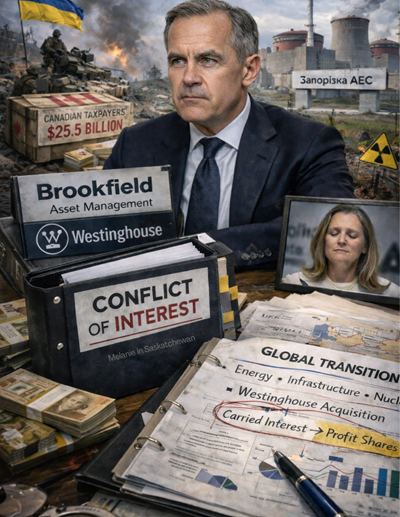
Image from Melanie in Saskatchewan

I need you to stop for a moment and really sit with this. Ask yourself a question that should make your stomach drop. What if the billions of your tax dollars being sent to Ukraine are not just about solidarity, democracy, or defending freedom? What if they also intersect with private financial interests connected to the very people making those decisions?

Because that is the bombshell.

And once you see the connections, you cannot unsee them.

Canada has now committed more than $25.5 billion to Ukraine. Just days ago, Prime Minister Mark Carney announced another $2 billion in military aid. Armoured vehicles. Equipment. Sanctions. More money flowing outward while Canadians juggle mortgage renewals, grocery bills, and heating costs that feel like ransom demands.

[…]

And to the Ethics Commissioner, Canadians deserve clarity. The Conflict of Interest Act is widely described as a disclosure regime. It relies heavily on what office holders report and on screening mechanisms that operate within defined boundaries. Committee testimony has acknowledged that screen administrators do not know the specific underlying assets within the Brookfield Global Transition Fund and that a significant portion of Brookfield’s broader portfolio is outside those screens. Mark Carney is the architect of Brookfield’s Global Transition Fund. He KNOWS what the assets in that fund are. He also has carried interest structures in that fund. If Konrad von Finckenstein does not take note and act, then I cannot validate the need for his position. We might as well install a potted Boston Fern in his chair, we’d still get the same results.

So the question becomes simple. If an issue of this magnitude does not justify proactive scrutiny and clear public documentation, then what does? Canadians are not asking for drama. They are asking for written determinations, documented recusals, and visible oversight that goes beyond procedural minimums.

Were Canadian Ukraine policy decisions structured, timed, or insulated in a way that ensures there is absolutely no benefit, direct or indirect, to any financial exposure connected to Brookfield-related structures? Have recusals been documented? Has the Ethics Commissioner issued written determinations? Has conflict screening been publicly disclosed?

Where is the paperwork?

If everything is clean, then showing the documentation should be effortless. If everything is arms-length, then release the recusal letters. If there is nothing to hide, then open the books.

Canadians are not children. We understand complexity. What we resent is opacity.

To Moose on the Loose, credit where it is due. Independent researchers willing to comb through filings, contracts, and timelines are the reason these overlaps are being discussed at all. Without that digging, most Canadians would never see the full picture.

Now it is on us.

Share this. Ask your MP. Demand written answers. Demand documentation. Demand transparency from Mark Carney.
December 6, 2025

Canada – a subsidiary of the Brookfield Corporation

Filed under: Cancon, Government — Tags: , , , , — Nicholas @ 03:00

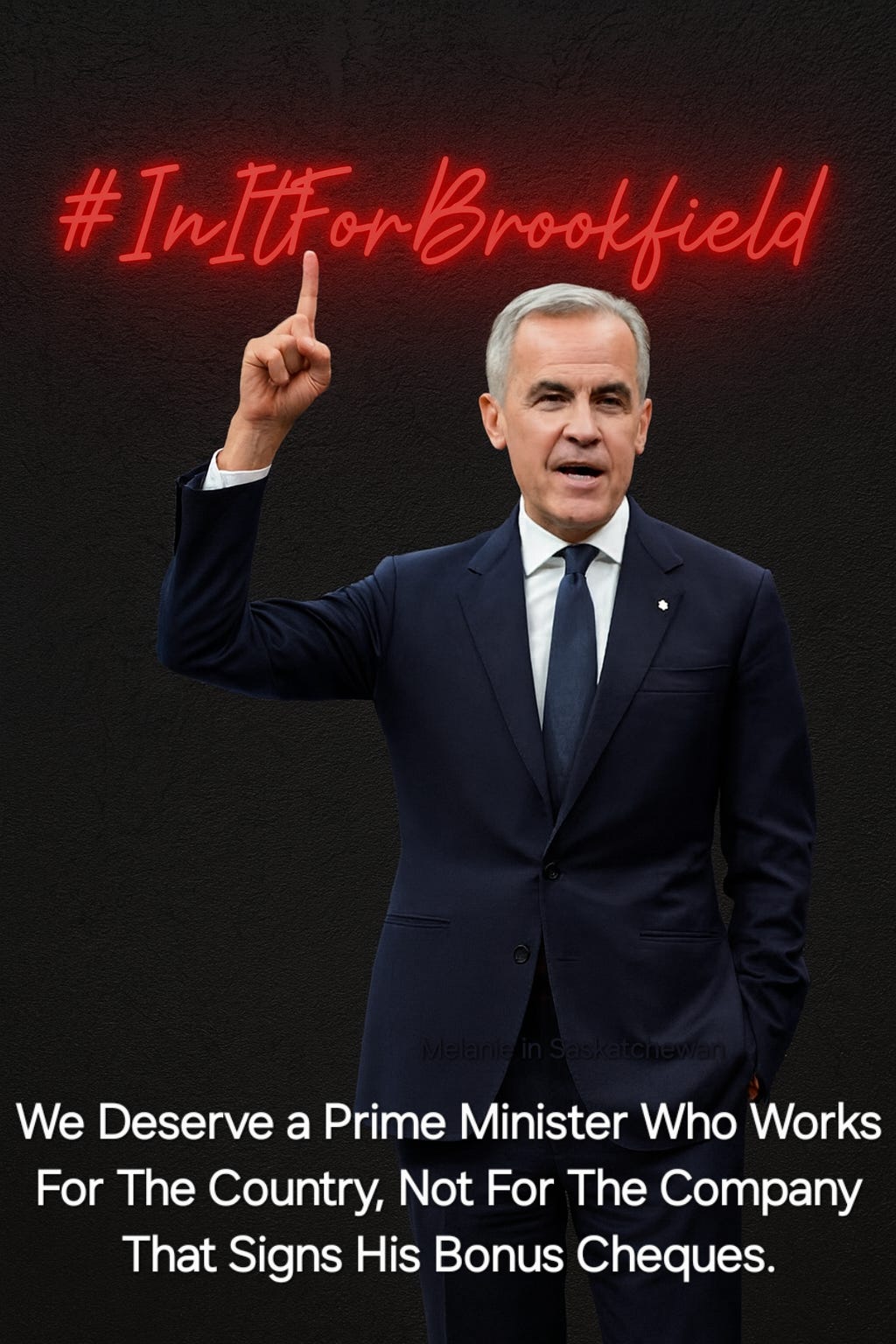
Melanie in Saskatchewan reminds us that Prime Minister Mark Carney’s interests seem to align far more with those of the Brookfield Corporation than with those of ordinary Canadians:

Canadians are tired of being treated like an afterthought. Eight months ago, Mark Carney parachuted into the safe Liberal seat of Nepean, shoved aside a long-serving MP, and promised voters he would be their voice in Ottawa. Today, there is still no constituency office open in the riding. Residents who need help with immigration files, CRA problems, or passports are told to send an email and wait, sometimes for several weeks. That betrayal starts at home, and Nepean is living proof that Carney’s priorities lie somewhere else entirely.

That “somewhere else” has a name: Brookfield Asset Management.

A $500-million federal “green steel” subsidy was rushed through cabinet for Algoma Steel in Sault Ste. Marie. Nothing wrong with helping steelworkers, except the electricity for the project comes almost exclusively from wind farms owned by Brookfield Renewable Partners. Mark Carney still holds roughly $6 million in unexercised Brookfield stock options that vest based on the company’s renewable-energy profits. In other words, every tax dollar sent to Algoma flows through to the bottom-line gains that Carney himself pockets.

The Parliamentary Budget Officer has already flagged the transaction as one of several in Carney’s $78-billion deficit budget that rely on “creative accounting” to hide the true cost.

This isn’t a conspiracy theory; it’s on the public record in Carney’s own ethics disclosure filed with the Conflict of Interest Commissioner Konrad von Finckenstein. The same disclosure that conveniently claims his former advisory role was “exempt” from stricter rules, rules that apply to every other cabinet minister.

While Canadians wait 33 hours in emergency rooms, watch their real wages shrink, and see layoff notices pile up at Stellantis, CAMI, and Algoma itself, the Prime Minister’s old firm is doing just fine. Brookfield’s stock is up 18 per cent since the subsidy was announced. Coincidence?

Hardly.

The hypocrisy runs deeper than one subsidy. Carney spent years on the world stage lecturing banks and governments about “climate risk and the urgent need to phase out fossil fuels”. Yet the same Alberta energy memorandum that triggered Steven Guilbeault’s resignation quietly allows new pipelines and extends oil recovery through carbon-capture tax credits, credits that, once again, flow disproportionately to companies in which Brookfield has major stakes.

Green Party Leader Elizabeth May says Carney personally assured her those provisions would never see the light of day. Nine Liberal MPs are now telling reporters, off the record, that they feel betrayed by the same broken promise.

November 26, 2025

The importance of “a bicycle shop in Bermuda” to Mark Carney’s financial affairs

Filed under: Cancon, Government, Law, Media, Politics — Tags: , , , , , , — Nicholas @ 03:00

It’s no secret that Prime Minister Mark Carney is a rich man. When he entered politics, he put his financial holdings into a blind trust to satisfy the federal government’s ethical and conflict of interest rules. But through this arrangement, he still owns significant positions in companies whose fortunes can (and are) affected by the actions of his government. On Monday, this was discussed at some length by a Parliamentary committee in Ottawa, as reported on his Substack by Dan Knight:

On November 24, in a basement room of West Block, MPs spent two hours asking a very simple question that everyone in Ottawa is suddenly pretending is complicated:

If Mark Carney gets richer when Brookfield does better, and Brookfield is running big climate and infrastructure funds out of what one MP described as a bicycle shop in Bermuda, how on earth is that not a problem for the Prime Minister of Canada?

The man in the hot seat was Justin Beber, Chief Operating Officer of Brookfield Corporation. His job was to calm everyone down. Instead, under oath, he calmly confirmed just about everything the government would rather you didn’t think about too hard.

He started with the corporate biography. Brookfield, he reminded the committee, is a massive global investor headquartered in Toronto. It has more than 600 direct employees in Canada, more than 15,000 workers in its operating businesses, and it paid over $750 million in federal tax last year, not counting provincial and local taxes. All of that is true. None of it changes the basic conflict: the sitting Prime Minister still has long-term compensation that rises when Brookfield, and certain Brookfield funds, succeed.

Conservative MP Michael Barrett went straight there. He asked Beber whether, when Brookfield’s value increases, the value of stock options and deferred share units also increases. Beber said yes. Then Barrett asked whether that changes if those options and units are placed in a blind trust. Beber said no. It does not. The economic reality is exactly the same: if Brookfield’s share price goes up, those instruments are worth more, whether they are in Mark Carney’s brokerage account or parked with a trustee behind frosted glass.

[…]

Cooper spelled out why it matters. Carney, he said, knows what kind of public policy could improve the success of the fund. The fund’s success determines his future bonus pay. Without knowing who the investors are or all of the fund’s positions, Canadians have no way to see where those incentives may line up — or collide — with the national interest. These are not theoretical conflicts. They are simply invisible ones.

Eventually, after some confusion over terminology, Beber did confirm that Transition Fund I has invested in 20 companies and that their names are listed in the ethics annex. Only one of those firms, Entropy, is in Canada. The rest of the portfolio, and the roster of big-money investors behind it, sits offshore, beyond any serious public scrutiny, while the Prime Minister’s upside rides on how well those bets pay off.

The tax side of the story is just as revealing. Bloc MP Luc Thériault put it bluntly: tax avoidance is not a conspiracy theory, it is a business model so widespread that the OECD and G20 built an entire 15 percent global minimum tax regime to deal with it. He cited Canada Revenue Agency estimates of tens of billions of dollars in lost federal revenue each year, including billions attributable specifically to tax avoidance. He asked Beber whether Brookfield engages in tax avoidance. Beber refused to use the term. “We practice tax planning”, he said, like “any other company”. He repeated that Brookfield pays all taxes that are “due and payable” in the jurisdictions where it operates.

That phrase sounds reassuring until you remember who writes the rules that decide what is “due and payable”, and who benefits when the system can be routed through Bermuda via something that, on paper, looks like a bicycle shop.

[…]

At some point, the pattern becomes impossible to ignore. The Prime Minister of Canada left a giant global investor with standard executive incentives, kept his vested long-term instruments, retained a carried interest in a $15 billion Bermuda-run climate fund that will operate into the 2030s, and knows exactly which sectors that firm is betting on. His government is now pouring public money and regulatory support into many of those same sectors. The firm uses structures justified as “tax transparent” that just happen to run through low-tax jurisdictions, including one address a Conservative MP described as a bicycle shop in Bermuda. The man running the firm’s operations will not say the Prime Minister’s potential upside is small. He will not say the global minimum tax is being met in practice. He will not disclose who the fund’s other investors are.

You do not need to be an expert in securities law to see the conflict. You do not need to be an expert in global taxation to see why a bicycle-shop registration in Bermuda is not about cycling. You just need to watch what they are desperate not to talk about directly: the hard link between public power in Ottawa and private profit offshore, wrapped in legal jargon, buried in annexes, and shielded from sunlight by a blind trust and a lot of very careful answers.

August 31, 2025

Didn’t we once have “conflict of interest” rules for politicians?

Filed under: Business, Government, Media, Politics, USA — Tags: , , , , — Nicholas @ 03:00

It’s become a commonplace that politicians leave office vastly wealthier than they went in, far in excess of their official salaries. Once upon a time, even though it probably still happened, the fat cats managed to stay below the event horizon with their ill-gotten gains. Today, they no longer care if you find out that this or that senator has consistently beaten the market on their investments during their entire time in office. After all, what are you going to do about it, punks? Maybe something like this:

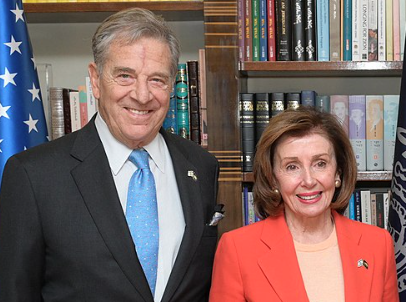
Paul and Nancy Pelosi, 16 February, 2022.
Detail of a photo by Amos Ben Gershom via Wikimedia Commons.

The original research was on how Senators seem to make 12% annually. That’s, erm, a lot.

Markets — something that always comes as a surprise to politicians — react:

    American lawmakers are so consistently successful that a flurry of new platforms and apps now compile filing data from US politicians as a key input in strategies for retail investors and even hedge funds.

    The number of people using these so-called “copy trading” strategies has exploded. Tens of thousands of Americans now follow and imitate trades made by members of Congress, and they are making millions of dollars in the process.

OK, what fun, eh?

Even more fun would be Megan McArdle’s suggestion, that the CongressThieves must announce that they intend to trade an hour before they do so that everyone else can front run them.

Because, you know, Ms. Pelosi:

    She beat every single hedge fund last year.

But there’s something even more fun:

    Dub launched in March 2024 as America’s first regulated brokerage to offer copy trading accounts to mimic politicians and star traders.

    “It’s been absolutely insane in terms of growth,” says Steven Wang, the founder and chief executive who dropped out of his freshman year at Harvard to build the platform. Today, it has 1.5 million users across America.

    Of the $100m or so invested across Dub, nearly $23m is in its Pelosi tracker account. Since its launch in early 2024, its paper gains are 172pc.

Stock prices do not move “because”. Interest rates change, profits go up, or down, or tariffs or … stock prices change because people buy and or sell more of them. That may be in reaction to those other things but the actual price movement is that buy and sell stuff.

Which means that if we copy Nancy’s trades — after she’s done them — then we’re making money for Nancy. Because we are piling in our weight of money into a position she already holds.

Which, when you think about it, is really pretty shitty. Sure, it’s nice to make money ourselves by trading upon that congressional information. But there is that very, very, heavy cost of making Ms. Pelosi even richer as a consequence.

June 30, 2025

DOGE couldn’t address the structural problems with the US government

At the Foundation for Economic Education, Mohamed Moutii looks at the reasons DOGE was unable to come close to achieving the lofty goals it was launched with:

DOGE’s biggest failure was its inability to deliver its promised sweeping transformation. From the start, its $2 trillion savings target was unrealistic. Cutting nearly 30% from a $7 trillion budget was never feasible, especially with politically untouchable programs like Social Security, Medicare, Medicaid, and Defense off the table.

Musk’s claim that eliminating waste alone could close the gap didn’t hold up. While most budget experts support cutting inefficiencies, they agree that waste isn’t the main driver of the fiscal crisis. Even slashing all discretionary spending would save only $1.7 trillion. The real pressure comes from mandatory programs, which account for nearly two-thirds of the budget, leaving only a quarter of spending truly up for debate.

As reality set in, Musk’s savings claims shrank from $2 trillion to just $150 billion. While DOGE cites $170 billion saved, independent estimates suggest closer to $63 billion, less than 1% of federal spending, with many claims either inflated or unverifiable. Some savings were credited to long-canceled contracts. Though headline-grabbing layoffs and cuts were made, they were often botched, forcing agencies to rehire staff or reverse course. Meanwhile, federal spending rose by $166 billion, erasing any gains. Trump’s fiscal agenda worsens the outlook with the first-ever $1 trillion defense budget, sweeping tax cuts, and protected entitlements — all while annual deficits approach $2 trillion.

Yet DOGE’s failures ran deeper than mere fiscal naiveté. What began as Musk’s role as a “special government employee” quickly expanded into an unchecked exercise of executive power, raising constitutional alarms. His team reportedly accessed classified data, redirected funds, and sidelined entire agencies — actions taken without Senate confirmation, potentially in violation of the Appointments Clause of the Constitution. Legal pushback swiftly followed, with fourteen states suing Trump and Musk over the constitutionality of Musk’s White House-granted authority.

Meanwhile, glaring conflicts of interest became impossible to ignore. Musk’s companies — X, SpaceX, and Tesla — hold $38 billion in federal contracts, loans, tax breaks, and subsidies while facing over 30 federal investigations. His push to dismantle regulatory agencies like the Consumer Financial Protection Bureau (CFPB) — while X launches the “X Money Account“, a mobile payment service subject to CFPB oversight — only deepened concerns. Musk was legally obligated to separate his business dealings from government decisions. One major result has been the impact on Musk’s reputation. Once hailed as a visionary for his promotion of electric cars, he is now viewed unfavorably by many former fans.

December 10, 2024

Countering the “Managerial Revolution”

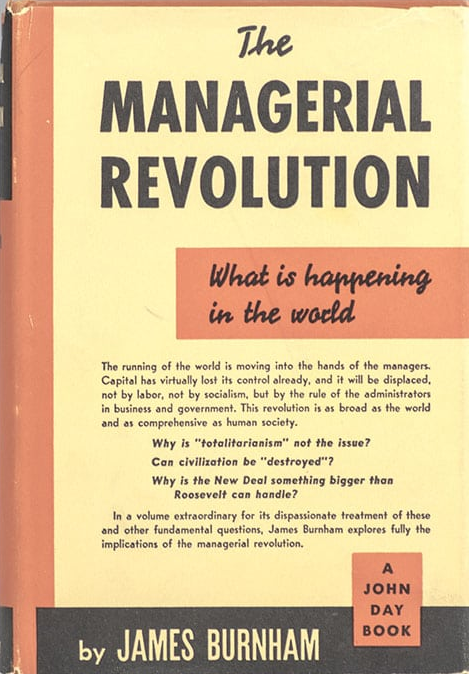
Tim Worstall discusses the rise of the managerial class — described in 1941’s Managerial Revolution by James Burnham — and how detrimental to individual enterprises and the wider economy managerialism has been:

This, rather joyously, explains a lot about the modern world. We could go back to the mid-1980s and the bloke who ran the ‘baccy company written up in Barbarians at the Gates. In which he, as CEO, had a fleet of private planes, the company paid for his 11 country club memberships and so on. His salary was decent, sure, but the corporation rented him all the trappings of a Gatsbyesque — and successful — capitalist. Until the actual capitalists — the barbarians — turned up at those gates and started demanding shareholder returns.

Or we can think of the bureaucratic classes in the UK in more recent decades. Moving effortlessly between this NGO, that quasi-governmental body and a little light sitting on the right government inquiry. All at £1500 a day and a damn good pension to follow.

Or, you know, adapt the base idea to taste. There really is a bureaucratic and managerial class that gains the incomes and power of the capitalists of the past without having to do anything quite so grubby as either risk their own money or, actually, do anything. They, umm, administer, and the entire class is wholly and absolutely convinced that everything must be administered and they’re the right people to be doing that.

You know, basically David Cameron. Met him once, when he was just down from uni. At a political meeting – drinkies for the Tory activists in a particular council ward, possibly a little wider than that. Hated him on sight which I agree has saved me much time over the decades. And I was right too. There is nothing to Cameroonism other than that the right sort of people should be administering — the managerial revolution.

Sure, sure, we used to have the aristocracy which assumed the same thing but we did used to insist that they could chop someone’s head off first — show they had the capability. Also, they didn’t complain nor demand a pension when we did that to them if they lost office.

But the bit that really strikes me. France — and thereby the European Union — seems to me to be where this Managerial Revolution has gone furthest. Get through the right training (the “enarques“) and you’re the right guy to be a Minister, run a political party, manage the oil company, sort out the railways etc. You don’t have to succeed or fail at any of them, you’re one of the gilded class that runs the place. Because, you know, everything needs to be run and one of this class should do so.

The divergence or even active conflict of interests between the owners and the non-owning managers is part of the larger Principal-Agent Problem.

December 6, 2024

Liberal cabinet minister accepts “free” Taylor Swift tickets

Filed under: Cancon, Media, Politics — Tags: , , , , , — Nicholas @ 03:00

I’ve often joked that it isn’t surprising that politicians can be bought … what is surprising is just how little it can take. This situation isn’t quite as clear-cut as that, but it looks bad to everyone except Liberal Party insiders:

Former Canadian Defence Minister Harjit Sajjan in happier times (yeah, it’s the only picture I have of the minister).

On Tuesday we learned that federal Liberal cabinet minister Harjit Sajjan will be attending a Taylor Swift concert at BC Place in Vancouver, in a private suite, courtesy of PavCo, the Crown corporation that operates the stadium. The federal government partially funds PavCo, including $116 million earlier this year for improvements to the stadium in advance of the 2026 World Cup.

It’s a textbook conflict of interest. Open and shut. Dead to rights. So much for Sajjan’s political career. Only … not. The only people who seem to disagree that it’s a conflict are federal Liberals and, sorry to say, the office of the Conflict of Interest and Ethics Commissioner — because Sajjan donated $1,500 to a food bank as a gesture to compensate for the coveted opportunity.

“If an item is paid for through a charitable donation, then it would not be considered a gift,” a spokesperson for the commissioner said in response to questions from National Post. “In the case of Minister Sajjan, for example, the original market value of a ticket to a Taylor Swift concert in Vancouver was roughly $600.”

Where do we even begin with this nonsense?

PavCo offered private-box seats to various dignitaries on the understanding they would donate some appropriate amount of money to good causes. Sajjan says he’s proud to have participated.

But you can’t “pay for” a free concert ticket — to use the commissioner spokesperson’s term — by giving money to a food bank. That’s like The Keg offering you a free dinner so long as you pay for it at Montana’s … except food-bank donations, unlike steak dinners, come with tax receipts.

June 12, 2024

“Treason never prospers” … except in Canadian politics, apparently

Filed under: Cancon, Government, Media, Politics — Tags: , , , , , — Nicholas @ 05:00

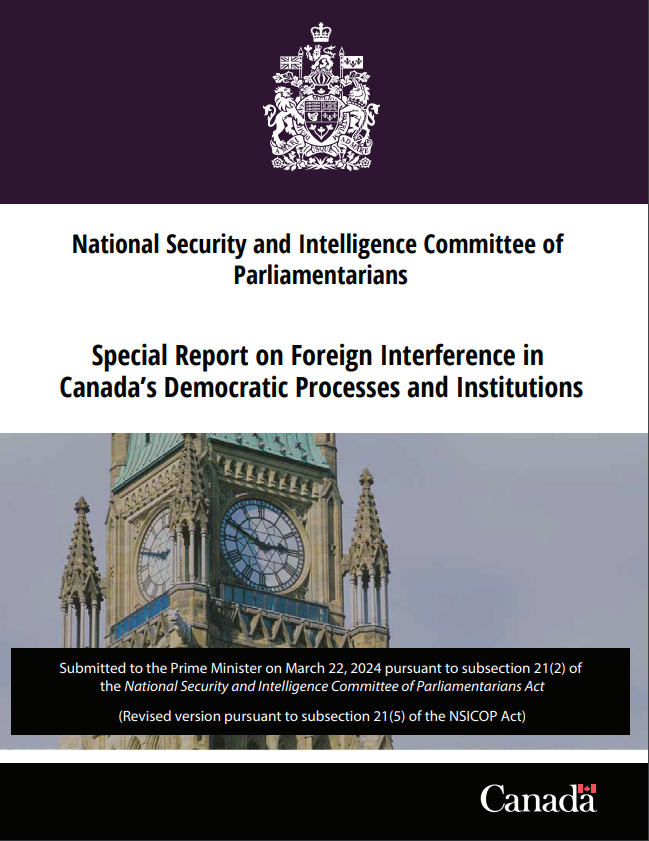
Justin Trudeau and his unindicted co-conspirators in Canada’s federal parliament don’t think the names of Members of Parliament who have been acting as enablers or actual agents of foreign powers — that is, possible traitors — should be made public. The National Security and Intelligence Committee of Parliamentarians (NSICOP) Even the least cynical may be forgiven for thinking that this isn’t what a mature country would do in similar circumstances:

The cover of the NSICOP special report on foreign interference (PDF here)

… MPs have an obligation to protect the institution that is the House of Commons. Every MP is required as a condition of taking their seats, to swear the following oath: “I, [name], do swear that I will be faithful and bear true allegiance to His Majesty King Charles the Third, King of Canada, his heirs and successors. So help me God.”

The violation of that oath, or the suspected violation of that oath, is absolutely arguably contempt against the House of Commons. We don’t have a ton of precedent for that, because MPs who have been alleged to have collaborated, even unwittingly, with a foreign power in the past usually have the good sense to resign. But MPs should absolutely be allowed to pass judgment on the actions of their colleagues, with the express intent of expelling from the House any members who have transgressed against their oath to King and Country. This isn’t just their duty, it is a duty that they are uniquely positioned and obligated to perform. Until we know exactly which parliamentarians we’re talking about, a spectre hangs over all 400-plus of them. That very much compromises the public’s opinion of Parliament and has a demonstrable impact on their ability to do their jobs as parliamentarians.

Once upon a time, children, ministers of the Crown would offer their resignations for mistakes made by members of the civil service in the ministry for which he or she held responsibility, never mind mistakes of their own. In modern times, of course, it’s rare to find a minister resigning voluntarily until the RCMP is literally knocking on the door, and sometimes not even then.

Second, we are a large and multicultural country. MPs are expected to represent members of any diaspora community which may exist in their constituency. If you’re a Tibetan or Uyghur activist, how can you be represented by an MP who’s demonstrated a willingness to collaborate with the government of the People’s Republic of China? If you’re an Iranian democracy and reform activist, how can you be represented by an MP who has close ties to Iran’s diplomatic and intelligence operation?

The answer, of course, is that you can’t be. The government has a greater responsibility to the democratic rights of those Canadians than it does to protecting the identity of any single unscrupulous or otherwise compromised parliamentarian. With every day that passes, Ottawa looks more like it has an interest in partisan butt-covering than it does in maintaining the long-term faith that democracy requires for our institutions to survive.

A good Member of Parliament recognizes the responsibility to the constituents — whether they voted for that particular MP or not — and would keep that responsibility as faithfully as possible. On that reckoning, we have fewer good MPs than we should have … and if the intelligence turns out to be fully supported upon full investigation, there should be a lot of open seats to run by-elections for (even if no formal charges of treason are ever laid).

Finally, I accept that intelligence is not evidence. I also accept, as noted in the Globe by Philippe Lagassé and Stephanie Carvin, that we must be cautious to not compromise intelligence sources and methods, or compromise ongoing investigations. Parliamentarians should not replace the criminal justice system or undercut our defence, but they what they are capable of doing, and indeed are required to do because no one else can do it for them, is broadly defining what the acceptable behaviour for parliamentarians should be. If an MP or a senator has engaged with a foreign power’s diplomatic or security services and they do not believe they have crossed the line for what we deem to be acceptable behaviour, they will be more than welcome to go on Power and Politics, or take to social media, or show up at what I’m sure will be many committee hearings, and make their case.

It is not a hardship to ask them do so. They are not being hard done by. The question here is not whether what they’ve done is criminal. It wasn’t criminal when Bev Oda billed the taxpayers for her juice. It wasn’t criminal when Bill Morneau forgot to leave a cabinet meeting where a decision was made that was a perceived conflict of interest. But both of those parliamentarians were forced to accept that their behaviour had failed the people they were sworn to represent. They resigned.

And the idea that orange juice crosses the line, but aiding a foreign intelligence service — even “semi-wittingly” — does not, will fail to pass the smell test with a very large number of Canadians. And that is entirely correct. The public is well ahead of the politicians on understanding this.

Public trust in politicians has been ebbing for quite some time and was fading even before the pandemic exposed so many of them as would-be dictators, poltroons, and idiots. There is no deep reservoir of respect for politicians that can be drawn on at this point. Swift action is the only thing that Parliament can do and by “swift”, I don’t mean setting up a Royal Commission with a multi-year remit to bury the issue until after the next federal election.

May 13, 2024

Unravelling the actual origins of Covid (aka Wuhan Coronavirus)

In Spiked!, Matt Ridley outlines some of the more recent admissions-against-interest of the people who used to accuse you of tinfoil-hattism and peddling conspiracy theories when the topic of the origins of Covid came up:

Wuhan Institute of Virology.
Wikimedia Commons.

Two of the key figures in the story of Covid’s origins gave away vital new information last week before the US Congress.

One of these figures is Ralph Baric, the University of North Carolina professor who invented ingenious techniques for genetically altering coronaviruses. He effectively taught scientists at the Wuhan Institute of Virology in China how to do “gain of function” experiments with bat-derived sarbecoviruses to make them more infectious or lethal in humanised mice. The other figure is Peter Daszak, the highly paid president of the non-profit, EcoHealth Alliance. Over many years, EcoHealth Alliance has channelled large sums of US taxpayer money to the Wuhan Institute of Virology for “gain of function” experimentation, and for finding new sarbecoviruses in bats.

Up until now, Baric and Daszak have taken slightly different approaches to (hardly) helping the world understand what went on in Wuhan before the Covid-19 outbreak in November 2019. Baric has remained largely silent, refusing to do interviews or sign up to articles in the scientific press. He remained silent last week, too, but the Congressional Select Subcommittee on the Coronavirus Pandemic released the transcript of a lengthy closed-door session it held with him in January.

Daszak, by contrast, has adopted a high profile, organising round-robin letters defending his friends and colleagues in Wuhan, giving interviews, writing articles and getting himself appointed to not one but two commissions investigating Covid’s origins, despite a glaring conflict of interest. He appeared before the subcommittee on 1 May.

Both men reluctantly admitted under oath to points that markedly strengthen the already strong hypothesis that the pandemic began with an accident in a laboratory in Wuhan. But before considering what they said, it might be worth briefly looking at the relationship between the two.

In comments on a draft of a grant proposal written in 2018, which were made public last year, Daszak boasted of how cheap it is to do experiments in Wuhan because they use a lower biosafety level (BSL-2), without negative-pressure work cabinets. Baric responded that US scientists would “freak out” at that. So a newly released email Baric sent to Daszak on 27 May 2021 smacks one’s gob somewhat. Responding to Daszak’s insistence that the Wuhan Institute actually used safer versions of these low safety standards for its experiments, Baric wrote:

    Your [sic] being told a bunch of BS. Bsl2 [with] negative pressure, give me a break. There [sic] last paper mentioned bsl2 [with] appropriate PPE. This last part was the first and only time this was ever mentioned, never in earlier papers, and in the latest paper never defined either. I have no doubt that they followed state-determined rules and did the work under bsl2. Yes China has the right to set their own policy. You believe this was appropriate containment if you want but don’t expect me to believe it. Moreover, don’t insult my intelligence by trying to feed me this load of BS.

Baric clearly does not have a high regard for the Wuhan Institute of Virology’s safety standards, or indeed for his virus-hunting grantrepreneur colleague, Daszak. Nor do some other scientists who have nonetheless defended Daszak in public. Thanks to freedom-of-information revelations, we now know that “Dastwat” and “EgoHealth” are just two of the epithets used about him by his friends. With friends like that …

Both men still insist, however, that the pandemic began naturally – but, to borrow from Mandy Rice-Davies, they would say that wouldn’t they? Before the subcommittee, where even the Democrats gave him a pasting, Daszak was forced to concede some key points on which he had previously stonewalled or said the opposite.

Firstly, he had to concede that a lab leak was possible. Yet back in 2020, Daszak told Democracy Now that “the idea that this virus escaped from a lab is just pure baloney. It’s simply not true … So it’s just not possible.”

April 12, 2024

Busybody Alberta cabinet minister claims cheap booze is not in “compliance with … the spirit of Albertans”

Filed under: Cancon, Government — Tags: , , , , — Nicholas @ 03:00

Chris Selley points and laughs at Dale Nally, Alberta cabinet minister with responsibility for the regulation of gambling, booze, and cannabis:

Lauren Boothby on Twit, er, I mean “X” – https://twitter.com/laurby/status/1776437318435422493/photo/1

The latest prude eruption comes from Alberta — Canada’s freedom capital, by some accounts. Over the weekend, Edmonton Journal reporter Lauren Boothby quite rightly informed her social-media followers of an extraordinary bargain she had discovered at Super Value Liquor in Edmonton’s Mill Woods neighbourhood: $49.99 for four litres of store-brand “Value Vodka”, produced at the T-Rex distillery in St. Albert, sold in a clear plastic jug, and labelled roughly as you might label a jug of vinegar or bleach (appropriately, per the vodka snobs on X).

“Alberta rules”, Boothby reported, and in many respects I agree.

Alas, a very Canadian scene then unfolded. Dale Nally, the minister responsible for Alberta Gaming, Liquor and Cannabis (ALGC), declared himself not OK with these vodka jugs. Not even slightly tolerant was Nally of these jugs; no sirree, Bob. He conceded the vodka was perfectly legal to sell — a minor but important detail — but claimed the jugs were somehow not in “compliance with … the spirit of Albertans”.

That’s not bad as an accidental pun, but you’ll notice that it’s absolutely meaningless as an explanation or justification for a policy. (Ironically, Nally is also Alberta’s minister responsible for eliminating red tape.) In my experience, when a politician or activist tells you something is against your society’s values or “spirit”, chances are they’re somewhere between 30 and 180 degrees wrong about it. I certainly tend to trust a distillery, a liquor store chain and the people of Alberta over a government minister on the question of whether there’s a market for cheap vodka.

Now to be fair, by any Canadian standard at least, Super Value Liquor is selling some astonishingly cheap hooch. Had someone other than a credible journalist posted that photo on X, I would have disbelieved my eyes. You can’t legally sell a four-litre vessel of vodka in Ontario for less than $144, and in practice it will cost you considerably more than that.

Ontario will always be the capital of Canadian prudery, but that’s almost three times as much! Canadian provinces have their policy and pricing discrepancies, but not many that big.

I’m all for reasonably cheap booze and a wide-open market in pretty much everything that doesn’t inherently harm other people. But in the wrong hands, certainly, alcohol does harm other people, in addition to its consumer. I wish it weren’t true, but it is. Curbing excessive alcohol consumption is a reasonable public-health goal that every serious government and opposition party in the developed world shares to some extent. And the simplest, most efficient and therefore most lucrative way for governments to accomplish that goal is through pricing.

(We’ll leave aside for now the howling conflict of interest inherent in governments selling alcohol — and casino gambling, lottery and sportsbooks, for heaven’s sake — while officially trying to dissuade people from partaking.)

February 3, 2024

“There are no tangible consequences for politicians who violate ethics rules. The maximum fine is just $500”

Chris Selley helpfully explains why — even if the ethics commissioner turns a blind eye, again — Justin Trudeau should avoid ostentatiously living like an aristocrat in the Ancien Régime of pre-revolutionary France:

Image from Blazing Cat Fur

Interim federal Ethics Commissioner Konrad von Finckenstein authored a great moment in Canadian political accountability on Tuesday in explaining to a parliamentary committee when and why he might investigate a very generous gift to the prime minister from a friend. (Gifts from friends are explicitly allowed for in the Conflict of Interest Act.) The gift would have to be “really exceptional,” he suggested, like “a Ferrari,” or “$1 million,” to trigger an investigation.

You can get two Ferrari 296s for $1 million. Or a Daytona SP3 for around $2.5 million. It’s a very confusing standard.

Not rising to this “exceptional” level, apparently, is the free nine-day vacation in a luxury Jamaican villa the Trudeau clan enjoyed over the Christmas break, with a retail cost of around $84,000, courtesy of family friends who own the estate.

“This is a true friend, who has no relations with the government of Canada,” von Finckenstein told the committee (read: unlike the Aga Khan, whom von Finckenstein’s predecessor Mary Dawson found not to have been a real-enough friend to escape her wrath). “What we have here is clearly a generous gift, but it’s between people who are friends and I don’t see why, just because they’re well off, they can’t exchange gifts.”

Leaving aside what the prime minister is allowed to do with his truly rich true friends, it remains utterly astonishing to me that Justin Trudeau or someone with an ounce of sway in his office wouldn’t put a stop to this conspicuously consumptive behaviour as a matter of choice.

[…]

Hard cases make bad law, and it’s almost impossible to imagine a future prime minister luxuriating in his birthright lifestyle the way Trudeau does. In fact, so long as such gifts are disclosed — which the Aga Khan caper might well not have been, had the National Post not been tipped off — I think it’s probably better to let Canadians decide for themselves what they think of their PM’s behaviour when he’s unshackled by hard-and-fast rules.

It’s not as though the ethics commissioner’s findings of guilt have any real effect. There are no tangible consequences for politicians who violate ethics rules. The maximum fine is just $500. Former finance minister Bill Morneau was dinged just $200 for forgetting to disclose his villa in Provence. (I suspect La Villa Oubliée is unavailable to rent at any price.)

September 13, 2020

Are the Kielburgers fleeing before the real story breaks?

Filed under: Cancon, Government, Politics — Tags: , , , , — Nicholas @ 05:00

Ted Campbell listened to an Evan Solomon radio report recently and spells out the key points:

The Kielburgers, he notes are neither newcomers nor naifs. Mark Kielburger is a Rhodes Scholar and Craig Kielburger has, he say, “been rubbing shoulders with politicians since he was 12 years old.” They have, Mr Solomon says, been selling the “halo effect” to politicians and other celebrities, a list which he tells us includes Justin Trudeau, Barack Obama, Oprah Winfrey and Erin O’Toole and the “halo effect” says, in effect, if you come out and make us look good then we, being a famous, big-league charity will make you look good, too. It’s all part of an astute marketing plan.

But then Evan Solomon gets to the real question: if Tylenol, he says, can survive a scandal in which people died then why are the Kielburgers reacting so dramatically to what is, really, on the surface, a minor league scandal? So the Kielburgers paid Margaret Trudeau a few hundred thousand dollars to make a few charity appearances, is that such a big deal? I mean the Trudeaus are wealthy, aren’t they? They can’t be bought, can they? Well, most if us don’t have million dollar plus trust funds and most of us didn’t earn $450,000 in speaking fees in a year, but the Trudeau family is unlikely to have just forgotten about $250,000 in speaking fees paid to Margaret Trudeau. Bill Morneau may have forgotten about owning a villa in France, but unlike the Trudeaus, Mr Morneau is rich … really rich. So are the Kielburgers. The commercial property part of their WE empire, alone, is worth $50 Million. Could a few thousands dollars per appearance (she made 28 over four years, about one every couple of months) paid to Margaret Trudeau really threaten the entire WE empire?

[…]

My guess, and that’s all it is, is that there is real fear in the WE boardrooms and in WE’s legal department that Prime Minister Trudeau might be guilty of something more than just conflict of interest. Someone like Pierre Poilievre or the Lobbying Commissioner, for example, might think that further, deeper investigations are needed and those questions might lead investigators to look more deeply into why and how Justin Trudeau and the Kielburger brothers, themselves, cooked up the idea of WE Charity running a multi-hundred-million-dollar government programme and then trying to cover-up the whole thing.

Might those questions be enough to bring Justin Trudeau down?

Might those questions be enough to threaten the Kielburgers’ fortunes, even their freedom?

July 19, 2020

In some mature countries, politicians resign when caught in ethics violations … but this is Canada (by definition, an immature country)

Filed under: Australia, Britain, Cancon, Media, Politics — Tags: , , , , — Nicholas @ 03:00

Chris Selley lists some of the ethical mire the Trudeau Liberals are wading through, and points out that other countries wouldn’t put up with corrupt sh!t like Canadians do:

Other countries’ prime ministers occasionally have to work at keeping their jobs. Not so much Canada’s. We look down our noses at Australia’s “leadership spills” as unconscionably chaotic, though they have ushered in a new prime minister a grand total of three times in 30 years. If only we had such chaos, PMs might at least be reminded occasionally they aren’t elected emperor in non-negotiable four-year chunks. Instead many of us blanch even at the idea of minority governance. So unstable!

Other countries’ ministers sometimes stand on points of principle, too, and not just over epochal events like the Iraq War or Brexit. Sajid Javid resigned as Britain’s chancellor of the exchequer last year after Prime Minister Boris Johnson insisted on appointing Javid’s senior staff. “No self-respecting minister would accept those terms,” he said. Every Trudeau minister accepts those terms.

There is simply no culture of accountability in Ottawa — not for big stuff and not for small. When Trudeau headed off to Harrington Lake while advising everyone else to hide under the bed, it was considered gauche to complain. The National Post reported this week that Health Minister Patty Hajdu took four round trips in a government jet between Ottawa and Thunder Bay during the lockdown, and Treasury Board President Jean-Yves Duclos was chauffeured six times to and from Quebec City. Ho hum. Another nothingburger.

OK, many conclude, so let’s at least give the Conflict of Interest Act some teeth! Some legislative dentures might be worth a try — though they’re by no means universally appreciated. When the Access to Information, Privacy and Ethics Committee reviewed the Conflict of Interest Act in 2014, some witnesses argued for doing away with financial penalties altogether, on the theory “the strongest sanctions the Commissioner has at her disposal are her moral authority and the power of condemnation.” The current maximum fine of $500 may well be the worst of both worlds: Not only does it offer no deterrent, it brings the law itself into disrepute.

[…]

On Thursday, Deputy Prime Minister Chrystia Freeland said she was “really sorry” about the WE debacle. But she expressed her “full confidence” in the prime minister. In other countries, it might be seen as ominous that she felt it necessary. Here, however, it’s safe to take it at face value. None of us expect much of our politicians, and that’s exactly what we get.

January 22, 2017

QotD: Conflict of interest

Filed under: Bureaucracy, Government, Quotations, USA — Tags: , , — Nicholas @ 01:00

I am not sure that this is a suitable subject for a blog post, probably more a project for an aspiring PhD student, but with all the discussion of conflicts of interest in the Trump cabinet, it strikes me that the most glaring conflict in the public sector is ignored: The CoI between state and local politicians elected with the support of public sector unions who then participate in compensation negotiations for the members of those unions. Here the temptation of the politicians to buy the support of the unions with public money is overwhelming. The impact of this is potentially trillions when public pension liabilities are included.

This is such an obvious conflict that I have looked to see if there are laws preventing this, but my initial research shows nothing.

It would be interesting to see if there is a statistical relationship between union support and subsequent pay rises. I would expect this relationship to be especially strong with deferred compensation (such as pensions) since this is very difficult for voters to monitor and can be easily gamed with unrealistic assumptions about, for example, investment returns.

Roger Barris, quoted by Tyler Cowen, “Understudied conflicts of interest in American government”, Marginal Revolution, 2017-01-11.

June 20, 2013

Supreme Court refuses to hear appeal of Rob Ford’s conflict-of-interest case

Filed under: Cancon, Law, Media, Politics — Tags: , , , , , — Nicholas @ 11:07

The Toronto Star must be feeling devastated by this:

The Supreme Court of Canada says it will not hear an appeal in a conflict-of-interest case against Toronto Mayor Rob Ford.

The court dismissed it with costs, but did not give reasons for the ruling.

Lawyer Clayton Ruby was trying to restore a lower court decision from November 2012, in which Superior Court Justice Charles Hackland ruled Ford be removed from office.

However, as part of Ford’s appeal, the decision was overturned by an Ontario Divisional Court panel in January 2013.

Deputy mayor Doug Holyday said this was all about antagonizing the mayor.

“There was no reason to take this to the Supreme Court; there was very little likelihood of it every getting put before the Supreme Court,” Holyday said.

Update: The CBC reports that Ford feels vindicated by the decision:

Toronto Mayor Rob Ford expressed relief Thursday that a conflict challenge that previously threatened to oust him from office won’t be revived in the country’s top court.

“I’m so happy this is finally over. I’ve been vindicated and we can move on,” Ford told reporters in Toronto, about two hours after the Supreme Court of Canada rejected an application to hear a final appeal in the much-publicized conflict case that began last year.

As is customary, the Supreme Court gave no reasons for dismissing the appeal, but legal experts — including the lawyer who filed the application himself — had acknowledged the odds of reviving the conflict of interest case were a long shot.

The court only accepted 12 per cent of appeal requests made last year.

Toronto resident Paul Magder filed an application in an Ontario court last year, alleging that Ford had violated conflict of interest legislation when he participated in a council vote that absolved his need to pay back funds donated to his private football foundation.

Powered by WordPress