… it is a general truism that the majority of persons who run for office in North America and various European countries do so because they sincerely want to help and improve their communities/countries. However, in all of Africa and most of Asia, persons who seek public office do so for one purpose, and one purpose only: to steal everything that they can get away with. So when some ignorant, naïve, American shows up with buckets full of money, oblivious of the culture and the longstanding, entrenched, corruption, and with an announced intention to make the local community more like an American community, they are welcomed with open arms while suppressing their snickering. This also explains something where Americans exhibit willful blindness: other cultures don’t play fair. Honesty is seen as the trait of fools. Fools are to be taken advantage of. Especially in trade and diplomacy. Just look at China.
Prior to the Cold War, America’s interference in other countries’ internal affairs was practically nonexistent outside of the Caribbean where America’s preoccupation was with the stability in the region. What went on in Egypt, Thailand, Argentina, or Greece was none of our business, nor did we frankly care. However, having just survived the cataclysm of WWII, and the realization that Communism was a danger bent on world domination, and that each country that became Communist made that possibility much more likely changed that laissez faire attitude 180 degrees. Whereas NATO was formed for the purpose of deterring a military attack on Western Europe by the Soviet Union (the generals mentally fighting the last war as is always the case, not realizing that the war now was ideological and propagandistic rather than military), diplomats began to question how to best combat Communist insurgencies in the Third World. The arrived (wrong) conclusion was that the reason a country became Communist was because the dirt-poor people were so desperate that they became Marxists in order to improve their lives, so if the West helped poor countries economically Communists could not gain a foothold. As such, they ignored the fact that most Communist movements are organized and headed not by poor people, but by a cadre of power-hungry middle-class intellectuals.
As has been mentioned, the first approach was with foreign aid. The second was with military intervention, in Korea, Vietnam, Santo Domingo, Grenada, and Lebanon. Although such interventions were mostly successful, they carried a heavy price as American blood was spilled in foreign countries. America’s supposed allies hardly helped at all, including the citizens of the countries (Korea and Vietnam) that themselves were in danger of being conquered by Communist forces.
Armando Simón, “Schlimmbesserung“, New English Review, 2022-06-16.
September 21, 2022
QotD: Why postwar western economic and humanitarian “interventions” almost always failed
September 20, 2022
Hannah Arendt in postwar Germany
In Quillette, Roger Berkowitz discusses what Hannah Arendt found when talking to Germans after the Second World War, which she characterized as their collective “escape from reality”:

In 1949, when Hannah Arendt (1906–1975) went to Germany as part of the New York-based Jewish Cultural Reconstruction Commission, she was struck by the way the Germans showed an “at times vicious refusal to face and come to terms with what really happened”. This “escape from reality”, as Arendt named it, meant that the reality of the Holocaust and the death factories was spoken of as a hypothetical. And when the truth of the Holocaust was admitted, it was diminished: “The Germans did only what others are capable of doing”.
The Germans, at times, simply denied the facts of what had happened. One woman told Arendt that the “Russians had begun the war with an attack on Danzig”. What Arendt encountered was a “kind of gentleman’s agreement by which everyone has a right to his ignorance under the pretext that everyone has a right to his opinion”. The underlying assumption for such a right is the “tacit assumption that opinions really do not matter”. Opinions are just that, mere opinions. And facts, once they are reduced to opinions, also don’t matter. Taken together, this led to a “flight from reality”.
The focus of Arendt’s lifelong engagement with the human flight from reality was her encounter with ideologies, specifically Nazism and Bolshevism. In The Origins of Totalitarianism and other texts (especially her essay, “On the Nature of Totalitarianism“), Arendt defines an ideology as a system that seeks to explain “all the mysteries of life and the world” according to one idea. Nazism is an ideology that blames economic disaster, political loss, and the evils of modernity on the Jews — inhuman flotsam who must be exterminated to allow a master race to flourish. Bolshevism, on the other hand, “pretends that all history is a struggle of classes, that the proletariat is bound by eternal laws to win this struggle, that a classless society will then come about, and that the state, finally, will wither away”. The bourgeoisie are not simply class traitors, they are a dying class, and killing them only supports a law of history. As ideologies, both Nazism and Bolshevism insist on explaining the events of the world according to theories “without further concurrence with actual experience”. The result, Arendt argues, is that such ideologies bring about an “arrogant emancipation from reality”.
Because an ideology “looks upon all factuality as fabricated”, it “no longer knows any reliable criterion for distinguishing truth from falsehood”. As reality recedes, ideologies organize society to transform their ideas into living reality. If antisemitism as an ideology says that all Jews are beggars without passports, the fact of wealthy and established Jews must be eliminated. If Bolshevism says that the bourgeoisie are corrupt, they must admit their corruption or be killed. The realization of such ideological realities can be accomplished, of course, through terror.
But even before a totalitarian movement takes power and mobilizes the secret police in the machinery of terror, ideological movements can employ propaganda to deny and nullify facts, or change them. The Nazis, she writes, “did not so much believe in the truth of racism as desire to change the world into a race reality”. Similarly, the Bolshevist ideology that classes were dying was not something real, but something that had to be made real. The purges and terror that Stalin unleashed were supposed to “establish a classless society” by exterminating all social groups that might develop into classes. In both instances, the purpose of the ideology was to transform a mere opinion — race consciousness or class consciousness — into the “the lived content of reality”.
The point, as Arendt concludes, is that “ideological consistency reducing everything to one all-dominating factor is always in conflict with the inconsistency of the world, on the one hand, and the unpredictability of human actions, on the other”. What ideology demands is that man — an unpredictable and spontaneous being — cease to exist as such, that all humans be subjected to laws of development that follow ideological truth. That is why the turn from an unreliable reality to coherent fantasy requires an absolute elimination of human spontaneity and freedom.
September 18, 2022
Austria’s Take on the Uzi: Steyr MPi-69
Forgotten Weapons
Published 13 May 2022
(more…)
September 10, 2022
The Land Rover Defender Story
Big Car
Published 27 Dec 2019The Land Rover is Britain’s bullet-proof off-roader born out of Rover’s post-war desperation and became the indispensable go-anywhere vehicle. Like its famed bullet-proof ruggedness, Land Rover production kept going, and going, and going. But with a brief gap of 4 years, the Land Rover is still with us and looks like it’s not going away any time soon.
(more…)
September 9, 2022
The Velvet Glove and Sparrow II missiles; A Beginners Guide To Post-War Bomber Interception Tactics
Polyus Studios
Published 14 Jul 2018The Velvet Glove was a semi-active guided missile system developed by the Canadian Armament Research and Development Establishment. Its successor, the Sparrow II, was developed by Canadair in association with the US Air Force. This is the story of the development of the missiles in the context of contemporary weapons systems.
(more…)
September 2, 2022
Alliance For Peace (1951) North Atlantic Treaty Organization Promo Film
PeriscopeFilm
Published 14 May 202sProduced by NATO and the Signal Photographic Service of the U.S. Army, this black & white film is about the formation of NATO and its importance in the defense of the free world. Copyright 1951. The film features a score by William Alwyn. The film dates from the time when Gen. Dwight Eisenhower was supreme commander of NATO (1950-52), a post he left in order to run for President of the United States.
(more…)
September 1, 2022
Rheinmetall MG42/59: The Slow-Fire Commercial MG42
Forgotten Weapons
Published 4 May 2022After World War Two, when West Germany was allowed to reconstitute its army and join NATO, it needed small arms. The new Bundeswehr chose the MG42 as its standard GPMG, and the Rheinmetall firm undertook the project of recreating the technical data package to build them. The work was completed in 1958, and the company began making new MG42s in 7.62 NATO for the commercial export market as well as for the Bundeswehr (which designated the gun the MG1). Rheinmetall made a number of iterative improvements to the design, including nearly doubling the bolt weight (from 550g/1.2lb to 950g/2.1lb) for their MG42/59 model to bring the rate of fire down to a reasonable 700-900 rpm. The bolt (and its associated heavy buffer) was not adopted by the Bundeswehr, but was bought by other clients.
The MG42/59 also includes many of the other upgrades that would be implemented on the final MG3 version adopted by the military. These include:
– Top cover hinge that holds the cover in a raised position
– Feed tray to mount modern belt boxes and prevent belts from falling out when opened
– Integrated AA rear sight
– New muzzle booster designThis particular one is a beautiful example made in 1964 and brought to the US early enough to be a registered, transferrable, C&R piece.
(more…)
August 20, 2022
Czech M14: The ZK-420S Battle Rifle
Forgotten Weapons
Published 7 Apr 2017The ZK-420S is an experimental Czech rifle that is virtually unknown today, but which was remarkably influential, bearing significant elements of the Garand and several other Czech designs, and influencing the M14 and Kalashnikov rifles. Originally designed by Josef Koucky in 1942, the plans were hurriedly dusted off and improved at the end of World War 2. With many nations looking at the possibility of adopted self-loading military rifles, Brno hoped to make export sales of the design.
The ZK420S uses the trigger mechanism of the M1 Garand and a gas-operated rotating bolt action very similar to the Garand and AK rifles. It has a simple adjustable 3-position gas system, and a quick and simple disassembly procedure. It uses detachable box magazines (10 round, and not copied from an existing design) and was made in a variety of calibers for testing — including 8×57, 7×57, 7.5 Swiss, 6.5 Swedish, and .30-06. Examples were trialed or examined in the United States, Argentina, Israel, Ethiopia, England, Switzerland, Sweden, Norway, Denmark, and elsewhere — this particular rifle is from the Norwegian trials.
In my opinion, it is an excellent rifle, and its failure to sell was probably due to price and the combination of tight budgets and cheap surplus war material in the late 1940s. It is handy, well balanced, and has a good magazine design and good sights. Recoil is comparable to the Garand. Ultimately the development program in Czechoslovakia would lead to the ZK-472 in 7.5x49mm, which would proceed to the 7.62x45mm in the vz.52 rifle.
(more…)
August 8, 2022
FN-DA1: The BAR for NATO
Forgotten Weapons
Published 13 Apr 2022After World War Two, FN put the BAR back into production. This was initially the FN-D version with a quick-change barrel, but with NATO’s adoption of the 7.62mm cartridge, there was a demand for the BAR in that chambering. The Belgian Army adopted this new round, and plenty of other nations did as well. This prompted FN to release a new version of the FN-D for it, designated the FN-DA1.
In addition to the new chambering, the DA1 also had these three changes:
– Larger bipod feet and a wider bipod stance
– A rear aperture sight instead of an open notch
– A more protected barrel release latchThe FN-DA1 would remain in production until 1967, when it was finally discontinued.
(more…)
August 5, 2022
Don Camillo blesses the river Po
Perhaps the first foreign author I encountered as a child was Giovanni Guareschi — in English translation, of course, I’m not a natural linguist — and I’d read most of his stories by the time I was twelve. They didn’t always make a lot of sense to me as far as the political aspects were concerned, but the human stories always hit home. Clearly, Sarah Hoyt (who is a natural linguist … she read them in the original Italian, although I’d expect they would work very well for Portuguese readers) feels much the same way about the Don Camillo stories:
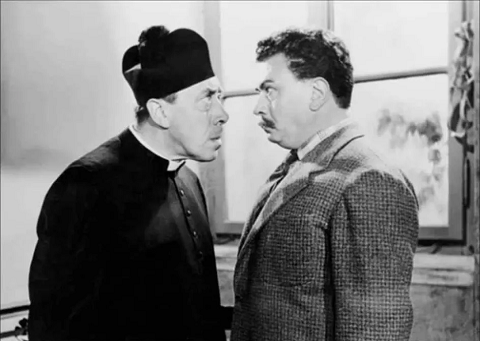
A still from one of the 1952-1965 film adaptations of the Don Camillo stories, with Fernandel as Don Camillo and Gino Cervi as Mayor Peppone.
There is a poignant scene in one of the Giovanni Guareschi Don Camillo books, (set in mid-century Italy, where communism and Catholicism are fighting it back and forth. They’re humorous, profoundly human, and easy reads. The stories are like 200 words each.) in which, during a period of high strife, the priest goes out to bless the river. Btw, if you need examples of how to be a flea on the side of the commies, that character is terribly subversive in little ways (as well as liking to hit them on the head. I might have taken him for a model when I was a pre-teen. Sigh. And Comrade Don Camillo is the best book for how to turn things on their heads if you’re in deep hiding in a lefty stronghold, either professional or geographic.)
Anyway, in the little village on the Po river where the priest and the communist mayor fight it out, the river is an ever present danger, and people cope with it the way they have coped with such things throughout history: every year the priest goes to the river and blesses it, in the hopes that it will become (I am remembering in Italian, the English translation is probably different) “A well behaved citizen and stay within its bounds”.
Now, this is not magic, of course, and the priest explains that. Blessing the river does not guarantee that the river won’t burst out of its bed and flood the village (later on in the book there are accounts of a flood, and if you think that a book can’t paint a picture, be sure it can. For the rest of my life, I’ll carry the image of the priest saying mass in the deserted and flooded village, while across the river, on the safe bank, his flock who fled the flood kneel on the muddy soil at the tolling of the consecration bell. BTW Guareschi is the writer I’d like to be when I grow up. Trained as a journalist, he uses minimal words, but the images stay with you.) It’s just that blessing it gives people hope it won’t, and allows them to live in a precarious place, at a precarious time without losing their minds. (It is important to remember that whatever else humans are, they’re creatures of ritual and habit, and sometimes those are the only panaceas for difficult situations.)
Well, the communists have their dander up, so they tell the priest they want to march in the procession to bless the river with their flags and paraphernalia and the priest says no, they say anyone in the procession will get beaten. They demand the priest cancel it, and people lose their minds. So, the priest says he’ll go alone, if needed. Needless to say, the communists follow, in what is an intimidation maneuver (they have no new moves, really.)
So, Don Camillo, without looking back, gets to the river and prays that the Lord will keep the river within its bounds. And of course, because he knows the audience at his back, he says “If the houses of decent people could float, I’d ask you for a flood like Noah’s. But since the houses of decent people are made of the same stone and brick and sink like the houses of scoundrels, I beg you to make the river behave.”
In case you’re wondering what went wrong in America, and why we are where we are: we forgot our houses can’t flood.
July 31, 2022
Look at Life — Pipeline (1961)
ian16th Jones
Published 20 Aug 2017Refuelling at Sea and in the Air 1960’s style
July 29, 2022
Nightmare Fuel For Soviet Submarines; the story of the Canadair CP-107 Argus
Polyus Studios
Published 4 Dec 2020Don’t forget to like the video and subscribe to my channel!
Support me on Patreon – https://www.patreon.com/polyusstudiosIn its day the Argus was the most formidable anti-submarine warfare platform fielded by any NATO country. Canadair adapted the Bristol Britannia into a highly effective low and slow sub hunter. This gave Maritime Air Command the edge in the North Atlantic. It served on the front-line of the Cold War and kept the Soviet submarine threat in check for almost 25 years.
(more…)
July 24, 2022
QotD: British armour from BAOR to the first Gulf War
To that end generations of British soldiers were stationed there training for a war that they hoped would never come. To this day there are still serving Cold War veterans who even into the late 1980s knew where they would deploy to, and the likely exact spot in the field or woods where they would dig their trenches and realistically be killed.
This force though was essentially a static one, designed to operate defensively and underpinned by an enormous static logistical and support network stretching from the Inner German Border all the way back to Antwerp and then the UK. The British Army was able to sustain armour in large numbers in part because it had the threat to face, the space to operate and the support network in place to enable this to occur. To this day the subject of how well supported BAOR was through the extensive rear communications zone efforts, and the widespread workshops (such as in Belgium) designed to repair and support UK units is not widely known or told, but deserves much greater recognition.
This matters because when people look back to the size of the British Army in 1990 and look at how many tanks we had then compared to now, they forget that the Army’s MBT capability was essentially a static garrison force waiting to conduct a defensive campaign against a peer threat where it expected to take heavy losses and probably operate very quickly in an NBC environment. It was not intended to be a deployable force capable of operating across the planet on an enduring basis.
This is why when people talk about how many tanks were deployed in 1991 to the Gulf War (some 220 Challenger 1’s were deployed) they forget that this was the first time since Suez that the UK had operated heavy armour overseas. It took many months to get this force into place, and it came at the cost of gutting the operational capability of the remaining BAOR units, who found their logistical support chains hammered in order to support the forces assigned to GRANBY.
The harsh, and perhaps slightly uncomfortable reality for the UK is that OP GRANBY required nearly 6 months of build up at the cost of gutting wider armoured warfare capability – proving that away from home, having 900 tanks is irrelevant if you are operating outside normal parameters and are having to effectively cannibalise or mothball most of them to keep 220 in the Gulf.
By contrast OP TELIC saw over 100 tanks deployed, but a significantly shorter lead in time for the deployment – testament to the significant investments made in the intervening period in logistical capabilities.
Sir Humphrey, “Tanks for nothing — Why it does not matter if the British Army has fewer tanks than Cambodia”, Thin Pinstriped Line, 2019-04-24.
July 23, 2022
Tank Chat #152 | Swiss Centurion | The Tank Museum
The Tank Museum
Published 25 Mar 2022
(more…)
June 26, 2022
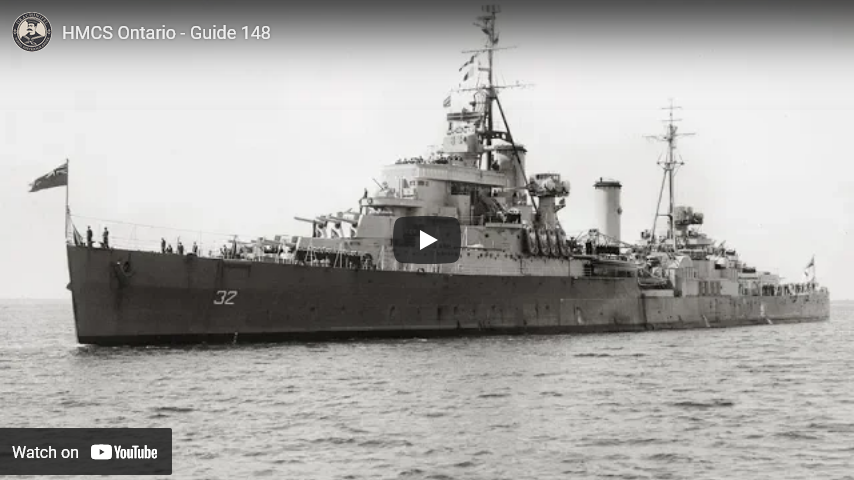
HMCS Ontario – Guide 148
Drachinifel
Published 12 Oct 2019HMCS Ontario, last of Canada’s cruisers and a Minotaur class vessel, is the second subject of the day.
Want to support the channel? – https://www.patreon.com/Drachinifel
Want a shirt/mug/hoodie – https://shop.spreadshirt.com/drachini…
Want a medal? – https://www.etsy.com/uk/shop/Drachinifel
Want to talk about ships? https://discord.gg/TYu88mt
Want to get some books? www.amazon.co.uk/shop/drachinifel
Drydock Episodes in podcast format – https://soundcloud.com/user-21912004