
Forgotten Weapons
Published 5 Aug 2022The story of the conversion of the Lee Enfield to 7.62mm NATO would not be complete without the L39A1. This is essentially the civilian competition version of what would become the L42A1. It was actually in British service as a target rifle — not intended for combat. It followed the L8 (the first British military attempts at a 7.62mm precision version of the Enfield) and the L42A1. It was basically a copy of the conversions done by civilian competition shooters in the British NRA.
Sights were made by several different companies, as the rifles were not issued with sights — they were obtained by the unit they went to, whatever particular model that unit preferred. This example has Parker Hale diopter sights. The L39A1 also used a .303 caliber magazine, as they were intended for slow-fire, single-loaded competition but the magazine was used as a loading tray. The .303 magazine will not reliably hold 7.62mm cartridges, but 7.62mm conversion magazines can be put in the L39A1 and will then work just fine. They also sometimes are fitted with .303 extractors. The stock here has a semi-pistol grip a bit less substantial than the L8 .22 rifle, although most had standard No4 stocks.
The original sights were removed, and remarked as L39A1. They were made in 1969, 1970, and 1972, with a single serial number range used for the L39A1, the pretrial trials examples of the L39, and the “7.62 Conv” rifles. A total of 1,213 L39A1 rifles were made, with the other types accounting for about 28 additional rifles.
(more…)
December 4, 2022
L39A1: British Service Target Rifle Before the L42A1
November 29, 2022
Near Peer: Russia
Army University Press
Published 25 Nov 2022AUP’s Near Peer film series continues with a timely discussion of Russia and its military. Subject matter experts discuss Russian history, current affairs, and military doctrine. Putin’s declarations, advances in military technology, and Russia’s remembrance of the Great Patriotic War are also addressed. “Near Peer: Russia” is the second film in a four-part series exploring America’s global competitors.
Tank Chat #159 | Warrior | The Tank Museum
The Tank Museum
Published 29 Jul 2022Join David Willey for a new Tank Chat on Warrior.
(more…)
November 27, 2022
Aleksandr Solzhenitsyn and One Day in the Life of Ivan Denisovich
In Quillette, Robin Ashenden discusses the life experiences of Aleksandr Slozhenitsyn that informed the novel that made him famous:

The book was published less than 10 years after the death of Joseph Stalin, the dictator who had frozen his country in fear for nearly three decades and subjected his people to widespread deportation, imprisonment, and death. His successor Nikita Khrushchev — a man who, by his own admission, came to the job “elbow deep in blood” — had set out on a redemptive mission to liberalise the country. The Gulags had been opened and a swathe of prisoners freed; Khrushchev had denounced his predecessor publicly as a tyrant and a criminal and, at the 22nd Party Congress in October 1961, a full programme of de-Stalinisation had been announced. As for the Arts, previously neutered by the Kremlin’s policy of “Socialist Realism” — in which the values of Communism had to be resoundingly affirmed — they too were changing. Now, a new openness and a new realism was called for by Khrushchev’s supporters: books must tell the truth, even the uncomfortable truth about Communist reality … up to a point. That this point advanced or retreated as Khrushchev’s power ebbed and flowed was something no writer or publisher could afford to miss.
Solzhenitsyn’s book told the story of a single day in the 10-year prison-camp sentence of a Gulag inmate (or zek) named Ivan Denisovich Shukhov. Following decades of silence about Stalin’s prison-camp system and the innocent citizens languishing within it, the book’s appearance seemed to make the ground shake and fissure beneath people’s feet. “My face was smothered in tears,” one woman wrote to the author after she read it. “I didn’t wipe them away or feel ashamed because all this, packed into a small number of pages … was mine, intimately mine, mine for every day of the fifteen years I spent in the camps.” Another compared his book to an “atomic bomb”. For such a slender volume — about 180 pages — the seismic wave it created was a freak event.
As was the story of its publication. By the time it came out, there was virtually no trauma its author — a 44-year-old married maths teacher working in the provincial city of Ryazan — had not survived. After a youth spent in Rostov during the High Terror of Stalin’s 1930s, Solzhenitsyn had gone on to serve eagerly in the Red Army at the East Prussian front, before disaster struck in 1945. Arrested for some ill-considered words about Stalin in a letter to a friend, he was handed an eight-year Gulag sentence. In 1953, he was sent into Central Asian exile, only to be diagnosed with cancer and given three weeks to live. After a miraculous recovery, he vowed to dedicate this “second life” to a higher purpose. His writing, honed in the camps, now took on the ruthless character of a holy mission. In this, he was fortified by the Russian Orthodox faith he’d rediscovered during his sentence, and which had replaced his once-beloved, now abandoned Marxism.
Solzhenitsyn had, since his youth, wanted to make his mark as a Russian writer. In the Gulag, he’d written cantos of poetry in his head, memorized with the help of matchsticks and rosary beads to hide it from the authorities. During his Uzbekistan exile, he’d follow a full day’s work with hours of secret nocturnal writing about the darker realities of Soviet life, burying his tightly rolled manuscripts in a champagne bottle in the garden. Later, reunited with the wife he’d married before the war, he warned her to expect no more than an hour of his company a day — “I must not swerve from my purpose.” No friendships — especially close ones — were allowed to develop with his fellow Ryazan teachers, lest they take up valuable writing time, discover his perilous obsession, or blow his cover. Subterfuge became second nature: “The pig that keeps its head down grubs up the tastiest root.” Yet throughout it all, he was sceptical that his work would ever be available to the general public: “Publication in my lifetime I must put out of my mind.”
After the 22nd Party Congress, however, Solzhenitsyn recognised that the circumstances were at last propitious, if all too fleeting. “I read and reread those speeches,” he wrote later, “and the walls of my secret world swayed like curtains in the theatre … had it arrived, then, the long-awaited moment of terrible joy, the moment when my head must break water?” It seemed that it had. He got out one of his eccentric-looking manuscripts — double-sided, typed without margins, and showing all the signs of its concealment — and sent it to the literary journal of his choice. That publication was the widely read, epoch-making Novy Mir (“New World”), a magazine whose progressive staff hoped to drag society away from Stalinism. They had kept up a steady backwards-forwards dance with the Khrushchev regime throughout the 1950s, invigorated by the thought that each new issue might be their last.
November 25, 2022
Canada’s all-purpose VTOL transport that could have changed everything; the Canadair CL-84 Dynavert
Polyus Studios
Published 14 Jul 2018The program that developed the CL-84 lasted for almost 20 years and produced one of the most successful VTOL aircraft ever, as far as performance. Canadair produced four Dynavert’s over those 20 years and two of them crashed. In fact one crashed twice. The story of the great CL-84 is one of perseverance and missed potential.
(more…)
November 20, 2022
Cold War echoes on the Polish-Ukrainian border
In The Line, what Matt Gurney calls a “surprise fire drill” for a potential nuclear war:
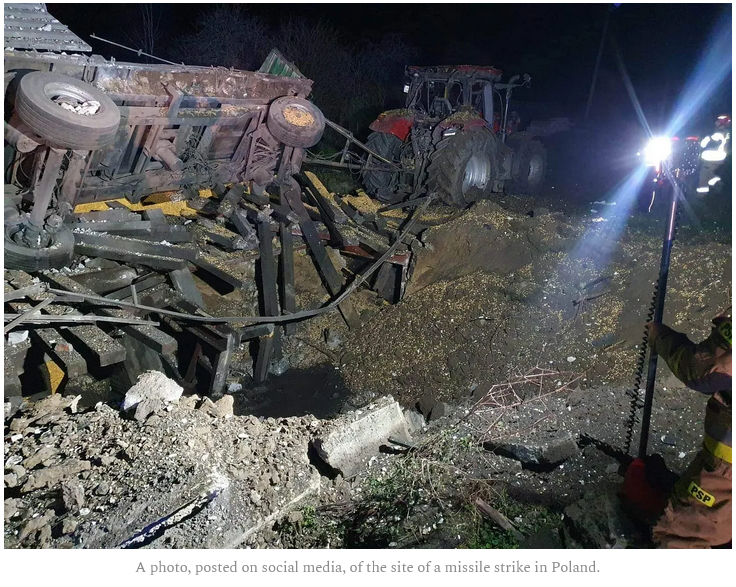
Those with any memory of the Cold War probably got a bit of a cardio workout even if they were sitting still earlier this week when Polish news sources, which were quickly matched by American ones, reported that a Russian missile had landed in Poland, killing two civilians. An armed attack by Russia, in other words, on a NATO member state, even if a likely accidental one — Russia was bombing targets in Ukraine at the time and the site of the Polish blast was quite near the border with its embattled neighbour.
Still. Oops.
It didn’t take long before doubt emerged. At present, the official theory offered by Poland and accepted by NATO is that the missile that killed the two unfortunate Poles was actually a Ukrainian air-defence missile that was fired at incoming Russian missiles in self-defence. It somehow malfunctioned and landed in Poland. The Ukrainians themselves seem unconvinced and there are certainly those wondering if a wayward Ukrainian missile is a cover story to de-escalate a Russian mistake. Personally, I’d guess no. It probably was a Ukrainian missile. And if it is all a cover story in the cause of keeping tension between Moscow and the West at a low-sweat stage, I can live with that, for now.
The point isn’t for me to pretend I’m a munitions expert, capable of instantly solving the case with only the briefest glance at photos of a fragment of twisted missile debris. It’s more to consider what this event felt like, and what it easily could have been: one of the scarier scenarios Western officials and analysts have been worried since this war began nine months ago — accident kicking off a conflict neither side wanted but neither will back down from once it’s begun.
This isn’t a new fear. It was a fear during the Cold War. And a justified one. At several points during that long standoff, technical malfunctions or political miscalculations raised the danger of a nuclear war to horrifying levels. On a few occasions American defense commanders wrongly believed that the Soviets were launching an attack; luckily for everyone, the Americans had redundancies and were well trained and cooler heads always prevailed. In 1983, Soviet satellites reported the Americans were firing ballistic missiles at the Soviet Union. Tensions were high at the time and the Soviets had decided to launch a full strike on the West as soon as any NATO launches were detected. But Lieutenant Colonel Stanislav Petrov, a relatively low-ranked Soviet officer working the night shift, concluded that the warnings were probably a glitch — it didn’t make sense to him that America would open a surprise attack with a handful of missiles instead of the full arsenal. Rather than pass on a warning that would have triggered Soviet launches against NATO, he reported that the launch detections were a technical malfunction in the Soviet equipment. He did that again when further launches were detected. Lt. Col. Petrov then spent a few long and anxious minutes waiting to see if any NATO nuclear weapons exploded over targets in the Soviet Union. Waiting to see what happened was the only way the colonel could know if he’d made the right call, or a very, very bad one.
He was right, of course. It was a glitch. New Soviet satellites were being tricked by sunlight bouncing off clouds at high altitude. But for a few minutes, the fate of the world hung on one mid-ranked Soviet officer’s middle-of-the-night judgment call.
These real-life examples are horrifying. But learning of them never hit me quite as hard as the fictional scenario portrayed in the 1962 film Fail-Safe. Released around the same time as the more famous Doctor Strangelove, Fail-Safe, adapted from the novel Red Alert, was a grimly serious counterpart to Kubrick’s dark comedy. With an all-star cast that includes Walter Matthau and Henry Fonda, Fail-Safe depicts a series of small accidents that result in a group of American bomber pilots concluding that they have been ordered to conduct a retaliatory strike on the Soviet Union. There is no war. It’s entirely a misunderstanding, a fluke of American technological glitches and Soviet jamming. But the American pilots, trained to expect Soviet tricks and lies and to accept no order to abort (as such an order could be faked) relentlessly bore in on their targets, truly believing that they are avenging a Soviet strike on America.
Tank Chat #158 Spartan and Stormer | The Tank Museum
The Tank Museum
Published 22 Jul 2022David Fletcher is back with the next Tank Chat instalment! This week he chats about not one but two vehicles, Spartan and Stormer.
(more…)
November 5, 2022
Psyops in theory and practice
Theophilus Chilton on the development of psyops and some examples of their use in US civilian contexts in recent years:

I trust that most readers are familiar with the concept of a “psyop”, a psychological operation designed to sway its targets in certain desired directions. Many of the mechanics of psyops were pioneered by the CIA and other intelligence agencies during the Cold War but have now been turned against civilian populations in the USA and elsewhere in an effort by the Regime to maintain control and minimise opposition to its various agendas. However, I’d like to make the point that psyops qualitatively differ from standard, run-of-the-mill propaganda such as governments have used for millennia.
The difference is primarily that of the time preferences involved. Whether it’s designed to whip up a population against an enemy or to try to obfuscate the truth about some particular event that has occurred, propaganda tends to operate on a shorter timescale and with more limited and simple policy goals in mind. It’s not surprising that modern propaganda techniques share a lot in common with commercial advertising designed to induce an “impulse buy” response in potential customers. Propaganda generally operates the same way — create a monodirectional response to a particular stimulus.
Psyops, on the other hand, are quite a bit more complex and generally involve the building of a narrative memeplex over the course of months, years, or even decades. Psyops are, of course, also fake but theirs is a fakeness that builds upon constant, repetitious narrative-building that lays out a foundational lens through which any individual incident or act can be systematically interpreted, adding them to the overall saga being told.
With conventional propaganda, the aim is to communicate Regime diktat to the average citizen. However, it does not necessarily expect the recipients to believe the propaganda, but merely comply with the goals. The Powers That Be in such cases don’t care why Havel’s greengrocer puts the sign up in his window, but merely that he does so. The primary purpose of psyops, on the other hand, is to ensure compliance by convincing the target to self-comply, rather than it having to be done by outside force or persuasion. It’s always touch and go when you’re making someone outwardly comply but inwardly they’re dissident. When the mark can be convinced to willingly self-police, this makes the government’s job easier since they don’t have to worry about this closet dissidence. The true believer is the best believer.
In essence, propaganda aims for immediate reactive persuasion while psyops seek long-term groundlaying that gives more all-inclusive means of maintaining overarching narrative control.
Now, a lot of people out there like to think they’re immune to psyops because “hurr durr I don’t beleeb da media!!” But they’re not. Indeed, a lot of these boomercon types are just as susceptible to psyops as anyone else when the right buttons are pushed. This is because they’ve been primed for it by the systematic, society-wide preparation of the psychological battle space without their ever realising it. In many cases, the foundations for a psyop are so culturally systematic that people don’t even realise what is happening.
For example, there are a ton of people out there who would pride themselves on being independent thinkers who nevertheless believed everything that was peddled during the covid and vaccine psyops. The reason for this is because they want to think of themselves as smart, knowledgeable about science, etc. Smart People believe the Right Things, after all. That, in turn, is the result of decades of psyops that have ensconced “science” as the arbiter of morality and truth in post-Christian America. So even when the science is fake or wrong, it is still accorded a moral authority that it does not deserve.
QotD: The use of chemical weapons after WW2
During WWII, everyone seems to have expected the use of chemical weapons, but never actually found a situation where doing so was advantageous. This is often phrased in terms of fears of escalation (this usually comes packaged with the idea of MAD (Mutually Assured Destruction), but that’s an anachronism – while Bernard Brodie is sniffing around the ideas of what would become MAD as early as ’46, MAD itself only emerges after ’62). Retaliation was certainly a concern, but I think it is hard to argue that the combatants in WWII hadn’t already been pushed to the limits of their escalation capability, in a war where the first terror bombing happened on the first day. German death-squads were in the initial invasion-waves in both Poland, as were Soviet death squads in their invasion of Poland in concert with the Germans and also later in the war. WWII was an existential war, all of the states involved knew it by 1941 (if not earlier), and they all escalated to the peak of their ability from the start; I find it hard to believe that, had they thought it was really a war winner, any of the powers in the war would have refrained from using chemical weapons. The British feared escalation to a degree (but also thought that chemical weapons use would squander valuable support in occupied France), but I struggle to imagine that, with the Nazis at the very gates of Moscow, Stalin was moved either by escalation concerns or the moral compass he so clearly lacked at every other moment of his life.
Both Cold War superpowers stockpiled chemical weapons, but seem to have retained considerable ambivalence about their use. In the United States, chemical weapons seem to have been primarily viewed not as part of tactical doctrine, but as a smaller step on a nuclear deterrence ladder (the idea being that the ability to retaliate in smaller but still dramatic steps to deter more dramatic escalations; the idea of an “escalation ladder” belongs to Herman Kahn); chemical weapons weren’t a tactical option but baby-steps on the road to tactical and then strategic nuclear devices (as an aside, I find the idea that “tactical” WMDs – nuclear or chemical – could somehow be used without triggering escalation to strategic use deeply misguided). At the same time, there was quite a bit of active research for a weapon-system that had an uncertain place in the doctrine – an effort to find a use for a weapon-system the United States already had, which never quite seems to have succeeded. The ambivalence seems to have been resolved decisively in 1969 when Nixon simply took chemical weapons off of the table with an open “no first use” policy.
Looking at Soviet doctrine is harder (both because I don’t read Russian and also, quite frankly because the current epidemic makes it hard for me to get German and English language resources on the topic) The USSR was more strongly interested in chemical weapons throughout the Cold War than the United States (note that while the linked article presents US intelligence on Soviet doctrine as uncomplicated, the actual intelligence was ambivalent – with the CIA and Army intelligence generally downgrading expectations of chemical use by the USSR, especially by the 1980s). The USSR does seem to have doctrine imagine their use at the tactical and operational level (specifically as stop-gap measures for when tactical nuclear weapons weren’t available – you’d use chemical weapons on targets when you ran out of tactical nuclear weapons), but then, that had been true in WWII but when push came to shove, the chemical munitions weren’t used. The Soviets appear to have used chemical weapons as a terror weapon in Afghanistan, but that was hardly a use against a peer modern system force. But it seems that, as the Cold War wound down, planners in the USSR came around to the same basic idea as American thinkers, with the role of chemical weapons – even as more and more effective chemicals were developed – being progressively downgraded before the program was abandoned altogether.
This certainly wasn’t because the USSR of the 1980s thought that a confrontation with NATO was less likely – the Able Archer exercise in 1983 could be argued to represent the absolute peak of Cold War tensions, rivaled only by the Cuban Missile Crisis. So this steady move away from chemical warfare wasn’t out of pacifism or utopianism; it stands to reason that it was instead motivated by a calculation as to the (limited) effectiveness of such weapons.
And I think it is worth noting that this sort of cycle – an effort to find a use for an existing weapon – is fairly common in modern military development. You can see similar efforts in the development of tactical nuclear weapons: developmental dead-ends like Davy Crockett or nuclear artillery. But the conclusion that was reached was not “chemical weapons are morally terrible” but rather “chemical weapons offer no real advantage”. In essence, the two big powers of the Cold War (and, as a side note, also the lesser components of the Warsaw Pact and NATO) spent the whole Cold War looking for an effective way to use chemical weapons against each other, and seem to have – by the end – concluded on the balance that there wasn’t one. Either conventional weapons get the job done, or you escalate to nuclear systems.
(Israel, as an aside, seems to have gone through this process in microcosm. Threatened by neighbors with active chemical weapons programs, the Israelis seem to have developed their own, but have never found a battlefield use for them, despite having been in no less than three conventional, existential wars (meaning the very existence of the state was threatened – the sort of war where moral qualms mean relatively little) since 1948.)
And I want to stress this point: it isn’t that chemical munitions do nothing, but rather they are less effective than an equivalent amount of conventional, high explosive munitions (or, at levels of extreme escalation, tactical and strategic nuclear weapons). This isn’t a value question, but a value-against-replacement question – why maintain, issue, store, and shoot expensive chemical munitions if cheap, easier to store, easier to manufacture high explosive munitions are both more obtainable and also better? When you add the geopolitical and morale impact on top of that – you sacrifice diplomatic capital using such weapons and potentially demoralize your own soldiers, who don’t want to see themselves as delivering inhumane weapons – it’s pretty clear why they wouldn’t bother. Nevertheless, the moral calculus isn’t the dominant factor: battlefield efficacy – or the relative lack thereof – is.
Bret Devereaux, “Collections: Why Don’t We Use Chemical Weapons Anymore?”, A Collection of Unmitigated Pedantry, 2020-03-20.
November 4, 2022
Tank Chats #157 | Ferret MKII & V | The Tank Museum
The Tank Museum
Published 1 Jul 2022Join David Fletcher for a new Tank Chat on the Ferret.
(more…)
October 27, 2022
MPi-81: Steyr Basically Makes the Uzi
Forgotten Weapons
Published 17 Jun 2022
(more…)
October 17, 2022
Tank Chat #156 | FV432 Bulldog | The Tank Museum
The Tank Museum
Published 10 Jun 2022Want to learn more about Bulldog? Check out David Willey’s Tank Chat on this infantry transport vehicle this week.
(more…)
October 15, 2022
An Israeli LMG, Part I: The .303 Dror
Forgotten Weapons
Published 6 Jun 2022
(more…)
October 11, 2022
A tribute to the F-101 ‘Voodoo’ Fighter
Matsimus
Published 4 Jun 2022The McDonnell F-101 Voodoo is a supersonic jet fighter which served the United States Air Force (USAF) and the Royal Canadian Air Force (RCAF).
Initially designed by McDonnell Aircraft Corporation as a long-range bomber escort (known as a penetration fighter) for the USAF’s Strategic Air Command (SAC), the Voodoo was instead developed as a nuclear-armed fighter-bomber for the USAF’s Tactical Air Command (TAC), and as a photo reconnaissance aircraft based on the same airframe. An F-101A set a number of world speed records for jet-powered aircraft, including fastest airspeed, attaining 1,207.6 miles (1,943.4 km) per hour on 12 December 1957.[1] They operated in the reconnaissance role until 1979.
Delays in the 1954 interceptor project led to demands for an interim interceptor aircraft design, a role that was eventually won by the B model of the Voodoo. This required extensive modifications to add a large radar to the nose of the aircraft, a second crew member to operate it, and a new weapons bay using a rotating door that kept its four AIM-4 Falcon missiles or two AIR-2 Genie rockets hidden within the airframe until it was time to be fired. The F-101B entered service with USAF Air Defense Command in 1959 and the Royal Canadian Air Force in 1961. US examples were handed off to the USAF Air National Guard where they served until 1982. Canadian examples remained in service until 1984.
(more…)
October 3, 2022
France in the Cold War: AA52 Replaces the Hotchkiss
Forgotten Weapons
Published 27 May 2022
(more…)


