
The [Eastern Roman] Empire was faced by a triple threat to its existence. There were the northern barbarians. There was militant Islam in the south. There was an internal collapse of population. Each of these had been brought on by changes in the climate that no one at the time could have understood had they been noticed. It would not be until after 800 that the climate would turn benign again. In the meantime, any state to which even a shadow of Lecky’s dismissal applied would have crumpled in six months. Only the most courageous and determined action, only the most radical changes of its structure, could save the Empire. And saved the Empire most definitely was.
The reason for this is that the Mediaeval Roman State was directed by creative pragmatists. Look for one moment beneath its glittering surface, and the Ancient Roman Empire was a ghastly place for most of the people who lived in it. The Emperors at the top were often vicious incompetents. They ruled through an immense and parasitic bureaucracy. They were supreme governors of an army too large to be controlled. They protected a landed aristocracy that was a repository of culture, but that was ruthless in its exaction of rent. Most ordinary people were disarmed tax-slaves, where not chattel slaves or serfs.
The contemporary historians themselves are disappointingly vague about the seventh and eighth centuries. Our only evidence for what happened comes from the description of established facts in the tenth century. As early as the seventh century, though, the Mediaeval Roman State pulled off the miracle of reforming itself internally while fighting a war of survival on every frontier. Much of the bureaucracy was shut down. Taxes were cut. The silver coinage was stabilised. Above all, the senatorial estates were broken up and given to those who worked on them, in return for service in local militias. Though never abolished, chattel slavery became far less pervasive. The civil law was simplified, and the criminal law humanised – after the seventh century, as said, the death penalty was rarely used.
The Mediaeval Roman Empire survived because of a revolutionary transformation in which ordinary people became armed stakeholders. The inhabitants of Roman Gaul and Italy and Spain barely looked up from their ploughs as the Barbarians swirled round them. The citizens of Mediaeval Rome fought like tigers in defence of their country and their Orthodox faith. Time and again, the armies of the Caliph smashed against a wall of armed freeholders. This was a transformation pushed through in a century and a half of recurrent crises during which Constantinople itself was repeatedly under siege. Alone among the ancient empires in its path, Mediaeval Rome faced down the Arabs, and kept Islam at bay for nearly five centuries. Would it be superfluous to say that no one does this by accident?
Sean Gabb, “The Mediaeval Roman Empire: An Unlikely Emergence and Survival”, SeanGabb.co.uk, 2018-09-14.
August 20, 2022
QotD: The improbable survival of the Byzantine empire
August 18, 2022
The acute lack of numbers in every climate debate
The Grumpy Economist notes that every discussion of laws and regulations “to tackle climate change” only ever seem to cover one side of the issue — how much your taxes will go up and how much more your life “needs” to be regulated to “save the planet”. The almost universally lacking numbers are the expected benefits of the law or regulation in climate terms:
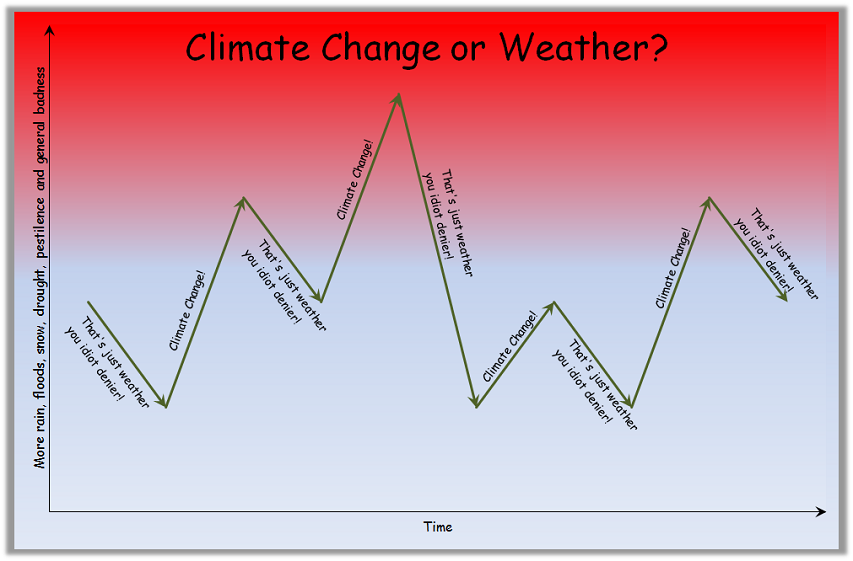
Most legislation or regulation that spends hundreds of billions of dollars aimed at a purpose is extensively analyzed or scored to that purpose. OK, the numbers are often, er, a bit unreliable, but at least proponents go through the motions and lay out assumptions one can examine and calculate differently. Tax and spending laws come with extensive analysis of just how much the government will make or spend. This is especially true when environment is concerned. Building anything requires detailed environmental assessments. An environmental review typically takes 4.5 years before the lawsuits begin.
In this context, I’m amazed that climate policy typically comes with no numbers, or at least none that I can find readily available in major media. We’re going to spend an additional $250 billion or so on climate policies in the humorously titled “inflation reduction act”. OK, how much carbon will that remove, on net, all things included, how much will that lower the temperature and when, how much and when will it quiet the rise of the oceans?
Finally, I have seen one number, advertised in the Wall Street Journal,
Our contributor Bjorn Lomborg looked at the Rhodium Group estimate for CO2 emissions reductions from Schumer-Manchin policies. He then plugged them into the United Nations climate model to measure the impact on global temperature by 2100. He finds the bill will reduce the estimated global temperature rise at the end of this century by all of 0.028 degrees Fahrenheit in the optimistic case. In the pessimistic case, the temperature difference will be 0.0009 degrees Fahrenheit.
Bjorn’s twitter stream on the calculation.
Maybe you don’t like Bjorn’s numbers and the IPCC model. (Not exactly a right-wing operation). Maybe you don’t like the Rhodium group’s analysis. A quick reading left me the impression its thumb might be on the wildly over-optimistic side of what this rathole of pork can produce, and of experience with what the similar past ratholes have produced:
Our preliminary estimate is that the IRA can cut US net greenhouse gas emissions down to 31% to 44% below 2005 levels in 2030—with a central estimate of 40% below 2005 levels — compared to 24% to 35% under current policy. The range reflects uncertainty around future fossil fuel prices, economic growth, and technology costs. It will also meaningfully reduce consumer energy costs and bolster US energy security over the medium-term,
10% of 2005 levels is a lot. Subsidies reduce consumer costs, but not the cost to society overall. Clever. How one can claim that clamping down on fossil fuels and subsidizing windmills and solar panels helps energy security with the German example before us is a good question. Bjorn’s point is that even with this immense thumb on the scale, the actual climate benefit is tiny. If you disagree, fine, produce some alternates.
(BTW, politicians who tell you we need to do something about climate to turn off heat waves and stop forest fires are either lying or profoundly ignorant. Nothing even Greta Thunberg proposes will actually lower temperatures in our great grandchildren’s lifetimes. Read carefully, “reduce the temperature rise“. Not “reduce temperatures”.)
August 17, 2022
“It’s weird what happens when you choke off people’s ability to make a living”
Elizabeth Nickson offers to decode the latest war cry from the great and the good, the well-meaning, the deluded, and the modern-day fellow travellers (who are still useful idiots):
The political circus is gripping, the play before us hypnotic. Audience members drop in, forswear the brutalism of it and go back to their lives, refusing engagement, refusing to look. That’s what it’s for, to alienate you from the real stuff that goes on in the middle of nowhere, where I live.
[…]
This is a slogan that has been picked up by every operative in every western democracy. State legislators appear on MSNBC frantic with fear, wall-eyed, saying the right is stealing democracy.
Expect to hear this ceaselessly for the next three years. Every hour of every day.
This is what they really mean:
When I moved to the middle of nowhere twenty years ago, I became fascinated with local politics. It seemed that there were a lot of little groups, attached like sucker fish to the giant tax eating behemoth that slid through our lives. Their aims were simple and seemingly good hearted, more waterbird protection, more water protection, more tree protection, more protection of the other sexed, more goodness towards and immigration of the huddled masses in South and Central America, more legislated feminist demands, endless demands of the schools by advocacy groups funded by teachers unions, and of course, stopping all development and industrial production because of climate change. They all had groups, they all lived on little bits of money, they were always harried and despairing. They fought a tight game. Small advances, lots of setbacks. Mostly innocent, though the enviro people had deep-buried terrorist groups who created lovely fires for any developer who particularly crossed them. But otherwise, you could invite them to tea with the Queen.
Twenty years on, they flourish with budgets of seven or eight figures, most of which they receive from the various governments they lobby, but also from the world’s greatest foundations, not to mention substantial funding from the EU, the WEF and the UN. And they are in every capital, waking up every morning for one reason: to force the government to cave to their needs. They are always attached to the bigger of the left-wing parties, who fund them big time. In the US it is the Democrats. In Canada, the Liberal Party. They are paid to act as political action committees, while posturing as neutral advocacy groups. They write legislation. And boy, have they written legislation. They developed a thousand, thousand committees which have methodically re-written laws from the extreme local to national.
The ones I met were upper-middle-class, from nominally Christian households, who had been captured by the socialist dream. They called what they did a new iteration: participatory democracy. Leaders were from Britain or the US. Those seemed the most aggressive. More connected. Very little work has been done on their unnerving connectedness. Most reporters agree with their task, don’t want to dig.
The reason they called it participatory democracy was because they were participating. It seemed no one else was, other than business needing a rule change or permit, so they had free rein. And, to give them credit, they did change the culture. It is rare to find a soul who does not support equality of the sexes, the protection of the environment, acceptance of the other-sexed, pity for the huddled masses in the south and an anxious wish for people of colour to do well.
But then … the German Malthusian Eugenicists at the WEF realized they could fund them and bend them to their purpose. With 100x the power, the good kids went rogue. The goal was to break the power of the American middle class in order to save the climate. To disenfranchise them, to de-legitimize them, to identify them as racist, sexist, homophobic and patriarchal. To de-pluralize them. To drive them to the margins. It was, frankly, an adoption of evil, an adoption of kill-to-save.
August 4, 2022
Barbarian Europe: Part 5 – The Vandals in Africa
seangabb
Published 21 May 2021In 400 AD, the Roman Empire covered roughly the same area as it had in 100 AD. By 500 AD, all the Western Provinces of the Empire had been overrun by barbarians. Between April and July 2021, Sean Gabb explored this transformation with his students. Here is one of his lectures. All student contributions have been removed.
(more…)
August 1, 2022
The fertilizer front in Justin Trudeau’s renewed war on Canada’s farmers
In The Line‘s weekly dispatch, one of the items discussed was the Trudeau government’s decision to follow the Netherlands and Sri Lanka down the path of ensuring that millions may be at risk of starvation to mollify the global warming lobby and the WEF:
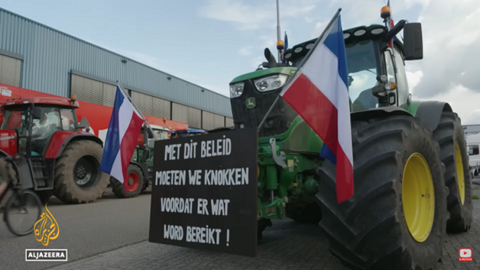
In 2020, the federal government announced a plan to reduce greenhouse gas emissions arising from fertilizer application by 30 per cent below 2020 levels within the next decade. The targets, then fairly vaguely spelled out, have been a subject of considerable consternation among farmers in the wheat belt ever since. However, as the feds moved into a consultation process, set to end by the end of August, it’s now become clear that those targets are a little more set in stone than they had previously feared. Further, the “consultation” process is looking increasingly tokenistic.
“The commitment to future consultations are only to determine how to meet the target that Prime Minister Trudeau and Minister Bibeau have already unilaterally imposed on this industry, not to consult on what is achievable or attainable,” according to a press release sent out jointly by the Alberta and Saskatchewan agriculture ministers last week.
Why does this matter? Well, firstly because these emissions targets are coming on top of tariffs placed on chemical precursors to fertilizer coming out of Russia. And further because according to industry lobbyists and many farmers themselves, it’s not going to be possible to meet these kinds of emissions targets without significantly reducing fertilizer use — which is already efficiently applied owing to the fact that the stuff is expensive.
The meat of it (ha!) is that if we reduce fertilizer use further, there is significant fear that we will cut into food yields, just as the world’s growing population is facing a possible famine thanks to war. It’s not like these concerns are temporary, either. In the long run, climate change is only going to add to food insecurity; and Canada may be well-positioned in a changing climate to address the global food supply.
And, yeah, all of this is very ironic. Of course we should be doing all we can to cut emissions, but, perhaps — just hear us out, here — given the broader geopolitical realities, agriculture is not the most obvious or well-placed target for those emissions cuts. Especially considering Canada still accounts for a very small fraction of global greenhouse emissions overall. (Yes, we know our per-capita emissions are high. That’s the unfortunate consequence of living in a very cold, poorly populated expanse. However, our actual population remains low. These two facts are not coincidences!)
Now, if we were going to give the federal government some benefit of the doubt, we’d point out that we’re still in a consultation process. We’d also further point out that if the government wanted to reduce agriculture emissions, there are probably some smarter ways to go about it — equipment upgrades, for example. Investments in soil testing could go a long way to helping farmers apply nitrogen more efficiently, which could help them increase yields while maintaining profits. Win-win!
Yet, from what we’ve seen from this government since the last election, we’re not betting on sensible, win-win solutions. Farmers in the Netherlands have been so put out by similar climate-change inspired emissions cuts that they’ve engaged in convoy-like protests themselves. Further, we suspect the Trudeau government salivates at the prospect of a bunch of another round of spitting-mad, truck-driving farmers rolling into Parliament to protest climate change policies. Every pissy article in the Federalist is a win to this cabinet.
If you’re angering the right people, you’re winning, right?
And how do we imagine arcane policies like this are going to play out internationally in the next three to nine months, if we witness more and more developing countries closing borders to grain exports and significant swathes of the developing world look set to starve? How well are these climate-change policies going to sit against real, hard geopolitical realities like a frozen Europe in winter or significantly curtailed industrial production in Germany, leading to further supply chain issues and economic recession?
If this government is not careful, they’re going to drag a lot of the progressive movement — and its genuinely very noble ideals — along with it. This is a government that appears to have said “fuck it,” retreating ever deeper into self-reinforcing ideological bubbles as the world decides it has much bigger problems than those that the Trudeau government seems able to address. To put it bluntly, how are pious climate-change goals going to look if they have to be measured against piles of emaciated bodies in the developing world? Because that’s the danger. Nobody in Canada is going to starve.
July 28, 2022
“… this time it will be worldwide”
Elizabeth Nickson recounts her journey from dedicated environmentalist to persecuted climate dissident and explains why so many of us feel as if we’re living on the slopes of a virtual Vesuvius in 79AD:
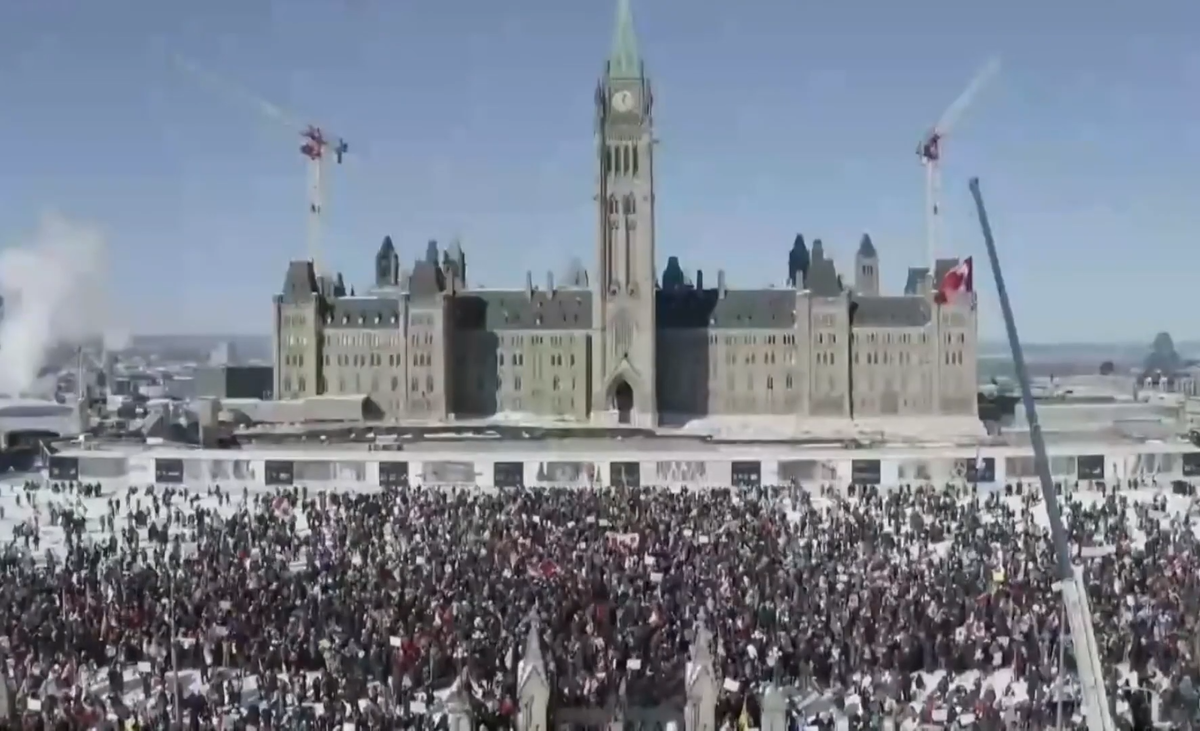
A screenshot from a YouTube video showing the protest in front of Parliament in Ottawa on 30 January, 2022.
Photo via Wikimedia Commons.
I was experiencing a time-worn campaign to shut down a voice that conflicted with an over-arching agenda. And in the scheme of things, I was nothing. But in fact, I was almost the only one, everyone else had been chased out. I was an easy kill, required few resources. It was personal, it was vicious beyond belief, and it had nothing to do with truth. If I had continued my work in newspapers, they would have attacked my mother and my brothers, two of the three of whom were fragile.
As of now, this has happened to hundreds of thousands of people in every sector of the economy. The chronicles of the cancelled are many and varied, and they all start with the furies, unbalanced, easily triggered and marshalled to hunt down and kill an enemy. These programs, pogroms, are meticulously planned, they analyze you, find your weakness, and attack it. In my case, it was my solitude, my income, my need to look after my family that made me an easy sacrifice.
I was such an innocent. I thought with my hard-won skills, my ability to reason, to number crunch, to apply economic theory and legit charting, and report, the truth would be valuable, useful.
Every single member of the cancelled has had their faith in the culture badly shaken. They all thought, as I did, that we were in this together, we needed the truth in order to make good decisions, decisions that would promote the good of all.
Not now. Not anymore.
The truth I found behind the fields and forests of the natural world is animating people on the streets in Europe today, the Dutch, French and German farmers. It animated the revolution in Sri Lanka.
Because what I and hundreds of others had found was censored, the destructive agenda has advanced to the point where their backs are against the wall. They don’t have a choice. They have to win. And they are in the millions.
Same with Trump’s people. They aren’t mindless fans or acolytes or sub-human fools. Their backs are against the wall. They have no choice but to fight.
But because I and the many like me, who know what happened, were shut down, disallowed from writing about it, cancelled and vilified, no one understands why this is happening in any depth. City people mock and hate rural people. My photographer colleague/best friend in New York: “racists as far as the eye can see”. My old aristocratic bf London: “Pencil neck turkey farmers”. No city person can take on board that they have allowed legislation and regulation which is destroying the rural economy because they have been brainwashed by the hysteria in the environmental movement. This destruction is not the only reason but it is the fundamental reason for our massive debts and deficits. The base of the economy has been destroyed. We have lost two decades of real growth.
And we did it via censorship.
There is a truism about revolutions in China. All of a sudden, across this great and massive country with its five thousand year culture, people put down their tools and start marching towards the capital, hundreds of millions all at once.
We are almost there. But this time it will be worldwide.
July 26, 2022
Barbarian Europe: Part 4 – The Ostrogoths in Italy
seangabb
Published 10 May 2021In 400 AD, the Roman Empire covered roughly the same area as it had in 100 AD. By 500 AD, all the Western Provinces of the Empire had been overrun by barbarians. Between April and July 2021, Sean Gabb explored this transformation with his students. Here is one of his lectures. All student contributions have been removed.
(more…)
July 23, 2022
Some of the events that lead to the Dutch farmers’ revolt
In UnHerd, Senay Boztas provides a useful chronology of how the Netherlands government managed to piss off so many Dutch farmers, leading to the protests we are still seeing (even if the legacy media is doing their best to ignore it):
“For many farmers it’s the end of their business and they will fight until the last. Sometimes these farms go back generations, they were built by hand, and people feel farmers heart and soul. This is all being taken away.”
Jan Brok, vice chairman of the BoerBurgerBeweging (BBB) party, understands why Netherlands farmers have spent the past month blockading food distribution centres, roads and ministers’ driveways. They are horrified by a new environmental policy that will mean a likely 30% reduction in livestock.
The Netherlands is a country of four million cattle, 13 million pigs, 104 million chickens, and just over 17 million people. It is Europe’s biggest meat exporter with a total area of just over 41,000 square kilometres, and a fifth of this is water. It is one of the world’s most densely populated countries, with the EU’s highest density of livestock.
But there is a significant cost to this abundance: the local environmental impact. Such intensive agriculture, and livestock farming in particular, creates harmful pollution. Manure and urine mix to produce ammonia, and together with run-off from nitrogen-rich fertiliser on fields ends up in lakes and streams, where it can promote excessive algae that smothers other life. Manure here is not a vital fertiliser but a problem waste product.
For decades, this success in trade and agriculture has been accompanied by high emissions of harmful nitrogen compounds, including nitrogen oxides emitted by industry and transport. Levels were dropping, and in 2015, the Dutch introduced a “trading scheme” known as the Programmatische Aanpak Stikstof (PAS) to try to reduce the pollution.
But a Council of State court ruling in 2019 — on a case brought by two local environmental organisations against various farms — ruled that this offsetting scheme was invalid. Permission could not be granted for polluting projects or farm expansion in exchange for promised nitrogen-related reductions in the future: the reductions needed to come first.
The government panicked: national shutdowns were put in place, building projects were put on hold and traffic speeds reduced to 100 kph in the daytime on major roads; it was also obvious that farming was a problem — something needed to be done about all ammonia, nitrogen oxide and nitrous oxide emissions.
Then, in January, the conservative-liberal-Christian coalition pledged to halve nitrogen production by 2030, with a €25 billion budget to back it up. That money was the loud part. The quiet part included the possibility of expropriation, of the government forcibly purchasing farmland. Plans drawn up by civil servants include slashing livestock numbers by 30%. More than €500 million is being brought forward for regional government to buy out farmers this year and next.
Leading the charge among the coalition partners are the Democrats 66 (D66) party. They insisted on “real action for the climate” in their last manifesto. Tjeerd de Groot, the D66 nature and farming spokesman, pointed out that the Netherlands is Europe’s biggest nitrogen emitter, followed by Belgium and Germany. He told a current affairs programme last week: “It is absolutely essential — but also painful — that the plans go through.”
In June, the government published two documents. One: a map showing the areas that need to reduce emissions by between 12% and 95%. The second was a statement that aimed to help farmers — which De Groot admits failed spectacularly. Farmers saw ruin, not a pair of documents. They looked at the percentage reduction figures next to their farms, and began interpreting how many cattle they would need to cull. It was an enormous blow. Many of them had made huge, expensive investments in new equipment to reduce the environmental impact of their herds.
Hence the massive uprising.
July 21, 2022
Farmers’ protests against insane environment mandates continue in the Netherlands
For some unknown reason, the huge protests by Dutch farmers against ridiculous environment-protection rules seems to be getting almost no media coverage. As Rex Murphy pointed out in the National Post, if this was happening in Canada, the government would already have imposed the Emergencies Act and be actively depriving people of their civil rights across the board. Somehow, this protest is uninteresting to most of the legacy media, but as Brendan O’Neill explains, it is a huge deal:
This strange, sunny week has provided the best proof yet that the West’s elites have taken leave of their senses. That they have fully retreated from reason, and from reality itself. As farmers and workers across the world continue to rise up against the tyrannical consequences of climate-change alarmism, what are the elites doing? Engaging in yet more climate-change alarmism. Wringing their hands over the hot weather and its forewarning, as they see it, of the manmade heat-death of the planet that is apparently just around the corner. They continue to peddle the very politics of eco-dread that is whacking farmers and the working class and storing up problems for us all.
The contrast could not have been more stark. On one side we have farmers everywhere from Ireland to the Netherlands to, of course, Sri Lanka making it as plain as they can that the warped ideology of Net Zero will make it harder for them to produce the food that humanity needs. And on the other side we have the Net Zero fanatics of the upper middle classes continuing to push their dire, destructive green ideology. The heatwave proves we must cut emissions even faster and more severely, they tweet in their breaks from sunning themselves in their spacious gardens, even as farmers tell them that the zealous obsession with cutting emissions will make it harder to grow crops. So this is where we’re at – with a ruling class more invested in fact-lite narratives of apocalypse than in the basic responsibility of a society to make food.
This politics is best understood as luxury apocalypticism. It is clearer than it has been for a very long time that the fantasy of the end of the world, of marauding, industrious mankind polluting itself into oblivion, is something only the well-off and time-rich can afford to indulge. The dream of eco-doom is a simultaneously self-hating and self-serving political narrative. It expresses the elite’s turn against the very modernity they helped to create while also flattering their belief that only they can save us. That only their plans to slash emissions, to cut back on global travel and generally to shrink the “human footprint” can hold Armageddon at bay. The great benefit of the global revolt of farmers and workers is that it is injecting a truth and a realism into public discussion that might just help to push back the luxurious and ruinous ideologies of the new elites.
Everywhere, farmers are saying “Enough”. In the Netherlands farmers have been revolting for weeks against their government’s perverse demands that they slash their use of nitrogen compounds. The Dutch government, under pressure from the EU, has committed itself to cutting its nitrogen emissions in half by 2030. This would entail farmers getting rid of vast numbers of their livestock, crushing their ability to make a living and to produce what needs to be produced. So we have the truly surreal situation where Dutch farmers are protesting in their thousands for the right to feed the people of the Netherlands while the elites of the Netherlands demonise them, harass them and even shoot at them. I can think of no better illustration of the loss of logic and humanity within the modern elites than this strange spectacle.
July 20, 2022
Climate change is nothing new, and it was warmer in England for a few hundred years in the Middle Ages
If you’ve been reading the blog for a while, you’ll have noticed that I’m not a fan of trying to panic people about climate change … catastrophism just isn’t my thing. I certainly don’t deny that climate change happens and I agree that it is happening now, but I’m highly skeptical that human action has more than a minor influence compared to the ups and downs of long-term climate shifts driven by natural forces. Ed West has a thumbnail sketch of just how much the European (and especially English) climate change impacted ordinary people during the Middle Ages:
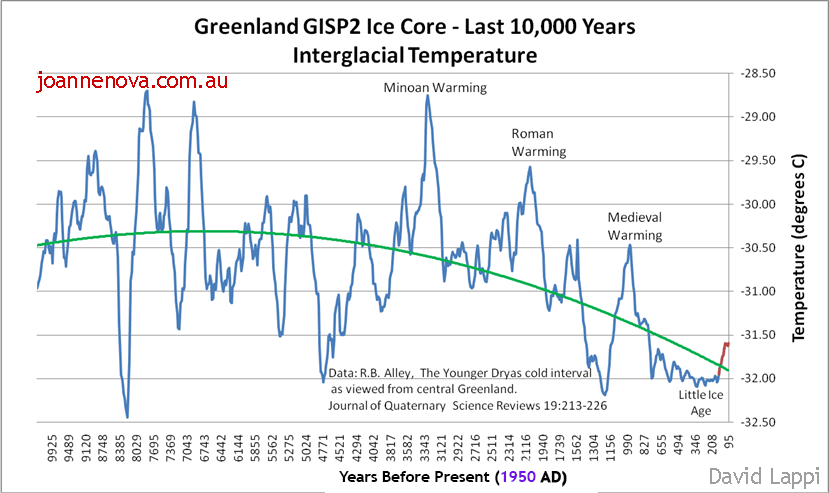
Chart from the Journal of Quaternary Science Reviews showing Greenland ice core data over the last 10,000 years. At the end of the Minoan Warming came the Bronze Age Collapse, after the Roman Warming came the fall of the western Roman Empire.
The climate is changing, with all that entails, something we’ve known about for several decades now. Among the early proponents of the theory of climate change was mid-century climatologist Hubert Lamb, who spent most of his career at the Met Office and during the course of his studies made a curious historical discovery.
It was once widely believed that climate remained relatively stable over recorded history, civilisational lifespans being too brief to see such grand changes. But while looking into medieval chroniclers, Lamb was struck by the numerous references to vineyards in England, some as far as the midlands. As long as anyone had ever remembered, the country had been too cold to grow wine, except in tiny pockets of Sussex which occasionally produced almost-drinkable white.
William of Malmesbury, living in the 12th century, observed of his native Wiltshire that “in this region the vines are thicker, the grapes more plentiful and their flavour more delightful than in any other part of England. Those who drink this wine do not have to contort their lips because of the sharp and unpleasant taste, indeed it is little inferior to French wine in sweetness.” How could that have been?
Lamb concluded that Europe must have been considerably warmer during the Middle Ages, and in 1965 produced his great study outlining the theory of the Medieval Warm Period; this posited that Europe was at its hottest in the High Middle Ages (1000-1300) and then became unusually cool between 1500 and 1700.
Since then, Lamb’s thesis has been reinforced by analysis of pollen in peat bogs, as well as the radioactive isotope Carbon-14 found in tree rings (the less sun, the more Carbon-14). In Medieval Europe, every summer was a hot girl summer — and tiny changes could make earth-shattering differences.
The people of Europe enjoyed that extended period of warmer weather for about 300 years, then things suddenly got far worse:
Across Europe, people must have noticed a change. Farmers in the Saastal Valley in Switzerland were probably the first to observe what was happening, back in the 1250s, when the Allalin Glacier began to flow down the mountain. Surviving plant material from Iceland suggests an abrupt decrease in the temperature from 1275 — and, as Rosen points out, a reduction of one degree made a harvest failure seven times more likely. From 1308 England saw four cold winters in succession; the Thames froze, chroniclers recalling dogs chasing rabbits across the icy surface for the first time.
As with many things, change was gradual, until it was dramatic, for then came the disastrous year of 1315. The Chronicle of Guillaume de Nangis, written by a monk at the Abbey of Saint-Denis outside Paris, recorded that in April the rains came down hard — and didn’t stop until August.
Drenched and starved of sunlight, the crops failed across Europe. The price of food doubled and then quadrupled. By May 1316, crop production in England was down by up to 85 percent and there was “most savage, atrocious death”, as a chronicler put it. Hopeless townsfolk walked into the countryside, searching for any bits of food; men wandered across the country to work, only to return and find their wives and children dead from starvation. At one point, on the road near St Albans, no food could be found even for the king. Emaciated bodies could be seen floating face down in flooded fields.
The Great Famine killed anywhere between 5-12% of the European population, although some areas, such as Flanders, suffered far worse death rates, losing up to a quarter of their population to hunger.
July 12, 2022
“Misrepresentation, exaggeration, cherry picking or outright lying … in support of the theory of imminent catastrophic global warming”
Y’know, the folks at The Daily Sceptic really need to tell us what they think instead of cloaking their opinions in euphemisms:
Two top-level American atmospheric scientists have dismissed the peer review system of current climate science literature as “a joke”. According to Emeritus Professors William Happer and Richard Lindzen, “it is pal review, not peer review”. The two men have had long distinguished careers in physics and atmospheric science. “Climate science is awash with manipulated data, which provides no reliable scientific evidence,” they state.
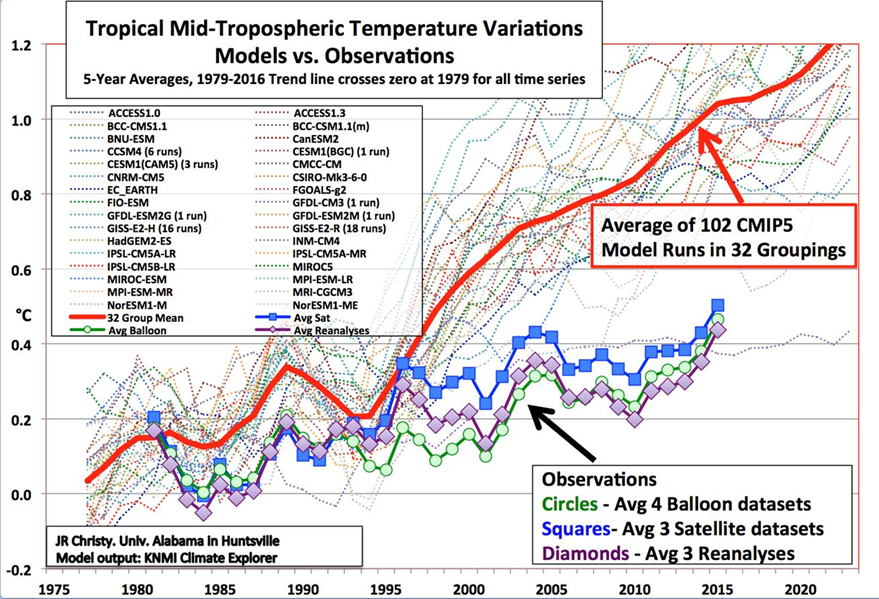
No reliable scientific evidence can be provided either by the Intergovernmental Panel on Climate Change (IPCC), they say, which is “government-controlled and only issues government dictated findings”. The two academics draw attention to an IPCC rule that states all summaries for policymakers are approved by governments. In their opinion, these summaries are “merely government opinions”. They refer to the recent comments on climate models by the atmospheric science professor John Christy from the University of Alabama, who says that, in his view, recent climate model predictions “fail miserably to predict reality”, making them “inappropriate” to use in predicting future climate changes.
The “miserable failure” is graphically displayed below. Since the observations cut-off, global temperatures have again paused.
Particular scorn is poured on global surface temperature datasets. Happer and Lindzen draw attention to a 2017 paper by Dr. James Wallace and others that elaborated on how over the last several decades, “NASA and NOAA have been fabricating temperature data to argue that rising CO2 levels have led to the hottest year on record”. The false and manipulated data are said to be an “egregious violation of scientific method”. The Wallace authors also looked at the Met Office HadCRUT database and found all three surface datasets made large historical adjustments and removed cyclical temperature patterns. This was “totally inconsistent” with other temperature data, including satellites and meteorological balloons, they said. Readers will recall that the Daily Sceptic has reported extensively on these issues of late and has attracted a number of somewhat footling “fact checks”.
Happer and Lindzen summarise: “Misrepresentation, exaggeration, cherry picking or outright lying pretty much covers all the so-called evidence marshalled in support of the theory of imminent catastrophic global warming caused by fossil fuels and CO2.”
July 6, 2022
The ongoing protests by Dutch farmers demand your attention
Protests in many countries in the western world can get violent and even be claimed (by the targets of the protest) to be “insurrections”, but protests in the Netherlands always have more of an edge to them than elsewhere, because when the Dutch really get angry they have, in the past, gone so far as to kill AND EAT their prime minister. The current protests haven’t gone that far yet, but politicians should keep in mind that Dutch farmers can react primally to being treated in the way the Soviets treated the kulaks:
This is really important – you know, on the level of “pay attention or your food supply is next”.
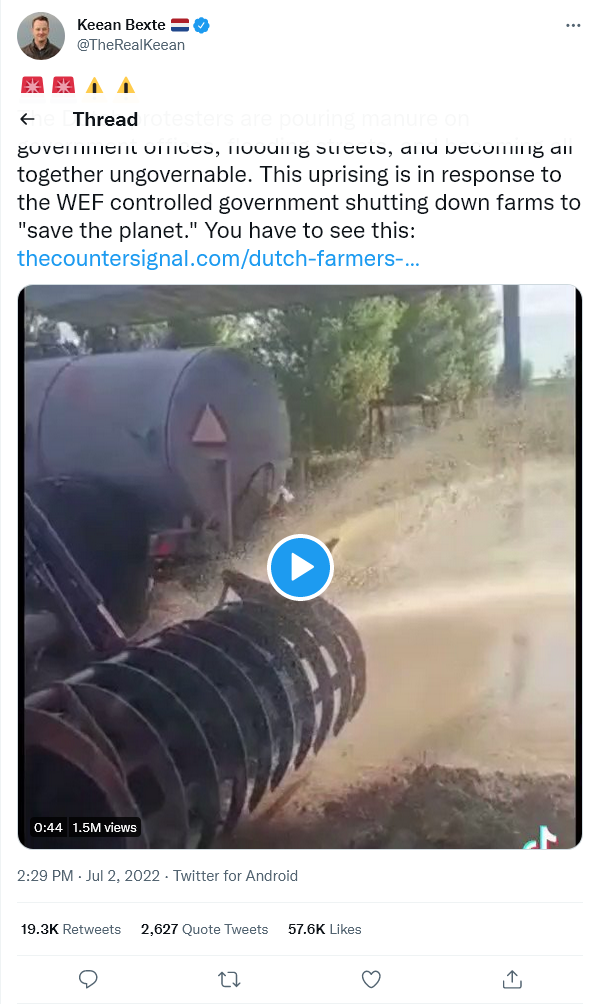
We reported last week that Dutch farmers were attacking government vehicles, blocking roads, and dumping manure on government buildings in response to a new “climate” policy that shut down numerous family farms because their cows were farting too much.
These farmers are now banned from working their own land to feed their families.
Let me explain what’s happening and why it is of the utmost importance as I randomly drop in videos of what the Dutch farmers are doing to keep your attention.
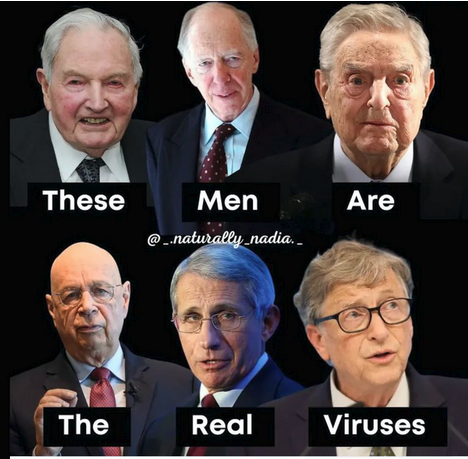
Unelected elites at the World Economic Forum, World Bank, United Nations, and BlackRock think us little people are rodents that are polluting the Earth, and that it’s their job to cull us and tame us so we can follow their smartypants amazingness into what is obviously a glorious future.
These elites get corporations to fall in line by promoting “Environmental-Social-Governance” metrics (a scorecard, if you will) that shows how many woke policies a company is adopting. Do they have a climate pledge? Are they hiring based on skin color, gender, and sexual fetish? Do they fly a rainbow flag over their headquarters? Do they have at least a few dozen “equity” executives to make sure everyone is a good little Marxist?
Companies lose customers by joining this radical, perverse cult, but they get access to the trillions of dollars represented by the elites and the corrupt organizations, from the WEF to the WHO to the mega-investment firms. They don’t care if you boycott them because they are expecting to simply outlast you.
The elites then get governments to fall in line by lobbying, pushing big money into local elections, and taking over school boards and classrooms to ensure good little disciples are being churned out to vote for the right people. They get young people riled up, telling them the planet is burning and that unarmed black men are yelling “Hands up, don’t shoot!” while being gunned down by racist white cops in the streets. Good people watch as their cities burn and politicians bail out the rioters.
June 8, 2022
The Climate Wars are dead, merely collateral damage from the Russia-Ukraine War
JoNova links to this Foreign Policy article by Ted Nordhous, signfiying the end of a “lame Cold War substitute” as the conflict in Ukraine pushes it decisively off the agenda for most western nations:
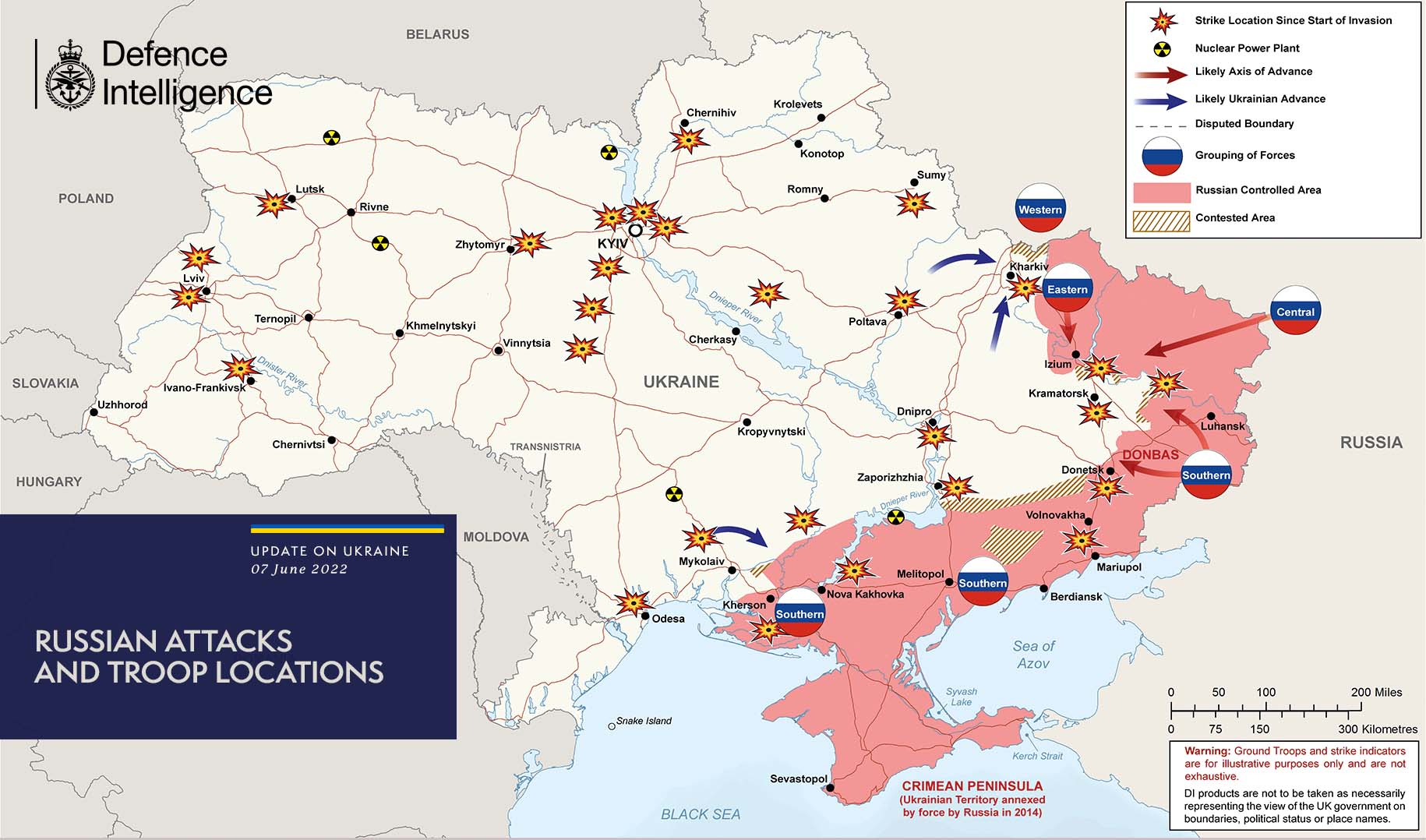
Four days after Russian tanks rolled into Ukraine, the U.N. Intergovernmental Panel on Climate Change released its latest assessment of the impacts of global warming. Leading media outlets did their best to pick out the most dire scenarios and findings from the report. But the outbreak of the first major European war since 1945 kept the report off the front page or, at the very least, below the fold. “Climate Change Is Harming the Planet Faster Than We Can Adapt” simply couldn’t compete with “Putin Is Brandishing the Nuclear Option”.
Meanwhile, the headlong rush across Western Europe to replace Russian oil, gas, and coal with alternative sources of these fuels has made a mockery of the net-zero emissions pledges made by the major European economies just three months before the invasion at the U.N. climate summit in Glasgow, Scotland. Instead, questions of energy security have returned with a vengeance as countries already struggling with energy shortages and price spikes now face a fossil fuel superpower gone rogue in Eastern Europe.
In the decades following the end of the Cold War, global stability and easy access to energy led many of us to forget the degree to which abundant energy is existential for modern societies. Growing concern about climate change and the push for renewable fuels also led many to underestimate just how dependent societies still are on fossil fuels. But access to oil, gas, and coal still determines the fate of nations. Two decades of worrying about carbon-fueled catastrophes — and trillions of dollars spent globally on transitioning to renewable power — haven’t changed that basic existential fact.
Virtually overnight, the war in Ukraine has brought the post-Cold War era to a close, not just by ending Europe’s long era of peace, but by bringing basic questions of energy access back to the fore. A new era, marked by geopolitically driven energy insecurity and resource competition, is moving climate concerns down on the list of priorities. If there is a silver lining in any of this, it’s that a shift of focus back to energy security imperatives might not be the worst thing for the climate. Given the scant effect international climate efforts have had on emissions over the past three decades, a turn back toward energy realpolitik — and away from the utopian schemes that have come to define climate advocacy and policymaking worldwide — could actually accelerate the shift to a lower-carbon global economy in the coming decades.
The issue of climate change burst into the global debate just as the Cold War was coming to an end. As one existential threat seemingly receded, another came into view. For much of the international community, particularly the United Nations and its agencies, climate change also became much more than an environmental issue, offering an opportunity to reshape the post-Cold War order to be more equitable, multilateral, and politically integrated.
Nonetheless, when the framework for climate action emerged in the early 1990s, it built on the experience of the Cold War era. U.S.-Soviet arms control agreements became the model for global cooperation on climate change. Just as the superpowers had signed treaties to gradually draw down their nuclear weapons stocks, nations would commit to draw down their emissions. Yet the first major agreement to propose legally binding limits on emissions — the 1997 Kyoto Protocol — was dead from the moment the U.S. Senate unanimously rejected its terms, even before the negotiations had been finalized. Combine U.S. opposition with the understandable reluctance of energy-hungry, fast-developing nations such as China and India to even consider limiting emissions, and the inefficacy of international climate action was set.
April 24, 2022
Let us bid an unfond farewell to all the “cool city” initiatives
Elizabeth Nickson on a few of the ways that governments’ and pan-national organizations’ love for urban intensification looks to be finally fading away:
“Hong Kong night Panorama” by Andos_pics is licensed under CC BY-NC-SA 2.0


A decade ago cool cities were all the rage and tax money was pouring into cultural events and buildings to “attract” and densify people because “climate change”. Richard Florida, drawing upon a dubious book about cultural creatives had started his ferocious PR drive towards the mega-city as the apex of modernist civilization, a mixed-race cauldron of creativity and more, an economic engine that would power the world and leave the countryside to the bees and trees. Smart Growth was insinuated into every regulatory structure in order to, just like Captain Picard, make it so.
There were a few oppositional voices. There was me, a very minor chord along with Randal O’Toole, Wendell Cox, Joel Kotkin who detailed the risks. But mostly it was all rah rah rah. If we build it they will come. Masses of public money poured in to attract “them”. Country infrastructure was starved, and if broken, left to rust.
And did they come. To all the glamorous cities came the genius thieves of the modern age, oligarchs creating bolt holes for their money and mistresses, looters from Communist regimes, ditto for Africans stealing aid money. Every crime syndicate facing looser immigration rules started branch-plants, laundering money, and seducing the marginal into lives of misery.
Increased levels of crime was one of our objections, but hell on wheels, the devastation in LA, San Francisco, Chicago, New York and Vancouver sure wasn’t foreseen.
Housing affordability would collapse said Wendell Cox, and was he right. In Vancouver, which has been taken over by Chinese mega-crime-syndicates, is the third most expensive city in the world. People whose families founded the city, can’t afford a studio apartment.
Politicians did nothing but take the laundered cash earned by ruining the lives of their citizens, and used it to build casinos so laundering drug money from all over North America would be easier. We Canadians are so helpful. And nice. To everyone, Even child traffickers. Yeah, come here, the scenery is grand and we can take care of all the people you broke with our “free” health care.
I objected to the potential noise being noise sensitive. Also viruses. That was a big one. Courtesy of my ex-husband’s trips to Asia, I picked up a couple viruses which my immune system couldn’t suppress, since I had no built immunity. The indiscriminate mixing, flooding of people overwhelming resources would create health catastrophes I thought, and lo and behold, it looks like WHO is planning for world-wide pandemics as far as the eye can see.
So, like all the other bad ideas of the age, cool cities failed leaving massive massive debt. Everyone with a scrap of money and initiative is plotting to leave the mega cities for the distinctly uncool country these days. Out here we are bracing ourselves for your bad ideas, but we are also ready. We know what you are like. You are as dumb as rocks, and you would destroy the country just like you ruined the cities. You have zero humility. You are a nightmare coming to join the other nightmare visited on our home places, the mass confiscation of our land. The land that feeds you idiots.
April 3, 2022
Of all the things the future might hold, “food shortages” was never one of the entries I expected to see on the Bingo card
Elizabeth Nickson on the astonishing news that we may be facing actual food shortages in the near future:
Food shortages. Food. Shortages. That’s how incompetent this vast superstructure of over-paid, over-benefited, bullies are. Out of their vast superstructures, their buildings filled with “administrators”, their massive computer systems that track everything and everyone, unending flows of money that they just print when they need it, they have created food shortages.
We haven’t had food shortages since the Blitz in London. You basically have to have been under bombardment by Nazis to have food shortages in the western democracies. Furthermore our wealth has grown since the early 1940s by about 1000%. You have to be bombed by 100 many Nazis as there were Nazis per capita, to have food shortages in the 21st century.
That’s how malignant they are.
I guess destroying millions of businesses in the last two years, blowing up national and sub-sovereign debt way way way past sustainable level, ruining children, setting them back years, having to start math, reading, science all over again, their minds so slippery they have lost a half-decade of learning. Let’s not forget all the doctor’s visits that didn’t happen, the cancers that ran away, the heart disease that bolted given the nightmare stress they created. The domestic violence that spiked, the depression that spiked, the loneliness that turned into addiction. And then they launch a “vaccine” that has killed more people than the cold virus they engineered using elements of HIV using our money.
Everything they do turns to shit.
They expect us to forget this. We won’t. No one outside their civil services, their pet (read funded) satellites, their quangos, the PPPs that have subsumed corporations in their vicious enterprises, believes a word they say anymore. It is all bullshit, all the time.
Why the hell do we put up with them? What kind of forelock-tugging stupor leads us to believe anything they say about anything? They are the stupidest people the world has ever seen. And the most malignant, and that is saying something because history is filled with Game-of-Thrones level malignity.
This is all easier to understand once you take on board the fact that they hate us and want us to die.
Even before the lockdown pandemic theatre we all put up with for much of the last two years, the other globalist hobby horses had been out for quite some time:
The over-arching scam they are using is “climate change”. Which is not happening. No one with even basic statistics on board can read into the science and within a few hours know what a complete fabrication this is. The climate (and nature) is so complex, we probably know about 5% of what we need to know to make the decision that three billion people must die. Early on, it was engineers who realized it was false because engineers build things that can’t be faked. If a building, mine or bridge collapses, it’s because they fudged the math. Climate Change is entirely fudged math.
Everything about green energy is falsified. It doesn’t work. Other than of course, for the people who “invested” in it, which means their returns come from government subsidies, ie other people’s life energy. Here we find an ethical uncoupling at the deepest human level: Who are you to profit by the energy of others, by something that is destroying the energy system? Because destroy it, it does. Nowhere does “green” “energy” deliver sustained power. Literally nowhere. It is always breaking down, always failing, meaning that every winter the coal mines are 100% busy. It might work if the backup systems are reliable, or the climate absolutely perfect, in the desert say, but only on a small scale, never country, state or even county-wide.
“Coal is on the way out”, my CBC radio producer daughter said to me a couple of years ago. I looked at her, and managed not to laugh. Coal delivers 50% of the electricity on the east coast of North America. And it will continue. For fucking ever. Until we have nuclear.
So now, we have energy shortages. Our current inflation is caused by our administrative elites closing down energy creation and transport in the US, Canada and Europe. Energy prices have skyrocketed. Which means old people freezing in their homes.


