Quotulatiousness

August 7, 2013

Gibraltar as this year’s “shark story” filler

Filed under: Britain, Europe, Media — Tags: , , , , , — Nicholas @ 11:28

Sir Humphrey thinks there’s rather less than meets the eye in the media’s coverage of the Spanish government’s recent series of escalations over Gibraltar:

Its August, the sun is shining, the politicians are on holiday and the media are desperately searching around for some kind of story to fill the news. Suddenly, the perfect story has emerged — those dreadful Spanish are doing all manner of dubious things to threaten Gibraltar and simultaneously the Falkland Islands. Is there reason for panic, or is it a case of just summer bluster in order to distract attention from other problems? The UK has always had a challenging relationship with the Spanish over Gibraltar — no matter how much the UK wishes to move the relationship forward (and in many areas it remains an extremely strong and positive relationship), this feels as if it is an issue which cannot easily be resolved.

The current situation owes much to the Spanish ratcheting up tensions after claims that Gibraltar was laying concrete blocks into local waters, in turn threatening traditional fishing grounds. It is hard to work out whether this is a genuine grievance, or merely a convenient pretext in order to gain some traction on putting pressure on the territory. Following a previous weekend where long traffic jams occurred with checks on all cars transiting the border, the Spanish are now reportedly considering imposing an entrance / exit tax of 50 Euros on anyone transiting their side of the border. While such taxes may be deeply unpleasant, they are perhaps not necessarily new (many countries impose similar entrance taxes around the world). The question is to what extent would this damage the local economy? It is worth considering that many Gibraltarians work in southern Spain, so any tax would probably make it difficult to get to work and damage the livelihood of many small businesses – perhaps appealing in a nation where youth unemployment is ever higher, but in the interim it could easily cause more long term economic damage to both the Spanish and Gibraltarian economies.

So what is the tie-in to the Falkland Islands? A media report on Spain selling Mirage fighter jets to Argentina:

It is not clear whether this is actually news, or whether it’s the case that the Tabloid press have been looking on Wikipedia and turned what is a one line entry on future Spanish Mirage jet prospects into an article designed to raise tensions. In reality this site has long made the point that the Argentine Armed Forces are in a parlous state, and that they are desperately short of spares, training and operational experience.

They’ve also taken various fleets of aircraft out of service in recent years, so its entirely reasonable to expect some form of replacement at some point. In the case of the Mirage jets, they entered service in 1975 and are extremely old and not necessarily front line fast jet material any longer. Acquisition of a small number of 1970s vintage jets which have been worked hard for nearly 40 years is not really going to change the balance of power in the South Atlantic. Indeed, its worth noting that right now (if you believe Wikipedia) the entire Argentine Mirage fleet is grounded anyway due to spares and safety issues. At best this acquisition may try and restore some limited capability. So, its fair to say that the Falkland Islands are hardly at risk of collapse — if the acquisition of a small number of ancient fighter aircraft materially changes the balance of power, then something has gone very badly wrong in UK defence planning circles.

August 3, 2013

“RCMP officers stopping American citizens on the Buffalo side of their border”

Filed under: Cancon, Law, USA — Tags: , , , — Nicholas @ 00:03

Where’s the outrage? Nobody seems to care! Oh, but I got the nationalities confused in that headline:

Bit by bit, agreement by agreement, Canada is giving away more and more in the name of trade. To Conservatives, none of this is a threat to our sovereignty, as if the very act of stating so makes it so.

But let us consider this fantasy scenario: RCMP officers stopping American citizens on the Buffalo side of their border. Picture the horrified expression of those resilient New Yorkers as they are forced to slow down on their Interstate highway so as to be greeted by a smiling RCMP officer who is to inspect their property, ask questions about where they live, where they’ve come from, and the like — all part of a so called “pre-clearing” program.

Of course, this scene would never occur. The United States protects, obsessively, their sovereignty. But here in Canada, armed American police officers will now be able to stop Canadians, in Canada, inspecting, checking and asking questions.

Again, the Conservatives will tell us that an armed American cop in Canada is all about trade, jobs and security, not sovereignty. If this is true, then can we not expect to see Mounties stopping Americans on the Buffalo side?

I blogged about this issue last year, too.

July 29, 2013

Spanish border guards stage virtual blockade of Gibraltar

Filed under: Britain, Europe, Military — Tags: , , , — Nicholas @ 10:18

The Spanish claim to Gibraltar is being pursued by other means, it would seem:

Spanish police stopped every one of 10,000 vehicles leaving Gibraltar for the mainland yesterday, causing six-hour traffic jams in the latest escalation in the standoff over the Rock.

Officers from the Royal Gibraltar Police were forced to impose diversions and create beachside holding areas as Spanish authorities ‘choked’ the border, causing massive tailbacks in 30C heat.

It was the second day that border guards had blocked links to the mainland, in a move that seemed calculated to bring Gibraltar to a standstill.

[…]

Most recently Spanish fishermen sparked a stand-off with the Royal Navy as they attempted to disrupt the creation of an artificial reef in the Bay of Gibraltar last week.

The fishermen used fast boats to weave in between British vessels involved in the reef-laying operation in a bid to create large waves to disrupt the work, the Sunday Express reported.

Intervention by a Royal Navy patrol boat brought an end to the protests. A Gibraltar government spokesman has accused Spain of launching the ‘draconian’ border checks which continued yesterday in ‘retaliation’.

He said the decision to lay the reef, which consists of large concrete blocks sunk to the bottom of the bay, had been taken on environmental grounds.

However, he added, it had infuriated Spanish fishermen since it would also foil any attempts by their vessels to carry out illegal trawling of the bottom of the Bay of Gibraltar.

Criticising the Spanish government’s response, the spokesman added to the Sunday Express: ‘Not only are these measures affecting thousands of innocent Spanish workers who make their living on Gibraltar, but we are extremely concerned about pensioners and families with young children being forced to suffer in this way just because they want to visit the mainland.’

July 26, 2013

BC Premier highlights antiquated inter-provincial trade rules with wine

Filed under: Cancon, Law, Wine — Tags: , , , — Nicholas @ 08:22

The rules governing inter-provincial trade in wine date back to the Prohibition era. BC’s Christy Clark would like to see the rules brought into this century:

British Columbia Premier Christy Clark brought a case of her province’s wine to the heart of Ontario’s vine land.

Clark presented the vintages to her dozen provincial and territorial colleagues in a bid to lower trade barriers.

Even though Ottawa eased interprovincial rules surrounding wine last year, it is still illegal for Ontarians to buy wine in bulk directly from B.C. vineyards.

To get around that, Clark’s six-person entourage brought two bottles apiece to have a full case for the premiers at their annual Council of the Federation gathering.

I linked to an item on this issue by Michael Pinkus earlier this year.

July 18, 2013

The cost of withdrawal

Filed under: Military, USA — Tags: , , , — Nicholas @ 08:14

A couple of days ago, I posted an item on the costs of removing military equipment from Afghanistan (that is, due to lack of direct port access, thousands of tons of gear have to be flown out at an eye-watering $14,000 per ton). The Washington Post had an article yesterday discussing the customs dispute between the US military and the Afghan government which is making the situation even more fraught:

An escalating dispute between the Afghan government and the United States over customs procedures has halted the flow of U.S. military equipment across Afghanistan’s borders, forcing commanders to rely more heavily on air transport, which has dramatically increased the cost of the drawdown, according to military officials.

The Afghan government is demanding that the U.S. military pay $1,000 for each shipping container leaving the country that does not have a corresponding, validated customs form. The country’s customs agency says the American military has racked up $70 million in fines.

If left unresolved, the disagreement could inflate the price tag of the U.S. military drawdown by hundreds of millions, if not billions, of dollars because of the higher cost of shipping by air — an unwelcome expenditure at a time when the Pentagon is scrambling to cope with steep congressionally mandated budget cuts and the White House is attempting to jump-start negotiations over a long-term security cooperation deal with Kabul.

The Afghan government’s demand for payment is part of a broader dispute over Kabul’s authority to tax entities from the United States, its chief benefactor. As the war economy that for years bankrolled Afghanistan’s political elite starts to deflate, the government is increasingly insisting that U.S. defense contractors pay business taxes and fines for a range of alleged violations.

H/T to Doug Mataconis who also wrote:

We invaded Afghanistan, arguably liberating them from the grip of the Taliban and their al Qaeda allies. We’ve spent ten years or so fighting to protect the government of Hamid Karzai from those same forces. And now they want to charge us to leave? Surely, this is a first, isn’t it? On the other hand, I can see a benefit here. If we knew going into a war that we’d have to pay money to get out at the end perhaps we’d be less willing to start it.

July 12, 2013

QotD: Canada as mirror-America

Filed under: Cancon, Humour, Quotations — Tags: , , — Nicholas @ 00:01

Have you heard about this place called Canada? It’s like some weird parallel America where they never had a revolution. There’s some other differences too: It’s colder, for instance, and they call their Seattle “Vancouver.” Also, they keep their Louisiana in the north instead of the south, and every now and then it threatens to leave. Apparently, if you change just a few little variables like that, history comes out differently: You get socialized medicine, and a lot of signs and stuff are in French, and instead of Saturday Night Live there was a show called SCTV which was funnier but didn’t last as long.

Legend has it that if you journey to the far, far north, you can pass through a portal to this alternate America. Unless you live in Alaska, in which case I gather you have to drive west. (*)

(* Or maybe east. The legends are cloudy.)

Jesse Walker, “Canada Repeals Restriction on Online ‘Hate Speech'”, Hit and Run, 2013-07-11

June 20, 2013

The world map of modern slavery

Filed under: China, Law, Liberty, Russia — Tags: , , , , , — Nicholas @ 14:05

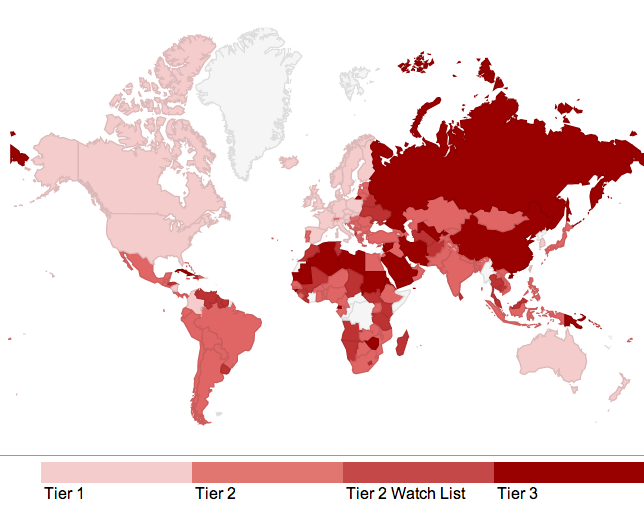
In The Atlantic, Olga Khazan talks about the countries that appear on this US State Department map of human trafficking:

World Map of Slavery, 2013

China, Russia, and Uzbekistan have been named among the worst offenders when it comes to human trafficking, according to a State Department report released Wednesday, joining Iran, North Korea, Cuba, Sudan, and Zimbabwe on the bottom “tier” of the U.S. human trafficking rank.

Their lower designation means the U.S. may sanction those countries with measures like cancelling non-humanitarian and military assistance, ending exchange visits for government officials, and voting against any IMF or World Bank loans.

China, Russia, and Uzbekistan had previously been on the “Tier 2 Watch List,” a middling designation for countries that show little progress in making strides in preventing forced labor. Because they had been on the “Watch List” for four years, the State Department was obligated to either promote or downgrade them.

In China, the one-child policy and a cultural preference for male children perpetuates the trafficking of brides and prostitutes.

“During the year, Chinese sex trafficking victims were reported on all of the inhabited continents,” the report found. “Traffickers recruited girls and young women, often from rural areas of China, using a combination of fraudulent job offers, imposition of large travel fees, and threats of physical or financial harm, to obtain and maintain their service in prostitution.”

However, the State Department also singled out the country’s epidemic of forced labor, in which both internal and external migrants are conscripted to work in coal mines or factories without pay, as well as its continued use of re-education hard labor camps for political dissidents.

However, it’s also worth keeping in mind that there are two common definitions of human trafficking in use, one of which is an outrage to common decency while the other is an attempt to conflate sex work with slavery:

1) The transport of unwilling people (usually women, but of course can at times be either men or children) into forced prostitution. This is of course illegal everywhere: it’s repeated rape just as a very start. It is also vile and we should indeed be doing everything possible to stamp it out.

2) The illegal movement of willing people across borders to enter the sex trade. Strange as it may seem there really are people who desire to be prostitutes. People would, other things being equal, similarly like to be in a country where they get a lot of money for their trade rather than very little. Given these two we wouldn’t be surprised if people from poorer countries, who wish to be in the sex trade, will move from those poorer countries to richer countries. And such is the system of immigration laws that many of them will be unable to do this legally: just as with so many who wish to enter other trades and professions in the rich world. You can make your own mind up about the morality of this but it is obviously entirely different from definition 1).

June 15, 2013

Moral panic of the month – sex trafficking

Filed under: Europe, Law — Tags: , , , , , — Nicholas @ 10:18

In Forbes, Tim Worstall explains why so many stories about sex workers being smuggled across borders and forced to work as prostitutes may be based on imaginary numbers:

The full paper is here. And I’m afraid that it’s a horrible mess. And not just because they rather gloss over the two meanings of “trafficking” that are used in the debate.

Those two meanings are as follows:

1) The transport of unwilling people (usually women, but of course can at times be either men or children) into forced prostitution. This is of course illegal everywhere: it’s repeated rape just as a very start. It is also vile and we should indeed be doing everything possible to stamp it out.

2) The illegal movement of willing people across borders to enter the sex trade. Strange as it may seem there really are people who desire to be prostitutes. People would, other things being equal, similarly like to be in a country where they get a lot of money for their trade rather than very little. Given these two we wouldn’t be surprised if people from poorer countries, who wish to be in the sex trade, will move from those poorer countries to richer countries. And such is the system of immigration laws that many of them will be unable to do this legally: just as with so many who wish to enter other trades and professions in the rich world. You can make your own mind up about the morality of this but it is obviously entirely different from definition 1).

There is a third possible meaning which is used by some campaigners which is any foreigner at all who is a sex worker. This is obviously a ridiculous one: especially in the EU given the free movement of labour.

We might paraphrase the two definitions as the “sex slavery” definition and the “illegal immigrant” one. I would certainly argue that the first one is a moral crime crying out to the very heavens for vengeance while the second leaves me with no more than a heartfelt “Meh”.

He also links to a Guardian story about a sex trafficking investigation in Britain from a few years ago called Operation Pentameter:

The UK’s biggest ever investigation of sex trafficking failed to find a single person who had forced anybody into prostitution in spite of hundreds of raids on sex workers in a six-month campaign by government departments, specialist agencies and every police force in the country.

The failure has been disclosed by a Guardian investigation which also suggests that the scale of and nature of sex trafficking into the UK has been exaggerated by politicians and media.

Current and former ministers have claimed that thousands of women have been imported into the UK and forced to work as sex slaves, but most of these statements were either based on distortions of quoted sources or fabrications without any source at all.

We could simply assume that there’s something wildly different about the UK. Something that means that there are, to a reasonable approximation, zero sex slaves in the UK while 30% or more of sex workers in Denmark, Sweden and Germany are all sex slaves. This isn’t an argument that’s likely to pass the smell test to be honest. The explanation is instead that the two different meanings of “trafficked” are being used here.

June 7, 2013

The world’s longest undefended “no touching zone”

Filed under: Cancon, History, USA — Tags: , , — Nicholas @ 00:01

H/T to John Farrier for the link.

May 30, 2013

Latest EU legal move may drive support to UKIP

Filed under: Britain, Europe, Law — Tags: , , , , — Nicholas @ 08:13

Mats Persson explains why Nigel Farage and UKIP may see a spike of support when the latest legal challenge gets going:

The European Commission will today take the UK to the European Court of Justice — the body meant to police the EU treaties — over its rules on EU migrants’ access to benefits. The Commission says the UK’s so-called “right to reside” test — a filter used to make sure that EU migrants are eligible to claim benefits — is illegal under EU law as British citizens pass it automatically. The UK Government is disputing this claim saying it is clear that the UK rules “are in line with EU law.” In other words, the folks in Brussels are about to throw a hand grenade into the already red-hot domestic EU debate.

The legal details around this case are hugely complex as are the rules governing EU migrants’ access to benefits […] But essentially, this is about the EU’s one-size-fits-all model sitting poorly with the UK’s ‘universalist’ welfare system, which is largely made up of means tested benefits rather than contribution-based benefits — unlike many other systems in Europe. The UK government feels it needs a filter — practically and politically — to make sure migrants come here to work rather than to claim benefits. Legally this is a grey area but it’s clear that the Commission is taking the strictest interpretation.

As I’ve argued before, claims that EU migrants come here in droves to claim benefits are widely exaggerated — and free movement of workers has been largely beneficial for the UK and Europe. However, it’s clear that the combination of immigration, Europe and benefits is one of the potentially most toxic ones in modern day politics, so needs to be treated with kid gloves. Even if all the evidence suggests EU migrants are less likely to claim benefits than British citizens, the perception of “benefit tourism” is still absolutely explosive.

May 18, 2013

The micro-state of Sealand

Filed under: Britain, Europe, Government, Liberty, WW2 — Tags: , , , — Nicholas @ 08:56

Thomas Hodgkinson reports on his week-long visit to the tiny nation of Sealand:

Sealand

Seven miles off the coast of Suffolk, there is a country. It isn’t a very big country. In fact, its surface area extends to no more than 6,000 square feet, which is about twice the size of a tennis court. You won’t find it on Google Maps and it isn’t a member of Nato or, indeed, the EU. But it exists. And I know, because I’ve been there.

[. . .]

The reason for this suspicion of strangers in general lies in the violent, picaresque nature of its past. Sealand was built in 1943 by the Royal Navy as an anti-aircraft fortress designed to shoot down Luftwaffe planes. In those days it was equipped with two 94mm Vickers heavy anti-aircraft guns and two 40mm Bofors light anti-aircraft guns, and manned by 120 seamen crammed into accommodation in the hollow concrete towers. It was known as HM Fort Roughs, or Roughs Tower for short. Abandoned after the War, it gathered rust and guano, a gloomy relic of conflict, until the era of pirate radio in the 1960s.

Then two rival entrepreneurs competed for possession, regarding the fort as the perfect place (since it was outside the three-mile zone that then constituted British territorial waters) from which to broadcast pop music to a grateful generation of teenagers. The piratical pair were the long-haired Irish chancer Ronan O’Rahilly, of Radio Caroline fame, and one Roy Bates, a cravat-wearing former Army major.

Each time one of them put men on Roughs Tower, the other would send people to eject them, sometimes forcibly. It was a question of who was prepared to go further, and the answer turned out to be the Englishman. For Bates, the solitary fortress became far more than a radio project. It became an obsession that would absorb not only his life, but also the lives of his wife and children.

The key thing, he knew, was to maintain a presence. With even one occupant, Roughs Tower was tough to take. But Roy couldn’t afford a guard, so instead he plucked his 14-year-old son Michael out of school and put him up there, sometimes with his daughter Penny, sometimes with his wife Joan. For Michael, this was a welcome escape from the dreary rigours of a public-school education, but as he confided to me during a long lunch on-shore after my visit, “I expected it to last six months, not 40-something years”.

Sealand2

May 4, 2013

Why the terror-through-shipping-container threat has not materialized (yet)

Filed under: Business, Military, USA — Tags: , , , — Nicholas @ 09:11

Strategy Page explains why the much-discussed threat of terrorists smuggling in weapons of mass destruction using the ubiquitous shipping container has not actually happened:

A decade ago there was much talk about how vulnerable the United States was to a terror attack via shipping container. It never happened. It’s also unlikely because of the large number of variables the terrorists face. The problems associated with using cargo containers to move a nuclear or conventional bomb are manifold. The big problem is that these containers often don’t arrive right on schedule. Sometimes the ship breaks down or encounters bad weather. This last event leads to thousands of containers a year falling off cargo ships and going to the bottom with their cargo. Sometimes containers get lost “in the system.” More frequently containers get robbed or opened by mistake. Customs officials open a small percentage (this varies by port) for inspection. Another problem, whether the bomb goes off or not, is the fact that containers have to have documentation like bills of lading and such. These can be faked, but the problem is that a paper trail is being created and that can lead to terrorists getting arrested. All containers must officially belong to someone, they are tracked and any that aren’t being tracked tend to get noticed. Many countries do scrutinize containers coming from certain countries in an attempt to catch people smuggling drugs or arms. Large bombs, be they nuclear or conventional, are relatively fragile and may not survive (in working condition) the punishment received during a long sea voyage. If all that weren’t enough to make terrorists nervous, container ships can be delayed when trying to enter a port because of congestion. This can delay arrival by days, or even weeks.

Tax “competition” is a feature, not a bug

Filed under: Government, USA — Tags: , , , — Nicholas @ 08:49

At the Adam Smith Institute blog, Tim Worstall explains that Adam Smith was right about conspiracies to raise prices, especially when we look at governments:

Imagine that you don’t like the taxes that are being imposed upon you. No, go on, just imagine. You as an individual voter don’t actually have much influence over this. Which is why that option of exit is so important. The ability to simply say “The hell with you lot” and leave. We should note that there are very definitely some campaigners who insist that that exit route should be closed off. As, largely, it already is for US citizens. They can leave the US, certainly, but find it very difficult indeed to escape the clutches of the IRS.

Mitchell’s also making a very good Smithian point there. It is indeed true that once businessmen have gathered together for that conspiracy against the public then it is indeed competition from alternative suppliers that is said public’s only method of beating the conspiracy. And so it is with government: we can only preserve a modicum of freedom (and a modest portion of our wallet) if we are indeed free to choose among competing providers of those governmental services.

Which is what much of the conspiracy among governments is all about: seeking to deny us that exit, that protection from their monopoly.

April 24, 2013

More on the currency choices facing an independent Scotland

Filed under: Britain, Economics, Europe — Tags: , , , , , — Nicholas @ 10:49

John Kay works through the short list of options about money that a newly independent Scotland would need to decide about:

Speculation about Scotland’s currency future would begin on the day Scotland voted for independence — or the day on which a poll showed that this result was likely. Scotland would have three main options — the euro, the pound sterling, or its own distinct money.

The euro is the official currency of the EU, and Scotland would in principle be committed to its adoption. But there would be little enthusiasm for that course in either Edinburgh or Brussels, and Scotland — like the UK — would not meet the criteria on debt and deficits for joining the euro. A vague Scottish aspiration to join the single currency at some distant date would probably satisfy everyone.

The sensible outcome would be continued currency union with England — or with the entity that, in deference to Wales and Northern Ireland, participants in the Scottish debate call rUK — rest of UK. Scotland might ask for — and get — a Scottish economist on the Bank of England’s Monetary Policy Committee (not a representative of Scotland — the rules of the committee preclude representative roles). But that would be the extent of Scottish influence on monetary policy.

[. . .]

If I represented the Scottish government in the extensive negotiations required by the creation of an independent state, I would try to secure a monetary union with England, and expect to fail. Given experience in the eurozone, today’s conventional wisdom is that monetary union is feasible only as part of a move towards eventual fiscal union. But desire to break up fiscal union was always a major — perhaps the principal — motive for independence in the first place.

Scotland could continue to use the pound unilaterally, whether the Bank of England liked it or not — as Ecuador uses the dollar and Montenegro the euro. But this is not really an attractive course, and the only countries that have adopted it are those — such as Ecuador and Montenegro — whose monetary histories are so dire that they prefer to entrust their policies to foreigners.

April 10, 2013

Despite government denials, the iPod duty is alive and well

Filed under: Bureaucracy, Business, Cancon, Government — Tags: , , , , — Nicholas @ 08:13

Expect to pay more for your iPods and similar devices, says Mike Moffatt in the Globe and Mail:

Last week, I wrote that the federal government’s changes to tariffs in Budget 2013 would result in new import duties on models of MP3 players and three of four models of Apple iPods. The tariff changes involve changing the tariff status of 72 countries, so music devices manufactured in China, Indonesia and Malaysia will pay a 5 to 6 per cent tariff rather than their “preferential” rate of zero, starting in 2015.

The article caused quite a stir, and the government denied it was true. A spokeswoman for Finance Minister Jim Flaherty said the article was wrong. “Music devices like iPods are imported into Canada duty-free under a long-standing special tariff classification from 1987,” she wrote. That classification, which was unaltered by the recent budget, is known by its number: 9948.00.00. (We’ll call it 9948 for short.)

However, a close reading of the relevant document, Tariff Item 9948.00.00 (9948 for short), shows that to qualify for the special classification, the importer must meet strict criteria.

My position that importers cannot meet the requirements of 9948 rests on three straight-forward premises:

1. It appears that sellers of iPods and MP3s are required to collect “end use certificates” from the final consumer on each sale, and be able to present these to the CBSA if audited.

2. The 9948 requirement for “end use certificates” appears to be actively enforced by the CBSA.

3. Retailers cannot reasonably collect these certificates from consumers when they buy an iPod.

These three, put together, make retail sales of iPods and MP3 players ineligible for 9948 and therefore subject to an iPod tariff. What follows is my evidence.

The importer must maintain a database (what Moffatt calls “an iPod registry”) of personal information on the final purchasers of the devices, but there is no matching legal requirement on the consumer to provide this personal information (which would probably violate privacy laws in any other context).

The CBSA’s Memorandum D10-14-51 requires that consumers attest that they will use the iPod in a manner in which it is “physically connected” to a computer (though not necessarily permanently so, according to the memo) and will “enhance the function” of that computer. The consumers must attest that their devices will be “solely used for the purpose for which they were imported.”

If a consumer uses a device in a manner not covered by 9948 during the first four years of ownership, the importer is required to “make a correction to the declaration of tariff classification and pay any applicable duties and taxes.”

This rule is not trivial. CITT Appeal No. AP-2008-023 discusses the need for sellers claiming the tariff reduction (here Code 2101, the predecessor to 9948.00.00) to show that the end consumer is using the goods in the manner described on the certificate.

But there is no practical way an importer could possibly verify and ensure that that the retailer’s customers have not changed how they are using iPods and MP3 players.

« Newer PostsOlder Posts »

Powered by WordPress