
Rex Krueger
Premiered 29 minutes agoMore video and exclusive content: http://www.patreon.com/rexkrueger
(more…)
June 13, 2019
Make your own marking gauge for FREE!
Comments Off on Make your own marking gauge for FREE!
Americans “don’t really believe in foreigners”
A few days back, Sarah Hoyt wrote a long post about the actual differences between American culture and the many different cultures that most Americans have difficulty understanding:

I don’t think anyone who hasn’t actually acculturated between two countries understands how different cultures can be, deep down, at the bone level and the most basic reactions level, let alone what causes the difference, from inherited influences to just deep built in assumptions about climate/physical plant/fauna.
And some of the people who have acculturated, at that, might not be self-aware enough to see the difference, and just replace one set of assumptions with another and roll with it. (Or get caught somewhere between. Well, to some extent we all get caught somewhere between. The question is, what percentage is in the new country. I’d say for me, after being in Portugal recently, probably 95% American. There are things trained in before the age of 3 which I’ll never let go of, though some got truly weird with the acculturation, like how I react to “shame.”)
That experience this weekend was the “clicking in” of something that’s been bothering me for a long time. In our writers’ group I used to run across people who projected modern AMERICAN female back into the time of pharaohs. One of my best friends refused to believe me when I told her there was zero chance of an alien race having the same university system as the US since even Portugal (avowedly human) doesn’t. There were other things. You guys have heard me rant about several “historical” books that make the past exactly like the future only with different tech. The fact that they don’t understand that tech affects not just how people live but how they think, feel and react is another of those things I don’t get, as I think even within living memory we should be able to see how different things have gotten. See for instance not wearing of aprons, because the clothes are cheap enough and abundant enough that ruining a shirt is not a big deal, unless it’s a very good shirt.
Technological shifts in living memory have made ordinary life from before the new technology (like cheap, dependable cell phones) almost unimaginable. How many movies and TV shows from before the mobile phone became widely available depended as a plot point on the characters being unable to communicate with one another at key moments? Many mystery novels of the pre-mobile-phone era probably make no sense at all to modern readers because instant communication has become “baked in” to our world.
The clothing aspect has been less obviously important, yet only a couple of generations back, most people owned perhaps three changes of clothing, including one “good” suit/dress for church-going or special occasions. We’ve become so wealthy as a culture that almost everyone has more than enough clothes for any imagined need … although church-going has become almost exotic to urban and even suburban folks, and formal attire is becoming more and more rare. (But everyone has more T-shirts and shorts than they know what to do with.)
But until this weekend I didn’t realize how prevalent and universal it is, since the clash took place between two people from native anglophone cultures, both of which are denizens of the net and contact people of other countries, regularly. Okay, one of them didn’t know she was dealing with a foreigner […] This weekend I realized people don’t really believe in foreign countries either. They’re willing to accept that some things (and those usually conform to their mental picture of the generic “culture” or “region”) are different, but that the fundamentals and the cherished unexamined assumptions might be different is unthinkable — literally. And if we can think of them, we still assume the other country is somehow “wrong” or worse “pretending” to be different to be contrary.
This means, ultimately, that even an era of instant all over the world communication, human tribalism still wins. And with it, I suppose, nationalism.
The wave of populism in the west that has taken the establishment and the mainstream media by surprise is a predictable response to the globalist attitudes of the elites. If you work hard enough at it, you can provoke unpleasant responses from those who don’t agree with your worldview, and the transnational elites have been working very hard indeed.
There are other implications: since it’s virtually impossible to avoid faster communication and more widespread travel in the future, this is going to make the next couple/three centuries a series of epic clashes, until either some sort of understanding emerges or polarized cultures can immigrate to the stars and far far away from each other.
Mass immigration is a REALLY bad idea (‘mkay) not that this is a surprise to any of you. People inhabiting enclaves of “their kind” are slow to acculturate (three generations, if it happens at all.) And the number of people coming over the Southern border is like nothing we’ve ever experienced before. And trust me, in terms of functionality, you do NOT want to import any culture descended from 17th century Spain. There is a reason that the American countries South of us are in crisis on a more or less permanent basis, and that Brazil, screwed up though it is, is more functional than the others. No, just no.
I’m certainly not against immigration, but I strongly believe it is possible to have too much immigration, as Europe and the United States are being forced to confront. When people leave their native land to go somewhere else, be it for economic or political reasons, there’s a natural expectation that they will at least attempt to acculturate to their new country. To western elites, this is wrong (or at least, misguided) and “we” should encourage new immigrants to avoid acculturation and to embrace and celebrate the culture they came from. Because reasons. And a lot of immigrants are happy to avoid the hard work of learning how to fit in to the foreign culture they find themselves in — and it is hard work — leading to second or third generations who still can’t or won’t fit in and adapt to the culture.
Let me just say that is one more proof of “people don’t really believe in foreigners.”
Sure, a lot of American culture is triumphant and imitated. Only it’s more “spoofed” because what they imitate is what they see in movies, and proving that humans prefer narrative to lack there of, even when it makes no sense, the bad parts are often picked up first. And they’re often bad parts only seen in movies, btw. Like certain underclass behaviors being seen as glamorous.
But it’s an overlay. At a deep down level, these people dressing in jeans and t-shirts are still foreign and — THIS IS VERY IMPORTANT — don’t believe Americans software-in-the-head is different, which leads to cargo-cultish attempts to import American successes without getting what brings them about, from innovation, to social mobility to freedom of speech. Not really, not at a deep level.
[…]
This means the left’s project of “fighting nationalism” is not just doomed, but it’s stupid as eating rocks, and will cause only unending misery suffering and war. (So, SOP for Marxists. In fact, chalk this whole internationalism bullshit as something else Marx was wrong about. Workers of the world unite, my little sore feet.)
Comments Off on Americans “don’t really believe in foreigners”
Shooting the MG-34 and MG-42
Forgotten Weapons
Published on 11 May 2014Cool Forgotten Weapons Merch! http://shop.bbtv.com/collections/forg…
Theme music by Dylan Benson – http://dbproductioncompany.webs.com
The MG-34 and MG-42 machine guns were the mainstay of German infantry (and vehicle) firepower during World War II, and it will take several videos to properly cover them. For now, we are shooting them both, and explaining how to load, unload, and operate them (including changing barrels on the MG42). Enjoy!

Comments Off on Shooting the MG-34 and MG-42
QotD: Justice and Social Justice
It bears repeating: actual justice holds you responsible for the actions you take. “Social justice” holds you responsible for actions taken, without your knowledge or consent, by people you do not know and have never met. It’s guilt by association, and a perversion of true justice.
Sam Duncan, in a comment posted to “Elsewhere (234)”, DavidThompson, 2017-06-01.
Comments Off on QotD: Justice and Social Justice
June 12, 2019
A Canticle for Leibowitz – Dystopias and Apocalypses – Extra Sci Fi
Extra Credits
Published on 11 Jun 2019A Canticle for Leibowitz is a book about cycles and violence — about the cost of progress. But it is also about the persistence of humanity’s quest for knowledge and endless resilience. Unlike other post-apocalyptic fiction tropes, it is focused on the lives and goings of everyday people, rather than on the setting itself, and is a critical work to study if you want to understand the post-apocalyptic genre better.
Inspired by his own experience being part of the bombing campaign that leveled the ancient monastery of Monte Cassino during World War 2 and the fear of nuclear annihilation that gripped America during the Cold War, Walter M. Miller Jr. imagined the world in a brand new dark age, ushered in by the hubris of humankind — in the only novel he ever published.

Comments Off on A Canticle for Leibowitz – Dystopias and Apocalypses – Extra Sci Fi
Men’s mental health and the conflicting demands they face
In Psychology Today, Rob Whitley explains the paradoxical demands that men make active efforts to talk about mental health issues and to “check their privilege” and shut up:

Men, Please Talk More
Men experience elevated rates of numerous mental health issues including suicide and substance use disorder while showing low rates of mental health service utilization and a tendency to bottle-up. This has led many scholars to posit a silent crisis of men’s mental health.
Consequently, many mental health organizations and high-profile individuals are sending out an insistent message that men must talk more about their mental health.
Even royalty has endorsed this message, with HRH Prince William stating in a recent documentary that we need to “pass the message onto men everywhere that it’s okay to talk about mental health… and be able to talk about our emotions.”
Fine words indeed.
Men, Please Shut Up
However, other individuals and organizations are sending out a completely different message, namely that men as a group need to remain silent and “check their privilege.” As wryly noted by Bloomberg journalist Ramesh Ponnuru “check your privilege means shut your mouth.”
Such messages can be seen all over the Internet, with pleas for men to shut-up or stop whining. Of note, these pleas come from both men and women. These echo comments men often hear in face-to-face interactions, even from their intimates and their employers.
Indeed, such perspectives can emanate from high places, including the U.S. Senate, with Hawaii Senator Mazie Hirono recently stating, “I just want to say to the men in this country: just shut up and step up. Do the right thing for a change.” For some, male silence is a sign of moral rectitude.
This situation creates a men’s mental health double-bind. On the one hand, men are being told to talk more and open-up; on the other hand, men are being told to check their privilege and be silent. This can only create cognitive and emotional distress.
Interestingly, the men’s mental health double-bind manifests itself beyond the borders of the U.S. As such, examples from the U.K and Canada are given below to illustrate its global nature.
Comments Off on Men’s mental health and the conflicting demands they face
High Hitler! – Nazis on Crystal Meth Part 1 – WW2 SPECIAL
World War Two
Published on 11 Jun 2019You might have heard he a was vegetarian. You might have heard that he shunned alcohol. You might have heard he was anti-tobacco. Then you might think he was against hard drugs as well, but you’d be wrong…
Join us on Patreon: https://www.patreon.com/TimeGhostHistory
Or join The TimeGhost Army directly at: https://timeghost.tvFollow World War Two on Instagram @World_war_two_realtime https://www.instagram.com/world_war_t…
Join our Discord Server: https://discord.gg/D6D2aYN.
Between 2 Wars: https://www.youtube.com/playlist?list…
Source list: http://bit.ly/WW2sourcesWritten and Hosted by: Indy Neidell
Produced and Directed by: Spartacus Olsson and Astrid Deinhard
Executive Producers: Bodo Rittenauer, Astrid Deinhard, Indy Neidell, Spartacus Olsson
Creative Producer: Joram Appel
Research by: Spartacus Olsson
Edited by: Wieke Kapteijns
Sound design: Joakim BrodénColorisations by Julius Jääskeläinen https://www.facebook.com/JJcolorization/
A TimeGhost chronological documentary produced by OnLion Entertainment GmbH.
From the comments:
World War Two
2 hours ago (edited)
This is the first of our specials on drug use in the Third Reich, and this episode is about the drug addiction of Adolf Hitler himself. As Indy mentions in the video, YouTube regularly demonetises our content. Instead, we fully rely on our Patreon supporters to finance these series and this special. What doesn’t help, is that YouTube algorithm recommends demonetised episodes less, even further limiting our efforts. So, please share this video with your brothers and sisters, your friends, neighbours, your grandma and your history teacher. And make sure to turn on your notifications! And if you really like what we do – please consider supporting us on https://www.patreon.com/TimeGhostHistory or at https://timeghost.tv.

Comments Off on High Hitler! – Nazis on Crystal Meth Part 1 – WW2 SPECIAL
The fantastic notion that Donald Trump is “at heart really a free trader”
Guest-posting at Catallaxy Files, Don Boudreaux explodes the farcical notion that President Trump is using protectionist tools with an eventual free trade goal:

Donald Trump addresses a rally in Nashville, TN in March 2017.
Photo released by the Office of the President of the United States via Wikimedia Commons.
In the case of Donald Trump, the claim that he is at heart really a free trader who raises tariffs today with the aim of bringing about lower tariffs tomorrow — and all because he is committed to achieving free traders’ ideal goal of maximum possible expansion of the international division of labor — is especially preposterous.
Trump has pontificated on trade for decades, and every word out of his mouth clearly reveals a man who knows nothing about the economics of trade and who is as clichéd an economic nationalist as can be imagined.
Behold this line from a 1990 interview he did in Playboy: “The Japanese double-screw the US, a real trick: First they take all our money with their consumer goods, then they put it back in buying all of Manhattan. So either way, we lose.”
Let’s examine this unalloyed gem of economic witlessness.
Overlooking Trump’s outrageous exaggerations, such as his claim that the Japanese buy up “all” of Manhattan, we start by stating an obvious truth: the voluntary purchase of a good is not a transaction in which the buyer is “screwed” or has his or her money “taken.” Instead, the buyer’s money is voluntarily spent. While every person of good sense sees a foreign seller who makes attractive offers to domestic buyers as someone who improves the well-being of each buyer who accepts the offer, Trump sees this seller as a con artist or thief.
And so Trump ignores the value to Americans of the imports we purchase. In typical mercantilist fashion, he believes that the ultimate purpose of trade is to send out as many exports as possible in exchange for as much money as possible — money that in Trump’s ideal world is never spent on imports. His view on this matter is even more bizarre than that of ordinary mercantilists. For Trump, imports are not merely costs that we endure in order to export, they are actual losses. (Although it goes without saying, I’ll say it nevertheless: Trump does not understand that imports are benefits and that exports are costs.)
Furthermore, by describing the money spent on imports as “our money,” Trump reveals his belief that money earned by each American does not belong to that individual but, instead, to the collective.
Also in the fashion of the typical mercantilist, the presumption is that the nation is akin to a gigantic household whose members all share in and collectively own its money. And just as Dad justly superintends little Emma’s and Bobby’s spending to ensure that they don’t dissipate the family’s wealth, Uncle Sam must superintend his subjects’ spending in order to ensure that we don’t dissipate the nation’s wealth.
One other flaw in the above quotation from Trump’s Playboy interview is notable: he believes that foreign investments in America inflict losses on us. He doesn’t pause to consider that when we Americans sell assets to foreigners we regain ownership of some of the dollars that Trump, in his previous sentence, lamented are lost to Americans when we bought imports.
Nor does he ask what the American sellers of these assets do with the sales proceeds. Perhaps we invest some or even all of them. And if so, perhaps these new American investments will prove to be more profitable than are the investments made in America by foreigners. (By the way, contrary to another mercantilist myth, Americans are not made better off when foreigners’ investments in America fail. Quite the contrary.)
An even deeper error infects Trump’s “understanding” of foreign investment: he implicitly — and, once again, like all mercantilists — assumes that the amount of capital in the world is fixed. Only then would it be true that each American sale of assets to foreigners necessarily reduces Americans’ net financial worth (which is presumably what Trump means when he says that “we lose” when the Japanese purchase Manhattan real estate).
Comments Off on The fantastic notion that Donald Trump is “at heart really a free trader”
Instant Access Tool Center
Patrick Sullivan
Published on 9 Mar 2019Designing and building a case that provides instant access for most of the small tools that you use regularly. This portable fixture is set up so that you can easily access the tools you need, and also replace them the second you are finished with them, keeping your workplace organized. It protects small tools from damage or loss, and increases efficiency by ensuring that they will not get lost in workbench clutter.
Plans: this fixture needs to be customized to each woodworker’s personal needs and tools, so it makes little sense to exactly duplicate my layout. However, I will post photos of the case on my website, with dimensions, to help you get started with your own layout. Here is the link to my website:
https://psullivancarmel.wixsite.com/t…

Comments Off on Instant Access Tool Center
QotD: Militant Islam and the Western media
“I’m always willing to stand with the guys in Denmark,” says Steyn. “But the reason all these left-wing Europeans end up on a stage with an eccentric right-wing Canadian like me is that no real A-list stars will agree to be there. At the tenth anniversary both the American State Department and the British Foreign Office even issued official warnings to their citizens to stay away from the Danish Parliament, where we were holding the ceremony. What kind of signal does that send? Why don’t the artists show up for these things? Why aren’t the movie stars there? When Theo Van Gogh was assassinated, no one at the Oscars had a word to say about it. They didn’t even put him in the obituary montage. And yet they congratulate themselves on their moral courage. George Clooney wears a Je suis Charlie Hebdo pin. Helen Mirren wears a brooch. But they were not with Charlie. Those guys died alone. This is gesture politics. No one would stand with them. I honour the genuine courage of Ayaan Hirsi Ali. Ayaan’s point is absolutely right — in the end you have to share the risk. Charlie Hebdo supported the Danish cartoonists, but the rest of the world didn’t. If every newspaper had published those cartoons, there would have been no point in killing anyone because there would have been too many people to kill. Instead, nobody stands with them, and so the small publication that does ends up massacred. The writer of the comic strip Doonesbury in America [Garry Trudeau] attacked the decision of PEN to honour Charlie Hebdo. Well, they were lying on the floor, bleeding and dying. I don’t think they noticed.”
The Danish cartoon controversy was actually the first moment the American press had been challenged by Islam and could do something in response — and their reaction was a spectacular failure of will and principle. In several countries around the world, it was actually against the law to publish the Danish cartoons, but many editors stepped up, published them anyway, and suffered the civil and criminal consequences. In the United States — where there was no such law — no major publication would print them.
Mark Steyn, interviewed by John Bloom, “Mark Steyn, Cole Porter and Free Speech”, Quadrant, 2017-05-11.
Comments Off on QotD: Militant Islam and the Western media
June 11, 2019
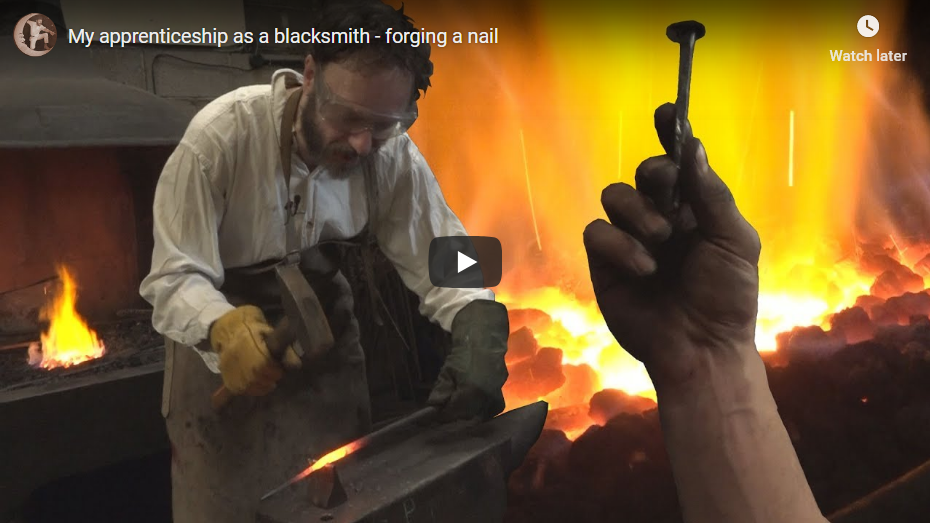
My apprenticeship as a blacksmith – forging a nail
Lindybeige
Published on 16 Jan 2018Before forging my sword, I had to do an apprenticeship as a blacksmith, and make a nail. Here witness my training.
Support me on Patreon: https://www.patreon.com/Lindybeige
I was a guest of The Cut and Thrust Collective – four blacksmiths who have banded together in a forge that was once known as The Forge of Avalon, in Glastonbury. There I spent most of a week, and there I forged my sword – Arnander – the making of which will be the subject of further videos.
I’m quite pleased with the amount of information I got into this video about how forging is done. It shows you several details of how to use a forge to heat metal, and how to hammer shapes into metal.
Many thanks to Joseph McDonald for inviting me in the first place, acting as cameraman, and cooking lots of bacon. Thanks too to my teacher here Thom Leworthy.
The company takes commissions for blacksmithing, and runs courses so that you can go in and make your own pieces. glastonburysmith@gmail.com
Lindybeige: a channel of archaeology, ancient and medieval warfare, rants, swing dance, travelogues, evolution, and whatever else occurs to me to make.
▼ Follow me…
Twitter: https://twitter.com/Lindybeige I may have some drivel to contribute to the Twittersphere, plus you get notice of uploads.
website: http://www.LloydianAspects.co.uk
Comments Off on My apprenticeship as a blacksmith – forging a nail
“[I]t may suddenly occur to you that Mazin has turned a deadly epochal disaster into … a buddy-cop movie”
I haven’t watched Chernobyl, but a lot of sensible people, including Colby Cosh, insist that it’s well-worth the watching:

It looks as though HBO’s miniseries Chernobyl will take the title as the prestige TV event of the first half of 2019. This is pretty remarkable, all things considered. The writer of the series, Craig Mazin, is still described on Wikipedia as “an American screenwriter and film director best known for writing Identity Thief, The Hangover Part II, The Hangover Part III, and The Huntsman: Winter’s War.” The director, Johan Renck, is a Swede who got his start as a Eurodance performer with the nom de guerre “Stakka Bo.” For the zillionth time, HBO has spread its patented secret sauce over unpromising ingredients and delivered superb television.
I am being something of a jerk about these people, of course. Screenwriters don’t have much control over which of their scripts get made and what happens to those scripts on the set, and Mazin is admired as a critic and teacher. (Unusual respect for writers is an obvious component of that HBO magic.) As for Renck, he got from trashy music to HBO through an apprenticeship in music video — the same kind of apprenticeship that brought us David Fincher, Spike Jonze and Michel Gondry. He may, in this regard, be the last gasp of a noble tradition.
It is not that the Chernobyl series doesn’t have elements of hackiness. After spending a couple of hours watching Jared Harris’s austere scientist and Stellan Skarsgård’s smarter-than-he-looks apparatchik warm to each other while trying to save Eastern Europe from obliteration, it may suddenly occur to you that Mazin has turned a deadly epochal disaster into … a buddy-cop movie. Set aside the wonderful visual poetry, the period detail and the fine soundtrack, and the spine you’re left holding is a whodunit. It’s the Case of the Exploding Reactor.
I think Mazin would probably admit this, if he hasn’t already, but if it’s not clear enough, the whole thing winds up in the last episode with a contrived courtroom drama, one which does not quite resemble anything that ever happened in connection with Chernobyl.
Here is the funny and admirable thing: the solution that Mazin’s “cops” work out is highly technical and involved, is explained in careful detail, and is more or less the real solution to the mystery of Chernobyl. Mazin, who is my age and was therefore a teenager when the reactor went kablooie, is not some Jordan Peterson-esque Soviet-history nerd or someone who wanted to turn Chernobyl into a metaphor. It just seems to have occurred to him one day, quite recently, that he knew the word “Chernobyl,” and remembered that Chernobyl was very bad, but wasn’t sure what exactly had happened. When he found out he realized there was a movie in it.
Between the accidents at Chernobyl and Three-Mile Island (in 1979), the nuclear power industry was set back literally decades … despite being one of the best — and safest — answers to the problem of generating enough electricity to keep modern industrial countries humming along while also reducing production of carbon dioxide in the atmosphere. Maybe someone will produce a TV mini-series to de-mystify the American nuclear accident soon, and debunk the half-truths, quarter-truths, and outright lies that still bedevil any discussion of nuclear power in the western world.
Comments Off on “[I]t may suddenly occur to you that Mazin has turned a deadly epochal disaster into … a buddy-cop movie”
Handsaw Comparisons | Paul Sellers
Paul Sellers
Published on 16 Apr 2016Paul compares a few saws and suggests an affordable option that is widely available.
For more information on these topics, see https://paulsellers.com or https://woodworkingmasterclasses.com

Comments Off on Handsaw Comparisons | Paul Sellers
Actually, this explains so much about the British Tory party

Image by Peter Reynolds
https://peter-reynolds.co.uk/2019/06/01/which-conservative-leadership-candidate-has-the-intelligence-and-courage-to-legalise-cannabis/
I look at the race to succeed Theresa May as Tory leader and I wonder, to modify our Sunday Poem, where are the squares of yesteryear? No Conservative seeking to maintain political viability wants to seem too disconnected from the debauchery of contemporary Britain. So it has become the habit to confess to “youthful indiscretions”, “youthful” being a term of art stretching easily into late middle age.
This time round the craze is for drug-fiend Tories. Of this week’s crop of alleged leadership contenders, Foreign Secretary Jeremy Hunt says he had a cannabis lassi while backpacking in India; International Development Secretary Rory Stewart admits he puffed on an opium pipe at an Iranian wedding; my old boss Boris Johnson claims to have snorted icing sugar at Oxford; former Brexit Secretary Dominic Raab discloses he’s tried cannabis but never any “Class A drugs”; and, just to put the hallucinogenic icing on the psychotropic trifle, the Environment Secretary Michael Gove reveals he only does “Class A drugs”.
Mr Gove purports to have taken cocaine as a “young journalist” twenty years ago – that’s to say, when he was in his thirties and working for The Times. He applied for a job round about that time at a publication for which I then wrote, and the chum of mine who took the interview reported back that Gove was one of the most boring men he’d ever had the misfortune to sit through lunch with. If he was snorting in the bog between the soup and fish, it evidently didn’t add any sparkle to his repartee. For American readers, the notion of Michael Gove as a cokehead is roughly analogous to discovering Mike Pence spends his weekends in a gay leather bar: It renders the very concept of transgression pointless. Given what he’s like on his face, the idea of Gove off his face is too surreal to contemplate.
Comments Off on Actually, this explains so much about the British Tory party
TAB Episode 48: QF 6pdr Anti-Tank Gun
The Armourer’s Bench
Published on Apr 28, 2019The 6pdr AT Gun was introduced in 1942, joining the lighter 2pdr, the new gun was more capable of dealing with the increasing thickness of Axis armour. The 6pdr first saw action in North Africa and was used throughout the war in Europe and Asia. It also armed a series of British armoured cars, tanks, ships and even aircraft!
In this video Matt looks at the history, development and use of Britain’s second dedicated anti-tank gun.
Check out our accompanying blog on the 6pdr AT Gun over at: http://armourersbench.com/2019/04/28/the-6pdr-qf-anti-tank-gun/If you enjoyed the video please consider supporting our work via Patreon, TAB is a viewer supported, non-monetised channel and any help is very much appreciated!
Check out our Patreon page here: https://www.patreon.com/thearmourersb…Where to find TAB:
https://armourersbench.com
https://imgur.com/user/ArmourersBench
https://discord.gg/DAjRSBcDon’t forget to like, share and subscribe and spread the word!

Comments Off on TAB Episode 48: QF 6pdr Anti-Tank Gun


