Extra Credits
Published on 17 Jun 2019Download the World of Tanks game for free https://tanks.ly/2WjU75T and use the invite code
EXTRATANKS1to claim your starter packJoin the Patreon community! http://bit.ly/EMPatreon
Last we saw Ōkuninushi, he showed kindness to a hare in distress, and the hare of Inaba had foretold that he would be the one that the princess of Yakami would desire. And this was true, because when his 80 brothers showed up at court and declared their intentions, the princess insisted she would only marry him — so thus, his brothers began trying to kill him off…
June 18, 2019
Ōkuninushi’s Tale – Japanese Myth – Extra Mythology
Blitzkrieg on Speed – Nazis on Crystal Meth Part 2 – WW2 SPECIAL
World War Two
Published on 17 Jun 2019While many armies use performance enhancing drugs during WW2, the Wehrmacht takes it to extremes in 1940, with more than debatable consequences.
Join us on Patreon: https://www.patreon.com/TimeGhostHistory
Or join The TimeGhost Army directly at: https://timeghost.tvJoin our Discord Server: https://discord.gg/D6D2aYN.
Between 2 Wars: https://www.youtube.com/playlist?list…
Source list: http://bit.ly/WW2sourcesHosted by: Indy Neidell
Written by: Astrid Deinhard, Joram Appel and Spartacus Olsson
Produced and Directed by: Spartacus Olsson and Astrid Deinhard
Executive Producers: Bodo Rittenauer, Astrid Deinhard, Indy Neidell, Spartacus Olsson
Creative Producer: Joram Appel
Post Production Director: Wieke Kapteijns
Research by: Joram Appel and Astrid Deinhard
Edited by: Spartacus Olsson
Sound Engineering: Joakim BrodénColorisations by Spartacus Olsson
Archive by Reuters/Screenocean http://www.screenocean.com
A TimeGhost chronological documentary produced by OnLion Entertainment GmbH.
From the comments:
World War Two
1 hour ago
Read before you comment; “it wasn’t just the Germans” This video treats the use of methamphetamine by the German Wehrmacht and its cultural background. The purpose of this video is not to attribute any atrocities that the Nazis perpetrated to that they were simply on drugs – we know that this was not a contributing factor to what they did, although it perhaps influenced how they did it. It is also not the purpose of this video to single out Germany as the only belligerent to use drugs in WW2. As we point out in the video, many belligerents (to not say all) used drugs, especially amphetamines during WW2. In fact amphetamines are still in official, monitored used by for instance the US Army in some situations to this day. However, the Wehrmacht and a few of the Axis allies used methamphetamine which is different than amphetamine as the effects of meth is unpredictable and comes on faster and harder. These unpredictable effects include hallucinations and delusions, which amphetamines do not induce, or at least to a lesser and more predictable degree. Methamphetamine metabolizes into amphetamine in the body, but in that process it creates a number of side effects that contribute to its unstable effects. Of course this was poorly understood in 1940 and meth was also available commercially over the counter in many places like the US and Australia, mostly as a dieting pill and (somewhat ironically) an anti-depressant. While amphetamines like Benzedrine are still administered by doctors for certain conditions, methamphetamine is now known to be a very dangerous, potentially lethal, drug that only has recreational use, and in 2019 it is therefore illegal almost everywhere in the world. Last but not least, the Wehrmacht was singular in how liberal they were in distributing drugs to the troops, at least to begin with. It is important to also point out that beside the official use of drugs, many soldiers throughout the ages have resorted to intoxicating themselves to deal with the unfathomable horrors of war, and in this respect WW2 was no different. We will cover drug use by other belligerents and in general during the war in future videos.
Hong Kong protests
Colby Cosh tests Betteridge’s Law by asking if the protests in Hong Kong are the birth pangs of a new nation (commonsense and a slight knowledge of Chinese history militate against answering “yes”):

2019 Hong Kong anti-extradition law protest on 16 June, captured by Studio Incendo from Flickr.
Photo via Wikimedia Commons
For the past week, Hong Kong has been taking another step toward figuring out exactly what it is. In an unprecedented display of resistance to Chinese power, literally innumerable hordes have been taking to the streets of HK, protesting the Communist Party-anointed chief executive and her effort to introduce a law allowing for the extradition of citizens to the mainland.
To anyone who follows Hong Kong affairs, these protests seem different qualitatively from those of the past. Earlier, related demonstrations like the Umbrella Movement of 2014 could be dismissed as economic unrest acted out by the young and irresponsible — by people who had not yet entered into, or who feared being excluded from, the strange social bargain between mainland power and HK’s wealth. 2019’s mass action is new: now everyone is marching. The revolt against the extradition bill is led by students, but persons of all ages — in some cases, multiple generations of the same family — are taking to the streets. Business owners are displaying sympathy with the marchers by means of small gestures. Commuters, who would normally be as annoyed with chaos and delay as any Torontonian trying to manoeuvre around a human rights demo, are signalling solidarity. The Hong Kong legal profession, aware that unrestricted extradition would annihilate their distinct system and the freedoms China promised to preserve, staged its own silent protest march. Hongkongers abroad are joining in symbolically.
Is this the birth of a nation? Those who wanted to push Hong Kong in the direction of formal independence have always been politely outnumbered. But the challenging, explosive assertion that “Hong Kong is not China” has become a routine feature of Hong Kong life.
Hong Kong was relinquished to China in 1997 after Britain secured paper guarantees that its independent judiciary and Commonwealth-style legal procedures would survive at least until 2047. When the handover was executed, the number 2047 meant — to the British trying to extract themselves from their last imperial briar patch — “far enough in the future for mainland China to have liberalized a bit.” The advent of Xi Jinping has since shown that progress, alas, does not proceed in a predictable linear way.
What Happened to the Giant Hovercraft SR-N4? – The Concorde of the Seas
Curious Droid
Published on 8 Sep 2017They were once known as the “Concorde of the Seas”: mighty flying boats that ferried their passengers with speed and style. Hovercraft was a symbol of national innovation and represented the future of transport in the 20th Century.
And yet, like the Concorde, the huge iconic “Mountbatten-class” hovercraft that once traversed the 22-mile English Channel from England to France carrying hundreds or passengers and cars are no longer with us.
So what happened to the giant hovercraft SN-R4?
Patreon : https://www.patreon.com/curiousdroid
Paypal.me : https://www.paypal.me/curiousdroidSponsors: Symon Hamer, Florian Hesse, Georgi Dobrev, Douglas Gustafson, Marcus Chiado, Mitchell Payce, Skalgrin, Jorn Karlsen, John Roscoe.
This episode’s shirt was the Trip Paisley Surf Retro by Madcap England and is available from http://www.atomretro.com/madcap_england
Get 10% discount with the code DROID10Presented By Paul Shillito
Written & Researched by Andy Munzer
Additional Material by Paul Shillito
Images and Footage : retepbleck, MAD Hovercraft, http://www.hovercraft-museum.org, Griffon Hoverwork, kentishmanvideo
Music by Mike Mullen, http://www.positrosmic.com
QotD: The birth of Jesus and the open concept house
Jesus was not born in a stable. That’s not to say the birth wasn’t attended by farm animals — the Gospel of Luke tells us twice the baby’s first bed was a feeding trough — but rather that the animals lived in the house.
Peasant homes in first century Bethlehem were designed with what we would today call an “open concept.” They typically had one large room with the nicer living space in an open loft or on the roof, while the main floor area was where the family’s animals would be brought for safekeeping at night. The guestroom that was unavailable to Jesus, Mary, and Joseph was that loft or roof space, and the big room where they stayed instead served as the kitchen, living room, dining room, and farmyard all at once. The defining feature of Jesus’ birthplace was not isolation, as we often tend to think, but an utter lack of privacy: Mary delivered in a crowded farmhouse with few, if any, interior walls.
And that was perfectly normal, if not exactly desirable, for our modern fixation on the open floor plan is a historical anomaly. It flies in the face of literally millennia of consensus that more rooms is better, and it is a dreadful mistake. The last 70 years of open concept construction and remodeling has left us with dysfunctional houses, homes that are less conducive to hospitality, less energy efficient, and more given to mess.
Bonnie Kristian, “Open concept homes are for peasants”, The Week, 2019-05-12.
June 17, 2019
“We’ve reached peak identitarian bollocks”
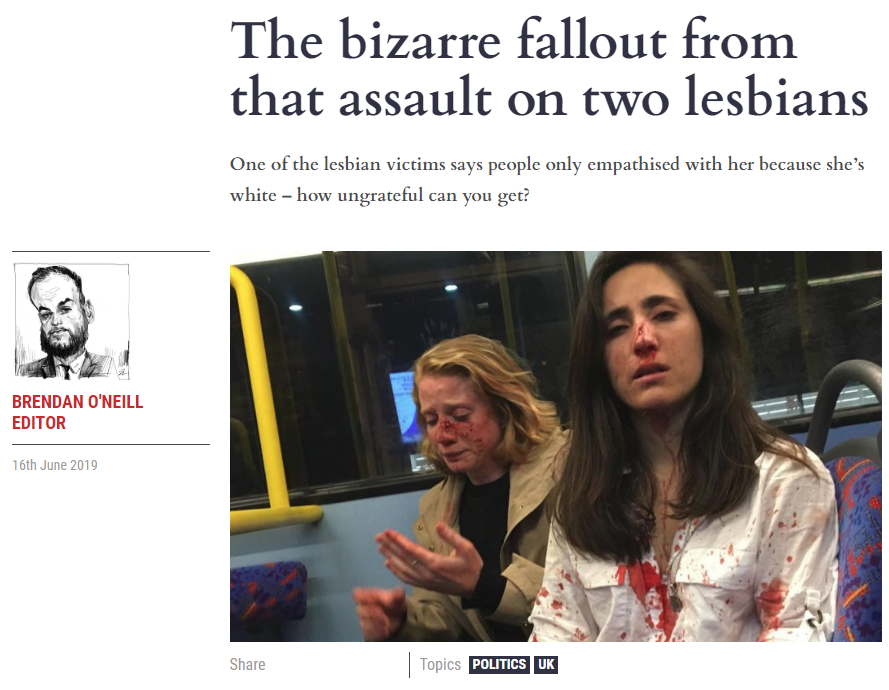
Brendan O’Neill follows up on the disturbing story of two lesbians who were physically assaulted on a London bus:
Talk about ungrateful. Brits, and people around the world, offered empathy and solidarity to the two gay women who were battered by thugs on a London bus. And yet now one of the women has turned around and told us we only care about them because they are white. It’s only because they are “two attractive, white, cisgender women” that so many people and organisations gave a damn about them and tweeted about them, apparently. Thanks a bunch. We offer our human concern for your wellbeing and you tell us we’re being racist. We’ve reached peak identitarian bollocks.
The woman in question, who goes only by the name “Chris”, has written a piece for the Guardian. Natch. The intro lets us know what we’re in for: “The photo of me and my date went viral – but only as we’re white, feminine and cisgender.” Translation: you racist, transphobic idiots wouldn’t have cared half as much if this had been two bloodied and bruised black women or trans women. The “commodification” of “my face” came at the “expense of other victims whose constant persecution apparently does not warrant similar moral outrage”, says Chris.
What is most striking about her piece is that she flagellates herself for her privilege. Yes, this woman who last month was badly beaten allegedly on account of her sexuality is now beating herself up in the national press over her privileged identity. She says she has “evaded much of the violence and oppression imposed on so many others by our capitalist, white-supremacist, patriarchal system because of the privileges I enjoy by dint of my race, health, education, and conventional gender presentation”. What a strange, self-hating mindset it must take to be victimised for your sexuality and then to say: “God, I’m SO privileged.”
Chris even does us the service of providing a list of people who are far less privileged than her and who us phoney empathisers should finally start noticing. It is “open season”, she says, on “people of colour, indigenous people, transgender people, disabled people, queer people, poor people, women and migrants”. This is classic virtue-signalling. She is engaging in the Oppression Olympics while making it clear she doesn’t deserve any gold medals in said Olympics because she is white, educated, cisgender, etc. A masterclass in identitarian showboating.
How does RADAR work? | James May Q&A | Head Squeeze
BBC Earth Lab
Published on 29 Nov 2013How does RADAR work? It’s a bit like shouting very loudly at a cliff and waiting for the echo to come back to you. Whether you use rude words or not is completely up to you.
RADAR is emitting a sound wave and waiting for the echo to come back to you. By timing the returning echo you can work out where exactly another object is.
The really interesting thing about radar is if you use multiple angled receivers you can work out the position and height of a target. This technology was essential in winning the Battle of Britain in 1940.
But that was 1940, what about radar now? Is it as defunct as the 3 ½ inch floppy disk? Well, no actually. Radar is still pretty important in the military but the technology is a lot more advanced. In fact each time you connect to a sat nav to figure out where you are, you are using the network of satellites that calculate your position using the same principles of radar.
Thanks to Alyssa Ann for her portrait of Jeremy Clarkson: http://alyssamenold.com/
Britain’s Conservative Party – the Quisling Right
Sean Gabb outlines recent British history, with emphasis on “the project” — the gradual take-over of the educational and cultural power-centres of Britain by a self-styled new ruling class and the total melt-down of the Conservatives:

Boris Johnson, Secretary of State for Foreign and Commonwealth Affairs at an informal meeting of the Foreign Affairs Council on 15 February 2018.
Photo by Velislav Nikolov via Wikimedia Commons.
I will begin with what I believe has been a loose Project unfolding through my entire life. Since about the 1960s, we have seen the rise of a new ruling class, committed to the transformation of Britain into a new sort of country. Because I have discussed the Puritan Hypothesis at some length here and here, I will now give only a summary. In short, the new ruling class wants to reshape our thoughts into its own conception of The Good. This means a long-term project of securing cultural hegemony through control of education and the media, and a shorter-term project of compelling us to act as if we already believed in the new order of things. Though I will emphasise that it is in no meaningful sense either Marxist or socialist, the overall Project has been carried through by a careful use of what Louis Althusser called the ideological state apparatus and the repressive state apparatus.
One important element of this Project has been to maintain the appearance of political diversity. Because Britain — or at least England — is a rather conservative nation, this means ensuring a Conservative Party that makes conservative noises, but never does anything measurably conservative. I spent several years after 1997 grumbling about “the Quisling Right.” Though I have mostly fallen silent since then, here it is the idea of the Quisling Right briefly stated in a speech I gave in 2005 during a debate with Boris Johnson.
Though I will not call their predecessors real conservatives, the Conservative Party was taken over in 2005 by a small group headed by David Cameron. These people spent the next five years making vaguely conservative noises, without ever challenging the new order of things that had come fully into shape under the New Labour Governments. Because of this, they failed to win an election against Gordon Brown, but were able to form a coalition government with the Liberal Democrats, who were just as committed to the new order of things as Labour.
[…]
I think it a reasonable conclusion that the Conservative Party is the Quisling Right — and, or but, or both, that it is run by a clique of politicians unfit for any conceivable purpose. Theresa May will leave office with the label fixed to her of the worst Prime Minister in history. But the reason she was able to last so long is that she had no obvious replacement. As I write, her most likely replacement is Boris Johnson. He is lazy. He is unprincipled. He is a thug. He is an adulterer who paid for at least one of his mistresses to have an abortion. He was a ludicrous Mayor of London. He was the worst Foreign Secretary I can recall. This Conservative Government has landed us in a first-class national and international crisis. It has provoked the European Union into refusing to entertain any leaving terms short of the ruinous. It has made no good preparations for leaving without a deal. It has landed us in a position where the best exit involves throwing ourselves on the mercy of the Americans, and to hope that they will treat us no more ruthlessly than they did in 1940. The last person we should ask to navigate this crisis is Boris Johnson.
It seems the sheep in the Parliamentary Party have agreed he is their only hope of keeping their seats at the next election. Perhaps the Party membership will be taken in by his Churchillesque wind-baggery. But this will not do. He will be brushed aside by the Europeans. He will be taken for a ride by his fellow Americans. That is if, before then, he can avoid a general election in which he will by murdered by Jeremy Corbyn. I am told, in his defence, that only he who is without sin should cast the first stone. Well, I have never done what Boris Johnson so far has. So, if I am not the first to ask for one, hand me a stone, and make it a big one.
No conspiracy here. These people have failed us. But it was never their purpose to do otherwise. More importantly, they have failed the Project. For that, I suppose, we should feel minimal gratitude. Even so, their survival in office for so long raises a further question with no comforting answers. How could a clique of total incompetents have been allowed, without meaningful challenge, to take over and run into the ground one of our main parties of government? What does this say about us as a people?
100 Years War
Ryan Reeves
Published on 2 Jul 2014The 100 Years War between France and England lasted more than 100 years and was not one war but many. We explore Henry V and other important kings, and finish by exploring Joan of Arc as the savior of France.
Ryan M. Reeves (PhD Cambridge) is Assistant Professor of Historical Theology at Gordon-Conwell Theological Seminary.
Twitter: https://twitter.com/RyanMReevesWebsite: http://www.gordonconwell.edu/academic…
For the entire course on ‘Church History: Reformation to Modern’, see the playlist: https://www.youtube.com/playlist?list…
QotD: Betteridge’s Law of Headlines
This story is a great demonstration of my maxim that any headline which ends in a question mark can be answered by the word “no.” The reason why journalists use that style of headline is that they know the story is probably bullshit, and don’t actually have the sources and facts to back it up, but still want to run it.
Ian Betteridge, “TechCrunch: Irresponsible journalism”, Techechnovia.co.uk, 2009-02-23. (Link goes to archived page at the Wayback Machine.)
June 16, 2019
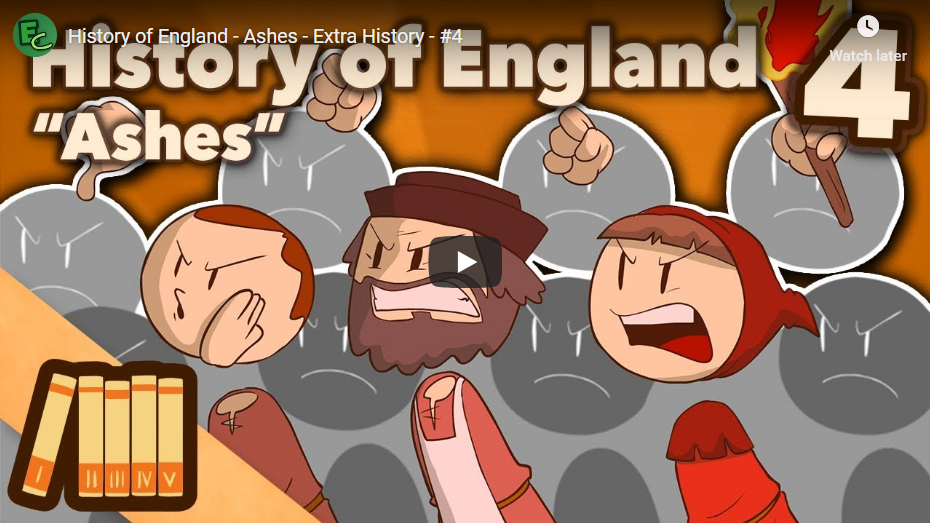
History of England – Ashes – Extra History – #4
Extra Credits
Published on 15 Jun 2019Bertrand du Guesclin was the hero the French needed. Focused on fortifying defenses and cities, Guesclin rebutted the advances of the Black Prince — who ended up contracting an illness that undid his iconic image of triumph and chivalry. Edward became beset by drama in the royal court, and England started to lose power…
Thanks again to David Crowther for writing AND narrating this series! https://thehistoryofengland.co.uk/pod…
Join us on Patreon! http://bit.ly/EHPatreon
Encountering Richard Mitchell’s Less Than Words Can Say
In Quillette, Mark Andre Alexander recounts his first brush with “The Underground Grammarian”:
My first upper division English class shocked me when a dinosaur English professor, Dr. David Bell — a professor in Richard Mitchell’s mold, but not yet a curmudgeon — gave me my first C on a paper, busting my A-student self-image. That wake-up call helped me to see that, although I was published, I had much to learn about writing. Worse, in my first graduate course, Bell’s “Austen and Bronte,” I discovered that I had much to learn about reading, and that I lacked the acuity to appreciate Jane Austen’s clear, witty, and precise prose.
Not long before, I’d read Richard Mitchell’s first book, Less Than Words Can Say. I don’t recall how I stumbled upon him. I’d probably read some opinion column that referred to his work. In a publication announcement in the Underground Grammarian, Mitchell described it as “a melancholy meditation on the dismal consequences of the new illiteracy.”
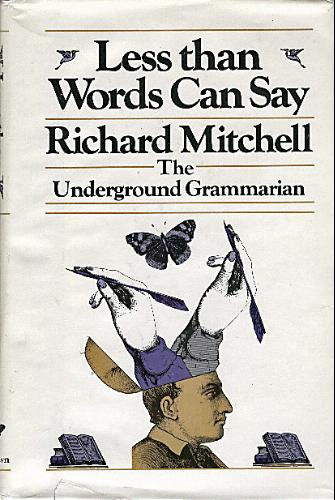
He had wanted to title the book The Worm in the Brain, pointing to the dangers of administrative rhetoric. The publisher rejected that title as “too frightening and grisly,” But I knew I had found a fellow traveler when I read his Foreword:
Words never fail. We hear them, we read them; they enter into the mind and become part of us for as long as we shall live. Who speaks reason to his fellow men bestows it upon them. Who mouths inanity disorders thought for all who listen. There must be some minimum allowable dose of inanity beyond which the mind cannot remain reasonable. Irrationality, like buried chemical waste, sooner or later must seep into all the tissues of thought.
With that prophetic book, I first experienced the “cleansing fire [that] leaps from the writings of Richard Mitchell,” as George F. Will later described it.
Mitchell did title the first chapter “The Worm in the Brain,” in which he told the story of a colleague who would send him a note whenever there was some committee meeting. At first the note read something like, “Let’s meet next Monday at two o’clock, OK?” But when he aspired to become assistant dean pro tem, the simple, perfect prose changed. “This is to inform you that there will be a meeting next Monday at 2:00.” After achieving that appointment, the note read, “You are hereby informed that the committee on Memorial Plaques will meet on Monday at 2:00.” The worm in the brain had done its work.
I began to notice the worm in the brain during my everyday interactions with friends and colleagues at the university, especially the English professors. It often took the form of a label which created an image in the brain that prevented thought. One such professor, smart and engaging, returned a paper analyzing a passage in the U.S. Constitution. She gave the paper an A, but added, “I can’t help but feel that your argument is wrong, although I can’t explain why. I showed it to my husband, and he thought that it was a conservative argument.”
That statement invalidated the A, and I experienced my first taste of how subtly an abstract label can paralyze an otherwise thoughtful mind. Years later, while teaching at a business college, I saw a more pronounced form of the same phenomena. During a Business English class, I chatted with a bright student who volunteered for the NAACP. We would discuss all kinds of interesting topics, such as the similarities and differences between Martin Luther King and Malcolm X.
That is, until I noticed a change. She had stopped talking to me like a fellow human being and started talking at me like a white male. I stopped her and asked if she noticed what she had just done. She hadn’t, so I pointed out that she had shifted from talking to me to talking to an image inside her head. I told her that I would hold my hand up and block my face every time she did it. As the conversation proceeded, and I raised my hand, lowered it, and then raised it again, she became aware of the worm in her brain, a mental-emotional implant that prevented her from treating me as a colleague when certain topics were engaged.
Her implant was creating rubbish, of course, but it was insidious by nature because it disguised itself as something in the real world. Worms in the brain are like that.

Britain Votes to Leave – WW2 – 042 – June 15 1940
World War Two
Published on 15 Jun 2019The fighting in France isn’t over, not even when Paris falls, as the Germans advance and Italy joins the fight. But the Brits now have their back to yet another ocean and see no option but out. Further east Stalin uses the chaos in the West as cover to start moving in on his neighbours.
Join us on Patreon: https://www.patreon.com/TimeGhostHistory
Or join The TimeGhost Army directly at: https://timeghost.tvFollow WW2 day by day on Instagram @World_war_two_realtime https://www.instagram.com/world_war_t…
Join our Discord Server: https://discord.gg/D6D2aYN.
Between 2 Wars: https://www.youtube.com/playlist?list…
Source list: http://bit.ly/WW2sourcesWritten and Hosted by: Indy Neidell
Produced and Directed by: Spartacus Olsson and Astrid Deinhard
Executive Producers: Bodo Rittenauer, Astrid Deinhard, Indy Neidell, Spartacus Olsson
Creative Producer: Joram Appel
Research by: Indy Neidell
Post Production Director: Wieke Kapteijns
Edited by: Marek Kamiński
Map animations: EastoryColorisations by Norman Stewart and Julius Jääskeläinen https://www.facebook.com/JJcolorization/
Eastory’s channel: https://www.youtube.com/channel/UCEly…
Archive by Screenocean/Reuters https://www.screenocean.com.Sources: Italo-Scottish Research Cluster, Alchemist-hp
A TimeGhost chronological documentary produced by OnLion Entertainment GmbH.
From the comments:
World War Two
2 days ago
Paris… German soldiers in 1914 left their homes for the western front painted “To Paris” on their train carriages, little did they know what horrors were awaiting them. And that after four years of fighting in the trenches, none of them made it to Paris. This week, after another month of fighting in France, they finally do.Whenever we read that some of you think that it’s just Indy making all of this, we have a good laugh. Actually, there are over 10 people working on this project. We have multiple editors, researchers/historians, producers, fact-checkers, colorisers and volunteers working on this. And of course there’s Eastory making the maps. We’d like to pay each and everyone of them for their hard work so they can feed themselves. Truth is, many of them work on a voluntary or part-time basis right now. The support we get on Patreon and our website is great and helps us sustain this channel, but we’re not nearly at the point that everyone involved gets what they deserve. If you like our work here on YouTube and you want to support the people who make it, please check us out on https://www.patreon.com/TimeGhostHistory or on our website https://timeghost.tv. Help us make history! Every dollar counts!
Cheers,
Joram
The “NBA” unveiled
Just before his mysterious disappearance (police are baffled, no clues have been found, etc., etc.), Colby Cosh filed a bizzare rant with his newspaper that they somehow forgot to spike:

Kawhi Leonard of the Toronto Raptors about to attempt a free throw during game 2 of the 2019 NBA Finals.
Photo by Chensiyuan via Wikimedia Commons.
By the time you read this, I may be dead. The newspaper industry’s taboo against openly discussing the scriptwriters who create the elaborate soap operas we call “professional sports” is a strong one, and viciously enforced. The money we make from pretending that sports aren’t fake is too important to our bottom line. Good people who have tried to write articles like this have found their careers and lives cut short.
No doubt it will be so with me, but I feel that the geniuses behind the “National Basketball Association” — rumoured to be a tight-knit group of a half-dozen or so fiction veterans recruited from Hollywood, the manga industry, and, in at least one case, Harlequin Enterprises Ltd. — deserve credit. Decades of planning went into this ambitious, implausible Toronto Raptors story line. The conquest of Canada now seems complete.
For decades no one thought that basketball, as a theatrical production, could make headway in Canada against the National Hockey League. The NHL’s scriptwriters were thought to be too naturally, intuitively in touch with Canada’s Victorian and Protestant values. And Canada, owing to its geography, had a natural market corner on “athletic” performers who could skate. The league could always come up with a backstory and an affable personality for a “Wayne Gretzky” (actually a figure skater from Swift Current named Kevin Feinberg) or “Alexander Ovechkin” (born Dennis Brian York in Nepean, Ont.)
Unfortunately, the NHL, its creative staff increasingly laden with third- and fourth-generation mediocrities, started to spin its wheels as any monopolistic institution does in the end. It became the CBC of sports. Head showrunner Gary Bettman adopted an ambitious strategy of colonizing new American markets, but failed to bring new blood into the writing room. He was left with increasingly cheap, desperate moves like inventing the “Vegas Golden Knights” and injecting them directly into the Stanley Cup final.
Accounts of when and how the so-called “National Basketball Association” decided to exploit this weakness remain cloudy. They say one of the writers was thumbing through the sport’s “bible,” the binder every television program keeps on hand to guarantee continuity, and noticed that basketball’s creation myth actually involves a Canadian inventor-hero, “James A. Naismith.” (This has always invited suspicion among the punters. How many Naismiths do you run across?)
Finnish Bofors 37mm anti-tank gun
Forgotten Weapons
Published on 27 Apr 2014Cool Forgotten Weapons Merch! http://shop.bbtv.com/collections/forg…
Theme music by Dylan Benson – http://dbproductioncompany.webs.com
The Swedish Bofors company developed a sophisticated and very high-quality light anti-tank gun in the early 1930s, and found significant commercial success with it. A variety of countries either purchased the guns outright from Bofors or paid for licenses to produce them domestically. These countries included Denmark, Finland, Poland, the Netherlands, and Sweden itself. The largest number were in Poland (1200 or more), and there is speculation that some may have been sold to Spain during the Spanish Civil War (both these guns and a 40mm AA gun which definitely went to Spain were designated wz.36). A significant number were also captured and reused by German and Russian forces during WWII. On the Allied side, some of the guns were sold to the Sudan and used by British forces in North Africa (generally mounted on trucks).
The gun itself was an excellent design, capable of 12 rounds/minute of accurate fire and potent enough to deal with most of the smaller tanks in existence at the beginning of WWII. New tank developments made it obsolete, but it was at least effective against Russian light tanks (BT, T-26, T-28) in the Winter War if not the heavier T-34s. The gun has a sophisticated suspension system to help absorb recoil energy, and fired a 37 x 257mm shell with a 740g projectile at about 825 m/s (26oz @ 2700 fps). The action was semi-automatic, meaning that once fired, the action would recoil on the carriage, and automatically eject the empty case. It would then return to battery with the breech open, ready for a new shell to be loaded (in the video, the ejection mechanism has been disabled to help preserve the brass cases).