
The L-word is not taken to mean American “liberalism”, the distressingly anti-liberal, lawyer-driven politics of increasing governmental planning and regulation and physical coercion. It is instead the rest of the world’s “liberalism”, economist driven, “the liberal plan”, as old Adam Smith wrote in 1776, “of [social] equality, [economic] liberty and [legal] justice”, with a modest, restrained government giving real help to the poor. True modern liberalism.
A liberal “rhetoric” explains the good features of the modern world compared with earlier and later illiberal régimes — the economic success of the modern world, its arts and sciences, its kindness, its toleration, its inclusiveness, and especially its massive liberation of more and more people from violent hierarchies ancient and modern. Its enemies claim that it also explains alleged evils, such as the reduction of everything to money or the loss of community or the calamity of immigration by non-Christians. But they are mistaken.
Dierdre McCloskey, “The power of liberalism can combat oppression in all its forms”, The Economist, 2020-01-08.
May 28, 2026
QotD: Re-defining economic liberalism
May 27, 2026
Tim Hortons now pretends they’re going to stop abusing the TFW program, maybe
There are few Canadian companies who’ve done more to trash their own reputation than Tim Hortons over the last decade or so. What used to be everyone’s coffee chain of choice, through breathtaking abuse of the Temporary Foreign Worker scheme and other shady employment practices, has now become one of the most detested companies in the land. Everyone I’ve talked to seems to have their own Tim Hortons anecdotes, and none of them are complimentary to the firm or its largely non-Canadian workforce. Last week, Dunkin’ Donuts announced that they would be re-entering the Canadian market and suddenly Tim Hortons claims they’ll be hiring a whole bunch of Canadian workers to staff their restaurants:



If you believe yesterday’s announcement that Tim Hortons plans to dial back its use (and clear abuse) of the Temporary Foreign Worker Programme (TFWP) to hire “10,000 people locally” out of the goodness of its heart, I have a below-sea-level basement apartment to sell you in Richmond, B.C.’s peat-based Delta soil.
Let’s start with the obvious: If those 10,000 positions suddenly exist now, they never should have been outsourced to begin with. And yet, Tim Hortons spent the better part of a decade lobbying the Canadian federal government to increase and maintain workforce percentage caps that directly impacted thousands of positions, and influenced the entirety of the Canadian labour market.
Rather than ever lobbying for a specific number of individuals (because, again, they didn’t have an actual need when the market was showing a perpetual 20+ percent youth unemployment rate), Tim Hortons and its parent company, Restaurant Brands International Inc., instead lobbied to manipulate the overall percentage (or cap) of TFWs allowed per restaurant. During supposed “pandemic-era shortages”, they successfully massaged wilful dupes in government to increase that cap, allowing up to 30 percent of a restaurant’s workforce to consist of TFWs.
When the federal government finally cut the cap back down to 10 percent to curb immigration numbers, Tim Hortons heavily lobbied through 2024 and late 2025 to raise the limit back to 20 percent or 30 percent. Up until yesterday, they argued that rural and remote franchises continued to face severe labour shortages.
What they actually face is competition from Dunkin’ Donuts, with the popular American coffee chain set to break ground on its first Canadian locations in 2026, under a plan to aggressively expand to 600-700 locations nationwide.
If one were to charitably take Tim’s sudden shift in labour strategy at face value, this framing of yesterday’s announcement from the Globe and Mail might be enough to let bygones be bygones.
Tim Hortons was one of the biggest proponents of the TFWP, a controversial immigration stream that expanded in popularity during the pandemic and came to symbolise some of the failings of the Trudeau-era immigration strategy.
Restaurant Brands International Inc., Tim Hortons’ parent company, is also pledging to stop lobbying the federal government to expand the TFWP, citing the high youth unemployment rate.
But the devil, they say, is in the details; in this instance, in the lack thereof. That “10,000 people locally” includes foreign students, and TFWs already in the country, with both groups still on active and expired permits in the millions.
And that’s just the start: graduates on Post-Graduation Work Permits (PGWP), and individuals under the International Mobility Program (IMP) do not require a Labour Market Impact Assessment (LMIA). Meaning a single restaurant could be staffed almost 100% by temporary visa holders, but if those employees are international students or PGWP holders, Tim’s corporate metrics classify them as “local hires”, not TFWs.
That also means Tim’s supposed “cap” on TFWs was never an inherently honest number.
Corporate cynicism is nothing new, but Tim Hortons’ hiring practices have effectively replaced tens of thousands of part time jobs for Canadian teens with full- and part-time jobs for foreign students, temporary foreign workers, asylum seekers, illegal immigrants, visa-overstayers, and any other kind of cheap and exploitable employee who can be depended upon to meekly accept whatever working conditions are on offer with minimal chance of anyone appealing to health inspectors or federal regulators. Very convenient for Tim Hortons and their franchisees. Not very Canadian, but very convenient.
Update: Perhaps another reason that Tim Hortons is backing away from the TFW designation is that the government has given them an even easier way to hire foreign workers:
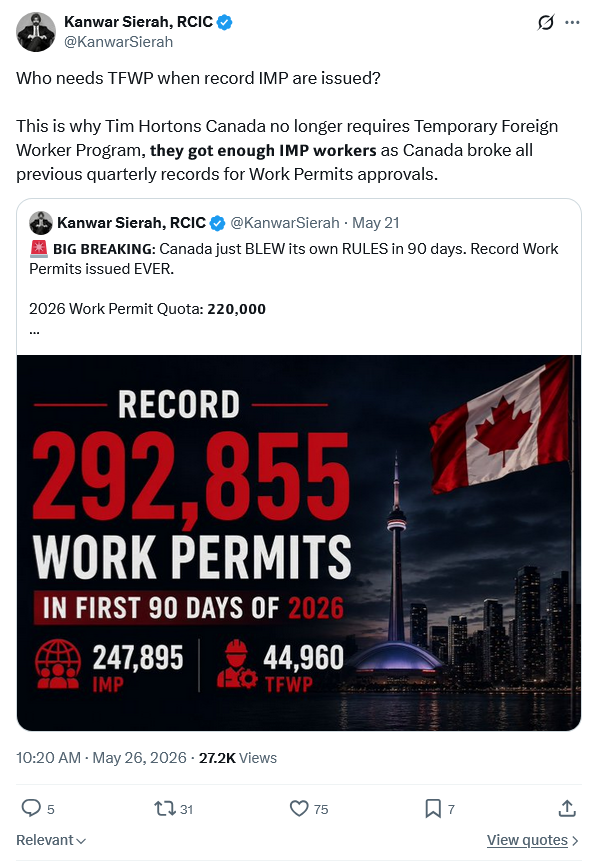
Mark Carney is lying to you.
In the first 90 days of 2026, Canada issued 292,855 work permits, smashing the full-year target of 220k–230k.
247,895 under IMP (International Mobility Program)
44,960 under TFWP
Why employers love the IMP:
It’s a much cheaper, faster, and easier alternative to the TFWP.
Key Financial & Practical Benefits of IMP (vs TFWP):
No LMIA required → Saves $770+ per worker (no $1,000 LMIA fee)
No mandatory job advertising to Canadians
Much faster processing (weeks vs months)
Lower compliance costs — only $230 employer fee
Fewer obligations around housing, wages, and recruitmentMore flexible permits for workers (easier to retain staff)
This is exactly why companies like Tim Hortons and many in hospitality/retail have shifted heavily to IMP workers. It’s faster, cheaper, and bypasses most of the strict labour market tests required under the TFWP.
That would seem to explain Tim Hortons’ sudden change of heart rather more than the risk of increased competition by a revived Dunkin’ Donuts expansion.
The Korean War Week 101 – Another Week, Another POW Riot – May 26, 1952
The Korean War by Indy Neidell
Published 26 May 2026In the wake of the kidnapping of the Koje-Do POW camp commandant, UN Commander Mark Clark is busy really working on expanding security at all the POW camps in Korea and gaining total internal control of them. However, the damage done to the UN’s global reputation by the whole incident is considerable, and at the negotiating table the Communists denounce the UN and UN Chief Delegate Turner Joy leaves his post to return to the states. The war in the field goes on as always, with the Philippine Battalion Combat Team seeing success in the field.
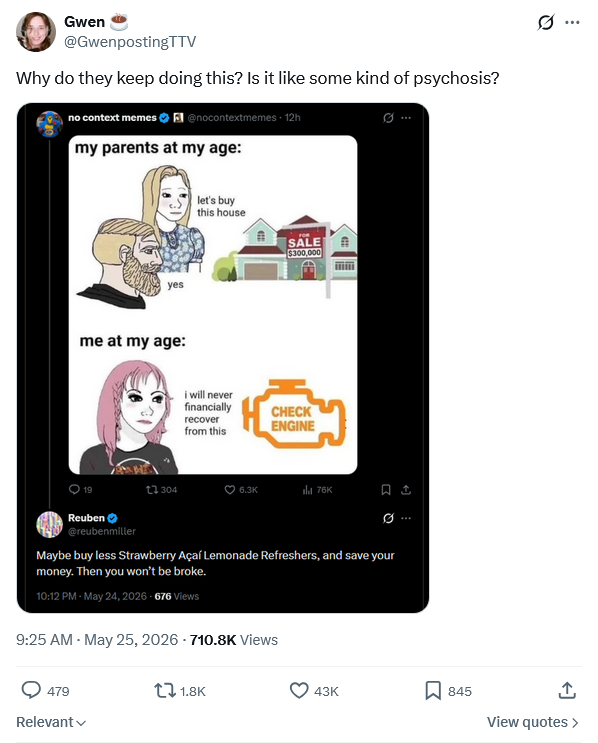
The boomers don’t hate you, they just prioritize feeling good about themselves
This is something I see very clearly in Canadian baby boomers — most of whom support Mark Carney and the Liberals because they feel that’s what nice people do, and boomers want to think of themselves as nice people above all else. On the social media site formerly known as Twitter, Devon Eriksen responds to a meme expressing later generations’ view of the boomers:
On the surface, it sounds like Boomers hate you. Or like they have the attention span and logical thinking skills of a goldfish.
Neither one of these is true.
Their complete dismissal of any of your concerns, and their total refusal to understand your situation or worldview, is actually quite sensible in light of one key fact about them.
They’re not hateful. They’re not dumb. They just have an incredibly low emotional pain threshold.
They cannot stand to feel bad about themselves for any reason, even for a moment.
When you create a meme like this, or you tell the story of how you are forty years old and can’t afford a house because you trained for three different careers and got rugpulled by work visas and offshoring every time …
… then they don’t even think about it as a worldview or a perspective or an experience that you have. They don’t think about you at all.
They think only about the effect on their own self-esteem, which must be parried.
You have, you see, told a tale of playing life on hard mode, which implies that they were playing life on easy mode, which implies that they are not wizards of insight and paragons of virtue.
That’s why they will immediately respond with these incoherent lines about whining and bootstraps and firm handshakes and avocado toast. Of course they don’t make sense. They don’t have to make sense. The goal isn’t to persuade you of anything or engage with you at all.
The goal is simply to have an excuse to avoid thinking about something which might make them feel bad.
These Boomerisms are magic talismans used to ward off emotional discomfort, in much the same fashion as all the species of plants they smoked their way through when they were your age.
I don’t see a solution to this.
I don’t know any way to tell Boomers that Hart-Cellar, CRA1964, DEI, open borders, social welfare programs, anti-racism, gay marriage, gun control, the sexual revolution, etc, were massive mistakes and need to be stopped, while hiding the obvious implication they were the ones who made those mistakes.
If we wish to save Western civilization, to make things good enough again that actual Americans can manage to have homes and marriages and children, then we’re going to have to find a way to work around the Boomers, because they’re never going to get on board.
The Real T26 “Tanker” M1 Garand
Forgotten Weapons
Published 5 Jan 2026The name “tanker” has been applied to shortened M1 Garand rifles for a long time and today we are looking at one of the rifles that was the genesis of that concept. It actually has nothing to do with tanks; the idea for a shortened M1 came from the Pacific Warfare Board of the US Army, looking for a handier weapon for jungle fighting. During 1944 when this idea was proposed, Springfield Arsenal was already independently working on the M1E5, a very similar paratrooper version of the M1. The PWB ordered the 6th Infantry Division in the Philippines to make 150 samples for testing, of which two were sent back to Springfield for testing.
In testing, the T26 showed the same problems as the M1E5 — excessive recoil, noise, and concussion. Despite this, 15,000 were recommended for production in the summer of 1945, but the war ended before any production actually took place. The name “tanker” came later, when companies started making cut-down Garands for commercial sale and thought that marketing them as specialized tanker weapons would help them sell.
Thanks to the Springfield Armory National Historic Site for giving me access to this truly unique specimen from their reference collection to film for you! Don’t miss the chance to visit the museum there if you have a day free in Springfield, Massachusetts: https://www.nps.gov/spar/index.htm
(more…)
QotD: “Bring your whole self to work”
Organisations and institutions are formalised teams. Due to past ruthless selection — see the Neolithic y-chromosome bottleneck — the male expression of Homo sapien genes is much better at teams than is the female expression of the same. This does turn out to matter.
We have spent centuries, millennia, dealing with the bad traits of men in power. We better start wrestling seriously and quickly with the bad traits of women in power, or we could end up with a cascading collapse of complex systems (see the LA fires for an example). We are already seeing some serious institutional degradation.
But if we remain stuck in “if you criticise men, it’s feminism; if you criticise women, it’s misogyny”, we have a potentially terminal problem.
Lorenzo Warby, Substack Notes, 2026-02-21.
May 26, 2026
“She is hoping to disturb them in their privilege and veiled racism”
Millennial Woes on having sympathy for the Midwit:

In August 2022 I stumbled upon this video of a young female teacher in Utah. She is what we would once have called an SJW. She describes how she has equipped her fourth-grade classroom in a way that she expects will annoy the parents of her (aged 9-10) pupils: all of the materials have been vetted by her to ensure that they include no images whatsoever of White people — “not a single White face there”.
Even though she knows the school is majority White (over 85%), she has designed her classroom, in her own words, “for non-white students”. To be fair, this could be simply because she is bringing materials from her previous school, which was much more diverse. But even then, you would think the sensible thing would be to buy materials more fitting for her new school. She does not.
So the woke attitude goes far beyond merely accommodating non-white people, and beyond even the absurdity of giving them equal prominence in our ancestral society, but actually to giving them precedence over us there.
What I found striking about this video, apart from the mindboggling fact that this is someone presumably vocated to help people yet doing something that will clearly harm her pupils, is how she delights in the fact that what she has done will annoy parents. To be precise, it will annoy parents who, whether conscious of it or not, are “racist”. After all, if they really “don’t see race”, then how can they possibly care about this? Thus, they cannot argue that their kids should see representations of their racial kin without outing themselves as “racist”, which in turn will make them very vulnerable. So this younger teacher feels not just morally sound, but bulletproof against reprisals, and very clever.
There is also a social class element to this. She specifies that these will be “posh White parents”. Despite appearing to be all of 23 and only having taught in very diverse schools, she alludes to experience in dealing with such upper-class White parents before. She is hoping to disturb them in their privilege and veiled racism.
She also clearly assumes that, if any parents do complain, she will be safe. The institution — not just her school but the entire education sector, including all of the academics and every university department that sustains them — will be on her side. If and when the parents complain (having navigated their way through the minefield of realising they are “racist” and painstakingly forming some lame argument to hopefully avoid that accusation) they will find that she is protected not just by her employer but by an entire segment of society. They, the parents, might get some small local newspaper to back them, or more likely to report the story impartially, but in all likelihood they will find themselves shamed by some much bigger newspaper. That is what she was clearly expecting when she made this video.
[…]
What I find troubling about this story is that it illuminates both the viciousness and the vulnerability of the midwit. It wouldn’t be worth fretting over, except that there are many millions of these people about. Every one of them is bright enough to grasp the drivel at teacher training college, but not bright enough to realise that it is drivel. Every one of them is vicious enough to harm children and take pleasure in disturbing the parents and sadistically putting them in an impossible position … but every one of them is literally just doing what they have been told to do, and is spreading the ideas they have been trained to believe are good, healthy, and crucially needed.
Canadian parents are increasingly adopting the “helicopter” or “bulldozer” model
Eva Chipiuk on concerning trends in Canadian parenting styles and the long-term impact on children:
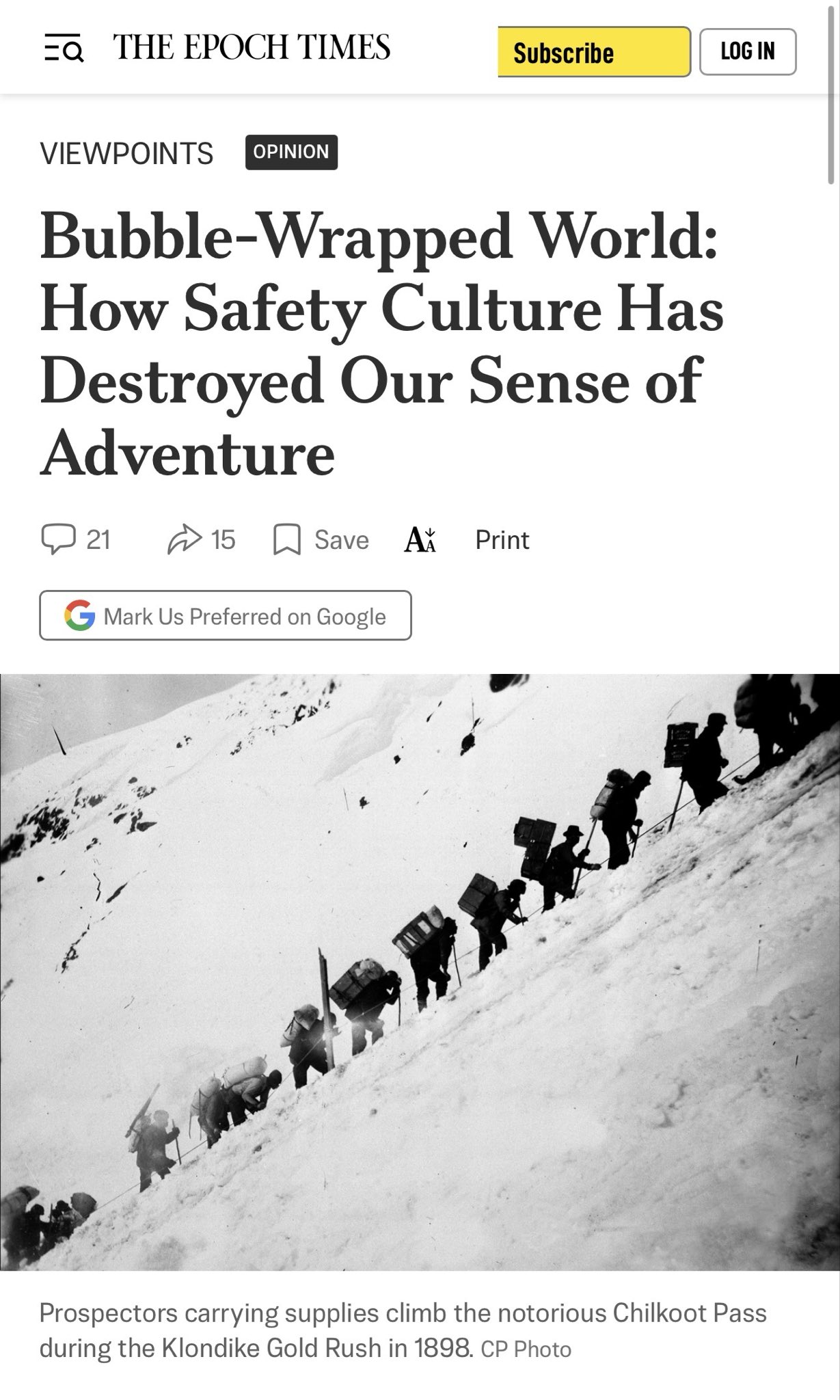
Not many people have really turned their minds to the psychology of Canadians. Most are too busy reacting to the latest outrage, headline, or political controversy.
However, David Redman has cautioned about what he has identified as a trend in Canada: “helicopter” and “bulldozer” parenting, where children are either constantly hovered over or where every obstacle is removed before they ever have to face it themselves.
Over time, that kind of environment can produce people who become uncomfortable with uncertainty, overly dependent on authority, fearful of risk, and hesitant to think independently or challenge difficult ideas. As this article put it:
Children, the authors observed, are now deliberately shielded from any sense of risk or uncertainty. How can anyone — young boys most of all — learn about the world around them when school principals announce at the onset of every snowfall that “all snow must stay on the ground”. The ideal of adventure and resilience has been replaced by a debilitating sense of fragility and risk-avoidance …
Adventure should properly be considered a spirit, not a place. It is driven by a powerful mixture of curiosity, necessity, and an openness to experiencing new things. And it can be found wherever uncertainty reigns. Today, that might entail travelling to strange lands, meeting new people, or even engaging in uncomfortable discussions about whether Alberta should remain part of Canada forever.
Wherever the unknown lies, adventure can be found.
That mindset does not just affect childhood. It shapes entire societies. It affects how citizens respond to disagreement, political debate, uncertainty, criticism, and even new ideas.
Somewhere along the way, many Canadians lost their sense of adventure, resilience, curiosity, and willingness to engage with uncomfortable conversations or difficult questions.
Where did that spirit go? What happened to the mindset that encouraged people to explore, question authority, take risks, debate ideas openly, and build something better even when the outcome was uncertain? Somewhere along the way, discomfort itself seems to have become something to avoid rather than something people grow through.
Because if we stop exploring, questioning, debating, and taking risks, we lose something essential about what it means to live freely and think independently. A society that becomes afraid of uncertainty eventually becomes dependent on being told what is safe, acceptable, and permitted.
If we are going to move forward in any meaningful way, we need to rediscover the spirit of curiosity, resilience, and adventure that pushes people to test ideas, challenge assumptions, and engage with the unknown instead of fearing it.
Perhaps one of the most important conversations we should be having is this: what does it actually mean to be Canadian today?
Because for many, it increasingly feels like the answer is becoming less about courage, resilience, curiosity, and self-determination, and more about compliance, comfort, and avoiding difficult conversations.
Gingerbread for Washington’s Army
Tasting History with Max Miller
Published 2 Dec 2025Beautifully spiced gingerbread cookies formed in a sea goat mold
City/Region: England | Philadelphia, Pennsylvania
Time Period: 1773Christopher Ludwick was a true hero of the American Revolution. A German immigrant, he made his fortune in part by baking gingerbread in Philadelphia, and then used his baking knowledge, patriotic spirit, and all of his fortune to aid the American cause.
These gingerbread cookies are not as gingery as many modern ones, but the addition of mace, coriander seeds, and caraway seeds makes for a complex spiciness that is delicious. If you have gingerbread molds, these are a great time to use them, and if you don’t, they’re still delicious as cut-out cookies.
To Make Ginger-bread
Take a pound and a half of treacle, two eggs beaten, half a pound of brown sugar, an ounce of ginger beaten and sifted; of cloves, mace, and nutmegs all together half an ounce, beaten very fine, coriander-seeds and carraway-seeds of each half an ounce, two pounds of butter melted; mix all these together, with as much flour as will knead it into a pretty stiff paste; then roll it out, and cut it into what forms you please; bake it in a quick oven on tin plates; a little time will bake it.
— The Universal Cook or, the Lady’s Complete Assistant by John Townshend, 1773
QotD: Entropy versus Revolution
They’re simply nihilists, and their nihilism is just a way station to suicide. Their “program”, such as it is, aims at absolute stasis — they want everyone and everything to be exactly one thing, now and forever, because this is the closest to annihilation they can get without being forced to admit to themselves that what they’re really longing for is the sweet release of death. The purpose of all those bespoke sexualities, for instance, clearly isn’t “to find a likeminded person to have sex with”; rather, it’s to make sure you can never have sex with anyone at all.
Ooops, sorry, you only fulfill 459 of the 462 bullet points on the checklist.
Which is weird, I realize, because the “Left” (for rhetorical convenience) are always in frantic motion. But it’s displacement activity. As I’ve written before, you can call it “permanent revolution”, but it’s Isaac Newton’s version, not Leon Trotsky’s — forever spinning in place, going nowhere. So long as they never stop spinning, they’ll never hear the vast emptiness of their own lives. They’ll never have to look their death wish straight in the eye.
The “Right” (again for rhetorical convenience) seems to be locked in a never-ending battle against entropy. That’s what it seems to boil down to. Things fall apart and pass away, and in their breakdown we are robbed of our fundamental dignity. In the end, that’s the only thing worth “conserving” — your fundamental dignity; the only “right” that matters is the right not to be a clown.
One always loses the battle against entropy eventually, but the dignity is in the fight. For the “left”, who have no dignity, the fight is just a distraction, sound and fury to distract from the nothingness that always threatens to overwhelm them … and that they secretly long for.
Severian, “Entropy vs. Revolution”, Founding Questions, 2022-06-21.
May 25, 2026
Enoch Powell, in person
I posted an excerpt from Niccolo Soldo’s post on Enoch Powell last week, which might be why Substack called my attention to this post from Francis Turner, which includes some memories of personal interaction with Powell during a visit Powell paid to Turner’s father in the early 1980s:

No wonder he was vilified for telling the truth … he was completely correct.
As I commented on Niccolo’s post I had the fortune to meet Enoch Powell in the early 1980s. I think it would have been about April 1983 but I could be wrong. I don’t recall the reason Powell came, it could have been something to do with the Bible or Greek Patristics, it could have been theology, it could have been Gladstone or it could have been something totally different that I can’t guess. Anyway he spent a few days with my father for some reason and the two of them got on like a house on fire.
Both were Cambridge educated classicists, though my father was there a decade after Powell, and they had a number of other things in common. They were of essentially the same social class and similar background. Both had been in intelligence in WW2 and concentrated on the Japanese front. Both had been to India — my father as missionary, Powell as soldier in WW2. Both had learned Indian languages — Powell learned Urdu, my father Tamil. Both had worked with “working class” people — my father as a vicar in Rochdale, Powell as MP in Wolverhampton. They also shared a similar political outlook, though I don’t think they discussed politics much beyond sharing their distaste for Europe.
What I recall of those few days was what a nice man Enoch Powell was. As I mentioned in the comment, he helped me with my homework, which was Herodotus. I recall him, in addition to giving me specific advice, discussing with me and my father the various dialects of ancient Greek and how remarkable it was that an educated Greek in Constantinople could have read Herodotus written a thousand years or more earlier without much difficulty. I also recall him encouraging my father to learn German and even Russian because “you’ve learned two non Indo-European languages already, so both will be easy for you as a classicist”.1 Since Powell spoke (or at least read and wrote) multiple Indo-European languages, including both of those, he may have been optimistic but his encouragement undoubtedly helped.
He entirely failed to mention to me that he’d spent years as an academic studying Herodotus and had actually published a well known book about his work. But that did explain how he could know precisely what passage I was having trouble with from just the first few words.
One thing that stood out was his intellect. He wasn’t in any way patronizing but he made little attempt to disguise his brains. He started off assuming you could more or less keep up and would adjust down until you did. He was also curious about new things. I don’t think he was faking it when he asked me about home computers and what good they were for. I’m not entirely sure I gave him a good answers but the questions he asked helped me realize that I really enjoyed programming them and that therefore a computer programmer might be a good career.
The other main thing that he taught me was to distrust the media. He gave some specific examples regarding the IRA and Northern Ireland and how the BBC and the newspapers had exaggerated certain events. He also pointed out that the media had to pick and choose what to report on and that they could prioritize some events over others.
One other thing. Part of his background was (Anglican) Christianity. He might not have gone to church every day, but he certainly did go on Sundays and if the opportunity presented itself he would attend Matins or Evensong. It was just the sort of thing one did. And one behaved accordingly.
- Quote not exact because it was 45 years ago
George Washington “basically started the world’s first global war”
On his Substack, Ed West talks about a book he had intended to write, but “put it on the back burner” for too long and the moment has passed:
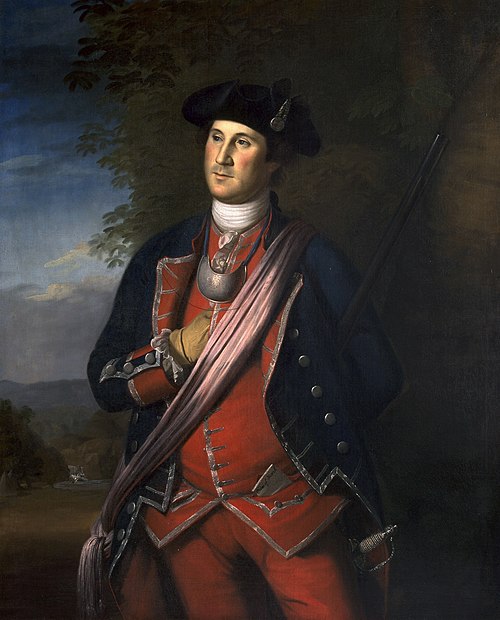
George Washington in the uniform of the Virginia Regiment, 1772.
Portrait by Charles Willson Peale (1741-1827) from the Washington and Lee University collection via Wikimedia Commons.
The story would start in the 1750s. The first truly world war is in full flow, as Britain and France battle for supremacy of the continent and the oceans. In North America, British colonial troops fight side by side with soldiers from the old country, who mock the bumpkin locals with their ditty “Yankee Doodle“. But, rivalries aside, they both know what they’re fighting for: if Louis XV’s absolute monarchy wins, all their liberties will be gone.
In a heroic battle the British regular and colonial forces take the French stronghold of Fort Duquesne and rename it Fort Pitt, after cabinet minister William Pitt “the elder” – it later becomes Pittsburgh. By 1763 the French are driven out of North America altogether. The British colonies are safe. One officer particularly shines during this war, and diarist Horace Walpole writes how “The volley fired by a young Virginian in the backwoods of America set the world on fire”.
That Virginian was George Washington. Born in Wakefield in Westmoreland County, this British hero was the great-grandson of an Essex clergyman thrown out of the church for drunkenness, and who had landed in that colony in 1657. Washington was an impressive man in every way – standing at 6’2″, with enormous hands and feet and a massive nose, he was notably strong and able to throw objects immense distances (although many of these accounts improved in the telling).
Despite having almost no teeth, like any good British patriot, Washington was very proper about his appearance, insisting on bringing a selection of fine linen shirts even into the backwoods. A conservative by nature and with ambitions to serve as an officer in His Majesty’s forces, he didn’t like the new fashion for shaking hands, preferring the more formal bow.
A major at 21, Washington’s first job was to lead his men into the Ohio Valley to warn away any Frenchmen they found there. The following year, 1754, and now a lieutenant-colonel, he went back and built Fort Necessity close to Fort Duquesne, where he stumbled upon a contingent of enemy troops. They ran for their muskets and Washington ordered his company to fire. Ten Frenchmen were killed, including their lieutenant, and the incident would spark a war in North America between the two great powers, which in 1756 linked up with a Europe-wide conflict later known as the Seven Years’ War. It’s strange to think that, as well as being the first president of a future global superpower, Washington basically started the world’s first global war.
But what if France had won that struggle? Would French-controlled colonies in North America have formed constitutions centred on the rights to life, liberty and the pursuit of happiness, not to mention the often-overlooked right to property? Would they have enshrined religious tolerance or the right to free speech? Trial by jury? Innocence until proven guilty? Hell, no! And if it wasn’t for us, my thesis went, you’d be speaking French.
Without England’s history of Parliamentary freedom, habeas corpus, Magna Carta and the jury system, the colonies would never have developed as they did. Neither would they have the same commercial spirit, downstream of their Puritan and Quaker inheritance.
I think I came up with the proposal after reading David Hackett Fischer’s Albion’s Seed, one of the most discussed and popular analyses of American culture. This great work of history and anthropology charts the foundation of the country’s cultural folkways through four migrations – East Anglian Puritans to New England, Cavaliers from England’s south and south-west to Virginia, the mostly northern Quakers to the middle colonies, and Borderers from Ulster to the Appalachians.
I was always very interested in founder effects, whereby colonies come to take on aspects of the mother country which subsequently disappear back home. This is reflected in the fact that many “Americanisms” are actually old English words, like fall, trash and garbage, even “gotten”. It’s also true to some extent of the American accent, developing out of various regional dialects which have since been flattened by the dominance of London. This is especially the case with Ocracoke Island in North Carolina, which apparently is the closest thing to Shakespearean English, although I fear that if I went there this would no longer be true, and they’d all say “like” four times in every sentence and tell you they’re “reaching out”.
Did The Taranto Raid Inspire Pearl Harbor?
TimeGhost Cartographic
Published 24 May 2026In November 1940, the British Royal Navy launched a daring carrier strike against the Italian fleet at Taranto. The attack shocked the world, crippled Italian naval power in the Mediterranean, and demonstrated just how devastating naval air power could be against battleships at anchor. But the consequences of Taranto didn’t end in Italy.
In this episode, we explore the aftermath of the raid, the race to understand how it had been achieved, and why military observers around the world paid such close attention to what happened there. From British convoy operations in the Mediterranean to Japanese investigations into shallow-water torpedo attacks, this episode examines how one raid would echo far beyond the harbor at Taranto.
How did the British make the attack possible? What lessons did foreign observers take away from it? And why did some nations react to the raid very differently than others?
“When I was in high school, I was taught that every single Canadian adored Pierre Elliott Trudeau”
My family arrived in Canada in October 1967, just as the last of the Centennial events were shutting down. Pierre Trudeau became Liberal leader and Prime Minister not long afterwards. I think the “Trudeaumania” of 1968 was nearly 100% media generated, but it was new to Canadian voters who liked the idea of Canada being led by a sophisticated international playboy rather than the stolid, rather unfashionable men who preceded Trudeau. The media continued to “love him long time”, which definitely helped keep him in power and then back into power after the brief Joe Clark experiment. Since he left office, his reputation has been cherished and burnished by progressives in the educational system, as Harrison Lowman relates:
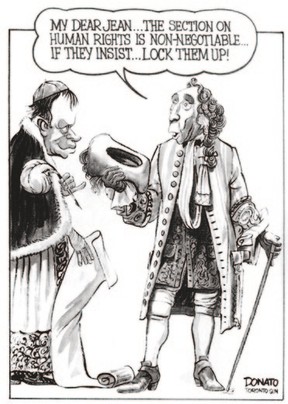
A Toronto Sun editorial cartoon by Andy Donato during Pierre Trudeau’s efforts to pass the Canadian Charter of Rights and Freedoms. You can certainly see where Justin Trudeau learned his approach to human rights.
“When I was in high school, I was taught that every single Canadian adored Pierre Elliott Trudeau. I learned that when the rose-pinned prime minister winked and pirouetted, the whole nation swooned.
It wasn’t until first-year university that I was first exposed to the fierce Western backlash to his National Energy Program.
It wasn’t until I graduated that I learned about any opposition to his Charter of Rights and Freedoms, his policy of national bilingualism, and official multiculturalism.
It was my Ontario high school civics teacher’s fault. While she was a great educator in other ways, the politics lessons she taught us were clearly slanted in the Liberal direction; a direction she supported.
My experience as a young person 20 years ago demonstrates the immense power teachers hold in moulding young minds. It’s a power that concerns me when I imagine dropping off my eight-month-old son at school in three years. Today, that teaching slant has become even steeper, with too many educators unwilling or unable to provide political or ideological balance in their classes.
This week, I interviewed Stephen Reich, a PhD student at The Ontario Institute for Studies in Education (OISE) who researches the proliferation of critical theory in kindergarten to Grade 12 policymaking.
Reich told me I should be concerned—that the educational leaders in this country have all but abandoned what should be the true purpose of education: imparting civilizational knowledge to the next generation. Instead, they’ve replaced it with seeking multiple “truths” and a narcissistic obsession with oppression narratives. Never mind that 92 percent of Canadians polled say they don’t want their children separated by race: taught to see themselves as “privileged” vs. “oppressed”. Reich says certain teachers are far less interested in producing independent thinkers and far more interested in producing activists.
“I have a feeling that success [for them] is ideological conformity,” he explained. That they aim to help foment some sort of “liberation.”
CP-121 Tracker; carrier-borne ASW powerhouse turned aerial firefighter
Polyus
Published 31 Jan 2026This is an aircraft carrier borne submarine hunter, dressed up like a firefighter. Its story is one of Cold war posturing, coastal policing, and aerial firefighting. Quite the career for such an unassuming looking aircraft. It was the de Havilland Canada CP-121 Tracker, an icon of Canadian aviation for almost 60 Years.
0:00 Introduction
0:30 Historical Context
1:58 Tracker or Gannet?
4:26 Canadian built CS2F-1 Trackers
9:06 CS2F-2
10:23 CS2F-3
13:12 New roles
15:14 Marine Reconnaissance
16:10 Conair Firecat/Turbo Firecat
17:48 Conclusion
(more…)


