
Recently, over lunch, Mrs. Muros regaled me with tales of authors who treat their readers to several new novels a year. As she waxed rhapsodic on the subject of the people who put the “p” in “prolific”, I scribbled notes on a credit card receipt. “Why is it”, I wrote, “that these ink-strained Atalantas can fill several pages with reasonably readable prose in the time it takes me to assemble a simple Substack post?”
The answer, I mused, might have something to do with sex. All of the authors mentioned by My Yankee Sweetheart, after all, were fully paid-up members of the distaff half of humanity. Could it be that my words fail to flow like summertime honey because my brain has been pickled in androgens? Or, to be somewhat less of a bio-Calvinist, could it be that my refusal to engage in the formal study of literature — a policy which owed much to my belief that the subject was “for girls” — left me bereft of some of the most useful tools of the writer’s trade?
Later that day, as I ransacked back issues of obscure journals in the hope of finding an uncooperative fact, a warm yellow bulb of incandescent understanding appeared above my head. ‘Twas not the writing that slowed me down, I realized, but the research. Indeed, were it not for the pesky puzzle piece I was trying to find, my article would have been done and dusted well before The Love of My Life and I sat down to our midday meal.
Before it faded, my wee epiphany bore two sprogs. The elder of these reminded me that, like other forms of mass production, the prodigious productivity of the quill-drivers in question owed much to the avoidance of novelty. That is, they were able to write so much because, in effect, they made repeated use of familiar formulae, tried-and-true tropes, and recurring turns-of-phrase. The younger of my mind-sparks added that, in addition to taking up time that an writer might otherwise spend at the keyboard, the discovery of a new fact will often lead to a quest for fresh forms of expression.
So, to quote the immortal words of David Crowther, you pays your money and you takes your choice. You can write quickly, or you can say something new, but you can’t do both.
Bruce Ivar Gudmundsson, “The Price of Speed”, Extra Muros, 2024-05-21.
August 29, 2024
QotD: The Price of Speed
August 28, 2024
1974 – Britain’s nadir
In the second part of Ed West‘s appreciation of Dominic Sandbrook’s Seasons in the Sun, Britain was described as “sliding, sinking, shabby, dirty, lazy, inefficient, dangerous, in its death throes, worn out, clapped out, occasionally lashing out” by Margaret Drabble in her 1977 novel The Ice Age, and it certainly seems to fit the bill quite well:
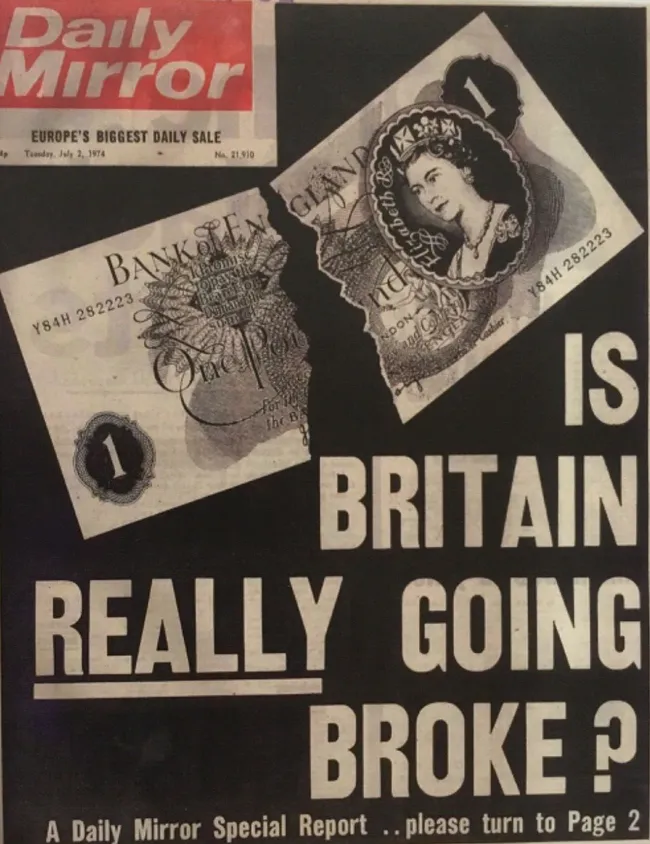
The Times reported in October of that year that London’s West End was in a “sorry state”, with parts of Shaftesbury Avenue and Charing Cross Road “in the sort of condition that, in Birmingham or Manchester, would qualify them for wholesale slum clearance”.
Journalist Clive Irving wrote that London had become “a semi-derelict slum”, a city blighted by “tacky porno shops, skin movies, pinball arcades, and toxic hamburger joints” while “behind neon facades the buildings are flaking and unkempt”.
The capital had lost a million and a half people since its peak in 1939, and would continue its decline for another decade. Whitehall Mandarin Ronald McIntosh declared that “London is evidently losing population quite heavily [and] services are steadily deteriorating, and nobody seems to have the least idea of how to deal with it”.
The country as a whole was haemorrhaging people, and in 1975 its population fell for the first time since records began. In the spring of 1974 applications for emigration to Canada went up 65 per cent, while New Zealand even felt compelled to put restrictions on people fleeing the old country.
Doctors in particular were leaving in droves, and recruitment agency Robert Lee International estimated that the number of professionals wanting to move abroad rose by 35% in just six months, from January and July 1975. Interest was keenest among engineers, accountants, scientists and teachers.
Many high earners were fleeing excessive tax rates, so punitive that even the Bond producer Albert R Broccoli left to make the iconic British movies elsewhere, and Moonraker would be filmed in France.
Gone were the days of the Swinging Sixties; instead, the London of George Smiley was “the city of the Sex Pistols and The Sweeney, not the Beatles and The Avengers; a city of tramps and hooligans, hustlers and muggers, the downtrodden and the disappointed, haunted by the deadly figure of the IRA bomber”.
Britain’s second city was in an even worse state. During Wilson’s first term Birmingham had been hailed as “the most go-ahead city in Europe”. Now the Times admitted it looked like a “large and chaotic building site”.
Travel writer Jonathan Raban described Southampton’s Millbrook estate as “a vast, cheap storage unit for nearly 20,000 people”. The country’s increasing problem with crime, hooliganism, graffiti and drug addiction meant that residents wouldn’t even hang their clothes in communal areas, for fear of theft.
The great architectural feats of the post-war era were beginning to look like a miserable failure, and none more so than the utopian social housing schemes, which had often entailed destroying closely-knit and organic communities in overcrowded and run-down – but rescuable – terraced housing.
Christopher Brooker visited Keeling House in Bethnal Green and found “its concrete cracked and discolouring, the metal reinforcement rusting through the surface, every available inch covered with graffiti”. Here was the story of modern Britain, “the bright, anticipated dream followed by a seedy, nightmarish reality”.
The National Theatre’s Peter Hall visited the New York Juilliard School and upon return home “found it depressing to compare it with our own already run-down, ill-maintained South Bank building”.
“The English apparently no longer care enough about material surroundings,” he wrote: “They even seem to take a positive pleasure in defiling them.”
The Korean War Week 010 – MacArthur and the Incheon Meeting – August 27, 1950
The Korean War by Indy Neidell
Published 27 Aug 2024Douglas MacArthur has a plan for an amphibious invasion of Incheon, and he thinks it will turn the tide of the war. This week comes his heavy pitch to be allowed to do it to the powers-that-be among American command. The war in the field continues as the UN forces win the Battle of the Bowling Alley, but an air force attack accidentally hits targets over the border in China. Mao Zedong is furious. Also, MacArthur gets flak this week from the President for outspokenly advocating actions counter to US official policy with regard to China, so the Chinese situation grows ever more tense.
Chapters
01:28 Battle of the Bowling Alley
04:14 U.N. Air Power
06:46 Supply Issues
09:05 The British are coming
10:55 Incheon Plans
14:52 The Incheon Meeting
17:06 MacArthur and the VFW
20:25 KPA Plans for Next Week
21:24 Summary
(more…)
H.R. McMaster dishes on Trump’s first term in office
In Reason, Liz Wolfe covers some of the head-scratchers former National Security Advisor H.R. McMaster revealed about working for Donald Trump:

Donald Trump addresses a rally in Nashville, TN in March 2017.
Photo released by the Office of the President of the United States via Wikimedia Commons.
What might a second Trump White House be like? In his new book, At War with Ourselves: My Tour of Duty in the Trump White House, Lt. Gen. H.R. McMaster, who served as national security adviser to Donald Trump (for one year), characterizes Oval Office meetings as “exercises in competitive sycophancy” where advisers would greet him with lines like “your instincts are always right” or “no one has ever been treated so badly by the press”.
Trump, meanwhile, would come up with crazy concepts, and float them: “Why don’t we just bomb the drugs?” (Also: “Why don’t we take out the whole North Korean Army during one of their parades?”)
This is one man’s account, of course. McMaster’s word should not be taken as gospel, and some of his frustration might stem from his dismissal, or his foreign-policy prescriptions being at times ignored by his boss. But it’s a somewhat revealing look behind the curtain at policy-setting in a White House helmed by an especially mercurial commander in chief, who “enjoyed and contributed to interpersonal drama in the White House and across the administration”.
It also shows how quickly Trump fantasies have percolated through the Republican Party, namely the “let’s just bomb Mexico to get rid of the cartels” line, which Trump has been toying with since roughly 2019 (or possibly more like 2017, after he chatted with Rodrigo Duterte, former president of the Philippines, who had promised to kill 100,000 drug traffickers during his first six months as president). A few years prior, in 2015, he had suggested that Mexico was sending rapist and drug-traffickers across the southern border, and that we’d need to build a wall between the two countries, but it wasn’t until nine American citizens were killed in Mexico that Trump trotted out the idea of declaring cartels foreign terrorist organizations and using military might to eradicate them.
Trump’s line from 2019 has now become standard fare, notes The Economist: The Republican primary debates included lots of tough talk on Mexico, specifically on the bombing front, with Florida Gov. Ron DeSantis claiming he’d send special forces down there on Day One. Right-wing think tanks have embraced the messaging, with articles headlined “It’s Time to Wage War on Transnational Drug Cartels”. Taking cues from other members of her party, Georgia Rep. Marjorie Taylor Greene asked why “we’re fighting a war in Ukraine, and we’re not bombing the Mexican cartels”. Whether it’s economic protectionism (10 percent across-the-board tariffs, with 60 percent tariffs imposed on Chinese imports) or Mexico-bombing, Trump has near-magical abilities to get other members of his party to accept something previously regarded as absurd.
Then I’ll Take Her When You’re ☠️Dead☠️!
Jill Bearup
Published May 13, 2024Ah, Captain Blood. Swords, sand, and piratical shenanigans. Let’s do this.
The Fight Master Vol 1 Issue 1: https://mds.marshall.edu/fight/1/
Buy my book: books2read.com/juststabmenow (or try your local Amazon/bookstore)
QotD: NFL team owners
It’s probably also worth noting that the new Vikings owner is very big on family. By my count, [new Minnesota Vikings majority owner] Zygi [Wilf] used the word “family” 1,068 times during the 45-minute interview session. He mentioned his family, the Vikings family, his partners’ families, local families and the family business.
Asked about meeting the other NFL owners for the first time, Wilf said — you guessed it — they are like a family. Which I can see, particularly when I envision the Corleone family.
Tom Powers, “No news is good snooze with Wilf”, St. Paul Pioneer Press, 2005-06-17.
August 27, 2024
Was 1974 the worst year in British politics or just the worst year so far?
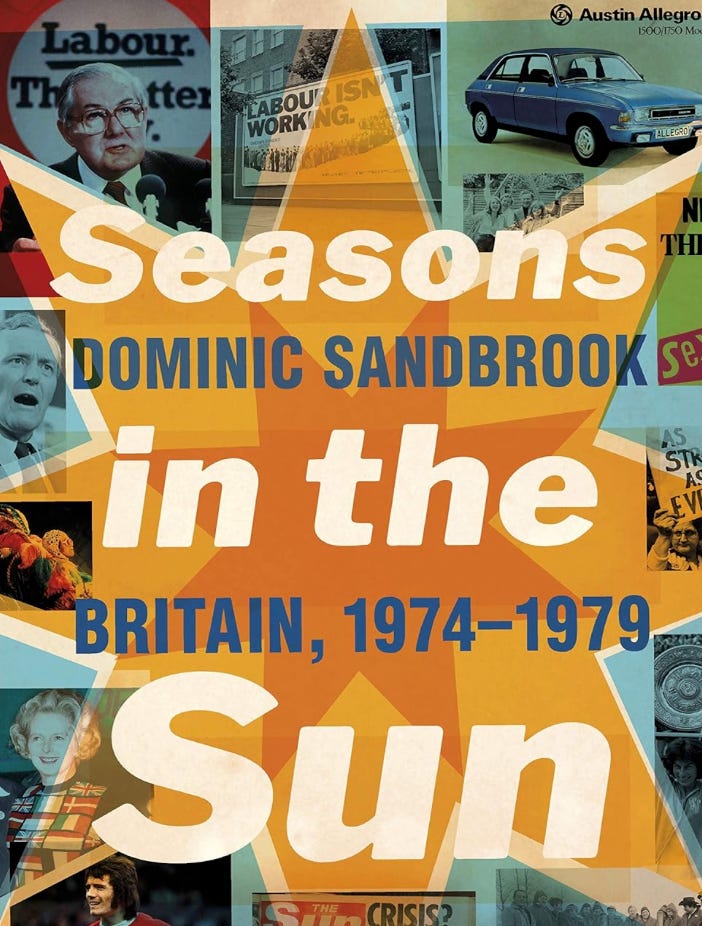
I wasn’t in the UK in 1974 (although I did spend a couple of dystopian weeks there in January 1979), so I don’t know from personal experience just how bad things were, but as Ed West considers Dominic Sandbrook’s very informative social history Seasons in the Sun, he certainly helps make a strong case for it:
One of my favourite moments from reading Fever Pitch as a teenager was the passage where Nick Hornby and a friend bunk off school to watch Arsenal play West Ham, a game which was being held on a weekday afternoon because there wasn’t enough electricity for the floodlights. Britain was enduring a three-day week due to the energy crisis, and assuming the ground would be empty, Hornby is stunned to find it packed with 60,000 people, all skiving off work, and he recalls his hypocritical juvenile disgust at the idleness of the British public.
The scene encapsulates the comic crapness of that period, one that many of us have enjoyed laughing at with the recent Rest is History series on 1974. I began reading Sandbrook’s book Seasons in the Sun afterwards, from where the material for the series was drawn; the early chapters comprise a highly entertaining account of what he described on the podcast as “the worst year in British politics”. Reassuring, perhaps, for those of us inclined towards pessimism, although to paraphrase Homer Simpson, perhaps it was only the worst year so far.
Nineteen-seventy-four saw two elections, the first of which ended in a hung parliament, with Labour as the largest party, and the second with Harold Wilson winning with a majority of 3. These were fought between parties led by exhausted leaders who had run out of ideas, with a third, the Liberals headed by Jeremy Thorpe, soon to be notorious as a dog killer. Britain had declined from the richest country on the continent to one of the poorest in western Europe, and its economy seemed to be falling apart.
During his troubled four years in office Edward Heath had called a state of emergency several times, culminating in ration cards for petrol and power restrictions. In 1973 Heath had “told his Chancellor, Anthony Barber, to go for broke”, Sandbrook writes: “It was one of the greatest economic gambles in modern history: while credit soared and the money supply boomed, Heath hoped to keep inflation down through an elaborate system of wage and price controls”. By October that year, “his hopes were unravelling at terrifying speed”.
The “Barber boom” led to “house prices surging by 25 per cent in just six months, the cost of imports rocketing and Britain’s trade balance plunging deep into the red”. Yet just a week after Heath had published details of his “Stage Three” incomes policy, “the Arab oil exporters in the OPEC cartel announced a stunning 70 per cent increase in the posted price of oil, punishing the West for its support for Israel. It was a devastating blow to the world economy, but nowhere was its impact greater than in Britain.”
The stock market lost a quarter of its value in just a month, while by January 1974 share prices had fallen by almost half in under two years. Just before Christmas, the government cut spending by 4 per cent, and Labour’s Shadow Chancellor, Denis Healey, “warned his colleagues that Britain stood on the brink of an ‘economic holocaust'”. Nine out of ten people told a Harris poll that “things are going very badly for Britain” and nearly as many foresaw no improvement in the coming year. They turned out to be correct.
Amid trouble with the National Union of Mineworkers, in November 1973 “Heath announced his fifth state of emergency in barely four years. Floodlighting and electric advertising were banned; behind the scenes, the government began printing petrol ration cards. As the railwaymen voted to join the miners in pursuit of higher pay, it seemed that Britain was sliding into darkness. Offices were ordered to turn down their thermostats, while the BBC and ITV were banned from broadcasting after 10.30 at night. On New Year’s Day, with fuel supplies running dangerously low, the entire nation went on a three-day working week.” Happy days.
Britain as the modern Panopticon
Jeremy Bentham proposed a new kind of prison in the 1700s, one where all of the prisoners in their cells were under constant observation by the guards. What sounds like a horrific way to live to any sensible rational person seems to have a fascinating appeal to the kind of micromanaging, busybody control freak who runs for office in British politics today:
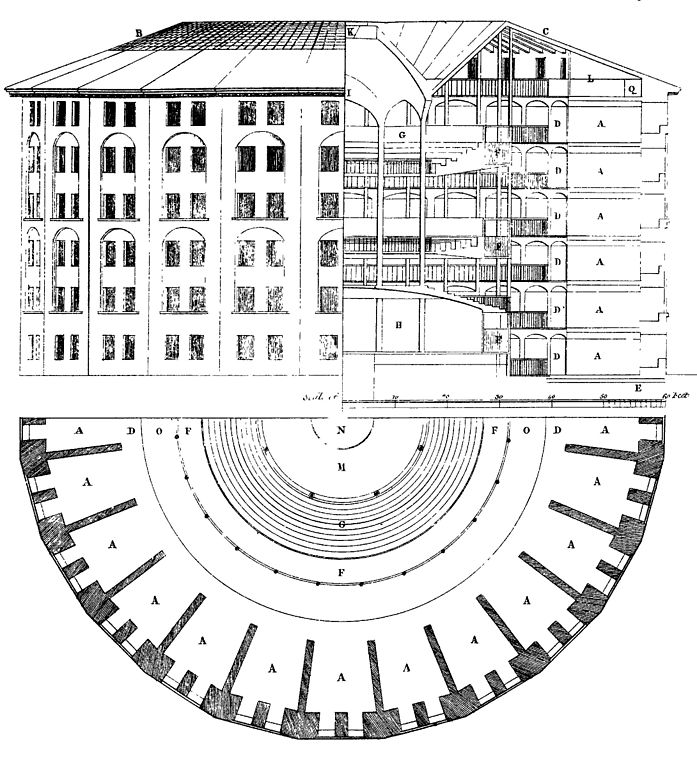
An illustration of Jeremy Bentham’s Panopticon prison.
Drawing by Willey Reveley, 1791.
In Britain authorities use cameras to monitor private individuals in real time. They track cars using number plate software, and human beings using facial recognition software and analysis of gait.
The rationale for these intrusive measures is to prevent illegal activity as well as recording crimes for use in trials.
This troubles many since it places unsupervised control mechanisms in the hands of politicians and authorities increasingly out of touch with the interests of the majority.
Full-spectrum surveillance
The British Government has recently threatened to use this surveillance technology to clamp down on “extremists”.
Currently that means anti-immigration protestors, although there is provision for “anti-establishment” protestors too.
There is much Britain’s political class will not tolerate in the people who elevate them to power.
They have promised to relentlessly hound detestables using advanced spy technology, principally facial recognition software. This is specifically designed to identify individuals and track their movements in real time.
None of this has been requested by the public, and polls reflect considerable unease, particularly with facial recognition software, a powerful tool few are comfortable with.
Advocates of surveillance claim this erosion to our privacy is a necessary step to tackle crime. Cameras enable the police and authorities to identify criminals as well as detect and record the crimes they commit.
To the casual observer it sounds plausible and even reasonable. We won’t be using it to spy on you, only them. It has some public benefits.
This seems like a workable idea. So why is it so useless at stopping a very visible crime?
Food at your regional end-of-summer fair/exhibition/extravaganza
For us in the Greater Toronto Area, it’s the Canadian National Exhibition but for a lot of Americans it’s their State Fair. James Lileks considers the sad fact that the interesting and exotic food choices at these shindigs is … overrated:

“Fruity Cereal Tenders”, one of the weird food offerings at the 2024 Canadian National Exhibition in Toronto.
Photo from blogTO, “Here’s all the outrageous food and drinks at the 2024 CNE”
I do not understand is why people go to the Fair and queue up at the hamburger stand. I often think this as I am in the queue at the hamburger stand.
After all, there’s so much more to eat. Corn dogs, for example. A low-flavor tube of minced abattoir sweepings, dipped in batter, plunged in oil, and served on a stick with a sharp point on the end. When you get to the last few bites, you either have to shimmy the butt of the corn dog up the skewer, or sword-swallow the thing so the sharp point spears your soft palate. Condiments? Why, yes — a smear of ketchup, or a smear of mustard, or, if you’re one of those people who believe in grabbing life by the lapels and shouting give me all you got, you have both.
Never in my life have I ever thought “I could go for a Corn Dog right about now,” but put me at the Fair and I have to eat one within five minutes of entering the grounds. It’s like the pistol shot that starts a race, and, like a bullet, goes through you just as fast.
It’s the same with mini-donuts. When I was doing the trivia contest at the newspaper stage, one of the questions was “how many mini-donuts can you eat before you are overcome with self-loathing?” The answer varies, I suppose, according to how much pre-existing self-loathing you bring to the job. Maybe you’re already hating yourself for eating a Sweet Martha’s bucket of cookies, a popular item at the fair. It has a handle so you can amble around as you eat. One of these years I expect it will come with a yoke and a spring-loaded tab that pops them in your you at present intervals, for hands-free consumption. My friends, a bucket of cookies is to personal girth management as a cup of quarters at a casino is to financial planning.
This year’s hot new item is “deep fried ranch dressing”, which seems impossible, like “sugar-dusted humidity on a stick”. How do they do that? Just pour the ranch in the roiling oil and and scoop out a globule?
“Well, first you shape the dressing into patties, then — ”
Wait, no, you cannot shape dressing. It defies your attempts to give it form, unless you’ve added a thickening element. (Of course, everything they serve at the Fair is a thickening element, in a sense.) It’s supposed to be delicious, but I wouldn’t eat one without first unbuttoning my shirt and smearing conducting gel on my chest, just to save time. Maybe even draw a dotted line on my sternum.
Updated to add the correct URL. Management would like to apologize for this error. The people responsible for it have been sacked.
Finland’s Prototype Belt-Fed GPMG: L41 Sampo
Forgotten Weapons
Published May 13, 2024During the 1930s, there was interest in Finland in replacing the Maxim heavy machine gun with something handier and more mobile. There were experiments with large drum magazines for the LS-26 light machine gun, but these were not satisfactory. Aimo Lahti began to work on a gas-operated GPMG, but lack of funding and competing priorities led to it having slow progress until the eve of the Winter War. By the time the gun was completed and the first preproduction batch ready for troop trials, the Continuation War was underway.
Twenty eight of the L41 Sampo machine guns were sent out to a variety of units for field testing in the fall of 1942, and the guns were generally well liked, although not perfect. Before improvements and full-scale production could begin, though, the Finnish military was basically distracted by an alternative possibility of procuring MG42 receivers from Germany and building them into complete guns in 7.62x54R. At least one such prototype was completed, and that project caused the L41 program to stall. By the time it might have progressed, the war was going rather badly for Germany and the possibility of getting receivers was basically gone. The L41 never did see further refinement or production, although the trials guns remained in service with their units, in a few cases right until the end of the war.
Mechanically, the L41 is a fascinating hybrid of Bren/ZB and Maxim elements, and incredibly sturdily built. Only seven are know to survive today, six in Finland and this one in the UK. Thanks to the British Royal Armouries for giving me access to it to film for you!
(more…)
QotD: Who were the good guys?
A movie can get away with showing mostly shades of gray, but in the case of the Valkyrie plot, both shades are pretty damn close to black.
Nor was the 2008 movie, starring Tom Cruise, an isolated case. A few years earlier, Jude Law and Ed Harris squared off as dueling snipers in Enemy at the Gates … set during the Battle of Stalingrad. Who do you root for, the Nazi or the Commie? The producers opt for “commie”, obviously, but their attempts to humanize the Jude Law character are embarrassing — even if we accept Law’s character as totally apolitical, no movie featuring a political commissar in a vital supporting role, not to mention “cameos” by Khrushchev and Stalin himself, can fail to remind viewers that everyone involved was awful. Even the most gripping battle scenes (and to be fair, some of them were pretty good) can’t make up for the fact that the world would be a far, far better place if they somehow both could’ve lost.
Those are high-level failures, conceptual mistakes, the kind that professional storytellers simply shouldn’t make. Not only that, though, both movies have unforgivable mistakes in the execution, at almost every level. Tom Cruise, for instance, is comically miscast as Stauffenberg. I’ve written before about how weird it is that casting directors seem to obsess over finding actors who look like even obscure historical figures. Cruise looks a bit like Stauffenberg, I guess, but there’s simply no way a guy with his … ummm … distinctive acting style should be anywhere near a historical drama. Tom Cruise only ever really plays Tom Cruise, so “Tom Cruise dressed up as a Nazi” is really jarring.
And that’s before you consider the accents. Maybe Tom Cruise can’t do a German accent, I dunno. I seem to recall he did an Irish accent in a movie once, and that turned out ok, but again, whatever character he was playing was just “Tom Cruise with an Irish accent.” So maybe if you feel you must cast him as a German, letting him use his “natural” American accent is the way to go. But if you’re going to do that, please, for pete’s sake, make everyone else do an American accent, too. I know Kenneth Branagh can do one. So either cast guys who can do the right accent, or, failing that, who can do each other’s accent. Otherwise you get a huge, distracting mess.
Enemy at the Gates was actually worse: Law, Joseph Fiennes (the commissar), and Rachel Weisz (the love interest) all used their native British accents … but they’re different kinds of British accent, at least in Law’s case. Meanwhile, Ed Harris (the Nazi antagonist) uses the “neutral” American accent, while supporting player Ron Perlman, who is American, does a comically over-the-top Russian … as do the guys playing Khrushchev and Stalin. It’s just weird. In both movies, you’ve got supposedly tight groups of friends (or, at least, co-conspirators) talking to each other in wildly different accents. That kind of thing is bad enough in a movie like Robin Hood, Prince of Thieves, which made no pretenses to historical accuracy; it’s movie-destroying in a supposedly serious, historically-based thriller.
Severian, “Storytelling Fail”, Rotten Chestnuts, 2021-07-13.
August 26, 2024
David Friedman – “my fargroup … are being attacked by my outgroup. My enemy’s enemy …”
I’m much of David Friedman‘s opinion on the candidates for both the Democratic and Republican parties in the current US presidential election … and I also find myself leaning more toward Trump even though his re-election would almost certainly be worse for Canada:

Donald Trump, surrounded by Secret Service agents, raises his fist after an attempt on his life during a campaign speech in Butler, PA on 13 July, 2024.
My opinion of the election is “a plague on both your houses”. Kamala Harris is an extreme representative of an ideology I have opposed for most of my life. Donald Trump has three major positions on two of which, immigration and trade, he manages to be even worse than his opponent. While I have some sympathy for his views on the third — I have been arguing against an interventionist foreign policy for something over fifty years now — I do not trust him to execute a consistent and competent alternative. His disinterest in whether what he says is true, extreme even for a politician, I find offensive.
That is my intellectual view of the matter. It is not my emotional view. Reading news stories and observing the effect on my feelings, I note that I am reacting like a Trump partisan. Poll results that look good for him make me happy, poll results that look bad for him make me sad. Accounts of outrageous statements by Trump or Vance I ignore — I don’t expect them to tell the truth. Accounts of demagoguery by Harris or Waltz arouse feelings of indignation. If Harris wins I will feel disappointed. If Trump wins I will feel relieved, at least until the first outrageous thing he does.
The explanation of my inconsistent reaction is provided by Scott Alexander in “I Can Tolerate Anything Except The Outgroup“, one of the best of his many good essays. In it he points out that someone’s outgroup, the group for whom he feels and expresses strongly negative views, is typically made up not of people distant from him, geographically and intellectually, but of people close. The outgroup of the Nazis was not their Japanese allies or the Chinese the Japanese were fighting, it was German Jews, people with the same language and, in most respects, the same appearance and culture. The outgroup of American leftists is not Muslim fundamentalists but American conservatives.
Conservatives have doubts about gay marriage. Muslim fundamentalists view homosexual intercourse as a capital offense.1 American conservatives would like their schools to be more tolerant of creationism. Muslim fundamentalists want their schools to teach the truth of Islam. And yet, when conservatives criticize Muslims, leftists defend them. When Muslims kill Jews and Jews respond by killing Muslims, it is the Muslims that the American leftists support, the Jews that they blame — although Israelis have much more in common, ideologically as well as culturally, with American leftists than Palestinians do.
We think of groups close to us in Near Mode, judging them on their merits as useful allies or dangerous enemies. We think of more distant groups in Far Mode – usually, we exoticize them. Sometimes it’s positive exoticization of the Noble Savage variety (understood so broadly that our treatment of Tibetans counts as an example of the trope). Other times it’s negative exoticization, treating them as cartoonish stereotypes of evil who are more funny or fascinating than repulsive. Take Genghis Khan – objectively he was one of the most evil people of all time, killing millions of victims, but since we think of him in Far Mode he becomes fascinating or even perversely admirable – “wow, that was one impressively bloodthirsty warlord”. (Scott Alexander, “Post-Partisanship Is Hyper-Partisanship“)
Conservatives are the leftists’ outgroup, Muslims their far group. The far group can be ignored; large parts of the world are more sexist and more racist than any part of America but invisible to progressives campaigning against sexism and racism. The far group can even be supported, at least if the outgroup is attacking it. My enemy’s enemy is my friend. Muslim fundamentalists. Hamas.
Kamala Harris is an American leftist. American leftists are my outgroup. Trump and Vance are American populists. I disagree with their views, in some cases more than I disagree with the views of American leftists, but I have nothing against them, just as I have nothing against believing Catholics or Orthodox Jews or Black Muslims or believers in Christian Science.
Trump and his movement are my fargroup. They are being attacked by my outgroup. My enemy’s enemy …
1. In some times and places Muslim culture has been tolerant of homosexuality; there are two famous medieval essays on the relative attractions of homosexual and heterosexual intercourse and quite a lot of poetry celebrating homosexual love. But the religious doctrine, which fundamentalists take seriously, holds homosexuality to be forbidden.
The craft of the historian, then and now
At Extra Muros, Bruce Ivar Gudmundsson contrasts the way historians used to research and write their books with the much more convenient, yet still imperfect methods of modern historians:
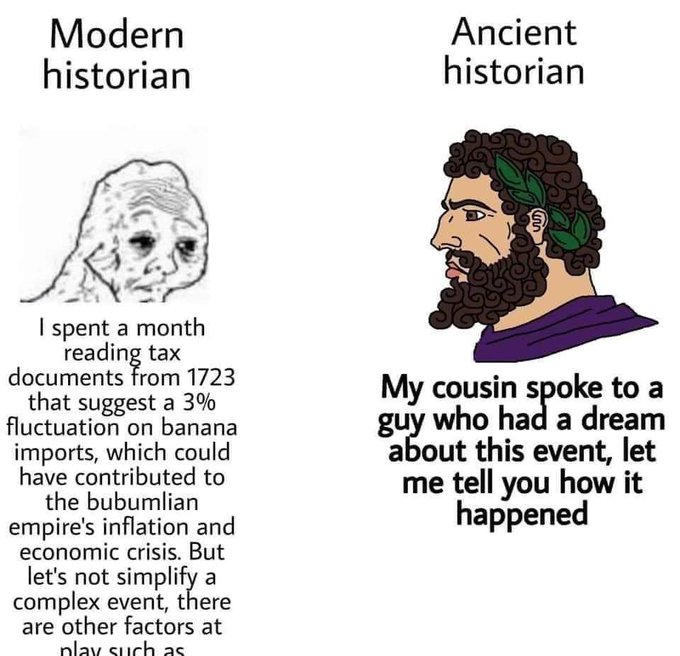
Another difference between ancient historians and their modern counterparts.
In days of yore, when visiting an archive required long journeys by sea, or, at the very least, a tiring trek o’er moor and mountain, considerate historians stuffed their works, with extensive excerpts from primary sources.1 Later, when trains, planes, and automobiles made it easier for people to visit the places where original documents could be found, these quotations shrank, eventually to the point where the word “citation”, which had once described the products of scholarly stenography, came to designate the label that enabled readers to locate the one-of-a-kind text in question.
No doubt, this development saved many trees from the woodman’s axe. At the same time, however, it changed the role played by historians. Rather than showcasing selections from the correspondence of old-timey movers and shakers, Clio’s children devoted most of the ink that they spilled to the explanation of texts that, despite the blessings bestowed by coal and petroleum, most readers would not be able to read.
Many a noble soul resisted the temptation to sacrifice verbatim reproduction on the altar of erudite interpretation. Realizing that readers might prefer a faithful facsimile of the real McCoy to a ponderous paraphrase, these saints of the scriptorium prepared primary sources for the press. However, rather rewarding these benefactors of the historically curious with condign praise, the denizens of the faculty lounge often dismissed them as “editors” and, in moments of especial cruelty, “antiquarians”.
In the fullness of time, the convenience provided by recent interpretations led many historians to prefer them to the relics of bygone bureaucracies. After all, reading a fresh-smelling, neatly-bound, clearly-printed, recently-written book asks less of a scholar than the deciphering of unfamiliar turns-of-phrase scribbled on the dusty, mite-bitten contents of cardboard boxes. Moreover, while the reader of a scholarly monograph often enjoys a wide choice of restaurants and coffee shops, and, at the very least, the delights of his own kitchen, the archival archaeologist must often make do with the decidedly institutional offerings of a ground-floor cafeteria.
Ostentatious reliance on recent interpretations also enables a scholar to exhibit his collegiality. “See”, the favorable footnote screams, “someone noticed your work and, marvelous to say, made use of it”. Conversely, failure to cite the work of a peer, let alone a scholar of superior standing, signals a degree of nonchalance bordering on contempt. “I am fully aware”, it says to the author of the unreferenced work, “that you poured your heart and soul, as well as a dozen years of your life, into your study, but I could not be bothered to type out its title, let alone turn a page to discover its date of publication”.
Finally, the making of new monographs out of the pieces of slightly older ones honors the founding fable of the research university, the myth of scholarly progress. The monograph still warm from the press, we presume, offers more in the way of insight and understanding than one that has been sitting on the shelf for decades. (If you wish to drive a dagger into the heart of an older academic, describe one of his earlier works, especially one that once made a splash in the kiddie-pool of his subfield, as “somewhat dated”.)2
Prejudice in favor of up-to-date interpretations creates a paradox. Historians, who exist to bring the past to life, favor interpretations created on the eve of now. The speakers for the dead (hat tip to Orson Scott Card) limit themselves to the thoughts of the living.
1. For a brief, and delightfully documented, description of the work of the paragon of this approach to the writing of history, Angelo Fabroni (1732-1803), see Anthony Grafton The Footnote: A Curious History (Cambridge: Harvard University Press, 1997) pages 82 and 83.
2. Ask me how I know!
History Summarized: Beauty and Brutalism
Overly Sarcastic Productions
Published May 10, 2024No no no guys you just don’t GET IT, Brutalism is actually really clever and impressive and in this essay I wi–
SOURCES & Further Reading:
Architecture in Minutes: 200 key buildings and movements in an instant by Susie Hodge – an extremely useful reference for 20th century structures and famous figures outside my usual wheelhouse, and the fortuitous inspiration for this video via the entry on “Concrete” with an opposite-facing image of the Baha’i House of Worship
“Brutalism was the Greatest Architectural Movement in History. Change My Mind.” by Pat Finn, Architizer, https://architizer.com/blog/inspirati…
“Concrete: the most destructive material on Earth” by Jonathan Watts, The Guardian, https://www.theguardian.com/cities/20…
“The Salk Institute and the Lost Ethics of Brutalism” by James E Churchill, Docomomo, https://www.docomomo-us.org/news/the-…
“The New Brutalism” by Reyner Banham, Architectural Review, https://www.architectural-review.com/…
“Busting the Myths of Brutalism” by Stewart Hicks @stewarthicks, My Take on the Whole Brutalism ThingMusic:
“Scheming Weasel” by Kevin MacLeod (Incompetech.com)
https://creativecommons.org/licenses/… Licensed under Creative Commons: By Attribution 4.0 LicenseOur content is intended for teenage audiences and up.
PODCAST: https://overlysarcasticpodcast.transi…
MERCH: https://overlysarcastic.shop/
OUR WEBSITE: https://www.OverlySarcasticProductions.com
QotD: The job of a Soviet economic planner
Gia Jandieri (GM): Our department inside of Gossnab [the State Supply Committee for the Central Planning Authority] was responsible for monitoring the execution of agreements for production of goods and government orders. My task was to verify that the plans had been executed correctly, to find failures and problems, and to report to the higher authorities.
This included reading lots of reports and visiting the factories and their warehouses for auditing.
The Soviet economy had been in a troublesome condition since the 1970s. We (at the Gossnab) had plenty of information about failures, but it wasn’t useful. We knew that the quality of produced goods was very low, that any household good that was of usable quality was in deficit, and that the shortages encouraged people to buy on the black market through bribes.
In reality, a bribe was a substitute for a market-determined price; people were interested in paying more than the official price for the goods they valued, and the bribe was a way for them to indicate that they valued it more than others.
The process of planning was long. The government had to study demand, find resources and production capacities, create long-run production and supply plans, compare these to political priorities, and get approval for general plans at the Communist Party meetings. Then the general plans needed to be converted to practical production and supply plans, with figures about resources, finances, material and labour, particular producers, particular suppliers, transportation capacities, etc. After this, we began the process of connecting factories and suppliers to one another, organizing transportation, arranging warehousing, and lining up retail shops.
The final stage of the planning process was to send the participating parties their own particular plans and supply contracts. These were obligatory government orders. Those who refused to follow them or failed to fulfill them properly were punished. The production factories had no right or resources to produce any other goods or services than those described in the supply contracts and production plans they received from the authorities. Funny enough, though, government officials could demand that they produce more goods than what was indicated in the plans.
Matthew Mitchell, “Central planning from the inside—an interview with a Soviet-era economist”, Fraser Institute, 2024-05-25.


