
World War Two
Published 3 Jun 2023The Allies head north in Italy after the fall of Monte Cassino last week; the Japanese head south in China in a new phase of their offensive; and the Soviets and the Western Allies make ever more concrete plans for their huge offensives, to go off very soon.
(more…)
June 4, 2023
The Allies are Driving for Rome – WW2 – Week 249 – June 3, 1944
Comments Off on The Allies are Driving for Rome – WW2 – Week 249 – June 3, 1944
D-Day Series: RCN and Operation Neptune
Valour Canada
Published 28 Dec 2015This video describes the Royal Canadian Navy’s (RCN) invaluable contributions to the invasion on D-Day, June 6, 1944. Operation Neptune was the name of the English Channel-crossing portion of the larger Normandy invasion (named Operation Overlord).
1. Overview (0:00)
Dawn. June 6, 1944. D-Day. Operation Overlord, the largest amphibious invasion in history, is about to begin. This is a description of the battlefield prior to the attack and also tells how the RCN played an important role both in the English Channel and along the French coast.2. Stop the U-boats (2:55)
Churchill said that the only thing that scared him during the war were the U-boats. This describes the problematic German U-boats and how the British and Canadian Navies (Operation Neptune) worked together to find, track, and destroy the underwater menace prior to D-Day.3. Clear the Mines (6:27)
“There is no doubt that the mine is our greatest obstacle to success” – British Admiral Bertram Ramsay. The size and effectiveness of the German minefield that guarded the D-Day beaches and how the Allied Navies worked together to prepare a route through which the invasion could occur.4. Cover the Beaches (9:49)
The Canadian Tribal-class destroyers played a significant role in eliminating the German Navy’s major surface warships’ threat to the invasion fleet. The RCN destroyer squadron and their mission of clearing the English Channel of German ships before, during, and after the invasion. A battle between the Canadian destroyers Haida and Huron and four German ships near the port of Brest on June 9 is discussed. Also covered are the two Canadian destroyers, Algonquin and Sioux, that were tasked with shore bombardment at Juno Beach.5. Land the Troops (13:01)
Shortly after dawn and following a forty-minute naval barrage at Juno Beach, the first Canadian soldiers came ashore. By noon, the beach was held by the Canadians and millions of tons of supplies were being brought ashore. This section describes the first waves of the invasion and the tanks, artillery, vehicles, and supplies that were soon to follow.
(more…)
Comments Off on D-Day Series: RCN and Operation Neptune
June 3, 2023
Why Was Normandy Selected For D-Day?
Real Engineering
Published 28 Mar 2020In the debut episode of the Logistics of D-Day we explore the logic and planning that resulted in Normandy being chosen as the location for the largest amphibious invasion in the history of human kind.
(more…)
Comments Off on Why Was Normandy Selected For D-Day?
June 2, 2023
“Montgomery was a military talent; Slim was a military genius”
Dr. Robert Lyman is a known fan of Field Marshal Slim (as am I, for the record), not only for his brilliant military achievements, but also as a writer:
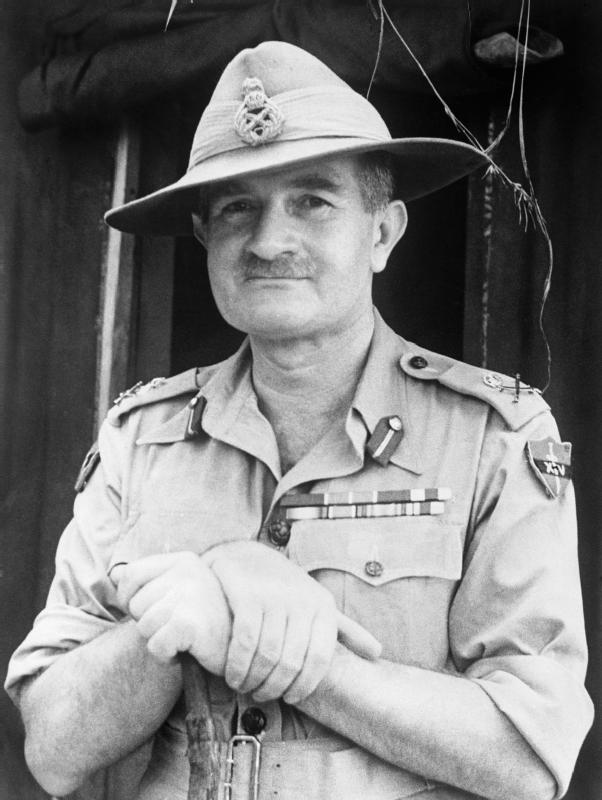
Field Marshal Sir William Slim (1891-1970), during his time as GOC XIVth Army.
Portrait by No. 9 Army Film & Photographic Unit via Wikimedia Commons.
How many British generals have been able to write as well as they could fight? Strangely perhaps, quite a few. Field Marshal Sir Michael Carver (Dilemmas of the Desert War, The Seven Ages of the British Army), General Sir David Fraser (And We Shall Shock Them), General Sir John Hackett (The Third World War) and Major General John Strawson (Beggars in Red) are four outstanding soldier-writers that spring immediately to mind. Even Monty wrote his memoirs. And in our own day I’ve read plenty of competent books from a slew of men who’ve reached the top of the profession of arms. The work of some, like that of General Sir Richard Sherriff (2017: War with Russia), Major General Mungo Melvin (Manstein) and Brigadier Allan Mallinson (Too Important for the Generals et al), could be described as outstanding. Julian Thompson and Richard Dannatt also fit this bill. But by far and away the best of Britain’s soldier-writers in the last century was also probably the greatest soldier – and field commander – of them all: Bill Slim. He was, more properly, Field Marshal William J. Slim KG, GCB, GCMG, GCVO, GBE, DSO, MC, KStJ, the onetime General Officer Commanding the famous 14th Army – the so-called Forgotten Army – of Burma fame. He was, in this author’s view, the greatest British general of the last war (to avoid further debate, let’s just agree that Monty failed as a coalition commander, whereas Slim excelled). Slim’s ability as a general is perfectly summed up by the historian Frank McLynn:
Slim’s encirclement of the Japanese on the Irrawaddy deserves to rank with the great military achievements of all time – Alexander at Gaugamela in 331 BC, Hannibal at Cannae (216 BC), Julius Caesar at Alesia (58 BC), the Mongol general Subudei at Mohi (1241) or Napoleon at Austerlitz (1805). The often made – but actually ludicrous – comparison between Montgomery and Slim is relevant here … there is no Montgomery equivalent of the Irrawaddy campaign … Montgomery was a military talent; Slim was a military genius.1
Some hint of Bill Slim’s fluency with the written word to complement his ability as a soldier came with the publication of Defeat into Victory in 1956, his superb retelling of the Burma story. Apart from its remarkable tale – the humiliation of British Arms in 1942 eventually overturned by a triumphant (and largely Indian) army in 1945 (87% of Slim’s army was Indian) – the quality of the writing was astonishing. Its author, a man who would be appointed Chief of the Imperial General Staff in 1949 (following Monty), the first Sepoy General ever to do so, and by Attlee no less, could clearly wield a pen every bit as he could destroy Japanese armies in battle (a feat he achieved twice, first in 1944 and again in 1945). When the book was first published it was an instant publishing sensation with the first edition of 20,000 selling out immediately. The Field recorded: “Of all the world’s greatest records of war and military adventure, this story must surely take its place among the greatest. It is told with a wealth of human understanding, a gift of vivid description, and a revelation of the indomitable spirit of the fighting man that can seldom have been equalled – let alone surpassed – in military history.” The London Evening Standard was as effusive in its praise: “He has written the best general’s book of World War II. Nobody who reads his account of the war, meticulously honest yet deeply moving, will doubt that here is a soldier of stature and a man among men.” The author John Masters, who served in the 14th Army, wrote in the New York Times on 19 November 1961 that it was “a dramatic story with one principal character and several hundred subordinate characters”, arguing that Slim was “an expert soldier and an expert writer”. The book remains a best seller today.
The following year Slim also published an anthology of speeches and lectures, loosely based on the theme of leadership, called Courage and Other Broadcasts. Then in 1959 he published his second book, Unofficial History, which bears out in full Masters’ description of Slim as a superb writer. It was a deeply personal, honest though light hearted account of events during his service. It received widespread acclaim. The author John Connell described it as “for the most part uproarious fun. If Bill Slim hadn’t been a first-rate soldier, what a short story writer he might have made.” For its part, The National Review wrote: “One of the most significant aspects of Field Marshal Slim’s book is the affectionate respect he shows when he writes about British and Indian soldiers. He finds plenty to amuse him too. I doubt whether a kindlier or truer description of the contemporary soldier has been given anywhere than in Unofficial History … It is one of the most delightful and amusing books about modern campaigning I have ever read.”
1. The General Wondered Why https://amzn.eu/d/45gHfOH
Comments Off on “Montgomery was a military talent; Slim was a military genius”
Germany Adopts the PPSh in 9mm: the MP-41(r)
Forgotten Weapons
Published 20 Feb 2023During World War Two, both German and Russian soldiers often thought that the other side’s weapons were better than their own. In particular, both sides often preferred their opponents’ SMGs. In late 1941, a group of German officers formally requested that Germany simply copy and produce the PPSh-41. This led to the HWA formally studying the question of PPSh-41 vs MP-40 … and they found that the German gun was better, but the Russian magazine was better.
Naturally, as a result of this finding, the German military chose to convert captured Russian PPSh-41s to use MP-40 magazines. The conversion used standard MP40 magazines, and required magazine well adapters and new 9mm barrels. Some 10,000 such conversions were made in total. Some used cast magwell adapters and some were stamped, and the barrels were made from standard MP40 barrels turned down to fit PPSh trunnions.
The standard 7.62mm PPSh-41 in German service was designated MP-717(r), while the ones changed to 9x19mm like this were designated MP-41(r). Many thanks to Limex for giving me access to film this one for you!
(more…)
Comments Off on Germany Adopts the PPSh in 9mm: the MP-41(r)
May 31, 2023
Improvised Weapons of WW2 | Anti-Tank Chats #8 | The Tank Museum
The Tank Museum
Published 10 Feb 2023Historian Stuart Wheeler is back with another Anti-Tank Chat. In this episode, he looks at the development and use of improvised, thrown and placed infantry anti-tank weapons, available to British and Commonwealth forces in World War II.
(more…)
Comments Off on Improvised Weapons of WW2 | Anti-Tank Chats #8 | The Tank Museum
May 29, 2023
The Moment D-Day Was Announced
World War Two
Published 28 May 2023D-Day is just around the corner, we’re in the end game now. You can learn more about the project and how to get involved at http://DDay.TimeGhost.tv
Comments Off on The Moment D-Day Was Announced
May 28, 2023
Breakout from Anzio! – WW2 – Week 248 – May 27, 1944
World War Two
Published 27 May 2023After four months, the Allies breakout from their bridgehead at Anzio and meet with the advancing troops heading north after the fall of Monte Cassino last week. The Japanese begin phase two of their big operation in China, and both the Soviets and the Western Allies continue making plans for their massive June offensives to squeeze the Axis from both sides of Europe.
(more…)
Comments Off on Breakout from Anzio! – WW2 – Week 248 – May 27, 1944
May 24, 2023
The Original PB&J from 1901
Tasting History with Max Miller
Published 23 May 2023
(more…)
Comments Off on The Original PB&J from 1901
May 22, 2023
What Happened Behind a Photographer’s Lens on D-Day
World War Two
Published 21 May 2023Robert Capa has gone down in history as one the most groundbreaking war correspondents in all of journalism. His account of what happened on D-Day was something we wanted to share with all of you.
(more…)
May 21, 2023
The Fall of Monte Cassino – WW2 – Week 247 – May 20, 1944
World War Two
Published 20 May 2023In Italy, the Allies finally overcome Monte Cassino and break through the Gustav Line; in Burma Merrill’s Marauders surprise the Japanese and take Myitkyina Airfield; in China, it’s the Japanese who are playing offense, as Operation Ichi Go and the siege of Luoyang continue. That’s the field action, but there’s big planning behind the scenes for major June offensives going on by both the Western Allies and the Soviets.
(more…)
Comments Off on The Fall of Monte Cassino – WW2 – Week 247 – May 20, 1944
May 14, 2023
Victory at Sevastopol! – WW2 – Week 246 – May 13, 1944
World War Two
Published 13 May 2023The Soviets push the Axis out of the Crimea this week once and for all. In Italy, the Allies launch a major offensive, and the French make a breakthrough there by week’s end. In China, the Japanese are aiming at Luoyang, but in India at Kohima they’re slowly being pushed back.
(more…)
Comments Off on Victory at Sevastopol! – WW2 – Week 246 – May 13, 1944
May 13, 2023
Arnold Ridley – “Private Charles Godfrey” – a real story from Dad’s Army
The History Chap
Published 1 Feb 2023The story of Arnold Ridley — Private Charles Godfrey — Dad’s Army
After my last video all about Lance Corporal Jones in Dad’s Army I have been inundated by requests for the real story of another character from the classic comedy series: Private Godfrey.
Private Charles Godfrey, played by Arnold Ridley, is an ageing and slightly doddery member of the Walmington-on-Sea Home Guard platoon. His comrades are somewhat surprised and concerned when he announces that he was a conscientious objector during the First World War. However, thanks to his sister, the platoon learn his real (well, fictitious as it is a TV comedy show) story. Godfrey was indeed a conscientious objector but like many others he did volunteer to serve his country – just not to kill. Many men who felt likewise, joined the Army Medical Corps. Whilst not fighting they not only served their country and played a valuable role in the war effort but they also put themselves in harm’s way. Many of them became stretcher bearers, going out into no man’s land to fetch the wounded to safety. And many were decorated for their bravery.
William Coltman, became the most decorated NCO in the entire British army during the First World War … and he never fired a shot in anger!I will be telling the story of William Coltman VC in the near future.
Private Charles Godfrey was awarded the Military Medal for bravery during the battle of the Somme.
What makes Godfrey’s character all the more fascinating is that his actor, Arnold Ridley, was no conscientious objector but a volunteer in World War One. he was severly injured at the battle of the Somme in 1916 and discharged the following year.
Indeed, his injuries would influence how he played his character in Dad’s Army.
After the war, Ridley became a play writer. Arnold Ridley penned over 30 pays, the most famous of which was The Ghost Train written in 1923.
At the outbreak of the Second World War he once more volunteered to serve his country. Following the battle of Boulogne in 1940, he was evacuated to Britain, having been injured, once more, he was again given a medical discharge.
For the rest of the war he worked for ENSA – the forces entertainment organisation — and was a member of his local Home Guard. He continued his acting career through the 1940’s and 50’s before landing the role of Private Charles Godfrey in Dads Army in 1968. He was ever-present until the show ended in 1977. By then he was 81 years old.
Arnold Ridley died in 1984 and is buried in Bath Abbey.
(more…)
Comments Off on Arnold Ridley – “Private Charles Godfrey” – a real story from Dad’s Army
May 11, 2023
Bechowiec: Polish Teenager Makes a Resistance SMG
Forgotten Weapons
Published 25 Jan 2023The Bechowiec (or Beha) is a fascinating SMG produced in small numbers in southern Poland under German occupation during World War Two. It was made for use by the Bataliony Chłopskie (Peasant Battalions) by a young man named Henryk Strąpoć.
Henryk built his first (quite illegal) gun at the age of 15 in 1937, and was promptly arrested for it. He avoided prison only on account of being a minor, and promised not to do it again. Well, at least he promised not to get caught again — he built three more guns (two semiauto pistols and a revolver) by the time Germany invaded Poland in 1939. During the occupation he joined the the resistance and set to work doing what he must have fantasized about; building clandestine small arms.
Being more or less familiar with pistols but having never handled a submachine gun, he made some creative design choices. His SMG is basically a scaled-up Ruby-type action — chambered for 9x19mm with a simple blowback slide, it is hammer fired from a closed bolt. He designed a complex but effective selective-fire trigger system, complete with a correct auto sear. The first gun was ready in the spring of 1943, and he had a makeshift production going by early 1944. A total of 11 of the guns were made by July 1944, some in 9mm (using bored-out WW1 Mauser barrels) and some in 7.62x25mm Tokarev (using Mosin Nagant barrels).
Only one example survives today, and it is housed in the Polish Army Museum (and sadly, deactivated). Many thanks to the Museum for giving me access to film it for you! Check them out at: http://www.muzeumwp.pl/?language=EN
(more…)
Comments Off on Bechowiec: Polish Teenager Makes a Resistance SMG
May 9, 2023
QotD: Changing German Panzer tactics in 1943
Report of the Commanding General of the 17th Armored Division, 24 April, 1943
The following report, though obviously written in haste with little regard for elegance of expression, gives a good view of the changes in tank tactics which took place on the Eastern Front. This translation was made from a typed copy of the original and thus bears no signature. Nonetheless, there is good reason to believe that the author was the famous Fridolin von Senger und Etterlin, who commanded the 17th Armored Division at this time.
1. The tank tactics which led to the great successes of the years 1939, 1940, and 1941 must now be considered obsolete. Even if it were possible today to breakthrough an antitank front by means of the massive employment of concentrated waves of tanks, we would not be able to make use of these methods, which would once more lead to considerable losses, because of our [tank] production situation. These methods, often employed in rapid succession, would lead to such a quick reduction in tank strength that the character of an armored division would be fundamentally altered. This would lead to difficulties for the higher leadership.
The change in tank tactics is logical. The beginning successes of the weapon, the shock effect of which rested upon the technical achievement and overwhelming invincibility of the attacker, found at last its end in the development of appropriate defenses. From the point of view of production, the building of tanks could not keep pace with the building of antitank weapons. Apparently, a thousand antitank rifles, or dozens of antitank guns, can roll off the production lines for every tank.
The following are drawn from these insights.
2. The new tank tactics, which have already gained inevitable acceptance in the divisions, are outlined below.
The tank group no longer forms the nucleus of the armored division, about which other weapons are grouped as auxiliaries. The tank is a new arm acting in concert with and equal to the old arms. In cooperation with other weapons, it retains its power, even though its numbers are far below those called for by tables of organization.
Its meaning as a new arm is a function of the fact that it combines in itself a goodly portion of the two elements important to the attack: fire and maneuver. It derives these qualities from the fact that it is invulnerable, or less vulnerable, because of its armor.
Because the tank arm combines in itself firepower and mobility to a greater degree than other arms, it is the appropriate weapon for forming the main effort [Schwerpunkt].
The combat of the armored division is characterized by the fact that it is a mobile unit in all its parts and, as a result, the division commander is in a position, in the course of a battle, to chose and form a main effort [Schwerpunkt]. This principle excludes an irrevocable commitment of the tank group before an attack. Rigid employment within the framework of an already established battle plan is replaced by division commander himself holding [the tank group] in readiness and the flexibly employing it in the course of fighting against the required, or known to be appropriate, position.
The battle will begin with the infantry attack. The infantry attack provides the required foundation for the strength of the antitank front, for its length and depth. If the antitank front is known, then the tank attack can be ordered according to the classical principles for leading mobile units against the flanks or, if possible the rear, of an enemy defensive position. This attack should only be carried out exclusively by tanks when they can gain complete surprise. If surprise cannot be gained, then in this flank attack fire superiority must be fought for through the employment of artillery and, for the time being and to a certain extent the fire of the tanks themselves, until the enemy antitank front can be shaken or at least split up. If surprise can be gained, then a break-in against the flank of an antitank front can succeed without preparatory fire.
The attack against an enemy antitank front by means of a successful move against its flanks and rear cannot be carried out by tanks alone. It requires the support of artillery. In our experience, however, tank attacks carried out against the flanks and rear have outrun the artillery groups in direct support. Shifting fires by means of forward observers alone is not enough to ensure the shooting up of defensive fronts. What is needed here is thus the self-propelled batteries, which in the same manner as tanks themselves can quickly change their firing positions and thus attain the same mobility as the tank groups.
3. Now that these principles of the new tactics have been laid out, their use in practice will be explained.
a. The use of tanks as the first attack wave against a strongly fortified, deeply organized defensive position leads always to great losses and is thus false.
b. The use of tanks against deeply organized antitank positions is possible with the stipulation that it be commanded by an all-arms leader in close cooperation with other weapons after the formation of a main effort on the spot and that the further prosecution of the battle be steered by the same all-arms leader.
c. The employment of tanks leads to the greatest success when, sent into action and controlled by the all-arms leader, when they are used to strike the enemy in the flank, soon after the latter has begun an attack and before his antitank weapons have established firm antitank positions. Also in this last case, the attack must, with a view to direction and timing, be ordered by the all-arms leader on the spot. (With this last method the weak forces of the worn out 17th Armored Division annihilated one enemy division at Kuteinikowskaja on the 5th of January 1943 and another at Talowaja on the 27th of January, 1943.)
4. These new tactics are based upon the cooperation of the three main arms (infantry, tanks, and artillery) during the entire course of a battle. This cooperation can only be assured when the leader, that is to say, in all cases where the mass of the division is employed, the division commander himself, controls the cooperation of the arms on the spot throughout the entire battle. If, under the press of circumstance, as generally was the case during the battles between the Don and the Volga, widely separated battle groups [Kampfgruppen] of infantry, tanks and artillery had to be formed, it is essential that each of these battle groups be commanded by an all-arms leader, who is neither the commander of the tank element nor the infantry element of the battlegroup.
The all-arms leader’s means of command is the 10-watt radio built into a tank. With this equipment the leader is connected with the tank leaders as well as the leader of the infantry group, who, in case the proper radios are lacking, is provided with a tank. The all-arms commander is also in contact, by means of his armored personnel carrier, with battlegroups not forming part of the main effort and with his first general staff officer (Ia) working far to the rear.
The leader of the artillery group locates himself, according to the ordinary rules of command and control, with the all-arms leader. He is able, as was explained above, to give effective support only as the leader of an artillery group made up of self-propelled batteries. If he does not have access to some of these, there is always the danger the leader of the tank group would find his mobility limited by being bound to the less mobile towed artillery supporting him.
The place of the leader in combat is far forward, so that he can easily see the tank combat and, on the basis of these observations, can steer the course of the battle. He is sufficiently separated from the forward wave of tanks that he does not get involved in the tank-versus-tank and tank-versus-antitank battles, for this combat will focus his attention on the tanks fighting in the forward lines, to the point where tactical decisions which derive from the cooperation of all arms, can no longer be made.
The place of the leader can, however, rarely be chosen outside of the zone of enemy artillery fire. He can nevertheless remain mobile, thanks to the peculiar virtues of his means of command, namely voice radio. In the course of an attack in progress, he should be far enough forward to allow contact with the infantry group. Through it he can exert the leadership of a combined arms combat.
an armored personnel carrier used as a mobile command post in Russia in 1941From his location the leader should be in a position to himself assemble, according to the development of the situation and the requirements of the cooperation of arms, discrete tank groups.
Cooperation between discrete tank groups and infantry groups is possible if the all-arms leader remains in voice radio contact with the tank group in question. The attachment of tank groups to infantry groups is, as a matter of principle, always to be avoided. The infantry is not in a position to ensure the cooperation of infantry, heavy infantry weapons, and artillery as well as tanks because it is fully occupied with the conduct of the combat of other weapons. On this basis, the attachment of tanks to infantry divisions, which cannot be trained in the cooperation of the three arms, is, as a matter of principle, to be avoided.
The requirement to achieve success by the cooperation of all three arms does not exclude the concentration of all tanks in a single attack. This is still to be striven for. The concentration of tank power in the main effort [Schwerpunkt] will, however, not to striven for through systematic employment on the basis of an established plan, but rather in the course of the battle through the assembling of certain tank groups, in short, through the flexible combat leadership and formation of the main effort [Schwerpunkt] in the course of the battle through the all-arms leader himself.
This battle method, which aims at the close cooperation of the three main arms, cannot function without the formation of a special infantry group mounted in armored personnel carriers. Because it is essentially different, this group does not belong with the wheeled-vehicle mounted infantry of the division. They form, rather, an integrated part of the tank group. They can be attached to the later or will be employed according to the decision of the all-arms leader in accordance with the same principles that apply to the employment of tank waves.
The armored personnel carrier group of the infantry which is attached to the tank group corresponds closely to the self-propelled artillery. Both are special branches of their main arm, which work within the tank group itself and without which the cooperation of the tank group with the mass of the truck-mounted infantry and the towed artillery would not be possible.
5. The following deductions for the construction of tanks can be drawn from the aforementioned portrayal of the tactics and command techniques of the armored division. Because the race between tanks and anti-tank defenses can only be won by even heavier types and thus can not be guaranteed, the focus of effort [Schwerpunkt] in construction must be towards mobility and firepower.
The cooperation of arms can never be so close that artillery-infantry attacks alone can prepare an antitank front so that the tank attack can break through it in a rapid rollover. Instead, tanks must be an a position to use long-range fire to put anti-tank fronts out of action or at least so suppress them so as to make possible the further prosecution of the attack. They are only in a position to do this when they possess weapons of such a caliber that they can win superiority over immobile antitank weapons by means of fire and mobility.
According to this line of reasoning, great things can be expected from the creation of self-propelled artillery batteries. As unarmored fire units with greater range than tanks themselves they are in a position to attain that fire superiority which is necessary to gain the upper hand against the antitank defense.
During this winter’s fighting the best results were gained from assault gun battalions which, because of their great mobility and firepower, were employed and led in the same way as tanks. From the point of view of mobility, they outdid the tanks. Self- propelled guns were likewise successfully employed according to the same principles, to augment tank and assault gun groups, particularly by fire.
In contrast, the Tiger tanks, which were supposed to have fulfilled all three requirements, namely firepower, mobility, and heavy armor, were less successful, for their mobility was not sufficient for the elastic battle leadership outlined above. (In this experience it is important to take into account that the units sent fresh into battle were not at the height of their powers, especially where the use of radio was concerned. The impression of their lack of mobility, especially in rolling country with hard-frozen ground, however, would have been the same, even if the training of the personnel had been completed.)
These lessons of the more and more similar tactics of tanks, assault guns, and self-propelled artillery, which in more or less ad hoc arrangements establish the principle of fast-moving heavy firepower, causes one to wish that these weapons could be organized under a single leader with the goal of combining under him standardized training and well-schooled cooperation. This commander is the commander of the division’s tank group, that is to say, all more or less armored weapons mounted on tracked vehicles that are used for the fire battle. He must also have attached as an essential part an infantry group mounted in armored personnel carriers which should be made available according to a ratio of at least one infantry company for each three tank companies of whatever type.
The self-propelled artillery battalion should not be made an organic part of the tank group because of artillery training and the proposed design that will allow the guns to be dismounted. It should remain an organic part of the artillery regiment and be as- signed, on a case by case basis, to the commander of the tank group.
Unsigned report, probably authored by Fridolin von Senger und Etterlin, who commanded 17th Panzer Division at that time, via Bruce Gudmundsson’s Tactical Notebook, 2023-02-06.
Comments Off on QotD: Changing German Panzer tactics in 1943


