
The Tank Museum
Published 10 Mar 2023In this video, Chris Copson gives us a glimpse inside one of the most formidable German tanks of World War II – the King Tiger.
(more…)
June 15, 2023
See Inside King Tiger | Tank Chats Reloaded
Comments Off on See Inside King Tiger | Tank Chats Reloaded
June 14, 2023
Michael Wittmann: The Fascination with the Panzer Ace of Villers-Bocage
OTD Military History
Published 13 Jun 2023American historian, Carlo D’Este seemed to have an intense admiration for Michael Wittmann, the SS Panzer ace best known for his actions at Villers-Bocage in Normandy on June 13 1944. This video shows why this problematic and even misplaced.
(more…)
Battle Of The Rivers (1944)
British Pathé
Published 13 Apr 2014Title reads: “Battle of the Rivers”.
Allied Forces invasion of France.
Various shots of mechanised units of the British and Canadian army preparing for assault on the Rivers Odon and Orne. Infantry mount the Sherman tanks and they head along the dusty road. Various shots of Sherman flail tanks passing camera (not flailing). Road bank collapses and one tank rolls onto its side
Various shots of Lancaster bombers over industrial area of Vaucelles. Aerial shots of bombs dropping from planes. Night shot of coloured markers cascading down to light up target area. More aerial shots, including L/S of Lancaster bomber crashing in flames.
Various shots of heavy artillery in action in the fields. Various shots of Royal Engineers putting Bailey Bridge across the Caen Canal. L/S of tanks crossing the bridge. Various shots of badly damaged industrial area near Caen. L/S of Canadian tanks on the move over open countryside and tracks. We see a soldier extinguishing flames where a tank’s grass camouflage has caught fire. The tanks cross a railway line.
Various shots of Winston Churchill being greeted by American officers as he arrives by plane in the Cherbourg area. He then tours the peninsula, looking at structures that were supposed to be V2 sites. M/S of Churchill climbing into spotter plane (“flying jeep”), piloted by Air Vice Marshal Broadhurst. Various shots of Churchill driving around Caen in an open-topped car, with him are Field Marshal Bernard Montgomery (Monty) and General Dempsey. Various shots of Churchill posing with a group of soldiers, he then spends some time chatting to them.
(more…)
Comments Off on Battle Of The Rivers (1944)
June 11, 2023
The Invasion of Normandy begins! – WW2 – Week 250 – June 10, 1944
World War Two
Published 10 Jun 2023The Allies’ gigantic amphibious invasion of France begins and by the end of the week they’ve carved out a decent-sized beachhead. Meanwhile in Italy the Allied advance takes Rome. The Soviets are launching new attacks of their own — now against the Finns, and the Japanese at Kohima … have just plain had enough.
(more…)
Comments Off on The Invasion of Normandy begins! – WW2 – Week 250 – June 10, 1944
June 10, 2023
George MacDonald Fraser – Quartered Safe Out Here
We Have Ways of Making You Talk
Published 16 Jan 2023Merry Christmas from “We Have Ways of Making You Talk”. Over the next 12 days Al and James are reading extracts from some of their favourite books about the Second World War. Today Al is reading from Quartered Safe Out Here, by George MacDonald Fraser.
(more…)
Comments Off on George MacDonald Fraser – Quartered Safe Out Here
June 8, 2023
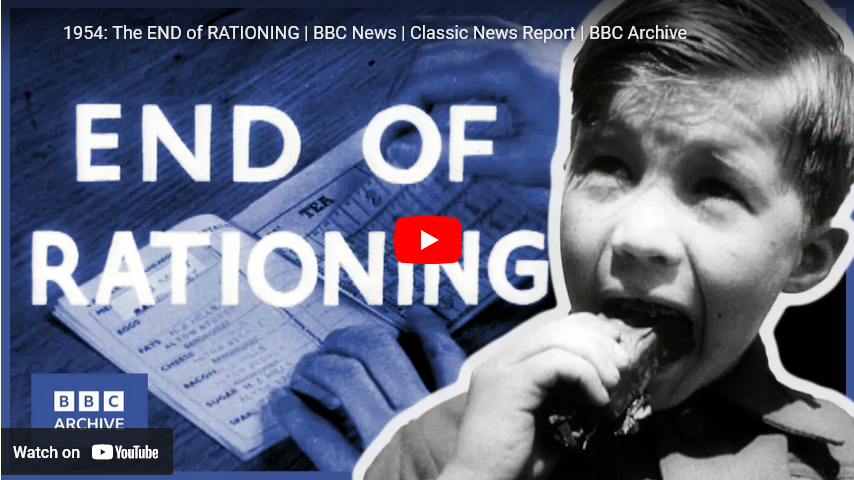
1954: The END of RATIONING
BBC Archive
Published 5 Mar 2023“The ration book has done its job. It’s been a long job. Indeed, children up to school-leaving age have never known life without the ration book.”
On the fourth of July, the rationing of meat in Britain came to an end, the final step in dismantling Britain’s whole wartime system of food distribution. After fourteen long years, Britons can at last tear up their ration books.
Richard Baker looks back at some of the key moments in the story of rationing and de-rationing.
Originally broadcast 5 July, 1954.
Comments Off on 1954: The END of RATIONING
June 7, 2023
German Counterattack – D-Day [Part 4]
World War Two
Published 6 Jun 2023When the amphibious landings begin, they run straight into Hitler’s Atlantic Wall. Eisenhower has predicted a third of his troops may fall. While they land, the news breaks across the world.
(more…)
Comments Off on German Counterattack – D-Day [Part 4]
Piercing the Atlantic Wall – D-Day [Part 3]
World War Two
Published 6 Jun 2023With wide gaps struck in the Atlantic Wall, it is now up to the Allies to secure the beachheads and move inland. There they will face off with new German defenses, and the Norman geography.
(more…)
Comments Off on Piercing the Atlantic Wall – D-Day [Part 3]
A Harbour goes to France – Mulberry Harbours – Normandy Landings
British Army Documentaries
Published 24 Jun 2020Mulberry harbours were temporary portable harbours developed by the United Kingdom during the Second World War to facilitate the rapid offloading of cargo onto beaches during the Allied invasion of Normandy in June 1944. After the Allies successfully held beachheads following D-Day, two prefabricated harbours were taken in sections across the English Channel from UK with the invading army and assembled off Omaha Beach (Mulberry “A”) and Gold Beach (Mulberry “B”).
(more…)
Comments Off on A Harbour goes to France – Mulberry Harbours – Normandy Landings
QotD: A “second front” in 1943
Which brings us to the debate about the possibility of an invasion in 1943 – Roundup. Something that a surprising number of historians, and even a few not entirely incompetent generals, have suggested might have been possible, and should have been tried.
There are some points in their favour. The invasions of North Africa definitely took resources that could have been built up in Britain, and therefore slowed things down. (And the withdrawal of the new escort carriers, escort groups, and shipping from the Battle of the Atlantic for the North African adventure, definitely did huge damage in the loss of shipping and supplies, slowing things down further.) As a result the huge buildup in North Africa was much easier to use against Italy before moving on to France. Certainly another distraction or delay … but only if you don’t think that knocking Italy out of the war would make Germany weaker!
But once Sledgehammer [the plan to invade France in 1942] was abandoned, this operation was the only possible way to get US troops into combat in Europe, short of shipping some to Russia. It was also the only possible way of coming close to keeping Roosevelt’s ridiculous promise to the Russians.
[…]
Nonetheless it is wrong to think that the British never had any intention of [mounting Operation] Roundup. Despite what Roosevelt and many other Americans convinced themselves, the British were, at the start of 1942, far more optimistic about the possibility of invading Europe through France in 1943 than they had been about Sledgehammer. Their studies seemed to show that Germany would only have to be weaker, not suddenly collapse, to make invasion in 1943 a realistic possibility. Realistic that is as long as the rest of the plans for training and shipping troops, building and concentrating invasion craft, and moving enough supplies to make it sustainable, all came together.
They didn’t.
For the British, the middle of 1942 revealed how little would be available in time for the middle of 1943. Even on the best assumptions of American training and preparation, there was no chance that the majority of forces for Roundup would not be British … assuming they could supply them either. In practice mid-1942 saw the Axis continue to advance on every front. Burma collapsed; the Allied position in New Guinea was under threat; the Japanese were still expanding to places like Guadalcanal; Rommel was advancing in Egypt; the Germans were advancing on the Caucasian oil fields and towards the Middle East; and more and more was needed just to keep Russia in the war. As a result British troops, shipping and supplies were continuing to flow away from Britain, not towards it.
Much of the Royal Navy was trying to save the dangerous losses caused by [US Chief of Naval Operations Admiral] King’s refusal to have convoys in American waters (too “defensive-minded” he thought.) These alone, the worst eight months of the war, were threatening to scupper Roundup. The rest was so busily deployed in the Indian and Pacific Oceans against the Japanese, or North Atlantic trying to fight supplies through to Russia (a high proportion of tanks and planes defending Moscow were British-supplied), that there was virtually nothing left in the Med to slow Rommel’s advance. The merchant ships surviving the fight across the oceans were actually more vitally needed to take men and equipment from the UK to other places than to bring in a buildup for the UK.
Nor was the American buildup going to plan. Less well-trained troops were becoming available too slowly, could not be shipped in adequate numbers anyway, and were in no condition to face German veterans. (The very best US units to go into action in 1942 – the Marines in Guadalcanal – and 1943 – the 1st Infantry and 1st Armored divisions which were actually professional troops not conscripts in North Africa – had very steep learning curves. Particularly at Kasserine. They were clearly not fit to face German veterans yet.
And American resource buildup was also not up to promises. King and MacArthur were milking supplies far beyond what had originally been agreed under “Germany first”. In practical terms they were doing so for the same reasons the British were: an immediate desperate situation had to be saved before a future ideal one could be pursued.
Nonetheless I have read all sorts of apparently serious suggestions that after North Africa was cleared, or at the very least after Sicily was cleared, an invasion of France should have happened.
Delusional.
Nigel Davies, “The ‘Invasion of France in 1943’ lunacy”, rethinking history, 2021-06-21.
Comments Off on QotD: A “second front” in 1943
June 6, 2023
Through The Gates of Hell – D-Day [Part 2]
World War Two
Published 6 Jun 2023When the amphibious landings begin, they run straight into Hitler’s Atlantic Wall. Eisenhower has predicted a third of his troops may fall. While they land, the news breaks across the world.
(more…)
Comments Off on Through The Gates of Hell – D-Day [Part 2]
Invasion by Air – D-Day [Part 1]
World War Two
Published 5 Jun 2023In the early hours it is up to the Allied airborne troops to secure the battlefield perimeter, and protect the operation. Now they will find out if the Germans have been deceived, or are ready and waiting with mortal force.
(more…)
Comments Off on Invasion by Air – D-Day [Part 1]
Juno Beach: The Fighting Canadians on D-Day | History Traveler Episode 194
The History Underground
Published 6 Feb 2022When one thinks about where the most violent fighting took place on D-Day, you wouldn’t be wrong in citing Omaha Beach where the highest number of casualties were inflicted. But as a percentage of the landing force, the Canadians on Juno Beach suffered more than any other Allied nation. In this episode, we’re joined by Paul Woodadge of @WW2TV to explore a few of the areas along Juno Beach where men to the 3rd Canadian Infantry Division landed on June 6th.
(more…)
Comments Off on Juno Beach: The Fighting Canadians on D-Day | History Traveler Episode 194
QotD: “A second front” in 1942
[…]
A plan put together for the incredibly unlikely event of sudden German collapse, was Sledgehammer. This was the understanding of Sledgehammer adopted by most Americans. A very limited offensive by very inadequate forces, which could only succeed had Germany already gone close to collapse. Given the circumstances this was somewhat delusional, but it never hurts to plan for eventualities, and the British were happy to go along with this sort of plan.
[…]
Any attempt at Sledgehammer would of course have failed. The German army had not yet been bled dry on the Eastern front, and the Luftwaffe was still a terrifying force which could be (and regularly was) easily moved from Russian mud to Mediterranean sunshine and back again in mere weeks. Even ignoring the opposition, the British were gloomily aware that the Americans had not a clue of the complexities of such a huge amphibious operation. At the time of discussion – May 1942 – the British were using their first ever Landing Ship Tanks and troopships equipped with landing craft to launch a brigade-size pre-emptive operation against the Vichy French on Madagascar. (Another move many historians think was useless. But coming only months after the Vichy had invited the Japanese into Indo-China – fatally undermining the defenses of Malaya – and the Germans into Syria, it was probably a very sensible precaution. Certainly Japanese submarines based in Madagascar [could] have finally caused the allies to lose the war at sea!)
The British deployed two modern aircraft carriers, and a fleet of battleships, cruisers, destroyers and escorts and a large number of support ships, on this relatively small operation. It was the first proper combined arms amphibious operation of the war, and was very helpful to the British to reveal the scale of amphibious transport needed for future operations. By contrast the US Marines hit Guadalcanal six months later from similar light landing craft, and with virtually the same Great War-vintage helmets and guns that the ANZACS had used at Gallipoli. Anyone who reads the details of the months of hanging on by the fingernails at Guadalcanal against very under-resourced Japanese troops, will be very grateful that the same troops did not have to face veteran German Panzer divisions for several years.
So I do not know of any serious historian who imagines that an invasion of France in 1942 could have led to anything except disaster. There are no serious generals who thought it either. (Only Marshall and his “yes-man” Eisenhower consistently argued that it might be possible. And Eisenhower later came to realise – when he was in charge of his third or fourth such difficult operation – that his boss was completely delusional in his underestimation of the difficulties involved. See Dear General: Eisenhower’s Wartime Letters to Marshall for Eisenhower’s belated attempts to quash Marshalls tactical ignorance about parachute drops and dispersed landings for D-Day.)
In practice no matter how much Marshall pushed for it, only British troops were availabe for such a sacrificial gesture, and the British were not unnaturally reluctant to throw away a dozen carefully nurtured and irreplaceable divisions on a “forlorn hope”, when they would prefer to save them for a real and practical invasion … when circumstances changed enough to make it possible.
Unfortunately Roosevelt told the Soviet foreign minister Molotov that “we expect the formation of a second front this year”, without asking even Marshall, let alone wihtout consulting his British allies who would have to do it with virtually no American involvement. The British Chiefs of Staff only had to show Churchill the limited numbers of landing craft that could be available, and the limited number of troops and tanks they could carry, to make it clear that this was ridiculous. Clearly this stupidity was just another example of Roosevelt saying stupid things without asking anyone (like “unconditional surrender”) that did so much to embitter staff relations during the war, and internationaly relations postwar. But it seems likely that the British refusal to even consider such nonsense was taken by Marshall and Stimson as a sample of the British being duplicitous about “examining planning options”.
The British fixed on a “compromise” to pretend that a “second front” could be possible. North Africa, could be conquered without prohibitive losses. It was not ideal, and in practical terms not even very useful. But it might satisfy the Americans and the Russians. Nothing else could.
Marshall in particular spent the rest of the war believing that when the British assessment clearly demonstrated that action in Europe was impractical and impossible, they had just been prevaricating to get what they always intended: operations in the Med. In some ways he was correct. The British had done the studies on France despite thinking that it was unlikely they would be practical, and were proved right. Marshall and Eisenhower had just deluded themselves into thinking an invasion might be practical, and could not accept that there was not a shred of evidence in favour of their delusion.
Nigel Davies, “The ‘Invasion of France in 1943’ lunacy”, rethinking history, 2021-06-21.
Comments Off on QotD: “A second front” in 1942
June 5, 2023
The Longest Day: 75 Things You Don’t Need to Know
A Million Movies
Published 6 Jun 2019In honor of the 75th anniversary of the D-Day invasion, I’m taking a look at my favorite D-Day movie … The Longest Day.
Also, unlike most of my other videos, there are some things in here I think you do need to know. Number one on that list is to hear some of the true stories of the men and women featured in this movie. They, along with hundreds of thousands of other heroes and heroines, saved the world.
Fair warning: My pronunciation of anything French is going to be amazingly bad. No disrespect intended.
Comments Off on The Longest Day: 75 Things You Don’t Need to Know


