
World War Two
Published 6 Jul 2023Until now Miklos Horthy’s Kingdom of Hungary has been a rare sanctuary where most Jews have lived in relative safety. That changes with the German occupation. Now Adolf Eichmann. the Nazis, and their Hungarian allies bring the Holocaust to Hungary.
(more…)
July 7, 2023
Nazis destroy last Jewish sanctuary – War Against Humanity 102
Comments Off on Nazis destroy last Jewish sanctuary – War Against Humanity 102
Prototype Silenced Sten for Paratroops: the Mk4(S)
Forgotten Weapons
Published 24 Mar 2023The Sten Mk4 was developed experimentally in 1943 for use by British paratroops. It used a remarkably awful folding stock along with a shortened receiver and barrel to make a very compact package — albeit one that must have been very uncomfortable to shoot. Several different models were made, with this one being a Mk4a(S) — the suppressed version. The suppressor is essentially the same system as used on the MkII(S), but with the rear endcap and barrel being permanently fixed to the receiver of the gun.
Only a small number (allegedly 2000) Mk4 guns were originally made, and they were used for testing only — never for field service. Virtually all were destroyed after the war, with a few remaining examples in British museums. This one was amnesty registered in 1968, and is almost certainly the only one in private hands in the US (and possible the only privately owned one in the world).
The Mk4 was dropped in favor of the Mk5, which was a much more effective gun and was used by the British paratroopers in the late days of World War Two.
(more…)
Comments Off on Prototype Silenced Sten for Paratroops: the Mk4(S)
QotD: Nazi Germany’s plans for Eastern Europe versus their actual implementation of those plans
… it’s easy to see what the evidence is (or would be): The well-documented awfulness of life under Stalin. There’s also plenty of evidence that the Wehrmacht certainly thought they’d be greeted as liberators, and while it’s hard to put too much weight on the anecdotes of individual soldiers and civilians (most recorded long after the fact), there seems to be a fair amount of evidence they actually were greeted as liberators …
… at least in some places, and at least initially. There’s a second inference here: “the exigencies of war led Germany to behave tactfully”. Here’s where our initial ground rules of evidence become extremely important. Those anecdotal reports of civilian / military interaction, above: What weight do we assign those? And why?
If I’m arguing for the “greeted as liberators” theory, I can use all those recollections of cordial civilian / military interaction. But I need to be consistent: If I say “You can trust those, even though they’re personal memories written down long after the fact, because XYZ”; then I can’t turn around and dismiss contrary evidence of the same type: “All those reports of brutality are just personal memories written down long after the fact.” That’s one of the ways you catch a propagandist: they constantly conflate the two.
Fortunately, in this case we’re dealing with two totally ideologized societies. Even better, one of those totally ideologized societies was German, with their well-documented love of paperwork. All armies generate scads of paperwork, and an ideologized army’s paperwork is full of ideology. So: How does the Army of Occupation’s paperwork tell the tale? That should give us some clues as to their future plans — obviously the occupiers would need to be part of it — and some insight as to the day-to-day.
As it turns out, the second part of your inference — “the exigencies of war led Germany to behave tactfully” — is false. We’ve got the paperwork on it, starting with the infamous “Commissar Order” and working down. Ideology trumps exigency. It seems clear from Wehrmacht paperwork that so long as military efficiency was maintained, you could do pretty much whatever you wanted out there.
[Interestingly, in a bit of meta-irony, the Wikipedia “thumbnail” — the little box you get on the side of the search results page — says of the Commissar Order: “Nazi conspiracy-enforcing unit of the Nazi military.” [Sic], of course — they really want you to know these guys were Nazis. Also, what’s a “conspiracy-enforcing unit”? One imagines a Q-tard goon squad, beating up people whose faith in the God-Emperor is wavering. Finally, it wasn’t a “conspiracy” — they were right out in the open with it. We’ve got lots of copies of the Commissar Order, because it was read out to the troops before the invasion. ALL the troops].1
That segues into the “Organizational Darwinism” thing. The paperwork shows us that “the Nazis” really did have grandiose plans for settling a whole bunch of Germans in the depopulated East. They even got a pilot program underway, as I recall — a whole bunch of ethnic Germans from Bohemia or someplace getting stuck in a transit camp in eastern Poland, or even Ukraine. But notice I put “the Nazis” in quotation marks. The guys with the grandiose plans were RuSHA, the Main Race and Settlement Office. And not even all of them: It was the fourth department, “Settlement”, inside RuSHA. And RuSHA was inside the SS, which was inside — but also outside, over, under, around, and through — the rest of the Nazis’ plate-of-spaghetti org chart.
And it’s actually way more complicated than that, because of course it is — these are the Nazis we’re talking about. I’m not going to dive into the details (not least because it all makes my head hurt), but if you were an ethnic German who wanted to get resettled in Ukraine for some reason — and this is all mostly theoretical, I hasten to add, very few actually moved so far as I know — you’d have to deal with a bewildering array of bizarrely-acronymed organizations. RuSHA, VOMI, the Generalgovernment (Occupied Poland), the SS (in general; over and above RuSHA), the army, the whole bewildering array of groups represented in Generalplan Ost, which was a “plan” in much the same way the “Holy Roman Empire” was holy, Roman, and an empire. Various Party goons would want to get their beaks wet, as would the Gestapo (hell yes they want to know if people are moving around the Reich, especially towards the front on military railroads), and so on.
As weird as this sounds, all this elaborate mishmash of ass-pulled “organization” was by largely by design. For one thing, it diffuses responsibility for really nasty shit — when it comes to certain events on the Eastern Front, even scrupulously neutral historians are often reduced to Ilhan Omar’s level: some people did some things. Who gave what order? Who was he reporting to? And in what capacity? Insufficient data.
Severian, “Organizational Darwinism”, Founding Questions, 2023-01-30.
1. Side note: Ideology really increases military efficiency, up to a point. Recalling that I’m not even an armchair general, it seems like the American military is really missing a trick there. Imagine what the Americans could’ve done in Vietnam if their regular forces had been better indoctrinated, instead of punting military-civilian relations off to CORDS. Properly indoctrinated, I mean, with an ideology that kinda sorta makes sense and is internally consistent and at least somewhat intersects with the real world. “Spreading democracy” would work ok, if they actually ideologized the ranks (instead of having the PR guys just parrot it to the cameras). The AINO military is of course fully indoctrinated, but see above: we’re talking combat efficiency here, not butt stuff.
Comments Off on QotD: Nazi Germany’s plans for Eastern Europe versus their actual implementation of those plans
July 2, 2023
Allies Liberate Cherbourg – WW2 – Week 253 – July 1, 1944
World War Two
Published 1 Jul 2023Several weeks after the invasion of Normandy began, the Allies finally take a port city there, though the actual harbor has been destroyed. On Saipan the Americans have the advantage, in Finland, the Soviets do, but the big news is the Soviet destruction of huge chunks of German Army Group Center, demolishing entire Army Corps, and surrounding tens of thousands of the enemy.
(more…)
Comments Off on Allies Liberate Cherbourg – WW2 – Week 253 – July 1, 1944
Tank Chats #170 | Sd. Kfz. 251 | The Tank Museum
The Tank Museum
Published 31 Mar 2023Curator David Willey is back with another Tank Chat. This time, he will be discussing the Sonderkraftfahrzeug 251, which is more commonly referred to as the Sd.Kfz. 251.
(more…)
Comments Off on Tank Chats #170 | Sd. Kfz. 251 | The Tank Museum
June 29, 2023
The End of Nazi Intelligence in 1944 – WW2 Documentary Special
World War Two
Published 27 Jun 2023After years of undermining the Nazi regime and aiding the resistance, Abwehr Chief Wilhelm Canaris finally loses his battle with Heinrich Himmler and the SS. The Abwehr Trojan Horse is no more, and German intelligence is at death’s door at the most crucial moment.
(more…)
Comments Off on The End of Nazi Intelligence in 1944 – WW2 Documentary Special
June 28, 2023
How to Fund a War: Lend Lease, Billion Dollar Gift, and Aid to Britain
OTD Military History
Published 27 Jun 2023Programs like Lend Lease, Mutual Aid, and the Billion Dollar Gift were support from Canada and the United States that helped Britain with war supplies and material in the darkest days of World War 2.
(more…)
Comments Off on How to Fund a War: Lend Lease, Billion Dollar Gift, and Aid to Britain
June 27, 2023
Uncancelled History with Douglas Murray | EP. 05 Winston Churchill
Nebulous Media
Published 20 Dec 2022Andrew Roberts joins Douglas Murray on this episode to discuss Winston Churchill. The two discuss the soldier, writer and prime minister in detail, leaving nothing off limits. Should the British Bulldog stay cancelled?
(more…)
Comments Off on Uncancelled History with Douglas Murray | EP. 05 Winston Churchill
June 26, 2023
DShK-38: The Soviet Monster .50 Cal HMG
Forgotten Weapons
Published 10 Mar 2023In 1925 the USSR began a program to develop a heavy machine gun for antiaircraft use. After some initial experimentation with a converted Dreyse machine gun, they brought in Degtyarev to scale up his recently-adopted light machine gun to the task. Degtyarev’s first design was ready in 1930, and underwent testing until 1933. It was designated the DK, and used a 30-round drum magazine. This contributed to an unacceptably low rate of fire (~360 rpm), and the feed system was replaced by an ingenious development of Georgiy Shpagin to use belts instead.
Fitted with the Shpagin feed system, the DShK finished field testing in 1939 and was adopted as the model 1938. Production was slow, and the guns were not used on anything like the scale of American M2 use during World War Two. A total of about 9000 were in use at the end of the war, although the subsequent update to the DshKM (aka DShK 38/46) pattern would see it fitted to many armored vehicles, and total production eventually topped one million.
This example is a very early production 1939 example, most likely a Finnish capture piece from the Winter War or Continuation War.
(more…)
Comments Off on DShK-38: The Soviet Monster .50 Cal HMG
June 25, 2023
The Greatest Pincer Movement in Military History – WW2 – Week 252 – June 24, 1944
World War Two
Published 24 Jun 2023The Red Army surges forward in Operation Bagration, a mighty new offensive to destroy German Army Group Centre. Fighting continues in Normandy, Italy, and Finland. The United States Navy tears the heart out of the Imperial Japanese Navy in the Philippine Sea even as the Imperial Japanese Army has success in China. The British and Indian armies lift the siege of Kohima.
(more…)
Comments Off on The Greatest Pincer Movement in Military History – WW2 – Week 252 – June 24, 1944
June 23, 2023
The Combat Engineers of D-Day – WW2 Special Documentary
World War Two
Published 22 Jun 2023How do you blast through the obstacles and minefields on the beaches of Normandy? How do you get thousands of tonnes of tanks, guns, and men into the fight? And what about reopening the shattered French ports? You need men who are as skilled in construction as they are destruction. You need the engineers.
(more…)
Comments Off on The Combat Engineers of D-Day – WW2 Special Documentary
From Operation Barbarossa in 1941 to the disinformation and cover-up over the origins of the Wuhan Coronavirus
Chris Bray outlines the utterly amazing situation between the Soviet Union and Nazi Germany on the eve of Hitler launching Operation Barbarossa — where Stalin refused to believe that Hitler would attack Russia despite overwhelming evidence from many sources — to the parallel situation over Covid:
Several sources quite specifically reported to the Soviet government that the Germans would invade around dawn on June 22. Their reports can be found in the Soviet archives in a “folder of dubious and misleading reports”. Then, shortly before dawn on June 22, Germany invaded the Soviet Union. Military leaders on the border called in reports of the invasion, and the people they talked to in Moscow declined to believe them. Soviet border troops held their fire, seeing Germans while being ordered to understand that no true invasion could possibly be underway. Stalin knew better, and contradicting Josef Stalin was known to be a fatal mistake. Achieving an entirely avoidable surprise, the Germans destroyed much of the Soviet air force on the ground, parked wingtip-to-wingtip for the convenience of the invader’s bombers.
[…]
An invasion that could have been met with brutal severity from the first moment instead achieved considerable initial success against a supine nation because the Soviet leader, and the chain of subordinates beneath him who were forced to adopt his conception of facts and truth, assumed that things they didn’t wish to believe constituted disinformation. Millions of lives were wasted for that illusion. A society that categorizes inconvenient truths in this way is committing a form of suicide, hiding from hard facts that demand acknowledgment.
Now: In 2021, the lab leak theory was a disgusting lie with “racist roots”.
In June of 2023, the, uh, first people who got sick with Covid turn out to have been, uh, scientists at the lab in Wuhan. BUT THEY PROBABLY HAD SOME BAT SOUP AT THE WET MARKET, IS WHY, or something.
Stupid conspiracy theorists, you people are such MORONS, do you actually bel— okay, that one’s true too.
We’ve somehow developed an industry of professional information barriers, dimwitted parasitical human garbage whose sole function in life is to prevent understanding by pasting “disinformation” stickers on things that you’re not supposed to know.

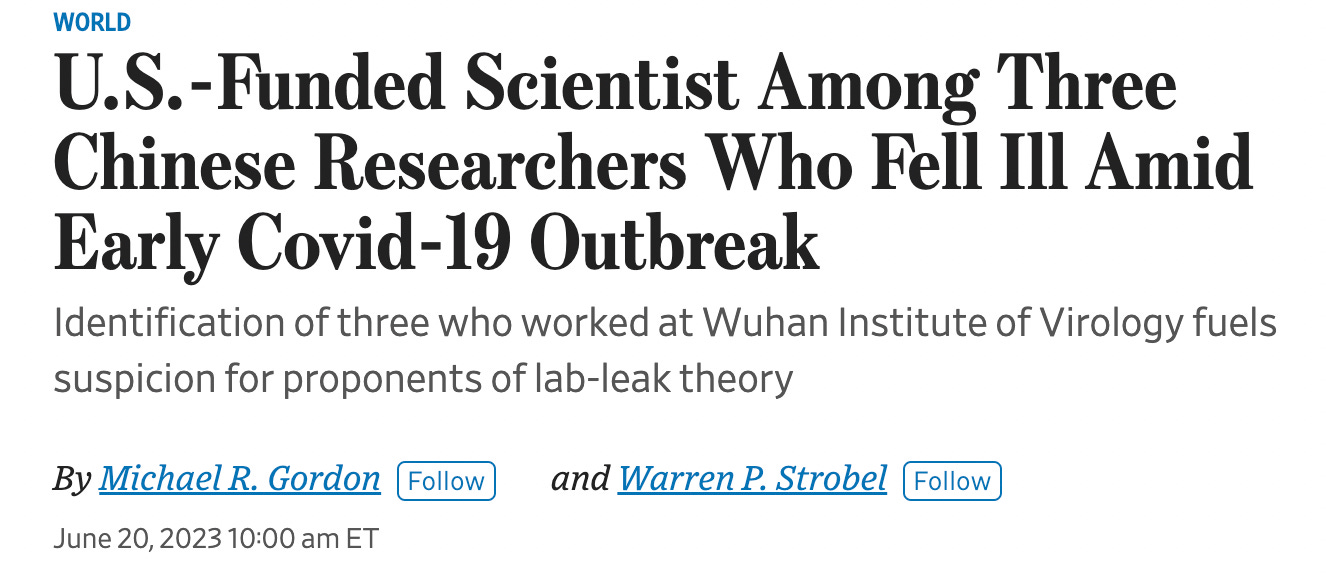
Comments Off on From Operation Barbarossa in 1941 to the disinformation and cover-up over the origins of the Wuhan Coronavirus
FG-42: Perhaps the Most Impressive WW2 Shoulder Rifle
Forgotten Weapons
Published 8 Mar 2023The first production version of the FG42 used a fantastically complex milled receiver and a distinctive sharply swept-back pistol grip. A contract to make 5,000 of them was awarded to Krieghoff in late spring of 1943, but by the fall its replacement was already well into development. The milled receiver used a lot of high-nickel steel which was becoming difficult for Germany to acquire, and it was decided to develop a stamped receiver to ease production obstacles. Ultimately only about 2,000 of the early Type E FG42 rifles were actually made, and only 12 or 15 are registered in the US. They are a remarkably advanced rifle, and extremely interesting.
(more…)
Comments Off on FG-42: Perhaps the Most Impressive WW2 Shoulder Rifle
June 18, 2023
Titanic Clash Looms In Pacific – WW2 – Week 251 – June 17, 1944
World War Two
Published 17 Jun 2023Japanese and American navies are heading for a showdown in the Philippine Sea, even as American forces land on Saipan in the Marianas in force. The Japanese have Changsha under siege in China, the Allies advance in both Normandy and Italy, the Soviets advance in Finland, and the massive Soviet summer operation is coming together and will begin in a matter of days.
(more…)
Comments Off on Titanic Clash Looms In Pacific – WW2 – Week 251 – June 17, 1944
June 17, 2023
Why Rommel Lost the Battle for North Africa
Real Time History
Published 16 Jun 2023The North African campaign of WW2 is one of the most famous ones. The almost mythical story of the British “Desert Rats” defeating Erwin Rommel’s Afrika Korps. But why did Rommel lose in North Africa?
(more…)


