
The Tank Museum
Published Mar 16, 2024This is the story of the evolution of the tank during World War One. Notorious for its appalling human cost, the First World War was fought using the latest technology – and the tank was invented to overcome the brutally unique conditions of this conflict.
Arriving at the mid-point of the war, they would be built and used by the British Commonwealth, French and German armies – with the US Army using both British and French designs.
00:00 | Intro
01:17 | The Beginnings of WWI
02:13 | The Solution to Trench Warfare
03:47 | Initial Ideas
05:42 | How to Cross a Trench
08:08 | How Effective was the Tank?
15:40 | Battlefield Upgrades
17:09 | New Designs
24:32 | ConclusionThis video features archive footage courtesy of British Pathé.
#tankmuseum #evolution #tank #tanks #ww1 #technology
July 4, 2024
How the First Tanks CONQUERED the Trenches
June 26, 2024
Lord Balfour
Arthur Lord Balfour, Conservative Prime Minister from 1902 to 1905, is perhaps best known for the Balfour Declaration issued during World War 1 that established the formal goal of an independent homeland for the Jews in the Holy Land. Who was he? Barbara Kay’s essay originally published in the Dorchester Review was recently reposted at Woke Watch Canada:
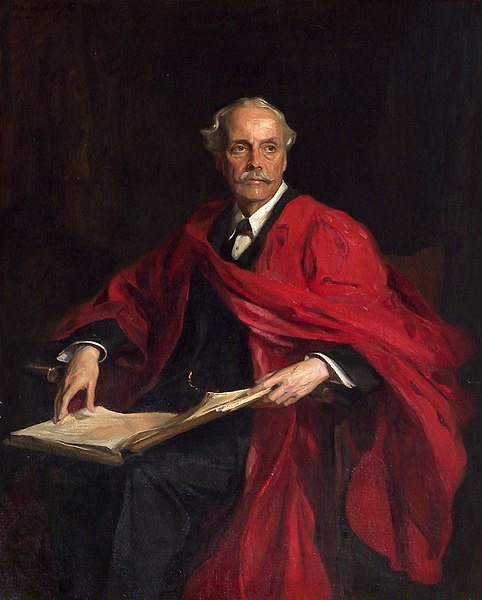
“Arthur James Balfour, 1st Earl of Balfour, KG, OM, PC, Prime Minister and Philosopher” portrait in oil by Philip de László, 1914.
From the Trinity College collection via Wikimedia Commons.
Why was the aristocrat Lord Balfour, the social antithesis of this humble Jew from the Pale of Russia, so taken with Weizmann’s vision that he was willing to expend political capital and exert so much effort to see it realized? Who was Balfour? What was he?
Arthur James Balfour was born at his family seat, Whittingehame, in East Lothian, the “granary of Scotland”. A forebear had made a fortune in India in military materials, so he was financially secure for life, and socially connected at the highest levels.
Having lost his father when he was 7, Balfour was lucky in his mother, a strong-willed and educated woman who, according to Mrs Dugdale, inculcated the idea of duty as “the uncompromising foundation of his character”. He attended Eton and Cambridge, where he was described by a friend as “a man of unusual philosophy and metaphysics”, who could hold his own with the Dons (professors), “some of them men of undoubted genius”. He was devoted to his extended family, and much beloved by his nieces and nephews.
In his essay “Arthur Balfour: a Fatal Charm”1 cultural critic Ferdinand Mount cites “nonchalance” as Balfour’s defining trait. Legendarily indolent, he rarely rose before 11 a.m., claimed never to read newspapers, and disdained the ritual schmoozing of fellow backbenchers expected by his peers in the Members’ Smoking Room. Mount says he was “indifferent to what his colleagues, the public or posterity thought of him or his policies”.
This loftiness — echoed in his unusual physical height — was perceived as admirable or maddening according to the observer and circumstances. Churchill said of him: “He was quite fearless. When they took him to the Front to see the war, he admired the bursting shells blandly through his pince-nez. There was in fact no way of getting to him.”
His self-sufficiency was no act. Sports-mad, he skipped lunch with the Kaiser to watch the Eton and Harrow cricket match, and when in Scotland might play two full rounds of golf a day (his handicap of 10 was better than P. G. Wodehouse and about the same as thriller writer Ian Fleming’s).
Balfour sounds from my description so far as if he was something of a playboy, but that is a very partial portrait. He was also known as “Bloody Balfour” for his readiness to endorse police action and his apparent indifference to their cost.
The Irish loathed him. In 1887 he became personal secretary for Ireland under his uncle, Lord Salisbury, just in time to enforce the Coercion Act against the volatile Irish Land League. Indeed, Balfour’s parliamentary critic William O’Brien saw him as a man who harboured a “lust for slaughter with a eunuchized imagination” who took “a strange pleasure in mere purposeless human suffering, which imparted a delicious excitement to his languid life”.
One hopes this accusation of actual sadism is an exaggeration of Balfour’s indubitable detachment. Yet indifference to human life is certainly not an uncommon charge laid against intellectuals for whom ideas loom larger in their claims to attention than the fate of those beyond their particular tribes.
For balance, we have Barbara Tuchman’s assessment:
Balfour had a capacious and philosophical mind. Words to describe him by contemporaries are often “charm” and “cynicism”. He had a profound and philosophic mind, he was lazy, imperturbable in any fracas, shunned detail, left facts to subordinates, played tennis whenever possible, but pursued his principles of statecraft with every art of politics under the command of a superb intelligence.
Fortunately for his temperament, Balfour’s life circumstances had landed him at the centre of a genuinely intellectual circle. His brothers in-law, for example, were Lord Rayleigh, who became head of the Cambridge Laboratory and won the Nobel Prize for Physics, and Henry Sidgwick, the Cambridge philosopher who with his wife Elaine Balfour founded Newnham College.
Politically, Balfour enjoyed both dramatic success and dramatic failure. He led the Unionist Party longer than anyone before him since Pitt the Younger. And he was a minister longer than anyone else in the 20th century, including Winston Churchill. Balfour was the only Unionist who was invited to join Asquith’s first war cabinet, and continued as foreign secretary after the coup that brought Lloyd George to power.
As Churchill put it: “He passed from one cabinet to the other, from the prime minister who was his champion to the prime minister who had been his most severe critic, like a powerful, graceful cat walking delicately and unsoiled across a rather muddy street”.
One of Balfour’s teachers at Eton described him as “fearless, resolved and negligently great”. On the other hand, Mount tells us, “indecisiveness” was his bane. He would stand paralyzed in the mezzanine of his London home agonizing over which of the matching staircases to descend by. He could love — the great love of his life died after an unreasonably long engagement — but, allegedly too staggered by the loss of his almost-fiancée, he never married.2 He could not be pinned down politically on many issues, a matter of great frustration to his colleagues, and this cost him dearly. As Mount notes, his charm was indisputable, “but more than charm he would not give” and “in the end, the charm is all that remains.”
Balfour fought three general elections as party leader and lost them all. His premiership lasted less than four years and ended in a Liberal landslide in 2006, a great electoral humiliation in making him the only prime minister in the 20th century to lose his own seat. He did not seem greatly to repine at the rejection, though, and it is thanks to the loss that he had time to further his education on the Zionist movement.
1. Mount, Ferdinand, English Voices (2016), pp 358 ff.
2. One suspects that even if May Lyttleton had lived, Balfour would have avoided marrying her on some pretext or other. There is no evidence that Balfour was a closeted homosexual, but he may have been asexual. He enjoyed an “amitié amoureuse” with (married) Mary Elcho for 30 years involving little or nothing in the way of sex, after which she wrote to him, “I’ll give you this much, tho, for although you have only loved me little, yet I must admit you have loved me long”.
June 9, 2024
Men In Armour (1949) – The origins and operation of tanks
FWD Publishing
Published Feb 18, 2024Lengthy documentary made in 1949 about the men and tanks of the Royal Armoured Corps (RAC).
June 6, 2024
QotD: Herbert Hoover as Woodrow Wilson’s “Food Dictator”
In 1917, America enters World War I. Hoover […] returns to the US a war hero. The New York Times proclaims Hoover’s CRB work “the greatest American achievement of the last two years”. There is talk that he should run for President. Instead, he goes to Washington and tells President Woodrow Wilson he is at his service.
Wilson is working on the greatest mobilization in American history. He realizes one of the US’ most important roles will be breadbasket for the Allied Powers, and names Hoover “food commissioner”, in charge of ensuring that there is enough food to support the troops, the home front, and the other Allies. His powers are absurdly vast – he can do anything at all related to the nation’s food supply, from fixing prices to confiscating shipments from telling families what to eat. The press affectionately dubs him “Food Dictator” (I assume today they would use “Food Czar”, but this is 1917 and it is Too Soon).
Hoover displays the same manic energy he showed in Belgium. His public relations blitz telling families to save food is so successful that the word “Hooverize” enters the language, meaning to ration or consume efficiently. But it turns out none of this is necessary. Hoover improves food production and distribution efficiency so much that no rationing is needed, America has lots of food to export to Europe, and his rationing agency makes an eight-digit profit selling all the extra food it has.
By 1918, Europe is in ruins. The warring powers have declared an Armistice, but their people are starving, and winter is coming on fast. Also, Herbert Hoover has so much food that he has to swim through amber waves of grain to get to work every morning. Mountains of uneaten pork bellies are starting to blot out the sky. Maybe one of these problems can solve the other? President Wilson dispatches Hoover to Europe as “special representative for relief and economic rehabilitation”. Hoover rises to the challenge:
Hoover accepted the assignment with the usual claim that he had no interest in the job, simultaneously seeking for himself the broadest possible mandate and absolute control. The broad mandate, he said, was essential, because he could not hope to deliver food without refurnishing Europe’s broken finance, trade, communications, and transportation systems …
Hoover had a hundred ships filled with food bound for neutral and newly liberated parts of the Continent before the peace conferences were even underway. He formalized his power in January 1919 by drafting for Wilson a post facto executive order authorizing the creation of the American Relief Administration (ARA), with Hoover as its executive director, authorized to feed Europe by practically any means he deemed necessary. He addressed the order to himself and passed it to the president for his signature …
The actual delivery of relief was ingeniously improvised. Only Hoover, with his keen grasp of the mechanics of civilization, could have made the logistics of rehabilitating a war-ravaged continent look easy. He arranged to extend the tours of thousands of US Army officers already on the scene and deployed them as ARA agents in 32 different countries. Finding Europe’s telegraph and telephone services a shambles, he used US Navy vessels and Army Signal Corps employees to devise the best-functioning and most secure wireless system on the continent. Needing transportation, Hoover took charge of ports and canals and rebuilt railroads in Central and Eastern Europe. The ARA was for a time the only agency that could reliably arrange shipping between nations …
The New York Times said it was only apparent in retrospect how much power Hoover wielded during the peace talks. “He has been the nearest approach Europe has had to a dictator since Napoleon.”
Once again, Hoover faces not only the inherent challenge of feeding millions, but opposition from the national governments he is trying to serve. Britain and France plan to let Germany starve, hoping this will decrease its bargaining power at Versailles. They ban Hoover from transporting any food to the defeated Central Powers. Hoover, “in a series of transactions so byzantine it was impossible for outsiders to see exactly what he was up to”, causes some kind of absurd logistics chain that results in 42% of the food getting to Germany in untraceable ways.
He is less able to stop the European powers’ controlled implosion at Versailles. He believes 100% in Woodrow Wilson’s vision of a fair peace treaty with no reparations for Germany and a League Of Nations powerful enough to prevent any future wars. But Wilson and Hoover famously fail. Hoover predicts a second World War in five years (later he lowers his estimate to “thirty days”), but takes comfort in what he has been able to accomplish thus far.
He returns to the US as some sort of super-double-war-hero. He is credited with saving tens of millions of lives, keeping Europe from fraying apart, and preventing the spread of Communism. He is not just a saint but a magician, accomplishing feats of logistics that everyone believed impossible. John Maynard Keynes:
Never was a nobler work of disinterested goodwill carried through with more tenacy and sincerity and skill, and with less thanks either asked or given. The ungrateful Governments of Europe owe much more to the statesmanship and insight of Mr. Hoover and his band of American workers than they have yet appreciated or will ever acknowledge. It was their efforts … often acting in the teeth of European obstruction, which not only saved an immense amount of human suffering, but averted a widespread breakdown of the European system.
Scott Alexander, “Book Review: Hoover”, Slate Star Codex, 2020-03-17.
June 4, 2024
Snipers in World War 1
The Great War
Published Feb 9, 2024In fall 1914, the British and French armies on the First World War’s Western Front were wrestling with a problem: unseen German riflemen were picking off any man who showed himself above the trench. Something had to be done about it – and the result was the birth of the modern sniper.
(more…)
June 1, 2024
I plead the Pith: a History of the Pith Helmet
HatHistorian
Published Jun 1, 2022A symbol of exploration, tropical adventure, and colonialism, the pith helmet has had a long history since its origins as the salakot, a Philippine sun hat. Through many iterations, it had become one of the most famous hats out there, a powerful part of popular imagination.
The helmets I wear in this video come respectively from a gift from a family friend (so I don’t know where it was bought, https://www.historicalemporium.com/, and Amazon.com. The red tunic comes from thehistorybunker.co.uk
Title sequence designed by Alexandre Mahler
am.design@live.comThis video was done for entertainment and educational purposes. No copyright infringement of any sort was intended.
May 9, 2024
How the First World War Created the Middle East Conflicts
The Great War
Published Dec 8, 2023The modern Middle East is a region troubled by war, terrorism, weak and failed states, and civil unrest. But how did it get this way? The map of today’s Middle East was mostly drawn after the First World War, and the war that planted many of the seeds of conflict that still plague Israel, Palestine, Iraq, Syria and even Iran today.
(more…)
April 17, 2024
French M14 Conversion – the Gras in 8mm Lebel
Forgotten Weapons
Published May 16, 2016The French adopted the Gras as their first mass-issued metallic cartridge rifle in 1874, replacing the needlefire 1866 Chassepot. Quite a lot of Gras rifles were manufactured, and they became a second-line rifle when the 1886 Lebel was introduced with brand-new smokeless powder and its smallbore 8mm projectile. When it became clear that the quick and decisive war against Germany was truly turning into the Great War, France began looking for ways to increase the number of modern Lebel rifles it could supply to the front.
One option that was used was to take Gras rifles from inventory and rebarrel them for the 8mm Lebel cartridge (which was based on the Gras casehead anyway). These could be issued to troops who didn’t really need a top-of-the-line rifle (like artillery crews, train and prison guards, etc). Then the Lebel rifles from those troops could be redirected to the front.
The rebarreling process was done by a number of contractors, using Lebel barrels already in mass production. The 11mm barrel from the Gras would be removed, and only the front 6 inches (150mm) or so kept. A Lebel barrel and rear sight would be mounted on the Gras receiver, and that front 6 inches of Gras barrel bored out to fit tightly over the muzzle of the new 8mm barrel. This allowed the original stock and nosecap to be used (the 8mm barrel being substantially smaller in diameter, and not fitting the stock and hardware by itself). It also allowed the original Gras bayonet to be fitted without modification, since the bayonet lug was also on that retained section of barrel. In addition, a short wooden handguard was fitted. This was designated the modification of 1914, and an “M14” was stamped on the receivers to note it.
These guns are of dubious safety to shoot, since the retain the single locking lug of the Gras, designed for only black powder pressures. However, this was deemed safe enough for the small amount of actual shooting they were expected to do.
February 29, 2024
Hotchkiss Portative: Clunky But Durable
Forgotten Weapons
Published Nov 27, 2023The Portative was an attempt by the Hotchkiss company to make a light machine gun companion to their heavy model (which had found significant commercial success). The Portative used the same feed strips, albeit loaded upside down, and the same gas piston operation, but a very different locking system. Instead of a tilting locking block the Portative had a “fermeture nut” that rotated to lock onto the bolt with three sets of interrupted thread locking lugs. In addition, many of the traditionally internal parts were mounted externally on the Portative, and it was quite the awkward gun to use.
The Portative was adopted by the American Army as the Model 1909 Benet-Mercié, and by the British early in World War One as a cavalry and tank-mounted gun. The remainder of Portative contracts were relatively small from second-tier military forces, including several South American countries.
(more…)
February 28, 2024
Why Germany Lost the First World War
The Great War
Published Nov 10, 2023Germany’s defeat in the First World War has been blamed on all kinds of factors or has even been denied outright as part of the “stab in the back” myth. But why did Germany actually lose?
(more…)
February 21, 2024
Can you make a tank disappear? The Evolution of Tank Camouflage
The Tank Museum
Published Nov 17, 2023It’s not easy to hide a tank. But over the years, military commanders have developed ways to disguise, cover and conceal the presence of their tanks from the enemy. This video is about the “art of deception” – and how, since World War One, through World War Two and into the present day, the science of tank camouflage has evolved to meet the conditions and threats of the contemporary battlefield.
00:00 | Intro
01:38 | WWI
06:26 | WW2
13:42 | Post War
19:40 | Conclusion
(more…)
February 8, 2024
Beretta 1915: The first of the Beretta pistols
Forgotten Weapons
Published Jun 22, 2016The Italian military went into WWI having already adopted a semiautomatic sidearm — the Model 1910 Glisenti (and its somewhat simplified Brixia cousin). However, the 1910 Glisenti was a very complex design, and much too expensive to be practical for the needs of the global cataclysm that was the Great War. In response to a need for something cheaper, Tulio Marengoni of the Beretta company designed the Model 1915, a simple blowback handgun chambered for the 9mm Glisenti cartridge.
Only 15,300 of the Model 1915 pistol were made, because even they proved to be a bit more than the military really needed. One of their most interesting mechanical features is a pair of manual safeties — one on the back of the frame to lock the hammer and one on the left side to block the trigger. This proved a bit redundant, and the gun overall was rather large and heavy. In 1917 a scaled-down version in .32 ACP (7.65mm) was introduced which would be produced in much larger numbers. The 1915/17 would also omit the rather unnecessary hammer safety.
It is important to note that while the 9mm Glisenti cartridge is dimensionally interchangeable with 9×19 Parabellum, pistols designed for the Glisenti cartridge should never be used with standard 9×19 ammunition, as it is nearly 50% more powerful than the Glisenti specs, and doing so will quickly cause damage (and potentially catastrophic failure).
February 2, 2024
The Sad Story of Churchill’s Iceman, Geoffrey Pyke
World War Two
Published Jan 31, 2024Geoffrey Pyke is remembered as an eccentric scientist who spewed out ideas like giant aircraft carriers made of icy Pykerete. But there was much more to him than that. He was a spy, a special operations mastermind, and his novel ideas contributed to the success of D-Day.
(more…)
January 6, 2024
Inside Mark I: The First Fighting Tank
The Tank Museum
Published 15 Sept 2023The first ever use of the tank in battle happened during the Battle of the Somme in 1916. In this video we look inside a unique survivor – the last British Mark I Heavy Tank in existence and examine the first tank action at Flers, an event that changed the face of warfare.
(more…)
January 1, 2024
Michael Palin’s Great-Uncle Harry
In The Critic, Peter Caddick-Adams reviews Michael Palin’s Great-Uncle Harry:
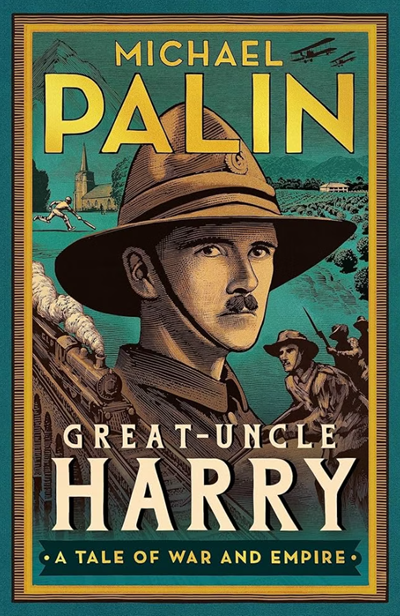
The first of last week’s volumes nestling on my desk, with its immediately identifiable Ripping Yarns cover illustration, was Sir Michael Palin’s story of his forebear, Great Uncle Harry, who travelled the world but disappeared on the Somme. Here, I felt an immediate connection, not least because Michael, I and his Great Uncle Harry Palin had hauled ourselves through the same academy of learning, Shrewsbury School, though at different times. There are plenty of 1914-18 memoirs and tributes around, but this is one of the best. The further the Great War (as it used to be called) recedes, the more we seem to need to torture ourselves with the staggering sacrifices it involved. I read my copy over Remembrance weekend, which made it doubly poignant.
In Great Uncle Harry, Palin’s gift is to give us the hinterland of his ancestor. Many First World War authors, here I could mention the great Lyn Macdonald, Richard Holmes and Martin Middlebrook, all of whom I place on pedestals, provide us with erudite studies, laced with gripping eyewitness accounts. I find myself doing the same with 1939-45, but of necessity there is no room to give the brave and the damned a back story. They are parachuted into the text. They fight and live or die and exit stage left. It is refreshing, therefore, to hold the hand of a first war warrior from birth unto death. Palin was lucky his Great Uncle Harry kept a series of notebooks and diaries of his time in khaki, and was able to research his globe-trotting years before battle. Our man was brought up in Herefordshire, and after school drifted out to British India. He had two stints, first working as a railway manager and latterly as overseer on tea plantations. The reader is fortunate that Palin the documentary-maker filmed in both environments and is able to look over his forebear’s shoulder and summon up the Edwardian social standards of the day, with its solar topees and chota pegs (sunset whiskeys), its heat and its dust. Palin the younger’s many diaries and written travelogues, of which I find New Europe (2007) the best, are equally good.
But Great Uncle Harry Palin was restless. The youngest and most headstrong of seven, he flounced out of each of his two jobs serving the Raj, and ended up trying his hand at farming in New Zealand. There he seemed more settled, but not quite. The Palin under the microscope, notes his great nephew, was one of the first to volunteer for war service with the 12th (Nelson) Regiment, a South Island infantry outfit, in August 1914 and sailed with them overseas, initially to Egypt. There they were absorbed into the Canterbury Battalion, and deployed to Gallipoli, from which Great Uncle Harry emerged without a scratch.
Gallipoli is a conjurer’s name. Now known by the Turks as their Gelibolu Peninsula, overlooking the ancient Hellespont (today’s Dardanelles Strait), its southern tip lies 200 miles from what was then Turkey’s capital, Constantinople, officially Istanbul after 1930. Only since the 1990s has this strategically significant sliver of land, across the Dardanelles from ancient Troy, and guarding entry to the Bosphorus and Black Sea, been opened up for tourists. The 1915 operation was dreamt up by Winston Churchill to break the stalemate of the Western Front. He advocated a naval advance on Constantinople, as a way of knocking the Austro-German alliance out of the war. Such a stratagem would then have offered Paris and London the ability to supply the troops of Tsar Nicholas the Last with modern arms and munitions to prevail against the Central Powers.
Instead of breaking the Western Front, Gallipoli broke Churchill. It was a campaign endlessly refought in the inter-war years, which generally concluded that amphibious warfare had no future, though Lieutenant Colonel George S. Patton in his 1936 General Staff study, The Defense of Gallipoli, found it fascinating. It was one reason why the allies had no maritime landing capability in 1939-40, to Britain’s detriment at Dunkirk, and later Germany’s disadvantage when planning a seaborne assault against southern England. Valuable lessons of what to do, and not to do, had to be relearned before D-Day in 1944 could be a success. My own assessment is right idea, wrong commanders. Gallipoli might have offered the success Churchill desired, but was executed poorly.
The original plan had been to overwhelm Constantinople with battleships, and there is evidence that the Turks were preparing to surrender. However, the Franco-British war fleet encountered German-supplied Krupp cannon along both shores of the Dardanelles and a minefield in the middle, and suffered catastrophic losses. A land campaign was then initiated to clear the Turkish land-based defences. This should have been foreseen and a simultaneous, rather than sequential, maritime-land attack might well have delivered the goods.
Instead, the few Turkish defenders on Gallipoli could see a landing was imminent, called in reinforcements and dug trenches ferociously. On the peninsula, amidst scrub, trench and memorials lie scattered British, Commonwealth, Ottoman and French (yes, they were there too) cemeteries, hinting at stirring tales of derring-do. Last time I was there, I encountered not only rifle cartridges, pieces of pottery rum jars, and shell cases, but human bones. My guide observed, “Probably wild pigs dislodging the topsoil. It happens all the time.” An indication of the 300,000 Allied and 255,000 Turkish killed, wounded and missing in a campaign where illness often took as many as combat wounds. Along the western coast, amidst shards of amphorae from pre-history, lie many wrecks associated with the 1915 campaign in crystal-clear water. It remains high on my recommended battlefields to visit.


