
Canada is an unmilitary community. Warlike her people have often been forced to be; military they have never been.
Repeatedly, during the French regime, Canadians took up arms in defence of their country. Twice during Canada’s early history as a British colony her people joined with British forces in defending the soil against attack by the neighbouring nation. On many occasions in later times there was danger of renewed war with the United States. Later still, when a happy evolution had put an end to such apprehensions, Canada’s increasing involvement in world politics led her to take a minor part in the South African War of 1899-1902 and a much larger share in the World War of 1914-18. None of these episodes proved sufficient to convince Canadians that there was a close connection between their nation’s welfare and the state of her military preparations. Fortunately for the country, there were always some people in it who interested themselves in such matters and sought to maintain a degree of active military spirit; but they were always a small minority.
For generations, Canadian governments and parliaments, and certainly also the public at large, appeared to be convinced that it was time enough to begin preparing for war after war had broken out. It would be easy to demonstrate the country’s traditional dislike of peacetime armaments and unwillingness to spend money upon them, and to give examples of how on many occasions the sudden appearance of a crisis led ministers and legislators to take, hurriedly and belatedly, the military measures for which in more peaceful moments they had seen no need. But it is not necessary to labour the point; nor need we here attempt to account fully for the country’s unmilitary outlook, which has certainly been due in great part to the happy accident of a political and geographical situation that, placed formidable barriers, in the shape of distance, ocean spaces and the power of great friendly nations, between Canada and potential aggressors. It is enough to say that not until the years following the Second World War did the Canadian people and their government show themselves ready to spend, in time of peace, money enough to maintain national armaments commensurate in any degree with the position claimed by Canada in the world.
It is a remarkable fact that the First World War, which affected Canadian development so fundamentally in so many ways, had almost no long-term influence upon the country’s military policy. In that war, the most important episode in Canadian history until its time, 628,000 Canadians served and 60,000 lost their lives. Canada intervened on a large scale on European battlefields, and her troops were recognized as being among the most formidable on the Western Front. Nevertheless, when the emergency was over the country reverted lightly and confidently to her earlier traditions, and reduced her armed forces to a level of insignificance almost as low as that of 1913.
C.P. Stacey, Six Years of War, 1956.
November 11, 2014
QotD: The Canadian tradition of military neglect
November 10, 2014
The World at War – The Ottoman Empire Enters The Stage I THE GREAT WAR Week 15
Published on 6 Nov 2014
Three months after the outbreak of the war, another world power enters the conflict: The Ottoman Empire. The Ottoman war minister Enver Pasha, a supporter of a new Turkish self confidence, wants to gain advantages for a future Turkey by declaring war. Meanwhile, another ship of the German East Asian Squadron is surprising the Royal Navy by sinking two of their ships near Coronel, Chile. Regardless, the battles on the Eastern, Western Front and in Serbia are continuing.
November 1, 2014
November 1, 1914 – The Battle of Coronel
A hundred years ago today, the Royal Navy lost the Battle of Coronel to Vice Admiral Graf Maximilian von Spee’s squadron of armoured and light cruisers off the coast of Chile. Rear Admiral Sir Christopher Cradock was killed along with 1,570 men when HMS Monmouth and HMS Good Hope were sunk. Public reaction was furious: blame was cast on the Admiralty and especially on the First Lord of the Admiralty, Winston Churchill. The British public fiercely believed that any British ship was more than a match for any foreign vessel, and losing two ships while inflicting no serious damage on the enemy was scandalous.
In the Plymouth Herald, Tristan Nichols explains why Plymouth in particular took the news so badly:
TODAY the figure is hard to comprehend. On November 1, 1914, just months after the start of World War One, the Royal Navy lost two warships and nearly 1,600 lives in the South Atlantic.
The outcome of ‘The Battle of Coronel’, as it would become known, sent shockwaves across Britain, not least Plymouth.
HMS Monmouth was one of the two British cruisers involved in the battle 40 nautical miles off the coast of Chile.
She was Devonport-based and Plymouth-manned.
And every one of the 735 men on board the cruiser died on the cold and stormy seas.
Hundreds more were lost on the other Royal Navy vessel, the Portsmouth-based HMS Good Hope.
The German squadron saw just three men injured during the battle.
The build-up, battle, and ultimate demise of the 4th Cruiser Squadron during that fateful day reads like a film script.
Rear Admiral Sir Christopher (Kit) Cradock led the Royal Navy squadron to hunt down and destroy the feared German East Asia Squadron.
Both sides had reportedly only been expecting to meet a solitary cruiser – but fate would play its hand.
Rear Admiral Cradock, leading two British armoured cruisers, was up against two German armoured cruisers, and a further three light cruisers.
He was reportedly given orders to engage with the enemy, despite outlining his concerns at being outnumbered and outgunned.
According to the history books the two British armoured cruisers were inferior in every respect.
Follow orders he did, and it led to a devastating outcome for the proud British squadron.
It’s not quite as clear that Cradock followed all of his orders, as Churchill had specifically instructed him to keep the old battleship HMS Canopus with his squadron at all times until a modern armoured cruiser, HMS Defence, was able to join him (Defence, however, had been recalled part-way to the Falklands). Instead, Cradock had detached Canopus to defend the coaling station in the Falkland Islands before crossing into the Pacific, headed toward Valparaiso. Without Canopus, Cradock was totally out-gunned by von Spee’s ships.
Wikipedia reports a Canadian connection with the battle:
The Coronel Memorial Library at Royal Roads Military College, now Royal Roads University in Victoria, British Columbia, Canada was named in honour of the four Canadian midshipmen who perished in HMS Good Hope at the Battle of Coronel.
Update: The Royal Canadian Navy is marking the anniversary.
The Royal Canadian Navy (RCN) will mark the Battle of Coronel on November 1st. This battle saw the first Canadian military casualties of the First World War, and the first ever casualties in the history of the RCN. RCN personnel serving today salute the following shipmates from the past:
- Midshipman Malcolm Cann, 19, of Yarmouth, Nova Scotia;
- Midshipman John V. W. Hatheway, 19, of Fredericton, New Brunswick;
- Midshipman William Archibald Palmer, 20, of Halifax, Nova Scotia; and
- Midshipman Arthur Wiltshire Silver, 20, of Halifax, Nova Scotia.
All four RCN midshipmen died in the Battle of Coronel, which took place on November 1, 1914 off the coast of central Chile near the city of Coronel.
Let’s ditch that outdated relic called Daylight Saving Time
In the Wall Street Journal, Jo Craven McGinty examines the pro and con equation for Daylight Saving Time. The US government, of course, says it saves electricity by their measurement:
The historic reason for observing daylight-saving time — which ends at 2 a.m. on Sunday when clocks revert to standard time — is to conserve energy, by pushing sunlight forward into the evening, reducing the need for electric lights.
The U.S. government has found the strategy works. But two academic studies published in peer-reviewed journals rebut the idea, and one even concludes the policy increases demand for electricity.
The most recent government study, by the Department of Energy, tested whether expanding daylight-saving time by four weeks in 2007 reduced the use of electricity, as intended.
The study examined the additional weeks of daylight-saving time using data provided by 67 utilities accounting for two-thirds of U.S. electricity consumption. It compared average daily use in 2006, when there was no daylight saving, with the same period in 2007 when the extension took effect and found a reduction in electricity use of 0.5% in the spring and 0.38% in the fall.
However, non-government studies don’t agree:
The study, which was published in the Review of Economics and Statistics, examined residential data only, but the researchers didn’t believe commercial use would alter their findings.
“Big-box stores don’t turn on or off lights based on whether it’s light outside or dark,” Mr. Kotchen said. “In a commercial building, the lights are on when people are working no matter what.”
Rather than conserving electricity, the study found that daylight-saving time increased demand for electricity. Conditions may vary in other parts of the country, but the study concluded that Indiana is representative of much of the country.
That doesn’t mean daylight-saving time has never worked since its introduction during World War I. But, said Mr. Kotchen, “the world has changed. Lighting is a small amount of energy and electricity use in households. The big things are heating and cooling, particularly as air conditioning has become more prevalent. We’re fooling ourselves to continue calling it an energy policy given the studies that show it doesn’t save energy.”
H/T to Terence Corcoran for the link.
October 15, 2014
October 8, 2014
Russia’s oldest warship being moved to shipyard for restoration work
From the Wikipedia page:
Aurora (Russian: Авро́ра, tr. Avrora; IPA: [ɐˈvrorə]) is a 1900 Russian protected cruiser, currently preserved as a museum ship in St. Petersburg. Aurora was one of three Pallada-class cruisers, built in St. Petersburg for service in the Pacific Far East. All three ships of this class served during the Russo-Japanese War. The Aurora survived the Battle of Tsushima and was interned under U.S. protection in the Philippines, eventually returned to the Baltic Fleet. The second ship, Pallada, was sunk by the Japanese at Port Arthur in 1904. The third ship, Diana, was interned in Saigon after the Battle of the Yellow Sea. One of the first incidents of the October Revolution in Russia took place on the cruiser Aurora.
[…]
During World War I Aurora operated in the Baltic Sea performing patrols and shore bombardment tasks. In 1915, her armament was changed to fourteen 152 mm (6 in) guns. At the end of 1916, she was moved to Petrograd (the renamed St Petersburg) for a major repair. The city was brimming with revolutionary ferment and part of her crew joined the 1917 February Revolution. A revolutionary committee was created on the ship, with Aleksandr Belyshev elected as captain. Most of the crew joined the Bolsheviks, who were preparing for a Communist revolution.
At 9.45 p.m on 25 October 1917 (O.S.) a blank shot from her forecastle gun signaled the start of the assault on the Winter Palace, which was to be the beginning of the October Revolution. In summer 1918, she was relocated to Kronstadt and placed into reserve.
September 28, 2014
The “Live Bait Squadron” in the Broad Fourteens
Antoine Vanner recounts the tragic story of the sinking of three Royal Navy armoured cruisers (HMS Aboukir, HMS Hogue, and HMS Cressy) early in the First World War:
Despite this “wake up call” regarding vulnerability of warships at low speed the Royal Navy initiated a patrol of the northern entrance of the English Channel with five obsolete Cressy class armoured cruisers. This group was known as “Cruiser Force C” and the patrol area they were assigned to was in the shallow waters off the Dutch coast known as the “Broad Fourteens”. The logic of maintaining a patrol in the area was unassailable as a fast German raiding force of destroyers could wreak havoc on British maritime supply lines between the English Coast and Northern France should they enter the Channel. Though destroyers and light cruisers would have been more suited to the task it was believed that destroyers would be unable to maintain the patrol in bad weather and insufficient modern light cruisers were available. The solution was to deploy old armoured cruisers which had at least got the necessary station-keeping capability. This was perhaps their only positive attribute.
The vulnerability of these cruisers was recognised by many senior officers, not only because of their obsolescence but because of their manning. Taken hastily from reserve – which meant they had been unmanned and poorly, if at all, maintained – on outbreak of war they were quickly overhauled and put back in service. Originally capable of 21 knots they now found it hard to make 15. Crews were in short supply, leading the ships to be manned by reservists, many middle-aged, many of them pensioners, who had not previously served or exercised together as units. In addition, nine naval cadets, some as young as 15, were allocated to each ship, being taken directly from the Royal Naval College. The general view of Cruiser Force C’s fighting potential was summed up in the nickname it quickly acquired – the “Live Bait Squadron”.
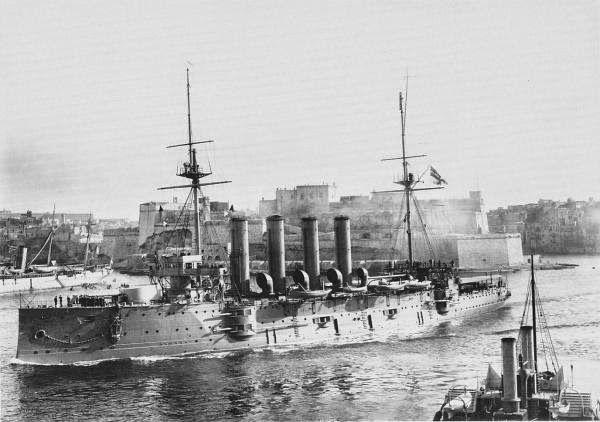
HMS Aboukir at Malta – note 6″ weapons in casemates along sides
Britain’s armoured cruisers can be fairly described as the most unsuccessful and unfortunate type of warship ever employed by the Royal Navy. The 34 vessels of this type that were in service at the outbreak of war had entered service between 1902 and 1908 – they were not old ships. Of these 34, a total of 13 were to be lost in the next four years. Intended to form part of the battle fleet, they had been rendered obsolete by the advent of the almost equally-disastrous battle-cruiser concept. The earlier classes – the six ships of the Cressy class being the oldest – had very limited offensive capability, especially in rough weather. They were large – and expensive – ships and they needed large crews.
[…]
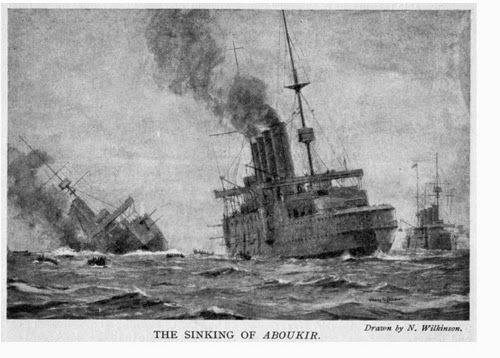
At dawn on September 22nd U-9 surfaced to find the storm over, the sea calm but for a slow swell. Smoke was seen on the horizon and the U-9’s engines were immediately shut down to get rid of their exhaust plume. A quick appraisal led Weddingen to order diving but he continues to observe through his periscope. Three vessels were approaching – the Aboukir, Cressy and Hogue – and Weddingen steered on his electric motors towards the central vessel, Aboukir.
Undetected, U-9 came within 600 yards of Aboukir’s port bow before firing a torpedo. As this was still running Weddingen took his craft down to 50 feet, then heard “a dull thud, followed by a shrill-toned crash”. Cheering erupted on U-9.
Aboukir sinking – as depicted by the famous British maritime painter Norman Wilkinson
the Hogue dropping boats to pick up survivors
September 25, 2014
Roll of Honour at the Tower of London, 24 September, 2014

Private William Penman who died in 1915 at Le Touret (25 years old) was Elizabeth’s great uncle. Private Walter Porteous who died in 1917 at Passchendaele (18 years old) was my great uncle.
Dear Sir/Madam,
Thank you for submitting a name for the Roll of Honour at the Tower of London. We are delighted to confirm that your nomination will be included at the ceremony on the 24th of September.
The list of 180 names will be read from the poppy-filled Tower moat at sunset, starting at 7:25pm (19.25). The names will be read the order in which they were submitted and validated.
We regret we are unable to make changes to the reading lists.
At the end of the reading, which will take about 20-30 minutes, an Army bugler will play the Last Post.
If you would like to watch, you can get a good view from the area in front of the Tower ticket desks on Tower Hill.
We will be filming the ceremony and posting the video online. This site is currently under construction, we will let you know when it goes live.
We are also adding the lists of names being read each night at http://rollofhonour.tumblr.com/ so that they can be seen and remembered from anywhere in the world.
September 19, 2014
When Royal Navy submarines fly the “Jolly Roger”
Ali Kefford on the origins of a colourful naval tradition:

Members of the crew of HMS Utmost with their “Jolly Roger” success flag, photographed alongside HMS Forth in Holy Loch, on their return from a year’s service in the Mediterranean, 6 February 1942. (via Wikipedia)
Sir Arthur Wilson was infamous within the Royal Navy for being an admiral with a tetchy temper. His nickname – Old ’Ard ’Art – was a bad joke about his uncaring nature.
Yet a verbal broadside he delivered in 1901 was to spawn one of the Submarine Service’s most loved and deeply ingrained traditions – the flying of the Jolly Roger flag to mark the victorious return from a successful patrol.
Wilson, later a hugely unpopular First Sea Lord, is said to have blasted the innovation of submarines, dubbing the covert way they operated as “underhand, unfair and damned un-English”.
He even went so far as to say: “They’ll never be any use in war and I’ll tell you why. I’m going to get the First Lord to announce that we intend to treat all submarines as pirate vessels in wartime and that we’ll hang all the crews.”
[…]
One hundred years ago this week, shortly after the start of the Great War, British submarine HMS E9 despatched two torpedoes at close range at Germany’s SMS Hela in a skirmish off Heligoland.
Its commanding officer, Lieutenant Commander Max Horton, had to dive immediately to avoid return fire, so he did not see the cruiser sink.
But the 13-year-old Silent Service had notched up its very first kill, confirming the deadly effectiveness of sneaking around in the deep then launching a surprise attack on an enemy.
Horton, recalling Admiral Wilson’s words, told his signaller to sew a piratical Jolly Roger flag, which flew proudly from his boat’s periscope as she sailed into Harwich, Essex.
A naval tradition was born, as the skull and crossbones went on to be the Royal Navy Submarine Service’s official emblem.
The tradition continues to today:
RT @shaunwatchorn: HMS Triumph returning to Devonport after tomahawk raid on Libya pic.twitter.com/dzRf8UYsFk
— NavyLookout (@NavyLookout) September 19, 2014
September 2, 2014
QotD: Shouting “fire” in a crowded theatre
First, there’s the shoutout to Oliver Wendell Holmes, Jr.:
There is no freedom to shout “fire” in a crowded theater.
Back in 2012 I wrote at length about the context for that Holmes quote. First of all, Professor Rosenbaum — like most Holmes fans — truncates the quote to render it vague. What Holmes actually said was “[t]he most stringent protection of free speech would not protect a man in falsely shouting fire in a theatre and causing a panic.”
But more importantly, Professor Rosenbaum — like most who misquote Holmes — ignores the context. To summarize rather than make you read my lengthy post: (1) Holmes made the analogy in deciding a shockingly brutal and censorious series of cases that are no longer good law, in which the Supreme Court gave the government free reign to jail people who criticized or agitated against American participation in World War I; (2) Holmes later repented of that position, undermined that line of cases through decisions he wrote or joined, and articulated a far more speech-protective line of authority that remains the law today, and (3) if you are fond of Holmes’ rhetorical flourishes, you ought to know he was the sort of statist asshole who said things like “three generations of imbeciles are enough” whilst upholding the right of the government forcibly to sterilize people deemed undesirable.
In other words, when you throw around the “shout fire in a crowded theater” quote, you’re echoing the rhetoric of a tyranny-cheerleader whose logic was later abandoned by everyone, including himself.
Ken White, “Professor Thane Rosenbaum Deceptively Carries On The Tradition of Censorship-Cheerleading”, Popehat, 2014-02-03
August 28, 2014
Feeding Tommy Atkins – WW1 food for British troops in the trenches
In the Express last week, Adrian Lee reports on a new exhibit at the Imperial War Museum in London:
They say an army marches on its stomach, so feeding the two million men who were in the trenches at the height of the First World War was some task. It was a great achievement that in the entire conflict not one British soldier starved to death.
Yet no one should think that the Tommies enjoyed the food that was served up by the military. According to the wags on the frontline, the biggest threat to life was not German bullets but the appalling rations.
Most despised was Maconochie, named after the company in Aberdeen that made this concoction of barely recognisable chunks of fatty meat and vegetables in thin gravy.
When served hot, as per the instructions on the tin, it was said to be barely edible. Eaten cold for days on end in the trenches, where a warm meal was usually no more than a fantasy, it was said to be disgusting.
It was the stated aim of the British Army that each soldier should consume 4,000 calories a day. At the frontline, where conditions were frequently appalling, daily rations comprised 9oz of tinned meat (today it would be known as corned beef but during the First World War it was called bully beef) or the hated Maconochie.
Additionally the men received biscuits (made from salt, flour and water and likened by the long-suffering troops to dog biscuits). They were produced under government contract by Huntley & Palmers, which in 1914 was the world’s largest biscuit manufacturer. The notoriously hard biscuits could crack teeth if they were not first soaked in tea or water.
August 24, 2014
Who is to blame for the outbreak of World War One? (Part twelve of a series)
You can catch up on the earlier posts in this series here (now with hopefully helpful descriptions):
- Why it’s so difficult to answer the question “Who is to blame?”
- Looking back to 1814
- Bismarck, his life and works
- France isolated, Britain’s global responsibilities
- Austria, Austria-Hungary, and the Balkan quagmire
- The Anglo-German naval race, Jackie Fisher, and HMS Dreadnought
- War with Japan, revolution at home: Russia’s self-inflicted miseries
- The First Balkan War
- The Second Balkan War
- The Entente Cordiale, Moroccan crises, and the influence of public opinion
- The Bosnian crisis of 1908
Who’s at the wheel? The less-than-transparent-or-unified governments of 1914
A common reaction (among both modern historians and lay readers) to the apparent incoherence of the decision-making process in the various great powers’ capitals is to ask just who exactly was in command when such-and-such a decision was taken. This reflects on our modern day belief that power has an identifiable source, and that actors had clear direction from a central authority. As Christopher Clark takes pains to outline in The Sleepwalkers this was not true even of the more centralized great powers:
… even a very cursory look at the governments of early twentieth-century Europe reveals that the executive structures from which policies emerged were far from unified. Policy-making was not the prerogative of single sovereign individuals. Initiatives with a bearing on the course of a country’s policy could and did emanate from quite peripheral locations in the political structure. Factional alignments, functional frictions within government, economic or financial constraints and the volatile chemistry of public opinion all exerted a constantly varying pressure on decision-making processes. As the power to shape decisions shifted from one node in the executive structure to another, there were corresponding oscillations in the tone and orientation of policy. This chaos of competing voices is crucial to understanding the periodic agitation of the European system during the last pre-war years. It also helps to explain why the July Crisis of 1914 became the most complex and opaque political crisis of modern times.
In The War That Ended Peace, Margaret MacMillan writes:
Old institutions and values were under attack and new ways and new attitudes were emerging. Their world was changing, perhaps too fast, and they had to attempt to make sense of it. “What were they thinking?” is a question often asked about the Europeans who went to war in 1914. The ideas that influenced their view of the world, what they took for granted without discussion (what the historian James Joll called “unspoken assumptions”), what was changing and what was not, all are important parts of the context within which war, even a general European war, became a possible option in 1914.
The uneasy state of the Serbian state
Serbia had been practically an independent state since shrugging off the last Ottoman military occupation in 1867 and that independence was formally recognized by the great powers in 1878 at the Congress of Berlin which was the peace conference called to end the Russo-Turkish War (which we briefly looked at in part two). One of the provisions of the treaty that strongly displeased the Serbs was that they were forbidden to take over Bosnia, which instead was placed in the care of the Austro-Hungarian empire: the Serbs had gone to war with the Ottomans in 1876 by proclaiming a union with Bosnia. The Austrians and the other great powers preferred a weakened Ottoman empire to retain titular possession of Bosnia than to allow an upstart principality to claim it.

King Milan of Serbia (via Wikipedia)

King Alexander and Queen Draga of Serbia (via Wikipedia)
According to one account, the king, flabby, bespectacled and incongruously dressed in his red silk shirt, emerged with his arms around the queen. The couple were cut down in a hail of shots at point-blank range. Petrović [the king’s adjutant], who drew a concealed revolver in a final hopeless bid to protect his master (or so it was later claimed), was also killed. An orgy of gratuitous violence followed. The corpses were stabbed with swords, torn with a bayonet, partially dismembered and hacked with an axe until they were mutilated beyond recognition, according to the later testimony of the king’s traumatized Italian barber, who was ordered to collect the bodies and dress them for burial. The body of the queen was hoisted to the railing of the bedroom window and tossed, virtually naked and slimy with gore, into the gardens. It was reported that as the assassins attempted to do the same with Alexandar, one of his hands closed momentarily around the railing. An officer hacked through the fist with a sabre and the body fell, with a sprinkle of severed digits, to the earth. By the time the assassins had gathered in the gardens to have a smoke and inspect the results of their handiwork, it had begun to rain.

King Peter I of Serbia (via Wikipedia)
Whether through fear of suffering the same kind of violent death as his predecessor or through a genuine belief in liberalization, King Peter’s early reign was marked by a return to more democratic representation and parliamentary control of the government. The Austrian government had been on relatively good terms with the former king, and viewed the increasing democratization in Serbia as a dangerous trend (for fear it would give more impetus to demands for autonomy not only in Bosnia, but also in other Slavic areas of the empire). The Wikipedia entry for King Peter’s reign is just a tad over-enthusiastic:
The Western-educated King attempted to liberalize Serbia with the goal of creating a Western-style constitutional monarchy. King Petar I became gradually very popular for his commitment to parliamentary democracy that, in spite of certain influence of military cliques in political life, functioned properly. The 1903 Constitution was a revised version of 1888 Constitution, based on the Belgian Constitution of 1831, considered as one of the most liberal in Europe.The governments were chosen from the parliamentary majority, mostly from People’s Radical Party (Narodna radikalna stranka) led by Nikola P. Pašić and Independent Radical Party (Samostalna radikalna stranka), led by Ljubomir Stojanović. King Peter himself was in favor of a broader coalition government that would boost Serbian democracy and help pursue an independent course in foreign policy. In contrast to Austrophile Obrenović dynasty, King Peter I was relying on Russia and France, which provoked rising hostility from expansionist-minded Austria-Hungary. King Peter I of Serbia paid two solemn visits to Saint-Petersbourg and Paris in 1910 and 1911 respectively, greeted as a hero of both democracy and national independence in the troublesome Balkans.
The reign of King Peter I Karadjordjević from 1903 to 1914, is remembered as the “Golden Age of Serbia” or the “Era of Pericles in Serbia”, due to the unrestricted political freedoms, free press, and cultural ascendancy among South Slavs who finally saw in democratic Serbia a Piedmont of South Slavs. King Peter I was supportive to the movement of Yugoslav unification, hosting in Belgrade various cultural gatherings. Grand School of Belgrade was upgraded into Belgrade University in 1905, with scholars of international renown such as Jovan Cvijić, Mihailo Petrović, Slobodan Jovanović, Jovan M. Žujović, Bogdan Popović, Jovan Skerlić, Sima Lozanić, Branislav Petronijević and several others.
The Black Hand: Serbia’s “plausibly deniable” interference in Bosnian affairs
The leader of the 1903 coup d’etat, former Captain, now Colonel Dragutin “Apis” Dimitrijević was in a key position indeed — he was the head of the Serbian Military Intelligence service in 1914. From that important post, he was able to conduct covert operations against the neighbouring empires with an eye to destabilization and eventual military action. In 1911, Apis established Ujedinjenje ili smrt! (the Black Hand) to enable him to conduct operations separate from — but with goals aligned with — the formal state organization. Another semi-secret pan-Slavic organization set up a few years earlier became a very valuable tool in the hands of Apis: Mlada Bosna (Young Bosnia).
Margaret MacMillan in The War That Ended Peace describes the kind of operations “Apis” set up and operated against Austria-Hungary and the Ottomans:
Within Serbia itself there was considerable support for the Young Bosnians and their activities. For a decade or more, parts of the Serbian government had encouraged the activities of quasi-military and conspiratorial organizations on the soil of Serbia’s enemies, whether the Ottoman Empire or Austria-Hungary. The army provided money and weapons for armed Serbian bands in Macedonia and smuggled weapons into Bosnia much as Iran does today with Hezbollah in Lebanon.
Margaret MacMillan describes the typical members of the Young Bosnians, who were of a type that we probably recognize more readily now than at any time since 1914:
[They] were mostly young Serb and Croat peasant boys who had left the countryside to study and work in the towns and cities of the Dual Monarchy and Serbia. While they had put on suits in place of their traditional dress and condemned the conservatism of their elders, they nevertheless found much in the modern world bewildering and disturbing. It is hard not to compare them to the extreme groups among Islamic fundamentalists such as Al Qaeda a century later. Like those later fanatics, the Young Bosnians were usually fiercely puritanical, despising such things as alcohol and sexual intercourse. They hated Austria-Hungary in part because they blamed it for corrupting its South Slav subjects. Few of the Young Bosnians had regular jobs. Rather they depended on handouts from their families, with whom they had usually quarreled. They shared their few possessions, slept on each other’s floors, and spent hours over a single cup of coffee in cheap cafés arguing about life and politics. They were idealistic, and passionately committed to liberating Bosnia from foreign rule and to building a new and fairer world. Strongly influenced by the great Russian revolutionaries and anarchists, the Young Bosnians believed that they could only achieve their goals through violence and, if necessary, the sacrifice of their own lives.
Apis and his Bosnian operators were determined to take advantage of the announced visit by Archduke Franz Ferdinand to the Bosnian capital of Sarajevo in June, 1914. The Archduke was the heir-presumptive to the throne of the Dual Monarchy and (contrary to what a lot of people believed at the time) a moderate who hoped to use his visit to reduce tension between the monarchy and the Slavic people in the southern fringe of the empire. He had already spoken against the empire taking military action against Serbia on more than one occasion after provocation … if he were not on the scene, Apis calculated, the chances of war went up significantly.
The stage is set, the pieces are starting to fall into place, and the curtain is about to go up.
August 23, 2014
August 18, 2014
Another look at the Ross Rifle, initial Canadian infantry weapon of WW1
Last year, I posted a video by Lickmuffin, showing his recently acquired Ross Mark III, a “sporterized” version of the model that equipped the First Canadian Division when it took the field in France in 1915. Yesterday, David Pugliese revisited the Ross controversy in the Ottawa Citizen:
When soldiers in the throes of battle discard their rifles and pluck a different weapon from the hands of dead allies, there’s clearly a serious problem, writes John Ward of the Canadian Press news service.
So it was with the Ross rifle, the weapon that Canadian soldiers took with them to the start of the First World War a century ago.
More from Ward’s article:
It was the brainchild of Sir Charles Ross, a wealthy Scottish-born engineer and inventor who offered it to the Canadian government as a military firearm well before the war began.
To Sir Sam Hughes, Canada’s minister of militia — defence minister in modern parlance — at the time, the Canadian-built Ross was highly accurate and the perfect tool for his soldiers, whom he saw as frontier marksmen.
But troops, some of whom sneered at the rifle as “the Canadian club,” soon discovered the Ross was not suited to dirty, rough-and-tumble trench warfare. They preferred the robust Lee-Enfield carried by their British comrades, picking them up from the battlefield when they could.
The .303-calibre, straight-pull Ross was longer than the Lee-Enfield, a problem in the cramped confines of the trenches. It was heavier, too, and in a day when infantrymen were over-burdened, any extra weight was unwelcome. When fired with its bayonet attached, it tended to shed the bayonet.
The Ross was also susceptible to jamming from dust and dirt and was very finicky about the quality of ammunition. The carefully machined cartridges made by the Dominion Arsenal worked fine, but not so the mass-produced British ammunition, which could vary in size beyond the Ross’s fine tolerances.
Further, it was easy to reassemble the Ross bolt incorrectly. Even when misassembled, the bolt would fit in the rifle and even chamber and fire a cartridge, only to slam back into the rifleman’s face — unheard of for most bolt-action rifles.
David Pugliese also linked to this Forgotten Weapons video, which investigates the best known failing of the Ross in combat:
Published on 16 Jun 2013
There is a long-standing urban legend about the Canadian Ross rifle, a straight-pull bolt action that was used in lieu of the SMLE by Canadian troops early in World War One. The story is that the Ross would sometimes malfunction and blow the bolt back into its shooter’s face, with pretty horrible results. Well, I wanted to learn “the rest of the story” – could this actually happen? What caused it? How could it be prevented? In short, what would a Ross shooter need to know to remain safe? And if I could get some cool footage of a bolt blowing out of a Ross in the process, all the better.
Well, reader Andy very generously provided a sporterized Ross for the experiments, and I started reading into what the issue really was. Turns out that the legend was quite true – you can put a Ross MkIII bolt together the wrong way, and it will allow you to fire without the locking lugs engaged, thus throwing the bolt back out of the gun at high velocity. However, the issue was recognized fairly quickly, and the vast majority of Ross rifles were modified with a safety rivet to prevent this from happening. It is also quite easy to determine if a Ross is assembled correctly, once you know what to look for.
Who is to blame for the outbreak of World War One? (Part eleven of a series)
You can catch up on the earlier posts in this series here (now with hopefully helpful descriptions):
- Why it’s so difficult to answer the question “Who is to blame?”
- Looking back to 1814
- Bismarck, his life and works
- France isolated, Britain’s global responsibilities
- Austria, Austria-Hungary, and the Balkan quagmire
- The Anglo-German naval race, Jackie Fisher, and HMS Dreadnought
- War with Japan, revolution at home: Russia’s self-inflicted miseries
- The First Balkan War
- The Second Balkan War
- The Entente Cordiale, Moroccan crises, and the influence of public opinion
We left the Austro-Hungarian Empire in a state of ferment back in part five, having undergone a near-death constitutional stroke in 1867, resulting in a bi-polar domestic and even world outlook to accommodate the newly redefined Dual Monarchy, and dangerously inconsistent treatment of their respective ethnic, linguistic, and religious minorities in the Cisleithanic (Austrian) and Transleithanic (Hungarian) “halves” of the empire. This might not have mattered much in the long run if the empire hadn’t been summarily extended in 1908 with the addition of new territory on the southern border of the empire.
Administration turns into annexation
Under the terms of the 1878 Treaty of Berlin, Austria-Hungary had been administering the Ottoman provinces of Bosnia and Herzegovina, with the provision that they would be returned at some future date when the stability of the occupied territories had been re-established. In 1908, however, something happened which drove the Austro-Hungarians into a panic: the somnolent Ottoman government was faced with a revolutionary movement called the Young Turks.
Since 1878, the Sultan had ruled without a parliament, having suspended the General Assembly and ending the short-lived First Constitutional Era. The Young Turks were an unlikely alliance of Turkish nationalists, reformers, pro-Western modernizers, and certain national minorities including Armenians and Greeks: in short, anyone with a grievance against the Sultan, the administration, or the general state of life in the empire. The Young Turks forced the Sultan to restore the 1876 constitution and recall the general assembly. They also announced plans to call elections throughout the empire, including the Austrian-occupied territories.

Map of South-Eastern Europe after the Congress of Berlin, 1878 (via Wikipedia)

Austro-Hungarian foreign minister Count Alois von Aehrenthal (via Wikipedia)
In order to forestall any such complications [a push by the Young Turks to reclaim the provinces], Aehrenthal moved quickly to prepare the ground for annexation. The Ottomans were bought out of their nominal sovereignty with a handsome indemnity. Much more important were the Russians, upon whose acquiescence the whole project depended. Aehrenthal was a firm believer in the importance of good relations with Russia — as Austrian ambassador in St. Petersburg during the years 1899-1906, he had helped to consolidate the Austro-Russian rapprochement. Securing the agreement of the Russian foreign minister, Alexandr Izvolsky, was easy. The Russians had no objection to the formalization of Austria-Hungary’s status in Bosnia-Herzegovina, provided St. Petersburg received something in return. Indeed it was Izvolsky, with the support of Tsar Nicholas II, who proposed that the annexation of Bosnia-Herzegovina be exchanged for Austrian support for improved Russian access to the Turkish Straits.

Russian foreign minister Count Alexandr Petrovich Izvolsky (via Wikipedia)
Despite these preparations, Aehrenthal’s announcement of the annexation on 5 October 1908 triggered a major European crisis. Izvolsky denied having reached any agreement with Aehrenthal. He subsequently even denied that he had been advised in advance of Aehrenthal’s intentions, and demanded that an international conference be convened to clarify the status of Bosnia-Herzegovina.
In his recent article in History Today, Vernon Bogdanor explains the reaction to this less-than-legal Austro-Hungarian swallowing act:
The annexation […] was a breach of the treaty and of international law. It would have significant consequences. The first was that it made non-Slav rule in Bosnia appear permanent, since the Austro-Hungarian Empire was far more durable than the Ottoman Empire. The annexation was a particular blow to the independent south Slav state of Serbia, which objected. Second, the annexation made the southern Slav issue an international problem, since it involved Serbia’s ally, Russia, which saw itself as the protector of the Slavs. In March 1909 Austria demanded, under threat of war, that Serbia accept the annexation, while Germany told Russia that, in case of war, it would take Austria’s side.
Britain helped persuade Serbia and Russia to back down. The great powers accepted the annexation. The Kaiser, unwisely perhaps, boasted in Vienna in 1910 that he had come to Austria’s side as a ‘knight in shining armour’.
The deciding factor in settling the issue of annexation turned out to be the active involvement of the German government in providing diplomatic pressure on Russia, as Christopher Clark explains:
The issue was resolved only by the “St. Petersburg note” of March 1909, in which the Germans demanded that the Russians at last recognize the annexation and urge Serbia to do likewise. If they did not, Chancellor Bülow warned, then things would “take their course”. This formulation hinted not just at the possibility of an Austrian war on Serbia, but, more importantly, at the possibility that the Germans would release the documents proving Izvolsky’s complicity in the original annexation deal. Izvolsky immediately backed down.
At the time, Aehrenthal took the blame for this fiasco, at least to some degree for his preference for secret deals and understandings. He may have been correct that there was no chance that the other signatories to the Treaty of Berlin would accept the Austrian proposal, but when it all became public, it tarnished his reputation directly and Austria-Hungary’s reputation generally.
Russia hardly came out improved in standing either. As Christopher Clark put it, “the evidence suggests that the crisis took the course that it did because Izvolsky lied in the most extravagant fashion in order to save his job and reputation.” This embarrassing incident at least partially explains why Russia became far more concerned about the fate of the south Slavic populations — having signally failed them once in 1908, Russia could not afford to look like they were going to fail them in future conflicts without forfeiting any influence or control over events in the Balkans. Clark explains the toxic combination of official misinformation, rising political awareness of the Russian middle classes, and the indirect power of the newspapers:
Intense public emotions were invested in Russia’s status as protector of the lesser Slavic peoples, and underlying these in the minds of the key decision-makers was a deepening preoccupation with the question of access to the Turkish Straits. Misled by Izvolksy and fired up by chauvinist popular emotion, the Russian government and public opinion interpreted the annexation as a brutal betrayal of the understanding between the two powers, an unforgivable humiliation and an unacceptable provocation in a sphere of vital interest. In the years that followed the Bosnian crisis, the Russians launched a programme of military investment so substantial that it triggered a European arms race.
Another important question in the wake of the annexation crisis was how Austria-Hungary would placate Serbia. Margaret MacMillan, in The War That Ended Peace outlines the rather small pickings Serbia was offered:
The most difficult issue to settle in the aftermath of the annexation was the question of compensation for Serbia, complicated by the fact that Russia was backing Serbia’s demands and Germany was supporting Austria-Hungary. The most Aehrenthal was prepared to offer Serbia was some economic concessions such as access to a port on the Adriatic, but only if Serbia recognized the annexation and agreed to live on peaceful terms with Austria-Hungary. The Serbian government remained intransigent and, as spring melted the snows in the Balkans, the talk of war mounted again around Europe’s capitals. […] In St. Petersburg, Stolypin, who remained opposed to war, told the British ambassador at the start of March that Russian public opinion was so firmly in support of Serbia that the government would not be able to resist coming to its defense: “Russia would have, in that case, to mobilise, and a general conflagration would then be imminent.”
War was averted in 1908, but the issues that arose (or were exacerbated) during the Bosnian crisis were almost all still significant in 1914. As a dress rehearsal, 1908 went down fairly well: only diplomatic force was exerted, but it showed some of the limits of mere diplomacy and foreshadowed the crisis of July 1914.


