Quotulatiousness

August 9, 2020

MGB 81, the Spitfire of the Seas | World War II gunboat review | Motor Boat & Yachting

Filed under: Britain, History, Military, Weapons, WW2 — Tags: , — Nicholas @ 02:00

Motor Boat & Yachting
Published 16 Jan 2019

We have the immense privilege of getting behind the wheel (and guns) of MGB 81, the Spitfire of the seas.

Filmed by Paul Wyeth: http://www.pwpictures.com/

► For the latest reviews, new gear launches and tour news, visit our website here – http://www.mby.com

►Follow us on Twitter here – https://twitter.com/mbytimeinc

August 8, 2020

Tank Chats #77 Jagdtiger | The Tank Museum

Filed under: Germany, History, Military, Weapons, WW2 — Tags: , , , — Nicholas @ 02:00

The Tank Museum
Published 14 Jun 2019

David Willey, Curator at The Tank Museum, presents a Tank Chat on the mighty WW2 German Jagdtiger.

Support the work of The Tank Museum on Patreon: ► https://www.patreon.com/tankmuseum

Visit The Tank Museum SHOP: ► https://tankmuseumshop.org/

Twitter: ► https://twitter.com/TankMuseum
Instagram: ► https://www.instagram.com/tankmuseum/
Tiger Tank Blog: ► http://blog.tiger-tank.com/
Tank 100 First World War Centenary Blog: ► http://tank100.com/ #tankmuseum #tanks #tankchats

August 7, 2020

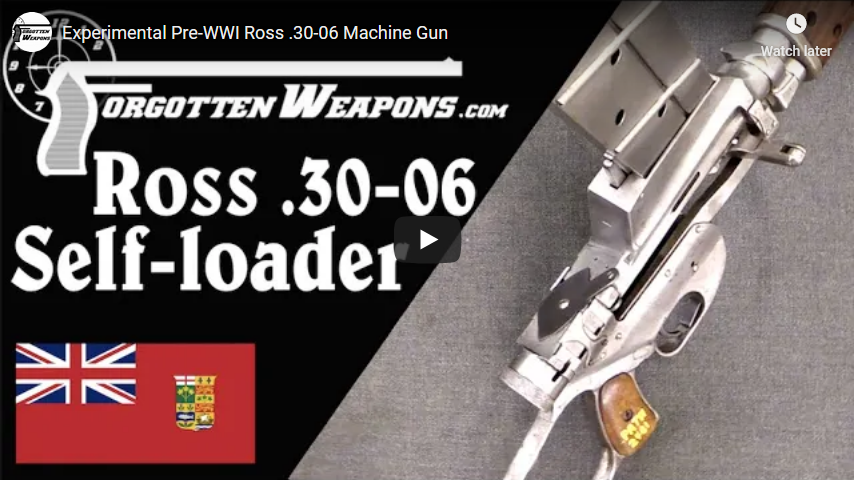
Myth and Reality of the Ross MkIII Rifle

Filed under: Cancon, History, Military, Weapons, WW1 — Tags: , , , , — Nicholas @ 02:00

Forgotten Weapons
Published 16 Jun 2013

There is a long-standing urban legend about the Canadian Ross rifle, a straight-pull bolt action that was used in lieu of the SMLE by Canadian troops early in World War One. The story is that the Ross would sometimes malfunction and blow the bolt back into its shooter’s face, with pretty horrible results. Well, I wanted to learn “the rest of the story” — could this actually happen? What caused it? How could it be prevented? In short, what would a Ross shooter need to know to remain safe? And if I could get some cool footage of a bolt blowing out of a Ross in the process, all the better.

Well, reader Andy very generously provided a sporterized Ross for the experiments, and I started reading into what the issue really was. Turns out that the legend was quite true — you can put a Ross MkIII bolt together the wrong way, and it will allow you to fire without the locking lugs engaged, thus throwing the bolt back out of the gun at high velocity. However, the issue was recognized fairly quickly, and the vast majority of Ross rifles were modified with a safety rivet to prevent this from happening. It is also quite easy to determine if a Ross is assembled correctly, once you know what to look for.

http://www.forgottenweapons.com

August 4, 2020

Sturmtruppen Firepower: The Artillery Luger

Filed under: Germany, History, Military, Weapons, WW1 — Tags: , , , , , — Nicholas @ 02:00

Forgotten Weapons
Published 4 Apr 2020

https://www.instagram.com/rockislanda…

https://www.youtube.com/user/RockIsla…

This is lot #3569 in the upcoming RIA Premier Auction. It was scheduled for April, but has been postponed — check their web site for upcoming Online Only auctions every month, though!

The lP08 (Lange pistole 08) was formally adopted in 1913 to replace the Reichsrevolver for the field artillery. These were the German light artillery troops, who were specifically given a pistol caliber carbine to provide maximum firepower in a very compact package. They were made by the Erfurt Arsenal in 1914, and by DWM throughout the war, with a total of about 180,000 made.

What is most interesting to me is the evolution of the use of the “artillery Luger” throughout the course of World War One. Starting as simply a compact weapon for artillery, it was quickly recognized by aviators as an ideal weapon for aircraft before the mass introduction of aerial machine guns. The stock allowed more accurate fire, and the semiautomatic operation minimized the handling movements required to fire. More substantially, it was adopted by the German Sturmtruppen for maximizing the striking power of small and flexible units. It is for these men that the 32-round drum magazine was developed in 1916. This represents one of the very few formal military uses of a pistol-caliber semiautomatic carbine, as it was superseded by the advent of the submachine gun in 1918.

A few small batches were made in the 1920s and 1930s, but it would not see significant use in World War Two – leaving it a weapon specifically iconic to the Great War.

http://www.patreon.com/ForgottenWeapons

https://www.floatplane.com/channel/Fo…

Cool Forgotten Weapons merch! http://shop.bbtv.com/collections/forg…

Contact:
Forgotten Weapons
6281 N. Oracle #36270
Tucson, AZ 85740

August 1, 2020

Secret Briefing: The Pedersen Device

Filed under: History, Military, USA, Weapons, WW1 — Tags: , , , , , — Nicholas @ 02:00

Forgotten Weapons
Published 8 Aug 2016

http://www.patreon.com/ForgottenWeapons

Welcome to your briefing on the new equipment we are issuing for the Spring Offensive of 1919. With this new secret weapon, we can finally push the Germans out of France and end the war!

July 30, 2020

Champagne Saber Time

Filed under: Weapons, Wine — Tags: , — Nicholas @ 02:00

Alton Brown
Published 7 May 2014

A daring way to open a Champagne Bottle. Please do not try this at home.

Read the full instructions at https://altonbrown.com/sabering-champagne/

July 29, 2020

What was TEKOI?

Filed under: History, Military, Russia, USA, Weapons — Tags: , , , , — Nicholas @ 04:00

CGP Grey
Published 28 Jul 2020

## Related Videos

Exploring Tekoi: https://www.youtube.com/watch?v=ABMV4…

Defeated by Tumbleweeds: https://www.youtube.com/watch?v=7FeXP…

## Special Thanks

Gregory Waltz

## Crowdfunders

Steven Snow, Bob Kunz, John Buchan, Nevin Spoljaric, Donal Botkin, BN-12 , Chris Chapin, Richard Jenkins, Phil Gardner, Martin, Steven Grimm, سليمان العقل, Elliot Lepley, Colin Millions, David F Watson, Saki Comandao, Ben Schwab, Jason Lewandowski, Bobby, rictic, Marco Arment, Shallon Brown, Shantanu Raj, emptymachine, George Lin, Jeffrey Podis, Ben Delo, Henry Ng, Thunda Plum, Awoo, David Tyler, Fuesu, iulus, Jordan Earls, Joshua Jamison, Nick Fish, Nick Gibson, Tyler Bryant, Zach Whittle, Oliver Steele, Kermit Norlund, Derek Bonner, Derek Jackson, Mikko, Orbit_Junkie, Ron Bowes, Tómas Árni Jónasson, Andrew Bereza, Rebecca Wortham, Bryan McLemore, Bear, chrysilis, David Palomares, Emil, Erik Parasiuk, Esteban Santana Santana, Freddi Hørlyck, John Rogers, ken mcfarlane, Leon, Maarten van der Blij, Peter Lomax, Rhys Parry, ShiroiYami, Tristan Watts-Willis, Veronica Peshterianu, Dag Viggo Lokøen, Essa omar, Ryan Richards, Alex Simonides, Felix Weis, John Lee, Maxime Zielony, Melvin Sowah, Elizabeth Keathley, Christopher Mutchler, Giulio Bontadini, Paul Alom, Ryan Tripicchio, Scot Melville, Kyle Wayman, Julien Dubois

## Music

David Rees: http://www.davidreesmusic.com

Update: CGP Grey posted a corrected version of this video here – https://www.youtube.com/watch?v=PCeMCwxayp0
He also posted the Director’s Commentary video (originally intended only for his Patrons) here – https://www.youtube.com/watch?v=ufsYK3Eecw4
There is also a video explaining how the whole process worked and how the error was missed, if you’re interested.

America’s First Assault Rifle: Burton 1917 LMR

Filed under: History, Military, USA, Weapons, WW1 — Tags: , , , , , — Nicholas @ 02:00

Forgotten Weapons
Published 4 Jul 2016

http://www.patreon.com/ForgottenWeapons
https://centerofthewest.org/explore/f…

America’s first assault rifle? Well, it does meet all the requirements — select-fire, intermediate cartridge, and shoulder-fired. It was never actually fielded, though.

The Burton Light Machine Rifle was developed during World War One, with the firing model completed in 1917. It was intended as an aircraft observer’s weapon for attacking balloons — a role which required incendiary ammunition. With this in mind, Winchester’s Frank Burton adapted the .351 WSL cartridge from his 1905 and 1907 self-loading rifles into the .345 WSL, with a spitzer bullet. He designed an open-bolt, select-fire shoulder rifle to fire it, which became known as the Light Machine Rifle.

Burton’s rifle was to be usable both in an aircraft where it could be fixed to a Scarff mount for a wide field of fire or used by an individual on the ground, fired from the shoulder. It weighed in at just about 10 pounds (4.5kg) and had a pistol grip and straight-line design to bring the recoil impulse directly into the shooter’s shoulder and minimize rise during automatic fire. The barrel was finned for better cooling, and infantry barrels were equipped with bayonet lugs.

The most distinctive elements of the design, of course, are the dual top-mounted magazines. Each one holds 20 rounds, and each has a pair of locking catches. One position locks the magazine into a feeding position, and the other holds it up above the cycling of the bolt. The idea here was to keep a second loaded magazine easily accessible for an aerial observer, so they could reload without having to find another magazine somewhere in the aircraft. Contrary to some speculation, there is no automatic transition between magazines. When one is empty, the shooter must pull it back to the second locking position (or out of the gun entirely) and then push the second magazine down into feeding position.

Despite Burton’s work — which was well ahead of its time — the LMR had been rendered obsolete for its primary role by the time it was ready. Synchronized, forward-mounted Vickers machine guns firing 11mm incendiary ammunition were being mounted on aircraft, and were more effective on balloons and airplanes than Burton’s weapon would have been. Only this single example was ever made, and it was not presented for infantry consideration as far as I can tell. It was lost for many years before being discovered in a Winchester building, and eventually ending up in the Cody Firearms Museum with the rest of the Winchester factory collection.

July 28, 2020

Roman kit: featuring armour, swords, spears, artillery, rations, deckchairs, and of course shoes

Lindybeige
Published 27 Jul 2020

Go to https://expressvpn.com/lindybeige and find out how you can get three months free.

A video of re-enactors and their Roman kit. Sorry about the wind noise.

Support me on Patreon: https://www.patreon.com/Lindybeige

Here’s a link to the Ermine Street Guard – Britain’s foremost imperial Roman re-enactment group: http://www.erminestreetguard.co.uk

Was your re-enactment group featured? Ask for a link here!

Buy the music – the music played at the end of my videos is now available here: https://lindybeige.bandcamp.com/track…

Buy tat (merch):
https://outloudmerch.com/collections/…

Lindybeige: a channel of archaeology, ancient and medieval warfare, rants, swing dance, travelogues, evolution, and whatever else occurs to me to make.

▼ Follow me…

Twitter: https://twitter.com/Lindybeige I may have some drivel to contribute to the Twittersphere, plus you get notice of uploads.

My website:
http://www.LloydianAspects.co.uk

Tank Chats #76 Tetrarch Tank | The Tank Museum

Filed under: Britain, History, Military, Weapons, WW2 — Tags: , , , — Nicholas @ 02:00

The Tank Museum
Published 31 May 2019

Tetrarch tanks were flown over on D-Day, 6th June, 1944, for the invasion of France during WW2. Find out more with David Fletcher.

Originally adopted by the British Army as a light tank it became the first British airborne tank.
Many thanks to Vitaly Kuzmin for providing the image of the Tetrarch at Kubinka https://www.vitalykuzmin.net

Support the work of The Tank Museum on Patreon: ► https://www.patreon.com/tankmuseum

Visit The Tank Museum SHOP: ► https://tankmuseumshop.org/

Twitter: ► https://twitter.com/TankMuseum
Tiger Tank Blog: ► http://blog.tiger-tank.com/
Tank 100 First World War Centenary Blog: ► http://tank100.com/ #tankmuseum #tanks #DDay75 #tankchats

July 26, 2020

Gewehr 98: The German WWI Standard Rifle

Filed under: Germany, History, Military, Weapons, WW1 — Tags: , , — Nicholas @ 02:00

Forgotten Weapons
Published 11 Jun 2016

Sold at auction for $1,840 (w/ 5 other rifles).

The Gewehr 1898 was the product of a decade of bolt action repeating rifle improvements by the Mauser company, and would be the standard German infantry rifle through both World Wars. Today we are looking at a pre-WWI example (1905 production) that shows all the features of what a German soldier would have taken to war in 1914.

July 23, 2020

Pattern 1913 Enfield Trials Rifle

Filed under: Britain, History, Military, Weapons, WW1 — Tags: , , , — Nicholas @ 02:00

Forgotten Weapons
Published 28 Apr 2016

http://www.patreon.com/ForgottenWeapons

Sold at auction for $6,325.

One of the lessons learned by the British military in the aftermath of the Boer War was that modern Mauser rifles were superior to their Lee-action rifles and carbines. In response, British ordnance began experimenting with a Mauser-pattern rifle, ultimately finalized as the Pattern 1913. This rifle would also leave behind the obsolescent .303 rimmed cartridge, in favor of a new rimless .276 Enfield round.

The Pattern 13 rifle itself was excellent — it balanced and handled well, it had very good sights, and a smooth and fast bolt throw. However, the .276 Enfield cartridge was really more potent than it needed to be, and caused problems. The cartridge threw a 165 grain bullet at just under 2800fps, pretty close to the ballistics of today’s 7mm Remington Magnum. Loaded with Cordite propellent, this led to excessive barrel wear and unpleasant recoil, along with some parts breakage. However, as final testing was being done in the first half of 1914, the Great War broke out.

At this point, plans for using a new cartridge were abandoned. The rifle itself was redesigned in the .303 cartridge, to be manufactured in large numbers by American firms under contract. It would also be refitted for the .30-06 cartridge and used in large numbers by the American armed forces as the M1917 Enfield rifle. According to General Julian Hatcher (who ought to know), it was the best rifle of the First World War.

July 21, 2020

Enfield L85A1: Perhaps the Worst Modern Military Rifle

Filed under: Britain, History, Military, Weapons — Tags: , , , , , — Nicholas @ 02:00

Forgotten Weapons
Published 29 Dec 2016

http://www.patreon.com/ForgottenWeapons

Cool Forgotten Weapons merch! http://shop.bbtv.com/collections/forg…

If you enjoy Forgotten Weapons, check out its sister channel, InRangeTV! http://www.youtube.com/InRangeTVShow


The L85A1 (part of the SA80 small arms family) was adopted by the British military in 1985 as a new generation of small arms to replace the L1A1 FAL (one quick note, where “A1” indicates a revision in American designations, it is simply the first iteration in British ones — there was no “L85”). As a bullpup rifle, the L85A1 was intended to replace both the FAL and Sterling SMG, similar to the French replacing the MAS 49/56 and MAT 49 with the FAMAS.

Unfortunately, the L85A1 had massive problems of both reliability and durability. They were kept pretty much hidden until Desert Storm, when it became unavoidably clear that the weapon was seriously flawed. The UK government denied the problems for several years, until finally contracting with H&K (then owned by Royal Ordnance) to redesign and rebuild the rifles. The result, after changes to virtually every part of the rifle, was the L85A2 — a much better rifle that will be tainted with its predecessor’s reputation regardless.

Mechanically, the L85A1 and A2 are basically copies of the Armalite AR-180, with a multi-lug rotating bolt and a short stroke gas piston. It feeds from STANAG magazines, and it universally fitted with the heavy but rugged SUSAT optical sight.

Thanks to the Institute of Military Technology for allowing me to have access to this rifle (which is extremely rare in the US) and bring it to you! Check them out at:

http://www.instmiltech.com

July 17, 2020

L96A1: The Green Meanie – the First Modern Sniper Rifle

Filed under: Britain, Military, Weapons — Tags: , , , — Nicholas @ 02:00

Forgotten Weapons
Published 16 Feb 2019

http://www.patreon.com/ForgottenWeapons

Cool Forgotten Weapons merch! http://shop.bbtv.com/collections/forg…

The Accuracy International Precision Marksman rifle was the winner of the British MoD’s competition to replace the L42A1 as the standard British sniper rifle, and was accordingly adopted as the L96A1. It was the vanguard of the modern sniper rifle, with a highly modular chassis design, and it revolutionized British sniping performance. Thanks to Steve Houghton, was have access today to one of a tiny number of original L96A1 rifles in private hands. If you are interested in learning more, I highly recommend checking out Steve’s newly released book, The British Sniper: A Century of Evolution. It can be found at:

https://www.swiftandboldpublishing.co…

Contact:
Forgotten Weapons
PO Box 87647
Tucson, AZ 85754

July 16, 2020

Tank Chats #75 M5A1 Stuart | The Tank Museum

Filed under: History, Military, USA, Weapons, WW2 — Tags: , — Nicholas @ 02:00

The Tank Museum
Published 17 May 2019

David Fletcher on the last in the Stuart series. Known unofficially as “Honeys”, the M5A1 Stuart was an improved version of the American’s M3 light tank. They were used by British armoured regiments and by most other Allied armies during WW2. They were fast, reliable and popular with their crews, but outclassed by the German tanks of 1944.

Support the work of The Tank Museum on Patreon: ► https://www.patreon.com/tankmuseum

Visit The Tank Museum SHOP: ► https://tankmuseumshop.org/
Twitter: ► https://twitter.com/TankMuseum
Tiger Tank Blog: ► http://blog.tiger-tank.com/
Tank 100 First World War Centenary Blog: ► http://tank100.com/ #tankmuseum #tanks #tankchats

« Newer PostsOlder Posts »

Powered by WordPress