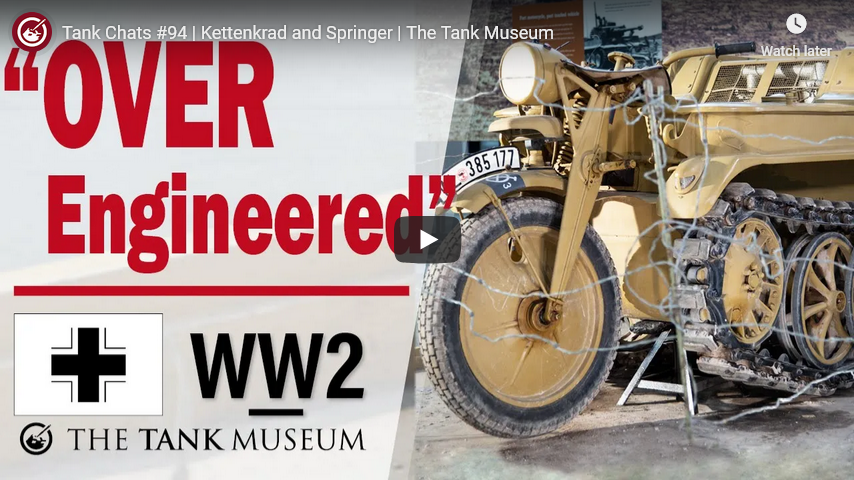
Here David Willey examines two WW2 German tracked vehicles. The first is the Sd.Kfz. 2, better known as the Kettenkrad, a light tractor. The second, the Springer, a demolition vehicle which was fundamentally a mobile bomb, which shared the Kettenkrad’s running gear and engine.
Everybody quarrels over the efficacy of the English longbow. Many historians, reenactors and history enthusiasts alike hold the view that arrows piercing armor is a myth. Some base this view on testing as was done for example by Tod from Tod’s workshop. Together with his team, he provided an invaluable data point for this debate. Others, such as traditionalist historians are often open to the possibility of arrows piercing armor, even though they are aware of actual testing of the longbow. In general, the efficacy of a weapon is much more complicated than its mere armor penetration value. So, in this video we’d like to shed light on the whole debate and explain why it is so hard to find common ground on this issue. This is why everybody disagrees on the efficacy of the English longbow.
Bibliography:
Rogers, C.J., The Efficacy of the English Longbow, 1998.
Devries, K., Medieval Military Technology, 1994.
Bane, M., “English Longbow Testing against various armor circa 1400”, 2006.
Soar, H., Gibbs, J., Jury, C., Stretton, M., Secrets of the English War Bow. Westholme, 2010, pp. 127–151.
Magier, Mariusz; Nowak, Adrian; et al., “Numerical Analysis of English Bows used in Battle of Crécy”. Problemy Techniki Uzbrojenia. 142 (2), 2017, 69–85.
Comments Off on Why Everybody Disagrees on the Efficacy of the English Longbow – A Video Essay
The MG42 was developed to be a more reliable and easier to manufacture replacement for the MG34, although both would serve side by side until the end of World War Two. Designed by Grossfuss company engineer Werner Gruner with no previous military or small arms design experience, the MG42 used heavy stampings for its main assemblies, thus reducing German need for expensive and difficult to obtain alloyed steels.
As a practical matter, the MG42 had a much higher rate of fire than the MG34, at 1500-1600 rounds per minute (more than 50% faster than the MG34). This was deemed desirable to improve the effectiveness of suppressing fire and the density of the cone of fire, but naturally resulted in much higher ammunition consumption than other machine gun models.
This example is a very early production Gustloff example, with the early horizontal charging handle, unreinforced wooden stock, and adjustable front sight. It was most likely captured in North Africa from Rommel’s forces, as they were a primarily user of the very early MG42s.
Contact:
Forgotten Weapons
6281 N. Oracle #36270
Tucson, AZ 85740
Comments Off on Hitler’s Zipper: The MG-42 Universal Machine Gun
Here David Fletcher takes a look at the Humber Hornet, a specialised air-deployable Armoured Fighting Vehicle. It was designed to carry the Malkara, an anti-tank guided missile developed by Australia and the United Kingdom.
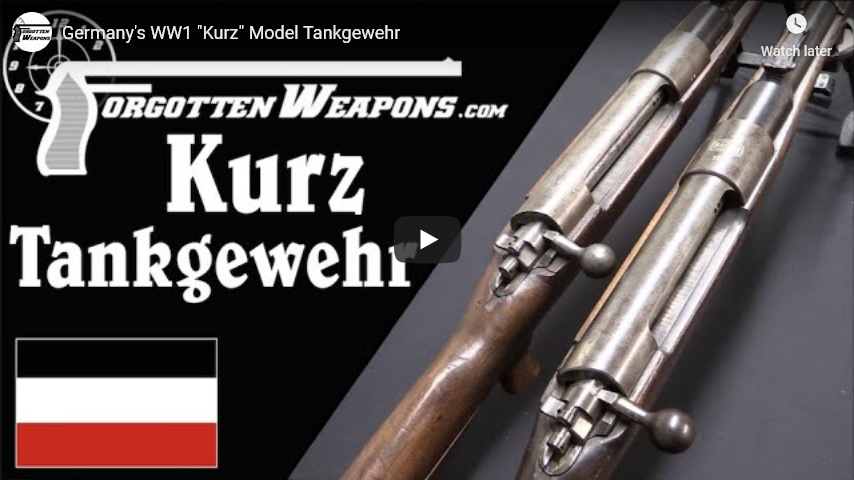
When the German Tankgewehr was introduced in May 1918, the first 300 or so guns were of a different pattern than the standard production that would follow (and of which about 16,000 would be made). The Kurz model had a barrel about 4 inches shorter than the standard, and was about 2 pounds heavier, because that barrel (although shorter) was much larger in diameter than the standard pattern.
Contact:
Forgotten Weapons
6281 N. Oracle #36270
Tucson, AZ 85740
Comments Off on Germany’s WW1 “Kurz” Model Tankgewehr
The rarest variation of the Webley-Fosbery automatic revolver is the .38 ACP model. Only 341 of these were made by Webley, in an attempt to compete with the new semiautomatic pistols appearing on the market — most notably the Colt Model 1900 and Model 1902. The Colt was chambered for .38 ACP, a remarkable cartridge for its time — high velocity and semi-rimmed. Webley figured that an 8-shot Fosbery-type revolver would offer the same capacity and ballistics as the new Colt, but in a revolver format familiar to the British market. The design could load cartridges individually, but also offered use of an 8-shot moon clip. Unfortunately for Webley, British legislation in 1903 hampered civilian handgun ownership and the military was not interested at all because the bore was too small. Of the 341 originally made, some were finally converted to .455 caliber after years of sitting unsold in Webley’s warehouse.
This model makes a notable appearance in Dashiell Hammett’s novel The Maltese Falcon, which quite specifically identifies it as an 8-shot, .38 caliber Webley-Fosbery. In the movie version, Humphrey Bogart mistakenly says it is an 8-shot .45, however…
Contact:
Forgotten Weapons
6281 N. Oracle #36270
Tucson, AZ 85740
Comments Off on .38 ACP Webley-Fosbery Automatic Revolver
In November of 1950, the US Ordnance Department requested an improved version of the Browning 1919 air-cooled machine gun for use in tanks. The new version was to be able to feed from either the left or right, a feature which was unimportant for an infantry gun but much more relevant when mounting guns into the tight spaces of an armored vehicle. An interim conversion of existing guns to the M1919A4E1 pattern came first, followed by manufacture of all-new guns by the Rock Island Arsenal and Saco-Lowell company from 1955 until 1957.
The design of the gun fell to Bob Hillberg at High Standard. He came up with a clever set of reversible plugs to change the bolt between left and right hand feed, as well as a captive recoil spring, manual safety, improved top cover and rear cover latches, and several other strengthened parts. He also incorporated a charging handle extension with integral manual hold open and a link ejection chute that could be mounted to either side of the gun. His T153 design was formally adopted as the M37, in caliber .30-06. A 7.62mm NATO version (the M37E1) followed as well. The M37 would serve into the late 1960s on the M48 and M60 tanks as well as several helicopters.
Contact:
Forgotten Weapons
PO Box 87647
Tucson, AZ 85754
Comments Off on M37: The Ultimate Improved Browning 1919
The MP-18,I was most likely the first true submachine gun to see combat use, issued in the final months of World War One to German Sturmtruppen. These guns were originally fitted with 32-round drum magazines form the Artillery Luger, but they were almost all quickly changed to standard System Schmeisser box magazines shortly after the war ended. This is a rare example of one still in its original configuration, as brought home by a US soldier as a war trophy.
The MP-18,I set the standard for basically all future SMGs. It has remarkably gentle to shoot, with a low rate of fire and nice big sights. The drum does throw the balance substantially off to the left side, but it has few other serious problems.
Contact:
Forgotten Weapons
6281 N. Oracle #36270
Tucson, AZ 85740
Comments Off on Doughboy Bringback MP-18,I on the Range
Part 2 of a two-part episode on Challenger 2 [part 1 was posted here]. As David Willey had so much to say about this British in-service vehicle, it has been split into two parts. The second part examines the Challenger 2 in service. David talks to soldiers currently serving on the Challenger 2, looks at where it has seen service and some of the tank’s features. With thanks to the British Army for their assistance.
Submachine guns have gone through a distinct evolution over the past one hundred years. Today we will look at these changes, specifically identifying:
– 1st Generation guns from World War One and through the 1930s
– 2nd Generation guns of World War Two
– 2nd Generation guns after World War Two
– 2nd Generation guns adapted to modern polymer manufacturing
– 3rd Generation guns in the form of rifle actions scaled down to pistol calibers
Comments Off on Evolution of the Submachine Gun: Three Distinct Generations
We were offered a rare glimpse into Federal’s rimfire plant in Anoka, MN to watch how .22 LR ammunition is made. We all know the basic components involved — each cartridge consists of a case with primer, propellant, and a bullet. Watching them all come together on a massive scale with a choreographed dance of modern automated machinery is a surprisingly gratifying experience.
Special thanks to our friends at Federal Ammunition and Vista Outdoor for the invitation!
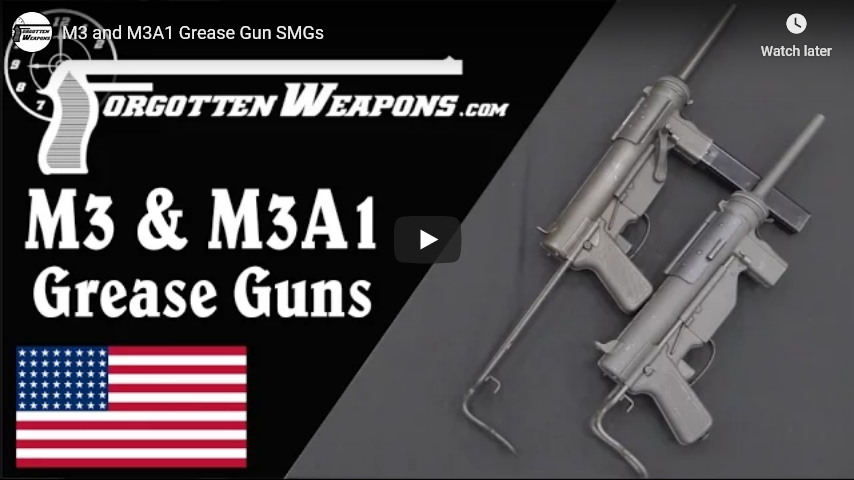
The M3 (and its followup improved M3A1 model) was the United States’ answer to the high cost and manufacturing complexity of the Thompson submachine gun. The M3 “Grease Gun” (because really, that is what it looks like) was a very inexpensive weapon with a stamped and welded receiver and only a few milled parts. It also had the slowest rate of fire of any World War 2 submachine gun at about 450 rounds/minute. Its weight, compactness, and controllability made it almost universally preferred over the Thompson, at least by soldiers who had to carry and fight with either of them.
The Grease Gun is reputedly extremely controllable because of its low rate of fire, but this is my first time to actually try shooting one. Will it live up to that reputation?
Part 1 of a two-part episode on Challenger 2. As David Willey had so much to say about this British in-service vehicle, it has been split into two parts. This first part looks at the design and development of Challenger 2. With thanks to the British Army for their assistance.
The US began looking for a cost-effective replacement for the Thompson submachine gun in 1942, and the “Grease Gun” was the result. Designed by George Hyde (a noted firearms designer at the time) and Frederick Sampson (GM/Inland chief engineer), it was a very simple and almost entirely stamped firearm. Chambered for the .45ACP cartridge, it is notable for its very low rate of fire — 350-400 rpm, which made it quite controllable and easy to shoot for relatively inexperienced troops.
The M3 was a quite reliable gun (and what problems it did have were mostly due to its single-feed magazine and not the gun itself), but a revision program was begun in April 1944. This would produce the M3A1, which further simplified the design by removing the charging handle (which had been the one mechanical trouble point of the M3 anyway) and replacing it simply with a notch in the bolt to cock the gun with a finger.
While the M3 and M3A1 were replaced in front-line service in 1957, they would remain in military inventory as armament for tank crews and truck drivers until 1992 — quite the legacy for such a crude looking weapon!
The M2 Carbine was a mechanically simple modification of the M1 Carbine to allow fully automatic fire. The fire prototypes of the M1 Carbine had actually been selective-fire guns, but that requirement had been dropped by the time the Winchester design was officially adopted as the M1. It was a feature quickly requested by troops once the Carbine entered active service, though.
In 1944 the US Army acknowledged this, and introduced the M2. A total of 217,000 were manufactured at the end of WW2, and did see limited service on Okinawa — and then extensive use in the Korean War and Vietnam War.
The M1 Carbine has long generated controversy among those attempting to rigidly define its role, as it falls awkwardly between the notion of submachine gun and assault rifle, firing a cartridge that is clearly more powerful than a pistol round but equally clearly less powerful than an intermediate rifle round. Its originally intended role was as a personal defense weapon more effective than the 1911 pistol, and in service it always scored high marks for handiness and poor marks for combat effectiveness. The opinion of soldiers using the Carbine in either its M1 or M2 form was very much dependent on what role they expected it to serve.
In my opinion, its light weight and stock design make it a sub-optimal submachine gun, and its light cartridge makes it a sub-optimal assault rifle. But if you need a light and handy carbine to carry a lot and only use in emergencies, it is hard to beat for its time.