
Published on 15 Aug 2016
Check out Othais channel C&Rsenal to learn all about the history of WW1 firearms: https://www.youtube.com/c/candrsenal
We partnered with Othais again a few months ago for a livestream showing the Austro-Hungarian weapons of WW1. This is the 2nd episode about the surprising variety of pistols.
August 16, 2016
Austro-Hungarian Pistols of WW1 I THE GREAT WAR Special feat. C&Rsenal
Comments Off on Austro-Hungarian Pistols of WW1 I THE GREAT WAR Special feat. C&Rsenal
August 7, 2016
Flamethrowers – Anti Aircraft Guns I OUT OF THE TRENCHES
Published on 6 Aug 2016
In this week’s episode we answer your questions about flamethrowers, anti aircraft guns and the role of reserves.
Comments Off on Flamethrowers – Anti Aircraft Guns I OUT OF THE TRENCHES
April 3, 2016
The Trench Cycle – What Happened to Captured Weapons? I OUT OF THE TRENCHES
Published on 2 Apr 2016
In this week’s episode of Out Of The Trenches Indy answers your questions about the trench rotation system, listening posts and captured weapons.
Comments Off on The Trench Cycle – What Happened to Captured Weapons? I OUT OF THE TRENCHES
March 27, 2016
Rifles – WW1 Uncut: Dan Snow
Published on 23 May 2014
http://www.bbc.co.uk/ww1 Dan puts to the test two of the most iconic weapons of the war. The Mauser Gewehr ’98 and the Lee Enfield Short Magazine MkIII were the standard issue rifles for the German and British armies respectively.
Comments Off on Rifles – WW1 Uncut: Dan Snow
March 9, 2016
Austro-Hungarian Rifles of WW1 I THE GREAT WAR – Special feat. C&Rsenal
Published on 7 Mar 2016
Indy and Flo sat down for one of our live streams about historical firearms again. Othais from C&Rsenal explained the various Austro-Hungarian rifles and pistols of the First World War. Among them of course the famous Mannlicher rifles. In our next episode we will also have a look at the iconic Austro-Hungarian pistols.
Comments Off on Austro-Hungarian Rifles of WW1 I THE GREAT WAR – Special feat. C&Rsenal
February 12, 2016
QotD: Military developments from 1870 onwards
The period of Colonial expansion coincided with three major developments in weapon-power: the general adoption of the small-bore magazine rifle, firing smokeless powder; the perfection of the machine gun; and the introduction of quick-firing artillery.
By 1871, the single-shot breech-loading rifle had reached so high a standard of efficiency that the next step was to convert it into a repeating, or magazine, rifle. Although the idea was an old one, it was not fully practicable until the adoption of the all-metal cartridge case, which reduced jamming in the breech. The first European power to introduce the magazine rifle was Germany who, in 1884, converted her 1871 pattern Mauser rifle to the magazine system; the magazine was of the tube type inserted in the fore-end under the barrel, it held eight cartridges. In 1885, France adopted a somewhat similar rifle, the Lebel, which fired smokeless powder — an enormous advantage. Next, in 1886, the Austrians introduced the Mannlicher with a box magazine in front of the trigger guard and below the entrance to the breech. And two years later the British adopted the .303 calibre Lee-Metford with a box magazine of eight cartridges, later increased to ten. By 1900 all armies had magazine rifles approximately of equal efficiency, and of calibres varying from .315 to .256; all were bolt operated, fired smokeless powder, and were sighted to 2,000 yards or metres.
Simultaneously with the development of the magazine rifle proceeded the development of the machine gun — another very old idea. Many types were experimented with and some adopted, such as the improved Gatling, Nordenfeldt (1873), Hotchkiss (1875), Gardner (1876), Browning (1889) and Colt (1895). The crucial year in their development was 1884, when Hiram S. Maxim patented a one barrel gun which loaded and fired itself by the force of its recoil. The original model weighed 40lb., was water cooled and belt fed, and 2,000 rounds could be fired from it in three minutes. It was adopted by the British army in 1889, and was destined to revolutionize infantry tactics.
The introduction of quick-firing artillery arose out of proposals made in 1891 by General Wille in Germany and Colonel Langlois in France. They held that increased rate of fire was impossible unless recoil on firing was absorbed. This led to much experimental work on shock absorption, and to the eventual introduction of a non-recoiling carriage, which permitted of a bullet-proof shield being attached to it to protect the gun crew. Until this improvement in artillery was introduced, the magazine rifle had been the dominant weapon, now it was challenged by the quick-firing gun, which not only outranged it and could be fired with almost equal rapidity, but could be rendered invisible by indirect laying.
J.F.C. Fuller, The Conduct of War, 1789-1961, 1961.
Comments Off on QotD: Military developments from 1870 onwards
January 13, 2016
The death of the duel
ESR has a theory on the rapid decline of the duelling culture that had lasted hundreds of years until the mid-19th century:
I’ve read all the scholarship on the history of dueling I can find in English. There isn’t much, and what there is mostly doesn’t seem to me to be very good. I’ve also read primary sources like dueling codes, and paid a historian’s attention to period literature.
I’m bringing this up now because I want to put a stake in the ground. I have a personal theory about why Europo-American dueling largely (though not entirely) died out between 1850 and 1900 that I think is at least as well justified as the conventional account, and I want to put it on record.
First, the undisputed facts: dueling began a steep decline in the early 1840s and was effectively extinct in English-speaking countries by 1870, with a partial exception for American frontier regions where it lasted two decades longer. Elsewhere in Europe the code duello retained some social force until World War I.
This was actually a rather swift end for a body of custom that had emerged in its modern form around 1500 but had roots in the judicial duels of the Dark Ages a thousand years before. The conventional accounts attribute it to a mix of two causes: (a) a broad change in moral sentiments about violence and civilized behavior, and (b) increasing assertion of a state monopoly on legal violence.
I don’t think these factors were entirely negligible, but I think there was something else going on that was at least as important, if not more so, and has been entirely missed by (other) historians. I first got to it when I noticed that the date of the early-Victorian law forbidding dueling by British military officers – 1844 – almost coincided with (following by perhaps a year or two) the general availability of percussion-cap pistols.
The dominant weapons of the “modern” duel of honor, as it emerged in the Renaissance from judicial and chivalric dueling, had always been swords and pistols. To get why percussion-cap pistols were a big deal, you have to understand that loose-powder pistols were terribly unreliable in damp weather and had a serious charge-containment problem that limited the amount of oomph they could put behind the ball.
This is why early-modern swashbucklers carried both swords and pistols; your danged pistol might very well simply not fire after exposure to damp northern European weather. It’s also why percussion-cap pistols, which seal the powder charge inside a brass casing, were first developed for naval use, the prototype being Sea Service pistols of the Napoleonic era. But there was a serious cost issue with those: each cap had to be made by hand at eye-watering expense.
Then, in the early 1840s, enterprising gunsmiths figured out how to mass-produce percussion caps with machines. And this, I believe, is what actually killed the duel. Here’s how it happened…
Comments Off on The death of the duel
December 30, 2015
German Pistols of World War 1 feat. Othais from C&Rsenal I THE GREAT WAR Special
Published on 28 Dec 2015
In the second part of our German weapons special, Othais introduces us to pistols. Among them are oddities like the Reichsrevolver but also iconic pieces of German engineering like the Luger including the rare Trommelmagazin.
Comments Off on German Pistols of World War 1 feat. Othais from C&Rsenal I THE GREAT WAR Special
December 18, 2015
QotD: The Roman combat system
The constitution of the Imperial legion may be described in a few words. The heavy-armed infantry, which composed its principal strength, was divided into ten cohorts, and fifty-five companies, under the orders of a correspondent number of tribunes and centurions. The first cohort, which always claimed the post of honor and the custody of the eagle, was formed of eleven hundred and five soldiers, the most approved for valor and fidelity. The remaining nine cohorts consisted each of five hundred and fifty-five; and the whole body of legionary infantry amounted to six thousand one hundred men. Their arms were uniform, and admirably adapted to the nature of their service: an open helmet, with a lofty crest; a breastplate, or coat of mail; greaves on their legs, and an ample buckler on their left arm. The buckler was of an oblong and concave figure, four feet in length, and two and a half in breadth, framed of a light wood, covered with a bull’s hide, and strongly guarded with plates of brass. Besides a lighter spear, the legionary soldier grasped in his right hand the formidable pilum, a ponderous javelin, whose utmost length was about six feet, and which was terminated by a massy triangular point of steel of eighteen inches. This instrument was indeed much inferior to our modern fire-arms; since it was exhausted by a single discharge, at the distance of only ten or twelve paces. Yet when it was launched by a firm and skilful hand, there was not any cavalry that durst venture within its reach, nor any shield or corselet that could sustain the impetuosity of its weight. As soon as the Roman had darted his pilum, he drew his sword, and rushed forwards to close with the enemy. His sword was a short well-tempered Spanish blade, that carried a double edge, and was alike suited to the purpose of striking or of pushing; but the soldier was always instructed to prefer the latter use of his weapon, as his own body remained less exposed, whilst he inflicted a more dangerous wound on his adversary. The legion was usually drawn up eight deep; and the regular distance of three feet was left between the files as well as ranks. A body of troops, habituated to preserve this open order, in a long front and a rapid charge, found themselves prepared to execute every disposition which the circumstances of war, or the skill of their leader, might suggest. The soldier possessed a free space for his arms and motions, and sufficient intervals were allowed, through which seasonable reenforcements might be introduced to the relief of the exhausted combatants. The tactics of the Greeks and Macedonians were formed on very different principles. The strength of the phalanx depended on sixteen ranks of long pikes, wedged together in the closest array. But it was soon discovered by reflection, as well as by the event, that the strength of the phalanx was unable to contend with the activity of the legion.
The cavalry, without which the force of the legion would have remained imperfect, was divided into ten troops or squadrons; the first, as the companion of the first cohort, consisted of a hundred and thirty-two men; whilst each of the other nine amounted only to sixty-six. The entire establishment formed a regiment, if we may use the modern expression, of seven hundred and twenty-six horse, naturally connected with its respective legion, but occasionally separated to act in the line, and to compose a part of the wings of the army. The cavalry of the emperors was no longer composed, like that of the ancient republic, of the noblest youths of Rome and Italy, who, by performing their military service on horseback, prepared themselves for the offices of senator and consul; and solicited, by deeds of valor, the future suffrages of their countrymen. Since the alteration of manners and government, the most wealthy of the equestrian order were engaged in the administration of justice, and of the revenue; and whenever they embraced the profession of arms, they were immediately intrusted with a troop of horse, or a cohort of foot. Trajan and Hadrian formed their cavalry from the same provinces, and the same class of their subjects, which recruited the ranks of the legion. The horses were bred, for the most part, in Spain or Cappadocia. The Roman troopers despised the complete armor with which the cavalry of the East was encumbered. Their more useful arms consisted in a helmet, an oblong shield, light boots, and a coat of mail. A javelin, and a long broad sword, were their principal weapons of offence. The use of lances and of iron maces they seem to have borrowed from the barbarians.
Edward Gibbon, “Chapter I: The Extent Of The Empire In The Age Of The Antonines — Part II”, History of the Decline and Fall of the Roman Empire, 1782.
Comments Off on QotD: The Roman combat system
December 14, 2015
The eternal “Ma Deuce”
Strategy Page on one of the longest-serving (and still serving) weapons in the US arsenal:

M2 machine gun (via Wikimedia)
A U.S. Army facility that is upgrading older 12.7mm (.50 caliber) M2 noticed that a lot of the guns coming in were quite old. M2 production began in 1921 and some three million have been produced since then. No one every kept track of how long M2s lasted. That question was recently answered when an M2 came in with serial number 324, meaning it was produced during the first year and was 94 years old. The serial number was on the receiver, the heaviest component of the M2 (25.5 kg/55 pounds in the most common version) and the one component that rarely wears out. In contrast the barrel is worn out after about 3,000 rounds and most other components eventually need replacement because of wear or damage. But the receiver is quite a sturdy block of machined metal.
Unfortunately for 324 the extent of the latest M2 upgrades means that it is often considered cheaper to scrap pre-World War II M2s rather than perform a number of accumulated fixes and modifications. But since 324 is the oldest to show up so far it will be displayed as a museum piece.
The M2 has lasted so long because it proved to be the most reliable and durable machine-gun of any caliber ever produced. That durability meant receivers would, if they could avoid battle damage or accidents, serve on and on. The army is seeing proof of that as more and more quite ancient receivers come back for which are mandatory and army-wide upgrades. Because of thus a lot of weapons NCOs have been checking their inventories and as they did that the word began spreading on the Internet (even army armorers have their own online forums) that there were a lot of very old M2 receivers out there.
November 24, 2015
German Rifles of World War 1 feat. Othais from C&Rsenal I THE GREAT WAR Special
Published on 23 Nov 2015
The next live stream about the Austro-Hungarian rifles and pistols of WW1 will be next Sunday!
Indy and Flo sat down for one of our live streams about historical firearms again. Othais from C&Rsenal explained the various German rifles and pistols of the First World War. Among them of course the famous Gewehr 98 from Mauser and its predecessor, the Gewehr 88. In our next episode we will also have a look at the iconic German pistols such as the Reichsrevolver or the Mauser C96.
Comments Off on German Rifles of World War 1 feat. Othais from C&Rsenal I THE GREAT WAR Special
November 19, 2015
Korea: Admiral Yi – III: The Bright Moonlight of Hansando – Extra History
Published on 10 Oct 2015
While Yi found success at sea, the Korean land army suffered terrible losses. Yi Il, the man who once accused Yi of negligence, lost one battle after another, until finally the regular forces were annihilated at Chungju. The Joseon court that ruled to Korea fled to Pyongyang, on the verge of being pushed out of their own country. But that same day, Admiral Yi tore through a Japanese fleet at Okpo. He moved on to Sacheon, where he baited the Japanese commander into a trap and debuted his turtle ship. The unstoppable turtle ship carried the day, so he used this tactic again and again he destroyed a Japanese fleet while suffering no losses of his own. Finally, Hideyoshi ordered his naval commanders to take Jeolla, Yi’s headquarters. Sadly for him, his general Wakisaka Yasaharu grew too eager and engaged Yi without backup at Gyeonnaeryang Strait, only to find himself lured into an even more sophisticated version of Yi’s bait-and-retreat strategy: a “Crane’s Wing” of ships that collapsed on the overextended target from all sides. In one of the largest naval battles in history, Yi scored a decisive win and again didn’t lose a single ship. He headed to Angolpo to attack Hideyoshi’s two remaining generals and seal his victory, but they refused to be baited. He had to settle for a long range exchange of cannon fire, which worked at the cost of many injuries to his own men. In the end, he destroyed all but a few Japanese ships, and those he only spared to give the Japanese some means to escape and stop raiding in Korea. But he had accomplished his goal: Hideyoshi ordered a halt to all naval operations except guarding Busan, and without this control of the sea, Japan could not re-supply their troops nor hope to resume the assault that would have finally pushed Korea’s leaders out of Korea.
Comments Off on Korea: Admiral Yi – III: The Bright Moonlight of Hansando – Extra History
November 16, 2015
Who Laid The Barbed Wire In No Man’s Land? I OUT OF THE TRENCHES
Published on 14 Nov 2015
Indy sits in the chair of wisdom again to answer your questions. This time we tell you how the barbed wire was laid in No Man’s Land and what fate Luxembourg had in World War 1.
Comments Off on Who Laid The Barbed Wire In No Man’s Land? I OUT OF THE TRENCHES
November 12, 2015
Korea: Admiral Yi – II: Be Like a Mountain – Extra History
Published on 3 Oct 2015
Japan invaded Korea after a series of long civil wars that had finally culminated in Toyotomi Hideyoshi leading a unified Japanese army. Their martial society had trained extensively with weapons like the arquebus, early guns, and the civil war had given them tremendous experience with siegecraft. By contrast, Korea had not been at war for hundreds of years: they were mostly troubled by raiders from without and corrupt government officials from within. However, their unique situation meant that they had great cannons for fighting off pirates and secure if minimal hill-top forts. As a tributary ally of the Chinese, the Koreans were startled and confused when Japan asked permission to march through their territory and make war on China. Many officials thought the Japanese were only bluffing, but Ryu Seong-ryong recognized the threat and made sure his friend Yi was moved to naval service to help defend the country. Yi trained his men and commissioned a new ironside ship design called the Turtle Ship. Unfortunately, other commanders did not take the threat seriously: even when Japanese ships appeared on the horizon, the southern commander convinced himself it was a trade fleet and took no action while the ships docked, then unloaded their soldiers onto Korean soil. The well-trained Japanese army crushed the Korean army and quickly advanced to Seoul. Meanwhile, Yi organized his small fleet of warships and launched quick strikes against the Japanese navy, catching them off-guard and on-patrol. He destroyed 43 enemy ships without losing a single one of his own, and was promoted accordingly to become the new Southern Commander of the Korean navy.
Comments Off on Korea: Admiral Yi – II: Be Like a Mountain – Extra History
November 4, 2015
The XM-25 “Punisher” isn’t dead yet
Five years back, there were interesting reports about a prototype weapon that seemed to have an inside edge for getting into the hands of front-line troops in Afghanistan for specific bunker-busting and similar missions. Then it went silent. Recently, Strategy Page says it may be back in the running:
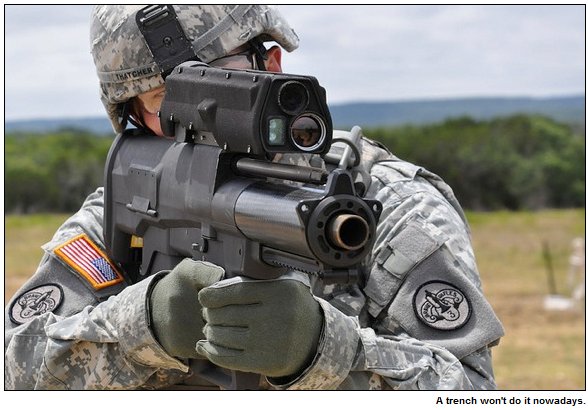
Two years after having its budget sharply cut in 2013 the U.S. Army XM25 grenade launcher is back on track and is now expected to enter service by 2017. It’s been a long road from concept to acceptance and mass production. The army began working on this type of weapon back in the 1990s as the OICW (Objective Individual Combat Weapon) and that mutated into the XM25 (the “X” in XM25 designates a system that is still in development). Since then the similar South Korean K11 and Chinese ZH05 have appeared. The XM25 is the only one of three to have been tested extensively in combat but because of a misfire during a demonstration, budget cuts and some troops finding there were not really that many situations calling for the XM25, the system was thought to be cancelled (development funding was eliminated) in 2013. But the army managed to keep the project on life support. That was mainly because a lot of troops who got to use it in combat liked it a lot and even gave it a nickname; “punisher.”
The initial spectacular success and popularity of the XM25 grenade launchers in Afghanistan led the army to request that the weapon enter regular service as the M25 in 2014. But Congress, looking for ways to reduce military spending in 2013 cut all money for the M25. The army never gave up and managed to scrounge enough cash to build 1,100 of them. Currently the XM25 cost $35,000 each with the 25mm ammo going for $55 per round. Initially SOCOM (Special Operations Command) had some XM25s and some enthusiastic users but in 2013, with few American troops in combat there is not a lot of demand for a weapon like this. The resumption of counter-terrorism efforts in the Middle East and Afghanistan changed that led to more support for reviving the project.
When the first evaluation models of the XM25 arrived in Afghanistan in 2011 the weapon soon became much sought after by infantry troops. There were never more than a few dozen XM25s in Afghanistan and limited supplies of ammunition. Despite that the weapon quickly developed a formidable reputation. The Special Forces had priority on the weapon because it is very useful for special operations missions. The army planned to buy enough so that they could issue one per infantry squad. There are 27 squads in an infantry battalion.
Comments Off on The XM-25 “Punisher” isn’t dead yet


