Quotulatiousness

August 18, 2014

Another look at the Ross Rifle, initial Canadian infantry weapon of WW1

Filed under: Cancon, History, Military, Weapons, WW1 — Tags: , , , , , — Nicholas @ 12:11

Last year, I posted a video by Lickmuffin, showing his recently acquired Ross Mark III, a “sporterized” version of the model that equipped the First Canadian Division when it took the field in France in 1915. Yesterday, David Pugliese revisited the Ross controversy in the Ottawa Citizen:

When soldiers in the throes of battle discard their rifles and pluck a different weapon from the hands of dead allies, there’s clearly a serious problem, writes John Ward of the Canadian Press news service.

So it was with the Ross rifle, the weapon that Canadian soldiers took with them to the start of the First World War a century ago.

More from Ward’s article:

It was the brainchild of Sir Charles Ross, a wealthy Scottish-born engineer and inventor who offered it to the Canadian government as a military firearm well before the war began.

To Sir Sam Hughes, Canada’s minister of militia — defence minister in modern parlance — at the time, the Canadian-built Ross was highly accurate and the perfect tool for his soldiers, whom he saw as frontier marksmen.

But troops, some of whom sneered at the rifle as “the Canadian club,” soon discovered the Ross was not suited to dirty, rough-and-tumble trench warfare. They preferred the robust Lee-Enfield carried by their British comrades, picking them up from the battlefield when they could.

The .303-calibre, straight-pull Ross was longer than the Lee-Enfield, a problem in the cramped confines of the trenches. It was heavier, too, and in a day when infantrymen were over-burdened, any extra weight was unwelcome. When fired with its bayonet attached, it tended to shed the bayonet.

The Ross was also susceptible to jamming from dust and dirt and was very finicky about the quality of ammunition. The carefully machined cartridges made by the Dominion Arsenal worked fine, but not so the mass-produced British ammunition, which could vary in size beyond the Ross’s fine tolerances.

Further, it was easy to reassemble the Ross bolt incorrectly. Even when misassembled, the bolt would fit in the rifle and even chamber and fire a cartridge, only to slam back into the rifleman’s face — unheard of for most bolt-action rifles.

David Pugliese also linked to this Forgotten Weapons video, which investigates the best known failing of the Ross in combat:

Published on 16 Jun 2013

There is a long-standing urban legend about the Canadian Ross rifle, a straight-pull bolt action that was used in lieu of the SMLE by Canadian troops early in World War One. The story is that the Ross would sometimes malfunction and blow the bolt back into its shooter’s face, with pretty horrible results. Well, I wanted to learn “the rest of the story” – could this actually happen? What caused it? How could it be prevented? In short, what would a Ross shooter need to know to remain safe? And if I could get some cool footage of a bolt blowing out of a Ross in the process, all the better.

Well, reader Andy very generously provided a sporterized Ross for the experiments, and I started reading into what the issue really was. Turns out that the legend was quite true – you can put a Ross MkIII bolt together the wrong way, and it will allow you to fire without the locking lugs engaged, thus throwing the bolt back out of the gun at high velocity. However, the issue was recognized fairly quickly, and the vast majority of Ross rifles were modified with a safety rivet to prevent this from happening. It is also quite easy to determine if a Ross is assembled correctly, once you know what to look for.

August 4, 2014

Who is to blame for the outbreak of World War One? (Part six of a series)

Filed under: Britain, Europe, Germany, History, Military, Technology, Weapons, WW1 — Tags: , , — Nicholas @ 00:02

Over the last week, I’ve posted entries on what I think are the deep origins of the First World War (part one, part two, part three, part four, part five). And yes, to be honest, I didn’t think it would take quite this many entries to begin to explain how the world catastrophe of August 1914 came about — putting together this series of blog posts has been educational for me, and I hope it’s been at least of interest to you. The previous post examined the history of the Dual Monarchy of Austria-Hungary, in some detail (yes, it matters). Today, we finally clear the Victorian era altogether and begin to look at the last decade-or-so before the outbreak of the war.

The Anglo-German naval race

Even after the creation of the German Reich in 1871, Germany was not seen (by the British government) to be a major threat to British interests: Germany had no significant presence beyond Europe to worry the Colonial Office, and instead was seen as a potentially useful balancing factor in the European theatre. That all changed with the accession of Kaiser Wilhelm II as explained by Christopher Clark in The Sleepwalkers:

The 1890s were […] a period of deepening German isolation. A commitment from Britain remained elusive and the Franco-Russian Alliance seemed to narrow considerably the room for movement on the continent. Yet Germany’s statesmen were extraordinarily slow to see the scale of the problem, mainly because they believed that the continuing tension between the world empires was in itself a guarantee that these would never combine against Germany. Far from countering their isolation through a policy of rapprochement, German policy-makers raised the quest for self-reliance to the status of a guiding principle. The most consequential manifestation of this development was the decision to build a large navy.

In the mid-1890s, after a long period of stagnation and relative decline, naval construction and strategy came to occupy a central place in German security and foreign policy. Public opinion played a role here — in Germany, as in Britain, big ships were the fetish of the quality press and its educated middle-class readers. The immensely fashionable “navalism” of the American writer Alfred Thayer Mahan also played a part. Mahan foretold in The Influence of Sea Power upon History: 1660–1783 (1890) a struggle for global power that would be decided by vast fleets of heavy battleships and cruisers. Kaiser Wilhelm II, who supported the naval programme, was a keen nautical hobbyist and an avid reader of Mahan; in the sketchbooks of the young Wilhelm we find many battleships — lovingly pencilled floating fortresses bristling with enormous guns. But the international dimension was also crucial: it was above all the sequence of peripheral clashes with Britain that triggered the decision to acquire a more formidable naval weapon. After the Transvaal episode, the Kaiser became obsessed with the need for ships, to the point where he began to see virtually every international crisis as a lesson in the primacy of naval power.

The Royal Navy (RN) had been Britain’s most obvious sign of global dominance, and Britain’s fleets had gone through many technological changes over the century since Waterloo. What had been for centuries a slow, steady process of gradual improvement and incremental change suddenly became the white-hot centre of rapid, even revolutionary, change:

At the same time that you need to add armour to protect the ship, you also need to mount heavier, larger guns. Between placing your order with the shipyard for a new ship, the metallurgical wizards may have (and frequently did) come up with bigger, better guns that could defeat the armour on your not-yet-launched ship. Oh, and you now needed to revise the design of the ship to carry the newer, heavier guns, too.

The ship designers were in a race with the gun designers to see who could defeat the latest design by the other group. It’s no wonder that ships could become obsolete between ordering and coming into service: sometimes, they could become obsolete before launch.

The weapons themselves were undergoing change at a relatively unprecedented rate. As late as the mid-1870′s, a good case could be made for muzzle-loading cannon being mounted on warships: until the gas seal of the breech-loader could be made safe, muzzle-loaders had an advantage of not killing their own crews at distressingly high frequency. Once that technological handicap had been overcome, then the argument came down to the best way to mount the weapons: turrets or barbettes.

The RN’s international prestige invited envious imitators (like Wilhelm) and challengers (the United States Navy and the Imperial Japanese Navy), but the RN was the supreme naval power against which all other nations measured themselves. In 1889, parliament passed the Naval Defence Act, which specified that the Royal Navy would be maintained at the “two-power standard”: that the RN’s fleet of capital ships would be at least equal to the number of battleships maintained by the next two largest navies (at that time, the French and Russian navies). The increased spending allowed ten battleships plus cruisers and torpedo boats to be added to the fleet … but the French and Russian navies added twelve battleships between them over the same period of time. “Another British expansion, known as the Spencer Programme, followed in 1894 aimed to match foreign naval growth at a cost of over £31 million. Instead of deterring the naval expansion of foreign powers, Britain’s Naval Defence Act contributed to a naval arms race. Other powers including Germany and the United States bolstered their navies in the following years as Britain continued to increase its own naval expenditures.”

In The War That Ended Peace, Margaret MacMillan describes the implicit power of the RN in peacetime:

In August 1902 another great naval review took place at Spithead in the sheltered waters between Britain’s great south coast port of Portsmouth and the Isle of Wight, this time to celebrate the coronation of Edward VII. Because he had suddenly come down with appendicitis earlier in the summer, the coronation itself and all festivities surrounding it had been postponed. As a result, most of the ships from foreign navies (except those of Britain’s new ally Japan) as well as those from the overseas squadrons of the British navy had been obliged to leave. The resulting smaller review was, nevertheless, The Times said proudly, a potent display of Britain’s naval might. The ships displayed at Spithead were all in active service and all from the fleets already in place to guard Britain’s home waters. “The display may be less magnificent than the wonderful manifestation of our sea-power witnessed in the same waters five years ago. But it will demonstrate no less plainly what that power is, to those who remember that we have a larger number of ships in commission on foreign stations now than we had then, and that we have not moved a single ship from Reserve.” “Some of our rivals,” The Times warned, “have worked with feverish activity in the interval, and they are steadily increasing their efforts. They should know that Britain remained vigilant and on guard, and prepared to spend whatever funds were necessary to maintain its sovereignty of the seas.”

Admiral Fisher’s new broom

Admiral Sir John "Jackie" Fisher (via Wikipedia)

Admiral Sir John “Jackie” Fisher (via Wikipedia)

In 1904, Admiral Sir John “Jackie” Fisher was appointed as First Sea Lord (the professional head of the RN, reporting to the First Lord of the Admiralty, a cabinet minister). Fisher was a full-steam-ahead reformer, with vast notions of modernizing and reforming the navy. He was brilliant, argumentative, abrasive, tactless, and aggressive but could also be charming and persuasive. “When addressing someone he could become carried away with the point he was seeking to make, and on one occasion, the king asked him to stop shaking his fist in his face.” (Fortunately for Fisher, the king was a personal friend, so this did not hinder his career.)

Margaret MacMillan describes him in The War That Ended Peace:

Jacky Fisher, as he was always known, shoots through the history of the British navy and of the prewar years like a runaway Catharine wheel, showering sparks in all directions and making some onlookers scatter in alarm and others gasp with admiration. He shook the British navy from top to bottom in the years before the Great War, bombarding his civilian superiors with demands until they usually gave way and steamrollering over his opponents in the navy. He spoke his mind freely in his own inimitable language. His enemies were “skunks”, “pimps”, “fossils”, or “frightened rabbits”. Fisher was tough, dogged and largely immune to criticism, not surprising perhaps in someone from a relatively modest background who had made his own way in the navy since he was a boy. He was also supremely self-confident. Edward VII once complained that Fisher did not look at different aspects of an issue. “Why should I waste my time,” the admiral replied, “looking at all sides when I know my side is the right side?”

Fisher had been a maverick throughout his career (which makes it even more amazing that he eventually did rise to become First Sea Lord), as his actions when he took command of the Mediterranean Fleet clearly illustrate:

A programme of realistic exercises was adopted including simulated French raids, defensive manoeuvres, night attacks and blockades, all carried out at maximum speed. He introduced a gold cup for the ship which performed best at gunnery, and insisted upon shooting at greater range and from battle formations. He found that he too was learning some of the complications and difficulties of controlling a large fleet in complex situations, and immensely enjoyed it.

Notes from his lectures indicate that, at the start of his time in the Mediterranean, useful working ranges for heavy guns without telescopic sights were considered to be only 2000 yards, or 3000-4000 yards with such sights, whereas by the end of his time discussion centred on how to shoot effectively at 5000 yards. This was driven by the increasing range of the torpedo, which had now risen to 3000-4000 yards, necessitating ships fighting effectively at greater ranges. At this time he advocated relatively small main armaments on capital ships (some had 15 inch or greater), because the improved technical design of the relatively small (10 inch) modern guns allowed a much greater firing rate and greater overall weight of broadside. The potentially much greater ranges of large guns was not an issue, because no one knew how to aim them effectively at such ranges. He argued that “the design of fighting ships must follow the mode of fighting instead of fighting being subsidiary to and dependent on the design of ships.” As regards how officers needed to behave, he commented, “‘Think and act for yourself’ is the motto for the future, not ‘Let us wait for orders’.”

Lord Hankey, then a marine serving under Fisher, later commented, “It is difficult for anyone who had not lived under the previous regime to realize what a change Fisher brought about in the Mediterranean fleet. … Before his arrival, the topics and arguments of the officers messes … were mainly confined to such matters as the cleaning of paint and brasswork. … These were forgotten and replaced by incessant controversies on tactics, strategy, gunnery, torpedo warfare, blockade, etc. It was a veritable renaissance and affected every officer in the navy.” Charles Beresford, later to become a severe critic of Fisher, gave up a plan to return to Britain and enter parliament, because he had “learnt more in the last week than in the last forty years”.

One of his first changes was to sell nearly one hundred elderly ships and move dozens of less capable vessels from the active list to the reserve fleet, to free up the crews (and the maintenance budget) for more modern vessels, describing the ships as “too weak to fight and too slow to run away”, and “a miser’s hoard of useless junk”. Between his reforms as Third Sea Lord (where he had championed the development of the modern destroyer and vastly increased the efficiency and productivity of the shipyards) and his new role as First Sea Lord, Fisher was able to get more done even on a budget that dropped nearly 10% in the year of his appointment than his predecessor had managed.

HMS Dreadnought and the naval revolution

Fisher was not a naval designer, but he knew how to push new ideas to the front and get them adopted. The one thing that most people remember him for is the revolutionary battleship HMS Dreadnought, the first all big gun, fast steam turbine powered battleship, and when she went into commission, she signified the obsolescence of every other capital ship in every navy from that moment onwards.

HMS Dreadnought underway, circa 1906-07

HMS Dreadnought underway, circa 1906-07

Dreadnought was the platonic ideal of a battleship: she was faster than any other capital ship in any other navy, her guns were at least the equivalent in range, rate of fire, and throw of shot, and her armour was sufficient to allow her to take punishment from opposing ships and still deal out damage herself. She was the first British ship to be equipped with electrical controls allowing the entire main armament to be fired from a central location. Thanks to Fisher’s earlier efforts with the shipyards, Dreadnought took just a year to build — far faster than any other battleship had been built.

The “entirely crazy Dreadnought policy of Sir J. Fisher and His Majesty”

The Kaiser was not happy with the new British battleship, as it had been German policy since his accession to build up the German navy to at least provide a tool for pressuring Britain (if not for actually confronting the Royal Navy in battle). Now his entire naval plan had been upset by the Dreadnought revolution. Margaret MacMillan:

As far as the Kaiser and [Admiral] Tirpitz were concerned the responsibility for taking the naval race to a new level rested with what Wilhelm called the “entirely crazy Dreadnought policy of Sir J. Fisher and His Majesty”. The Germans were prone to see Edward VII as bent on a policy of encircling Germany. The British had made a mistake in building dreadnoughts and heavy cruisers, in Tirpitz’s view, and they were angry about it: “This annoyance will increase as they see that we follow them immediately.” […] Who could tell what the British might do? Did their history not show them to by hypocritical, devious and ruthless? Fears of a “Kopenhagen”, a sudden British attack just like the one in 1807 when the British navy had bombarded Copenhagen and seized the Danish fleet, were never far from the thoughts of the German leadership once the naval race had started.

German fears of British attack increased almost in lockstep with British fears of German attack (William Le Queux had his equivalents among the German press and popular novelists). The thought had actually occurred to Fisher himself, who outlined a possible coup de main against the German fleet. The king responded “My God, Fisher, you must be mad!” and the suggestion was ignored, thankfully.

The popular worries about an attack from Britain fed the support for the German Navy laws, which funded dreadnought and battlecruiser building programs. In direct proportion, the increased German support for their naval expansion worked to the advantage of British politicians who wanted to build more dreadnoughts of their own. And, in fairness, Britain risked far more by allowing an enlarged German navy than Germany risked by stopping their building program … but in either case, the fear of popular unrest kept the shipyards humming anyway. As Churchill later wrote, “The Admiralty had demanded six ships; the economists offered four; and we finally compromised on eight.”

There we go, finally getting within striking distance of the triggering events of the First World War … and I’m still not sure how many more posts it will take to get us there! More to come this week.

July 21, 2014

The science of ballistics, the art of war, and the birth of the assault rifle

Filed under: History, Military, Technology, Weapons — Tags: , , , — Nicholas @ 15:47

Defence With A “C” summarizes the tale of how we got to the current suite of modern military small arms. It’s a long story, but if you’re interested in firearms, it’s a fascinating one.

To understand why we’ve arrived where we are now with the NATO standard 5.56mm calibre round you have to go all the way back to the war of 1939-1945. Much study of this conflict would later inform decision making surrounding the adoption of the 5.56, but for now there was one major change that took place which would set the course for the future.

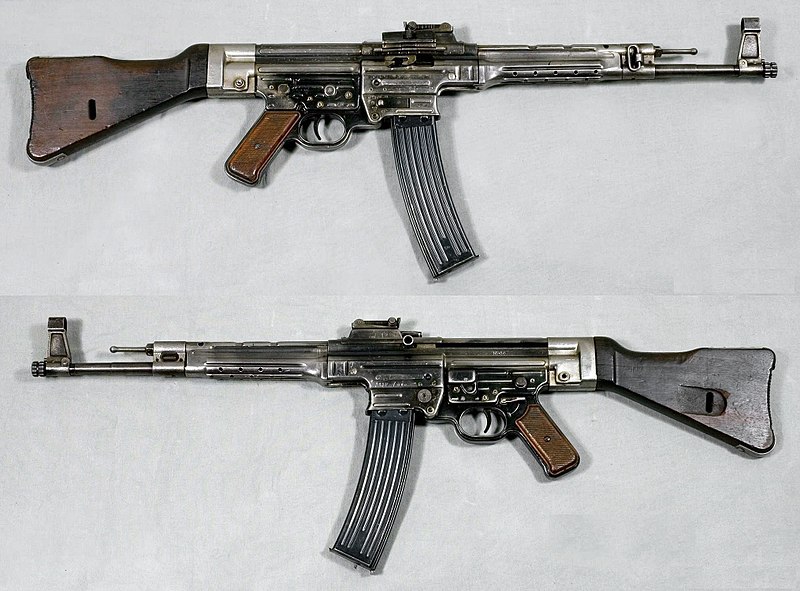
The German Sturmgewehr 44 is widely accepted as the worlds first true assault rifle. Combining the ability to hit targets out to around 500 yards with individual shots in a semi-automatic mode, as well as the ability to fire rapidly in fully automatic mode (almost 600 rounds per minute) the StG 44 represented a bridge between short ranged sub-machine guns and longer ranged bolt action rifles.

[…]

After the second world war the US army began conducting research to help it learn the lessons of its previous campaigns, as well as preparing it for potential future threats. As part of this effort it began to contract the services of the Operations Research Office (ORO) of the John Hopkins University in Baltimore, Maryland, for help in conducting the scientific analysis of various aspects of ground warfare.

On October 1st, 1948, the ORO began Project ALCLAD, a study into the means of protecting soldiers from the “casualty producing hazards of warfare“. In order to determine how best to protect soldiers from harm, it was first necessary to investigate the major causes of casualties in war.

After studying large quantities of combat and casualty reports, ALCLAD concluded that first and foremost the main danger to combat soldiers was from high explosive weapons such as artillery shells, fragments from which accounted for the vast majority of combat casualties. It also determined that casualties inflicted by small arms fire were essentially random.

Allied troops in WW2 had been generally armed with full-sized bolt action rifles (while US troops were being issued the M1 Garand), optimized to be accurate out to 600 yards or more, yet most actual combat was at much shorter ranges than that. Accuracy is directly affected by the stress, tension, distraction, and all-around confusion of the battlefield: even at such short ranges, riflemen required many shots to be expended in hopes of inflicting a hit on an enemy. The ORO ran a series of tests to simulate battle conditions for both expert and ordinary riflemen and found some unexpected results:

A number of significant conclusions were thus drawn from these tests. Firstly, that accuracy — even for prone riflemen, some of them expert shots, shooting at large static targets — was poor beyond ranges of about 250 yards. Secondly, that under simulated conditions of combat shooting an expert level marksman was no more accurate than a regular shot. And finally that the capabilities of the individual shooters were far below the potential of the rifle itself.

This in turn — along with the analysis of missed shots caught by a screen behind the targets — led to three further conclusions.

First, that any effort to try and make the infantry’s general purpose weapon more accurate (such as expensive barrels) was largely a waste of time and money. The weapon was, and probably always would be, inherently capable of shooting much tighter groups than the human behind it.

Second, that there was a practical limit to the value of marksmanship training for regular infantry soldiers. Beyond a certain basic level of training any additional hours were of limited value*, and the number of hours required to achieve a high level of proficiency would be prohibitive. This was particularly of interest for planning in the event of another mass mobilisation for war.

July 17, 2014

Israel’s Iron Dome systems

Filed under: Middle East, Military, Weapons — Tags: , , , — Nicholas @ 00:01

Austin Bay discusses the relative success of the Israeli anti-missile defence system called Iron Dome:

According to the Israeli government, in this latest round of Israel-Hamas combat, Israel’s Iron Dome missile defense system has (so far) intercepted 90 percent of targeted incoming Hamas rockets.

Iron Dome is a very sophisticated tactical (short-range) anti-missile and anti-artillery projectile defense system. In terms of combat operations, Iron Dome’s “sensor-shooter” system is a drastically scaled-down strategic anti-missile defense system, a mini-ABM system in the mold of the Reagan administration’s Strategic Defense Initiative. In fact, Iron Dome is an SDI descendant and a cousin of the current U.S. Missile Defense program. I will return to the cousin connection in a moment.

For good reason the 2006 Israel-Lebanese Hezbollah War is also called “The Rocket War.” Hezbollah fired several thousand unguided rockets into Israeli territory.

Human Rights Watch, a non-governmental human rights organization, accused Hezbollah and the Israeli Defense Forces of launching “indiscriminate” attacks that killed civilians on both sides of the border. As usual, HRW’s legalistic accusations against Israel received more international media attention. Though Hezbollah rocketeers frequently fired from positions within civilian neighborhoods (as Hamas rocket teams are doing in 2014), HRW argued that the Israelis “failed to distinguish between civilian and military targets.” HRW berated the IDF for employing cluster munitions.

However, to its credit, HRW’s detailed 2007 investigation of Hezbollah confirmed the harsh but obvious conclusion that Hezbollah had “deliberately targeted” civilian areas within Israel. HRW’s report concluded that, “Hezbollah repeatedly fired rockets in the direction of civilian-populated areas in which there was no evident military target.”

An HRW press release summarizing the investigation said that indiscriminate rocket fire directed at densely populated civilian neighborhoods “killed or injured civilians in Jewish, Arab and mixed villages, towns and cities.” In other words, Hezbollah wanted to spill civilian blood — lots of blood — and if it happened to be Arab blood, so be it.

[…]

In the last two weeks, Iron Dome has demonstrated that it can successfully protect people. Several press reports have noted the Israeli claim that Iron Dome’s demonstrated capabilities have given the Israeli government something very precious in a crisis: time. Instead of facing demands to strike back immediately, the government can consider military and political options.

July 16, 2014

Rolling Stone is your top source for reliable, informative gun news

Filed under: Media, Technology, USA, Weapons — Tags: , , — Nicholas @ 08:10

The folks at Rolling Stone are concerned for your safety, so they’ve helpfully put together a primer on the five “most dangerous” guns in America. Because they love you, America:

Rolling Stone dangerous guns 3

Yes, we’re apparently talking about grenade launchers here. I didn’t even know grenade launchers were available to civilians. Awesome!

Rolling Stone dangerous guns 5

Wait, “the explosive that creates the energy to fire the gun occurs in the fixed shell of a shotgun rather than the metallic cartridge of a rifle”. Why would I expect the charge that propels the shot out of a shotgun to be ignited in a rifle cartridge? Is this some sort of magic that allows you to fire a different weapon than the one you’re holding? No wonder Rolling Stone thinks this is such a dangerous weapon!

H/T to Charles C. W. Cooke for the link.

June 8, 2014

Modern weapons would make a D-Day style landing almost impossible

Filed under: Military, Technology, Weapons — Tags: , , , — Nicholas @ 11:34

At The Diplomat, Zachary Keck looks at how the evolution of military technology would make future D-Day style invasions much more difficult:

Seaborne invasions are one of, if not the most, difficult kind of military operation. That is partially why, as Mearsheimer points out, the great stopping power of water is so consequential in international politics. At first glance, it might seem like the innovations in transportation and communication technology that have triggered globalization would make contemporary amphibious assaults easier

Not so, however. To begin with, many of the basic challenges that have always plagued seaborne invasions are rooted in geography, which remains relatively fixed. Namely, the defending force in amphibious invasions are usually heavily fortified while the landing force typically has to initially fight in the open. The landing force also remains extremely vulnerable before actually reaching land, especially since the defending force can rely on land-based defense systems.

In fact, as Stratfor, a private global intelligence firm, points out, modern defense technologies have made amphibious assaults much more difficult. The most “significant development” since World War II, Stratfor points out, is precision-guided munitions (these did exist in rudimentary form during the conflict). The analysis goes to explain:

“A contemporary landing force would approach the beachhead in an amphibious landing vehicle such as the U.S. Assault Amphibious Vehicle, which moves at around 13 kph (8 mph). This would be vulnerable to anti-tank guided missiles fired from positions onshore. On D-Day, ships in the Allied invasion fleet were also able to come relatively close to shore to deploy landing craft. The deadly threat of anti-ship cruise missiles in modern warfare would force a modern fleet to remain farther out to sea, leaving amphibious vehicles even more exposed.”

This last point is especially important. As Sydney Freedberg noted back in April, “The new [Marine] Corps concept, Expeditionary Force 21, predicts long-range threats will force the fleet to stay at least 65 nautical miles offshore, a dozen times the distance that existing Marine amphibious vehicles are designed to swim.”

Smaller invasions against undefended coastline — think of both the initial Argentinian attack on the Falkland Islands and the British counter-attack as examples — are still possible, especially in bolt-from-the-blue surprise fashion, but an attack against an active defence with modern weapons might well be unacceptably hard for even the US Marine Corps.

May 14, 2014

Turning pixel weapons into bronze and steel

Filed under: Gaming, Technology, Weapons — Tags: , — Nicholas @ 07:41

I thought this Geek & Sundry project might be interesting. It’s called Arcade Arms and the idea is they take a weapon from an online game and try to create a real-world version, then use that to see what kind of damage you can do with it. The first episode is about a massively oversize mace from the game Elder Scrolls Online:

Published on 13 May 2014

Jake Powning shows Nika Harper how to forge the Mace of Molag Bal, featured in The Elder Scrolls series. Then Andre Sinou shows her how much damage a mace can really do!

Get Elder Scrolls Online for yourself: http://www.elderscrollsonline.com

In Arcade Arms Nika brings gaming into real life by taking the most potent digital weapons, from Final Fantasy XIV‘s Gae Bolg to Elder Scrolls Online‘s Mace of Molag Bal, and smashing things with their real life counterparts.

Real world downer note: most single-handed weapons were significantly lighter than this fantasy mace: it clocks in at 35 pounds, which is a lot more weight than you’d be able to swing in a real fight (their combat demonstrator also points this out … and note how much smaller the examples he shows are compared to the “Mace of Molag Bal”).

I’d hoped there would be more “how we made this” footage, but I understand the majority of the audience only really want to see how much damage the weapon can do…

March 29, 2014

China’s “barbarian-handling tools” date back 2,000 years

Filed under: China, History, Military, Weapons — Tags: , , — Nicholas @ 09:35

Edward Luttwak describes the very first time China was able to bring powerful “barbarians” into a tributary state, and how that first success has become a key element of Chinese geostrategic thought ever since:

It is this successful transformation of a once superior power first into an equal (signified by imperial marriages) and then into a subservient client-state that seems to have left an indelible residue in China’s tradition of statecraft. It was achieved with a specific “barbarian-handling” tool box first described by its early practitioner, the scholar and imperial advisor Lou Jing (婁敬) 199 BCE. His method was first applied when the Xiongnú [匈奴 horse-nomad state] were still very strong and the Han were not only tactically inferior (their chariots were totally obsolete for fighting mounted archers) but also beset by political divisions, so much so that a 198 BCE4 treaty required the payment of an annual tribute in kind (silk, grain, etc.), and the formal attestation of equality for the Chanyu [Qagan, Khan] embodied in a marriage alliance, formalized by imperial letters that make the equality fully explicit.

The first barbarian-handling tool is normally translated as “corruption” in English translations, but perhaps “addiction,” or more fully “induced economic dependence” are more accurate: the originally self-sufficient Xiongnú were to be made economically dependent on Han-produced goods, starting with silk and woolen cloths instead of their own rude furs and felt. At first supplied free as unrequited tribute, these goods could still be supplied later on when the Han were stronger, but only in exchange for services rendered.

The second tool of barbarian handling, is normally translated as “indoctrination”: the Xiongnú were to be persuaded to accept the authoritarian Confucian value system and the collectivistic behavioral norms of the Han, as opposed to the steppe value system, based on voluntary allegiance to a heroic (and successful in looting) fighting and migration leader. One immediate benefit was that once the Chanyu’s son and heir married an imperial daughter, he would be ethically subordinated to the emperor as his father-in-law — remaining so when he became Chanyu in turn.

The much larger, longer-term benefit of the second tool was to undermine the entire political culture of the Xiongnú, and make them psychologically well as economically dependent on the imperial radiance, which was willingly extended in brotherly fashion when the Han were weak, and then contemptuously withdrawn when the Xiongnú were reduced to vassalage. What happened between the Han and the Xiongnú from the equal treaty of 198 BCE to the vassalage treaty of 51 BCE, remained thereafter, and still remains today the most hopeful precedent for Han dealings with powerful and violent states — evidently the assigned role of the United States in the present Beijing world-view.

The method forms a logical sequence:

Stage One: start by conceding all that must be conceded to the superior power including tribute, in order to avoid damage and obtain whatever forbearance is offered. But this in itself entangles the ruling class of the still-superior power in webs of material dependence that reduce its independent vitality and strength.

Stage Two: offer equality in a privileged bipolarity that excludes all lesser powers, or “G-2” in current parlance. That neutralizes the still powerful Other party, and isolates the manipulated soon-to-be former equal from all its potential allies, preventing from balancing China with a coalition.

Stage Three: finally, when the formerly superior power has been weakened enough, withdraw all tokens of equality and impose subordination.

Until the Chinese government decided — very prematurely I believe — to awaken the world to its classically imperial territorial ambitions by demanding the cession of lands, reefs, rocks, and sea waters from India, Japan, Malaysia, the Philippines, and Vietnam (demands that disturb and damage the concurrent Tianxia narrative of an alternative and more harmonious state system, disseminated even within the confines of Stanford University), it was making much progress towards Stage Two, the stage of equality preparatory to the final stage of subordination.

March 21, 2014

Byzantium’s secret weapon

Filed under: Europe, History, Weapons — Tags: , , — Nicholas @ 07:50

Military History Now had a guest post from Κonstantinos Karatolios talking about the Byzantine secret weapon known as “Greek Fire”:

The thousand-year Byzantine Empire could not have survived through the centuries without its powerful military. But Constantinople’s mighty army and navy didn’t just keep enemies at bay, they also helped it to expand into new territories and ultimately dominate the whole of the Mediterranean for hundreds of years. Of course, while the Byzantines’ stunning battlefield success was in part a by-product of military knowledge inherited from the old Roman Empire, it was also born out of new tactics and weaponry. One example of this is Greek fire. Also known as thalassion pyr, skeyaston pyr and medikon elaion, this incendiary liquid, which could be squirted or hurled into the ranks of an enemy, was perhaps the most fearsome of all of the empire’s armaments. Its use, whether on land or sea, verges on legend and yet almost all we know about Greek fire remains clouded in mystery. We are sure of one thing however — it was used with devastating effect throughout the whole course of the Byzantine Empire.

Here are nine little known facts about Greek fire.

I think there’s a typo in the list, as it mentions the first recorded use of the weapon by Anastasios I in 541, which was actually the middle of the reign of Justinian I. Anastasios I reigned from 491 to 518.

March 18, 2014

Updating David’s sling, outraging Italian politicians

Filed under: Business, Europe, Italy, Media, Weapons — Tags: , , , — Nicholas @ 07:41

Virginia Postrel diagnoses the real reason politicians are upset about Armalite’s updated image of David’s armament:

David and the Armalite

Italian authorities were indignant when they discovered that the Illinois weapons maker ArmaLite had an advertising campaign showing Michelangelo’s David holding one of its rifles. “The advertisement image of an armed David offends and violates the law,” tweeted tourism minister Dario Franceschini. Angel Tartuferi, director of the Accademia Gallery, which houses the sculpture, agreed: “The law says that the aesthetic value of the work cannot be altered.”

This moral posturing is clearly about something other than respect for the sculpture’s “aesthetic value” or “cultural dignity.” Otherwise, officials would crack down on the David boxer shorts sold by countless Florentine vendors. And where was the outrage in 1981, when the David was flogging Rush brand poppers, amyl nitrite drugs used to enhance sexual pleasure, in magazines aimed at gay men?

It seems that it’s fine to use the David to sell things as long as you emphasize his nudity rather than his meaning.

[…]

ArmaLite’s ads broke the unwritten rules. Instead of highlighting the hero’s body, they emphatically made him a warrior. Hence Franceschini’s objection to an “armed David,” even though every David is armed. “David famously used a slingshot to defeat the giant Goliath, making the gun imagery, thought up by the Illinois-based ArmaLite, even more inappropriate,” writes Emma Hall in Ad Age.

To the contrary, the gun imagery, while incongruously machine-age, was utterly appropriate. David did not use a “slingshot.” He used a sling. As historians of ancient warfare — and readers of Malcolm Gladwell’s latest book, David and Goliath — know, a sling was no child’s toy. It was a powerful projectile weapon, a biblical equivalent of ArmaLite’s wares.

March 11, 2014

Stop That Tank!

Filed under: Cancon, History, Military, Weapons, WW2 — Tags: , , , — Nicholas @ 00:01

Published on 31 May 2013

During World War II, the Disney company joined in the Allied war effort by producing animated movie material at cost for the US government (they also created insignia mascots for hundreds of aircraft and warships by request). These films number well over one hundred – although most are only partially created by Disney – and cover topics from antenna tuning to Beechcraft airplane maintenance to anti-German and Japanese propaganda. However, one piece in particular is of interest to us here at Forgotten Weapons: Stop That Tank!

Produced in 1942 for the Canadian military, it is a training film on the operation and maintenance of the Boys anti-tank rifle. The Disney contribution is in animated x-ray views of the various parts of the gun, and about 3 minutes of introduction featuring a section of Nazi tanks (the lead one driven by none other than Adolf Hitler) being surprised and driven back by a bunch of plucky doughboys hiding Boys AT rifles in bushes, outhouses, and horses.

The intro is pretty hilarious, but the meat of the film is actually a very informative piece on how the Boys works and how to use it. There are a couple copies of this already on YouTube, but thanks to reader Frank, we have this nice high-quality version.

Just one thing: if it was a Canadian film, there wouldn’t be any “doughboys” involved…

H/T to Think Defence for the link. They’ve also got a video of a modern shooter firing the Boys ATR (not using the original ammunition, this has been refitted to fire .50 BMG).

February 28, 2014

“Reenactment’s for pussies”

Filed under: Europe, History, Russia, Sports, Weapons — Tags: , , — Nicholas @ 13:39

The SCA or Western Martial Arts not macho enough for you? You might be interested in medieval combat with steel weapons:

Steel kisses steel. Actual sparks fly. An axe snaps in half as it dents a helmet. A municipal garbage bin, carelessly left at the fringes of the fight, implodes in a sorry mess of dented plastic as four armored men collapse onto it.

I’m witnessing, from the far side of a flimsy rope, something much more violent than your average historical battle reenactment. These men are engaging in full-contact medieval combat in an open training session for the U.K. iteration of a growing global society. More GBH than LARP, it substitutes foam weaponry for real steel and scripted acting for unpredictable scuffling, and despite the mayhem, operates under tightly controlled rules and regulations.

[…]

The team’s press officer, Nick Birkin, agrees. “Reenactors are used to dink, dink,” he says, mimicking the prissy swordplay anyone who’s sat through a retelling of Agincourt will no doubt cringe to recall. Another weekend warrior sums up the distinction more succinctly: “Reenactment’s for pussies.”

I first heard about the Russian origins of this new organization from a co-worker who was still upset he’d had to leave his chainmail and weapons behind when he came to Canada from St. Petersburg. It sounded like great fun … but was significantly more injury-prone than the SCA combat of my youth.

The Russian connection also brings with it some aspects that make Western practitioners uncomfortable:

The West’s notions of fair play and how an international tournament should be run are, it would seem, at odds with that of the East’s. Dissent has been stirring among the camps and honor was called into question on several sides, and complaints started to be raised about the Russian organizers. The first to percolate were stories about rule-changing and underhand tournament organization.

“They said that under no circumstances can you have a metal handle on your shield, and that you can’t wear titanium armor,” U.S. team captain Andre Sinou tells me later over the phone from his native New Jersey. Sinou is also the owner of an armory manufacturer called Icefalcon. “So I told my guys that. Then when we went out there, all the Eastern teams had metal handles. We complained, and they said, ‘Oh, we sent out a memo’, which none of the Western countries got.”

Many of the Eastern fighters were wearing Kevlar armor under their suits and came with lethal equipment — such as two-handled halberd axes — that was banned for anyone else. “The weapons that some of the Eastern teams were using were just dangerous,” Sinou says. “They were pointy, they didn’t follow the rules for sharpness. After 2013, we had puncture wounds — we had a meaty guy who got punctured all the way down to the bone on the shoulder. It hit his spine. He could have been paralyzed.”

Nick Birkin from Team U.K. echoes many of these complaints and adds his own stories of match fixing, detailing devious techniques that would put a Sochi figure-skating judge to shame and which apparently allowed Russian teams to progress further and enjoy longer rest breaks between contests. But the growing concerns of an increasing number of countries was met by a response almost laughably Kafkaesque.

H/T to Steve Muhlberger for the link.

February 24, 2014

Euromaidan’s pseudo-medieval technological battle with Berkut

Filed under: Europe, Politics, Weapons — Tags: , , — Nicholas @ 10:59

Robert Beckhusen on the throwback to the Middle Ages in the fighting between the Euromaidan protestors and the paramilitary Berkut police:

But to understand why the protests succeeded in toppling Yanukovych, it’s worth taking a glance at its strategies and military-style tactics. The protesters not only built a broad and inclusive coalition, but innovated where it mattered most: on the streets.

Really, it turned medieval.

Protesters shot fireworks with makeshift launchers. In combination with throwing stones and using slingshots, they overwhelmed disoriented Berkut special forces units, who were pelted with flying objects as fireworks exploded around them.

Protesters wore military helmets and carried makeshift — or captured — shields. Wooden boards were used to protect their lower legs from shrapnel the police taped to exploding stun grenades.

Among the array of homemade weapons, some were perhaps a little too ambitious. A crude trebuchet — a type of medieval catapult which uses a counterweight to fling objects — was overrun and dismantled.

To shield themselves from the onslaught, the police special forces units known as Berkut adopted distinct tetsudo formations. This packed shield formation was used by the Roman Empire, developed to shield infantry units from arrows. The first line holds its shields forward, with each preceding line holding their shields towards the sky.

The problem with this tactic? It makes you much slower.

February 17, 2014

Looking forward by looking backward – military evolution

Filed under: History, Military, Technology, Weapons — Tags: , , , — Nicholas @ 11:52

Strategy Page discusses the problems of predicting the future … which isn’t just a task for science fiction writers:

How will warfare change in the next 30 years? Military leaders, and the people they protect, are always trying to figure this out. There’s an easy way to get some good insight on the future. Simply go back 120 years (1894) and note the state of warfare and military technology at the time, then advance, 30 years at a time, until you reach 2014. At that point, making an educated guess at what 2044 will be like will like will be, if not easy, at least a lot less daunting.

In 1894, many infantry were still using single shot black powder rifles. Change was in the air though, and the United States had just begun to adopt the newfangled smokeless powder, a few years after it became widely available. In 1894 American troops were still replacing their black power rifles with a smokeless powder model (the Krag-Jorgensen). The modern machine-gun had been invented in 1883 but armies took about two decades before they began adopting them on a large scale. Most artillery was still short ranged, not very accurate, and could only fire at targets the crew could see. Horses pulled or carried stuff and the infantry marched a lot when they were not being moved long distances by railroad or steamships. But the modern, quick-firing artillery was recently introduced and still unproven in battle. Communications still relied on the telegraph, a half century old invention that revolutionized, in only a few decades, the way commanders could talk to each other over long distances. They could now do it in minutes. This was a big change for warfare. Very big. At this time telephones were all local and not portable. Cavalry was still important for scouting, although less useful for charging infantry (a trend that began when infantry got muskets with bayonets two centuries earlier).

[…]

So what does this portend for 2044? Faster and deadlier, for sure. Information war will be more than a buzzword by then because better sensors and data processing technology will make situational awareness (knowing where you and your enemy are, knowing it first, and acting on it before the other guy does) more decisive than ever.

If the expected breakthrough in batteries (fuel cells) evolves as reliably and cheaply as expected, the 2040s infantryman will be something of a cyborg. In addition to carrying several computers and sensor systems, he might wear body armor that also provides air conditioning. Satellite communications, of course, and two way video. Exoskeletons are already in the works and may mature by then. A lot depends on breakthroughs in battery tech although engineers are also finding to do more with just a little juice. Historians tend to constantly underestimate the cleverness of engineers and inventors in general.

But the big new development will be the continued evolution of robotic weapons. The World War II acoustic torpedo (used by the Germans and the allies, from subs as well as the air) was the first truly robotic weapon. You turned it lose and it would hunt down its prey and attack. There may be a lot of public uproar over land based systems that have sensors, can use them to hunt, and have weapons that can be used without human intervention. But those systems will be easy and cheap to build by 2044, and as soon as one nation builds them others will have to follow. By 2044, machines will be fighting other machines more often than they will be looking for the stray human on the battlefield.

But there will be other developments that are more difficult to anticipate. In 1894 most of the 1924 technologies were already known in a theoretical sense. Same with the 1954 technologies in 1924 and so on. What is most difficult to predict is exactly how new tech will be employed. There will be imagination and ingenuity involved there, and that sort of thing is, by its very nature, resistant to prediction.

January 27, 2014

The not-so-humble torpedo and the genesis of the military-industrial complex

Filed under: History, Military, Technology, USA, Weapons, WW1 — Tags: , , — Nicholas @ 10:18

In the Boston Globe, Katherine C. Epstein makes a strong case for the origin of the military-industrial complex not being the era that President Eisenhower warned about, but actually in the run-up to the First World War:

The phrase [Eisenhower] popularized to describe the emerging system — the “military-industrial complex” — has since become a watchword, and Eisenhower’s account of its rise has struck most observers as accurate: It was a product of an immense war effort and the new attitudes spawned in the aftermath.

But what if Eisenhower — and others — had the origin story wrong? Although the military-industrial complex unquestionably became far larger and more deeply entrenched as a result of World War II and the Cold War, a closer reading of the history suggests that its essential dynamics were actually decades older. An armaments industry in close collaboration with the military — coping with global and national arms markets, sophisticated technology, intense geopolitical rivalries, and a government prone to expand its power in the name of national security — had its roots in the way geopolitics, industrialization, and globalization collided at the turn of the 20th century. And one key innovation that helped to tip the United States over into the national security regime that we recognize today was, of all things, the torpedo.

The torpedo didn’t just threaten to change naval warfare. It was a sophisticated new weapon so important to the US Navy that it forced the government to form a novel relationship with industry — and to introduce the trump card of national security as a rationale for demanding secrecy from private companies. The policy that developed along with the torpedo set the terms for the efforts to control information in the name of national security that we’re seeing now. To appreciate just how far back that policy runs — back to a time not of war, but of peace — gives us a new lens on our current struggles over the military-industrial complex, and perhaps a different reason to worry.

« Newer PostsOlder Posts »

Powered by WordPress