
World War Two
Published 2 Apr 2022American attacks in Tunisia meet with local disaster, but in general the Axis forces are withdrawing there. The Allies learn about the German rocketry plans this week, and both sides are making plans for action in the Pacific.
(more…)
April 3, 2022
Patton Has a Plan, and it’s Bad – WW2 – 188 – April 2, 1943
Comments Off on Patton Has a Plan, and it’s Bad – WW2 – 188 – April 2, 1943
April 2, 2022
Jon Stewart believes that “… the only thing that can possibly explain racial inequality today in America is still ‘white supremacy'”
Andrew Sullivan recounts his experiences on one of Jon Stewart’s shows:

Jon Stewart at the Montclair Film Festival, 7 May, 2016.
Wikimedia Commons.
… I found out, in fact, that there would be two other guests, and that it would, indeed, be a debate. Surprise! As the show started, I also realized for the first time there was a live studio audience and that the episode was called “The Problem With White People” — a title I’d never have been a party to, if I’d known in advance. (I wouldn’t go on a show called “The Problem With Jews” or “The Problem With Black People” either.) At that point I should have climbed carefully off the stake, tamped down the flames, made a path through the kindling, and walked away.
I protested to the producers that I’d been ambushed. And to be fair, they gave me the option of backing out at the last minute. But I didn’t want to leave them in the lurch, reassured myself that Stewart was a pro, and said I’d go ahead. I just assumed he wouldn’t demonize or curse at a guest; he would moderate; he would entertain counter-arguments; he would defend fair play. After all, this was the man who had lacerated Crossfire for bringing too much heat and not enough light. He believed in sane discourse. He was a liberal, right?
Wrong.
On the race question, Stewart has decided to go way past even Robin DiAngelo, in his passionate anti-whiteness. His opening monologue was intoned at times in a somber tone, as if he were delivering hard truths that only bigots could disagree with. He argued that no one in America had been prepared to have an honest discussion about race — until the “reckoning” of 2020. He also suggested that nothing had been done by whites to support African-Americans from 1619 (yes, he went there) … till now. The most obvious solution — reparations — was, he implied, somehow, absurdly, taboo.
His montage of “black voices” insisted that African-Americans are still granted only conditional citizenship, are still barred from owning property — “we don’t own anything!” — and ended with Sister Souljah — yes! — explaining that the thing that kills black people are not bullets, but white people. This is the same moral avatar who once said: “If black people kill black people every day, why not have a week and kill white people?” Stewart then hailed Angela Davis — a proud Communist, with a particular fondness for East Germany’s suppression of dissent — and warmly thanked her as “Angela”. But Stewart included not a single black voice of disagreement or nuance. He apparently believes that all black people hold the same view. And all white people just refuse to hear it.
Jon Stewart’s insistence that Americans had never robustly debated race before 2020 is also, well, deranged. Americans have been loudly debating it for centuries. There was something called a Civil War over it. His claim that white America has never done anything in defense of black Americans (until BLM showed up, of course) requires him to ignore more than 300,000 white men who gave their lives to defeat the slaveholding Confederacy. It requires Stewart to ignore the countless whites (often Jewish) who risked and gave their lives in the Civil Rights Movement. It requires him to erase the greatest president in American history. This glib dismissal of all white Americans throughout history, even those who risked everything to expand equality, is, when you come to think about it, obscene.
Stewart’s claim that whites never tried to ameliorate black suffering until now requires him to dismiss over $19 trillion of public funds spent in the long War on Poverty, focused especially on black Americans. That’s the equivalent of more than 140 Marshall Plans. As Samuel Kronen has shown, it requires the erasure from history of “the Food Stamp Act of 1964, the Child Nutrition Act of 1966, the Social Security Amendments of 1965, the Elementary and Secondary Education Act of 1965, the Social Security Amendments of 1962, and the Economic Opportunity Act of 1964, and on and on.” To prove his point, Stewart has to pretend LBJ never existed. That’s how utterly lost he now is.
Stewart then used crude metrics of inequality to argue, Kendi-style, without any evidence, that the only thing that can possibly explain racial inequality today in America is still “white supremacy”. Other factors — concentrated poverty, insanely high rates of crime and violence, acute family breakdown, a teen culture that equates success with whiteness, lack of affordable childcare — went either unmentioned or openly mocked as self-evident expressions of bigotry. He then equated formal legal segregation with voluntary residential segregation, as if Jim Crow were still in force. And he straw-manned the countering argument thus: white America believes that African-Americans are “solely responsible for their community’s struggles”.
I don’t know anyone who believes that. I sure don’t. It’s much more complex than that. And it’s that complexity that some of us are insisting on — and that Stewart wants to dismiss out of hand in favor of his own Manichean moral preening. His final peroration ended thus: “America has always prioritized white comfort over black survival.” Note: always. There has been no real progress; white people have never actually listened to a black person; America is irredeemably racist. Those fucking white men, Lincoln and LBJ, never gave a shit.
Comments Off on Jon Stewart believes that “… the only thing that can possibly explain racial inequality today in America is still ‘white supremacy'”
April 1, 2022
Underbusing Hunter Biden?
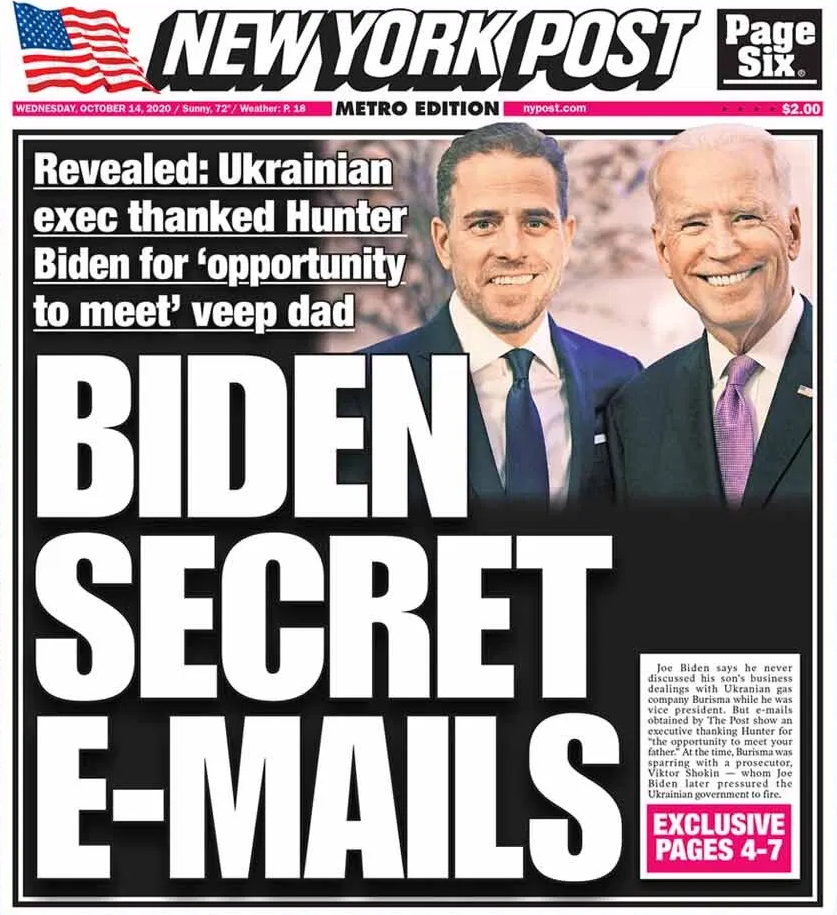
Long after the story was initially reported, and the New York Post was hammered for publicizing it at the time, the rest of the legacy media is showing interest in Hunter Biden’s laptop contents:
… If someone disappears for a while, it could mean nothing more than he is having a blood transfusion at one of Google’s secret rejuvenation centers. On the other hand, disparaging information about an oligarch in regime media could simply mean that one mob family is unhappy with another mob family and this is how they are communicating it. Using the media promotes the interests of the gangster class and delivers the message.
That is probably how to interpret the sudden interest by regime media in the famous Hunter Biden laptop from two years ago. For those not interested, this was the laptop that President Biden’s drug-addled son abandoned at a Delaware computer shop, which contained a trove of embarrassing information about the family. In addition to thousands of naked selfies and pics of Hunter smoking crack and meth with prostitutes, it had details of the Biden family criminal dealings.
Regime media dutifully covered this up by declaring it Russian propaganda and going as far as to imply it was a Trump campaign dirty trick. The New York Post, which was the first to report the laptop story, came under withering assault from the Silicon Valley crime families until they dropped the story. Facebook started banning people from their site for mentioning the story. Like the people air brushed from official photos in the Soviet Union, this story was erased from public view.
This is nothing new. The power of regime media is in what they can make the public ignore and this was a typical example. They do this by framing the issue as good guys versus bad guys, which is catnip for the American moralizer. Then they declare the thing to be ignored as the black hat and let the moralizers do the rest. Anyone mentioning the laptop on-line or even in private conversation was declared a crazy QAnon conspiracy theorist by others in their circle.
For no reason at all, the laptop story is back. First the intel community told the New York Times to admit they lied two years ago about it being fake. They did not mention that it was the intel community that lied, of course. Then the Washington Post was told to write about the Biden family’s criminal dealings that were on the laptop. The Post is the official organ of the intelligence community. You will recall that the Post was instrumental in the Russian collusion hoax in 2016.
Comments Off on Underbusing Hunter Biden?
Sarah Hoyt on the “Irrational Regime Hypothesis”
Sarah Hoyt on finding ways to make sense of the irrational-to-us actions of western governments since the start of the Wuhan Coronavirus pandemic:

I have the same need to make sense, to see “reason” out of things that don’t seem to. And I can’t stand it when something doesn’t FIT. If you want to drive me insane, you do something completely out of character for which there is no rational explanation. I’ll obsess over it for years, whether it’s in my favor or not.
This is why I knew the covidiocy was a sham of some sort. Not only weren’t the homeless dying like flies; the third world, despite some reports, also weren’t dying like flies. And the big cities in the US were encouraging homeless to crowd and congregate while everyone else was locked up. It didn’t add, unless the whole thing were a sham perpetrated by several groups for several related goals. (A prospiracy more than a conspiracy. I could expound on the cross-purpose goals I’ve uncovered so far, but that’s another post, right?)
In the same way, this whole “We really are in a shadow war with Putin! The cold war is back! Putin is crazy! He’s invading the Ukraine for funsies! Putin is invading because we crowded him! Biolabs in Ukraine!!!!!!” But at the same time — to give Trump his due — Putin, in this head to head (supposed) context, hasn’t dumped the contents of Biden’s laptop (of course they have it. I mean our FBI has it, and they are rapidly approaching status of enemy, domestic) into our national discourse. (I mean, it would complete disorganize us, and lose us whatever international prestige we still have, such as it is.) Or Putin could have dumped all the other Kompromat I’m sure they have on the not-very-bright and not particularly stealthy Biden crime family. Why hasn’t he?
And Biden, despite his continuous gaffes that take us to the brink of nuclear exchange, at least in theory, is STILL USING PUTIN TO BROKER THE SUICIDAL IRAN DEAL. And hasn’t opened up the Keystone pipeline and started authorizing drilling, which would sink Putin and possibly save the Democratic party. (Yes, Greens, but seriously. It’s either a war and an emergency or it’s not.)
This morning, this thread hit my mailbox from three separate sources (and if you’re not following Trent Telenko on Twitter, create a burner account to do so. I’m going to need to do it, since I refuse to log in to my real account (I just use it to echo my blogs) and Twitter is getting pushy about logging in. It’s worth dipping a toe into the sewer for the man’s insights, honest).
You should go and read the whole thing, but until you do, let me quote a bit, so you get what we’re talking about. Again, the thread is here:
Alright, this is the promised thread🧵explaining the “Irrational Regime Hypothesis.”
This is a national/institutional behavior template.
Warning: once you see this template. You cannot unsee it.The basic concept is that for certain unstable regimes (or even stable ones with no effective means of resolving internal disputes peacefully, particularly the succession of power) domestic power games are far more important than anything foreign, and that foreigners are
… only symbols to use in domestic factional fights.
The need to show ideological purity & resolve – “virtue signaling” in modern terms – as a means of achieving power inside the ruling in-group becomes more important than objective reality
Only the internal power matters… as outside reality is merely a symbol to be used in the internal power game.
The ruling Imperial Japanese military faction of 1931 – 1945 was a classic example of this irrational regime hypothesis.
Trent Telenko, on twitter
And suddenly the back of my mind clicked. Not conspiracy, which is hard on this scale — Not kabuki which didn’t feel quite right — but like the Covidiocy? Prospiracy. “We’re all going this way because we think it fits our goals.”
Now I want you to consider that it’s not one, but two irrational regimes, we’re dealing with.
This has been bothering the heck out of me, because it smells like they’re cooperating, only that’s not QUITE the right pattern.
None of this makes sense, unless you have TWO irrational regimes (Ours and Russia’s. China is too, but it’s another ball of wax. China doesn’t really believe other nations are real, anyway. They’re just Barbarians and China is all-under-heaven, so this is all much of a muchness on that front.) that are using each other as scarecrows to quiet the opposition at home.
Comments Off on Sarah Hoyt on the “Irrational Regime Hypothesis”
March 31, 2022
QotD: Nixon’s 1971 gamble to win re-election also tanked the economy for a full decade
[In 1971, economist Herb] Stein was saying aloud what they all knew. Prettifying a political grab by dressing it as an economic rescue was precisely the kind of action against which eminences like Burns warned foreign governments when they made grand speeches abroad. Nixon was indeed now preparing to do what Harold Wilson had done in 1967: disingenuously pretend that devaluing a currency would not affect the consumer. Stimulating the economy in this way might win Nixon the election, but inflation would eventually explode, as Friedman sometimes said, like a closed pot over high heat. Wage and price controls and taxes on imports could make the kind of growth America was accustomed to, the old bonanza, disappear for years, even a decade. True scarcity of key goods might suddenly become the rule. And that was true no matter how many times that cowboy Connally went around bragging about tariffs and telling others that America was “the strongest economy on earth”.
[…]
The 1971 run on American gold also, however, reflected foreigners’ insight. Outsiders knew a tipping point when they saw one. America had moved closer to Michael Harrington’s socialism than even Harrington understood. The United States had locked itself into social spending promises that might never be outgrown. Today, interest in Bitcoin and other cryptocurrencies serves as a measure of markets’ and individuals’ distrust of the U.S. dollar. In those days there was no Bitcoin, but gold played a similar role. The dollar was the common stock of America, and foreigners used gold to short it.
The disastrous performance of the U.S. economy in the following years proved the foreigners’ 1971 wager correct. To pay for its Great Society commitments, the U.S. government in the next decade found itself forced to set taxes so high that it further suppressed the commercialization of innovation. Products that could have been developed from patents awarded in the 1960s remained on the researchers’ shelves. Today we assume all markets will rebound given a decade. But there was to be no 1970s rebound for the Dow Jones Average. The Dow flirted with the 1,000 level throughout the decade, but did not cross the line definitively until 1982, an astonishingly long period to stagnate, nearly a generation. While markets languished, unemployment for all Americans rose. High prices, high interest rates, and federal budget deficits plagued the nation. “Guns and butter” had proved too expensive, but so indeed had butter alone. The 1960s commitments required spending that, then and down the decades, would be far greater than for Vietnam or most other wars. Those on the far left who had originally pushed for aggressive public-sector expansion had achieved what they sought, to subordinate the private sector. In 1977, Harrington actually titled a new book The Twilight of Capitalism.
Those who had counted on the private sector to sustain prosperity saw they had expected too much. The nation’s confidence evaporated. Indeed, by the late 1970s, President Jimmy Carter felt the need to undertake a national campaign to restore confidence, the kind of campaign Franklin Roosevelt had launched in response to the Great Depression. From being a nation that could afford everything, America morphed into a country that could afford nothing, a place where the president warned citizens to set their living room thermostats to sixty-five in January, or face catastrophe.
In a supreme irony, many of the people who caused the economic damage found themselves mired in the dirty work of reversing what they had wrought. The task of reducing inflation through punishing interest rates fell to Paul Volcker, who as a junior official aided leaders in the 1971 decisions that triggered the 1970s inflation in the first place. Mortgage rates rose to today incredible-sounding levels, over 15 percent. In the 1980s, the same John Connally who as treasury secretary in 1971 pounded on Nixon’s desk for populist measures that ensured an economic quagmire, went bankrupt, a casualty of the mess he had helped to create.
Amity Schlaes, Great Society: A New History, 2019.
Comments Off on QotD: Nixon’s 1971 gamble to win re-election also tanked the economy for a full decade
March 30, 2022
Combat Boots Save Lives – WW2 Special
World War Two
Published 29 Mar 2022Boots on the ground! Despite all the mobility provided by tanks, trucks and planes, the infantryman had to rely on his own two feet above all else. To march, run and fight, soldiers needed sturdy and comfortable footwear. Choosing between ankle-boots, service-shoes and jackboots, the warring nations were looking for the perfect combat-boot for their soldiers.
(more…)
Comments Off on Combat Boots Save Lives – WW2 Special
“It was as if millions of voices suddenly cried out in cringe …”
Ed West on recent events concerning the fighting in Ukraine:

Emperor PALPUTIN
Image by “usernameau” at funnyjunk.com
“Let me make this perfectly clear. Putin is Emperor Palpatine. The Ukrainian people and all those who stand up for democracy around the world and here in America are Rey Skywalker, Jyn Erso, and the Rebel alliance. Pick your side.”
Put like that, I think I’m with Putin.
This tweet, by former George Bush strategist Matthew Dowd, attracted much amusing scorn at the start of the war between Russia and Ukraine. It was as if millions of voices suddenly cried out in cringe …
American political commentary has for some time been dominated by pop culture references, in particular those two great modern fables, Star Wars and Harry Potter, which have replaced the classics as the source of communal knowledge. I’m not convinced that children’s books or films aimed at selling toys, enjoyable though they are, have that much to offer in the way of deep wisdom, compared to more ancient texts; I may be a declinist, but it is not commented on enough that America’s most-praised public intellectual didn’t know who St Augustine was.
These epic children’s stories serve as modern-day myths for a reason, drawing so heavily on older narratives and archetypes. Star Wars creator George Lucas studied anthropology and borrowed heroic narratives from around the world for his story; it also drew on historical folk memories of recent and ancient conflicts, in particular the Second World War, which has become the modern West’s origin story, its epic struggle between God and the Devil.
The most recent Lucas trilogy featured a plucky band of rebels in an existential struggle with a great empire (a story that drew heavily on … previous Star Wars films). In this tale of good and evil there was on one side a band of allies from every race on earth, and on the other a group joined by ethnic descent, a dynamic true to life and seen in countless wars and conquests since the Bronze Age. It’s the story of the Old Testament, the Persian Wars, and of such modern conflicts as the Vietnam War.
Yet of course Star Wars performed a role reversal to suit the sympathies of modern American audiences. For in reality, it is empires which are multi-cultural, and plucky rebels who tend to be linked by blood — whether it was ancient Greeks fighting off a Persian army of Medes, Babylonians, Egyptians and Sumerians, or Vietnamese nationalists in combat with French, Senegalese and North African troops.
So it is today in Ukraine, a rebel nation fighting off conquest by a neighbour 50 times its size. Ukraine’s position on the cultural fault lines of Europe has left it a multicultural inheritance, even after the depredations of Hitler and Stalin. Its heroic president Volodymyr Zelenskyy is a member of a 40,000-strong Jewish population, vastly reduced by the horrors of the early 20th century, but still surviving; indeed for three months in 2019 Ukraine had a Jewish president and prime minister, a first outside of Israel and quite an achievement for a supposedly “Nazi” state. There are also Tartars, although many were cut off by Russia’s annexation of the Crimea, having only been allowed back from their central Asian exile in the 1980s. There are Romanians, and, of course, a substantial Russian minority.
Yet these groups are relatively small in number, and Ukraine still has the composition of a typical European nation-state, built around a dominant ethnic group enjoying a super-majority.
Russia, in contrast, is home to around 50 ethnic groups, including — just the European ethnicities with more than half a million people — the Tatars, Bashkir, Chuvash, Mordvins and Udmurts, the latter known for having the reddest hair in the world (their homeland is an eastern outpost in this red hair map of Europe.)
Comments Off on “It was as if millions of voices suddenly cried out in cringe …”
March 29, 2022
QotD: SJW white guilt
In short, reading shit like this is penance for being white. Subjecting themselves to a stream of invective about their failings for being white gives them absolution. It’s kinda like those folks in the BDSM community who seek out a black dominatrix to work out their guilty feelings, and having paid for verbal abuse and a beating, feel that they’ve done their bit for race relations, and for the liberal side of the SF community, Mistress Nora is just the ticket, and they are paying her with sales and awards for all the abuse they can stomach.
Dr. Mauser, “Message Received”, Shoplifting in the Marketplace of Ideas, 2019-01-30.
Comments Off on QotD: SJW white guilt
March 28, 2022
QotD: The evolution of tanks through World War 2
The Germans, in contrast, made one error after another when it came to tank design and tank building. They were obsessed with coming up with the biggest, most powerful tank, rather than making lots of good enough tanks. The result was lots of innovative designs, but most were failures and there was never enough of them. The Panzer IV was a very good tank with a platform that was flexible, but the Germans kept trying to come up with a super tank, rather than make lots of these. That was a costly error.
The American tank, which was used by the British, was not a great tank, but they were cheap and reliable, which meant there were loads of them. It was also a flexible platform for all sorts of other uses. The Sherman tank was about using the two advantages the Americans had over the Germans. One was more industry and the other was more soldiers. The plan was to beat the Germans with volume. While it would take five Sherman tanks to take out a German tank, that was math that worked in favor of the Americans.
This conflict between the perfect and the good enough showed up in many places during the war. The Germans seemed to look at the whole thing as an engineering project. The first step was to accept the restraints and then solve for the variables. The Russian and American view was always to limit the constraints and thereby increase the number of possible right answers. The Germans had much better human capital, but their opponents always had many more choices. They also had numbers, which counts for a lot.
The Z Man, “Tanking It”, The Z Blog, 2019-03-01.
Comments Off on QotD: The evolution of tanks through World War 2
March 27, 2022
American Army Finally Does Something Right – WW2 – 187 – March 26, 1943
World War Two
Published 26 Mar 2021The British are attacking the Mareth Line in North Africa while the Americans hit the Axis flank, but the Allies are withdrawing in Burma. It’s the Germans who are pulling back in the USSR, though, and there is another attempt from within German Command to assassinate Adolf Hitler.
(more…)
Comments Off on American Army Finally Does Something Right – WW2 – 187 – March 26, 1943
QotD: Period culture in old movies and TV shows
What that meant is if you wanted to know what it was like to live in 1945, you had to ask someone who was alive in 1945. You could get a little taste of it from watching old movies on a Saturday afternoon, but that was a stylized version. To really get a feel for the age before color movies and television, you had to rely on the fading memories of grandma and grandpa. Of course, this was true for all of human history until recent. It’s why old people are good at telling stories about the old days. They’re built for it.
Today it is different. I watched The Thomas Crown Affair the other night off the Kodi machine. This was the 1968 version with Faye Dunaway and Steve McQueen. There was a remake of this in 1999 with Pierce Bronson. I had seen the remake a few times, but I never saw the original. In fact, I did not know there was an original. That’s a bit of interesting cultural data right there. Just about every movie produced over the last twenty-five years is either a remake or made from a children’s comic book.
What I found remarkable about the movie is something I notice whenever I watch old movies and that is the maturity. A movie about the cat and mouse between a male and female today will have at least half an hour of rutting and humping, along with some explosions and lots of vulgar language. The modern presentation of male-female relations is so crude, that porn makers of the past would have been offended. In the old days, the film maker and audience expected a more sophisticated portrayal of sexual relations.
That is the other thing that turns up in old movies and television. Hollywood made assumptions about the cultural awareness of the audience we don’t see now. In The Thomas Crown Affair, there is a long scene around a chess game. It was supposed to be a stand in for the sexual tension between McQueen and Dunaway. It’s a bit ham-handed, but vastly more sophisticated than anything you would see today. One reason is the typical viewer today knows nothing about chess, so it would be lost on them.
Part of that is due to Hollywood relying on international audiences to make money. You can’t expect to make money in China or India when your film is full of essential references to Anglo-Saxon cultural items. When you make films for the universal culture, you are making movies for a culture that does not exist. That means the goal is to remove cultural references, rather than rely on them to tell a story. There can be no subtlety and nuance without common cultural reference points understood by the audience.
The Z Man, “Old Movies”, The Z Blog, 2019-02-13.
Comments Off on QotD: Period culture in old movies and TV shows
March 26, 2022
Hollywood: Government Propaganda? – WW2 Special
World War Two
Published 24 Mar 2022Along with its arsenal of carriers, bombers, and tanks, America has perhaps the most powerful weapon of all: Hollywood. Hollywood is pumping out American and Allied propaganda as quickly as it can. But was this always the case?
(more…)
Comments Off on Hollywood: Government Propaganda? – WW2 Special
March 23, 2022
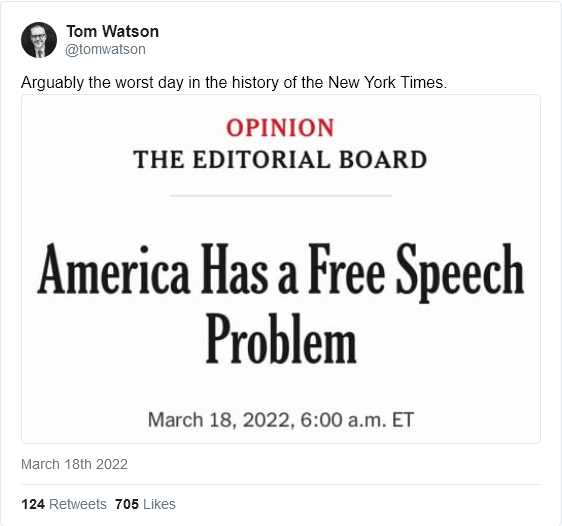
The New York Times and the “world’s dullest editorial”
Matt Taibbi explains why a milquetoast New York Times editorial got such immense blowback from other legacy media outlets:
The New York Times ran a tepid house editorial in favor of free speech last week. A sober reaction:
One might think running botched WMD reports that got us into the Iraq war or getting a Pulitzer for lauding Stalin’s liquidation of five million kulaks might have constituted worse days — who knew? Pundits, academics, and politicians across the cultural mainstream seemed to agree with Watson, plunging into a days-long freakout over a meh editorial that shows little sign of abating.
“Appalling,” barked J-school professor Jeff Jarvis. “By the time the Times finally realizes what side it’s on, it may be too late,” screeched Philadelphia Inquirer columnist Will Bunch. “The board should retract and resign,” said journalist and former Planet Money of NPR fame founder Adam Davidson. “Toxic, brain-deadening bothsidesism,” railed Dan Froomkin of Press Watch, who went on to demand a retraction and a “mass resignation”. The aforementioned Watson agreed, saying “the NYT should retract this insanity, and replace the entire editorial board.” Not terribly relevant, but amusing still, was the reaction of actor George Takei, who said, “It’s like Bill Maher is now on the New York Times Editorial board.”
The main objection of most of the pilers-on involved the lede of the Times piece, which really was a maladroit piece of writing:
For all the tolerance and enlightenment that modern society claims, Americans are losing hold of a fundamental right as citizens of a free country: the right to speak their minds and voice their opinions in public without fear of being shamed or shunned.
There’s obviously no legal right in America to voice an opinion without being criticized, so this line is indeed an error and an embarrassing one, for a labored-over first line of a major New York Times editorial. On the other hand, a lot of great liberal thinkers decried shaming tactics as utterly opposite to the spirit of free speech, with John Stuart Mill’s warning of a “social tyranny more formidable than many kinds of political oppression” being just one example. So, while the Times technically screwed up, cheering shaming and shunning as normal and healthy elements of life in free societies is a pretty weird gotcha. In any case, this bollocksed lede introduced a piece that had been in the works for a while, and came complete with a poll the paper commissioned in conjunction with Siena College.
[…]
This Times editorial is watered down almost the level of a public service announcement written for the Cartoon Network, or maybe a fortune cookie (“Free speech is a process, not a destination. Winning numbers 4, 9, 11, 32, 46 …”). It made the Harper’s letter read like a bin Laden fatwa, but it’s somehow arousing a bigger panic. Its critics view the mention of Republican legislative bans in conjunction with canceling as a monstrous affront, a felony case of both-sidesism. Obviously any implication that there’s any moral comparison between Republicans banning speech by law and Democrats doing it by way of informal backroom deals with unaccountable tech monopolies is unacceptable. Beyond that now, much of the commentariat seems to believe the op-ed page has outlived its usefulness unless it’s engaged in fulsome denunciations of correct targets
Comments Off on The New York Times and the “world’s dullest editorial”
March 22, 2022
West Germany’s Wirtschaftwunder — the staggering economic postwar recovery
Christian Monson debunks the common tale taught in western schools of reason for the amazing recovery of West Germany’s economy after World War Two:
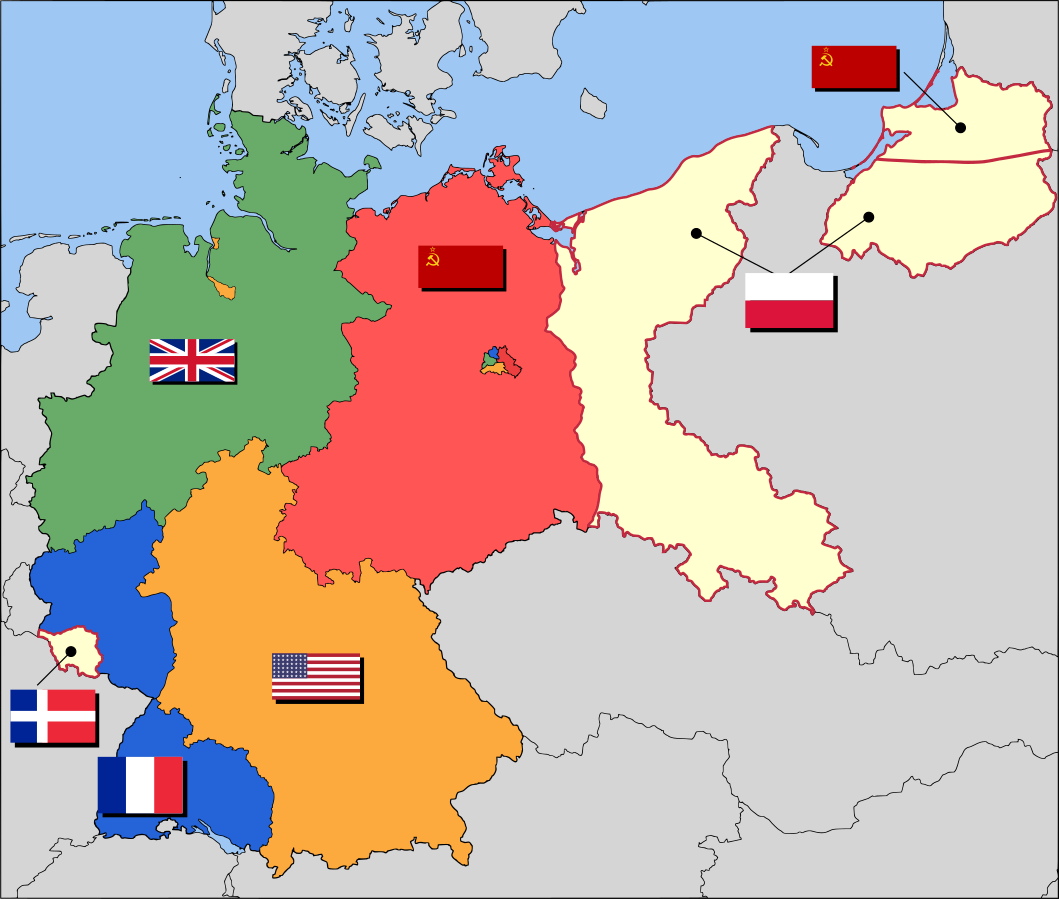
Occupation zone borders in Germany, 1947. The territories east of the Oder-Neisse line, under Polish and Soviet administration/annexation, are shown as cream as is the likewise detached Saar protectorate. Berlin is the multinational area within the Soviet zone.
Image based on map data of the IEG-Maps project (Andreas Kunz, B. Johnen, and Joachim Robert Moeschl of the University of Mainz) — www.ieg-maps.uni-mainz.de, via Wikimedia Commons.
This “economic miracle” is commonly referred to as die Wirtschaftswunder. But how did Germany go from rubble to riches in just a decade while neutral countries like Spain merely treaded economic water? If you ask your average American history student, they will say the Marshall Plan, of course!
Unfortunately, the ubiquity of the myth that the Marshall Plan rebuilt Germany is proof that state-controlled education favors propaganda over economic literacy. Despite the fact that most modern historians don’t give the Marshall Plan much credit at all for rebuilding Germany and attribute to it less than 5 percent of Germany’s national income during its implementation, standard history textbooks still place it at the forefront of the discussion about post-war reconstruction.
Consider this section from McDougal Littell’s World History (p. 968), the textbook I was given in high school:
This assistance program, called the Marshall Plan, would provide food, machinery, and other materials to rebuild Western Europe. As Congress debated the $12.5 billion program in 1948, the Communists seized power in Czechoslovakia. Congress immediately voted approval. The plan was a spectacular success.
Of course, the textbook makes no mention of the actual cause of the Wirtschaftwunder: sound economic policy. That’s because, for the state, the Marshall Plan makes great statist mythology.
Not only is it frequently brought up to justify the United States getting involved in foreign conflicts, but it simply gives support for central planning. Just look at the economic miracle the government was able to create with easy credit, they say.
And of course, admitting that the billions of dollars pumped into Germany after WWII accomplished next to nothing, especially when compared to something as simple as sound money, would be tantamount to admitting that the government spends most of its time making itself needed when it isn’t and thereby doing little besides getting in the way.
Credit for the turnaround should be accorded to Ludwig Erhard, according to Alasdair Macleod at the Cobden Centre:
Anyone who favours regulation needs to explain away Germany’s post-war success. Her economy had been destroyed, firstly by the Nazi war machine, and then by Allied bombing. We easily forget the state of ruin the country was in, with people in the towns and cities actually starving in the post-war aftermath. The joint British and American military solution was to extend and intensify war-time rationing and throw Marshall aid at the problem.
Then a man called Ludwig Erhard was appointed director of economics by the Bizonal Economic Council, in effect he became finance minister. He decided, against British and American misgivings, as well as opposition from the newly-recreated Social Democrats, to do away with price controls and rationing, which he did in 1948. These moves followed his currency reform that June, which contracted the money supply by about 90%. He also slashed income tax from 85% to 18% on annual incomes over Dm2,500 (US$595 equivalent).
Economists of the Austrian school would comprehend and recommend this strategy, but it goes wholly against the bureaucratic grain. General Lucius Clay, who was the military governor of the US Zone, and to whom Erhard reported, is said to have asked him, “Herr Erhard, my advisers tell me what you have done is a terrible mistake. What do you say to that?”
Erhard replied, “Herr General, pay no attention to them! My advisers tell me the same thing.”
About the same time, a US Colonel confronted Erhard: “How dare you relax our rationing system, when there is a widespread food shortage?”
Erhard replied, “I have not relaxed rationing, I have abolished it. Henceforth the only rationing ticket the people will need will be the deutschemarks. And they will work hard to get those deutschemarks, just wait and see.”
The US Colonel did not have to wait long. According to contemporary accounts, within days of Erhard’s currency reform, shops filled with goods as people realised the money they sold them for would retain its value. People no longer needed to forage for the basics in life, so absenteeism from work halved, and industrial output rose more than 50% in the second half of 1948 alone.
Comments Off on West Germany’s Wirtschaftwunder — the staggering economic postwar recovery
March 20, 2022
Kharkov Falls Once Again – WW2 – 186 – March 19, 1943
World War Two
Published 19 Mar 2022The British are attacking the Mareth Line in North Africa while the Americans hit the Axis flank, but the Allies are withdrawing in Burma. It’s the Germans who are pulling back in the USSR, though, and there is another attempt from within German command to assassinate Adolf Hitler.
(more…)
Comments Off on Kharkov Falls Once Again – WW2 – 186 – March 19, 1943


