
The Great War
Published on 26 Mar 2018Get Our New Oberschlesien Tank Poster: http://bit.ly/PanzerOberschlesien
The German Tank Museum: https://www.youtube.com/DasPanzermuseum
While the German Army only fielded 20 A7V tanks during World War 1, they understood the potential of the tank and started working on different designs in the last year of the war. Some designs like the LKII almost got deployed while the Sturmpanzerwagen Oberschlesien or the Krupp-Protze never left the prototype stage.
March 27, 2018
German WW1 Prototype Tanks Of 1918 I THE GREAT WAR On The Road
Comments Off on German WW1 Prototype Tanks Of 1918 I THE GREAT WAR On The Road
March 26, 2018
The container revolution in shipping
Is there anything as ubiquitous as the humble shipping container these days? There’re used for all kinds of “second career” purposes, but it’s easy to miss just how important to the growth in international trade … and the rise in global wealth … those containers have been. Marc Scribner gives a quick shout-out to the container:
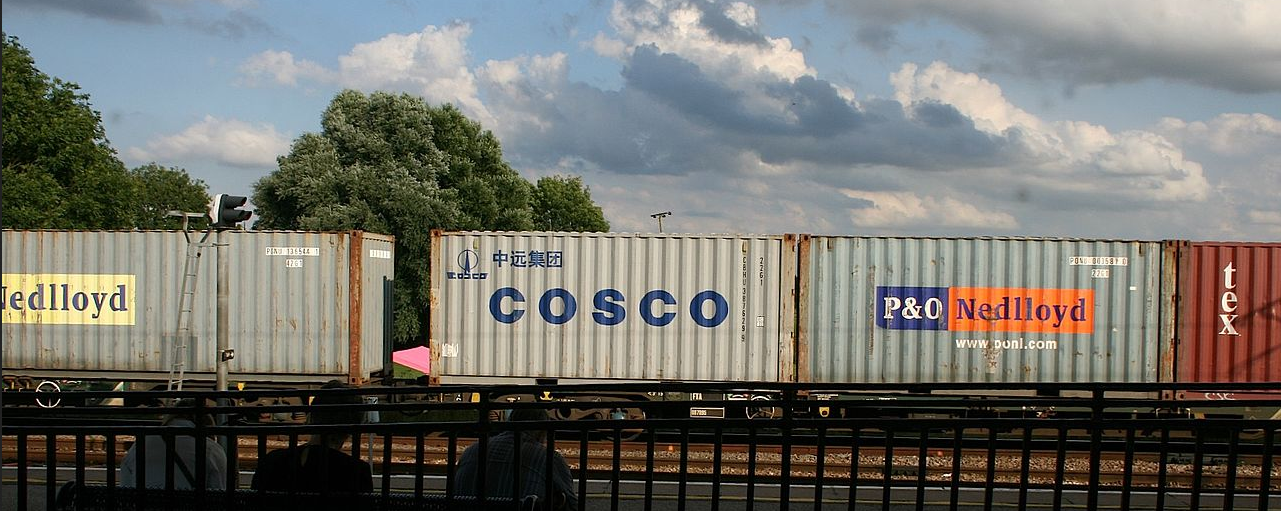
Deep-sea containers from China at Ely, Cambridgeshire
Via Wikimedia Commons.
One of the most underappreciated drivers of the modern global economy is the humble shipping container. Widely adopted internationally in the second half of the 20th century, intermodal containers largely supplanted break bulk cargo — the bags, barrels, pallets, and crates that must be individually loaded and unloaded onto ships, railcars, and trucks.
Intermodal containers are standardized in size and design, allowing them to be stacked onto large container ships, which can transport thousands of containers. In port, containers can be lifted onto railcars and flatbed trucks, enabling quick access to inland distribution centers and manufacturing facilities.
Containerization dramatically reduced costs all around. Fewer dockworkers were needed to load and unload vessels and larger ships were built thanks to stackable containers. Fewer ports were needed to transport an increasing volume of goods and freight insurance rates fell due to their durability and securability.
These transportation cost declines due to containerization have been estimated to have increased the volume of world trade far more than the proliferation of free trade agreements since the end of World War II. This means, according to recent research published in the Journal of International Economics, that while trade policy was important (and CEI is a strong supporter of trade liberalization), technological change in the shipping industry was responsible for enabling more trade among countries than improvements in government policy. It is important to note that for global commerce going forward, however, government policy is likely to be more important as containers have already been widely adopted, particularly in wealthy industrialized countries.
Comments Off on The container revolution in shipping
Kalashnikov vs Sturmgewehr!
Forgotten Weapons
Published on 17 Sep 2016http://jamesdjulia.com/item/3024-394/ (MP-44)
http://jamesdjulia.com/item/3020-394/ (Type 56 AK)The German Sturmgewehr and the Soviet Kalashnikov are widely and rightly considered the two most influential and iconic of the modern military rifles. While the German rifle certainly influenced the Soviet design, the two were designed with different intentions and goals. The Sturmgewehr was an attempt to blend the roles of rifle and light machine gun, while the Kalashnikov was intended to blend the roles of rifle and submachine gun – and yet they both reached largely the same practical reality.
Which do you think was the better system?
Comments Off on Kalashnikov vs Sturmgewehr!
March 24, 2018
James May doesn’t trust Sat Navs | Q&A extras | HeadSqueeze
BBC Earth Lab
Published on 27 Sep 2013Don’t trust the Sat Nav! Speaking from experience, James thinks we shouldn’t blindly trust a machine. Get a map!
Comments Off on James May doesn’t trust Sat Navs | Q&A extras | HeadSqueeze
March 23, 2018
The Grand Tour James May Running
The Grand Tour Fans
Published on 16 Mar 2018Do you think James May never ran on TV and during the episode of The Grand Tour where Jeremy Clarkson drove the Ford GT was the first time ever?
Well you’re wrong. In the third season of James May Man Lab he ran on public TV. Check out this video and see James Running (twice !!)
Comments Off on The Grand Tour James May Running
Tank Chats #25 Mark VIII | The Tank Museum
The Tank Museum
Published on 12 Aug 2016In the 25th Tank Chat David Fletcher explores the First World War Mark VIII tank. The Mark VIII tank, also known as The International was a joint project between the British and American forces, following their entry into the war. Once the designs had been refined massive orders were placed in 1918 and then swiftly cancelled with the end of the war. In the end six Mark VIII tanks were built for Britain of which The Tank Museum’s is the sole surviving example.
http://tankmuseum.org/museum-online/vehicles/object-e1949-363
Comments Off on Tank Chats #25 Mark VIII | The Tank Museum
March 22, 2018
March 20, 2018
Inside the German A7V WW1 Tank I THE GREAT WAR On The Road
The Great War
Published on 19 Mar 2018The German Tank Museum: http://daspanzermuseum.de/
We visited the German Tank Museum (in Munster, not Münster) and talked to the director Ralf Raths about the German tanks in World War 1. The only one that saw action was the A7V and will find out how it was designed, how up to 23 men fit inside one of these and what the operational history was.
Comments Off on Inside the German A7V WW1 Tank I THE GREAT WAR On The Road
March 19, 2018
The Katana
Lindybeige
Published on 4 Jun 2009Revered object of sacred mystery and deadly beauty, or tool for hitting people – you decide. I’ll help.
For examples of pattern forging, see http://www.paul-binns-swords.co.uk/Pattern_welding.htm
Comments Off on The Katana
March 18, 2018
The Truth About Wireless Charging
Real Engineering
Published on 23 Feb 2018
Comments Off on The Truth About Wireless Charging
March 17, 2018
Tank Chats #24 Vickers A1E1 Independent | The Tank Museum
The Tank Museum
Published on 5 Aug 2016In the 24th Tank Chat, David Fletcher looks at the rather unusual Vickers A1E1 Independent. The Independent originated in 1922 with a War Office specification for a heavy tank. Ultimately it proved to be a failed project was abandoned in 1935, by which time it had cost more than £150,000, and sent to Bovington. It is the only tank of its kind in existence.
Comments Off on Tank Chats #24 Vickers A1E1 Independent | The Tank Museum
March 16, 2018
Mostly Weekly Series Finale: Creative Destruction
ReasonTV
Published on 14 Mar 2018In the final episode of the webseries, we tackle how markets make and break stuff.
—–
In free and open markets people are able to make new technologies and business models, which displace older, established ones. That process of starting new companies and jobs destroys some professions while creating others.
It’s entirely understandable that people who lose their jobs want to keep them. But industries like manufacturing, coal mining, and mall retailers aren’t dying out because of competition from China, they’re being outmoded by automation, cheaper fuel sources, and online sales.
Despite the uncertainty that markets bring, they also create new jobs and entirely new professions. There aren’t gangs of unemployed lamplighters roaming the land; their descendants became Uber drivers, social media coordinators, and webseries producers.
In the end, it’s better for everyone to look at the world as it is and to move forward than to try and halt progress through the force of law.
Mostly Weekly is hosted by Andrew Heaton with headwriter Sarah Rose Siskind.
Script by Andrew Heaton and Sarah Rose Siskind with writing assistance from Brian Sack.
Edited by Austin Bragg and Sarah Rose Siskind.
Produced by Meredith and Austin Bragg.
Theme Song: Frozen by Surfer Blood.
Comments Off on Mostly Weekly Series Finale: Creative Destruction
March 7, 2018
Tank Chats #23 Hornsby Tractor | The Tank Museum
The Tank Museum
Published on 15 Jul 2016In the 23rd Tank Chat, David Fletcher takes a look at the Hornsby Tractor. The Hornsby Tractor was the first tracked vehicle in service with the British Army. They were designed to tow artillery.
The Museum’s example is still running and is the oldest vehicle in the collection.
http://tankmuseum.org/museum-online/vehicles/object-e1958-15
Comments Off on Tank Chats #23 Hornsby Tractor | The Tank Museum


