I’ve been dabbling more in the woodworking hand tool market recently, and found myself getting confused about the various manufacturers and their products. Mostly to try to sort out the history for myself, I started taking notes as I trawled from website to forum to auction site, looking for answers. In a very abbreviated and assuredly incomplete and inaccurate thumbnail sketch, here’s how I think the woodworking hand tool market has changed over the last hundred and fifty years or so:
- Until the mid-19th century, most woodworkers made their own tools whenever they could, as the ability of manufacturers to produce economical, dependable tools was limited, and woodworkers (like other skilled craftsman of the early industrial era) were capable of producing most of the necessary tools with only minimal outlay to other trades.
- By the mid-19th century, innovators and inventors were prolific in their proposed solutions to all kinds of problems (some real and many probably imaginary). Among those many, many febrile innovators was a gentleman named Leonard Bailey. Bailey managed to almost single-handedly revolutionize the woodworking market by coming up with a line of hand planes that could out-compete most of the hand-made competitors while taking advantage of the economies of scale offered by mass production. It became more economical for a woodworker to buy a ready-made tool rather than take time away from productive work to fabricate it for himself.
- The Stanley Works of Massachusetts bought Bailey’s company — probably more for the value of Leonard’s patents than for the company’s sake itself — and parlayed that patent protection into becoming the acknowledged standard for woodworking planes.
- Even after the Bailey patents expired, other manufacturers paid backhanded tribute to Bailey by straight-out cloning his designs with very minor changes and putting their own functional copies on sale in direct competition with the original Stanley products … often even using the same or barely concealed names/numbers for their clones (for example, the British company Record generally just prepended a zero in front of the “standard” Stanley model numbers, where a #4 plane from Stanley was a #04 from Record).
- In the British market following the financial crisis of 1929, the government’s imposition of tariffs against inter alia American hand tool manufacturers encouraged many British companies to introduce Stanley clones for both domestic and Imperial markets. To their credit, not all of the opportunistic entrants went for the low-hanging fruit, and some of the British clones were at least as good and in some cases superior to the original products.
- After the Second World War, the market for woodworking hand tools in North America began a rapid decline, although it remained strong enough in Britain to keep many of the clone manufacturers going for another 20 years or so. In response to the softening market, Stanley began to cheapen their manufacturing processes and the product quality began a precipitous decline.
- By the early 1970s, Stanley had almost completely given up the hand tool market in woodworking, and their products were a sad mockery of what they’d been producing just a decade before, but North American woodworkers were inundated with innovative power tools from, among others, Black & Decker and the Sears Craftsman line that promised better/faster/more productive output from amateur woodworking shops than could be done with hand tools alone. That, coupled with the decreased emphasis on “shop” subjects in North American high school curricula meant that youngsters didn’t automatically become familiar with the use of hand tools unless they were already interested and had access to a workshop to indulge that interest.
- The same process of shrinking market requiring “rationalization” and “economization” hit the British manufacturers fifteen to twenty years after Stanley and their surviving American competitors, and the order of the day was ever-shrinking profit margins, smaller markets, and mergers/bankruptcies/take-overs among the tool manufacturers.
- After the financial bloodbath of the 70s through the 90s, it became clear that there was still a small-but-affluent market for quality woodworking hand tools, and a few new entrants made their mark by first copying the best designs of the past and then, hesitatingly, innovating with modern technology beyond what was possible a generation or two earlier.
Here are some notes I jotted down about a few of the key woodworking hand tool manufacturers and their respective rise and decline, based on a very cursory survey of what information is available online at the moment:
STANLEY (USA, UK, CANADA and AUSTRALIA)
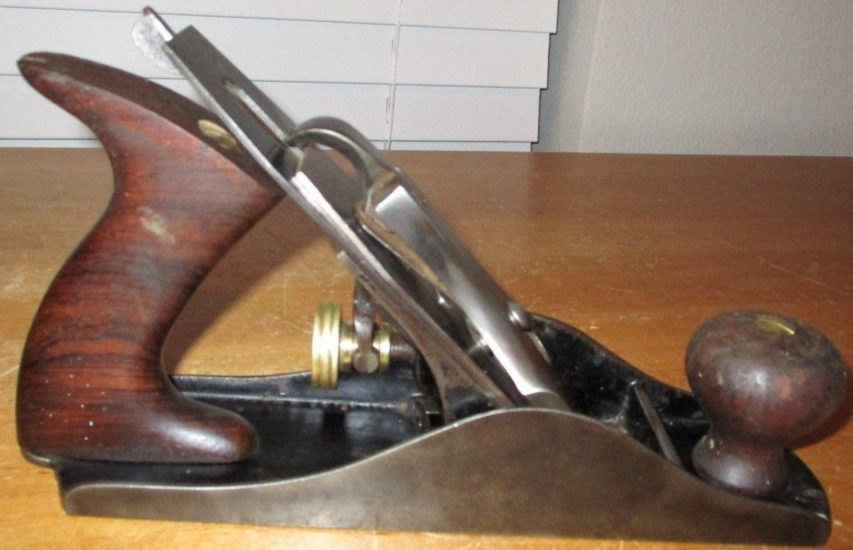
A vintage Stanley No. 4 smoothing plane from a recent eBay listing. Even though this is the single most common woodworking plane ever, the example I own is a late-70s piece of crap, so I went looking for a more representative image.
The Stanley Works was founded in 1843 by Frederick Stanley in New Britain, Connecticut.
In 1857, the Stanley Rule & Level Company was founded by Frederick Stanley’s cousin Henry. I imagine most people of the time assumed there was only the single Stanley company, as they produced products in related-but-not-competitive fields.
Stanley purchased Bailey, Chaney and Company in 1869 along with the Bailey plane patents. The Bailey patents were the key to Stanley’s future dominance of the hand plane market.
Stanley Rule & Level Co. purchased the Roxton Tool and Mill Company in Roxton Pond, Quebec (founded 1873). Manufacturing continued here from 1907 until about 1984. From the timing, I assume this was seen as a good way to get Stanley hand tools into the Canadian market without paying tariffs.
In 1920, The Stanley Works merged with the Stanley Rule & Level Company. The initials “S.W.” within a heart outline was introduced at that time. Later references to tools with this mark invariably refer to them as “Sweetheart”, but it’s not clear that the newly unified Stanley used that term in their own marketing until a few years later. The logo and name have been revived in the last decade or so, probably to cash in on the nostalgia factor.
In 1937, Stanley acquired J.A. Chapman (of Sheffield, England). I’m assuming this was a shortcut to getting non-tariff access to the British (and Imperial) hand tool market.
Stanley manufactured planes in Australia from 1965 to the early 1990s in Moonah, Tasmania.
In 2010, The Stanley Works merged with Black & Decker to become Stanley Black & Decker (Stanley Hand Tools is a division of the much larger company).
MILLERS FALLS (USA)
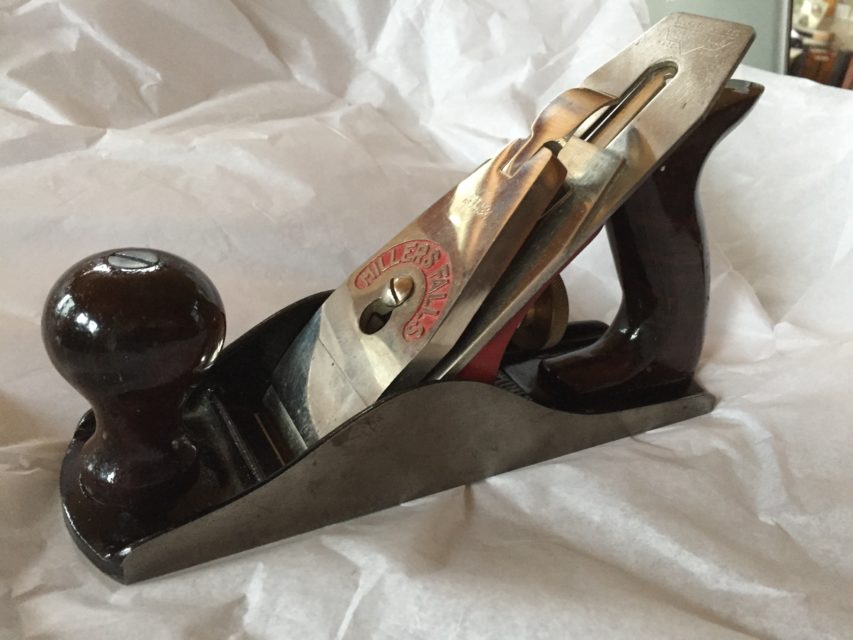
I happen to actually own a Millers Falls #9 smoothing plane (as of Friday). Look similar to the Stanley #4 above? It should, as it’s a near-clone.
Incorporated in 1868 as the Millers Falls Manufacturing Company, renamed as the Millers Falls Company in 1872. Introduced hand planes into its line of tools in 1928/29. Millers Falls chose to compete for the high-end of the hand tool market and managed to carve out a profitable niche for themselves, especially in the hand plane segment. Their futuristic plastic-and-chrome “Buck Rogers” planes of the late 1950s were visually distinctive enough that they kept the company in the black for longer than almost all of their US competitors.
In 1957, Millers Falls acquired the Union Tool Company of Orange, Massachusetts. The Union brand was kept active until 1975 when the Union plant was closed down.
Millers Falls became a subsidiary of Ingersoll Rand in 1962, and closed down their Massachusetts operation in 1982 with a corporate relocation to New Jersey after a buyout.
RECORD (UK)
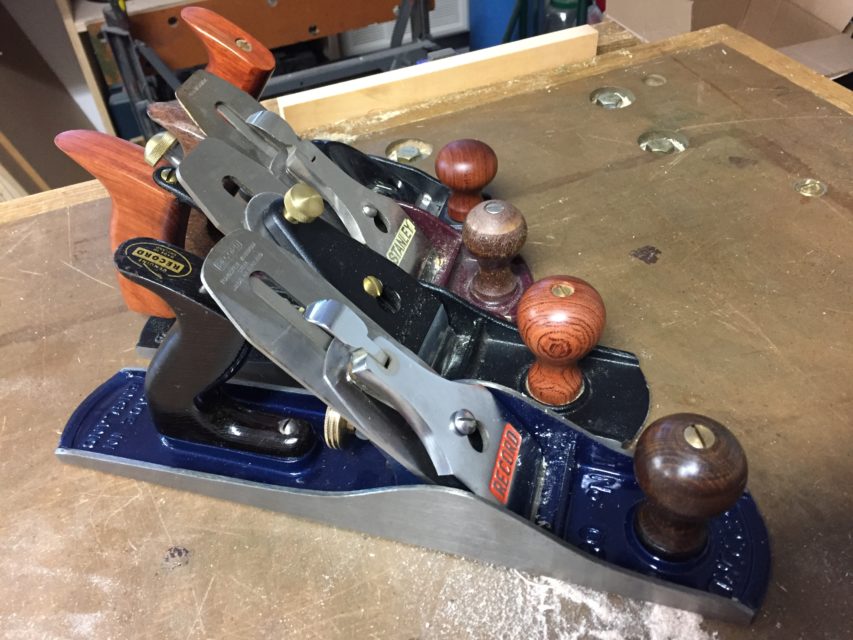
(front) A Record No. 05 jack plane, a close copy of the Stanley #5
Record was a brand name used by C & J Hampton from 1909. The company was founded in 1898 and incorporated a decade later. The founders, Charles and Joseph Hampton, had left the family business (The Steel Nut & Joseph Hampton Ltd in Wednesbury, Staffordshire) to set up shop in Sheffield. Joseph eventually returned to the family firm, but the sons of Charles succeeded to leadership roles in the younger company.
The first Record planes were offered for sale in 1931 (No. 03 through 08 and three block planes: No. 0110, 0120 and 0220). Record got into the plane business partly due to the preferential tariffs the British government levied on foreign (mainly American) hand tools and the fact that the Stanley Works’ Bailey patents had expired, so there was no legal issue with flat-out cloning Stanley’s plane line.
In 1934, Record took over production of some Edward Preston and Sons Ltd. products (mainly bullnose and rabbet planes). Preston had been acquired by John Rabone and Sons Ltd. (Birmingham) in 1932, but they decided to stick with the rule and level business and offload the plane manufacturing to Record.
Woden Tools Ltd was purchased from The Steel Nut & Joseph Hampton Ltd in 1961 and Record continued to use the Woden trademark for another 10 years (some sources say only five years: take your pick).
Record acquired 50% of William Marples and Sons Limited in 1963, the other 50% being held by William Ridgway & Sons, Ltd. (Parkway Works), also of Sheffield.
In 1972, Record merged with Ridgway to form Record Ridgway Tools Ltd.
In 1982, Record Ridgeway was acquired by AB Bahco of Sweden, but a management buyout in 1985 took it back to British ownership as Record Holdings plc.
In 1988 the company became Record Marples (Woodworking Tools) Ltd.
In 1998, Record Marples accepted an offer from American Tool Corporation and became part of the Record Irwin Group as Record Tools Ltd. Irwin was acquired by Stanley Black & Decker in 2017.
WODEN TOOLS (UK)
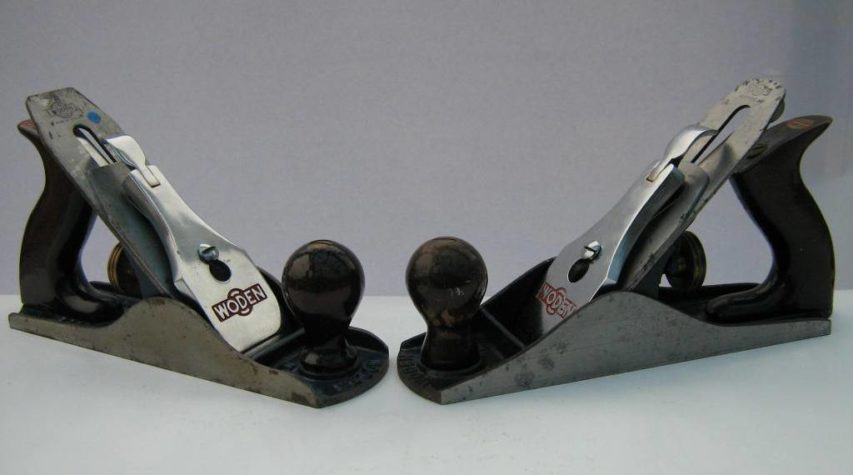
A pair of Woden planes as shown on the wodentools.com website.
Woden Tools was a wholly owned subsidiary of The Steel Nut & Joseph Hampton Ltd, producing planes from 1953/54 in Wednesbury, Staffordshire. (The planes were originally manufactured by W.S Manufacturing (Birmingham), which was acquired by The Steel Nut & Joseph Hampton around 1952.)
C & J. Hampton (Record) purchased Woden Tools Ltd from SNJH in 1961 and continued to use the Woden trademark for another 10 years (some sources say only until 1965).
LEE VALLEY/VERITAS (CANADA and USA)
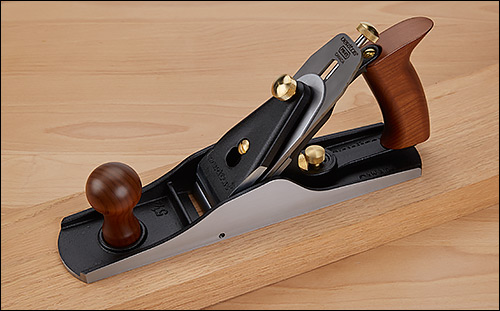
A current Veritas 5 1/4 junior jack plane from Lee Valley Tools
Founded in 1978 by Leonard Lee in Ottawa, Ontario. The first out-of-town store was opened in 1982 (Toronto West). I think I visited that store in its original location in 1984. The company launched their website in 1997 and added e-commerce features in 2000.
In the early-to-mid 1980s, Lee Valley contracted with Footprint (UK) to produce a line of bench planes to their specifications. The “Paragon” line were sold in Canada by Lee Valley and by Garret Wade in the United States for a few years, but quality issues apparently doomed the venture. In a thread on the Sawmillcreek.org forums, Robin Lee said “Actually – we ‘remanufactured’ many of them here [in Ottawa]… We set out the specs, made some tooling changes, and had Footprint make them for us (and GW). All planes were received and inspected … – and in many cases, fettled and reground… We abandoned the brand shortly after – and formed Veritas tools as our manufacturing company…”
In 1999, the first Lee Valley manufactured plane, the Low-Angle Block Plane, was introduced. The Veritas line of bench planes was launched in 2001. The first shoulder plane was introduced in 2003. In 2014, the Veritas Custom Bench Plane line was introduced, which the company characterizes as the first user-customizable line of planes in the industry.
In 1982, the company began manufacturing its own tools under the Veritas label. In 1985, Lee Valley Manufacturing Ltd. was incorporated and later renamed as Veritas Tools, Inc. Manufacturing is primarily in Ottawa and (possibly) in Ogdensburg, New York.