Quotulatiousness

September 13, 2019

Why You Wouldn’t Want to Fly The First Jet Airliner: De Havilland Comet Story

Filed under: Britain, History, Technology — Tags: , , — Nicholas @ 02:00

Mustard
Published on 1 Dec 2017

Air travel before the Jet Age wasn’t always glamorous. The relentless noise and vibration from a piston powered propeller aircraft often made long flights even more exhausting. Most aircraft also couldn’t fly high enough to avoid bad weather, so air sickness was more common.

After World War Two, as part of an effort to develop its civil aviation industry, Britain stunned the world by unveiling the world’s first jet airliner. The de Havilland Comet was sleek, quiet, and flew higher and faster than any airliner of the day. As piston propeller technology was reaching its limits, the conventional thinking was that jet engines were too unreliable and produced too little power relative to their fuel consumption. But the de Havilland Comet proved that jet travel was the future. When the Comet entered service in 1952, it immediately began breaking travel time records and became a point of national pride for Britain.

The de Havilland Comet was perhaps little too ahead of its time. With such a clean sheet design, there were still lessons to learn. When early Comets suffered from catastrophic depressurization incidents, the entire fleet was grounded and their Certificate of Airworthiness was revoked. Flaws in the design of the aircraft’s fuselage were resolved in later Comet versions. However, the rest of the world was now catching up, and manufacturers including Boeing and Douglas began to offer their own jet airliners. While later version Comets served airlines reliably, they were outsold by competing aircraft. There’s no question However, that the comet paved the way. The British had taken a massive risk and brought the world into the jet age. #DeHavilland #CometAirliner #Airplane

Want to help Mustard grow? Support us on Patreon: https://www.patreon.com/MustardChannel

September 10, 2019

Shooting the Milkor M32 40mm Grenade Launcher

Filed under: Africa, Military, Technology, USA, Weapons — Tags: , , , , — Nicholas @ 02:00

Forgotten Weapons
Published on 6 Jul 2019

http://www.patreon.com/ForgottenWeapons

Cool Forgotten Weapons merch! http://shop.bbtv.com/collections/forg…

Thanks to Milkor USA, I have a chance today to do some shooting with both the M32 and M32A1 rotary grenade launchers they make for the US military. I’m using 40mm chalk training ammunition, with some steel targets at about 75-85 meters. In live fire, it’s quite clear how much of an improvement the M32A1 trigger is over its predecessor!

Contact:
Forgotten Weapons
PO Box 87647
Tucson, AZ 85754

September 9, 2019

Milkor M32 and M32A1 40mm Grenade Launchers

Filed under: Africa, Military, Technology, USA, Weapons — Tags: , , , , — Nicholas @ 02:00

Forgotten Weapons
Published on 5 Jul 2019

http://www.patreon.com/ForgottenWeapons

Cool Forgotten Weapons merch! http://shop.bbtv.com/collections/forg…

The USMC adopted the Milkor USA M32A1 rotary multiple grenade launcher (MGL) in 2012. The history of this weapon goes back to South Africa, where designer Andries Piek was inspired to create it after building the 37mm “Stopper” for the South African police and then seeing a Manville 25mm gas launcher in the movie Dogs of War. He created a 6-barrel 40mm launcher that was adopted by the South African military, and proved quite popular. It was adopted by other countries subsequently, and by the early 2000s a company bought rights to produce it in the United States – Milkor USA.

The original M32 version was used in small numbers by US SOCOM, and the updated M32A1 widely purchased by the US Marines. The A1 version has a shorter barrel and is generally strengthen, allowing it to fire medium-velocity grenades instead of just the low velocity loadings. This increased its effective range from 375m to 800m as well as allowing larger grenade payloads and increased effectiveness on target.

Contact:
Forgotten Weapons
PO Box 87647
Tucson, AZ 85754

August 31, 2019

General Motors Diesel: The Modern Power (1937 and 1942)

Filed under: History, Military, Railways, Technology, USA, WW2 — Tags: , , — Nicholas @ 02:00

PeriscopeFilm
Published on 6 May 2016

Support Our Channel: https://www.patreon.com/PeriscopeFilm

First made in 1937 by General Motors and then repackaged for the WWII war effort, DIESEL THE MODERN POWER tells the story of the development and principles of the diesel engine. The film uses live action and animation to show how the diesel engine works, and live action footage of Sherman tanks, streamlined locomotives, switching engines, ships, and more.

The film begins with an historical overview that includes a brief lesson on how to make fire, including two stones, rubbing pieces of wood, and even the “fire syringe” that was used by the people of Southeast Asia. The syringe is used to demonstrate the operation of a piston in an engine.

At 14:30, 600 hp diesel engine are seen at the Century of Progress Exposition in Chicago. At 14:46, the Burlington Pioneer Zephyr is seen running from Chicago to Denver. Mainline passenger locomotives are seen, providing up to 6000 hp. Diesel switch engines are seen at the 15:30 mark.

At 18:40, lumber equipment, oil pumps, and earth moving equipment are seen — all driven by diesel engines.

The Detroit Diesel works is seen at the 19 minute mark. Diesel powered submarines, mine sweepers and coast patrol boats as well as fleet tugs, are also seen.

A two-stroke diesel engine is a diesel engine that works in two strokes. A diesel engine is an internal combustion engine that operates using the Diesel cycle. Invented in 1892 by German engineer Rudolf Diesel, it was based on the hot-bulb engine design and patented on February 23, 1893. During the period of 1900 to 1930, four-stroke diesel engines enjoyed a relative dominance in practical diesel applications. Charles F. Kettering and colleagues, working at the various incarnations of Electro-Motive and at the General Motors Research Corporation during the 1930s, advanced the art and science of two-stroke diesel technology to yield engines with much higher power-to-weight ratios than the two-stroke diesels of old. This work was instrumental in bringing about the dieselisation of railroads in the 1940s and 1950s.

All diesel engines use compression ignition, a process by which fuel is injected after the air is compressed in the combustion chamber, thereby causing the fuel to self-ignite. By contrast, gasoline engines utilize the Otto cycle, or, more recently, the Atkinson cycle, in which fuel and air are mixed before entering the combustion chamber and then ignited by a spark plug.

August 29, 2019

How do noise cancelling headphones work? | James May’s Q&A (Ep 10) | Head Squeeze

Filed under: Technology — Tags: , — Nicholas @ 02:00

BBC Earth Lab
Published on 7 Mar 2013

It’s actually more complex than you might think!

James May’s Q&A:
With his own unique spin, James May asks and answers the oddball questions we’ve all wondered about from “What Exactly Is One Second?” to “Is Invisibility Possible?”

August 27, 2019

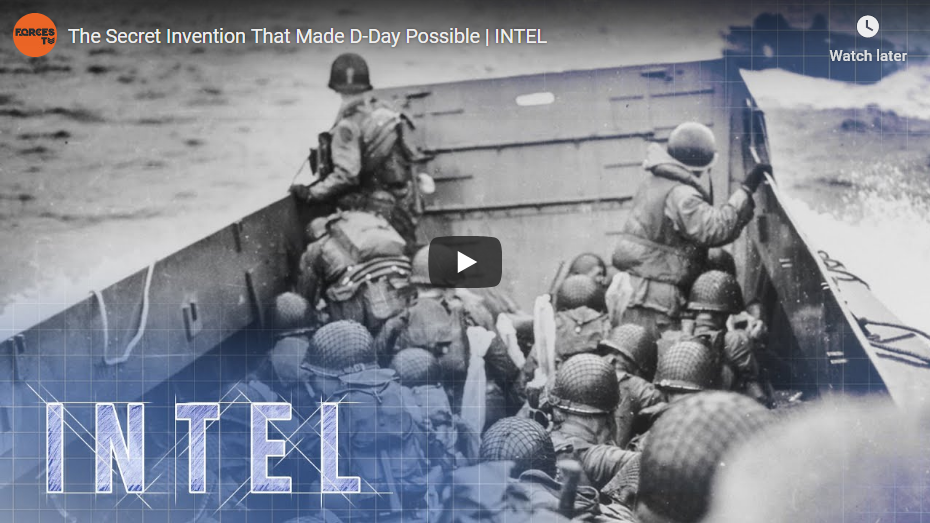
The Secret Invention That Made D-Day Possible | INTEL

Filed under: Britain, France, History, Military, Technology, USA, WW2 — Tags: , , , — Nicholas @ 04:00

Forces TV
Published on 7 Jun 2019

As much as the success of D-Day was down to the bravery of soldiers … it was made possible by inventions and new machines. These Mulberry Harbours were a real World War 2 engineering victory.

More Mulberry: https://www.forces.net/d-day/mulberry-harbours-how-allies-floated-concrete-win-d-day
Forces Net D-Day Hub: http://forces.net/dday

H&K Mk23 SOCOM .45 Development

Filed under: History, Military, Technology, USA, Weapons — Tags: , , , , — Nicholas @ 02:00

Forgotten Weapons
Published on 28 Jun 2019

http://www.patreon.com/ForgottenWeapons

Cool Forgotten Weapons merch! http://shop.bbtv.com/collections/forg…

The H&K Mk 23 pistol was developed in the 1990s for the US Special Operations Command and US Navy. The goal was to produce an “offensive handgun” that could serve as a primary armament for a special forces operator as well as a backup arm. It was required to be no more than 12 inches long, fit a suppressor and aiming module with laser and illumination options in both visible and IR spectrum, have at least 10-round magazines, chamber .45 ACP (specifically a 185gr +P loading), and pass a 30,000 round endurance test.

Only two companies were able to supply acceptable initial pistols; H&K and Colt. The Colt pistol failed to pass the 1st phase testing. H&K presented a gun based on the recently-developed USP design, was ultimately chosen as the project winner; adopted as the Mk 23 pistol in 1996. The testing this pistol went through during development is really quite remarkable.

Contact:
Forgotten Weapons
PO Box 87647
Tucson, AZ 85754

August 23, 2019

Sterling S11: Donkey in a Thoroughbred Race

Filed under: Britain, History, Military, Technology, Weapons — Tags: , , , , — Nicholas @ 02:00

Forgotten Weapons
Published on 26 Jun 2019

http://www.patreon.com/ForgottenWeapons

Cool Forgotten Weapons merch! http://shop.bbtv.com/collections/forg…

In the 1960s, the Sterling company began to worry about the prospects of continued sales of the Sterling (Patchett) SMG, especially in light of new competitors like the H&K MP5. Its chief design engineer, Frank Waters, created the S11 as a gun to replace the classic Sterling. The S11 was based on a simple stamped/folded steel receiver, and was intended to have a lower unit cost than the Sterling. It kept the excellent Patchett magazine, but had a barrel and sights offset to the left side, and offered two separate bayonet lugs – one for the No5 rifle and one for the L1A1/FAL.

Unfortunately for Sterling, it was determined that the tooling cost would have made the S11 actually more expensive than the existing guns, whose tooling costs had been long since covered. Also, the S11 was just not a very good or very reliable design – a “donkey in a thoroughbred race” to quote one Sterling manager. This one prototype was the only example ever made, and the project was shelved in 1967 in favor of expanding into more civilian models of the original Sterling.

Many thanks to the Royal Armouries for allowing me to film and disassemble this one of a kind submachine gun! The NFC collection there – perhaps the best military small arms collection in Western Europe – is available by appointment to researchers:

https://royalarmouries.org/research/n…

You can browse the various Armouries collections online here:

https://royalarmouries.org/collection/

Contact:
Forgotten Weapons
PO Box 87647
Tucson, AZ 85754

August 21, 2019

Slow Motion Malfunctions of Exotic Firearms

Filed under: Technology, Weapons — Tags: , , , — Nicholas @ 02:00

Forgotten Weapons
Published on 25 Jun 2019

http://www.patreon.com/ForgottenWeapons

Cool Forgotten Weapons merch! http://shop.bbtv.com/collections/forg…

Over many years of filming with my high speed camera, I have a decent little library of malfunctions in a wide variety of guns. These don’t normally make it into videos, and I figured it would be neat to present a bunch of them together. Enjoy!

Contact:
Forgotten Weapons
PO Box 87647
Tucson, AZ 85754

QotD: The cult of Japanese cultural superiority

Filed under: Japan, Media, Technology, Weapons — Tags: , , , , — Nicholas @ 01:00

The Forged in Fire people have a new show: Knife or Die. It’s hard to discuss, because I don’t want to ridicule anyone. Any person with a desire to compete can show up with a big knife, and they will turn you loose on an obstacle course of things to cut. The first episode featured a Caucasian man wearing an Aikido costume and running shoes. I am serious. He carried a katana or “samurai sword,” even though aikido guys aren’t taught how to fight with swords. He hit a block of ice with it, and it bent in the middle.

That was a major blow to the Japan cult. Katanas are supposed to cut concrete blocks! At least that’s what they say in the Tokyo airport gift shop.

Why does aikido attract troubled people with unrealistic expectations? A high school friend of mine took up aikido. The Internet says he runs a dojo now. He gave his life to aikido. Unfortunately, aikido has a serious problem: it doesn’t work at all. Sure, you can twist people’s wrists and immobilize them if they are stupid enough to give you their hands, but everyone who has tried aikido in the ring has had his behind handed to him in individually wrapped slices. I can’t understand devoting your life to a martial art which can be defeated easily by 95% of angry untrained drunks. Would you open a store that only sold appliances that didn’t work?

Here are the words that start every single aikido demonstration: “Give me your hand.”

People are enchanted by Japan. They think the Japanese have deep wisdom we lack. They do, and here it is: do your job well and treat your elders and your boss with respect. That’s about it; the rest is hocus pocus. There are no Japanese superpowers. There is no chi. Steven Seagal has never once used magical Japanese aikido to fight a real fight because he knows he would experience humiliating losses.

Forged in Fire has its funny moments, but Knife or Die is a little too ridiculous to lampoon. It’s almost sad. It’s probably dangerous, too. Untrained eccentrics swinging razor-sharp knives of unknown quality in a timed test are a recipe for deep wounds and severe blood loss. I would hate to be in the studio when half of a knife goes flying off at 60 miles per hour.

Steve, “Knives for Knaves”, Tools of Renewal, 2018-05-31.

August 19, 2019

QotD: Hitler’s “wonder weapons”

Filed under: Germany, History, Military, Quotations, Technology, WW2 — Tags: , , , , , , — Nicholas @ 01:00

Historians have generally thought of the Type XXI [submarine] — along with other systems like the Me 262, V-1 and V-2 rockets, and the Tiger tank — as an example of Wunderwaffen, wonder weapons. Since 1945 many have fixated on the revolutionary military technologies that the Third Reich developed in the last two years of the war. The cultural impetus behind the concept, as implicitly or explicitly acknowledged by historians in the uneven and largely enthusiastic literature on the subject, was an irrational faith in technology to prevail in operationally or strategically complex and desperate situations — a conviction amounting to a disease, to which many in the Third Reich were prone in the latter years of the Second World War. To the extent that it shaped decision making, faith in the Wunderwaffen was a special, superficial kind of technological determinism, a confidence in the power of technology to prevail over the country’s strategic, operational, and doctrinal shortcomings. To the extent that leaders, officers, engineers, and scientists after 1943 believed innovation to be the answer to Germany’s strategic dilemmas, they displayed a naive ignorance of how technology interacts with cultural and other factors to influence the course of events. In particular, they reflected a willful ignorance of the extent to which even substantial technological superiority has proved indecisive in human conflict throughout history.

Marcus Jones, “Innovation For Its Own Sake: The Type XXI U-boat”, Naval War College Review, 2014-04.

August 18, 2019

AAI 2nd Gen SPIW Flechette Rifles

Filed under: History, Military, Technology, USA, Weapons — Tags: , , , , — Nicholas @ 02:00

Forgotten Weapons
Published on 24 Jun 2019

http://www.patreon.com/ForgottenWeapons

Cool Forgotten Weapons merch! http://shop.bbtv.com/collections/forg…

The SPIW program began in 1962 with entries from Colt, Springfield, AAI, and Winchester. The first set of trials were a complete failure, and both Colt and Winchester abandoned the project at that point. AAI pressed on, producing these second generation rifles – one for trials in 1966 and one after. Both are chambered for the XM-645 5.6x57mm single-flechette cartridge. Under testing, both showed multiple serious problems in reliability, noise, cook-offs, and accuracy. The company would struggle on for years continuing to develop the flechette rifle system, but would be ultimately unsuccessful.

Thanks to the Rock Island Arsenal Museum for allowing me access to film this very interesting rifle! If you are in the Quad Cities in Illinois or Iowa, the Museum is definitely worth a visit. They have a great number of small arms on display as well as an excellent history of the Rock Island Arsenal.

http://www.arsenalhistoricalsociety.o…

Contact:
Forgotten Weapons
PO Box 87647
Tucson, AZ 85754

August 17, 2019

How Diablo was completely Reverse Engineered without Source Code | MVG

Filed under: Gaming, Technology — Tags: , — Nicholas @ 02:00

Modern Vintage Gamer
Published on Jul 1, 2019

In 1996 Blizzard Entertainment released Diablo, an Action RPG that sold over 2.5 million copies and defined a genre. In 2018 a developer known as GalaXyHaXz almost completely reverse engineered the code in 4 months and released it as open source. How was this accomplished? Find out in this episode!

► Consider supporting me – https://www.patreon.com/ModernVintage…

Links

DevilutionX (Open Source Diablo) https://github.com/diasurgical/devilu…
► My Nintendo Switch Port – https://github.com/lantus/devilution-nx

August 15, 2019

How Does it Work: Stoner’s AR System

Filed under: Technology, USA, Weapons — Tags: , , — Nicholas @ 02:00

Forgotten Weapons
Published on 18 Jun 2019

http://www.patreon.com/ForgottenWeapons

Cool Forgotten Weapons merch! http://shop.bbtv.com/collections/forg…

Eugene Stoner’s AR-10 and AR-15 use an operating mechanism that is often called “gas impingement,” but which is actually a cleverly structured gas piston located within the bolt carrier. Gas is tapped from the barrel and moved all the way back to just behind the chamber, where it enters the bolt carrier. There the carrier and bolt act as the two parts of a sealed piston, and when the bolt carrier moves rearward the cam pin forces the bolt head to rotate and unlock. The expanding gas is then vented out through holes in the side of the bolt carrier. By locating the piston on the same axis as the barrel, the harmonics are improved and the overall weight of the gun can be reduced by using the gas piston elements as mass in the bolt carrier assembly. Contrary to the old adage “it shits where it eats,” the operating gasses are not vented into the magazine or chamber, and the system has proven to be very reliable.

Contact:
Forgotten Weapons
PO Box 87647
Tucson, AZ 85754

August 14, 2019

1950s Willys Jeep Promotional Film – The Jeep Family Of 4 Wheel Drive Vehicles

Filed under: Business, History, Technology, USA — Tags: , , — Nicholas @ 02:00

PeriscopeFilm II
Published on 3 Sep 2015

Willys, the “World’s Largest Manufacturer of Utility Vehicles,” presents the Jeep Family of 4-Wheel Drive Vehicles and Special Equipment, a circa 1954 black-and-white film promoting Jeeps produced for civilian use. Following the success of Jeeps during World War II, the film opens with an explanation of how the vehicles soon their way to civilian use. Some of the vehicles seen in this film are used by construction companies, farmers, firefighters, and even at airports to tow aircraft and move cargo trailers and plow snow. At mark 02:49 the film introduces other types of Jeep equipment, such as a generator that turns the vehicle “into a mobile source of electric power to operate saws, communication equipment, motion picture equipment, flood and spotlights. And indeed any electrical equipment that must be moved around over bad terrain or in bad weather.” Scenes also capture telephone company repair crews, oil field crews, plus local and state road crews and construction companies. A Jeep is shown at a cemetery at mark 04:03 moving sand, shrubs, and burial equipment around the grounds in addition to lifting memorial markers. The viewer learns about variable engine speeds beginning at mark 05:55 with an up-close look at an engine and a discussion of its power, as well as various ways that power can be tapped for various operations. As it continues the film touts the Jeep rotary cutter (mark 07:45) as high brush is cut down, a hammer mill (mark 08:15), and a trencher (mark 08:30). There are forklift attachments, front and rear winches, as a front winch is shown pulling a dead tree from the ground (mark 10:10). The sales pitch rolls on at mark 11:42 showing some Jeep steel tops including the half-cab, master, and standard top — “each one designed for a special purpose but all three designed to stand up in rough hard service year after year.” Mark 12:00 begins an explanation of the vehicle’s 4-wheel drive capabilities, meaning that the vehicle “can go anywhere to do its job” including remote camping and hunting spots, while by mark 13:48 there’s a look at a Willys sedan delivery vehicle as grocery store employees are shown loading items into the back, and the Willys pick-up trick at mark 14:52. Other models are shown hauling grain and livestock, as well as an ambulance (mark 17:00).

Jeep is a brand of American automobiles that is a division of FCA US LLC (formerly Chrysler Group, LLC), a wholly owned subsidiary of Fiat Chrysler Automobiles. The original Jeep was the prototype Bantam BRC. Willys MB Jeeps went into production in 1941 specifically for the military, arguably making them the oldest four-wheel drive mass-production vehicles now known as SUVs. The Jeep became the primary light 4-wheel-drive vehicle of the United States Army and the Allies during World War II, as well as the postwar period. The term became common worldwide in the wake of the war. The first civilian models were produced in 1945. It inspired a number of other light utility vehicles, such as the Land Rover. Many Jeep variants serving similar military and civilian roles have since been designed in other nations. Willys-Overland and Ford, under the direction of Charles E. Sorensen (Vice-President of Ford during World War II), produced about 640,000 Jeeps towards the war effort, which accounted for approximately 18% of all the wheeled military vehicles built in the U.S. during the war.

From 1945 onwards, Willys took its four-wheel drive vehicle to the public with its CJ (Civilian Jeep) versions, making these the first mass-produced 4×4 civilian vehicles. In 1948, the U.S. Federal Trade Commission agreed with American Bantam that the idea of creating the Jeep was originated and developed by American Bantam in collaboration with some U.S. Army officers. The commission forbade Willys from claiming, directly or by implication, that it had created or designed the Jeep, and allowed it only to claim that it contributed to the development of the vehicle. However, American Bantam went bankrupt by 1950, and Willys was granted the “Jeep” trademark in 1950.

This film is part of the Periscope Film LLC archive, one of the largest historic military, transportation, and aviation stock footage collections in the USA. Entirely film backed, this material is available for licensing in 24p HD and 2k. For more information visit http://www.PeriscopeFilm.com

« Newer PostsOlder Posts »

Powered by WordPress