
The first thing we need to talk about is the physical location of Rome and the peoples directly around it. […] Rome in its earliest history was, essentially, a frontier city, placed at the very northern end of Latium, the region of Italy that was populated by Latin-speakers. Rome’s position on the Tiber River put it at the cultural meeting place of the Etruscan (and Faliscian) cultural zone to the North, Latium to the South and Umbrian-speaking peoples in the Apennine uplands to the North-East. To the West, of course, lay the Sea, which by Rome’s legendary founding date was already beginning to fill with seaborne merchants, particularly Phoenician and Greek ones […] These patterns of settlements and cultural zones are both attested in our literary sources but also show up fairly clearly in the archaeology of the region.
Rome itself, a cluster of hills situated at an important ford over the Tiber (and thus a natural trade and migration route running north-south along Italy’s Western side), was already inhabited by the close of the Neolithic with small settlement clusters on several of its hills. As you might well imagine, excavating pre-historic Rome is difficult, due to the centuries of development piled on top of it and the fact that in many cases pre-historic evidence must exist directly below subsequent ruins which are now cultural heritage sites. Nevertheless, archaeology sheds quite a lot of light. That archaeological evidence allows us to reject the sort of “empty fields” city foundation that Livy implies. Rather than being “founded”, the city of Rome as we know it formed out of the political merger of these communities (the technical term is synoecism from Greek συνοικισμóς, literally “[putting] the houses together”). There is, importantly, no clear evidence of any archaeological discontinuity between the old settlements on the hills and the newly forming city; these seem to have been the same people. The Palatine hill, which is “chosen” by Romulus in the legend and would be the site of the houses of Rome’s most important and affluent citizens during the historical period, seems to have been the most prominent of these settlements even at this early stage.
A key event in this merging comes in the mid-600s, when these hill-communities begin draining the small valley that lay between the Capitoline and Palatine hills; this valley would naturally have been marshy and quite useless but once drained, it formed a vital meeting place at the center of these hill communities – what would become the Forum Romanum. That public works project – credited by the Romans to the semi-legendary king Tarquinius Priscus (Plin. Natural History 36.104ff) – is remarkably telling, both because it signals that there was enough of a political authority in Rome to marshal the resources to see it done (suggesting somewhat more centralized government, perhaps early kings) and because the new forum formed the meeting place and political center for these communities, quite literally binding them together into a single polity. It is at this point that we can really begin speaking of Rome and Romans with confidence.
What does our archaeology tell us about this early community at this point and for the next several centuries?
The clearest element of this early polity is the Latin influence. Linguistically, Rome was of Latium, spoke (and wrote their earliest inscriptions) in Latin and it falls quite easily to reason that the majority of the people in these early hilltop communities around the Tiber ford were culturally and linguistically Latins. But there are also strong signs of Etruscan and Greek influence in the temples. For instance, in the Forum Boarium (between the Tiber and the Palatine), we see evidence for a cult location dating to the seventh century, with a temple constructed there in the early sixth century (and reconstructed again towards the end of that century); votive offerings recovered from the site include Attic ware pottery and a votive ivory figurine of a lion bearing an inscription in Etruscan.
Archaeological evidence for the Sabines is less evident. Distinctive Sabine material culture hasn’t been recovered from Rome as of yet. There are some clear examples of linguistic influence from Sabine to Latin, although the Romans often misidentify them; the name of the Quirinal hill, for instance (thought by the Romans to be where the Sabines settled after joining the city) doesn’t seem to be Sabine in origin. That said, religious institutions associated with the hill in the historical period (particularly the priests known as the Salii Collini) may have some Sabine connections. More notably, a number of key Roman families (gentes in Latin; we might translate this word as “clans”) claimed Sabine descent. Of particular note, several of these are Patrician gentes, meaning that they traced their lineage to families prominent under the kings or very early in the Republic. Among these were the Claudii (a key family in Roman politics from the founding of the Republic to the early Empire; Liv. 2.16), the Tarpeii (recorded as holding a number of consulships in the fifth century), and the Valerii (prominent from the early days of the Republic and well into the empire; Dionysius 2.46.3). There seems little reason to doubt the ethnic origins of these families.
So on the one hand we cannot say with certainty that there were Sabines in Rome in the eighth century as Livy would have it (though nothing rules it out), but there very clearly were by the foundation of the Republic in 509. The Sabine communities outside of Rome (because it is clear they didn’t all move into Rome) were absorbed in 290 and granted citizenship sine suffrago (citizenship without the vote) almost immediately; voting rights came fairly quickly thereafter in 268 BC (Vel. Pat. 1.14.6-7). The speed with which these Sabine communities outside of Rome were admitted to full citizenship speaks, I suspect, to the degree to which the Sabines were already by that point seen as a kindred people (despite the fact that they spoke a language quite different from Latin; Sabine Osco-Umbrian was its own language, albeit in the same language family).
The only group we can say quite clearly that there is no evidence for in early Rome from Livy’s fusion society are the Trojans; there is no trace of Anatolian influence this early (and we might expect the sudden intrusion of meaningful amounts of Anatolian material culture to be really obvious). Which is to say that Aeneas is made up; no great surprise there.
But Livy’s conception of an early Roman community – perhaps at the end of the sixth century rather than in the middle of the eighth – that was already a conglomeration of peoples with different linguistic, ethnic and religious backgrounds is largely confirmed by the evidence. Moreover, layered on top of this are influences that speak to this early Rome’s connectedness to the broader Mediterranean milieu – I’ve mentioned already the presence of Greek cultural products both in Rome and in the area surrounding it. Greek and eastern artistic motifs (the latter likely brought by Phoenician traders) appear with the “Orientalizing” style in the material culture of the area as early as 730 B.C. – no great surprise there either as the Greeks had begun planting colonies in Italy and Sicily by that point and Phoenician traders are clearly active in the region as well. Evidently Carthaginian cultural contacts also existed at an early point; the Romans made a treaty with Carthage in the very first year of the Republic, which almost certainly seems like it must have replaced some older understanding between the Roman king and Carthage (Polybius 3.22.1). Given the trade contacts, it seems likely that there would have been Phoenician merchants in permanent residence in Rome; evidence for such permanently resident Greeks is even stronger.
In short, our evidence suggests that were one to walk the forum of Rome at the dawn of the Republic – the beginning of what we might properly call the historical period for Rome – you might well hear not only Latin, but also Sabine Umbrian, Etruscan and Greek and even Phoenician spoken (to be clear, those are three completely different language families; Umbrian, Latin and Greek are Indo-European languages, Phoenician was a Semitic language and Etruscan is a non-Indo-European language which may be a language isolate – perhaps the modern equivalent might be a street in which English, French, Italian, Chinese and Arabic are all spoken). The objects on sale in the markets might be similarly diverse.
I keep coming back to the languages, by the by, because I want to stress that these really were different people. There is a tendency – we will come back to it next time – for a lot of modern folks to assume that, “Oh well, these are all Italians, right?” But the idea of “Italians” as such didn’t exist yet (and Italy even today isn’t quite so homogeneous as many people outside of it often assume!). And we know that the different languages were mirrored by different religious and cultural practices (although material culture – the “stuff” of daily life, was often shared through trade contacts). Languages thus make a fairly clear and easy marker for a whole range of cultural differences, though – and we will come back to this as well – it is important to remember that people’s identities are often complex; identity is generally a layered, “yes, but also …” affair. I have only glanced over this, but we also see traces of Latin, Etruscan, Greek and Umbrian religious practice in early Roman sanctuaries and our later literary sources; Phoenician influence has also been posited – we know at least that there was a temple to Uni/Astarte in Pyrgi within 30 miles of Rome so Phoenician religious influence could never have been that far away.
We thus have to conclude that Livy is correct on at least one thing: Rome seems to have been a multi-ethnic, diverse place from the beginning with a range of languages, religious practices. Rome was a frontier town at the beginning and it had the wide mix of peoples that one would expect of such a frontier town. It sat at the juncture of Etruria (inhabited by Etruscans) to the north, of Latium (inhabited by Latins) to the South, and of the Apennine mountains (inhabited by Umbrians like the Sabines). At the same time, Rome’s position on the Tiber ford made it the logical place for land-based trade (especially from Greek settlements in Campania, like Cumae, Capua and Neapolis – that is, Naples) to cross the Tiber moving either north or south. Finally, the Tiber River is navigable up to the ford (and the Romans were conscious of the value of this, e.g. Liv 5.54), so Rome was also a natural destination point for seafaring Greek and Phoenician traders looking for a destination to sell their wares. Rome was, in short, far from a homogeneous culture; it was a place where many different peoples meet, even in its very earliest days. Indeed, as we will see, that fact is probably part of what positioned Rome to become the leading city of Italy.
(For those looking to track down some of these archaeological references or get a sense of the source material, though it is now a touch dated, The Cambridge Ancient History, Vol 7.2: The Rise of Rome to 220 B.C., edited by F.W. Walbank, A.E. Astin, M.W. Frederiksen, and R.M. Ogilvie (1990) offers a fairly good overview, particularly the early chapters by Ogilvie, Torelli and Momigliano. For something more suited to regular folks, when I teach this I use M.T. Boatwright, D.J. Gargola, N. Lenski and R.J.A. Talbert, The Romans: From Village To Empire (2012) and it has a decent textbook summary, p. 22-42, covering early Rome with particularly good reference to the archaeology)
Bret Devereaux, “Collections: The Queen’s Latin or Who Were the Romans? Part I: Beginnings and Legends”, A Collection of Unmitigated Pedantry, 2021-06-11.
November 12, 2023
QotD: Archaeological evidence on the foundation of Rome
November 9, 2023
How they saved the holes in Swiss cheese
Tom Scott
Published 1 May 2023Agroscope is a Swiss government-backed agricultural research lab. It’s got a lot of other resarch projects too, but it also keeps a backup of the Swiss cheese bacterial cultures… just in käse.
(more…)
November 8, 2023
QotD: Climate change, sorcerism and magical thinking
A society like that may be a grim, paranoid place with everyone constantly on the hunt for sorcerers – but a sorcerer can be punished or killed more easily than a spirit or a blind force of nature. Therein lies the perverse appeal of this sort of belief system, what I’ll call “sorcerism” – you may not be able to stop your cattle from dying, but at least you can find the bastard who did it and hurt him until you feel better. Maybe you can even prevent the next cattle-death. You are not powerless.
[…]
The most puzzling thing about the whole exchange was his insistence on interpreting my talk about the weather as a political move. I report the Central Valley superstorm of 1861-62 and R’s response is “When did you turn into Rush Limbaugh?” Uh, WTF, over?
It took me a while to model the frame of mind that produced this, but when I managed to I had an insight. Which is why I’m writing this essay. I think, now, what I actually threatened was R’s belief that he, or somebody, could do something emotionally satisfying about the bad weather. Fix it, or prevent it from recurring, or at least punish the bastards who did it.
Supernaturalizing the causes of large-scale misfortunes has become a difficult strategy to sustain for anyone with more exposure to modern scientific knowledge than a cinderblock. Politicizing them into someone’s bad juju, however … that’s easy. And, perhaps, more attractive than ever before – because the alternative is to feel powerless, and that is painful.
Science and the increase in our control over our immediate environment at the small scale may, in fact, be driving us back towards a sort of sorcerism by making the feeling of powerlessness more painful. We are children of humanism and the Enlightenment; terror of the storm and dark is something we associate with the bad old days of angry gods. We should be beyond that now … shouldn’t we?
Thus, the politicization of every bad thing that happens. And people like R, for whom “When did you turn into Rush Limbaugh?” becomes a sort of aversive charm to ward off fear of the Central Valley superstorm and its like.
Yes, we need a word for this, too. Not “sorcerism”; “politicism”, perhaps. The insistence on locating for every large-scale problem a human cause that can be addressed through politics and a set of serviceable villains to punish. Also, the insistence that anyone who rejects the politically fashionable explanation must be in league with the evil sorcerers.
Unfortunately, reality isn’t like that. If a supernova goes off within eight parsecs of us and strips off the Earth’s ozone layer it won’t have been Halliburton or the International Communist Conspiracy that did it. And if the Central Valley superstorm does repeat on us – well, statistically that looked pretty likely at a mean interval of about 150 years; welcome to your new normal, and hunting for the evil carbon-or-whatever emitters that did it is highly unlikely to do any more than supplying you with a scapegoat to ease your hurt feelings.
Finally … feeling powerless may suck, but on the whole it’s preferable to sorcerer hunts. People get killed in sorcerer hunts, almost always people who are innocent. One reason I’m not a politicist is that I don’t want to be any part of a howling mob. It’s a form of self-restraint I recommend to others.
Eric S. Raymond, “Heavy weather and bad juju”, Armed and Dangerous, 2011-02-03.
November 7, 2023
Birth Gap, the future none of us expected
Elizabeth Nickson takes the warnings of infertility from BirthGap quite seriously:
Jordan Peterson’s face morphed through a series of changes as he realized that nine out of ten women who don’t have children, wanted them. Ready to blame the culture of narcissism, he stalled confused, wrestling his face to neutral. I knew that fact from experience. For the many women I know who don’t have children, it is an abiding sorrow. From country to country, class to class, race to race, the sorrow is coruscating and it is ignored or diminished.
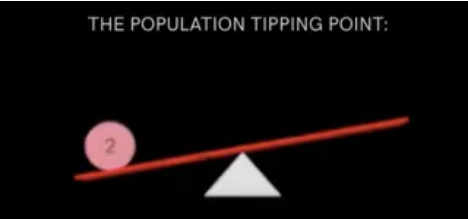
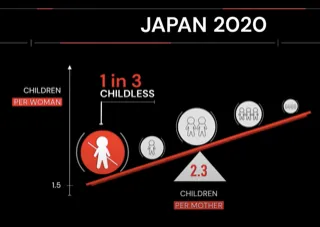
Only one in ten women actually don’t want children. One in ten is infertile, but the rest who don’t have children and that is one-third of us and counting, wanted them. By the time they are in their 40’s and incapable, badly.
Steven F Shaw searches for answers in Birth Gap, his masterwork documentary, the first part of which you can watch here. The most obvious is that they waited too long, thinking it was possible, their “career” taking precedence. He interviews two prominent women in their late 30’s, both journalists. One of whom has a child, and having had one, wanted more but it was too late. “No one told us”, she said. Throughout her childhood and education, no one told her that the hammer would come down, that fertility drops off a cliff in your 30’s. That if you are 30 and childless, there is a 50% chance you won’t have children. The other, Megan McArdle, who writes for the Washington Post, left it too late. McArdle is a brilliant woman. If she didn’t know she was playing with fire, who could?
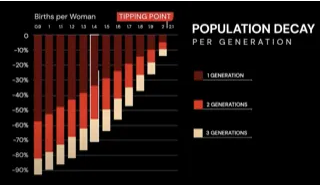
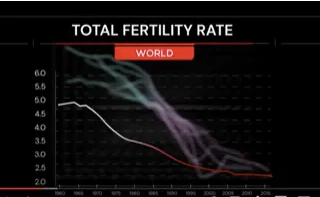
The catastrophic statistics run across all cultures but sub-Saharan Africa. Every industrialized country is racing to the bottom, which is to say extinction within four or five generations. Cities left to ruin, old people without help, decaying schools, hospitals, and no employees to be found. The unretrievable extinction of the culture and its people. I’ll leave it to you to follow Shaw’s math, but it is convincing. And he is by no means, alone in his analysis.
Europe, Japan and especially South Korea are by far the most in trouble. But Spain, Italy, the Scandis, are not far behind. America’s massive migration is masking the effect now, but, as Shaw doesn’t point out, but others have, immigrants quickly default to the current zeitgeist. Even in Muslim countries, pace Mark Steyn, women are choosing to not have children until too late. And forget multiples, even for the devout, it’s no longer on the cards.
To me, one underlying reason is the firehose of overpopulation propaganda that we have endured for the past fifty years. Women, in general, as kids, are good girls, accepting of authority, and compassionate. When told their desire for children is stressing the earth, they are more likely to accept that nonsense without question if it is coming from every authority figure in every sector of the culture. Today from kindergarten on, we are taught that we are a virus, a plague on the earth. Who among us, at the age of 15 or 25, can contravene that level of brainwashing? Contrast Peterson saying this week, “we can make the deserts bloom”. When was the last time you heard that sentiment from anyone in authority?
November 5, 2023
Dear Supreme Court of Canada, “ever get the feeling you’ve been cheated?”
Colby Cosh outlines the arguments the federal government used to persuade a majority of the sitting justices of the Supreme Court of Canada to greenlight Justin Trudeau’s carbon tax tax grab and wonders if they suspect they got fast-talked:
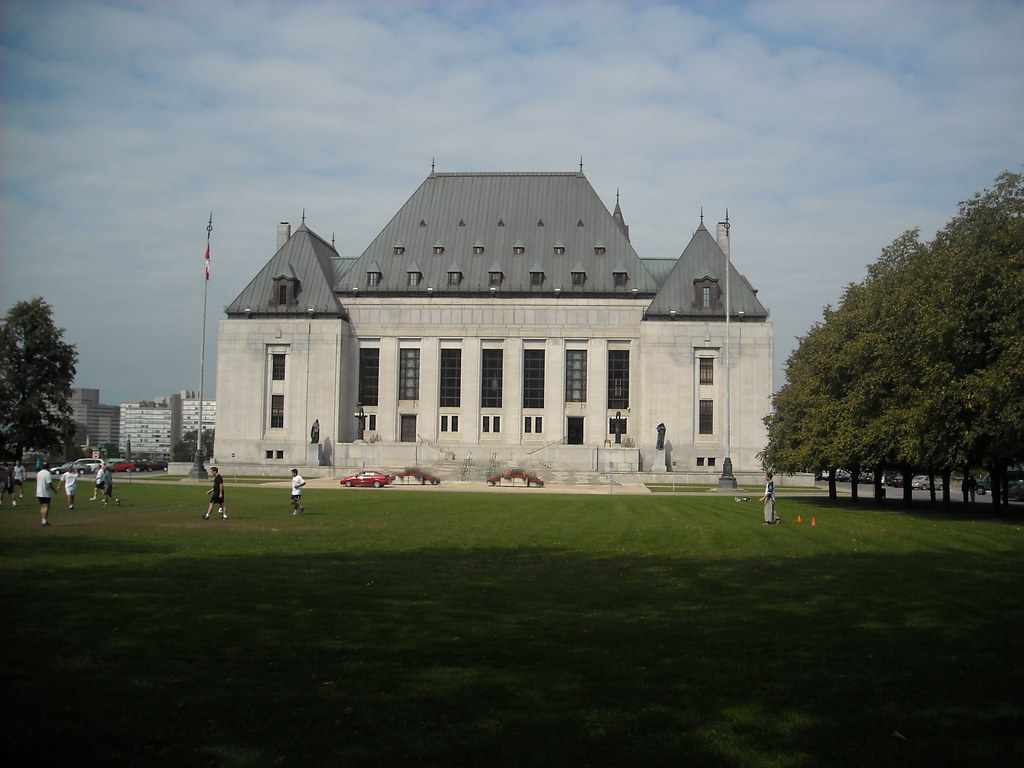
“Supreme Court of Canada, Ottawa” by daniel0685 is licensed under CC BY 2.0

The decision agreeing to this was signed by six of the nine justices of the court: Richard Wagner, Rosalie Abella, Michael Moldaver, Andromache Karakatsanis, Sheilah Martin and Nicholas Kasirer. Today I confront these eminences with the immortal question once asked by Johnny Rotten: ever get the feeling you’ve been cheated?
Last week the Liberal government whose hirelings rhapsodized about the urgent, indivisible, inherently national nature of carbon pricing announced a “temporary” total exemption for fuel oil used for home heating. This has the effect of letting some households in the Atlantic provinces out of a tax that applies to cleaner BTUs in the rest of the country, and the targeted regional nature of this move has been emphasized rather than concealed by Liberal ministers.
Oh, to be sure, it’s temporary. The three-year duration of the exemption just happens to push its expiry past the next federal election. What happens at that point, who knows? And to be sure, the exemption applies to fuel oil for home heating everywhere in Canada where the federal carbon tax applies. It just so happens that the electorally crucial Atlantic is the only place where a significant number of households still depend on the system. The Liberals can perhaps say with a straight face that there is no conflict here with the underpinnings of the arguments that succeeded so beautifully in the Supreme Court.
But if the GGPPA References were re-litigated now, after the attempt to impose the carbon tax and the panicky local retreat, one wonders whether the “national concern” blarney would seem quite so convincing. We are not, in turns out, all in this leaky planetary lifeboat together. The urgency of carbon pricing, it turns out, is not quite paramount and transcendent. Its indivisibility and inherent nationalness are not as promised. The Liberals didn’t want to save the planet quite so much, it seems, as they just wanted to make the rules for their own electoral benefit.
At The Line, Harrison Ruess, who recently switched his home heating solution from a mixed oil and propane to just propane, wonders why his choice to go with the lower-carbon option will end up penalizing him under the latest policy change by the feds:
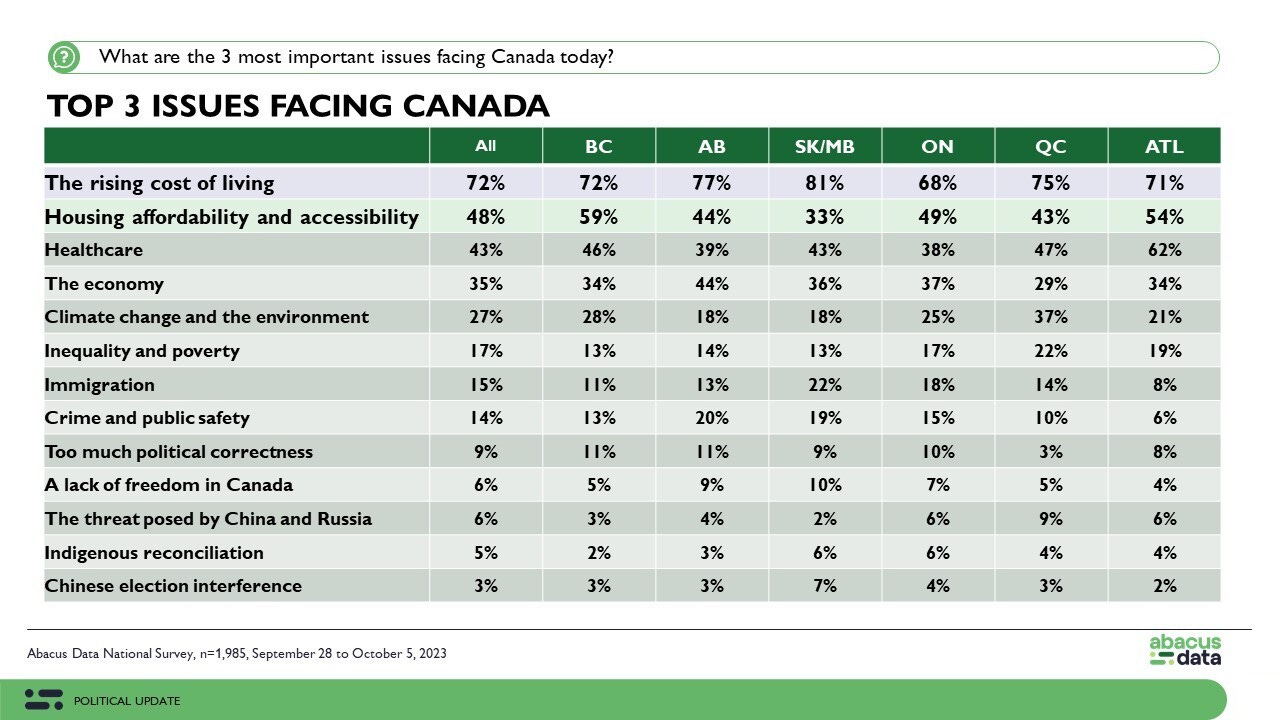
Indeed, in looking deeper at the regional numbers, the concern about the rising cost of living and housing affordability isn’t particularly acute in Atlantic Canada versus other parts of the country. The chart below, provided to me by David Coletto at Abacus Data, and published here at The Line first, reveals just how difficult a position the PM has now staked out for his government. While Atlantic Canadians are somewhat more concerned about housing affordability than average, they are very slightly less concerned than the average Canadian about the overall rising cost of living. In Saskatchewan and Manitoba, for example, the opposite is true: they’re less concerned than average about housing affordability, but more concerned than average about the rising cost of living.
The takeaway to me in looking at this is that all Canadians are worried about costs and affordability.
The other question that jumped to mind is: why only heating oil? Heating oil is useful in places without good access to natural gas pipelines, and that does include much of Atlantic Canada, but also to rural areas everywhere, where other fuels, such as propane or wood pellets, are also used. According to the propane association, there are about 200,000 Canadian homes using propane — of which about 30,000 are in Atlantic Canada.
I can speak to this with some personal experience. When my wife and I purchased our home in semi-rural Ottawa, it had a Frankenstein heating system that used heating oil for part of our home and propane for another. Just this summer we completed a (somewhat expensive) rationalization of our system to combine the two into one larger, though more efficient, propane system.
Having one system will hopefully save us money on maintenance and hydro costs — powering and maintaining one system should cost less than two. It will also save us a couple hundred bucks a year on our home insurance (did you know there’s an extra premium if you have a heating oil tank? Welcome to rural life, dear readers.) Ditching the oil and expanding the propane is also good environmentally, since the carbon impact of propane is considerably less.
But we didn’t get a break from the federal government. We’d only have gotten it if we’d gone the other way, and used the more polluting fuel. Why punish my family for heating our home using the cleaner fuel?
And why not provide an exemption for natural gas? It’s cleaner still. And why not people in cities? They don’t want to freeze either, and we’re all broke. The carbon tax isn’t helping, no matter which fuel you’re using or which part of the country you call home. The ultimate challenge the government will face is that they cannot talking-point their way out of a reality.
November 4, 2023
QotD: The munificent benefits of big government
This is the argument that government should run more of the economy of course.
No, don’t laugh, it is. Because these things are rising in price is exactly why, so the argument goes, government must regulate and control more, so as to lower the price.
Tim Worstall, “Ain’t Capitalism Great? Price Changes Over The Last 20 Years”, Continental Telegraph, 2019-07-13.
November 2, 2023
The carbon tax has been murdered, by Justin Trudeau, in the House, with a blatant self-interest
Rex Murphy believes the much-hated carbon tax — the Laurentian Elite’s revenge on working Canadians — has been dealt its mortal blow by the least likely suspect:
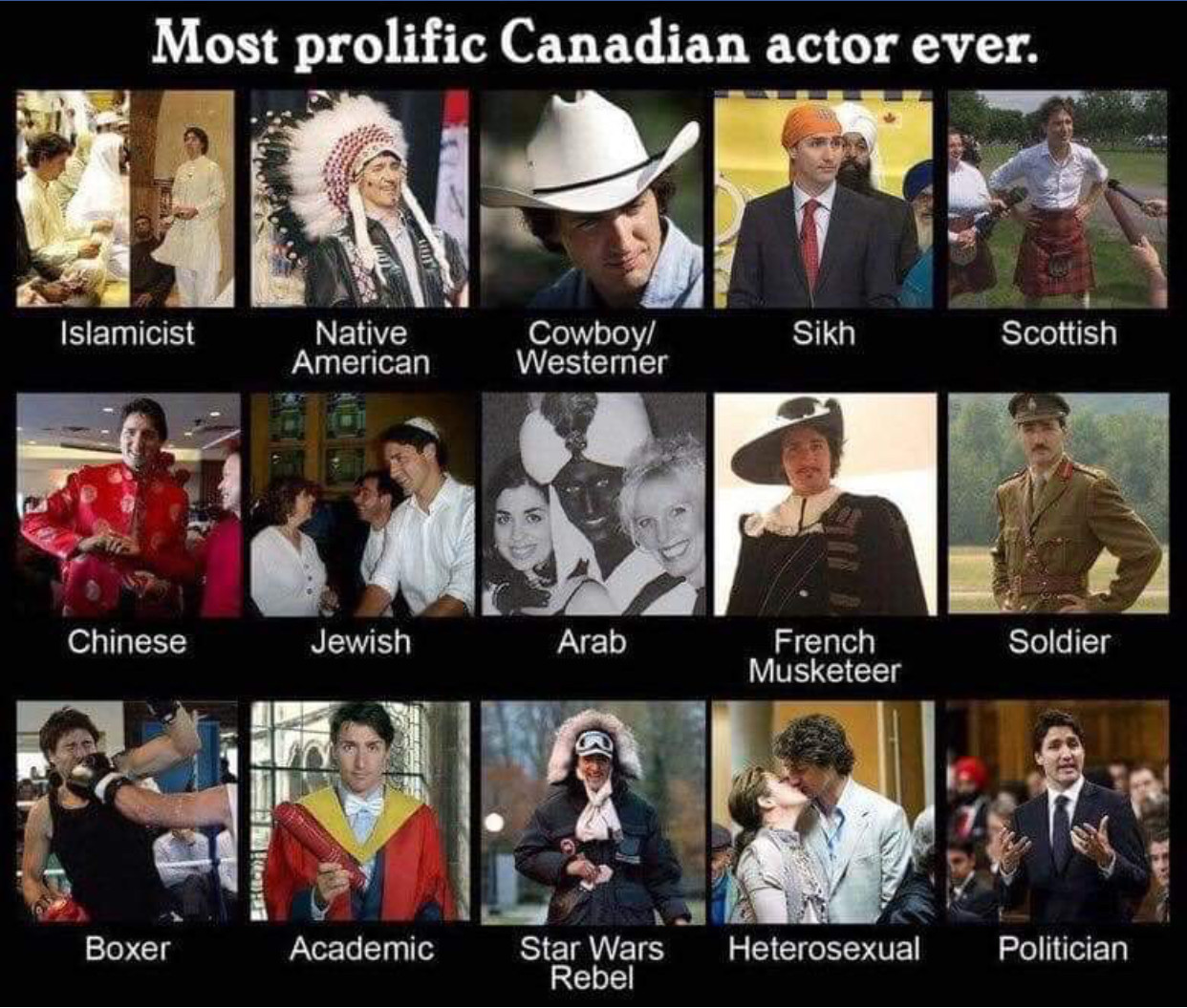
Justin Trudeau came into office on the spume of Canadian-level celebrity, built on a persona of ostentatious, idle gestures and token cheer (selfies, socks, costumes), the endless vocalization of woke crackerjack-box slogans and a smile cemented in place that had all the warmth of well-gelled cement. Just style. Style, understood as the adoption of surface mannerisms in place of deeply settled convictions, convictions built on a real attempt to understand Canada, to relate to all its regions, and an appreciation (which does not mean agreement) of the ideas, lifestyles and situations of mainstream Canadians: style adopted as a campaign dynamic.
It’s worth reminding that from the moment of its first swearing-in, the Liberal government has been an administration of show and tactics: tactics have been its policy, tactics have been its governing lifeblood. Policies — in so far as it can be said to have had policies — have been merely (temporary) scaffolding or window displays meant to shore up the tactics. They have not been, as with an honourable government, needful measures for Canadian well-being, shored up not by tactics but by their obvious benefit and their consonance with what Canadians made clear were their concerns.
Canada’s predominant commitment these past eight painful years, the “one ring to rule them all”, the only government commitment held with deepest conviction we have been told, has been combatting global warming. It is different. It is real policy. It is the core principle. It is immutable because its cause is existential. It has been Canada’s passport to an admiring progressive world. Above all it has absolutely glowed with virtue-signalling and superior progressive sensibility. It has been as good as a wristband was at a rock concert years back.
For all of his eight years Trudeau has incessantly promoted and promulgated his single cause. At home he has out-Suzukied David Suzuki, out-Mayed Elizabeth May, and there have been moments when he “out-dared” Greta. Abroad, he has been climate alarmism’s smiling Galahad.
Global warming has been his religion, and what he calls the carbon tax both eucharist and passport to net-zero paradise. To an increasingly skeptical Canadian public, anxious and distrustful of a government regularly racked by scandal and heroic mismanagement, he said (I paraphrase): “I know I’m taxing a necessity — heat for homes in northerly Canada — and I know it must hit the poor first and worst. But it’s to save the world! Saving the world keeps me up at night. And I want Canada to lead the way in saving it. And for that, there must be a tax on energy, on gas and oil, on heating. It must be done. It’s a sacrifice poets will write in praise of in the lower-temperature world we will be key to making happen.”
The tax on carbon dioxide — the great comedians of the Liberal party called it a “tax on pollution” — had to be imposed, even as inflation ravaged the country and further immiserated the already sufficiently immiserate, because Trudeau had a whole world to save. It was the signature element of the signature policy of Trudeau’s showcase government. It was the indispensable girder in building a post-oil-and-gas future for a post-nationalist Canada, the indestructible bridge to a golden net-zero tomorrow for our country. And, incidentally, a great shiny glittering Last Spike to doom Conservative Alberta’s economy and government, and no little whack for Saskatchewan.
This was principle as policy, and policy as principle. For seven plus years.
And now. A few fingers snapped somewhere and suddenly, Mr. Trudeau … cancels the carbon tax. Cancel for one and you must cancel for all.
Keeping Clean in Rome
seangabb
Published 2 Jul 2023A lecture, given in June 2023, about bathing and keeping clean in the Roman World — plus an overview of depilation and going to the toilet.
(more…)
October 31, 2023
The “better than average” effect versus the suspicion that everyone is partying without you
Rob Henderson considers the friendship paradox and the illusion of loneliness:
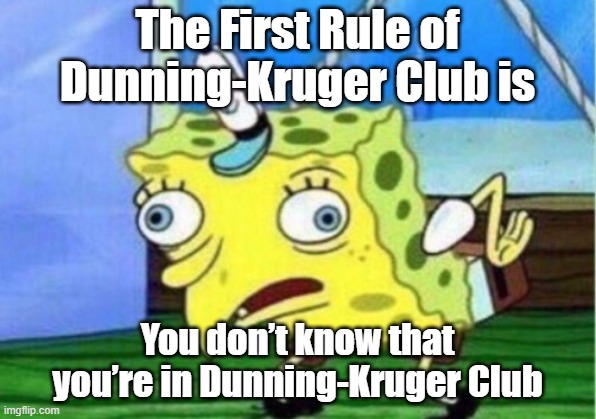
Generally, people hold a high opinion of themselves.
A large body of research has found that people tend to believe they are more intelligent, trustworthy, and have a better sense of humor than others. A recent study found that people believe they use ChatGPT more critically, ethically and efficiently than others.
People think they are better drivers than average, students think they are better students than average, professors think they are better professors than average. This is known as the “better than average” effect.
Intriguingly, people are selectively overconfident in their abilities that will garner higher status in their specific social environment. For example, people in individualistic cultures like the U.S. overestimate their ability to lead. But people in collectivistic cultures in Asia overestimate their ability to listen.
We even think we are better than ourselves.
One study asked participants how often they engaged in kind and cooperative acts to help others. A month and a half later, researchers showed these same people their own scores. But the researchers told them that these scores were provided by “their average peer”. So the participants didn’t know they were looking at their own scores.
The researchers asked them to rate themselves again. People rated themselves as higher than the score they were shown, claiming they were superior to themselves.
People also believe others are more susceptible to mass media influence than they themselves are. We overestimate the influence media has on others and underestimate the influence media has on ourselves. This tendency increases people’s support for censorship, because we think others are sheep who can’t handle certain information (or “misinformation”) while we are independent thinkers who can critically evaluate the information we encounter.
Likewise, people believe they are more immune to social biases than others. A recent study found that people think others are more likely than themselves to make decisions based on their preconceived notions and preexisting beliefs. And people believe others are less willing than themselves to update their views in light of new information.
The researchers concluded, “The more strongly people believed that biases widely existed, the more inclined they were to ascribe biases to others but not themselves”.
October 27, 2023
Scientific Wokemerican
In Spiked, James Esses on the formerly respected magazine Scientific American (I’ve been calling it JunkScientific American since they published a story on the “Racist Roots of Fighting Obesity”):
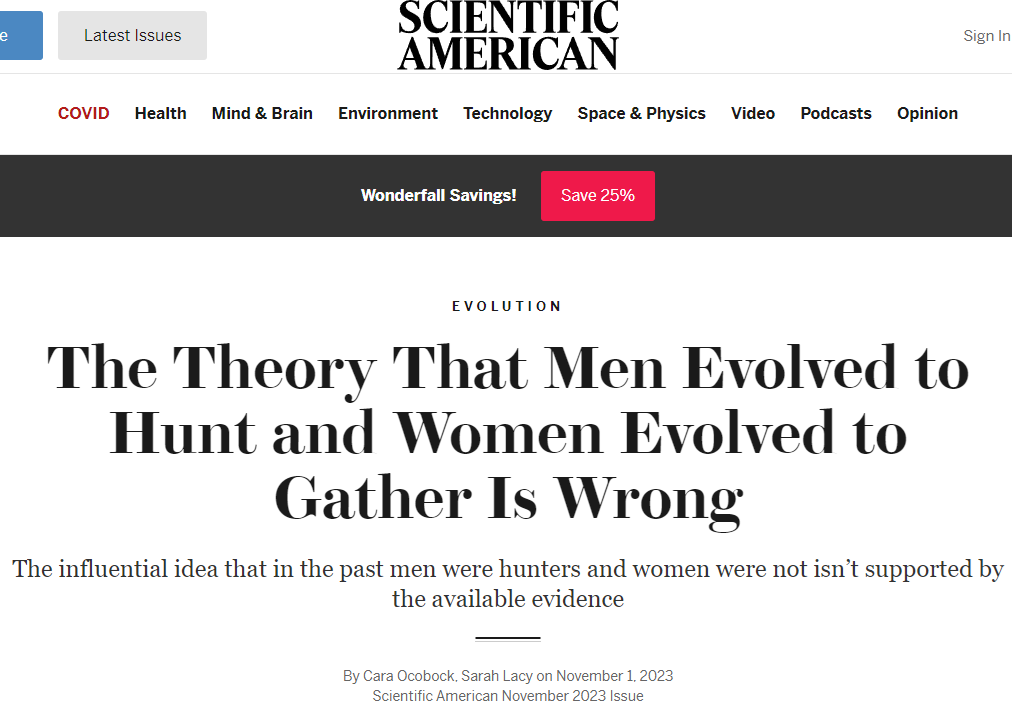
When you come across the longstanding magazine, Scientific American, you could be forgiven for assuming that scientific truth would play a pivotal role in its output.
But not any more, it seems. Scientific American, founded in 1845, is the oldest continuously published magazine in the United States. It has previously featured work by Albert Einstein, among others. However, in recent years, it appears to have been taken over by contributors who consider themselves activists first and scientists second. The magazine’s ethos now includes the express aim of “sharing trustworthy knowledge, enhancing our understanding of the world, and advancing social justice” (my emphasis). It has also started to intervene in electoral politics, too. In 2020, Scientific American broke with a 175-year history of non-partisanship to endorse Joe Biden in the US presidential election.
Worst of all, when its articles touch on questions of gender and biological sex, Scientific American seems to have abandoned objective facts entirely, in favour of trans-activist pseudoscience.
In 2019, an article by Simón(e) D Sun, who identifies as a “transgender nonbinary woman”, tells us to “Stop using phoney science to justify transphobia”. The piece is, as you might expect, filled with ideologically driven language and easily disprovable claims. For instance, it asserts that sex is “assigned” at birth when it is not – it is observed and recorded. It also suggests that “scientific endeavour is quantifiably better when it is more inclusive”. But what if “being inclusive” requires us to deny the reality of biological sex? That would surely put inclusivity at odds with science.
A patronising, finger-wagging tone runs throughout, too. At one point, readers are told to “hold onto your parts, whatever they may be. It’s time for ‘the talk'”.
Ironically, the article undermines its own premise within the first few paragraphs, as it walks readers through the clear biological differences between males and females, ranging from chromosomes to sexual characteristics to brain development. And at the end of the article, having done nothing to challenge the status quo of human biology, we are told: “The science is clear and conclusive: sex is not binary, transgender people are real”.
Of course, nobody has ever claimed “transgender people” are a figment of our imaginations. What gender-critical feminists have argued, however, is that sex is both binary and immutable – and that feeling uneasy about one’s sex is a symptom of mental distress, rather than proof of an innate gender identity that is at odds with one’s body.
And now, for its upcoming November issue, Scientific American has published another piece denying biological reality. Again, this article is peppered with ideological claims that purport to be scientific facts.
Two wild-eyed optimists claim that things aren’t as bad as you think
Who lets these dangerous lunatics talk to the press? If anyone listens to them, they may get unwarranted optimistic notions that go against the narrative:
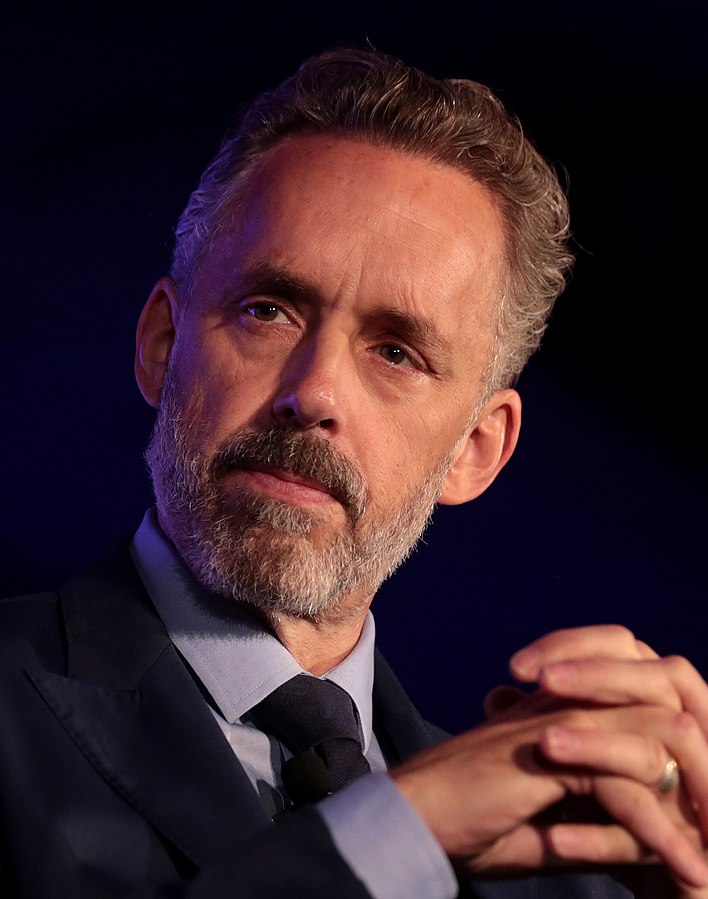
Jordan Peterson speaking at an event in Dallas, Texas on 15 June, 2018.
Detail of a photo by Gage Skidmore via Wikimedia Commons.
War is endlessly and eternally horrific. It is understandable and even necessary that the media spotlights today’s conflicts. But this can make us believe that we’re living through unprecedented violence. Russia’s war indeed meant that battle deaths in 2022 reached a high for this century, but they are still very low by historical standards. Last year, 3.5 in 100,000 people died as a consequence of war, below even the 1980s and far below the 20th-century average of 30 per 100,000. The world has in fact become much more peaceful.
This is of course little consolation to those living in conflict zones. But the data speaks to the problem with the constant barrage of contextless catastrophe and doom. Analysis of media content across 130 countries from 1970 to 2010 indicates that the emotional tone has dramatically and consistently become more negative. Negativity sells, but it informs badly.
The same pattern characterizes climate change reporting. A pervasive and false apocalyptic narrative draws together every negative event — ignoring the bigger picture almost entirely. Last summer, for example, forest fires made headlines, but coverage largely failed to mention that the annual burned global area has been declining for decades, reaching the lowest level ever last year. Likewise, deaths from droughts and floods make fill the front pages, but we don’t hear that deaths from such climate-related disasters have declined 50-fold over the past century.
The data show what we all fundamentally know: the world has improved dramatically. Life expectancy has more than doubled since 1900. Two centuries ago, almost everyone was illiterate. Now, almost everyone can read. In 1820, nearly 90 per cent of people lived in extreme poverty. Now it’s less than 10 per cent. Indoor air pollution has declined dramatically, and its outdoor equivalent has also done so in rich countries. If we could choose when to be born, having all the facts at hand, few would choose any time before today.
This incontrovertible progress has been driven by ethical and responsible conduct, trust, well-functioning markets, the rule of law, scientific innovation and political stability. We have to recognize, appreciate and proclaim the value, and comparative rarity, of each of these.
The constant barrage of negative stories may lead us to imagine that our forward progress is about to end. However, the evidence at hand does not support this conclusion. The latest Intergovernmental Panel on Climate Change scenarios indicate that, if not for climate change, the average person would be 4.5-times richer by the end of the century than they are today.
QotD: It’s the #BelieveScience fans who are most likely to fall for pseudoscientific scams
The paper consisted of the results of four pre-registered experiments of decent sample size, albeit administered online. They introduced false claims about a fictional virus created as a bioweapon, and about the carcinogenic nature of GMO foods.
The results were so, so very telling.
“Participants who trust science are more likely to believe and disseminate false claims that contain scientific references than false claims that do not,” and “We conclude that trust in science, although desirable in many ways, makes people vulnerable to pseudoscience.”
Let that sink in. The people who #BelieveScience are more vulnerable to falling for pseudoscientific claims, especially when those claims are presented with the comforting ephemera of science — the lab coats, the credentials, the technical studies filled with jargon. That’s because “Believing Science” isn’t the same thing as actually doing science. “Believing Science” is a statement of tribal affiliation. All this claim demonstrates is that a person wants to be seen as the sort of individual who believes experts and takes advice from trusted and credentialed officials. For the most part, this is a good instinct! But if those experts and trusted officials are wrong, malicious, or simply full of shit, the “Believe Science” crowd will reliably fall in line. Because of its ideological affiliation, this crowd is, ironically, far less capable of spotting bad science.
Actually doing science as opposed to merely believing in it requires that we all evaluate claims critically regardless of their origins; we look for inconsistencies, we examine the quality of the evidence presented, and we question the credibility of the people making the claims.
“Dispatch from the Front Line: Comms aren’t the government’s problem”, The Line, 2023-07-23.
October 26, 2023
“… despite all the evidence, British people still believe the NHS is the single best thing about Britain”
The picture Jess Gill paints of Britain’s National Health Service is equally true of Canada’s various provincially run socialized medical systems, and largely for the same reasons:
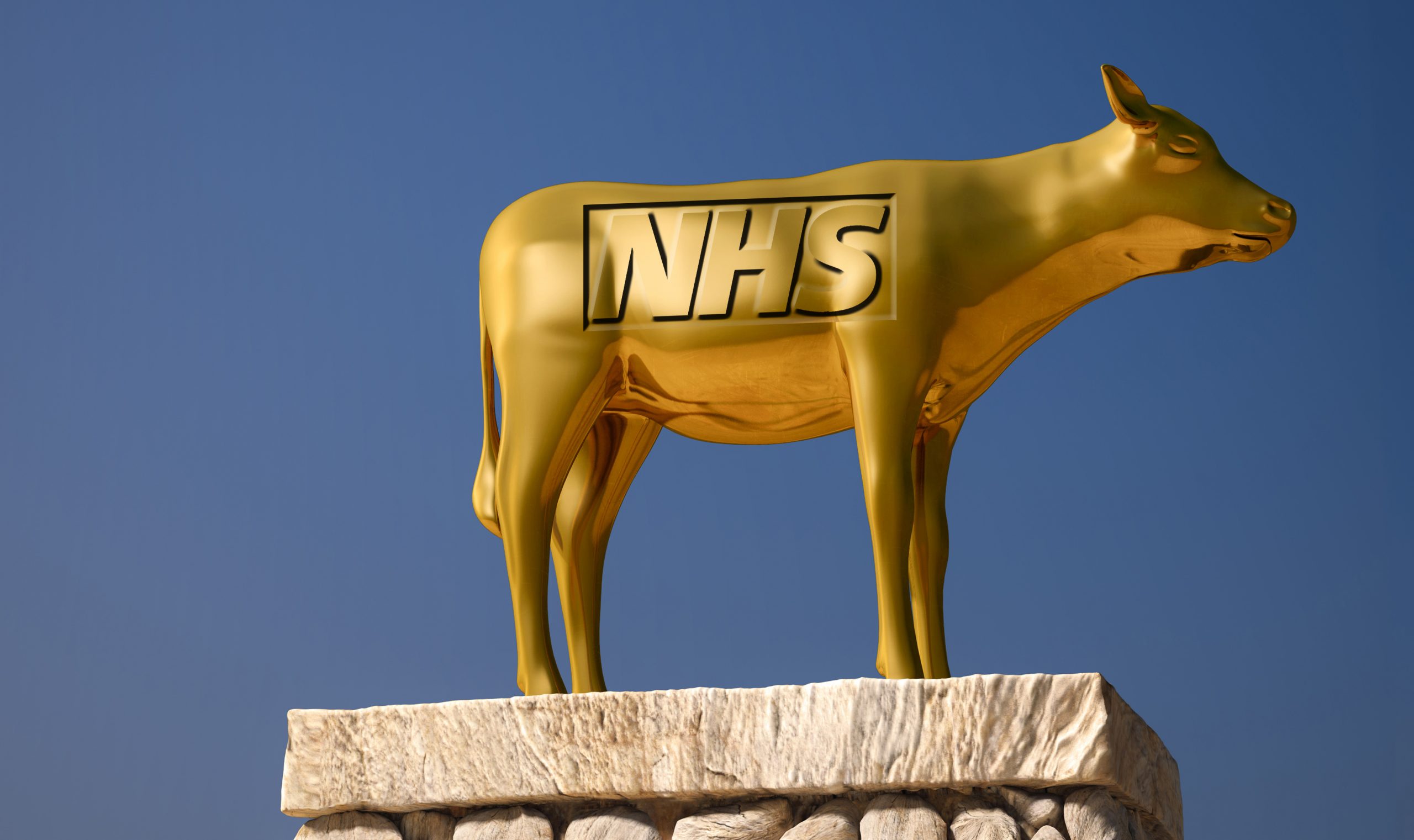
Not actually the official symbol of Britain’s National Health Services … probably.
It’s clear that Britain’s National Health Service is failing. 7.6 million people are on a waiting list, and 41% of them say their health has gotten worse while waiting for treatment. Compounding the problem, the UK has significantly fewer hospital beds, doctors, nurses, CT scanners, and MRI units than the OECD average. Furthemore, the UK has the second-highest rate of treatable deaths in Western Europe.
Yet despite all the evidence, British people still believe the NHS is the single best thing about Britain. From the country clapping outside their houses to “thank our NHS” during the Covid-19 pandemic, to the Prime Minister and the Leader of the Opposition attending a mass ceremony to celebrate the NHS’s 75th anniversary, praise for this institution is everywhere.
Even though it’s self-evident the emperor has no clothes, the NHS is treated like a sacred cow. This begs the question: why are people so loyal to a system that is clearly failing them?
There is a prevalent conspiracy theory that the NHS is being intentionally underfunded by the Conservative Government so that the resulting poor outcomes will provide justification for them to privatize it and transform it into the American model of healthcare. This theory is pushed by the establishment: from senior members of the British Medical Association, journalists, and Members of Parliament.
This theory achieves two things. One, it shifts blame for poor outcomes away from the NHS as a system itself and toward the politicians in power. Two, it frames the debate with the assumption that privatization is a bad thing, causing any meaningful reform to be met with fear mongering.
This narrative has caused a massive issue for opponents of the NHS as there are multiple levels of misleading rhetoric. The fact of the matter is that the Conservatives are not privatizing or underfunding the NHS. Furthermore, whether it be a fully privatized system or even the mixed system as seen in other European countries, free-market reform would significantly help patients and doctors.
QotD: Making steel
So we are going to limit ourselves here to just carbon and iron. Now in video-game logic, that means you take one “unit” of carbon and one “unit” of iron and bash them together in a fire to make steel. As we’ll see, the process is at least moderately more complicated than that. But more to the point: those proportions are totally wrong. Steel is a combination of iron and carbon, but not equal parts or anything close to it. Instead, the general division goes this way (there are several classification systems but they all have the same general grades):
Below 0.05% carbon or so, we just refer to that as iron. There is going to be some small amount of carbon in most iron objects, picked up in the smelting or forging process.
From 0.05% carbon to 0.25% carbon is mild or low carbon steel.
From about 0.3% to about 0.6%, we might call medium carbon steel, although I see this classification only infrequently.
From 0.6% to around 1.25% carbon is high-carbon steel, also known as spring steel. For most armor, weapons and tools, this is the “good stuff” (but see below on pattern welding).
From 1.25% to 2% are “ultra-high-carbon steels” which, as far as I can tell didn’t see much use in the ancient or medieval world.
Above 2%, you have cast iron or pig iron; excessive carbon makes the steel much too hard and brittle, making it unsuitable for most purposes.Bret Devereaux, “Collections: Iron, How Did They Make It, Part IVa: Steel Yourself”, A Collection of Unmitigated Pedantry, 2020-10-09.
October 24, 2023
What is a man?
Rob Henderson recently gave a lecture at the University of Richmond as part of their “Masculinity in a Changing World” series. Part of the lecture involved exploring the question “what is a man?”
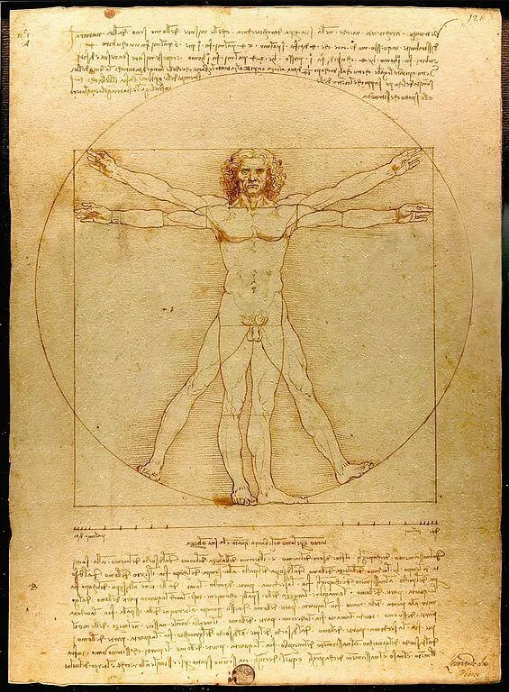
Of course, there are many ways of understanding what being man is about, and there are many valid ways to be a man. However, regardless of how it is expressed, it usually has something to do with strength and toughness and productivity.
In his cross-cultural research, the psychologist Martin J. Seager has found 3 consistent requirements to achieve the status of manhood in various societies around the world.
First, the individual must be a fighter and a winner.
Second, he must be a provider and protector.
And third, he must maintain mastery and control of himself at all times.
Across cultures, there seems to be an implicit understanding of what being a man is.
Indeed, in a widely-cited study of 25 cultures—including New Zealand, Finland, Zimbabwe, Malaysia, Pakistan, Bolivia, and Trinidad—definitions of masculinity and femininity hardly fluctuated at all. As a rule, participants in this study said they did not believe that men and women differed in all respects, and they did not view one sex as inherently superior to the other. But in every culture, men were seen as active, adventurous, dominant, forceful, independent, and strong.
Contemporary polemicists will rhetorically ask questions like, “What is a woman?” But seldom does anyone ask, “What is a man?” People seem to already know.
Indeed, many individuals resort to commonplace expressions such as, “Man up”, or “Be a man”, or, more crassly, “Grow some balls”. In polite society, people won’t publicly express such remarks, but many will still think them.
Men, of course, are responsive to these statements. In a famous literary illustration, Shakespeare’s Lady MacBeth reinforces the conception of manhood as strength. Early on in this 17th century play, she receives a letter from her husband. The letter details an encounter with 3 witches and their prophecy that her husband Macbeth will take over the throne from King Duncan.
Lady Macbeth is eager for this power and insists that she and her husband must murder the King themselves in order for this prophecy to come true. Lady Macbeth expresses her concerns however, when she grows worried about whether her husband will be manly enough to follow through with this agreement. Her fears are confirmed when Macbeth, upon reflecting on the consequences of treason, subsequently backs out of the plan.
Lady Macbeth then persuades her husband when she proclaims that if he were to go through with the murder, then he would not only be a man, but “so much more.”
By dangling the enticing reputation of manliness over her husband, Lady Macbeth succeeds in getting him to kill the king, and subsequently setting in motion the chaotic events of the rest of the story.
Shakespeare was clearly a keen observer of human nature in general and of men’s anxieties about their masculinity in particular.
Such anxieties regarding the belief that manhood is something that must be achieved through action appear to be ubiquitous around the world.
I’ll offer a few brief examples.
On the Greek Aegean island of Kalymnos, many of the inhabitants make their living by commercial sponge fishing. The men dive into deep water without the aid of special equipment, which they scorn. Diving is a gamble because many men are stricken and injured. Young divers who take precautions are mocked as effeminate and ridiculed by their peers.
Halfway around the world, in the high mountains of Melanesia, young boys undergo intense trials before achieving the status of manhood. Young boys are torn from their mothers and forced to undergo a series of brutal masculinizing rituals. These include whippings, beatings, and other forms of terror from older men, which the boys must endure stoically and silently. This community believes that without such hazing, boys will never mature into men but remain weak and childlike. Real men are made, they insist, not born.
To this extent, the psychologist Roy Baumeister has pointed out that, “in many societies, any girl who grows up automatically becomes a woman … Meanwhile, a boy does not automatically become a man, and instead is often required to prove himself, usually by passing stringent tests or producing more than he consumes.”
In many non-industrialized small-scale societies, girls are believed to become women when they are physically able to produce children. The ability to have kids is considered a major contribution in itself to the community. Boys, in contrast, do not have a clear and visible biological indicator of manhood, and must often endure culturally sanctioned rituals and painful trials to become men.
Indeed, masculinity is widely considered to be an artificially induced status, achievable only through testing and careful instruction. Real men do not simply emerge like butterflies from their boyish cocoons. Rather, they must be carefully shaped, nurtured, counseled, and prodded into manhood.
The literary critic Alfred Habegger has remarked that masculinity “has an uncertain and ambiguous status. It is something to be acquired through a struggle, a painful initiation, or a long and sometimes humiliating apprenticeship.”


