More bits of mating lore from the animal kingdom here.

More bits of mating lore from the animal kingdom here.
No, really:
I have been sitting here with two Stegosaurus models for 20 minutes now, and I just can’t figure it out. How did these dinosaurs — bristling with spikes and plates — go about making more dinosaurs without skewering each other?
Stegosaurus has become an icon of the mystery surrounding dinosaur sex. Dinosaurs must have mated, but just how they did so has puzzled paleontologists for more than 100 years. Lacking much hard evidence, scientists have come up with all kinds of speculations: In his 1906 paper describing Tyrannosaurus rex, for instance, paleontologist Henry Fairfield Osborn proposed that male tyrant dinosaurs used their minuscule arms for “grasping during copulation.” Others forwarded similar notions about the function of the thumb-spikes on Iguanodon hands. These ideas eventually fell out of favor — perhaps due to embarrassment as much as anything else — but the question remained. How can we study the sex lives of animals that have been dead for millions upon millions of years?
H/T to Maggie Koerth-Baker, who writes: “You’ve really got to read this entire article. Out loud. To someone you love. If they’re the kind of lover who wants to know about prehistoric mating rituals, the dino-sex theories of Victorian paleontologists, or how to sex a fossil, they’ll thank you. (And if they aren’t that kind of lover, well. Maybe it’s time to re-think the relationship.)”
Of all the EU states, the last one you’d expect to give up on wind power would be the one that everyone associates with windmills:
In a radical change of policy, the Netherlands is reducing its targets for renewable energy and slashing the subsidies for wind and solar power. It’s also given the green light for the country’s first new nuclear power plants for almost 40 years.
Why the change? Wind and solar subsidies are too expensive, the Financial Times Deutschland, reports.
Holland thus becomes the first country to abandon the EU-wide target of producing 20 per cent of its domestic power from renewables. This is a remarkable turnaround from a state that took the Kyoto Agreement seriously and chivvied other EU members into adopting renewable energy strategies. The FT reports that instead of the €4bn annual subsidy, it will be slashed to €1.5bn.
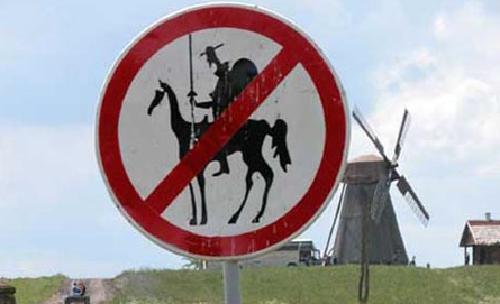
I did a quick Google image search for a typical Dutch windmill image, and decided that this one was too amusing to pass up:
I read a lot of history and thus know a fair bit about how weather impact has been perceived by humans over time. It is a fact that the 20th century was an abnormally lucky hundred years, meteorologically speaking. The facts I managed to jam into tweets included (a) the superstorm that flooded 300 square miles of the Central Valley in California in the 1860s, (b) rainfall levels we’d consider drought conditions were normal in the U.S. Midwest before about 1905, and (c) storms of a violence we’d find hard to believe were commonly reported in the 1800s. I had specifically in mind something I learned from the book Wicked River: The Mississippi When It Last Ran Wild, which relays eyewitness accounts of thunderstorms so intense that travelers had to steeple their hands over their noses in order to breathe air instead of water; but a sense that storms of really theatrical violence were once common comes through in many other histories.
We had a quiet century geophysically as well — no earthquakes even nearly as bad as the New Madrid event of 1812, which broke windows as far north as Montreal. And no solar storms to compare with the Carrington Event of 1859, which seriously damaged the then-nascent telegraph infrastructure and if it recurred today would knock out power and telecomms so badly that we’d be years recovering and casualties would number in the hundreds of thousands, possibly the millions.
(I’m concentrating on 19th-century reports because those tended to be well-documented, but earlier records tell us it was the 20th century calm that was unusual, not the 19th-century violence.)
The awkward truth is that there are very large forces in play in the biosphere, and when they wander out of the ranges we’re adapted to, we suffer and die a lot and there really isn’t a great deal we can do about it; we don’t operate at the required energy scales. For that matter, I can think of several astronomical catastrophes that could be lurking just outside our light-cone only to wipe out all multicellular life on Earth next week. Reality is like that.
Eric S. Raymond, “Heavy weather and bad juju”, Armed and Dangerous, 2011-02-03
Not at all Top Gear-ish.
H/T to Jon for the link.
There’s been enormous progress in genomics; we’re now on the threshold of truly understanding how little we understand. While the anticipated firehose of genome-based treatments hasn’t materialized, we now know why it hasn’t materialized, and it’s possible to start filling in the gaps in the map. Turns out that sequencing the human genome was merely the start. (It’s not a blueprint; it’s not even an algorithm for generating a human being. Rather, it’s like a snapshot of the static data structures embedded in an executing process. Debug that.) My bet is that we’re going to have to wait another decade. Then things are going to start to get very strange in medicine.
Charles Stross, “Reasons to be cheerful”, Charlie’s Diary, 2010-12-31
The Register, reacting to the decision by the Advertising Standards Authority to allow homeopaths and herbalists to be described as “scientists”, offers an alternative term:
We here at the Reg would like to offer as a new gold standard our use of the term “boffin” to replace the now officially discredited term “scientist” — which was already in our view unacceptably loosely applied, including as it did researchers in such fields as sports science, psychology etc.
A boffin, on these pages at least, will be a researcher whose work is based on hard sums and/or hard facts such as fossils, atomsmasher collisions etc. Statistics, especially ones gleaned by surveying students or counting up patents granted etc, will generally not count. Persons who work with the latter sorts of material will normally be known as eggheads, trick-cyclists, economists etc as appropriate.
And even though the word “scientist” now officially means nothing, we still aren’t going to apply it to homeopathic smellies experts.
Cue the outrage:
Despite the long push for more equality in parenting duties, new research suggests that mothers and fathers may actually get along better when parenting roles are divided along more traditional lines — that is, when fathers back off caregiving duties, such as feeding and bathing, and put more effort into playtime.
[. . .]
Families in which fathers were more involved in play activities had more of what researchers called supportive interaction between the two parents.
In contrast, more of what is described by researchers as “undermining behaviour” was seen among families in which fathers do more of the caregiving.
[. . .]
It is unclear why the study yielded the results it did, but Sarah Schoppe-Sullivan, a professor of family science at Ohio State University and one of the study’s co-authors, suggested parents may be subconsciously bothered when parenting roles conflict with their pre-conceived ideas.
From the mother’s point of view, it could be a function of “maternal gatekeeping,” she said. “For mothers, maybe, it’s hard to give up some control to the father. That could be a total social effect, but there could some sort of biological underpinning to it.”
It’s a single study, so the results are hardly conclusive, but the general tenor of the study will not be popular in certain academic and political circles.
Caroline May is almost right in the title to this article: “Stay vertical a bit longer, ladies: Study claims men are winning the game of love”.
It’s not all men who benefit, even if we just talk about men who are unmarried and not in a long-term relationship. The men who benefit from this development are the kind of men who already had high “market value” before the days of sexual equality:
“Girl power” might have brought women and girls victories in academics and sports but, as a recent book out of the University of Texas reports, an unintended consequence of women’s success has given men a leg up in the game of love.
Based on research published in their new book,“Premarital Sex in America: How Young Americans Meet, Mate and Think About Marrying,” Mark Regnerus and Jeremy Uecker, sociologists from the University of Texas at Austin, have found that with women becoming more educated and professionally successful than ever, it has become extremely difficult for them to find a committed man.
Part of the problem is that women traditionally have looked to have relationships with higher-status men (dating or marrying “up”). Now that women are achieving higher financial, academic, and professional status themselves, they’re finding a much-reduced group of men who meet their new (higher) expectations, but also facing much more competition from other women who have also achieved higher status. In economic terms, the market for high status men has more potential buyers chasing fewer sellers. Prices (in this case, willingness to offer sex earlier) must rise to compensate.
Thanks to relatively thorough genealogical records, the people of Quebec are of great and growing interest to genetic researchers:
One of the great things about the mass personal genomic revolution is that it allows people to have direct access to their own information. This is important for the more than 90% of the human population which has sketchy genealogical records. But even with genealogical records there are often omissions and biases in transmission of information. This is one reason that HAP, Dodecad, and Eurogenes BGA are so interesting: they combine what people already know with scientific genealogy. This intersection can often be very inferentially fruitful.
But what about if you had a whole population with rich robust conventional genealogical records? Combined with the power of the new genomics you could really crank up the level of insight. Where to find these records? A reason that Jewish genetics is so useful and interesting is that there is often a relative dearth of records when it comes to the lineages of American Ashkenazi Jews. Many American Jews even today are often sketchy about the region of the “Old Country” from which their forebears arrived. Jews have been interesting from a genetic perspective because of the relative excess of ethnically distinctive Mendelian disorders within their population. There happens to be another group in North America with the same characteristic: the French Canadians. And importantly, in the French Canadian population you do have copious genealogical records. The origins of this group lay in the 17th and 18th century, and the Roman Catholic Church has often been a punctilious institution when it comes to preserving events under its purview such as baptisms and marriages. The genealogical archives are so robust that last fall a research group input centuries of ancestry for ~2,000 French Canadians, and used it to infer patterns of genetic relationships as a function of geography, as well as long term contribution by provenance.
Reposted from 2009, but still valuable information:
Andrew Bolt wonders why the Australian government — which has banned the sale of old-fashioned incandescent light bulbs — is not being more pro-active about handling and disposing of the replacement compact fluorescents:
Tens of thousands of Australians will next month be forced to buy these new greenhouse-friendly CFLs without the Government warning them that, unlike normal light bulbs, they contain mercury and are dangerous when broken. What’s more, they shouldn’t just be thrown out with the rubbish.
How many consumers know this?
How many of them have looked up the Environment Department’s website to find what its bureaucrats falsely describe as the “simple and straightforward” precautions to take against poisoning should one of these lamps smash:
– Open nearby windows and doors to allow the room to ventilate for 15 minutes before cleaning up the broken lamp. Do not leave on any air conditioning or heating equipment which could recirculate mercury vapours back into the room.
– Do not use a vacuum cleaner or broom on hard surfaces because this can spread the contents of the lamp and contaminate the cleaner. Instead scoop up broken material (e.g. using stiff paper or cardboard), if possible into a glass container which can be sealed with a metal lid.
– Use disposable rubber gloves rather than bare hands.
– Use a disposable brush to carefully sweep up the pieces.
– Use sticky tape and/or a damp cloth to wipe up any remaining glass fragments and/or powders.
– On carpets or fabrics, carefully remove as much glass and/or powdered material using a scoop and sticky tape; if vacuuming of the surface is needed to remove residual material, ensure that the vacuum bag is discarded or the canister is wiped thoroughly clean.
– Dispose of cleanup equipment (i.e. gloves, brush, damp paper) and sealed containers containing pieces of the broken lamp in your outside rubbish bin – never in your recycling bin.
– While not all of the recommended cleanup and disposal equipment described above may be available (particularly a suitably sealed glass container), it is important to emphasise that the transfer of the broken CFL and clean-up materials to an outside rubbish bin (preferably sealed) as soon as possible is the most effective way of reducing potential contamination of the indoor environment.
“Simple and straightforward”? Peter Garrett’s department not only deceives you about global warming, but about the ease of this useful “fix”.
It doesn’t take a lot of imagination to foresee a lot of lawsuits down the road, as the majority of folks who need to change lightbulbs won’t have read these instructions, and will try to handle them the same as the ordinary light bulbs they’ve used forever.
A more recent (May 2010) source indicates:
. . . each fluorescent light bulb contains about 5 milligrams of mercury. Though the amount is tiny, 5 milligrams of mercury is enough to contaminate 6,000 gallons of drinking water, according to the Environmental Protection Agency (EPA).
Low level mercury exposure (under 5 milligrams) can cause tremors, mood shifts, sleeplessness, muscle fatigue, and headaches. High level or extended length exposure can lead to learning disabilities, altered personality, deafness, loss of memory, chromosomal damage, and nerve, brain, and kidney damage, as stated by the EPA. There is a particular risk to the nervous systems of unborn babies and young children.
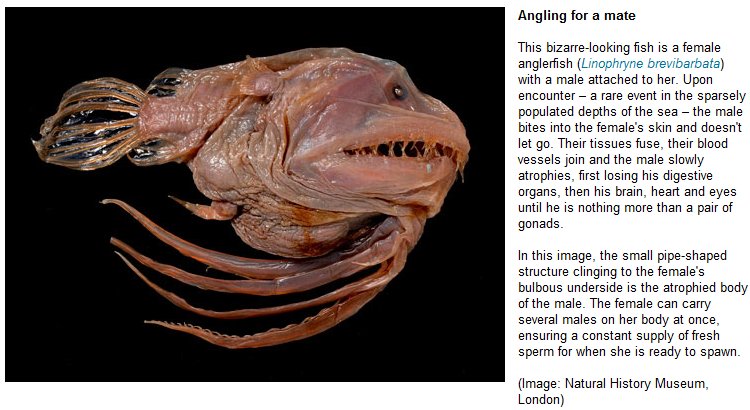
Probably NSFW, although it’s all science.
H/T to Radley Balko for the link.
My friend Roger is doing well (having been outside the worst of the flooding), and sent this update on the rail and transportation situation in Queensland:
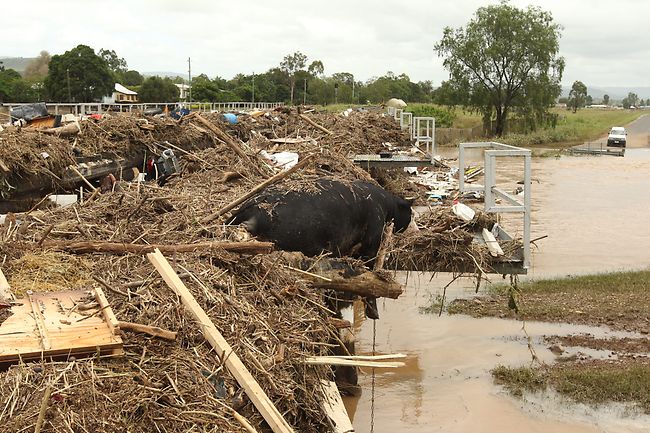
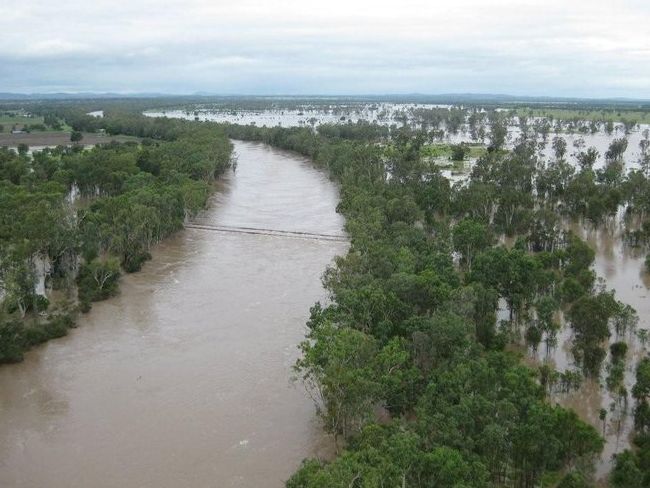
A couple of pictures of the western rail line from Brisbane to Toowoomba. The line, mostly double-track has been extensively damaged and willl probably be out of commission for over three months.
This shows flood debris, and a bull, lodged on one bridge. Some 20 people in the area are also missing so there may well be bodies in the debris as well. It is being carefully checked but there is a huge amount. One body was found in her house which had already been searched twice before.
Part of the Moura coal line in Central Queensland. There could be some delays here as well.
Meanwhile, in muddy Brisbane, in an effort to keep cars off the roads all public transport is free for the next few days. The railways parked their electric commuter trains on some tracks that were well above flood level. Unfortunately, graffiti artists, using Facebook and Twatter, called up every idiot on the East Cost that had a can of spray paint. Some even came from Melbourne. About half the train fleet was so badly overpainted that the sets could not be run. Cost estimates are in the order of a couple of million to clean.
The cops can now read Facebook etc. and feel they have enough evidence to throw at least some of the perps in the slammer. Hopefully with their private parts painted a bright blue.
Update: It’s not just flooding in Queensland . . . there’s also now flooding in Victoria. There are always idiots who try to do stupid things, especially around flooded rivers:
A bizarre decision to ride an inflatable doll down a flood-swollen Yarra River blew up in a woman’s face yesterday when she lost her latex playmate in a rough patch.
The incident prompted a warning from police that blow-up sex toys are “not recognised flotation devices’’.
Police and a State Emergency Services crew were called to the rescue when the woman and a man, both 19, struck trouble at Warrandyte North about 4.30pm yesterday.
They were floating down the river on two inflatable dolls and had just passed the Pound Bend Tunnel when the woman lost her toy in turbulent water.
There’s a reason that studies that depend on direct observation/measurement often differ in their results from studies that depend on self-reporting by the group being studied — because people lie:
Many mothers are under so much pressure to appear like perfect parents that they cover up how much television their children watch or what they cook their families, according to a survey.
Such “white lies” also extend to how much “quality time” mothers spend with their partner, website Netmums said its survey of 5,000 people suggested.
The parenting site said mothers often made each other feel “inadequate”.
[. . .]
Almost two-thirds of those surveyed said they had been less than honest with other mothers about how well they were coping and almost half covered up financial worries.
Almost a quarter of mothers admitted to downplaying how much television their children actually watched — and one in five “span a yarn” over how long they played with their children.
If Toronto was part of Canada, why would a forecast of five centimetres of snow (that’s about two inches) require a special weather statement from Environment Canada?
Really, Toronto? Five measly centimetres and you need a special “OMG! Snow!” notice from the weather folks? That’s too silly for parody.
I mentioned it to Elizabeth before starting this post, and she suggested that it’s another attempt to set up the media template for next year: “Look at the huge increase in special weather statements for the GTA over the last few years. Clearly this proves [global warming | climate change | climate chaos] is real.”



Powered by WordPress