Do you remember where you were when you heard that planes had struck the World Trade Center? That the Challenger shuttle had exploded? Or that Nelson Mandela had been released?
Your memories may be different from mine, but not as different as Fiona Broome’s. I remember watching the live TV footage of Nelson Mandela walking to freedom after 27 years in captivity, while Broome, an author and paranormal researcher, remembers Nelson Mandela dying in prison in the 1980s.
When Broome discovered that she was not the only person to remember an alternative version of events, she started a website about what she dubbed “the Mandela Effect”. On it, she collected shared memories that seemed to contradict the historical record. (The site is no longer online but, never fear, Broome has published a 15-volume anthology of these curious recollections.)
Mandela, of course, did not die in prison. On a recent trip to South Africa, I visited Robben Island, where he and many others were incarcerated in harsh conditions, to speak to former prisoners and former prison guards, and to wander around a city emblazoned with images of the smiling, genial, elderly statesman. How could it be that anyone remembers differently?
The truth is that our memories are less reliable than we tend to think. The cognitive psychologist Ulric Neisser vividly remembered where he was when he heard that the Japanese had launched a surprise attack on Pearl Harbor on December 7 1941. He was listening to a baseball game on the radio when the broadcast was interrupted by the breaking news, and he rushed upstairs to tell his mother. Only later did Neisser realise that his memory, no matter how vivid, must be wrong. There are no radio broadcasts of baseball in December.
On January 28 1986, the Challenger space shuttle exploded shortly after launch; a spectacular and highly memorable tragedy. The morning after, Neisser and his colleague Nicole Harsch asked a group of students to write down an account of how they learnt the news. A few years later, Neisser and Harsch went back to the same people and made the same requests. The memories were complete, vivid and, for a substantial minority of people, completely different from what they had written down a few hours after the event.
What’s stunning about these results is not that we forget. It’s that we remember, clearly, in detail and with great confidence, things that simply did not happen.
Tim Harford, “The detours on memory lane”, Tim Harford, 2024-06-20.
October 15, 2024
QotD: The Mandela Effect
October 14, 2024
The reviews are in for this season of The West and it’s as bad as you think
Spaceman Spiff has been a longstanding fan of The West, but the current season is doing much more than giving him the sadz:

The current season of The West is a disappointing mishmash of bad writing, wooden acting and implausible plot lines.
Critics have known the show has been in decline for years although have been reluctant to say openly.
But with cancellation rumours growing it is difficult to see how it can survive. If the current season is any measure they simply don’t have the writers even if the producers hadn’t lost their minds.
The plot thickens
The West has always been known for its compelling plots. Epoch-defining inventions, new technologies and globe-spanning empires. Even grand moral crusades no one else would consider such as ending slavery or elevating women to equal status.
Just some of the storylines they said would never work and yet we were glued to our screens as they unfolded.
Unfortunately, more recent seasons have shown none of the flair of the past.
The latest drama is the threat of another plague. It is difficult to know how this got the go ahead so soon after the Covid storyline.
The original pandemic idea got off to a roaring start since it was then a novel idea. But as the drama unfolded the plot became increasingly contrived. The writers became carried away and eventually struggled to get out of the hole they had dug themselves.
It ended in absurdity with obvious conflicts between the original lockdown plot and the later mask and vaccine subplots.
It was almost as if different teams of writers were competing with each other instead of cooperating on the story arc, exactly the kind of mistake audiences are increasingly complaining about.
The latest version is a species-jumping virus and is already facing criticism for lazy writing and reheating ideas from last time. Audiences are unimpressed. Time will tell if they can pull it off again.
The second plot they seem to be exploring is even more implausible, war with China.
After the last few seasons mired in the Ukraine storyline it beggars belief the writers went in this direction.
There were rumours of production overruns and expensive reshoots as the Ukraine storyline dragged on. We will never know the full extent of their production woes but tough decisions were clearly made as well as a shakeup of the production team.
Critics had warned wars were rarely popular. People like the drama of course, but audiences quickly get bored. None of this stopped the producers and the writers dutifully did as asked.
Now it is China.
Many are saying this is just a sign the producers have been there too long. It is time for another clear out.
At least war is exciting. But after numerous attempts to sell immigration storylines they are trying it again despite its unpopularity.
Previous attempts to promote immigration plots failed to resonate with audiences although it has always been popular with a small, loud minority.
Most found it too farfetched, millions of young foreign men just wandering into Western nations as if no one would stop them. The critics had a field day.
But this season they are going with climate migration. People moving around because of the weather.
This is partly to shore up their failing climate plot. It was obvious several seasons ago this long running theme, a strong favourite with the showrunners, was no longer popular.
October 12, 2024
QotD: From conspicuous consumption to junk science
Buck Throckmorton, “Organic Food & Anti-Vaxxers – Does The Fear of Safe Food Lead to Fear of Safe Vaccines”, Ace of Spades H.Q., 2019-12-08.
October 7, 2024
The demographic impact of modern cities
Lorenzo Warby touches on some of the social and demographic issues that David Friedman discussed the other day:
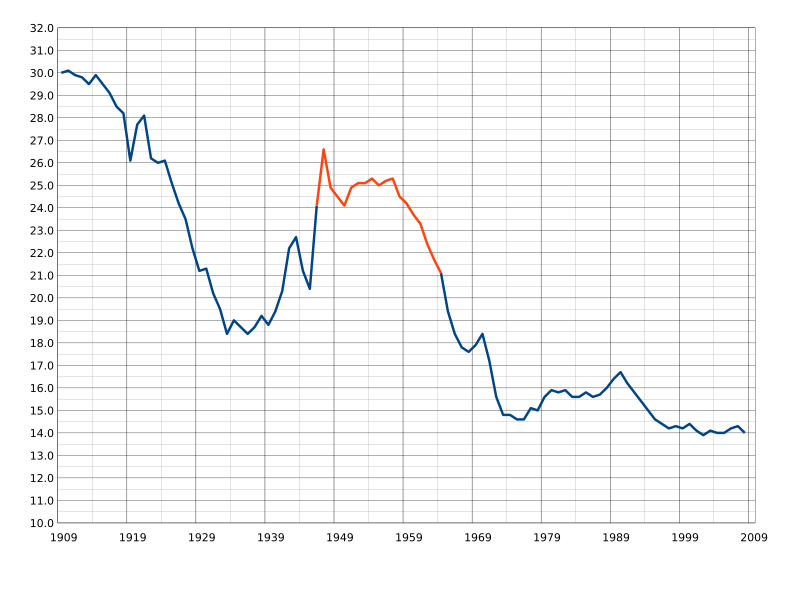
US Birth Rates from 1909-2008. The number of births per thousand people in the United States. The red segment is known as the Baby Boomer period. The drop in 1970 is due to excluding births to non-residents.
Graph by Saiarcot895 via Wikimedia Commons
Cities are demographic sinks. That is, cities have higher death rates than fertility rates.
For much of human history, cities have been unhealthy places to live. This is no longer true: cities have higher average life expectancies than rural areas. But they are still demographic sinks, for cities collapse fertility rates.
The problem is not that more women have no children, or only one child, making it to adulthood. Such women have always existed, though their share of the population has gone up across recent decades.
The key problem is the collapse in the demographic “tail” of large families. Cities are profoundly antipathetic to large families, and have always been so. This is particularly true of apartment cities — suburbs are somewhat more amenable to large families, though not enough to make up for the urbanisation effect.
While modern cities do not have slaves and household servants who were blocked from reproducing as ancient cities did, various aspects of modern technology have fertility-suppressing effects. Cars that presume a maximum of three children, for instance. An effect that is worsened by compulsory baby car-seats. Or ticketing and accommodation that presumes two children or less. There is also the deep problems of modern online dating. Plus the effects that endocrine disrupters and falling testosterone may be having.
These effects also extend to rural populations: falling fertility in rural populations is far more of a mystery than falling fertility in urban populations. How much declining metabolic health plays in all this is unclear. Indeed, futurist Samo Burja is correct, we do not really understand the “social technology” of human breeding.
Be that as it may, cities as demographic sinks is a continuation of patterns that go back to the first cities.
Matters at the margin
There are factors at the margin known to make a difference. Religious folk breed more than secular folk, though that is in part because rural people are more religious and city folk more secular.
Educating women reduces fertility. This is, in part, an urbanisation effect, as more education is available in cities. It is also an opportunity cost effect — there is more to do in cities, both paid and unpaid.
Education increases the general opportunity cost of motherhood, by expanding women’s opportunities. This also makes moving to cities more attractive. Women having more career opportunities reduces the relative attractiveness of men as marriage partners, reducing the marriage rate.
Strong cultural barriers against children outside marriage can reduce the fertility rate, by largely restricting motherhood to married women. This makes the fertility rate more dependant on the marriage rate.
Educating women makes children more expensive, as educated mothers have educated children. Part of the patterns that economist Gary Becker analysed.
October 5, 2024
David Friedman on falling birth rates
In the west, generally speaking, female employment and economic power has been rising and birth rates have been falling, except among religious minorities. David Friedman provides some explanations:
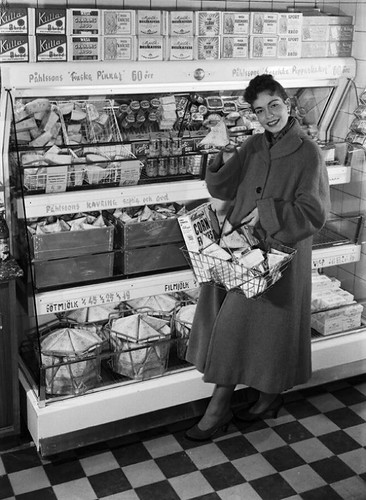
“Tetra Pak® – Housewife at the dairy counter in a Swedish shop” by Tetra Pak is licensed under CC BY-SA 2.0 

 .
.
One possible explanation is changes in norms and legal rules that make mate search more difficult. An example is a norm against dating fellow employees and a stronger norm against dating someone who has authority over you or you have some authority over.
For many people, their job is the only context in which they routinely interact with lots of other people, the best environment for mate search. The interaction often provides a way of evaluating someone for characteristics such as honesty and competence as well as compatibility, much harder to do in the context of dating, harder still in computer dating. It works better for people who not only are fellow employees but are actually working together, which often means one just above the other in the office hierarchy.
The same issue arises in the university context. Undergraduates are free to date each other — mate search is arguably one of the main functions of college. Junior faculty members, likely to be unmarried, are commonly not supposed to date students, even students not taking classes from them, certainly not students who are. I am not sure what current norms are for graduate student/undergraduate interaction, expect graduate student/faculty romance to be at least somewhat frowned upon, especially if the faculty member has some authority over the student which is likely if they are in the same field, the context in which they are most likely to get know each other.
Another cause for declining birth rates might be changing norms of courtship. I have not been part of that market for over forty years but I gather from what younger people say online that many men believe that making advances that do not turn out to be wanted is not only embarrassing but dangerous, that they risk being accused of harassment or some related offense. In the student context, many men believe that if a romantic partner changes her mind she can get him into a great deal of trouble by taking advantage of a college disciplinary process heavily biased against men. I do not know to what degree that belief is true but many men believe it is, which could be expected to discourage courtship.
Along related lines:
Also, when I was working for a big time international consulting firm, they tried to come out with a formal rule that said that you were allowed to ask out a co-worker, but only one time. If they said no, you could never ask again. Apparently the Italians howled with laughter and insisted that if this rule was enforced in Italy, no one would ever have kids, as the typical Italian courtship approach involves like a dozen rejections before ultimately the woman finally gives in. (GoneAnon)
That cannot be the full explanation since Italian birth rates are down too. Since birth rates are down in all or almost all developed countries and many less developed ones, it is worth investigating how widespread the relevant norms are.
Housewife Becoming a Low Status Profession
For a very long time, the default system for producing and rearing children was a married couple, with the husband producing income and the wife in charge of running the household and rearing the children. Over recent decades, the woman’s role in that division of labor has become a low status activity, lower status than making a living in the marketplace, much lower than professional success.1 Being an unmarried adult woman used to be, in most contexts, low status, on the presumption that if she could have caught a man she would have. At present, in much of western society, that has reversed — being a married housewife is lower status than being an employed single woman.
…arguments from the stay-at-home moms I know, who say people are constantly giving them grief about it, and who are often looking for some part-time make-work job they can take just so people will stop giving them grief about being a stay-at-home mother (Scott Alexander)
It is possible for a married woman to have both a job and children or for an unmarried woman to have children, but the former is more difficult than for a full time housewife, the latter much more difficult.
1. For a much more detailed presentation of this explanation, along with arguments against a variety of alternatives, see It’s embarrassing to be a stay-at-home mom.
October 1, 2024
TikTok’s Dissociative Identity Disorder (DID) community
The more we experience the joys of widespread social media, the more people seem to discover ways to bring attention to themselves for genuine or dishonest reasons. Freddie deBoer looks at the DID-sufferers on TikTok and assesses the chance that such a rare disorder can have had so many newly discovered sufferers:
Let me turn back to the TikTok “systems”, the strange, maybe-shrinking world of adolescent women on social media who pretend to have an incredibly rare and debilitating mental illness and treat it as a fun and quirky alternative lifestyle.
This piece from The Verge, though a little misguided, is a good jumping off point for this topic. The basic story is pretty simple. Dissociative identity disorder (DID), long referred to as multiple personality disorder, is a remarkably controversial diagnosis that has long captured the public imagination. It’s not hard to see why; the idea of someone who switches from one personality to the other is lurid and dramatic, making it easy fodder for television. (The number of episodes of legal dramas about DID is immense.) The condition also invites a particularly stark consideration of the question of individual agency and culpability for bad deeds. As you can imagine, pretending to have “alters” can be very convenient; a notorious case involved an embezzler whose only defense for his crimes was that he had multiple personalities and one of them stole the money. There have long been researchers and clinicians in psychiatry who doubt the very existence of DID, and even among those who are friendlier to the concept, the disorder is known to be incredibly rare. Many prominent cases of DID have proven in time to be fraudulent. The most famous American case, that of “Sybil“, was particularly tragic. The woman who supposedly suffered from the disorder, who faced a childhood of abuse and neglect, would go on to admit to her psychiatrist that she had made the alternate personalities up. (We know because we have the letters.) But the doctor, who had been made wealthy and famous thanks to her work with Sybil, threatened to withdrawn her financial support if Sybil did not recant that confession. Having no other choice, she did.
What DID TikTok asks us to believe is that, in the span of maybe half a decade, tens of thousands of adolescent women developed DID, an exceedingly rare disorder marked by symptoms entirely unlike those on your For You page. The Verge article, written by Jessica Lucas, is typical of the media’s take on this issue, to the degree that they’ve written about it at all: relentlessly sympathetic to the DID TikTok adolescents even when grudgingly admitting that there’s a lot of fakery. And admit that she does, as it would be essentially impossible to pretend otherwise. Even the wokest wokie couldn’t help but look at this shit and conclude that a lot of it is bullshit.
The cases of DID that are considered to be particularly valid or believable are very few, and the people who have suffered in them have been people living absolutely wasted lives, lives filled with abuse and instability and addiction and misery; the overwhelming majority of DID TikTokers appear to be living perfectly stable and successful adolescent lives. Those with DID have almost never professed to be able to switch from one alter to another on command; many DID TikTokers playact that exact behavior for their viewers. Alters are notoriously uncooperative towards each other; TikTok DID videos routinely feature alters happily participating in “roll calls” in which they switch from one identity to the next, conveniently timed for the creation of #content. (The DID people claim that really they’re just opportunistically capturing organic switches, but a) it’s very clear that many of these videos are filmed in one day and b) that would still require alters to willingly turn the camera on and get into the costume etc, which is not at all how alters have traditionally acted.) In the DID literature alters are almost never aware of what’s happening when another alter is “fronting”; on DID TikTok they almost universally are, justified with the convenient idea of “co-consciousness,” which is one of many evolutions of DID these people have implemented to allow their little pageant to continue. Most people with DID diagnosis, historically, have not been photogenic women with an interest in getting more followers. I could go on.
Lucas’s piece is particularly useful for the remarkable, remarkably depressing story of Dr. Matthew Robinson, a clinician and researcher from Harvard Medical School’s McLean Hospital. (The site of Girl, Interrupted, among other things.) Like a lot of people in psychiatry, Robinson noted with alarm that his hospital had “been inundated with referrals and requests from schools, parents, and our own adolescent treatment and testing services to assess for symptoms of what [patients] call DID.” He proceeded to discuss the difficulties this sort of situation provokes in an already-overtaxed mental health system, and spoke frankly about the fact that a considerable number of the people presenting with this disorder obviously do not in fact have it. He stated plainly that which many are too circumspect to say, which is that these TikTokers are faking. The consequence, of saying this in a lecture with his professional peers, was review-bombing of the hospital online, threats, a call to have Robinson’s medical license revoked, and sufficient harassment that McLean pulled online videos of the lecture. The online mob engaged in the typical social justice-vocabulary freakout campaign, McLean folded, and as stated in the piece, most researchers are now too scared to publicly comment on this absurd situation. If someone tells you that there is no such thing as a social justice-inflected cancellation campaign, you can point to this exact scenario and to the vicious and vengeful disability rights movement in general.
To be clear, I think that probably literally zero of the people who perform DID on TikTok have the disorder. Zero. I imagine that a significant portion of them have deluded themselves into thinking they do. But I’m quite confident that most of them are very well aware that they’re faking.
The pros and cons of living the digital life
Spaceman Spiff considers how much of modern western life is now being experienced online rather than in the real world and what are the trade-offs inherent in the switch to the life digital:
Life is what you pay attention to. Increasingly many of us are immersing into virtual worlds and spending less time out in the real world. We are attending to digital realms.
Everything it seems is going online, from shopping to entertainment to work. Almost no aspect of life remains untouched by the slow creep of technology.
Our entertainment is digital and our social networks are found online. For increasing numbers this may be their only connection to others.
Even work is becoming unavoidably remote with Zoom and comparable tools now standard fare.
The digitization of life continues apace. As a result, we are present in the real world less and less and this cannot be altogether healthy.
Many benefits
There are obvious benefits to our new digital world.
Thanks to the internet much has become convenient and easy. We can access a wide array of goods and have them delivered for a small fee.
The scale of the options is impossible to beat. The real world could not possibly provide the options on display. We can peruse virtual warehouses with everything. No bookstore is as big as Amazon.
The post-Covid world accelerated aspects of digital adoption, particularly video-based conferencing and other virtual tools. This is now ubiquitous, particularly in work settings.
One-click ordering and fast delivery makes everything else seem unreasonably tedious and complicated. It is a hassle going to a physical location to buy clothes or books or food when you can pay a slave to deliver it.
But people sense they lose something with digital tools even when it is convenient to not travel or leave home. It is not the same as face to face. Importantly it brings the world into our homes, so we cannot easily escape.
Other less visible changes are apparent too. We seem to socialize less. We go out less often.
We dine in and often by having unhealthy food delivered, all chosen and prepared by others. The appeal of going out and mixing with strangers is waning.
Behind this is a gradual bureaucratization of everything as we are continually reminded of external dangers; germs, extreme weather, domestic terrorism, none of which are likely to ever touch us but we are told are ever present. These require interventions we never get to vote on but affect us nonetheless.
The safety-obsessed post-Covid world wants you at home where you are safe and sound. Digital tools have proliferated to serve this need.
But of course, for all the benefits we can enjoy for living the internet lifestyle, there are also significant negatives …
September 30, 2024
British and Australian schools are teaching boys to hate themselves
Janice Fiamengo discusses the sort of things British and Australian boys are being taught about themselves and their role in society:
For years, feminists in the English-speaking school systems have done everything they can to psychologically destroy a generation of boys, calling their masculinity “problematic”, “hegemonic” and “toxic”.
At their least malign, feminist teachers have made it clear to boys that their perspectives and experiences aren’t as important as those of girls. Many businesses and organizations support programs aimed at girls’ academic success; there are no equivalent programs for boys. When study after study shows boys lagging behind girls in school, many feminists don’t even pretend to care, blaming the boys, as did Australian feminist Jane Caro, for their alleged privilege. Such ideologues continue to call for more feminist teaching, and moreover take direct aim at schoolboys’ maleness in what scholar Paul Nathanson has identified as a form of identity harassment, a pervasive psychological assault that creates doubt, shame, and alienation.
Under the feminist model, boys learn from a young age that their sex is responsible for violence and other serious harms, and that they must take personal responsibility for it. A few years ago, it came to light that the female principal of an Australian school thought it a good idea to hold an assembly in which the boys were to apologize for male misbehavior to the girl next to them. Naturally, no girls are ever expected to apologize to boys for the misdeeds of the female sex.
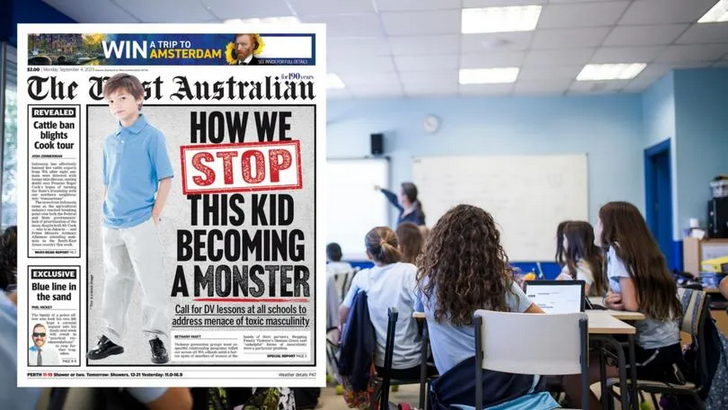
Calls regularly circulate, as in the West Australian‘s “How We Stop This Kid Becoming a Monster“, for teaching to address the problem of predatory masculinity. Unless the feminist deprogrammers can get to work in the early years, we’re told, the boys will succumb to their inner monster. Boys learn that they can hurt girls and women even without meaning to, just by looking at them or holding traditional views. As we’ll see, any boy who objects to his own vilification will learn that objecting itself is a technique of domination.
Teaching Toxic Masculinity
A recent report on UK schools provided a glimpse into what feminist instruction looks like, revealing that terms such as “hegemonic masculinity” and “toxic masculinity”, until a decade ago part of the radical feminist fringe, are now in the mainstream of pedagogy even in the lower grades.
The Family Education Trust surveyed materials used by UK schools in their sex education classes. Out of 197 schools that responded to a request for information (more than 100 did not respond), 62 schools confirmed that they were teaching about toxic masculinity. 10 schools even admitted to teaching that “men and boys possess traits that are inherently toxic and negative for society“. (One would be relieved to hear that the principals of such schools and all participating teachers were immediately sanctioned, or at least told to stop such claptrap — but of course such has not occurred.)
One slide from a lesson on toxic masculinity stated that while “masculinity in and of itself is not necessarily a harmful thing […] the way that masculinity is traditionally defined in society can be problematic”. Some of the materials don’t even make sense, as for example the statement that traditional masculine traits “can be limiting for women, girls and other people who don’t identify as men, who are not expected to display these traits”.
September 27, 2024
QotD: Nietzsche – a gamma male incel?
If you aren’t familiar with Vox Day’s sociosexual hierarchy [SSH], you can find the definition of its categories at his Sigma Game Substack here. Briefly, the SSH classifies men (and only men) according to the ways they relate to one another, and therefore (since women are exquisitely socially sensitive), to women. It divides men into the following categories: alphas, the natural leaders who get most of the female attention; betas or bravos, who are not Pyjama Boy, but rather the alpha’s lieutenants and capos, enforcing the alpha’s rule and getting some of the female attention that spills out of his penumbra; gammas, who are essentially low-t nerds with poor social skills that scare the hoes; deltas, who are basically the workers, the ordinary joes who keep everything running, and are sometimes after much struggle successful in landing a waifu; omegas, who are at the bottom of the hierarchy, neither receiving much from it nor contributing anything to it, and never leave their dirty basements; sigmas, who are essentially lone wolves with an ambivalent relationship to the hierarchy, which they don’t really care about (they have their own, more interesting thing they’re doing, which they’re happy to do alone if necessary), but nevertheless do quite well within it, often challenging the alpha’s authority without intending to; and lambdas, who exist outside of the sociosexual hierarchy because they are literally gay.
If you want an image of the SSH, consider your typical American high-school in the 1980s. The alpha is the captain of the football team; the betas are the other football team players; the gammas are the chess club nerds; the deltas are the normal kids with nothing much remarkable about them; the sigma is the kid in the metal shirt who cuts class because it bores him and then shows up at the party with a hot girl from a different school that no one has met before; the omegas are the dropout welfare trash kids; and the lambdas are the theatre kids.
So, was Nietzsche a gamma male incel? Was he a loser and a nerd?
Of course he was. Vox is absolutely correct about this.
Christians will usually follow up the gamma male incel attack by noting the absurd contrast between Nietzsche’s lived reality, as a frail neurasthenic with a terminal case of oneitis who could be sent into days of migraines by a chance encounter with a caffeinated beverage, and the concept of the Ubermensch he preached in his writings, most notably in his very strange novel? prose poem? mental breakdown? Thus Spake Zarathustra. By the same token we might note that Virgil was no Aeneas. The character created by the artist is not the artist; if the artist was the character, he’d be too busy running around doing heroic character things, not hunched over in his scriptorium scribbling away with ink-stained fingers.
And make no mistake about it – Nietzsche was as much the poet as the philosopher, indeed, probably more poet than philosopher. One of the most common complaints you’ll hear about Nietzsche is that it’s not at all clear, much of the time, what he’s getting at. What is the actual argument here? people will ask. They’re used to philosophers whose turgid prose is a loose string of logical syllogisms, composed with all the charm of a mathematical derivation. The wild electricity of Nietzsche’s divine madness is an entirely different genre.
We call Nietzsche a philosopher because that’s the closest category we have to throw him in, but this is a poor categorization. Nietzsche’s mind – and yes, this may well be because it was broken by syphilis – did not proceed according to the narrow rails enforced by a rigid adherence to logic and reason. It was not weighed down by the gravity of methodological rigour. That is not to say that he did not apply reason, simply that he was not limited to it. He made use of revelation, of inspiration, just as much. He felt as much as he thought when he wrote, inhabiting the ideas he developed with his passion as much as his intellect. He thought with his whole brain, using both his left hemisphere and his right – in Nietzsche’s language, the Apollonian and the Dionysian. Being aware that philosophy specifically, and Western thought more generally, was to an extraordinary and even pathological degree locked into the left-hemisphere mode, into the Apollonian realm of rational dialectic, he went out of his way to cultivate the Dionysian instead, to get into touch with his intuitive, subconscious, “irrational” mind. As much as Nietzsche was a philosopher, he was also an artist, a poet1, a mystic, and even, dare I say it, a prophet.
None of which is to say that he was not also a giant loser.
But then, most philosophers are nerds who are bad with the ladies. There are exceptions, of course. There is no record of Plato being bad with the ladies; Plato’s tastes are reputed to have run in different directions.
John Carter, “The Prophet of the Twentieth Century”, Postcards from Barsoom, 2024-06-25.
1. He published a volume of actual poetry, which wasn’t very good; he also dabbled in musical composition, which was even worse.
September 26, 2024
QotD: The Asshole License, First Class
Passive-aggressive behavior is characterized by a pattern of passive hostility and an avoidance of direct communication. Inaction where some action is socially customary is a typical passive-aggressive strategy (showing up late for functions, staying silent when a response is expected). Such behavior is sometimes protested by associates, evoking exasperation or confusion. People who are recipients of passive-aggressive behavior may experience anxiety due to the discordance between what they perceive and what the perpetrator is saying.
There’s definitely a lot of that going around, but it doesn’t describe the behavior of the apple polishers, or the people who have issued themselves the Asshole License. You know the ones I mean: SJWs, of course, but also CrossFitters, vegans, cyclists … basically, anyone who takes up a certain cause or lifestyle seemingly for the sole purpose of being an enormous douchebag about it in every possible social situation. Neither I nor anyone else would have a problem with vegans, say, if they really were doing it for their health, as they so often claim, because if they really were doing it for their health, they’d bring it up once, and then forever shut the fuck up about it.
But they don’t. Similarly, nobody would have a problem with bike riders if they’d just follow the goddamn rules of the road. But they don’t, and the more “cyclist” shit they own — the racing bikes made out of space station parts, the lycra bodysuits, the helmets that look like cranial jockstraps — the less the rules of the road apply to them. Spot one of those fuckers in full kit, and you’re guaranteed to see him weaving in and out of four lanes, turning abruptly without signaling, and blowing through stop signs at full speed, with nary a glance at cross traffic. They’re possessors of the Asshole License First Class, you see, so obviously the rules don’t apply when they’re doing their Official Asshole Thing.
See what I mean? That’s not “passive-aggressive”. But it’s not “active-aggressive” either. They’re not trying to pick a fight. It’s like virtue-signaling, in that you, the audience, are absolutely necessary, but unlike the standard virtue-signal, which is strictly an intra-Leftist competition, this one entails hostility towards the rest of the world, not just toward fellow Leftists …
Severian, “The Passive-Aggressive Society”, Rotten Chestnuts, 2021-07-24.
September 24, 2024
Trust, once lost, is very difficult to re-gain
Public officials and legacy media often complain about the public’s significant decrease in trust for once highly trusted organizations, yet rarely seem to realize that they’ve done everything they could to destroy the public’s confidence in them and their actions:
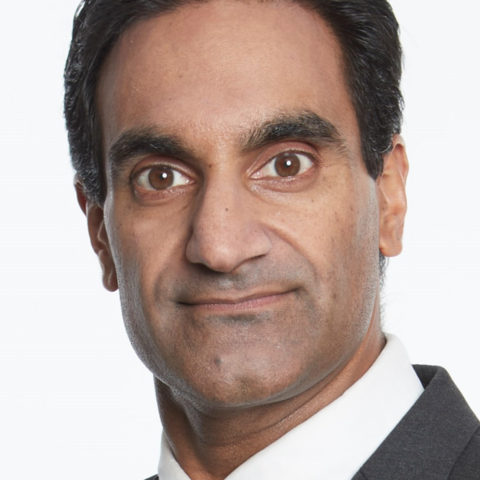
Dr. Jay Varma, 21 April, 2021.
Photo by the New York City Health Department via Wikimedia Commons.
I don’t want to be a cynic.
While I don’t think anyone should blindly trust anything or anyone who hasn’t earned it, I don’t want to blindly distrust everything and everyone, either.
However, there are areas where distrust is warranted.
Over the weekend, a number of stories popped up in my various feeds that sort of illustrated the point pretty well from a number of different angles.
Let’s start with partying in the time of COVID.
New York City’s former COVID czar was caught on a hidden camera boasting about having drug-fueled sex parties mid-pandemic — and admitting New Yorkers would have been “pissed” if they had found out at the time.
Dr. Jay Varma — who served as senior health adviser to then-Mayor Bill de Blasio and was tasked with running the Big Apple’s pandemic response — made the confession in secretly recorded conversations with a so-called undercover operative from conservative podcaster Steven Crowder’s “Mug Club“.
“I had to be kind of sneaky about it … because I was running the entire COVID response in the city,” Varma was filmed telling the unidentified woman on Aug. 1 in what appears to be a restaurant.
The edited clips of the hidden camera footage, which were all recorded between July 27 and Aug. 14 in New York, were released by Crowder on Thursday. The Post has not reviewed the full, unedited recordings.
Now, let’s remember that Varma admits to doing the exact opposite of what he was telling everyone else to do. He was part of the government and part of the effort to shape New York’s response to COVID-19.
And the city is large enough that their response was likely to inform other communities.
Meanwhile, he’s out partying it up while everyone else is sitting at home, trying to figure out how to survive.
Remember how our current problems stem from this time. People like Varma told us we all had to stay inside. Most of us couldn’t go to work, couldn’t go to bars or restaurants, couldn’t go out to the movies or to take part in activities. As a result, people suffered and the economy suffered. Stimulus plans were put in place to flush trillions of dollars into the economy, only to remain there as more and more got pumped in later, creating inflation and making the economy worse in the long run, but that time locked up was essential because we had to stop the virus.
And this twit is out sexing it up while the rest of us were shut inside trying not to go nuts.
He wasn’t alone, either. A number of folks from various institutions were part of the “rules for thee but not for me” crowd, such as California Gov. Gavin Newsom’s trip to dinner at The French Laundry — which is the dumbest name for a restaurant ever — during the lockdowns or Austin’s mayor telling everyone to stay inside while he went to Mexico.
Of course, bad public officials are nothing new. We’ve all seen them over the years.
But our media is also failing us.
QotD: Is vexillology considered part of the LGBT sexual spectrum?
But activists love their flags, and Pride Month™ wouldn’t be complete without the full range of other designs to represent the innumerable sexualities and genders that we’ve only just heard of but have apparently always existed.
There are flags to signify people who identify as nonbinary, polyamorous, polysexual, agender, genderfluid, genderqueer, neutrois, two-spirit and many more. If you haven’t heard of all of these terms, don’t worry. There’s a concerted effort in the public sector to fly these flags at every opportunity and educate the bigoted masses. In April, staff at Royal Stoke Hospital were photographed holding a banner with twenty-one of these flags. And in January, Network Rail unveiled its “Pride Pillar” at London Bridge station, which displayed a similarly garish range.
There are flags for pansexuals (those who are attracted to all sexual identities), somnisexuals (those who are only attracted to people in their dreams), parasexuals (those who don’t feel sexual attraction but will have sex for reproductive purposes) and dozens more. There’s even a flag for “allosexuals”, which apparently means anyone capable of experiencing sexual attraction. Presumably “Allo Allo Sexuals” are people who get aroused by dodgy French accents.
Andrew Doyle, “How many flags does one movement need?”, Andrew Doyle, 2024-06-22.
September 17, 2024
Unbearable anti-humanism
Tim Worstall responds to a recent dispatch-from-dystopia from Christopher Ketcham, decrying the “Unbearable Anthropocentrism” he sees in the world:
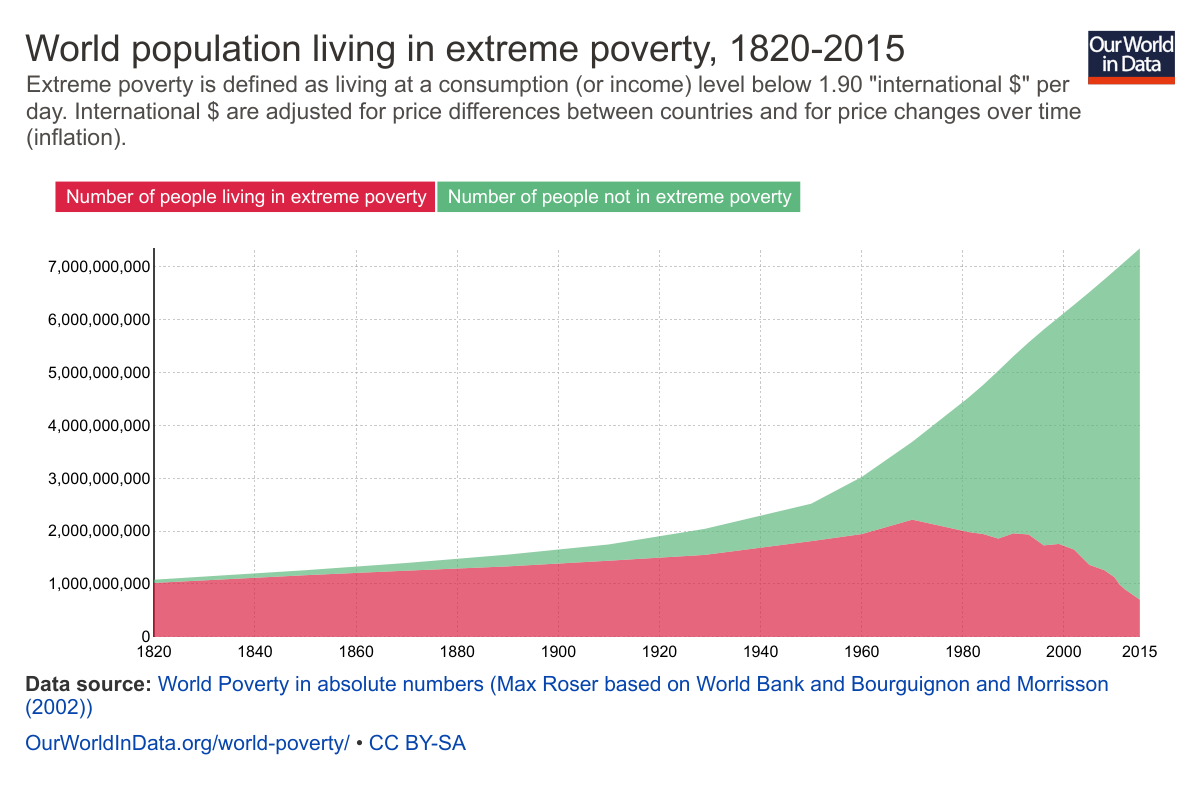
To true miserablists, this chart is pure bad news. How will we get to the revolution this way?
No idea who Ketcham is built then he doesn’t know who I am so we’re equal there. His complaint is that Our World in Data tends to show that the world is becoming a better place. Poverty is decreasing, infant mortality rates are falling, more folk have at least a square and ever increasing numbers are getting three and so on.
This is, as the cool kids say, problematic. Because if the thing to be opposed — capitalism and markets — is making the world a better place then where will we get the revolutionary fortitude to get rid of what is making the world a better place?
Something must be wrong here, right? Well, yes, it is:
For obvious reasons, Roser’s cheerful view of capitalist business-as-usual – and the data that would seem to support it – has made him a darling of libertarian market fundamentalists, who have lavished praise on his work.
See, this is problematic. So, what?
Given the support that Roser enjoys from billionaire oligarchs at the pinnacle of the capitalist system, one wonders if it is a coincidence that so much of the data he headlines for public consumption happens to valorize that system.
Oooooh, no, the claim isn’t that he’s writing lies. It’s just a question that is being asked. Could it, you know, I wonder if …
To which the correct answer is that Ketcham is a tosser. For it really is true that these last 40 years of global neoliberalism have coincided — at the very least coincided with — the greatest reduction in abject poverty in the entire history of our species.
But because capitalism, markets, the ghastly little tosser has to spread shade on someone reporting — honestly reporting — this truth. Hey, sure, we can have lots of lovely arguments about causation and so on. But reporting facts is wrong if they’re politically inconvenient? Someone will only report facts if they’re being paid — bribed — to do so?
Fuck off laddie, go die in a ditch.
Like, you know, far too many of us all did before this capitalism, markets, shit.
Fuck off.
September 1, 2024
The supermarket master plan to defeat the “far right” in Germany
There are elections ongoing in the German states of Thüringen and Saxony, and the polls show that the “far right” Alternative für Deutschland is potentially going to get 30% of the votes, which would give them more representation in those states than any of the other parties. Panic and hysteria have set in not only among the politicos and the mainstream media, but even among some businesses:
In Germany, all political parties have a colour. The Christian Democratic Union and the Christian Social Union are black, the Social Democratic Party is red, the liberal Free Democratic Party are yellow and the evil fascist Alternative für Deutschland are blue. This coming Sunday, Thüringen and Saxony will hold state elections, and the blue AfD are leading the polls in both states with about 30% support. This has a lot of people very, very upset. Most of them are merely upset with the AfD, but some psychologically unstable people have allowed their anger to embrace the colour blue more generally, because there can be no limits when it comes to resisting the evil antidemocratic forces of fascism.
Among the new sworn enemies of the blue band of the visible electromagnetic spectrum are the marketing team at Germany’s largest supermarket corporation, the Edeka Group. A few days ago, this supermarket chain, whose own logo strangely enough is primarily blue …
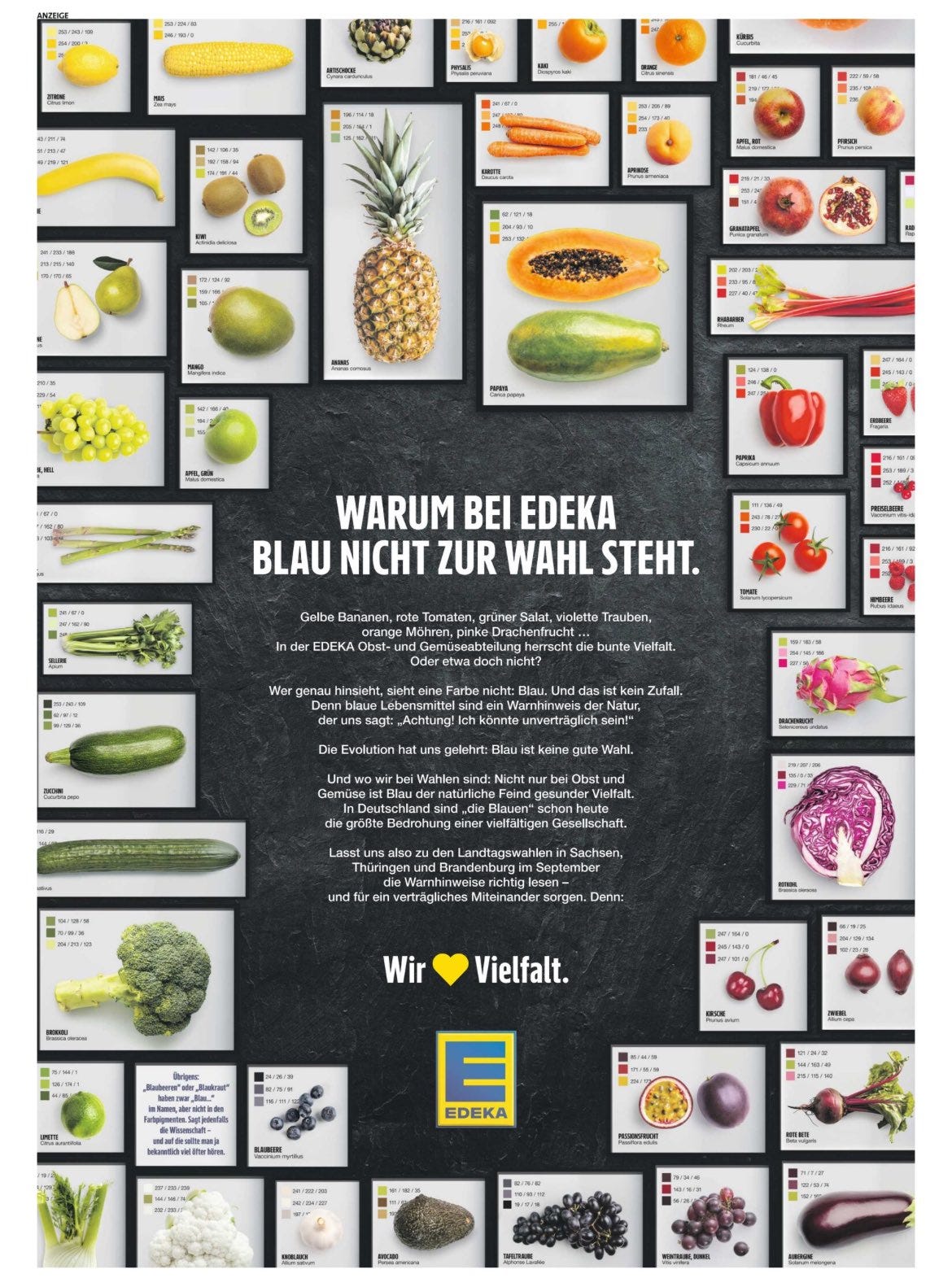
… ran an ad in Die Zeit and the Frankfurter Allgemeine Zeitung explaining “WHY BLUE IS NOT ON OFFER AT EDEKA”.
That wall of text in the middle reads as follows:
Yellow bananas, red tomatoes, green lettuce, purple grapes, orange carrots, pink dragon fruit … EDEKA’s fruit and vegetable department is full of colourful diversity. Or is it?
If you look closely, there’s one colour you won’t see: blue. And that’s no coincidence. Because blue food is nature’s way of warning us: ‘Watch out! I could be harmful!”
Evolution has taught us that blue is not a good choice.
And speaking of choices: Blue is not only the natural enemy of a healthy diversity of fruit and vegetables. In Germany, “the blues” are also the biggest threat to our diverse society.
So let’s read the warning signs correctly ahead of the state elections in Saxony, Thüringen and Brandenburg in September – and ensure that we can live together in harmony. Because we love diversity.
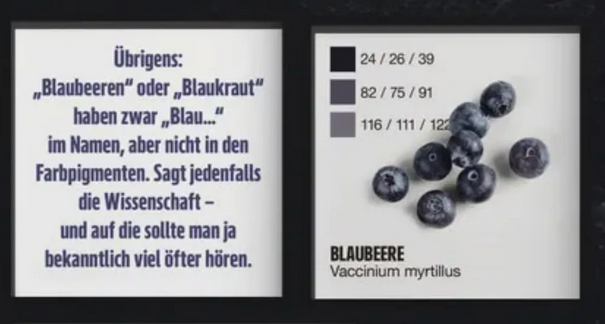
For those wondering whether Edeka have decided to cease selling fascist blue fruits like blueberries, there is a helpful note down in the corner:
There we learn that, while “‘Blueberries’ or ‘Blue cabbage'” may have “‘blue’ in their names”, their “colour pigments” are not blue. This is “at least what Science tells us – and as we know you should always listen to Science more”. Nothing about this is remotely obnoxious; indeed, if current-year Germany needs anything, it is more blind platitudinous calls to Follow the Science – particularly when it comes to exonerating innocent fruits and vegetables from suspicion of blue fascism.
August 20, 2024
Folk tale fictions about childbirth in “traditional cultures”
Jane Psmith finds that “everyone” has been doing certain “traditional” things during and after childbirth that she somehow wasn’t informed about until just a short while ago:
I just had a baby, which means I have once again been immersed in a sea of advice about how “traditional cultures” do things. And miraculously, every single kid, I discover some new practice I’ve never heard of but that apparently just everyone did until about five minutes ago. This time it was vaginal steaming. (Don’t Google, it’s exactly what it says on the tin.)
Which cultures, exactly? Oh, you know … the traditional ones, the ones whose folk wisdom is untrammeled by Western medicalization, where the pregnant woman is treated to the most nutritious foods, birth is a joyous event surrounded by supportive kin, the new mother puts her baby to the breast the minute he’s born, and she’s waited on hand-and-foot in bed for a month afterwards. So, you know, not the Ngongo of central Africa, who forbid women from eating meat, or the Netsilik Inuit or !Kung, both of whom send laboring women off to give birth in silent isolation, or any of the peoples from Fiji to northern Alberta who delay nursing for days … In fact, you might be excused if you began to suspect that the real measure of how “traditional” a culture is boils down to how much it resembles the practices of crunchy WEIRD people. You might even, if you had a nasty suspicious frame of mind, conclude that all this discussion of “traditional cultures” is just a disguised way of asserting our own preferences.
None of which is actually unique to the babies. (I’ve written about the babies before.) It’s not even unique to our era. The idea that we have been corrupted by civilization, that more primitive societies lead purer, nobler, more harmonious lives and enjoy access to truths and virtues we have lost, goes back millennia.1 And so, naturally, does the practice of using the supposed superiority of those other cultures as clubs to beat our own. Tacitus’ Germania, for instance, is a fun read if borderline useless as a source on the actual Germanic tribes — but it’s a wonderful guide to the angst of the early Empire and the pervasive fear that greed, luxury, and ambition had replaced the nobility, valor, and honor that had once characterized the Romans. Nowadays, of course, no one writes about the barbarians’ fides and virtus; instead you’ll get paeans to their idyllic existence lived in harmony with nature, their peaceful sense of community, and probably their joyful embrace of gender and sexual diversity. But either way, most of the books about small-scale societies are actually books about us and what the people writing the books think we lack.
Even professional anthropologists tend to assume that small-scale (this is a polite way of saying “primitive”) societies are more satisfying, meaningful, and fulfilling than complex ones. But in their case it goes hand in hand with another, allied assumption: that these societies have developed beliefs, practices, and institutions that work well for them. After all, the thinking goes, we know that people change their tools and their behavior when their environment changes, abandoning anything that no longer serves their needs and adopting new ways of life. Therefore, anything they haven’t abandoned must be somehow adaptive. Sure, these “primal communities” might do things that seem odd to us — things like torture, infanticide, ceremonial rape, cannibalism, and so forth — but they must serve some useful function or they wouldn’t have persisted. Thus, for example, the classic ethnography of the Navajo argues that their overwhelming fear of witchcraft, which led to pervasive anxiety, a hypochondriacal obsession with magical curing rituals, and of course regular violence perpetrated against suspected witches, actually had great benefits because it allowed the Navajo direct their stress and hostility at marginal members of the community and “keep the core of the society solid”.
The problem with this framework becomes obvious as soon as you mentally translate from some strange foreigners with funny (or no) clothes to, say, a business in the industrialized world. (Which can easily be larger than the kind of small-scale society that interests anthropologists.) No one would ever say, “Well, sure, the leadership of this company allows their mediocre employees to bully their highly productive peers out of the department so they do better in the stack ranking, but the company hasn’t gone bankrupt so it must be a savvy business move. Probably the solidarity created by banding together to surreptitiously delete someone else’s code enhances productivity more than losing a 10x engineer detracts from it …” But this is exactly what anthropologists (professional and armchair) are tempted to do when they set out to understand and explain another culture. Yes, sometimes apparently bizarre behavior contains a deep and hidden wisdom, but sometimes it’s just messed up.
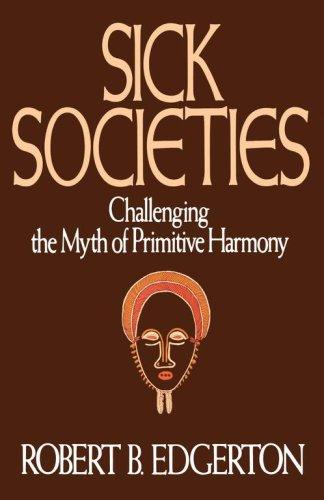
That’s the case the late UCLA anthropologist Robert Edgerton set out to make in Sick Societies: that some primitive societies are not actually happy and fulfilled, that some of their beliefs and institutions are inadequate or actively harmful to their people, and that some of them are frankly on their way to cultural suicide. The mere fact that people keep doing something doesn’t mean it’s actually working well for them, but just as the market can stay irrational longer than you can stay solvent, your society can stay dysfunctional longer than you can stay alive.
1. At least in the Occident. My informant tells me that the Noble Savage is a less common trope in, say, China. Maybe the Blue savages are just less noble.