
seangabb
Published 30 Dec 2022In this, the ninth in the series, Sean Gabb gives an overview of the last years of Byzantium, from the Crusader sack in 1204 to the Turkish capture in 1453.
Between 330 AD and 1453, Constantinople (modern Istanbul) was the capital of the Roman Empire, otherwise known as the Later Roman Empire, the Eastern Roman Empire, the Mediaeval Roman Empire, or the Byzantine Empire. For most of this time, it was the largest and richest city in Christendom. The territories of which it was the central capital enjoyed better protections of life, liberty and property, and a higher standard of living, than any other Christian territory, and usually compared favourably with the neighbouring and rival Islamic empires.
(more…)
January 24, 2023
The Byzantine Empire: Part 9 – The Last Centuries
Comments Off on The Byzantine Empire: Part 9 – The Last Centuries
January 11, 2023
QotD: “Little” gods in the ancient world
When we teach ancient religion in school – be it high school or college – we are typically focused on the big gods: the sort of gods who show up in high literature, who create the world, guide heroes, mint kings. These are the sorts of gods – Jupiter, Apollo, Anu, Ishtar – that receive state cult, which is to say that there are rituals to these gods which are funded by the state, performed by magistrates or kings or high priests (or other Very Important People); the common folk are, at best, spectators to the rituals performed on their behalf by their social superiors.
That is not to say that these gods did not receive cult from the common folk. If you are a regular sailor on a merchant ship, some private devotion to Poseidon is in order; if you are a husband wishing for more children, some observance of Ishtar may help; if you are a farmer praying for rain, Jupiter may be your guy. But these are big gods, whose vast powers are unlimited in geographic scope and their right observance is, at least in part, a job for important people who act on behalf of the entire community. Such gods are necessarily somewhat distant and unapproachable; it may be difficult to get their attention for your particular issue.
Fortunately, the world is full up of smaller and more personal gods. The most pervasive of these are household gods – god associated with either the physical home, or the hearth (the fireplace), or the household/family as a social unit. The Romans had several of these, chiefly the Lares and Penates, two sets of gods who presided over the home. The Lares seem to have originally been hearth guardians associated with the family, while the Penates may have begun as the guardians of the house’s storeroom – an important place in an agricultural society! Such figures are common in other polytheisms too – the fantasy tropes of brownies, hobs, kobolds and the like began as similar household spirits, propitiated by the family for the services they provide.
(As an aside, the Lares and Penates provide an excellent example on how practice was valued more than belief or orthodoxy in ancient religion: when I say that they “seem” or “may have originally been”, that is because it was not entirely clear to the Romans, exactly what the distinction between the Lares and Penates were; ancient authors try to reconstruct exactly what the Penates are about from etymologies (e.g. Cic. De Natura Deorum 2.68) and don’t always agree! But of course, the exact origins of the Lares or the Penates didn’t matter so much as the power they held, how they ought to be appeased, and what they might do to you!)
Household gods also illuminate the distinctly communal nature of even smaller religious observances. The rituals in a Roman household for the Lares and Penates were carried out by the heads of the household (mostly the paterfamilias although the matron of the household had a significant role – at some point, we can talk about the hierarchy of Roman households, but now I just want to note that these two positions in the Roman family are not co-equal) on behalf of the entire family unit, which we should remember might well be multi-generational, including adult children with their own children – in just the same way that important magistrates (or in monarchies, the king or his delegates) might carry out rituals on behalf of the community as a whole.
There were other forms of little gods – gods of places, for instance. The distinction between a place and the god of that same place is often not strong – when Achilles enrages the god of the river Scamander (Iliad 20), the river itself rises up against him; both the river and the god share a name. The Romans cover many small gods under the idea of the genius (pronounced gen-e-us, with the “g” hard like the g in gadget); a genius might protect an individual or family […] or even a place (called a genius locus). Water spirits, governing bodies of water great and humble, are particularly common – the fifty Nereids of Greek practice, or the Germanic Nixe or Neck.
Other gods might not be particular to a place, but to a very specific activity, or even moment. Thus (these are all Roman examples) Arculus, the god of strongboxes, or Vagitanus who gives the newborn its first cry or Forculus, god of doors (distinct from Janus and Limentinus who oversaw thresholds and Cardea, who oversaw hinges). All of these are what I tend to call small gods: gods with small powers over small domains, because – just as there are hierarchies of humans, there are hierarchies of gods.
Fortunately for the practitioner, bargaining for the aid of these smaller gods was often quite a lot cheaper than the big ones. A Jupiter or Neptune might demand sacrifices in things like bulls or the dedication of grand temples – prohibitively expensive animals for any common Roman or Greek – but the Lares and Penates might be befriended with only a regular gift of grain or a libation of wine. A small treat, like a bowl of milk, is enough to propitiate a brownie. Many rituals to gods of small places amount to little more than acknowledging them and their authority, and paying the proper respect.
Bret Devereaux, “Collections: Practical Polytheism, Part IV: Little Gods and Big People”, A Collection of Unmitigated Pedantry, 2019-11-15.
Comments Off on QotD: “Little” gods in the ancient world
January 10, 2023
The Early Emperors, Part 9 – Nero: Can We Trust the Sources?
seangabb
Published 25 Dec 2022This is a video record of a lecture given by Sean Gabb, in which he discusses the reasons for the black reputation possessed by the Emperor Nero.
The Roman Empire was the last and the greatest of the ancient empires. It is the origin from which springs the history of Western Europe and those nations that descend from Western Europe.
(more…)
Comments Off on The Early Emperors, Part 9 – Nero: Can We Trust the Sources?
January 6, 2023
The Church of England’s latest attempt to become “relevant”
In Spiked, Gareth Roberts discusses the announcement of Reverend Bingo Allison of themself’s “non-binary” status as the first openly genderqueer individual ordained as a priest in the established church:
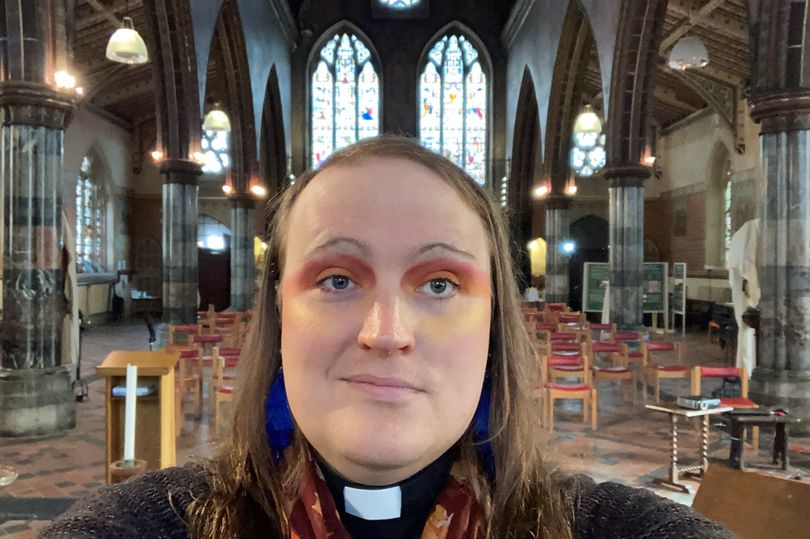
Rev. Bingo Allison selfie supplied to the Liverpool Echo.
Many have pinned the beginning of the “Great Awokening” – the transition of the venomous cocktail of extremely niche Tumblr culture and naff identity politics into the mainstream – to 2013. As we move into this 10th anniversary year of raving teenage internet nonsense being taken seriously in the real world by grown adults, perhaps we need a spiritual guide to lead us in our celebrations?
Step forward the Rev Bingo Allison, vicar of a church in a Liverpool suburb, and apparently both “nonbinary” and “genderqueer”. (We do not learn from Bingo’s New Year’s Day interview in the Liverpool Echo if Bingo is actually his – sorry, Them’s – real name-o.)
As ever, working out what the terms nonbinary and genderqueer actually mean is like knitting butter. In the case of the Rev Bingo, it seems from what he says and from the pictorial evidence in the Echo that this has something to do with wearing very, very badly applied cosmetics and regaling anybody silly enough to listen with cut-and-paste boilerplate, like “the history of biblical interpretation is littered with the opinions of rich, white, straight, cisgender, able-bodied, neurotypical men” – basically, ChatGPT with eyeshadow applied à la Black+Decker.
I’ve recently been wondering why so many men with a lady soul are so bad at the application of make-up – both the Rev Bingo and cyclist Emily Bridges seem to have particular difficulty with eyeliner. Applying cosmetics well is not that difficult. In my brief teenage flirtation with the crossover point between New Romantic and Goth, I mastered the art while travelling into London on the very bumpy stretch of the Metropolitan Line between Moor Park and Harrow-on-the-Hill. (It was fatal to even attempt androgyny while still in Hertfordshire, particularly if the end result just made you look like a very camp Herman Munster.) I’m beginning to realise that the wonky slap is an essential part of the non-illusion, of the passive-aggressive, male status display that is at work. It is saying: “I’m not even going to try and you still have to kneel to me.”
“Jesus loves sparkly eyeshadow”, Bingo told his Insta followers recently. I have news for the Rev. Us lads can wear sparkly eyeshadow too with no effect on our bodies or souls. It does not change your sex. It just makes you a man wearing sparkly eyeshadow, like the Sweet doing “Block Buster” on Top of the Pops – although in Bingo’s case there is, owing to a very binary dose of male-pattern baldness, a more marked resemblance to Brian Eno in his Roxy Music days, with a hint of Max Wall in there, too.
Comments Off on The Church of England’s latest attempt to become “relevant”
January 5, 2023
Roman Emperors, Part 8 – Nero: Life and Death
seangabb
Published 20 Dec 2022This is a video record of a lecture given by Sean Gabb, in which he discusses what we can know or suspect about the life of the Emperor Nero. Some criticism here of Tacitus as a reliable source.
The Roman Empire was the last and the greatest of the ancient empires. It is the origin from which springs the history of Western Europe and those nations that descend from Western Europe. It is the political entity within which the Christian faith was born, and the growth of the Church within the Empire, and its eventual establishment as the sole faith of the Empire, have left an indelible impression on all modern denominations. Its history, together with that of the Ancient Greeks and the Jews, is our history. To understand how the Empire emerged from a great though finally dysfunctional republic, and how it was consolidated by its early rulers, is partly how we much understand ourselves.
(more…)
Comments Off on Roman Emperors, Part 8 – Nero: Life and Death
December 25, 2022
What the heck is Wassail?
Tasting History with Max Miller
Published 16 Dec 2022
(more…)
Comments Off on What the heck is Wassail?
December 24, 2022
History-Makers: Saint Nicholas to Santa Claus
Overly Sarcastic Productions
Published 23 Dec 2022Merry Sinterklaasfeest to all, and to all a good night.
Our content is intended for teenage audiences and up.
(more…)
Comments Off on History-Makers: Saint Nicholas to Santa Claus
December 21, 2022
Tom Holland’s Dominion
Ed West expands on the review he wrote when Holland’s book was first published in 2019:
The Romans are the most “epic” figures in history, to use my young son’s favourite word, exerting a glamour and allure that no civilisation has successfully matched. This magnetism can also appear heightened by what followed, the illiterate bleakness of the early Middle Ages, and the fun-sucking religion that came with it. Many down the years have lamented the switch from the Rome of the Caesars to the Rome of the popes.
The young Tom Holland was one of them. Raised as an Anglican, the historian’s childhood fascination with dinosaurs evolved into one for the equally glamorous ancients. “Although I vaguely continued to believe in God,” he writes: “I found him infinitely less charismatic than the gods of the Greeks: Apollo, Athena, Dionysus. I liked the way that they did not lay down laws, or condemn other deities as demons; I liked their rock-star glamour. As a result, by the time I came to read Edward Gibbon and his great history of the decline and fall of the Roman Empire, I was more ready to accept his interpretation of the triumph of Christianity: that it had ushered in an ‘age of superstition and credulity’. My childhood instinct to see the biblical God as the po-faced enemy of liberty and fun was rationalised.”
This, indeed, is a widespread view. Since Gibbon wrote his great work in the late 18th century there has existed the popular idea that the Renaissance, with its return to classical values, and the Enlightenment, which saw the birth of reason over superstition, were a reaction to Christianity, which had in those thousand dark medieval years suppressed science and freedom.
Yet the truth and paradox, as Holland shows in this truly epic account of how Christianity came to shape the West, is that the western idea of secularism is itself a very Christian one. Liberalism was never a reaction to Christianity, it was a product, perhaps one might heresy; ditto Marxism, socialism and the various progressive creeds of the modern era, right up to the current Great Awokening with its focus on the sanctity of victimhood.
All our assumptions about progress, the rights of the individual, our horror of racism and sexual exploitation, even the acceptance of gay marriage, are the products of Christianity. They are not in themselves universal or “natural”, and to the Romans these ideas of human rights and dignity would have been incomprehensible, laughable even.
Holland made his name with thrilling popular histories set in the ancient world, yet the more he studied antiquity, the more alien it became to him. It wasn’t just that Spartans or Romans killed innocents in large numbers, but that they lacked even the suggestion that the weak might be worth pitying. “That my belief in God had faded over the course of my teenage years did not mean that I had ceased to be Christian,” he writes.
Cruelties such as the exposure of infants – especially female infants – were almost universally accepted in antiquity, except among one or two small German tribes and, at the other end of the empire, a monotheistic people in the eastern Mediterranean. Perhaps the obscenest horror, however, was the practice of crucifixion, a death so cruel that Roman writers barely touched on the subject. Indeed only “four detailed accounts of the process by which a man might be sentenced to the cross, and then suffer his punishment, have survived from antiquity. Remarkably, they all describe the same execution.”
This is the story of how on that one Friday in Judea the world was changed forever — with a moral revolution like nothing before or since.
Comments Off on Tom Holland’s Dominion
December 10, 2022
The “Dark” Ages were fine, actually — History Hijinks
Overly Sarcastic Productions
Published 5 Aug 2022Curb your Crusading – the artwork, literature, and scholarship are far more interesting.
SOURCES & Further Reading: China: A History by John Keay, Byzantium & Sicily & Venice by John Julius Norwich, Great Courses Lecture series Foundations of Western Civilization by Thomas F. X. Noble lectures 27 through 38: “The Emergence of the Catholic Church”, “Christian Culture in Late Antiquity”, “Muhammad and Islam”, “The Birth of Byzantium”, “Barbarian Kingdoms in the West”, “The World of Charlemagne”, “The Carolingian Renaissance”, “The Expansion of Europe”, “The Chivalrous Society”, “Medieval Political Traditions I”, “Medieval Political Traditions II”, and “Scholastic Culture”.
(more…)
Comments Off on The “Dark” Ages were fine, actually — History Hijinks
November 30, 2022
QotD: The rise of liberalism
In sum, as one of the Levellers in the English Civil War of the 1640s, Richard Rumbold, said from the scaffold in 1685, “there was no man born marked of God above another, for none comes into the world with a saddle on his back, neither any booted and spurred to ride him.” It was a shocking thought in a hierarchical society. In 1685 the crowd gathered to see Rumbold hanged surely laughed at such a sentiment. By 1885 it was a solemn cliché.
Dierdre McCloskey, “How Growth Happens: Liberalism, Innovism, and the Great Enrichment (Preliminary version)” [PDF], 2018-11-29.
Comments Off on QotD: The rise of liberalism
November 22, 2022
“Andrew Doyle is a dangerous man, and this is a dangerous book”
I missed this review when it first got posted at The Critic, which is why I’m only linking to it now. Stephen Daisley reviews The New Puritans: how the Religion of Social Justice Captured the Western World:
Andrew Doyle is a dangerous man, and this is a dangerous book. Don’t take my word for it: the bloke’s own mates think he’s one for the watching. Like the pal he tells us about who pegged him as “a fucking Nazi cunt”. Admittedly, vodka martinis had been taken and the friend’s evidence of fascist proclivities was Doyle’s vote to leave the EU and his satires of progressivism, but you can never be too careful.
So it was with some trepidation that I opened my copy of The New Puritans during a recent stay in hospital. I had lost patience with a John Grisham grabbed from the shop, which was largely concerned with how racist and stupid everyone is south of the Mason-Dixon Line. When did the gutsy master of Southern populist pulp turn into a sneering liberal bigot? A shift to the right was in order, so Doyle’s book it was.
As Nazi polemics go, The New Puritans is something of a disappointment. It’s a better read than Mein Kampf and less esoteric than The Myth of the Twentieth Century, but it’s pretty light on the old blood and soil. It turns out Doyle isn’t a Nazi at all, just a bog-standard, run-of-the-John-Stuart-Mill liberal. The New Puritans, far from a tract on Aryan racial purity, is an admonition against authoritarian trends in identity politics. Boy, are there going to be some red faces at the next Britain First reading group.
A broadcaster and stand-up comedian, Doyle is also a recovering academic with a PhD in “Renaissance discourses of gender and sexuality”, which takes some recovering from. It has, however, gifted him an intimate insight into a political insurgency that, in just a few years, has seized the commanding heights of government, law, medicine, education, journalism, the arts and private enterprise.
The architects of this movement are “the new puritans” and their religion is critical social justice, Doyle’s term for what is more commonly known as wokeism. They are “a prohibitionist and precisionist tendency who seek to refashion society in accordance with their own ideological fervour”. Their zealotry, philistinism and spiteful exercise of power over others reminds Doyle of the Salem Witch Trials and the vicious little girls whose “lived experience” sent 19 innocent women to the gallows.
Where Abigail Williams and her finger-pointing acolytes saw witches, their ideological descendants see racists and transphobes. They do so by applying a doctrine called intersectionality, which asserts interlocking systems of oppression as the basis of Western societies. They harness the power of social opprobrium to punish transgressors and sceptics. This is cancel culture — “retributive and performative mass denunciation in order to destroy lives and enforce conformity” — and today it rages on Twitter rather than a colonial settlement in Massachusetts.
In addition to punishment, the new puritans exercise prior restraint by banishing speech they disapprove of as harmful, a practice known as safetyism. Doyle notes how routinely this involves the privileged imposing their preferences on the lower orders. “Imagine,” he ventures, “Debrett’s guide to etiquette having been rewritten by someone with a histrionic personality disorder.”
Comments Off on “Andrew Doyle is a dangerous man, and this is a dangerous book”
November 21, 2022
QotD: Socialism is nihilism
That seems bizarrely wrong, considering how much effort Socialists put into saving the world. But look at it objectively, comrade (heh heh), and you’ll see that Save-the-World-ism, of whatever flavor, always boils down to Destroy-the-World-ism. Always. It doesn’t matter how the world gets “saved;” it always gets blown up in the process. You still can’t find a better primer on chiliastic psychology than Norman Cohn’s The Pursuit of the Millennium. The specifics of each loony doctrine changed, but the underlying presumption was always the same: Kill everyone, destroy everything, and then Jesus comes.
This is true even of millennialists whose doctrines don’t obviously entail killing everyone. Calvinists, for example. I spent decades trying to explain Calvinism to undergrads, and never once succeeded. The gulf between their words and their actions is too vast for the adolescent mind. There are only two logical responses to the doctrine of “double predestination”: quietism, or hedonism. They knew it, too, which is why they started burning people at the stake the minute they got any real power. Look at what they did, not what they said, and you’ll see nihilism plain as day. Calvin’s Geneva was the nearest thing to a police state that could be achieved with 16th century technology. The ideal Calvinist would say nothing, do nothing, think nothing, as he sat in the plain pews of his unadorned chapel, waiting for death and the Final Judgment. Calvinists wanted to grind the world to a halt, not blow it up, but once again the mass extinction of the human race is a feature, not a bug.
Take Jesus out of the equation, and you end up at pure shit-flinging nihilism in less than three steps. Marxism is perhaps the most exquisitely pointless doctrine ever devised. It’s more pleasant to have than to have not, I suppose, but no matter how much everyone has, we’re still just naked apes, living the brief days of our vain lives under an utterly indifferent sky. Marxists are a special kind of stupid, so they don’t realize it, but … they won. Modern Western “poor” people keel over from heart disease while fiddling with their smartphones in front of 50″ plasma tvs. While wearing $200 sneakers. We’re so far from being “alienated” from the fruits of our labor that “labor” is an all-but-meaningless concept for lots of us — and the further down the social scale you go, the more meaningless it gets. The modern ghetto dweller simply is Marx’s ideal proletarian. Does he look self-actualized to you? Ecce homeboy.
I assure you, the SJWs know this. Calvinists to the core, they know better than anyone the utter futility of all human effort. So they do what the original Calvinists did: Displace, displace, displace. Don’t take it from me, take it from a card-carrying Marxist. The end result is the same: Whether you’re a Puritan or an SJW, the only way to escape the crushing meaninglessness of your condition is to spend every moment of every day contemplating your pwecious widdle self.
Throw in the transitive property of equality, and you’ve got people like Hillary Clinton. If Socialism is Nihilism, then Nihilism is Socialism. Far from arguing against the idea … that Hillary et al are motivated solely by hatred, I’m 100% behind it. In fact, I’d argue that the Nihilism comes first — people who have convinced themselves that life is pointless always, always, embrace the biggest and most all-encompassing form of collectivism on offer. What could be crueler, than to be given all this for nothing? It’s not even a sick joke, since a joke implies a joker.
How can you not hate this world, then, and everything in it? More to the point: how can you not hate yourself, for seeing the world as it really is? Ignorance is bliss … but how can you not hate them, too, those poor deluded motherfuckers who still think stuff like God and love and family and the designated hitter might somehow mean something? Vanity, vanity, all is vanity … and if I have to face the existential horror of it all, then fuck it, so do you. “Capitalism,” the “free market,” “representative government” — call it what you will, it’s all just vanity, just another way for the sheeple to keep deluding themselves. Fuck it, and fuck them. Burn it down. Burn it allllll down.
Severian, “A Tyranny of Nihilism”, Rotten Chestnuts, 2019-10-22.
Comments Off on QotD: Socialism is nihilism
November 14, 2022
QotD: The first modern revolution
One of the dark little secrets of my past is my teenage membership of the English Civil War Society. I spent weekends dressed in 17th-century costumes and oversized helmets, lined up in fields or on medieval streets, re-enacting battles from the 1640s. I still have my old breeches in the loft, and the pewter tankard I would drink beer from afterwards with a load of large, bearded men who, just for a day or two, had allowed themselves to be transported back in time.
I was a pikeman in John Bright’s Regiment of Foote, a genuine regiment in the parliamentary army. We were a Leveller regiment, which is to say that this part of the army was politically radical. For the Levellers, the end of the monarchy was to be just the beginning. They aimed to “sett all things straight, and rayse a parity and community in the kingdom”. Among their varied demands were universal suffrage, religious freedom and something approaching modern parliamentary democracy.
The Levellers were far from alone in their ambitions to remake the former Kingdom. Ranters, Seekers, Diggers, Fifth Monarchists, Quakers, Muggletonians: suddenly the country was blooming with radical sects offering idealistic visions of utopian Christian brotherhood. In his classic study of the English Revolution, The World Turned Upside Down, historian Christopher Hill quotes Lawrence Clarkson, leader of the Ranters, who offered a radical interpretation of the Christian Gospel. There was no afterlife, said Clarkson; only the present mattered, and in the present all people should be equal, as they were in the eyes of God:
“Swearing i’th light, gloriously”, and “wanton kisses”, may help to liberate us from the repressive ethic which our masters are trying to impose on us — a regime in which property is more important than life, marriage than love, faith in a wicked God than the charity which the Christ in us teaches.
Modernise Clarkson’s language and he could have been speaking in the Sixties rather than the 1640s. Needless to say, his vision of free love and free religion, like the Leveller vision of universal equality, was neither shared nor enacted by those at the apex of the social pyramid. But though Cromwell’s Protectorate, and later the restored monarchy, attempted to maintain the social order, forces had been unleashed which would change England and the wider world entirely. Some celebrated this fact, others feared it, but in their hearts everyone could sense the truth that Gerard Winstanley, leader of the Diggers, was prepared to openly declare: “The old world … is running up like parchment in the fire”.
Paul Kingsnorth, “The West needs to grow up”, UnHerd, 2022-07-29.
Comments Off on QotD: The first modern revolution
November 5, 2022
The Byzantine Empire: Part 8 – The Breakdown, 1025-1204
seangabb
Published 20 May 2022In this, the eighth video in the series, Sean Gabb explains how, having acquired the wrong sort of ruling class, the Byzantine Empire passed in just under half a century from the hegemonic power of the Near East to a declining hulk, fought over by Turks and Crusaders.
Subjects covered include:
The damage caused by a landed nobility
The deadweight cost of uncontrolled bureaucracy
The first rise of an insatiable and all-conquering West
The failure of the Andronicus Reaction
The sack of Constantinople in 1204Between 330 AD and 1453, Constantinople (modern Istanbul) was the capital of the Roman Empire, otherwise known as the Later Roman Empire, the Eastern Roman Empire, the Mediaeval Roman Empire, or The Byzantine Empire. For most of this time, it was the largest and richest city in Christendom. The territories of which it was the central capital enjoyed better protections of life, liberty and property, and a higher standard of living, than any other Christian territory, and usually compared favourably with the neighbouring and rival Islamic empires.
The purpose of this course is to give an overview of Byzantine history, from the refoundation of the City by Constantine the Great to its final capture by the Turks.
Here is a series of lectures given by Sean Gabb in late 2021, in which he discusses and tries to explain the history of Byzantium. For reasons of politeness and data protection, all student contributions have been removed.
(more…)
Comments Off on The Byzantine Empire: Part 8 – The Breakdown, 1025-1204
Repost: Remember, Remember the Fifth of November
Today is the anniversary of the Gunpowder Plot:
Everyone knows what the Gunpowder Plotters looked like. Thanks to one of the best-known etchings of the seventeenth century we see them “plotting”, broad brims of their hats over their noses, cloaks on their shoulders, mustachios and beards bristling — the archetypical band of desperados. Almost as well known are the broad outlines of the discovery of the “plot”: the mysterious warning sent to Lord Monteagle on October 26th, 1605, the investigation of the cellars under the Palace of Westminster on November 4th, the discovery of the gunpowder and Guy Fawkes, the flight of the other conspirators, the shoot-out at Holbeach in Staffordshire on November 8th in which four (Robert Catesby, Thomas Percy and the brothers Christopher and John Wright) were killed, and then the trial and execution of Fawkes and seven others in January 1606.
However, there was a more obscure sequel. Also implicated were the 9th Earl of Northumberland, three other peers (Viscount Montague and Lords Stourton and Mordaunt) and three members of the Society of Jesus. Two of the Jesuits, Fr Oswald Tesimond and Fr John Gerard, were able to escape abroad, but the third, the superior of the order in England, Fr Henry Garnet, was arrested just before the main trial. Garnet was tried separately on March 28th, 1606 and executed in May. The peers were tried in the court of Star Chamber: three were merely fined, but Northumberland was imprisoned in the Tower at pleasure and not released until 1621.
[. . .]
Thanks to the fact that nothing actually happened, it is not surprising that the plot has been the subject of running dispute since November 5th, 1605. James I’s privy council appears to have been genuinely unable to make any sense of it. The Attorney-General, Sir Edward Coke, observed at the trial that succeeding generations would wonder whether it was fact or fiction. There were claims from the start that the plot was a put-up job — if not a complete fabrication, then at least exaggerated for his own devious ends by Robert Cecil, Earl of Salisbury, James’s secretary of state. The government’s presentation of the case against the plotters had its awkward aspects, caused in part by the desire to shield Monteagle, now a national hero, from the exposure of his earlier association with them. The two official accounts published in 1606 were patently spins. One, The Discourse of the Manner, was intended to give James a more commanding role in the uncovering of the plot than he deserved. The other, A True and Perfect Relation, was intended to lay the blame on Garnet.
But Catesby had form. He and several of the plotters as well as Lord Monteagle had been implicated in the Earl of Essex’s rebellion in 1601. Subsequently he and the others (including Monteagle) had approached Philip III of Spain to support a rebellion to prevent James I’s accession. This raises the central question of what the plot was about. Was it the product of Catholic discontent with James I or was it the last episode in what the late Hugh Trevor-Roper and Professor John Bossy have termed “Elizabethan extremism”?
Comments Off on Repost: Remember, Remember the Fifth of November


