
A cult claimed that a flood would destroy the Earth on December 21, 1954. Only the faithful would be saved, because they’d be evacuated by a flying saucer. 12/21/54 passed without incident, of course, but what you’d expect to happen to the cult, didn’t — instead of everyone dropping out and moving on with their lives, most stayed, and their commitment to the cult’s leader actually increased.
Why? From the Wiki summary, believers will persist in the face of overwhelming disconfirmation if:
- A belief must be held with deep conviction and it must have some relevance to action, that is, to what the believer does or how he or she behaves.
- The person holding the belief must have committed himself to it; that is, for the sake of his belief, he must have taken some important action that is difficult to undo. In general, the more important such actions are, and the more difficult they are to undo, the greater is the individual’s commitment to the belief.
- The belief must be sufficiently specific and sufficiently concerned with the real world so that events may unequivocally refute the belief.
- Such undeniable disconfirmatory evidence must occur and must be recognized by the individual holding the belief.
- The individual believer must have social support. It is unlikely that one isolated believer could withstand the kind of disconfirming evidence that has been specified. If, however, the believer is a member of a group of convinced persons who can support one another, the belief may be maintained and the believers may attempt to proselytize or persuade nonmembers that the belief is correct.
This is Leftism in a nutshell, and it explains why SJWs are impervious to factual, rational argument. Boiled down as far as it will go: Group identity is so important to the Leftist that, faced with the choice between continued group membership and the evidence of xzhyr own lying eyes, xzhey will pick group membership, every time. This sets up its own feedback mechanism, such that disconfirmations of their dogmas actually increase their commitment — only the truest, holiest believers would keep believing in the face of the facts.
Severian, “What Happens if the UFO Actually Comes?”, Rotten Chestnuts, 2019-09-25.
October 31, 2022
QotD: The True Believer
October 29, 2022
Witches, beware! It’s the Malleus Maleficarum!
It’s the season for ghosts, goblins, and — of course — witches, so Scott Alexander decided to review that famous book for witch-hunters, the Malleus Maleficarum:

Did you know you can just buy the Malleus Maleficarum? You can go into a bookstore and say “I would like the legendary manual of witch-hunters everywhere, the one that’s a plot device in dozens of tired fantasy novels”. They will sell it to you and you can read it.
I recommend the Montague Summers translation. Not because it’s good (it isn’t), but because it’s by an slightly crazy 1920s deacon every bit as paranoid as his subject matter. He argues in his Translator’s Introduction that witches are real, and that a return to the wisdom of the Malleus is our only hope of standing against them:
Although it may not be generally recognized, upon a close investigation it seems plain that the witches were a vast political movement, an organized society which was anti-social and anarchical, a world-wide plot against civilization. Naturally, although the Masters were often individuals of high rank and deep learning, that rank and file of the society, that is to say, those who for the most part fell into the hands of justice, were recruited from the least educated classes, the ignorant and the poor. As one might suppose, many of the branches or covens in remoter districts knew nothing and perhaps could have understood nothing of the enormous system. Nevertheless, as small cogs in a very small [sic] wheel, it might be, they were carrying on the work and actively helping to spread the infection.
And is this “world-wide plot against civilization” in the room with us right now? In the most 1920s argument ever, Summers concludes that this conspiracy against civilization has survived to the modern day and rebranded as Bolshevism.
Paging Arthur Miller…You can just buy the Malleus Maleficarum. So, why haven’t you? Might the witches’ spiritual successors be desperate to delegitimize the only thing they’re truly afraid of — the vibrant, time-tested witch hunting expertise of the Catholic Church? Summers writes:
It is safe to say that the book is to-day scarcely known save by name. It has become a legend. Writer after writer, who had never turned the pages, felt himself at liberty to heap ridicule and abuse upon this venerable volume … He did not know very clearly what he meant, and the humbug trusted that nobody would stop to inquire. For the most part his confidence was respected; his word was taken.
We must approach this great work — admirable in spite of its trifling blemishes — with open minds and grave intent; if we duly consider the world of confusion, of Bolshevism, of anarchy and licentiousness all around to-day, it should be an easy task for us to picture the difficulties, the hideous dangers with which Henry Kramer and James Sprenger were called to combat and to cope … As for myself, I do not hesitate to record my judgement … the Malleus Maleficarum is one of the most pregnant and most interesting books I know in the library of its kind.
Big if true.
I myself read the Malleus in search of a different type of wisdom. We think of witch hunts as a byword for irrationality, joking about strategies like “if she floats, she’s a witch; if she drowns, we’ll exonerate the corpse”. But this sort of snide superiority to the past has led us wrong before. We used to make fun of phlogiston, of “dormitive potencies”, of geocentric theory. All these are indeed false, but more sober historians have explained why each made sense at the time, replacing our caricatures of absurd irrationality with a picture of smart people genuinely trying their best in epistemically treacherous situations. Were the witch-hunters as bad as everyone says? Or are they in line for a similar exoneration?
The Malleus is traditionally attributed to 15th century theologians/witch-hunters Henry Kramer and James Sprenger, but most modern scholars think Kramer wrote it alone, then added the more famous Sprenger as a co-author for a sales boost. The book has three parts. Part 1 is basically Summa Theologica, except all the questions are about witches. Part 2 is basically the DSM 5, except every condition is witchcraft. Part 3 is a manual for judges presiding over witch trials. We’ll go over each, then return to this question: why did a whole civilization spend three centuries killing thousands of people over a threat that didn’t exist?
October 28, 2022
The Byzantine Empire: Part 7 – Recovery and Return to Hegemony, 717-1025 AD
seangabb
Published 2 May 2022In this, the seventh video in the series, Sean Gabb explains how, following the disaster of the seventh century, the Byzantine Empire not only survived, but even recovered its old position as hegemonic power in the Eastern Mediterranean. It also supervised a missionary outreach that spread Orthodox Christianity and civilisation to within reach of the Arctic Circle.
Subjects covered:
The legitimacy of the words “Byzantine” and “Byzantium”
The reign of the Empress Irene and its central importance to recovery
The recovery of the West and the Rise of the Franks
Charlemagne and the Holy Roman Empire
The Conversion of the Russians – St Vladimir or Vladimir the Damned?
The reign of Basil IIBetween 330 AD and 1453, Constantinople (modern Istanbul) was the capital of the Roman Empire, otherwise known as the Later Roman Empire, the Eastern Roman Empire, the Mediaeval Roman Empire, or The Byzantine Empire. For most of this time, it was the largest and richest city in Christendom. The territories of which it was the central capital enjoyed better protections of life, liberty and property, and a higher standard of living, than any other Christian territory, and usually compared favourably with the neighbouring and rival Islamic empires.
(more…)
October 25, 2022
The Byzantine Empire: Part 6 – Weathering the Storm, 628-717 AD
seangabb
Published 16 Feb 2022In this, the sixth video in the series, Sean Gabb discusses the impact on the Byzantine Empire of the Islamic expansion of the seventh century. It begins with an overview of the Empire at the end of the great war with Persia, passes through the first use of Greek Fire, and ends with a consideration of the radically different Byzantine Empire of the Middle Ages.
Between 330 AD and 1453, Constantinople (modern Istanbul) was the capital of the Roman Empire, otherwise known as the Later Roman Empire, the Eastern Roman Empire, the Mediaeval Roman Empire, or the Byzantine Empire. For most of this time, it was the largest and richest city in Christendom. The territories of which it was the central capital enjoyed better protections of life, liberty and property, and a higher standard of living, than any other Christian territory, and usually compared favourably with the neighbouring and rival Islamic empires.
The purpose of this course is to give an overview of Byzantine history, from the refoundation of the City by Constantine the Great to its final capture by the Turks.
Here is a series of lectures given by Sean Gabb in late 2021, in which he discusses and tries to explain the history of Byzantium. For reasons of politeness and data protection, all student contributions have been removed.
(more…)
October 19, 2022
QotD: Ritual change over time in pre-modern polytheistic religions
With the benefit of the strange sort of historical vision that lets us view multiple centuries at the same time, we can see that this is not so. Cult (by this term I don’t mean “creepy religion” I just mean “a unit of religious practice”, which is what it actually means) expands in importance or contracts. Certain gods that were seen as very important become less so and vice-versa. New practices move in, or arise seemingly out of nowhere, old practices pass out of use. And I find that also often befuddles students: so much is obviously changing, so how can these folks believe they’ve been doing everything the same since forever?
A big part of the answer is that they do not see history the way we do. For someone taking, say, a Greek history survey, you are viewing Greek society from space – zooming over entire decades, sometimes whole generations, in a single paragraph, compressing vast amounts of granularity. Change that appears rapid and obvious to us was often so slow as to be unnoticeable to people at the time – something we should remember will seem true about us when we are viewed by future humans as well.
The other thing to note is that these religious systems do allow for the idea that the gods are known imperfectly – this is another one of Clifford Ando’s excellence observations – and so the system is both devoted to tradition (if it works, keep doing it) and open to change (if it doesn’t work, innovate!). The system is thus more able to incorporate change without it seeming like anything has changed than many modern religions which have fixed religious texts with strongly accepted meanings.
Note here: it is not that the gods change, but that information about how to keep them happy can be learned. That does not produce a “newer is better” mentality though: new rituals are untested, whereas a ritual that has been practiced for centuries beyond counting has clearly worked for centuries beyond counting – after all, our society still exists and functions, so clearly, it worked!
Consequently, old practices are seen by practitioners as the best practices, but in the event of an emergency – a sudden setback that might imply the goodwill of a god (or, worse yet, the gods generally) has been lost, innovation is possible. And if that new ritual sets things right – the crisis abates – then it gets added to the portfolio of rituals-that-work, to be repeated, step for step, precisely, for future generations.
Bret Devereaux, “Collections: Practical Polytheism, Part I: Knowledge”, A Collection of Unmitigated Pedantry, 2019-10-25.
October 18, 2022
The War That Ended the Ancient World
toldinstone
Published 10 Jun 2022In the early seventh century, a generation-long war exhausted and virtually destroyed the Roman Empire. This video explores that conflict through the lens of an Armenian cathedral built to celebrate the Roman victory.
(more…)
October 16, 2022
The concept of “childhood” changes over time
Chris Bray on the steady changes in how adult societies have viewed their children from the “better whipped than damned” views of the Puritans to the “childhood is sexy” views of today’s avante-garde opinion pushers:
Childhood is mercury.
Puritans thought that children were born in a state of profound corruption, marked by Original Sin. Infants cry and toddlers mope and disobey because they’re fallen, and haven’t had the time and the training to grow into any higher character. The devil is in them, literally. And so the first task of the Puritan parent was “will-breaking”, the act of crushing the natural depravity of the selfish and amoral infant. A child was “better whipped than damned”, in need of the firm and steady repression of his natural depravity. Proper parenting was cold and distant; parents were to instruct.
By the back half of the 19th century, children were sweet creatures, born in a state of natural innocence, until the depravity of society destroyed their gentle character. (“Man is born free, and everywhere he is in chains.”) Meanwhile, the decline of family-centered industry changed the household. The historical father, present all day on the family farm and guiding his children with patriarchal modeling and moral instruction, left for work at the factory or the office, and mom occupied “the women’s sphere“, the nurturing home.
Depraved infants, stern and firm parents; innocent children, nurturing mothers. Those two conceptions of childhood and the family can be found less than a hundred years apart at their edges. There are some other pieces to layer into that story, and see also the last thing I wrote here about the history of childhood. But the briefest version of an explanation is that the changing idea of what it meant to be a child was a reflection of growing affluence and security: Calvinist religious dissenters living hard and unstable lives viewed childhood darkly, while the apotheosis of Romantic childhood appeared in the homes of the emerging Victorian management class.
So childhood is mercury: It moves and morphs with societal changes, becoming a different thing in different cultures and economies. It tells you what the temperature is.
In the febrile cultural implosion of 2022, childhood is sexy, and legislators work hard to make sure 12 year-olds can manage their STDs without the interference of their stupid clingy parents.
Or click on this link to see a fun story about a teacher in Alabama who has a sideline as a drag queen, reading a story to young children about a dog who digs up a bone and then cleverly telling the children, “Everybody loves a big bone.” Wink wink! I mean, really, what could be sexier or more fun than talking to very young children about thick adult erections, amirite?

Update: Corrected link.
October 14, 2022
That time that H.G. Wells fell afoul of Muslim sentiments
In the New English Review, Esmerelda Weatherwax recounts an incident from the 1930s where Muslim protestors took to the streets of London in reaction to a recent Hindustani translation of H.G. Wells’ A Short History of the World:
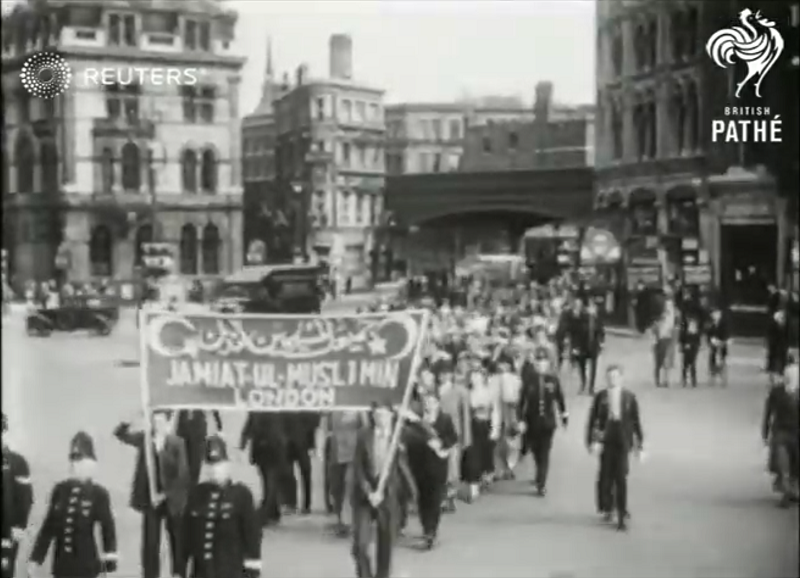
Screen capture of the 1938 Muslim protest march in London from a British Pathé newsreel – https://www.youtube.com/watch?v=ADausiEe4pM
… my husband was at the Museum of London and spotted a very brief mention of this protest in 1938 on a list of 20th century London events. I did some research.
The book they objected to was HG Wells’ A Short History of the World. This was originally published in 1922 but in 1938 an abridged version was tranlated into Hindustani and published in India. His observations about the Prophet Mohammed did not find favour with Indian Muslims (and as you know pre-partition the area called India covered what is now Pakistan and Bangladesh). There were protest meetings in Calcutta and Mumbai (then transliterated as Bombay) and the consignments of the books that WH Smith the booksellers sent to Hyderabad mysteriously never arrived. Investigation showed that the Sind government banned its import. Protests spread to east Africa and were reported in Nairobi and Mombasa.
The paragraphs concerned said “He seems to have been a man compounded of very considerable vanity, greed, cunning, self-deception, and quite sincere religious passion”. Wells concludes, not unfavourably, that “when the manifest defects of Muhammad’s life and writing have been allowed for, there remains in Islam, this faith he imposed upon the Arabs, much power and inspiration”.
There had been a number of Muslims living in east London for some years, sailors who came through the docks, retired servants, some professional men and in 1934 they formed a charitable association for the promotion of Islam called Jamiat-ul-Muslimin; they met on Fridays at a hall in Commercial Road.
On Friday 12th August 1938 a copy of A Short History of the World was, as apparently reported in the Manchester Guardian the following day “ceremoniously burned”. The main Nazi book burnings were over 5 years previously but I can’t but be reminded of them. I can’t access the Guardian on-line archive for 1938 as I don’t have a subscription, but I have no reason to doubt what they reported.
A few days later Dr Mohammed Buksh of Jamiat-ul-Muslimin attended upon Sir Feroz Khan Noon, the high commissioner for India. Sir Feroz tried to explain that in Britain we could (or could then) freely criticise Christianity, the Royal family and government as a right. He reminded Dr Buksh that Muslims were “a very small minority in England, and it would do them no good to try and be mischievous in this country, no matter how genuine their grievances were”.
October 5, 2022
Are the protests in Iran about to tip over into actual revolution?
In The Line, Kaveh Shahrooz reports on the still-ongoing public protests after the death of a young woman at the hands of the morality police:

Aftermath of anti-government protests in Bojnord, North Khorasan Province, Iran, 22 September, 2022.
Photo from Tasnim News Agency Bojnord Desk via Wikimedia Commons.
Revolutions are funny things. They sometimes appear impossible until, in one single moment, they become inevitable. In Iran, that moment came on September 13th with the murder of a young woman.
Mahsa Amini, a 22-year-old who was also known by her Kurdish name “Gina”, had come from Iran’s Kurdistan region to visit her brother in Tehran. It was during that trip that she faced a particular humiliation that has become a fact of life for tens of millions of women in that country: a run-in with the country’s gasht-e ershad (“Guidance Patrol”). The role of this roving gang, seemingly imported from Atwood’s Gilead and called Iran’s “morality police”, is to monitor the streets to find and punish violations of the regime’s seventh-century moral and dress codes.
Having determined that Mahsa’s hijab exposed a little too much hair — a few strands of a woman’s hair and men will simply be incapable of controlling their sexual urges, the logic goes — they detained and beat her severely. The story for most women who deal with the morality police typically ends there, after which they are released to seethe at having endured another round of state-imposed gender apartheid. For Mahsa, the story ended differently: with a skull fracture that caused her to be brought, brain dead, to a local clinic. She died there on September 16th.
The murder of Mahsa Amini was the spark that set off a revolution. The killing reminded women of their daily misery at the hands of a regime that, both de facto and de jure, treats them as second-class citizens. And it reminded everyone of the million other senseless cruelties, large and small, that they must endure daily at the hands of a barbaric theocracy. Outraged by the death of an innocent young woman, the people took to the streets in protests that continue to this day.
There have been mass protests in Iran before. In 2009, in response to a widespread belief that Mahmoud Ahmadinejad had illegally stolen the presidential election — to the extent the word “election” means anything in a country where candidates must first be approved by a clerical body loyal to the regime — citizens protested by the millions. Their slogan, “Where’s my vote?” rested on the premise that a fair, albeit controlled, election was something that could change the system for the better. The protesters typically avoided confrontation with security forces. Even when they happened to corner a regime thug periodically, they ensured that no harm was done to him.
September 30, 2022
History Re-Summarized: The Roman Empire
Overly Sarcastic Productions
Published 16 Sept 2022
The plot twist of Rome is that it was always a mess, now sit back and enjoy the marble-covered mayhem.This video is a Remastered, Definitive Edition of three previous videos from this channel — “History Summarized: The Roman Empire”, “History Hijinks: Rome’s Crisis of the Third Century”, and “History Summarized: The Fall of Rome”. This video combines them all into one narrative, fully upgrading all of the visuals and audio, with a substantially re-written script in parts 1 and 3.
(more…)
September 29, 2022
The Byzantine Empire: Part 5 – The Death of Roman Byzantium, 568-628 AD
seangabb
Published 21 Jan 2022In this, the fifth lecture in the series, Sean Gabb discusses the progressive collapse of Byzantium between the middle years of Justinian and the unexpected but sterile victory over the Persian Empire.
Between 330 AD and 1453, Constantinople (modern Istanbul) was the capital of the Roman Empire, otherwise known as the Later Roman Empire, the Eastern Roman Empire, the Mediaeval Roman Empire, or the Byzantine Empire. For most of this time, it was the largest and richest city in Christendom. The territories of which it was the central capital enjoyed better protections of life, liberty and property, and a higher standard of living, than any other Christian territory, and usually compared favourably with the neighbouring and rival Islamic empires.
The purpose of this course is to give an overview of Byzantine history, from the refoundation of the City by Constantine the Great to its final capture by the Turks.
Here is a series of lectures given by Sean Gabb in late 2021, in which he discusses and tries to explain the history of Byzantium. For reasons of politeness and data protection, all student contributions have been removed.
(more…)
The History of Cyprus Explained in 10 minutes
Epimetheus
Published 24 May 2022The history of Cyprus explained from ancient times to modern.
(more…)
September 27, 2022
QotD: The Poor Law Reform Act of 1834
One of the law’s architects, Edwin Chadwick — a man who made Mr Gradgrind [Wiki] look like one of the Cheeryble brothers [Wiki] — infamously commented that it was vital that the inmates of workhouses should be given the coarsest food possible. William Cobbett, a leading opponent of the bill, gleefully seized on this, nicknaming the Whigs, who pushed the legislation hardest, the “Coarser Food Party”. The idea of all this — rooted in the principles of utilitarianism, political economy and Malthusianism — was, as future Archbishop of Canterbury John Bird Sumner put it, to encourage the labouring poor to do everything they could to avoid the “intemperance and want of prudent foresight” that creates poverty, the “punishment which the moral government of God inflicts in this world upon thoughtlessness and guilty extravagance”.
In the 1830s, these ideas were at the very vanguard of progressive thinking. They were promoted by the metropolitan liberal elite of the age, men such as James Mill, Jeremy Bentham and David Ricardo, the forward-thinking “Philosophic Radicals” who spewed out reforming and “improving” ideas through their famous organ The Westminster Review. Other contributors included happy-go-lucky eugenicist pioneer and social Darwinist Herbert Spencer, as well as Harriet Martineau, the sort of woman who would cheerfully have put her “enlightened benevolence” into practice by personally taste-testing workhouse food to ensure it was sufficiently coarse.
These ideas were gleefully leapt upon by a large swathe of the Church leadership, who endorsed the grim dogmas of political economy with an alacrity that would only surprise anyone unfamiliar with the long history of our episcopacy’s lamb-like submission to secular liberal orthodoxies. As E.R. Norman pointed out many decades ago, the Church of England’s leaders have, again and again since at least the eighteenth century, “readily adopted the progressive idealism common to liberal opinion within the intelligentsia, of which they were a part”. They have “always managed to reinterpret their sources in ways which have somehow made their version of Christianity correspond to the values of their class and generation”, a process intimately connected to the fact that bishops are nearly always tied (by personal links, economic interests and a desire to conform) to their secular peers who set the broader cultural and political agenda.
Capel Lofft, “The closing of the Episcopal mind”, The Critic, 2022-06-21.
September 21, 2022
The Medieval Saint Diet
Tasting History with Max Miller
Published 20 Sep 2022
(more…)
September 20, 2022
The Byzantine Empire: Part 4 – Justinian, The Hand of God
seangabb
Published 1 Jan 2022Between 330 AD and 1453, Constantinople (modern Istanbul) was the capital of the Roman Empire, otherwise known as the Later Roman Empire, the Eastern Roman Empire, the Mediaeval Roman Empire, or The Byzantine Empire. For most of this time, it was the largest and richest city in Christendom. The territories of which it was the central capital enjoyed better protections of life, liberty and property, and a higher standard of living, than any other Christian territory, and usually compared favourably with the neighbouring and rival Islamic empires.
The purpose of this course is to give an overview of Byzantine history, from the refoundation of the City by Constantine the Great to its final capture by the Turks.
Here is a series of lectures given by Sean Gabb in late 2021, in which he discusses and tries to explain the history of Byzantium. For reasons of politeness and data protection, all student contributions have been removed.
(more…)


