
The story of liqueurs continues with a few more of the herbal type. In this context the word herb needs to be interpreted pretty broadly. Wherever drink is made, enterprising chaps will take some of the local spirit — distilled from grain, grapes, other fruit, rice or whatever it may be — and flavour it with almost anything they find growing near by. Many of these concoctions never travel from their home village, and no wonder. In the Dordogne area they produce a beverage called Salers, flavoured with the root of the yellow or mountain gentian, of which they have plenty. Well, there may be nastier drinks but I don’t care to imagine them.
Other agents used in liqueurs of this general type include tea, aloes, hazelnuts, thistles, cocoa, snake root, bison grass, lavender, soya beans and nutmeg, not to speak of tangy stuff like pyrethrum and rhizomal galangae — actually the last two help to produce the pleasantly burning or “warm” taste most liqueurs have.
The distinctively clean and fresh flavour of peppermint is at the heart of one of the most popular of all liqueurs, crème de menthe, of which there are numerous brands. It comes in two versions, the white or transparent and the more familiar artificially coloured bright green. Either is best served with crushed ice and drunk through a straw. If you find it too sweet, try cutting it with an equal part of cognac. When made with the white kind this is knows as the Stinger, once called for by no loss a drinks pundit than James Bond.
Peppermint is supposed to help digestion; so is aniseed, used to flavour all manner of anise liqueurs and anisettes. Marie Brizard is the most famous of them. The firm recommded it as part of a long drink with ice and fresh lemon juice, topped up with plenty of soda water. There’s no accounting for taste is what I always say.
Fans of Italian food, and others, will know about Sambuca, which is flavoured with a herb giving an effect very similar to aniseed. There’s rather a shy-making ritual that involves floating a few coffee beans on the top of your glass and putting a match In the surface to the drink, thus singeing them slightly.
Another Italian liqueur, Galliano, has gained a good deal of ground over the last few years, not as a drink on its own but as a constituent of the famous or infamous cocktail the Harvey Wallbanger, named after some reeling idiot in California. It’s basically a Screwdriver with trimmings, in other words you stir three or four parts fresh orange juice with one part vodka and some ice, then drop a teaspoonful or so of the liqueur on top.
My own favourite in this group is kümmel, flavoured with caraway seed, smooth, and best drunk slightly chilled and straight — as a liqueur, in fact.
Kingsley Amis, Everyday Drinking: The Distilled Kingsley Amis, 2008.
May 18, 2014
QotD: Liqueurs
May 16, 2014
Improving “privilege awareness” at Harvard
Conor Friedersdorf talks about a new privilege awareness exercise for new grad students at Harvard’s John F. Kennedy School of Government:
Such exercises are not without insight or merit (though I find it hard to believe that first-year graduate students at Harvard haven’t encountered this sort of thing before). It surprises me not at all that Harvard insiders would craft the exercise to highlight where they ostensibly stand relative to their fellow Harvard classmates.
As a Harvard outsider who will one day live under a governing elite populated by today’s KSG first-years, I’d only ask for one addition to the “step forward, step back” exercise. Prior to the day it is conducted, KSG should take out some ads in local media: $50 dollars available for the first 500 non-Harvard students to show up at the campus football field at an appointed time. Let them gather, black, white and brown; men and women; straight and gay. The hoi poloi and the KSG freshmen should all mass together behind one end zone. Then the stadium announcer should say, “If you’re not a Harvard student, stay where you are. And if you are a Harvard student, take 95 steps forward, until you’re at the 5 yard line by the far end zone.”
Once all the KSG freshmen are lined up straight at that 5 yard line, everyone can do the “step-forward, step-back” exercise as before. I submit that my augmented approach will afford a more accurate understanding of privilege as it operates at Harvard.
May 14, 2014
The rich boozehound’s guide to globetrotting
Got lots of money burning a hole in your bank account? Want to show off just how filthy stinking rich you are? Like spending your however-earned-or-inherited loot on fancy booze? Then there’s a million-dollar booze vacation you’ll probably like:
UK-based travel company Holidaysplease is offering a luxury world drinking tour in which you can learn and demonstrate the art of conspicuous consumption.
Starting and ending in London — although pickups are possible elsewhere — the ultimate hedonistic, money-no-object vacation takes in the world’s best hotels, swankiest restaurants and most exclusive bars in 10 upmarket destinations.
En route, drinkers take in the universe’s most ludicrously expensive niche beverages.
In Monaco, members of the bottomless budget brigade will mingle with other surreally high net individuals at the high end Hotel Hermitage Monte-Carlo and party at Flavio Briatore’s Billionaire Sunset Lounge in the hotel Fairmont Monte Carlo, quaffing selections from the $565,000 “in-house Armand de Brignac Dynastie” champagne collection.
It all comes complete with fawning waiters and diamond-filled ice buckets.
“We spend the first three nights in London in the five-star Corinthia Hotel and hang out in the Playboy Club, Park Lane, Mayfair,” says Byron Warmington of Holidaysplease.
Hef once said: “Life needs to be lived with a sense of style.”
As a taste of things to come, surrounded by grinning Bunnies, guests will sample the glam high life and swallow what’s reported to be the second most expensive drink in the history of mixology.
The Legacy cocktail includes 1788 Clos de Griffier Vieux Cognac, which comes in at $21,000 for a 40 ml shot.
It also includes ancient Kummel liqueur, vintage orange Curacao and four dashes of circa 1900 Angostura bitters.
February 13, 2014
When did “Child Find” morph into “Missing Persons”?
Some of my utility bills come with return envelopes (yes, even in this day of internet banking, lots of bill payments still go through the old-fashioned mail system). At least one of them uses the back of the return envelope to print Child Find alerts, with a photo and information about the missing child. This seems like a good idea, although the most recent example seems to be a bit of a stretch:

First, the information says that the missing child was twenty years old when last seen … have we officially decided that childhood lasts into the twenties? Second, the missing person has been missing for a pretty long time — since 1988 — and it seems unlikely that this photo will have much more than a casual resemblance to her current appearance (assuming that she’s still alive, of course).
February 6, 2014
He’d have gotten away with it, except for those pesky girls
Being shy can be a handicap for certain kinds of activities. It can prevent you from doing things you might otherwise want to do. Shockingly, however, the Ontario Human Rights Tribunal doesn’t think that you should get special treatment just because you’re afraid to be the only guy in a class full of women:
Sexual politics have erupted again in Toronto’s ivory tower as another male student has lost a bid to be excused from a class with women without losing marks, this time because he’s shy.
The Ontario Human Rights Tribunal has dismissed a complaint by University of Toronto student Wongene Daniel Kim, who accused his professor of discriminating against him as a male when she docked him marks for not coming to class because he was too shy to be the only guy.
The second-year health science major arrived at the opening of a Women and Gender Studies course for which he had signed up in the fall of 2012 — “It had spaces left and fit into my timetable” — only to discover a room full of women and nary a man in sight.
“I felt anxiety; I didn’t expect it would be all women and it was a small classroom and about 40 women were sort of sitting in a semicircle and the thought of spending two hours every week sitting there for the next four months was overwhelming,” said Kim, 20, adding he manages a part-time job with women because there are also other men.
[…]
However the tribunal ruled his complaint did not warrant a hearing.
“The applicant has not satisfied me that his claimed discomfort in a classroom of women requires accommodation under the (Ontario Human Rights) Code,” wrote adjudicator Mary Truemner. “He admitted that his discomfort is based on his own ‘individual preference’ as a shy person … and stated he thought they (the women) would not be willing to interact with him because of his gender.”
This was “merely speculation as he never gave the class, or the women, a chance,” wrote Truemner, vice-chair of the tribunal.
Kim had no evidence of being “excluded, disadvantaged or treated unequally on the basis of” his gender, she said.
H/T to Joey DeVilla who posted on Facebook, “Way to perpetuate the feckless Asian nerd stereotype, Kim. After all the work I did dispelling it!”.
December 13, 2013
No regerts
I really missed out on a great long-term investment when I didn’t put all my retirement savings into a tattoo removal chain:

H/T to Joey DeVilla for the image.
December 9, 2013
Proving (again) that any moron can do well at “fantasy” sports
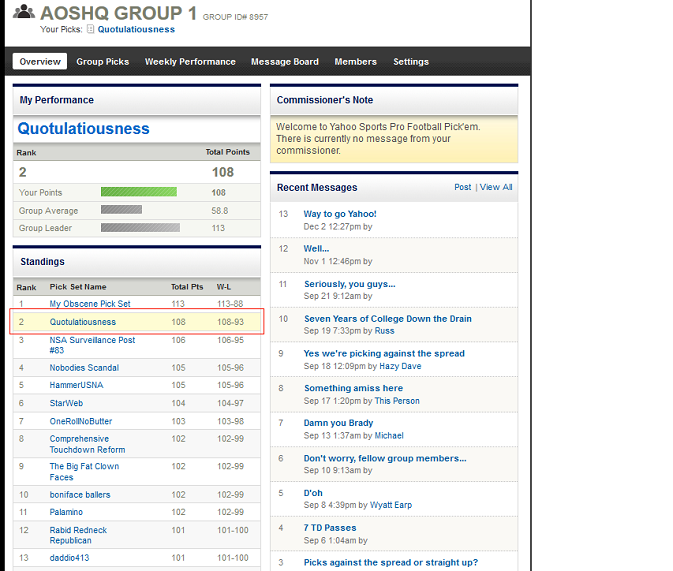
An excellent week for my picks in the Ace of Spades HQ fantasy football pool at Yahoo! That’s still a relatively big lead for the player who has been top-of-the-rankings from week 1, though:
November 20, 2013
Proving that any moron can do well at “fantasy” sports
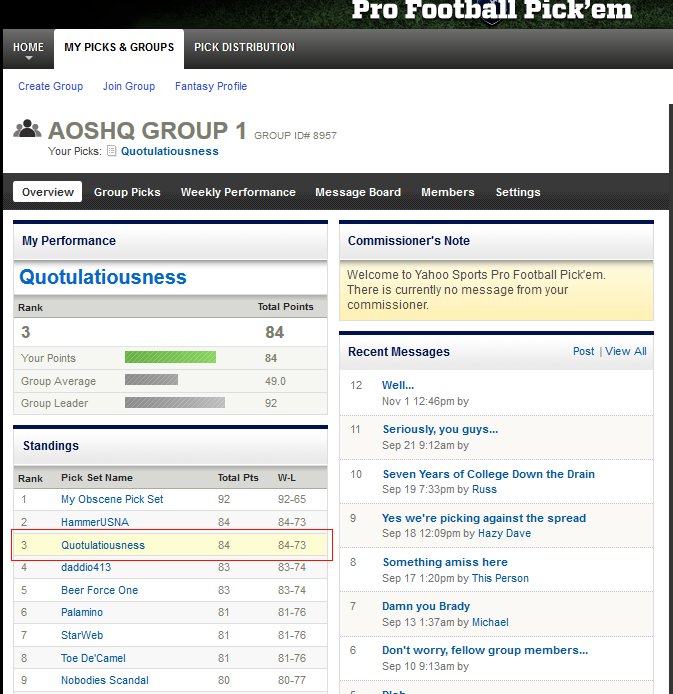
I’m actually doing quite well in the Ace of Spades HQ football pool at Yahoo this year:
October 27, 2013
Cupcakes are “butter-iced snares of self-loathing”
I’m not actually much of a fan of sweet concoctions, so the cupcake revolution swept past without leaving much of an impression on me, but from what I hear they’re still undeniably popular. In the Guardian, Matt Seaton isn’t impressed:
Cupcakes look absolutely fabulous, of course … in photographs, on e-commerce sites, in shop windows and in expensively beribboned boxes. But have you ever managed to eat one without either getting frosting on your nose or ending up with sticky slime between your fingers? They’re the edible equivalent of ultra-fashiony high heels: great to look at, ridiculously impractical.
And like heels, borderline masochistic. Why? Because cupcakes are very obviously a terrible food choice.
Now, anyone who knows me and my industrial-scale chocolate habit will be ready to yell “hypocrite” here. But I’m not preaching abstinence from treats. What irks me about cupcakes is that, for their implied young female, figure-conscious, on-off dieting customers, they set up this horrible dynamic of enabling indulgence in a forbidden object.
You know what cupcakes really are? — butter-iced snares of self-loathing that sell precisely because they exploit young women’s insecurity about their looks and identity, and offer a completely false and self-defeating solace of temporary gratification, almost certainly followed by remorse and disgust.
H/T to James Lileks for the link.
October 22, 2013
Dahlia Lithwick on smelling like a teenage boy for a week
It’s not just a scent … it’s a lifestyle:
When I first told my husband that I was planning on wearing only Axe men’s products for an entire week, his answer was a foreshadowing of things to come: “You’re planning on wearing that stuff to bed every night for a week? Man. Axe really does work. It’s only been a few minutes and look, you’re already single again … ”
[…]
Despairing of any kind of social response that wasn’t either threats of a formal legal separation from my husband or subtle nostalgia from mothers of former Axe users, I decided to trot out the stuff at the last night of Slate’s annual retreat in September. Having sprayed it liberally all over my body on the night of the big promlike party, I watched my roommate — Slate’s Dear Prudie — actually flatten herself up against a hotel room wall and slide uneasily down the hallway, in the manner of that poor cat being chased by Pepé Le Pew. Almost immediately upon my arrival at the festivities I was accosted by three female Slate colleagues who spontaneously observed that I smelled completely amazing. I was briefly thrilled at the enthusiastic response, until I realized that I didn’t really want my someday teenaged sons to ever be quite that amazing-smelling to women in their 30s and 40s. One colleague said it brought her right back to whatever it is that happened in the back of a truck when she was herself 14. The silence was slightly less awkward than after the pants-spraying story the week before.
October 19, 2013
Amusing maps – US population distribution in units of Canadas
You can find the most interesting things on Twitter. Here’s @Amazing_Maps with a map of the United States divided up into units of Canadas:

Click to embiggenate
October 15, 2013
QotD: Duties of a good host
Up to a point (i.e. short of offering your guests one of those Balkan plonks marketed as wine, Cyprus sherry, poteen and the like), go for quantity rather than quality. Most people would rather have two glasses of ordinary decent port than one of a rare vintage. On the same reasoning, give them big drinks rather than small — with exceptions to be noted later. Serious drinkers will be pleased and reassured, unserious ones will not be offended, and you will use up less chatting time going round to recharge glasses.
Kingsley Amis, Everyday Drinking: The Distilled Kingsley Amis, 2008.
October 13, 2013
October 3, 2013
The Bystander Effect in Philadelphia
Techdirt‘s Tim Cushing talks about an incident in Philadelphia where a transit police officer was losing a fight with a suspect, yet none of the people came to the assistance of the cop or even called 911:
The fact is that a certain number of citizens aren’t going to come to a cop’s defense simply because they’ve seen too much abuse occur at the hands of cops. When law enforcement struggles with an arrestee, they’re not too shy about bringing in several more officers to help out, or just sending an attack dog after them. They’re also in possession of several more weapons than most citizens carry — including pepper spray, batons, tasers and guns.
The odds are stacked in favor of police officers. When one is suddenly unable to avail himself of all the weapons at his disposal, police leadership seems to think the public should jump in and save their “heroes,” or at least call 911.
Over at PINAC’s writeup of the event, the oft-arrested/hassled photographer Carlos Miller points out why that’s a bad idea.
I admit I would be the one video recording, not necessarily because I wouldn’t want to help the cop, but because pulling out my camera and recording is very instinctive for me, while dialing 911 is anything but.
In fact, my instinct is to avoid calling 911 at all costs because I don’t trust police enough not to turn me into a suspect when they arrive, which we have seen happen numerous times in the past.
Beyond the chilly relationship between citizens and cops are further factors, legal and otherwise, that Chief Nestle isn’t considering when he expresses his shock at the public’s inaction.
First, there’s the Bystander Effect. Very basically, the more people present in a situation, the less likely that someone will offer aid. Two factors that came into play during this beatdown are empathy and the “diffusion of responsibility.” Many people simply don’t empathize with cops, even when a citizen has gained the upper hand. This disconnect leads directly to less altruistic behavior. The more someone empathizes with the victim, the more likely they are to respond. Judging from the majority of the comments under the news report, it’s very unlikely that any crowd would be filled with empathetic individuals.


