Quotulatiousness

February 26, 2016

Budd Rail Diesel Cars to return to Southern Ontario?

Filed under: Cancon, Railways — Tags: , — Nicholas @ 02:00

CBC News reports on a possible re-introduction of RDC service between London and Sarnia:

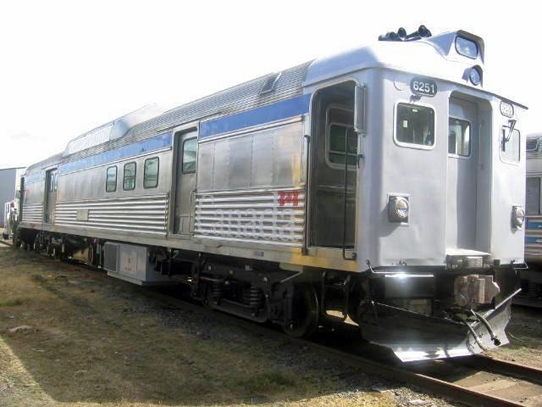
VIA refurbished RDC Test Run

Dozens of additional passenger train runs should be operating in southern Ontario later this year as Via Rail Canada continues its push to increase the frequency of trips in and out of London, Ont.

Proponents of increased passenger rail service got a glimpse of the company’s expansion plans when Via tested a couple rebuilt diesel cars near Chatham.

Testing out the diesel cars sends a signal of Via’s progress, according to Terry Johnson, president of the Southwestern Ontario Transportation Alliance.

The alliance has been advocating for increased passenger service for years.

“What we hear when we talk to people about what they would like to see done to make passenger service more attractive to use, frequency is a big factor,” Johnson told CBC News.

Via Rail confirmed its plan to add dozens of trips in the region, including four extra round trips between Sarnia and London and several others trips out of Windsor.

More details from the VIA Rail website:

The RDC fleet is being improved to ensure reliable service and upgrade interior comfort.

Structural upgrades include engine, transmission, heating, ventilation and air conditioning (HVAC) systems and refrigeration system replacements. Our goal is to achieve substantial fuel savings, while extending the life of our trains with new parts.

The trains will also feature fully-rebuilt diesel engines that meet Euro II emission standards and fully-rebuilt air brakes. There will be new cabs at one end of each RDC with new operator controls, and new LED lighting. A new camera system will record the operator’s track view from the cab, enhancing safety and minimizing wait time if a delay-causing incident occurs, allowing VIA to deliver passengers as quickly as possible.

New wheelchair lifts are now available on either side of the cars, allowing passengers to embark or unload at any station, regardless of which side the track is on.

In addition, we’ll be adding a modern touch to interiors with features designed for passenger comfort, including improved accessibility for passengers with special mobility needs. RDC train seats will be treated to new foam and reupholstered in bright new fabrics. As well the cars will feature new toilets with environmentally-friendly retention systems in redesigned, accessible washrooms.

Earlier this week, Hunter Holmes caught a pair of RDC units being test-run on the Chatham subdivision:

Published on 21 Feb 2016

Filmed: February 20, 2016
Chatham Ontario, Canada

On February 20, 2016 two VIA Rail RDC’s were brought to Chatham Ontario to test crossing response to the units and provide a feasibility study of future operations. The units are rare enough being two of only a handful of RDC’s still in revenue service anywhere they are also far from home. Hopefully we see more of these units in the future.

December 26, 2015

QotD: Progress

Filed under: Books, Quotations, Railways, Technology — Tags: , — Nicholas @ 01:00

Yes, Moist thought, there would be changes. You’d still find horses in town and Iron Girder couldn’t plough, although for a certainty Mr Simnel could make her do so. “Some people will lose out and others will benefit, but hasn’t that been happening since the dawn of time?” he said out loud. “After all, at the beginning there was the man who could make stone tools, and then along came the man who made bronze and so the first man had to either learn to make bronze too, or get into a different line of work completely. And the man who could work bronze would be put out of work by the man who could work iron. And just as that man was congratulating himself for being a smarty-pants, along came the man who made steel. Its like a sort of dance, where no one dares stop because if you did stop you’d be left behind. But isn’t that just the world in a nutshell?”

Terry Pratchett, Raising Steam, 2013.

December 18, 2015

HP Lovecraft’s model railway

Filed under: Railways — Tags: — Nicholas @ 03:00

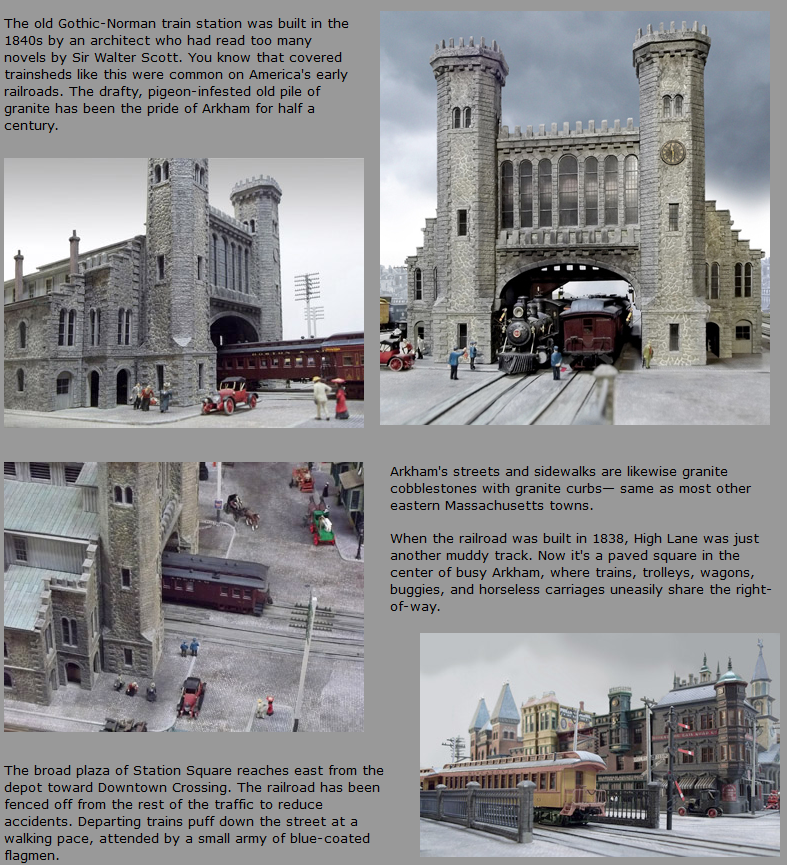
Well, not actually his railway, but a layout built by John Ott portraying the world in which HP Lovecraft’s stories were set:

“[T]he ancient, mouldering, and subtly fearsome town… witch-cursed, legend-haunted Arkham, whose huddled, sagging gambrel roofs and crumbling Georgian balustrades brood out the centuries beside the darkly muttering Miskatonic.”
—HP Lovecraft, “The Thing on the Doorstep”

It’s a shame your layover is so short, Howard. There’s not much time to look around. Not enough time to see Miskatonic University across the river, though I’m sure you’re familiar with what ivy-covered halls look like. You’re planning on going to Brown someday yourself, aren’t you, young man? Well, at any rate— you’ll have to stick around with me downtown, close to the station, and see what you may. Arkham is an… interesting place, even though it might not be apparent to the casual traveler.

We might be known for them, but you won’t find many gambrel roofs or decaying Georgian mansions downtown. Arkham is a prosperous modern city. Well… that is… it’s a once-prosperous city that still cherishes dreams of a bright future. Let’s just leave it at that.

And… oh yes, about all that stuff you’ve heard. You know… the things they say about Arkham. Strange cults, witches’ curses, child sacrifice… odd things. Well, remember it’s the year nineteen-hundred-and-seven Anno Domini. Those kinds of things just don’t happen any more. Arkham is a normal, quiet place. Very typical for eastern Massachusetts. Really.

Arkham by John Ott

H/T to Cory Doctorow for the link.

December 10, 2015

Your business model and transformative change

Filed under: History, Railways, USA — Tags: , , — Nicholas @ 03:00

At The Arts Mechanical, there’s a paean to the amazing technological achievement represented by this steam engine:

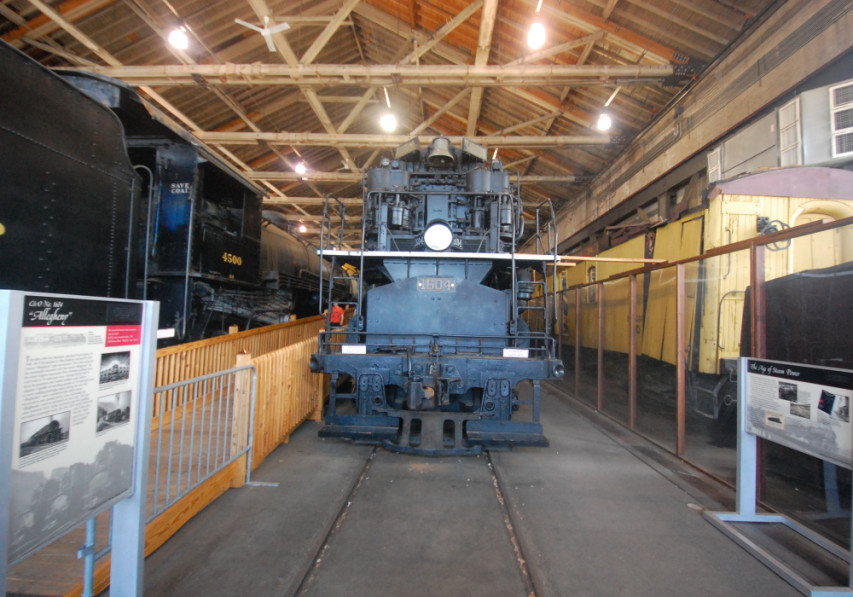
C&O RR H8 Allegheny

… and a return to reality by looking at how that amazing steam engine was made utterly obsolete by a humble diesel switcher and its direct descendants:

Which brings us to the picture at the head of this post. Anybody ever hear of Lima Locomotive? Here is what they did. That is a C&O RR H8 Allegheny. It is the largest and most powerful steam locomotive ever built. The locomotive was in the shed and there was no way I could get a side shot but the size of it boggles the mind. The firebox is the same size as a small house. The locomotive was designed to move mountains of coal and that’s what it did.

https://en.wikipedia.org/wiki/2-6-6-6

It was also obsolete before it was erected.

December 4, 2015

Britain’s “ghost trains”

Filed under: Britain, Railways — Tags: , , — Nicholas @ 02:00

BBC Future explains why there are some very odd trains that run on British railways, but aren’t advertised or even known about by railway staff:

The Leeds-Snaith line is what rail enthusiasts call a ghost train; Snaith station, a ghost station. The webpage about Snaith on ticket sales site TheTrainLine.com warns that ticket machines are not available at the station. Nor is there a ticket office, taxi rank or cab office.

It’s one of many train services around Britain that run with empty carriages – sometimes once or twice a day, sometimes as rarely as once a week. Sometimes even ticket sellers don’t know they exist, and it takes dedicated amateurs to seek them out. So why do these trains run at all?

There is no single definition of what constitutes a ghost train, although the general consensus is that it’s when a service is so infrequent, the train becomes effectively useless. Slippery or not, though, the term “ghost train” seems apt. It implies a service that is not exactly whole – something that whispers through towns and countryside, leaving barely a dent in its wake.

Perhaps most important of all, the term ghost train implies something that only a special few know exists. The press contact of the National Rail Museum of York, for example, was baffled by my request for an interview about ghost trains, thinking I wanted to discuss “haunted items” in the museum’s collection.

Nobody knows exactly how many ghost trains there are. On the website The Ghost Station Hunters, run by rail enthusiasts Tim Hall-Smith and Liz Moralee, there are 37 listed, and those are only the stations the intrepid pair has gotten to and written about so far. Hall-Smith says he’s counted more than 50 by looking through timetables.

So what is the point of running trains that almost nobody uses or even knows about?

Given the overcrowding on Britain’s trains, it may seem odd for these empty carriages to ride the rails – or for empty stations to stand sentry over them. From 1995-96 to 2011-12, the total number of miles ridden by train passengers leapt by 91%, while the entire UK train fleet grew by only 12%.

“Ghost trains are there just for a legal placeholder to prevent the line from being closed,” says Bruce Williamson, national spokesperson for the advocacy group RailFuture. Or as Colin Divall, professor of railway studies at the University of York, puts it: “It’s a useless, limited service that’s borderline, and the reason that it’s been kept is there would be a stink if anyone tried to close it.”

That is the crux of why the ghost trains still exist. A more official term is “parliamentary trains”, a name that stems from past years when an Act of Parliament was needed to shut down a line. Many train operators kept running empty trains to avoid the costs and political fallout – and while this law has since changed, the same pressures remain.

Closing down a line is cumbersome. There must first be a transport appraisal analysing the effect of a closure on passengers, the environment and the economy. The proposal is submitted to the Department of Transport and at that point its details must be published in the press, six months ahead of the closure. Then comes a 12-week consultation period, during which time anyone is welcome to protest; public hearings are sometimes held, especially if the closure is controversial. Then, finally, the plans are submitted to the Office of Rail and Road, who decide if the line closes.

In other words, it’s cheaper to run just enough service to keep the line “active” than it is to go through the bother and cost of shutting it down.

October 3, 2015

Great Britons: Isambard Kingdom Brunel Hosted by Jeremy Clarkson – BBC Documentary

Filed under: Britain, History, Railways, Technology — Tags: , , , — Nicholas @ 02:00

Published on 16 Jul 2014

Jeremy Clarkson follows in the footsteps of the great engineer Isambard Kingdom Brunel whose designs for bridges, railways, steamships, docks and buildings revolutionised modern engineering. But his boldness and determination to succeed often led him to repeatedly risk his own life. Jeremy Clarkson, discovers for himself just how terrifying that was.

H/T to Ghost of a Flea for the link.

September 17, 2015

Regulatory tangle may shut down major US railroads in December

Filed under: Bureaucracy, Business, Railways, USA — Tags: , , — Nicholas @ 02:00

A safety regulation for US common-carrier railroads is due to come into effect at the end of December, but the railroad companies are already warning that they may not be able to comply and that the only legal course of action under the current rules would be to shut down:

In a candid letter to a U.S. senator, BNSF Railway’s chief executive, Carl Ice, said September 9 that BNSF would in effect shut down most of its network rather than violate a federal law mandating that positive train control be operational by December 31. CSX Transportation has said it, too, questions whether it should violate federal laws, and other Class I carriers are likely to follow suit. This set up the real possibility of a national transportation crisis at the beginning of 2016. The public may be unaware of how closely the U.S. economy is tied to railroads, but the reality is that without railroads, this country will quickly cease to function normally. Imagine, for instance, no electricity to heat homes.

[…]

The Surface Transportation Board, which regulates railroads, in effect came to the aid of BNSF and other railroads this past week. Its chairman, Daniel Elliott, wrote to Thune to say that railroads can “lawfully suspend service for various reasons, including safety.” In other words, Elliott is saying that the common carrier obligation of railroads is not absolute. Elliott added that CSX has expressed sentiments similar to those of BNSF.

So what does this all mean? I take railroads at their word that they have diligently tried to install PTC by the deadline. Six years ago Congress thought it was giving railroads enough time to do this, and railroads did not object then to that deadline. But implementation has been a disaster. The technology being put in place is largely new. FRA was slow to issue necessary rules. Signal engineers able to put all the pieces together have been in short supply. And then for more than a year everything ground to a halt because the Federal Communications Commission would not issue permits for construction of radio towers and antennae.

Further, as Ice points out to Thune, PTC is full of bugs as railroads roll it out on their networks. Says Ice: “We are seeing the PTC system trigger unnecessary braking events in which trains are stopped with a full-service brake application. This means that significant work has to occur before the train can re-start. These kinds of delays are numerous and cumulatively consume railroad capacity.”

What railroads have sought is an extension of the deadline, something that Congress has thus far refused to act upon because the votes to permit an extension aren’t there. Now the industry is beginning to say fine, we will not disobey the law and as a result we will be able to offer only a fraction of the service our customers depend upon.

July 31, 2015

Rapido’s Real Train Car Restoration: 1

Filed under: Cancon, Railways — Tags: , — Nicholas @ 03:00

Published on 21 Jul 2015

The guys at Rapido Trains bought a full-size Pullman sleeping car and are in completely over their heads.

July 14, 2015

Washington’s streetcars

Filed under: Economics, Government, Railways, USA — Tags: , , , , — Nicholas @ 04:00

Warren Meyer isn’t a fan of streetcars in general, but he views the Washington DC streetcar project as being particularly deserving of scorn:

I am increasingly convinced that the appeal of streetcars and light rail has everything to do with class. From any rational perspective, these systems make no sense — they are 10-100x more expensive than buses and lack the flexibility that buses have to adjust to shifting demand patterns over time. A single extra lane of highway adds more capacity than any light rail line.

Streetcar’s single, solitary advantage is that middle and upper class whites who would not be caught dead on a bus seem to be willing to ride streetcars. I don’t know if this is because of some feature of the streetcars (they are shiny and painted pretty) or if it is some sort of self-segregation (the upper classes want to ride on something that is not filled with “riffraff”).

He also points out that even Vox.com can’t make the case for streetcars particularly well:

The arguments are:

  • Tourists like them, because you can’t get lost like you can on buses. My response is, “so what.” Unless you are one of a very few unique cities, tourists are a trivial percentage of transit riders anyway. Why build a huge system just to serve out-of-town visitors? I would add that many of these same cities (e.g. Las Vegas) considering streetcars are the same ones banning Uber, which tourists REALLY love.
  • Developers like them. Ahh, now we are getting somewhere. So they are corporate welfare? But not so fast, they are not even very good corporate welfare. Because most of the studies they cite are total BS, of the same quality as studies that say sports stadium construction spurs all sorts of business. In fact, most cities have linked huge tax abatement and subsidy programs to their streetcars, such that the development you get with the subsidy and the streetcar is about what you would expect from the subsidies alone. Reminds me of the old joke that mimicked cereal commercials: “As part of a breakfast with juice, toast, and milk, Trix cereal has all the nutrition of juice, toast, and milk.”
  • Good for the environment. But even Vox asks, “as compared to what.” Since they are generally an alternative buses, as compared to buses that have little environmental advantage and often are worse (they have a lot more weight to drag around when empty).
  • The Obama Administration likes them. LOL, that’s a recommendation? When you read the text, what they actually say is that mayors like the fact that the Obama Administration likes them, for it means the Feds will throw lots of Federal money at these projects to help mayors look good using other peoples’ money.
  • Jobs. This is hilarious Keynesianism, trying to make the fact that streetcars are 10-100x more expensive than buses some sort of positive. Because they are more inefficient, they employ more people! One could make the exact same argument for banning mechanical harvesters and going back to scythes. Left unquestioned, as Bastiat would tell us, is how many people that money would have employed if it had not been seized by the government for streetcar use.
  • Je ne sais quoi. I kid you not, that is their final argument, that streetcars add that special something to a neighborhood. In my mind, this is Vox’s way of saying the same thing I did the other day — that the streetcar’s appeal is primarily based on class, in that middle and upper class folks don’t want to ride on a bus with the masses. The streetcar feels more upscale than buses. The poor of course, for whom public transit is most vital, don’t want to pay 10 times more for sexiness.

Every argument I have ever been in on streetcars always boils down to something like “well, all the cool kids like them.”

July 8, 2015

Political correctness reaches even the railfan community

Filed under: Media, Politics, Railways — Tags: , , , — Nicholas @ 03:00

In his blog at Trains magazine, Fred Frailey explains why he’s not a fan of the attempt to shut down an advertiser’s access to the magazine for personal expressions of the advertiser that offended certain ultra-sensitive readers:

Jack runs a company that sells supplies to competitive swimmers. He advertises in Jill’s magazine, which is devoted to competitive swimming. And Bart is a competitive swimmer. On Facebook one day, Jack says that Bart is a alcohol-swilling has-been of a swimmer. Bill and Bob are admirers of Bart and subscribers to Jill’s magazine. They are angered by Jack’s remark and pressure Jill not to accept Jack’s advertising.

Jill asks, what in the dickens do I have to do with this? I didn’t start this fight, none of it occurred on the pages of my magazine, and Jack meets all our advertising standards. Am I to police everything that every advertiser says anywhere? Impossible, she says, and tells Bill and Bob no, she has no reason to ban Jack’s ads. But Bill and Bob respond, Bart is our hero and the hero of many if not most subscribers to the magazine. It’s a smart business decision to ban Jack. They cancel their subs to Jill’s magazine, naturally, thinking this will really, really hurt Jack (let’s all roll our eyes).

I have a name for this. It’s political correctness, and it is becoming the death of independent thought. The tempest involving a small advertiser in Trains Magazine over a comment he made on social media after the derailment of Amtrak train 188 has upset some readers of Trains, who have cancelled subscriptions. To be specific, the businessman ridiculed 188’s engineer, calling him a foamer.

[…]

To go back to my example — which I think fairly describes the dispute involving Trains Magazine as an uninvolved bystander — Bill and Bob’s normal recourse would be not to patronize Jack’s company. Certainly this is their right. But Bill and Bob don’t patronize Jack’s company to start with, and it is unlikely that boycotting Jack’s business would have much if any effect. So they twist the arm of Jill, a third party who has no dog in this hunt. It’s not her fight. She probably has no opinion of Bart one way or the other and if she did, it’s still a barroom brawl she isn’t interested in entering. And even if her editor wants to stake out a position on one side or the other on the editorial pages, what does this have to do with access to her magazine by an advertiser?

So now comes the insidious entrance of political correctness. On this blog this past weekend, a poster said to me in a comment: “I’m at a loss trying to figure out how dropping an advertiser that insults many of the magazine’s contributors and readers is somehow equal to stifling dialogue and free speech? Seems like a stretch.” I read that and thought to myself, this is politically correct thinking in full flower. Let me paraphrase the contributor: Some of us don’t like what was said, and therefore this offender must be thrown out, ostracized, punished, silenced. And it is fair to use any means at hand, including bringing outsiders into the fray.

July 4, 2015

Reason.tv – The Secret Scam of Streetcars

Filed under: Bureaucracy, Government, Railways, USA — Tags: , , , — Nicholas @ 03:00

Published on 1 Jul 2015

Meet the Thighmaster of urban public policy: Streetcars.

Municipal politicians all across the country have convinced themselves that this costly, clunky hardware can revitalize their flabby downtown economies.

That includes the fearless leaders of America’s capital city. The DC government has spent hundreds of millions of dollars over the last decade trying to erect a streetcar line in the up-and-coming neighborhood of H Street. The project has been an epic disaster, perfectly demonstrating how ill-suited streetcars are to modern urban life.

Watch the full video above, or click below for downloadable versions. And subscribe to Reason TV’s YouTube channel for daily content like this.

July 2, 2015

Frankford Junction, Pennsylvania

Filed under: History, Railways, USA — Tags: , , , — Nicholas @ 04:00

Rob McGonigal looks at the history of the railways in the area of Frankford Junction, where Amtrak train 188 came to grief in May:

In the aftermath of the tragic May 12 derailment due to excessive speed of Amtrak train 188 in Philadelphia, many casual observers wondered what a 50-mph curve is doing in the middle of the fastest, busiest rail corridor in the nation. It’s a reasonable question, especially given the generally tangent track and flat topography in the area.

The existence of that curve traces back to the earliest years of railroads in Philadelphia. As in many cities, Philadelphia’s rail network developed in piecemeal, uncoordinated fashion. What became Amtrak 188’s route through the city began in the 1830s as three separate projects.

The Philadelphia, Wilmington & Baltimore ran generally southwestward from a terminal about a mile south of downtown (“center city” to Philadelphians). The Philadelphia & Columbia, part of the Main Line of Public Works rail/canal system to Pittsburgh, utilized a terminal in center city. The Philadelphia & Trenton, which connected with services to New York, originated in Kensington — an inconvenient 2½ miles northeast of center city. As Albert Churella relates in the first volume of his mammoth history of the PRR (University of Pennsylvania Press, 2013), municipal authorities in 1840 granted the P&T permission to extend its line into center city, where it would connect with other railroads. However, fierce opposition from teamsters, who profited from hauling freight between the rail terminals, and area residents, who did not want steam trains in their streets, prompted the city to revoke permission, and the P&T was not extended.

Two decades later, it was clear that the three lines should be connected. In 1864 the Junction Railroad was opened, linking the PW&B with the P&C’s successor on the line to the west — the Pennsylvania Railroad. (Indeed, the PRR had interests in all three of the lines by this time.) Three years later the Connecting Railway opened. It diverged from the P&C/PRR line at a place designated Mantua Junction (and later, in expanded form, Zoo interlocking), arced around the northern part of the city, and connected with the P&T in the Frankford section of Philadelphia. As with the connection at Mantua Junction, the geometry of the lines at Frankford Junction resulted in a sharp curve.

July 1, 2015

Budd Railcars in 1952 – “Clear Iron”

Filed under: History, Railways, USA — Tags: — Nicholas @ 05:00

Uploaded on 17 Aug 2011

Educational film released in 1952 by Marathon Newsreel Production in association with the Budd company. Shows the railcars being manufactured and in operation. Also features many steam and diesel trains from the early 1950’s.

From https://en.wikipedia.org/wiki/Budd_Rail_Diesel_Car

The Budd Rail Diesel Car or RDC is a self-propelled diesel-hydraulic multiple unit railcar. In the period 1949-62, 398 RDCs were built by the Budd Company of Philadelphia, Pennsylvania, United States. The cars were primarily adopted for passenger service in rural areas with low traffic density or in short-haul commuter service, and were less expensive to operate in this context than a traditional locomotive-drawn train. The cars could be used singly or several coupled together in train sets and controlled from the cab of the front unit. The RDC was one of the few versions of the DMU-type train diesel multiple unit to achieve commercial success in North America.

The basic car was adapted from a standard 85 ft (25.91 m) coach. They were powered by two Detroit Diesel (then a division of General Motors) Series 110 diesel engines, each of which drives an axle through a hydraulic torque converter, a technology adapted from military tanks of World War II. RDC trains were an early example of self-contained diesel multiple units, an arrangement now in common use by railways all over the world.

[…]

Both the Canadian National Railway (CN) and Canadian Pacific Railway (CP) purchased RDCs. The Canadian National purchased 25 cars outright, and acquired many more second-hand from the Boston and Maine Railroad. These cars, which the CN called Railiners, were used primarily on secondary passenger routes. The CP purchased 53 cars. The first one ran on November 9, 1954, between Detroit, Michigan and Toronto. It was the first stainless steel passenger train to operate in Canada. CP used the RDCs, which it called Dayliners, throughout its system. CP also made extensive use of them on commuter trains around Montreal and Toronto. Via Rail inherited many of these cars when it took over CN and CP passenger services in 1978.[39] Via continues to use RDCs on the Sudbury–White River train in Ontario.

Another Canadian purchaser of RDCs was the Pacific Great Eastern Railway, which operated passenger service between North Vancouver and Prince George. RDCs continued to operate on this route until all passenger service ended under BC Rail, PGE’s successor, in 2002.

Extensively refurbished RDCs were supposed to been used to operate Blue22, a rail service between Toronto Union Station and Pearson Airport, by 2010. The service, which was transferred to Metrolinx ownership and opened in 2015 as the Union Pearson Express, ultimately uses newly designed Nippon Sharyo DMU trains instead.

Riding the “Budd cars” from Sudbury to White River

Filed under: Cancon, Railways — Tags: , — Nicholas @ 04:00

Malcolm Kenton reports on his recent trip on VIA Rail’s unique passenger service between Sudbury and White River, Ontario:

VIA Rail Canada’s Sudbury-White River train (formerly known as the Lake Superior), consisting of two (sometimes three) Budd-built Rail Diesel Cars (RDCs) that operate three days a week in each direction along a 301-mile section of Canadian Pacific’s transcontinental main line, is the only passenger train of its kind in North America for several reasons. It is currently the only regularly scheduled intercity passenger service using Budd RDCs (the only others being used as backups on two commuter lines, Tri-Met’s Westside Express in Oregon and Trinity Railway Express in Texas, and on a handful of excursion trains). It is the only intercity passenger train in Canada that uses Canadian Pacific trackage for a significant stretch (western Canada’s privately-run Rocky Mountaineer excepted). And it is one of three passenger train routes in northern Ontario that delivers people, supplies and equipment to points along the line that are not accessible by road (except for a few dirt logging roads) or air (except for a few wilderness lodge sites that have small landing strips for bush planes). I had the opportunity to travel aboard this service — whose parallel cannot be found on this side of the 49th Parallel — last week (June 18 & 19).

VIA refurbished all three of the RDCs within the past year, giving them new seats, electric outlets at each seat, restrooms, heating & air conditioning systems, and wheelchair accessibility features. One car has a large restroom whose doors slide open or closed and lock with the push of a button. A crew member on my trip referred to it as “the Cadillac bathroom.” Next to the engineer’s cab on each coach is an area that doubles as a baggage area and a crew break area, with refrigerator, sink and coffee maker. The highest passenger train speed limit on the route is 75 mph, reached for just a brief stretch between Sudbury and Cartier. Otherwise, it generally tops out at 60 — though on rare occasions where the train has had to run with just one RDC, it is limited to 45 mph — meaning the trip is usually completed just barely within the engineers’ legal limit of 12 consecutive hours of service, between which periods crews must be given at least eight consecutive hours of rest.

The vast majority of passengers on “the Budd cars” (as most locals refer to the train) — usually only a handful on each trip, though occasionally all 48 seats on both cars are occupied for a portion of the trip — are visiting remote cabins along the line to fish, hunt/trap, canoe or kayak, mountain bike, or otherwise enjoy the great outdoors. There are also year-round residents of the mid-route communities of Ramsey and Chapleau who use the train to visit family and friends and go to medical appointments in Sudbury (as there are no medical specialists in their hometowns). Passengers bring aboard an array of gear for wilderness expeditions — canoes, fishing gear, coolers, etc. — which is loaded into the baggage section of one of the RDCs (in the busy season, a third RDC car is added that is solely a baggage car, as was the case on my jaunt). And owners of cabins and retreats near the line use the train as a parcel service, having others buy groceries and supplies at one of the endpoints and drive them to the train, to be loaded into the baggage hold and unloaded at the stop nearest their outpost.

Eastbound train 186, with the RDC baggage car in the lead, passes a CP freight train carrying backhoes at the small White River, ON yard on June 19, approaching the station to begin its run towards Sudbury. (Photo by Malcolm Kenton)

Eastbound train 186, with the RDC baggage car in the lead, passes a CP freight train carrying backhoes at the small White River, ON yard on June 19, approaching the station to begin its run towards Sudbury. (Photo by Malcolm Kenton)

June 29, 2015

More on the “self-driving truck” issue

Filed under: Business, Economics, Railways, Technology, USA — Tags: , , , , — Nicholas @ 02:00

In the comments to this post, Tom Kelley provided a worthwhile digression on the topic that I felt deserved a wider audience, so with his permission, here’s Tom’s response:

Given that the trucking industry has been my sandbox for quite some time, I can safely extend Megan’s prognosis to also include the low long-term risk of job losses due to self-driving vehicles.

Frankly, I have to be wary of any “expert” who can’t even get the name of his source (the American Trucking Associations — yes, plural — not the American Trucker Association) transcribed correctly.

Apart from the myriad technical issues standing in the way of driverless trucks, the insurmountable barrier is anti-competitive trucking regulations passed on behalf of the government’s favorite white elephant, the rail industry. Invariably, these regulations are tarted up under some guise of safety (Let’s see, was it a truck or a train that blew the town of Lac-Mégantic off the map??? Hmm).

The bottom line is that any change that would have the slightest possibility of making trucking more productive is quickly met with massive dis-information campaigns, and even more massive lobbying from the rail industry. Even the most minor dimensional changes designed to reflect the current realities of truck freight transportation stand little if any chance of making it past regulators with a permanent disdain for free enterprise.

We can’t have electronically actuated brakes on trucks because the regulators have no grasp of brakes or electronics, and somebody wants to replace the driver with electronics? Seriously? Of course these same folks seen to have no problem flying cross-country at 500 MPH in a commercial jetliner that is literally flown by wire.

And even if the government types were perfect actors in this little tale, then you have the American tort law system, run/regulated by, for, and about the trial lawyers. Even with professional truck drivers who can deftly avoid putting incompetent car drivers on their way to a Darwin award, hundreds of four-wheeler drivers still manage to commit suicide-by-truck every year, followed quickly by their otherwise destitute estates suing innocent trucking companies for millions.

Can’t you just hear the jury summation now: “The eeevvilll trucking company wanted to save a few pennies by outsourcing the driver’s job to a microchip! The must be punished! My client, a fourth cousin of the homeless man who jumped off a bridge in front of a truck MUST be awarded $10 million for the pain and suffering from losing a relative he never met. No justice, no peace!”

No insurance company in their right mind would insure a driverless truck for real-world operation.

There’s no question that the technology is available to make the concept work, I was on-board numerous autonomous vehicles of all sizes back in 1997.

It will take several major societal shifts before any serious degree of autonomy makes it into real world trucking operations.

« Newer PostsOlder Posts »

Powered by WordPress