
In addition to the low regard that military history is sometimes held in from outside of the field, there is also an odd tension in being a life-long civilian who studies and teaches on military history. It often means teaching military topics to students (or readers) who have personal military experience. I have, of course, heard it suggested that military history ought not be studied by non-veterans, or that a civilian academic simply cannot provide any useful perspective on military activity without military experience (though I should note, I have never heard that opinion expressed by someone I knew to be a combat veteran themselves). And while obviously I do not find this argument persuasive, or I wouldn’t do the job I do, I also have to admit that on a fundamental level I will always be on the civilian side of the “civilians do not understand” gap that is discussed so frequently, particularly in the experience of veterans coming home.
At the same time, in the context of the discipline of history, this complaint is patently absurd. No Roman historian has ever bought garum at the market with sestertii, nor voted in the Roman comitia centuriata, or any experienced any of a nearly infinite number of the daily activities of life in ancient Rome. The same is obviously fundamentally true of literally any history that takes place before living memory. The closest we can ever come is something like experimental archaeology, trying out historical methods and objects and while that method is an important tool, especially for the pre-modern period, it is far from the only way to do history and not necessarily the best. So of course historians study things they have no personal experience of. That’s what history is.
Teaching military history to students either bound for the military or who have military experience is actually one of the most rewarding things I have gotten to do as an academic. In this sense I have been remarkably fortunate in a lot of my teaching, which has been at large state universities in North Carolina and Florida. Both states are well above the United States population-adjusted average for the percentage of veterans in the state and I get the sense that – though I have no hard data on this (so I may be wrong) – veterans tend to matriculate through public universities at higher rates than at smaller private liberal arts college. Moreover, every university I have taught at this far has a significant ROTC program.
Consequently, I am pretty accustomed to having both veterans back from abroad in my class, as well as students who expect to commission at the end of their college experience, along with some students who are active-duty military personnel while they are taking my classes. This is especially true (no surprise) in military history classes, as one might guess. It was not uncommon, in a 45 or 55 student section of a Global Military History survey to have the complete military-career-cycle present (though of course the ROTC students would be commissioning as officers, while the active-duty and veteran students were enlisted personnel and that is a meaningful difference). Of course those students were then side-by-side with students who have no plans to ever be in the military.
It is true that there is sometimes a higher bar of “proving” yourself to the students in those situations before they begin to trust you (as anyone who so much as looks at me knows I have never served in a military), though I would note that the hardest students to reach in this regard have always been the ROTC students (rather than active duty or veteran students), who ironically have no more experience of combat than I do. At the same time, those students are choosing to be in your class because they think you have something to say on the topic and clearing the bar of “this guy knows what he’s talking about” has never been a real problem for me. If you know your business and show that you take the subject seriously, the matter resolves itself.
Bret Devereaux, “Collections: Why Military History?”, A Collection of Unmitigated Pedantry, 2020-11-13.
June 8, 2024
QotD: Teaching military history
June 7, 2024
QotD: Wine labels
Lawrence Osborne, The Accidental Connoisseur: An Irreverent Journey Through the Wine World, 2004.
June 6, 2024
QotD: Herbert Hoover as Woodrow Wilson’s “Food Dictator”
Wilson is working on the greatest mobilization in American history. He realizes one of the US’ most important roles will be breadbasket for the Allied Powers, and names Hoover “food commissioner”, in charge of ensuring that there is enough food to support the troops, the home front, and the other Allies. His powers are absurdly vast – he can do anything at all related to the nation’s food supply, from fixing prices to confiscating shipments from telling families what to eat. The press affectionately dubs him “Food Dictator” (I assume today they would use “Food Czar”, but this is 1917 and it is Too Soon).
Hoover displays the same manic energy he showed in Belgium. His public relations blitz telling families to save food is so successful that the word “Hooverize” enters the language, meaning to ration or consume efficiently. But it turns out none of this is necessary. Hoover improves food production and distribution efficiency so much that no rationing is needed, America has lots of food to export to Europe, and his rationing agency makes an eight-digit profit selling all the extra food it has.
By 1918, Europe is in ruins. The warring powers have declared an Armistice, but their people are starving, and winter is coming on fast. Also, Herbert Hoover has so much food that he has to swim through amber waves of grain to get to work every morning. Mountains of uneaten pork bellies are starting to blot out the sky. Maybe one of these problems can solve the other? President Wilson dispatches Hoover to Europe as “special representative for relief and economic rehabilitation”. Hoover rises to the challenge:
Hoover accepted the assignment with the usual claim that he had no interest in the job, simultaneously seeking for himself the broadest possible mandate and absolute control. The broad mandate, he said, was essential, because he could not hope to deliver food without refurnishing Europe’s broken finance, trade, communications, and transportation systems …
Hoover had a hundred ships filled with food bound for neutral and newly liberated parts of the Continent before the peace conferences were even underway. He formalized his power in January 1919 by drafting for Wilson a post facto executive order authorizing the creation of the American Relief Administration (ARA), with Hoover as its executive director, authorized to feed Europe by practically any means he deemed necessary. He addressed the order to himself and passed it to the president for his signature …
The actual delivery of relief was ingeniously improvised. Only Hoover, with his keen grasp of the mechanics of civilization, could have made the logistics of rehabilitating a war-ravaged continent look easy. He arranged to extend the tours of thousands of US Army officers already on the scene and deployed them as ARA agents in 32 different countries. Finding Europe’s telegraph and telephone services a shambles, he used US Navy vessels and Army Signal Corps employees to devise the best-functioning and most secure wireless system on the continent. Needing transportation, Hoover took charge of ports and canals and rebuilt railroads in Central and Eastern Europe. The ARA was for a time the only agency that could reliably arrange shipping between nations …
The New York Times said it was only apparent in retrospect how much power Hoover wielded during the peace talks. “He has been the nearest approach Europe has had to a dictator since Napoleon.”
Once again, Hoover faces not only the inherent challenge of feeding millions, but opposition from the national governments he is trying to serve. Britain and France plan to let Germany starve, hoping this will decrease its bargaining power at Versailles. They ban Hoover from transporting any food to the defeated Central Powers. Hoover, “in a series of transactions so byzantine it was impossible for outsiders to see exactly what he was up to”, causes some kind of absurd logistics chain that results in 42% of the food getting to Germany in untraceable ways.
He is less able to stop the European powers’ controlled implosion at Versailles. He believes 100% in Woodrow Wilson’s vision of a fair peace treaty with no reparations for Germany and a League Of Nations powerful enough to prevent any future wars. But Wilson and Hoover famously fail. Hoover predicts a second World War in five years (later he lowers his estimate to “thirty days”), but takes comfort in what he has been able to accomplish thus far.
He returns to the US as some sort of super-double-war-hero. He is credited with saving tens of millions of lives, keeping Europe from fraying apart, and preventing the spread of Communism. He is not just a saint but a magician, accomplishing feats of logistics that everyone believed impossible. John Maynard Keynes:
Never was a nobler work of disinterested goodwill carried through with more tenacy and sincerity and skill, and with less thanks either asked or given. The ungrateful Governments of Europe owe much more to the statesmanship and insight of Mr. Hoover and his band of American workers than they have yet appreciated or will ever acknowledge. It was their efforts … often acting in the teeth of European obstruction, which not only saved an immense amount of human suffering, but averted a widespread breakdown of the European system.
Scott Alexander, “Book Review: Hoover”, Slate Star Codex, 2020-03-17.
June 5, 2024
QotD: Mental health at “Flyover State”
Given that, and given how lunatic professors’ actual beliefs are, there’s pretty much nothing you can’t get away with saying in the ivory tower if you play your cards right. In much the same way Jon Stewart rode his “clown nose on / clown nose off” act to adulation from the smart set, you can say whatever you want if you keep it ambiguously crazy. (You know how it goes — if you agree with Stewart, he’s doing straight political commentary; but if you disagree with him to the point where he might lose sponsors, c’mon man, he’s just a tv comedian).
I’ll give you an example. Back in 2008, during the Democratic primaries, it was all the rage on campus to be anti-Obama. You’ll just have to trust me on that, I guess, but if you believed my previous “inside the ivory gulag” posts, I’m sure you’ll understand why that fad existed — everyone’s playing the “more radical than thou” game, and what’s more radical than being against the black guy, because his positions are such weak sauce Liberal boilerplate? The real People’s Candidate back then was Dennis Kucinich, and if normal people remember anything about him, it’s that he was more than a little Fox Mulder-y on the question of extraterrestrial life.
Anyway, whenever anyone asked me who I was voting for, I’d give Obama both barrels, always from the most extreme conservative position … but when I noticed the SJW I was talking to had finally cottoned to that, I ended with something like “And what’s worst is that unlike some candidates, Obama refuses to take the saucer people menace seriously!!”
Severian, “Friday Mailbag”, Rotten Chestnuts, 2021-06-04.
June 4, 2024
QotD: “Let the market handle it”
Rodrik’s argument appears to be the height of reasonableness. “It is dogmatic and dangerous,” the argument’s champions rightly note, “to assume that one solution or one approach is the answer to every problem. Some problems call for the use of screwdrivers, others call for the use of hammers. Only a benighted fool insists on using a screwdriver to hammer in nails and on using a hammer to insert screws. The wise, non-ideological, enlightened, open-minded, reasonable, and scientifically aware person sometimes uses a screwdriver and other times uses a hammer. What could be more reasonable?!”
The error in this formulation is that markets are many tools. Markets are a toolkit with far more tools in it than government has access to. While government has only a few tools – mostly hammers (some sledge), saws, and clamps – the market is filled with many, almost countless, tools. And the market’s tools are much more varied, nuanced, specialized, and creative than are the government’s simple set of tools.
Put differently, to say “Let the market handle it” is just a shorthand way of saying “Let whoever is most willing, most able, most experienced, most knowledgeable, and best equipped be free to try his or her hand at dealing with each specific problem.” And to say “Let the market always handle it” is not – contrary to what Rodrik’s argument suggests – to propose a single, simple fix for all problems; it is to propose that the field be left open for as many fixes as are feasible to be tried. To say “Let the market always handle it” is to warn that using government as a fix crowds out – prevents – experimentation with many other possible fixes.
In short, the choice is not between only two alternative possible fixes: the market or the government. Instead, the choice is between a gigantically large and varied set of possible fixes (the market, with its many detailed specialized carpenters and master builders) or a tiny set featuring one possible fix (the government, with its hammering, sawing, and clamping officials, none of whom – unlike the case with market participants – can be reasonably presumed to know enough of the finer details of any of the problems that they are called upon to “fix”).
The truly reasonable person – the one who understands the benefits of having access to as many “solutions” to problems as possible – supports the market because he or she knows that to turn to government solutions is to drastically reduce the number of “solutions” that will be tried.
Don Boudreaux, “Very Bad Framing, or In Defense of ‘Let the Market Handle It'”, Café Hayek, 2016-08-12.
June 3, 2024
QotD: Economic feedback
Economics is full of it — as are other economic systems — and humans find it so annoying they have devised various means of shutting it down, and then become puzzled and do crazy stuff when the system goes out of control.
Take price controls. They deliberately shut down feedback. The idea is “people need to eat and the essentials should be cheap”. We went tons of rounds on this in the seventies in Portugal. It was FUN — not — and responsible for empty grocery shelves and problems getting the essentials. Because when cooking oil was dirt cheap by price control, everyone who had ridden this pony before (with bread, with toilet paper, with …) would buy everything in the grocery shelves. Meanwhile, because it was impossible for merchants to make a profit on the thing, they didn’t stock it. Which was okay, because the factories that made it couldn’t afford to at that price, so they stopped. And all the way down the line.
This is because what the idiot politicians were shutting down was the feedback. Prices are many things — and sometimes annoying when you really want a good pair of noise-cancelling headphones but your bank account is crying, to use a totally random example — but MOSTLY? They’re information. They’re feedback.
Because, yes, people work for profit, and profit — things that Warren and Sanders will never get — is not dirty, it’s what people live on, when prices go up — meaning there’s more demand than supply — people go “hey, you can make a profit in this” and start making more, until the supply and demand match, and you can’t make as much money, so people wander off to do other stuff.
You shut down the signal, and things go insane. You keep it shut down long enough while handing down lists of things that the government wants you to make, and vast famines sweep the land but you have a surplus of size 35 shoes for the left foot only. Because the directive handed the factory made that the easiest thing to do.
But it is not just in economics (though eh, everything is a branch of economics, as my reading in my 30s informed me. Which means that’s probably when I started going insane) that humans love shutting down feedback.
The truth is we don’t like reality very much, and are more or less perpetually at war with it.
We have this image of how things should be, and because we imagine it so clearly we think it’s a moral imperative.
Sarah Hoyt, “Shutting Off Feedback or How We Got Into This Fine Mess”, According to Hoyt, 2019-11-04.
June 2, 2024
QotD: The Spartans do not deserve the admiration of the modern US military
Even more concerning is the U.S. military’s love of all things Spartan. The U.S. Army, of course, has a Spartan Brigade (Motto: “Sparta Lives”) as well as a Task Force Spartan and Spartan Warrior exercises, while the Marine Corps conducts Spartan Trident littoral exercises — an odd choice given that the Spartans were famously very poor at littoral operations. Beyond this sort of official nomenclature, unofficial media regularly invites comparisons between U.S. service personnel and the Spartans as well.
Much of this tendency to imagine U.S. soldiers as Spartan warriors comes from Steven Pressfield’s historical fiction novel Gates of Fire, still regularly assigned in military reading lists. The book presents the Spartans as superior warriors from an ultra-militarized society bravely defending freedom (against an ethnically foreign “other”, a feature drawn out more explicitly in the comic and later film 300). Sparta in this vision is a radically egalitarian society predicated on the cultivation of manly martial virtues. Yet this image of Sparta is almost entirely wrong. Spartan society was singularly unworthy of emulation or praise, especially in a democratic society.
To start with, the Spartan reputation for military excellence turns out to be, on closer inspection, mostly a mirage. Despite Sparta’s reputation for superior fighting, Spartan armies were as likely to lose battles as to win them, especially against peer opponents such as other Greek city-states. Sparta defeated Athens in the Peloponnesian War — but only by accepting Persian money to do it, reopening the door to Persian influence in the Aegean, which Greek victories at Plataea and Salamis nearly a century early had closed. Famous Spartan victories at Plataea and Mantinea were matched by consequential defeats at Pylos, Arginusae, and ultimately Leuctra. That last defeat at Leuctra, delivered by Thebes a mere 33 years after Sparta’s triumph over Athens, broke the back of Spartan power permanently, reducing Sparta to the status of a second-class power from which it never recovered.
Bret Devereaux, “Spartans Were Losers”, Foreign Policy, 2023-07/22.
June 1, 2024
QotD: When the chimneys rose in London
In Ruth Goodman’s telling, though, the greatest difference between coal and wood fires is the smoke. Smoke isn’t something we think much about these days: on the rare occasions I’m around a fire at all, I’m either outdoors (where the smoke dissipates rapidly except for a pleasant lingering aroma on my jacket) or in front of a fireplace with a good chimney that draws the smoke up and out of the house. However, a chimney also draws about 70% of the fire’s heat — not a problem if you’re in a centrally-heated modern home and enjoying the fire for ✨ambience✨, but a serious issue if it’s the main thing between your family and the Little Ice Age outdoors. Accordingly, premodern English homes didn’t have chimneys: the fire sat in a central hearth in the middle of the room, radiating heat in all directions, and the smoke slowly dissipated out of the unglazed windows and through the thatch of the roof. Goodman describes practical considerations of living with woodsmoke that never occurred to me:
In the relatively still milieu of an interior space, wood smoke creates a distinct and visible horizon, below which the air is fairly clear and above which asphyxiation is a real possibility. The height of this horizon line is critical to living without a chimney. The exact dynamics vary from building to building and from hour to hour as the weather outside changes. Winds can cause cross-draughts that stir things up; doors and shutters opening and closing can buffet smoke in various directions. … From my experiences managing fires in a multitude of buildings in many different weather conditions, I can attest to the annoyance of a small change in the angle of a propped-open door, the opening of a shutter or the shifting of a piece of furniture that you had placed just so to quiet the air. And as for people standing in doorways, don’t get me started.
One obvious adaptation was to live life low to the ground. On a warm day the smoke horizon might be relatively high, but on a cold damp one (of which, you may be aware, England has quite a lot) smoke hovers low enough that even sitting in a tall chair might well put your head right up into it. Far better to sit on a low stool, or, better yet, a nice soft insulating layer of rushes on the floor.
Chimneys did exist before the transition to coal, but given the cost of masonry and the additional fuel expenses, they were typically found only in the very wealthiest homes. Everyone else lived with a central hearth and if they could afford it added smoke management systems to their homes piecemeal. Among the available solutions were the reredos (a short half-height wall against which the fire was built and which would counteract drafts from doorways), the smoke hood (rather like our modern cooktop vent hood but without the fan, allowing some of the smoke to rise out of the living space without creating a draw on the heat), or the smoke bay (a method of constructing an upstairs room over only part of the downstairs that still allowed smoke to rise and dissipate through the roof). Wood smoke management was mostly a question of avoiding too great a concentration in places you wanted your face to be. The switch to coal changed this, though, because coal smoke is frankly foul stuff. It hangs lower than wood smoke, in part because it cools faster, and it’s full of sulfur compounds that combine with the water in your eyes and lungs to create a mild sulfuric acid; when your eyes water from the irritation, the stinging only gets worse. Burning coal in an unvented central hearth would have been painful and choking. If you already had one of the interim smoke management techniques of the wood-burning period — especially the smoke hood — you would have found adopting coal more appealing, but really, if you burned coal, you wanted a chimney. You probably already wanted a chimney, though; they had been a status symbol for centuries.
And indeed, chimneys went up all over London; their main disadvantage, aside from the cost of a major home renovation, had been the way they drew away the heat along with the smoke, but a coal fire’s greater energy output made that less of an issue. The other downside of the chimney’s draw, though, is the draft it creates at ground level. Again, this isn’t terribly noticeable today because most of us don’t spend a lot of time sitting in front of the fireplace (or indeed, sitting on the floor at all, unless we have small children), but pay attention next time you’re by an indoor wood fire and you will notice a flow of cold air for the first inch or two off the ground. All of a sudden, instead of putting your mattress directly on the drafty floor, you wanted a bedstead to lift it up — and a nice tall chair to sit on, and a table to pull your chair up to as well. There were further practical differences, too: because a chimney has to be built into a wall, it can’t heat as large an area as a central fire. This incentivized smaller rooms, which were further enabled by the fact that a coal fire can burn much longer without tending than a wood fire. A gentleman doesn’t have much use for small study where he can retreat to be alone with his books and papers if a servant is popping in every ten minutes to stir up the fire, but if the coals in the grate will burn for an hour or two untended he can have some real privacy. The premodern wood-burning home was a large open space where many members of the household, both masters and servants, went about their daily tasks; the coal-burning home gradually became a collection of smaller, furniture-filled spaces that individuals or small groups used for specific purposes. Nowhere is this shift more evident than in the word “hall”, which transitions from referring to something like Heorot to being a mere corridor between rooms.
Jane Psmith, “REVIEW: The Domestic Revolution by Ruth Goodman”, Mr. and Mrs. Psmith’s Bookshelf, 2023-05-22.
1. Brief ferrous metallurgy digression: aside from the rare, relatively pure iron found in meteors, all iron found in nature is in the form of ores like haematite, where the iron bound up with oxygen and other impurities like silicon and phosphorus (“slag”). Getting the iron out of the ore requires adding carbon (for the oxygen to bond with) and heat (to fuel the chemical reaction): Fe2O3 + C + slag → Fe + CO2 + slag. Before the adoption of the blast furnace, European iron came from bloomeries: basically a chimney full of fuel hot enough to cause a reduction reaction when ore is added to the top, removing the oxygen from the ore but leaving behind a mass of mixed iron and slag called a bloom. The bloom would then be heated and beaten and heated and beaten — the hot metal sticks together while the slag crumbles and breaks off — to leave behind a lump of nearly pure iron. (If you managed the temperature of your bloomery just right you could incorporate some of the carbon into the iron itself, producing steel, but this was difficult to manage and carbon was usually added to the iron afterwards to make things like armor and swords.) In a blast furnace, by contrast, the fuel and ore were mixed together and powerful blasts of air were forced through as the material moved down the furnace and the molten iron dripped out the bottom. From there it could be poured directly into molds and cast into the desired shape. This is obviously much faster and easier! But cast iron has much more carbon, which makes it very hard, lowers its melting point, and leaves it extremely brittle — you would never want a cast iron sword. (The behavior of various ferrous metals is determined by the way the non-metal atoms, especially carbon, interrupt the crystal structure of the iron. Wrought iron has less than .08% carbon by weight, modern “low carbon” steel between .05% and .3%, “high carbon” steel about 1.7%, and cast iron more than 3%.)
2. The sales of those cooking implements went on to provide the capital for further innovation: Darby’s son and grandson, two more Abrahams, also played important roles in the Industrial Revolution.
May 31, 2024
QotD: Progressives believe you need to be changed to their design
This is a crucial difficulty, and it gives rise to all sorts of persuasion, nudging, compulsion, and outright violence. If the masses don’t know what’s good for them, they must be made to change. Every liberal in history, from Jean-Jacques Rousseau to Barack Obama, has adopted this course of action. The current liberal lions, Chuck Schumer and Nancy Pelosi, and their lion cubs – New Jersey’s Sen. Cory Booker and California’s Sen. Kamala Harris – appear to be even more radical.
Booker speaks repeatedly in favor of what he calls “the collective good”. Apparently, he knows what that good is, and others do not. And he seems willing to use uncivil means to achieve that collectivist end, such as lashing out at DHS secretary Kirstjen Nielsen. His humiliation of Nielsen was not just embarrassing. As I saw it, it revealed a cold, vicious, Leninist temperament, a willingness to sacrifice individuals in the service of the collective and of his own political ambition.
Then there is Harris. “Loose regulations and lax enforcement … That’s abandoning the middle class,” she says. What she seeks, apparently, is more government control with herself in charge.
Both of these über-liberals claim to know more than the rest of us, but what is it they know?
In a truth worthy of Wittgenstein, one could say that what they “know” is that they know, and nothing else. And what they oppose is any suggestion that they do not know.
In other words, liberalism is a temper, not a philosophy. It has no fixed content – it can be either communistic or fascistic, racially “progressive” or virulently anti-Semitic, pacifistic or militaristic – but in one respect, it never changes. It exerts control and demands obedience.
Jeffrey Folks, “Leftists versus the People”, American Thinker, 2018-02-24.
May 30, 2024
QotD: Is a “Pickup Artist” just an amateur method actor performing “fake it until you make it” drills?
Which forces us to consider a second question: How much of Game’s “success” is just practice? I’d wager very long money that no one, in the history of seduction, has ever said “I hit on fifteen girls a day, but I never seem to get anywhere”. And that of course is the very first thing the Game gurus have you do — just approach girls, dozens of them every day. Practice any skill for an hour a day and you’re bound to get a lot better pretty quickly. If you stink at golf, for instance, go hit a bucket of balls every day after work; in a month you’ll be dramatically better than you were, even if — make that especially if — you were terrible to start with.
Then throw in the marketing-style success rate. A 5% sales increase might not seem that big, but it’s millions of dollars. So, too, “scoring with 5% of your approaches” is a stunning success rate compared to 0%, especially since, you know, it’s sex, which our culture has taught us is the only meaningful standard.
Finally, though I will cheerfully admit to never having been a PUA, or anything close to it, I’ve read a fair amount of their stuff, and it seems to me that what they’re teaching is “how to fake self-confidence”, which is to say, they’re teaching Method acting. The theory is that you “fake it ’til you make it” — that is, by acting self-confident at all times, eventually you’ll really be self-confident. That virtue is as virtue does, and vice versa, goes back at least to Aristotle, so I’m certainly not going to argue with it. I’m simply going to point out that self-confidence, though of course very real, is more than just a set of behaviors, though our culture makes it very difficult to distinguish the two … and, worse, makes both of them very difficult to distinguish from “just being an asshole”.
Severian, “Mental Middlemen II: Sex and the City and Self-Confidence”, Rotten Chestnuts, 2021-05-06.
May 29, 2024
QotD: Wine
Lawrence Osborne, The Accidental Connoisseur, 2004.
May 28, 2024
QotD: Women’s voting interests
“I have to vote Conservative, for his sake,” she reasonably explained.
She had compounded his characteristic error in 1968, however, and felt she owed an explanation to her son. This began by reminding me of her fragile, female sex.
“One thinks of the party leader on the analogy of going for a date.”
And true enough, the Tory leader, Mr Robert Stanfield, was the sort of man you could present to your father. He could be relied on, to get you home safely, and on time.
“But there are times when a woman does not want to get home on time,” mama added.
She, a registered nurse acquainted with the eccentricities of mental patients, called my attention to a phenomenon I had not previously noticed. Whenever a truly monstrous (male) psychopath is strapped away in gaol, the prison receives adoring letters for him, from women. These correspondents have never met him, and know him only from accounts in the yellow press. He may have been found guilty of heinously murdering a succession of wives and lovers. But they promise to be waiting for him on the steps of the penitentiary; and as the police will confirm, they are still there.
My mother had never comprehended how a woman could be so crazy. But when she realized that she had herself just voted for “Pierre” [that’s Trudeau the elder, to clarify], she suddenly understood.
David Warren, “The women’s vote”, Essays in Idleness, 2024-02-22.
May 27, 2024
QotD: The Cursus Honorum in the Roman republic
The second caution is that the cursus honorum was, for most of its history, a customary thing, a part of the mos maiorum, rather than a matter of law. But of course the Romans, especially the Roman aristocracy, take both the formal and informal rules of this “game” very seriously. While unusual or spectacular figures could occasionally bend the rules, for most of the third and second century, political careers followed the rough outlines of the cursus honorum, with occasional efforts to codify parts of the process in law during the second century, beginning with the Lex Villia in 180 BC, but we ought to understand that law and others of the sort as mostly attempting to codify and spell out what were traditional practices, like the generally understood minimum ages for the offices, or the interval between holding the same office twice.
That said, there is a very recognizable pattern that was in some cases written into law and in other cases merely customary (but remember that Roman culture is one where “merely customary” carries a lot of force). Now the cursus formally begins with the first major office, the quaestorship, but there are quite a few things that an aspiring Roman elite needs to do first. The legal requirement is that our fellow – and it must be a fellow, as Roman women cannot hold office (or vote) – needs to have completed ten years of military service (Polyb. 6.19.1-3). But there are better and worse ways to discharge this requirement. The best way is being appointed as junior officers, military tribunes, in the legions. We’ll talk about this office in a bit, but during this period it served both as a good first stepping stone into political prominence as well as something more established Roman politicians did between major office-holding, perhaps as a way of remaining prominent or to curry favor with the more senior politicians they served under or simply because military exigency meant that more experienced hands were wanted to lead the army.
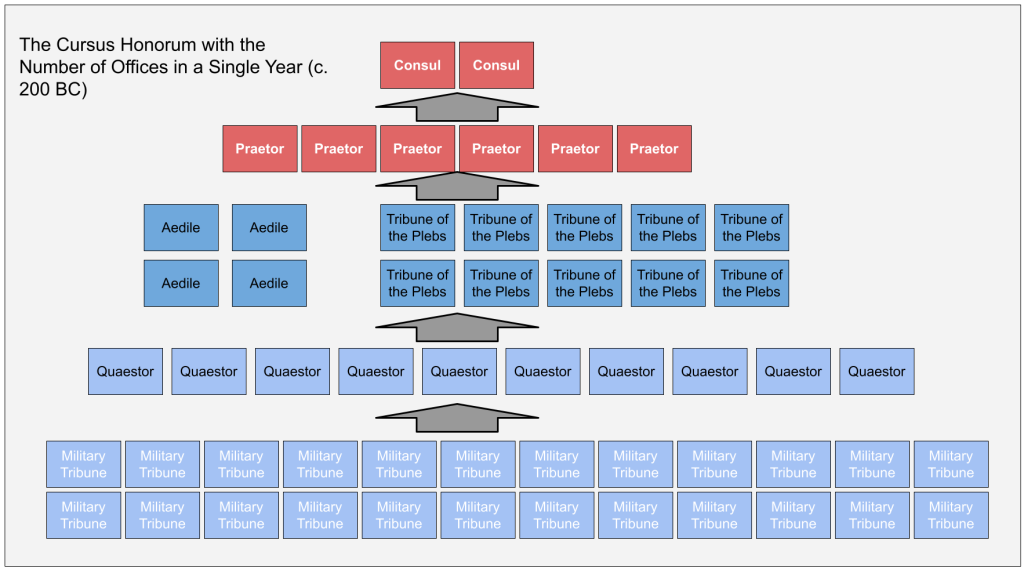
A diagram of the elected offices of the cursus honorum. Note that there were additional appointed military tribunes.
There are a bunch of other minor magistrates that are effectively “pre-cursus” offices too, but we don’t know a lot about them and they don’t seem generally to show up as often in the careers of the sort of Romans making their way up to the consulship, though this may be simply because our sources don’t mention them as much at all and so we simply don’t know who was holding them in basically any year. We’ll talk about them at the end of this set of posts, because they are important (particularly for non-elites).
I should note at the outset: all of these offices are elected annually unless otherwise noted, with a term of service of one year. You never hold the same office twice until you reach the consulship, at which point you can seek re-election, after a respectable delay (which is later codified into law and then ignored), but you may serve as a military tribune several times (this was normal, in fact, as far as we can tell).
The first major office of the cursus was the quaestorship. The number of quaestors elected grows over time. Initially just two, their number is increased to four in 421 (two assigned to Rome, one to each of the consuls) and then to six in the 260s (initially handling the fleet, then later to assist Roman praetors or pro-magistrates in the provinces) and then eight in 227. There may have been two more added to make ten somewhere in the Middle Republic, but recent scholarship has cast doubt on this, so the number may have remained eight until being expanded to twenty under Sulla in 81 BC through the aptly named lex Cornelia de XX quaestoribus (the Cornelian Law on Twenty Quaestors, Sulla being Lucius Cornelius Sulla Felix).2 It’s not clear if there was a legal minimum age for the quaestors and we only know the ages of a few (25, 27, 29 and 30, for the curious) so all we can say is that officeholders tended to hold the office in their twenties, right after finishing their mandatory stint of military service.3 Serving as a quaestor enables entrance into the Senate, though one has to wait for the next census to be added to the Senate rolls by the censors.
After the quaestorship, aspirants for higher office had a few options. One option was the office of aedile; there were after 367 four of these fellows. Two were plebeian aediles and were not open to patricians, while the two more prestigious spots were the “curule” aediles, open to both patricians and plebeians. The other option at this stage for plebeian political hopefuls was to seek election as a tribune of the plebs, of which there were ten annually, we’ll talk about these fellows in a later post because they have wide-ranging, spectacular and quite particular powers.
After this was the praetorship, the first office which came with imperium. Initially there may have just been one praetor; by the 240s there are two (what will become the praetor urbanus and the praetor peregrinus). In 227 the number increases to four, with the two new praetors created to handle administration in Sicily, Sardinia and Corsica. That number then increases to six in 198/7, with the added praetors generally being sent to Spain. Finally Sulla raises the number to eight in 81 BC. The minimum age seems to have been 39 for this office.
Finally comes the consulship, the chief magistrate of the Roman Republic, who also carried imperium but of a superior sort to the praetors. There were always two consuls and their number was never augmented. For our period (pre-Sulla) the consuls led Rome’s primary field armies and were also the movers of major legislation. Achieving the consulship was the goal of every Roman embarking on a political career. This is the only office that gets “repeats”.
Finally there is one office after the cursus honorum and that is the censorship. Two are elected every five years for an 18 month term in which they carry out the census. Election to the censorship generally goes to senior former-consuls and is one way to mark a particularly successful political career. That said, Romans tend to dream about the consulship, not the censorship and if you had a choice between being censor once or holding the consulship two or three times, the latter was more prestigious.
With the offices now laid out, we’ll go through them in rough ascending sequence. Today we’ll look at the military tribunes, the quaestors and the aediles; next week we’ll talk about imperium and the regular offices that carry it (consuls, praetors and pro-magistrates). Then, the week after that, we’ll look at at two offices with odd powers (tribunes of the plebs and censors), along with minor magistrates. Finally, there’s another irregular office, that of dictator, which we have already discussed! So you can go read about it there!
One thing I want to note at the outset is the “elimination contest” structure of the cursus honorum. To take the situation as it stands from 197 to 82, there are dozens and dozens of military tribunes, but just eight quaestors and just six praetors and then just two consuls. At each stage there was thus likely to be increasingly stiff competition to move forward. To achieve an office in the first year of eligibility (in suo anno, “in his own year”) was a major achievement; many aspiring politicians might require multiple attempts to win elections. But of course these are all annual offices, so someone trying again for the second or third time for the consulship is now also competing against multiple years of other failed aspirants plus this new year’s candidates in suo anno. We’ll come back to the implications of this at the end but I wanted to note it at the outset that even given the relatively small(ish) size of Rome’s aristocracy, these offices are fiercely competitive as one gets higher up.
Bret Devereaux, “Collections: How to Roman Republic 101, Part IIIa: Starting Down the Path of Honors”, A Collection of Unmitigated Pedantry, 2023-08-11.
1. See Lintott, op. cit. 104-5, n. 47.
2. These dates and numbers, by the by, follows F.P. Polo and A.D. Fernández, The Quaestorship in the Roman Republic (2019).
3. If you are wondering about how anyone can manage to hold the office before 27, given ten years of military service and 17 being the age when Roman conscription starts, well, we don’t really know either. The best supposition is that some promising young aristocrats seem to have started their military service early, perhaps in the retinues (the cohors amicorum) of their influential relatives. Tiberius Gracchus at 25 is the youngest quaestor we know of, but he’s in the army by at most age 16 with Scipio Aemilianus at Carthage in 146.
May 26, 2024
QotD: Ever-expanding government
Janice Rogers Brown, “Hyphenasia: the Mercy Killing of the American Dream,” Speech at Claremont-McKenna College (Sept. 16, 1999).
May 25, 2024
QotD: “Dirt Theory”
Robert Stacey McCain, “New Form of Racism Has Been Discovered”, The Other McCain, 2024-02-04.


