
Quotulatiousness

November 3, 2010

Monty: The flushing sound you just heard is California’s future

Filed under: Economics, Politics, USA — Tags: , , , , — Nicholas @ 08:57

Monty pronounces the final doom of California:

That sound you just heard was the State of California irretrievably flushing itself down the toilet.

[. . .]

California’s most dire problems right now are related to public-employee obligations (pensions and healthcare). The power of public-employee unions in California have held the State and local governments in thrall for years, and with the election of Jerry Brown as Governor, the people of California have opted to spray kerosene on a blaze that was already threatening to overwhelm them.

[. . .]

Well, the die has been cast, California. You have placed your fate into the hands of a political party and a governmental machine that cares for nothing except what it can squeeze out of you to keep the party-train rolling. There will come a time in the not-too-distant future when you will have cause to bitterly regret what happened last night, and to wonder when the disaster truly became unavoidable. Well, now you know: it happened last night when you elected Jerry Brown as your governor. You chose to kowtow to the labor unions; you chose to believe comforting lies rather than the horrible truth.

You will reap the whirlwind.

Update: A couple of Twitter updates from Iowahawk sum things up nicely.

10:28: Boxer, Brown, no on Prop 19: congrats, California. You have officially gone Full Retard.

11:05: And as if California wasn’t already full of idiots, lunatics, and drug abusers, I’m flying there this afternoon.

November 2, 2010

This is either App-alling or App-ealing, depending on your party affiliation

Filed under: Law, Politics, Technology, USA — Tags: , , , — Nicholas @ 09:30

There’s now an iPhone app for reporting suspicious election activity:

Just in time for Election Day, American Majority Action has created the nation’s first mobile application to help identify, report and track suspected incidents of voter fraud and intimidation. This free, cutting edge system will enable voters to take action to help defend their right to vote. Whether you’re a campaign junkie, or just want a better America, Voter Fraud will help you report violations at the election booth and serve to uphold the democratic process.

H/T to Ace of Spades HQ for the link.

November 1, 2010

QotD: The emergence of the Tea Party movement

There’s something else that’s been making me very happy lately, and frankly I don’t give a chipmunk’s cheeks who knows or what they may think about it. After years, decades, what even seems like centuries of unremittingly putrescent political news, we are suddenly all witnesses to the spectacular emergence of the so-called Tea Party movement.

The Tea Parties are just one of a number of historically pivotal developments (including the Internet, conservative talk radio, and perhaps even on-demand publishing) that became necessary to get over, under, around, and through the Great Wall of the Northeastern Liberal Establishment and its numberless, faceless hordes of duly appointed gatekeepers.

In that sense, the Tea Parties are exactly what the Berkeley Free Speech Movement and the New Left always aspired to be and never really were.

Just like each of those other developments, the Tea Parties are essentially a medium of communications. So far, they are leaderless and centerless (and at all costs, must remain that way). They have no founders, and no headquarters. They have no constitution, no by-laws, and no platform to argue over endlessly. More conventionally-minded politicrats might view all of these qualities as weaknesses, but they would be mistaken. As presently (un)constituted, Tea Parties can’t be taken over by high school student government types or mercenaries from the major political parties, who have nothing better to do with their lives.

I would point out, especially in the light of the recent Bob Barr embarrassment, that this arrangement is inexpressibly better suited to libertarians and to libertarianism than any formal, hierarchical structure copied from the other political parties (and I have been doing exactly that for almost thirty years) but that would be a digression.

L. Neil Smith, “My Tea Party”, Libertarian Enterprise, 2010-10-31

Gallup calls current polling data “unprecedented”

Filed under: Media, Politics, USA — Tags: , , — Nicholas @ 07:23

The US midterm elections are often taken as a poll on the performance of the President, so the Gallup organization is saying what many Republican and Tea Party speakers have been saying for weeks: Barack Obama is dragging down his party:

Gallup models the number of seats a party will control based on that party’s share of the national two-party vote for the House of Representatives, using historical voting data in midterm elections from 1946 to 2006. The model takes into account the majority party in Congress entering the elections.

Gallup’s historical model suggests that a party needs at least a two-point advantage in the national House vote to win a majority of the 435 seats. The Republicans’ current likely voter margin suggests that this scenario is highly probable, making the question of interest this election not whether the GOP will win the majority, but by how much. Taking Gallup’s final survey’s margin of error into account, the historical model predicts that the Republicans could gain anywhere from 60 seats on up, with gains well beyond that possible.

It should be noted, however, that this year’s 15-point gap in favor of the Republican candidates among likely voters is unprecedented in Gallup polling and could result in the largest Republican margin in House voting in several generations. This means that seat projections have moved into uncharted territory, in which past relationships between the national two-party vote and the number of seats won may not be maintained.

The other thing to keep in mind is that polling isn’t quite as definitive as pollsters would like you to believe: voters sometimes conceal their actual voting intentions. The most recent example of this was the Toronto municipal elections, where polls consistently had Rob Ford and George Smitherman in a statistical dead heat, but the actual result was a 12 point lead for Ford.

H/T to Ace for the link.

This will come as a surprise only to drug warriors

Filed under: Britain, Health, Law, Politics — Tags: , , , — Nicholas @ 07:10

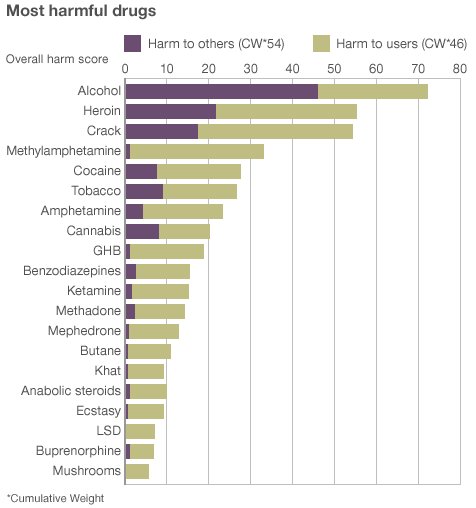
A recent British study totted up the effects both on the individual and costs to society of various legal and illegal drugs:

Alcohol is more harmful than heroin or crack, according to a study published in medical journal the Lancet.

The report is co-authored by Professor David Nutt, the former UK chief drugs adviser who was sacked by the government in October 2009.

It ranks 20 drugs on 16 measures of harm to users and to wider society.

Tobacco and cocaine are judged to be equally harmful, while ecstasy and LSD are among the least damaging.

H/T to DarkWaterMuse, who writes:

An interesting result, no doubt, but one thing the researchers failed to do is to aggregate the harm due to all illicit drugs, or even a handful of drugs frequently abused by the same users. Seems to me this would likely reveal alcohol as relatively benign though it’s not clear how additive the effects are.

October 28, 2010

It’s “like asking an alcoholic to run a distillery”

Filed under: Cancon, Economics, Military, Politics — Tags: , , , — Nicholas @ 13:26

The dissent on the announced purchase of F-35 fighter jets continues to gain traction:

In an interview on CBC’s Power and Politics last night, Industry Minister Tony Clement admitted we are buying the F-35s because the military wants them. “It is the best plane on the market. I will say on your program, I’m not the expert. The military are the experts. Why don’t the Liberals take the word of the Canadian military on that?” he asked.

Let me count the ways. A brief read of the A-G’s report on the purchase of military helicopters suggests a host of reasons why allowing the Department of National Defence to dictate procurement is like asking an alcoholic to run a distillery.

Sheila Fraser’s report concluded that National Defence knew, but did not tell the politicians, that the helicopter it wanted was not an “off-the-shelf “ model, with a relatively low risk of cost and time overruns.

In the event, the total cost for the 15 Chinook heavy lift helicopters more than doubled to $4.9-billion from the $2-billion price tag when the project was presented to the Conservative government and approved. Helicopters that were initially scheduled to be delivered last July, now won’t be ready until June 2013 — a state of affairs Ms. Fraser decried as “totally inappropriate”.

I’m not convinced that the F-35 is the aircraft Canada actually needs, and the DND’s track record on equipment purchases combined with the ultra-spendy pricetag on the F-35 make me concerned that they’re going to put themselves in the same state as the British armed forces by over-committing to kit that they (that is, we) can’t afford.

A significant indicator of social decline

Filed under: Economics, Government, Politics, USA — Tags: , , , , — Nicholas @ 12:04

Monty puts his finger on the biggest social change since the 1960’s and posits the likely results:

The recipe for the decline and fall of the American republic: most people who receive government benefits will not willingly give them up, or even allow them to be reduced. They’ve been told that these benefits are a right so often by the so-called “progressives” that they’ve come to believe it, and any attempt to reduce their benefits amounts, in their eyes, to a civil-rights violation. This is what the welfare state leads to — an entire class of dependents who insist upon receiving the sweat of your brow not as charity or payment for services rendered, but as a birthright not to be denied them. Class warfare (between public-sector workers and taxpayers) and generational warfare (between the recipients of Medicare and Social Security and those who must fund it) is the only possible outcome if things do not change soon. And I don’t mean that in rhetorical or symbolic terms; I mean in actual, bloody, street-fighting terms. It’s the culture of grievance, of victimhood, of moral equivalence playing out in real time. As I wrote in an essay a while back, look at what’s happening in England and France right now. That is our future — only more violent — if we don’t change our ways.

October 27, 2010

The new broom in Toronto

Filed under: Bureaucracy, Cancon, Politics — Tags: , , , — Nicholas @ 12:25

After a particularly hard-fought election campaign, Chris Selley looks at the opening moves Toronto mayor Rob Ford will be making:

It’s kind of funny to see people who’ve spent the past 10 months trashing Rob Ford now insist he needs to extend olive branches to the progressive community. If I were Rob Ford, and I had an olive branch, I might be tempted to extend it rather violently towards my harshest critics. (Then, in accordance with my new and improved image, I’d take two deep breaths and calm down.)

Clearly Mr. Ford is sticking with his gravy train priorities off the top: departmental efficiencies, contracting out services, cutting councillor budgets and staff. At a media scrum on Tuesday afternoon, his message hadn’t changed, that I could discern, from what it was during the campaign. Basically: Trust me. The money’s there to be saved, and it won’t hurt a bit.

Still, Mayor Ford will have a city to keep happy. And while they received very little notice during the campaign, his platform included several populist, pro-democratic and dirt-cheap measures I’d defy anyone to oppose and that could earn him some grudging praise from disaffected Pantaloons and Smithermanians.

The large turnout and the not-quite-majority of votes cast for Ford should at least quiet the claims that he “doesn’t have a mandate” for a little while. If he can actually deliver on some of his campaign promises to reduce spending and eliminate some of the least useful municipal programs/initiatives, he’ll be a vast improvement over the last mayor. Even if he doesn’t — he only has a single vote on council, so it’s not automatic that he’ll be able to implement his agenda — it should be an interesting term in office.

Kathy Shaidle shows why Rob Ford had “hidden” strength in the campaign that the media couldn’t account for:

What is Rob Ford most famous for?

No, not that he looks exactly like everybody’s drunk, abusive stepfather. No, not the “gravy train” line.

Rob Ford is “the guy who returns every call.”

That was always Ford’s claim to fame: that even if you didn’t [live] in his ward, he returned your call. If you were wrapped up in red tape and called Rob Ford, an hour or maybe a day later, the tape got snipped. The Wheeltrans showed up at your elderly mother’s door. That stupid problem you’d been screaming at bureaucrats about got taken care of.

Everyone in Toronto knows a Rob Ford story like that.

October 26, 2010

Did we just witness the start of “Tea Party Ontario”?

Filed under: Cancon, Politics — Tags: , , , , — Nicholas @ 07:53

Steve Paikin looks at the unexpected toppling of incumbent mayors across Ontario yesterday:

Did we just have our own “tea party” Ontario?

All over the province, incumbents were feeling the wrath of the electorate.

In the capital city, Rob Ford cruised to victory, besting George Smitherman by more than 90,000 votes. His margin of victory was bigger than David Miller’s when he “swept” into office with his broom seven years ago.

But it wasn’t only Toronto. Incumbent mayors lost in Hamilton, Ottawa, Burlington, Vaughan, London, Thunder Bay, and Sudbury.

In Mississauga, where Hazel McCallion is accustomed to winning with more than 90% of the vote, she only won re-election with 76%.

[. . .]

A few weeks ago, none of these results was seen as obvious.

[. . .]

The conventional wisdom in local politics is that name recognition counts for so much. The power of incumbency is fantastic.

Not last night. If anything, the opposite was true. If you were in, you had a target on you. And precious few escaped it, including many incumbent city councillors in Toronto.

A stunning night for upsets. A big night for turnout (more than 50% in Toronto…twice the normal turnout rate).

An Ontario Tea Party would be a good idea . . .

Toronto’s elite appalled: the barbarians have stormed City Hall

Filed under: Cancon, Politics — Tags: , , , , — Nicholas @ 07:24

I guess a lot of people were misleading the pollsters, as what looked like a dead heat only a few days before the election turned into a 12 point lead, just missing an actual majority for Rob Ford:

Right-wing juggernaut Rob Ford will take the top job in Canada’s most populous city, defeating former deputy premier George Smitherman in a bitter, 10-month race to become Toronto’s next mayor.

With 99 per cent of Toronto polls reporting Monday night, Ford took 47 per cent of the vote, compared to Smitherman’s 35 per cent and deputy mayor Joe Pantalone’s 12 per cent.

Smitherman was considered an early favourite to win, but couldn’t compete against Ford, a scrappy city councillor who tapped into a potent well of voter fury with his promises to cut taxes and kill big spending at city hall.

“This victory is a clear call from the taxpayers, enough is enough,” Ford told cheering supporters.

“The party with taxpayers’ money is over. We will respect the taxpayers again, and yes ladies and gentlemen we will stop the gravy train once and for all.”

The polarizing Toronto race was marred by ugly incidents, including homophobic ads targeting the openly gay Smitherman, and a newspaper article — later pulled from the Globe and Mail website — that took a shot at Ford’s weight.

His win is likely to send shockwaves all the way to Premier Dalton McGuinty’s office. Many experts have predicted that a Ford victory could herald a Conservative sweep in next fall’s Ontario election.

Ford is perhaps the least likely candidate to win in Toronto for decades, and is most certainly not the kind of mayor most progressives expected to see. He’s not particularly polished or smooth-talking or dignified, and has had a series of mis-steps that the media (and Toronto’s Liberal elite) expected to keep him from being more than a slight bump in the smooth road to Smitherman’s coronation. I expect this election result will be portrayed in the media, at least in the short term, as the suburbs “sticking it” to downtown (even though some polls showed Ford’s support to be nearly as strong in downtown wards as in the benighted suburbs).

Update: Chris Selley thinks that this is a wake-up call for politicians across the province:

One can only imagine the horror in certain quarters. Uncouth, uncultured, suburban, journalist-chasing, drunk driving, marijuana-possessing Air Canada Centre ejectee and lone wolf former city councillor Rob Ford is mayor-elect of Toronto — and not just by a little. Mayor David Miller congratulated him last night and so should everyone else. It sure won’t help not to.

Whatever happens over the next four years, this election sent a hugely important message to Canadian politicians: Ignore voter anger at your peril. If you think voters shouldn’t be angry, make your case early and sincerely. Don’t just blame a senior level of government for your problems.

Cost overruns are typical, but this is excessive

Filed under: Architecture, Cancon, Government, Politics — Tags: , — Nicholas @ 07:12

Canada’s parliament buildings have been sporadically under repair since 1992. The original estimate for all required work was $460 million. It has, of course, gone well past that budget:

The cost of renovating Parliament Hill is expected to hit $5 billion by the time the 25-year project wraps up, CBC reported Monday.

According to documents released by the Department of Public Works, the repairs to almost every building on Parliament Hill, originally pegged to be $460 million in 1992, will have ballooned to more than 10 times that amount upon completion.

Renovations started on the aging buildings in 1992, when builders began renewing Parliament’s West Block. The project was shelved in 1998, then restarted in 2005, with an estimated budget of $769 million. That total has since risen to more than $1 billion, according to CBC.

As Ezra Levant points out, “Burj Dubai, world’s tallest building, only cost $4.1B”.

Update: Ezra also pointed out that the “Bank of China tower in Hong Kong was $1.66B. Taipei 101 was $2B. “.

October 25, 2010

Voting for the right candidates

Filed under: Cancon, Politics — Tags: , , — Nicholas @ 15:37

I just got back from exercising my right to vote for municipal representation. It was a case of trying to find candidates who didn’t copy one another’s homework (and campaign promises).

In municipal elections in Ontario, party affiliations aren’t shown on the ballot, but given the claims I saw in most of the pamphlets and local newspaper articles, almost all of our local candidates are fully paid-up members of the Green party. I don’t know why our school trustees need to be so concerned with things well outside the municipal level of responsibility, but I’d kinda prefer they concentrated on, y’know, the fricking schools in the region, rather than deforestation in the tropics, CO2 emissions, and banning plastic bags.

I ended up not using all my votes, as I couldn’t find candidates for some of the positions who didn’t seem to want to spend all their time stuffing envelopes for Greenpeace rather than running the town and regional governments.

Oh, and a protip for future candidates, especially if you’re late entering the race: not having a website means I can’t look up your positions on anything, and I’m not going to vote for you just on the basis of you having an interesting name.

Amity Schlaes’ (condensed) The Forgotten Man

Filed under: Books, Economics, History, Politics, USA — Tags: , , , , , — Nicholas @ 13:07

An article encapsulating some of the key points of Amity Schlaes’ The Forgotten Man in PDF form:

We all know the traditional narrative of that event: The stock market crash generated an economic Katrina. One in four was unemployed in the first few years. It resulted from a combination of monetary, banking, credit, international, and consumer confidence factors. The terrible thing about it was the duration of a high level of unemployment, which averaged in the mid teens for the entire decade.

The second thing we usually learn is that the Depression was mysterious — a problem that only experts with doctorates could solve. That is why FDR’s floating advisory group — Felix Frankfurter, Frances Perkins, George Warren, Marriner Eccles and Adolf Berle, among others — was sometimes known as a Brain Trust. The mystery had something to do with a shortage of money, we are told, and in the end, only a Brain Trust’s tinkering with the money supply saved us. The corollary to this view is that the government knows more than American business does about economics.

Another common presumption is that cleaning up Wall Street and getting rid of white-collar criminals helped the nation recover. A second is that property rights may still have mattered during the 1930s, but that they mattered less than government-created jobs, shoring up home-owners, and getting the money supply right. A third is that American democracy was threatened by the rise of a potential plutocracy, and that the Wagner Act of 1935 — which lent federal support to labor unions — was thus necessary and proper. Fourth and finally, the traditional view of the 1930s is that action by the government was good, whereas inaction would have been fatal. The economic crisis mandated any kind of action, no matter how far removed it might be from sound monetary policy. Along these lines the humorist Will Rogers wrote in 1933 that if Franklin Roosevelt had “burned down the capital, we would cheer and say, ‘Well at least we got a fire started, anyhow.’”

To put this official version of the 1930s in terms of the Monopoly board: The American economy was failing because there were too many top hats lording it about on the board, trying to establish a plutocracy, and because there was no bank to hand out money. Under FDR, the federal government became the bank and pulled America back to economic health.

When you go to research the 1930s, however, you find a different story. It is of course true that the early part of the Depression — the years upon which most economists have focused — was an economic Katrina. And a number of New
Deal measures provided lasting benefits for the economy. These include the creation of the Securities and Exchange Commission, the push for free trade led by Secretary of State Cordell Hull, and the establishment of the modern mortgage format. But the remaining evidence contradicts the official narrative. Overall, it
can be said, government prevented recovery. Herbert Hoover was too active, not too passive — as the old stereotypes suggest — while Roosevelt and his New Deal policies impeded recovery as well, especially during the latter half of the decade.

H/T to Monty for the link.

October 23, 2010

“How Many Australian Politicians Does it Take to Change a Lightbulb?”

Filed under: Australia, Bureaucracy, Politics — Tags: , , , — Nicholas @ 12:13

None:

The (tangential) Free-Range issue here is this: Why are we increasingly subject to rules and regs that have nothing to do with REAL safety and everything to do with litigation, worst-case-scenario-fantasizing and good ol’ CYA? It’s a time, money and morale-waster, with the added benefit of turning competent people into incompetent cowards. Just like so many rules and regs are implementing with kids: No, children, you CANNOT ride your bikes to school. No, children, you CANNOT do your own chemistry experiments. No, children, you CANNOT babysit/whittle/get a paper route/smile at a stranger. It is all TOO DANGEROUS.

And someday we will wonder why no one in the world (except, perhaps, electricians) can do anything.

H/T to Walter Olson.

October 21, 2010

I still think they should call it the “milliVolt”

The much-less-than-promised Chevy Volt goes on sale next month. If it had been a private company delivering so few of their promises, lawsuits or regulatory sanctions would be forthcoming. Because it’s a product of Government Motors, we’re being told that the “Electric Edsel” is not fraud, it’s fantastic:

Government Motors’ all-electric car isn’t all-electric and doesn’t get near the touted hundreds of miles per gallon. Like “shovel-ready” jobs, maybe there’s no such thing as “plug-ready” cars either.

The Chevy Volt, hailed by the Obama administration as the electric savior of the auto industry and the planet, makes its debut in showrooms next month, but it’s already being rolled out for test drives by journalists. It appears we’re all being taken for a ride.

[. . .]

So it’s not an all-electric car, but rather a pricey $41,000 hybrid that requires a taxpayer-funded $7,500 subsidy to get car shoppers to look at it. But gee, even despite the false advertising about the powertrain, isn’t a car that gets 230 miles per gallon of gas worth it?

We heard GM’s then-CEO Fritz Henderson claim the Volt would get 230 miles per gallon in city conditions. Popular Mechanics found the Volt to get about 37.5 mpg in city driving, and Motor Trend reports: “Without any plugging in, (a weeklong trip to Grandma’s house) should return fuel economy in the high 30s to low 40s.”

Car and Driver reported that “getting on the nearest highway and commuting with the 80-mph flow of traffic — basically the worst-case scenario — yielded 26 miles; a fairly spirited backroad loop netted 31; and a carefully modulated cruise below 60 mph pushed the figure into the upper 30s.”

As I said in an earlier post:

I’m very much in favour of an economical electric car: the Volt doesn’t meet that definition. It’s been rushed to market for political, not for economic reasons. It’ll be kept in the market regardless of sales figures for the same reason: it allows Barack Obama and senate leaders to point at the Volt as tangible proof that they care about the environment and reducing American dependence on foreign oil.

« Newer PostsOlder Posts »

Powered by WordPress

