
January 30, 2012
January 28, 2012
Photoshopping images is so passé: using game footage is the new trend
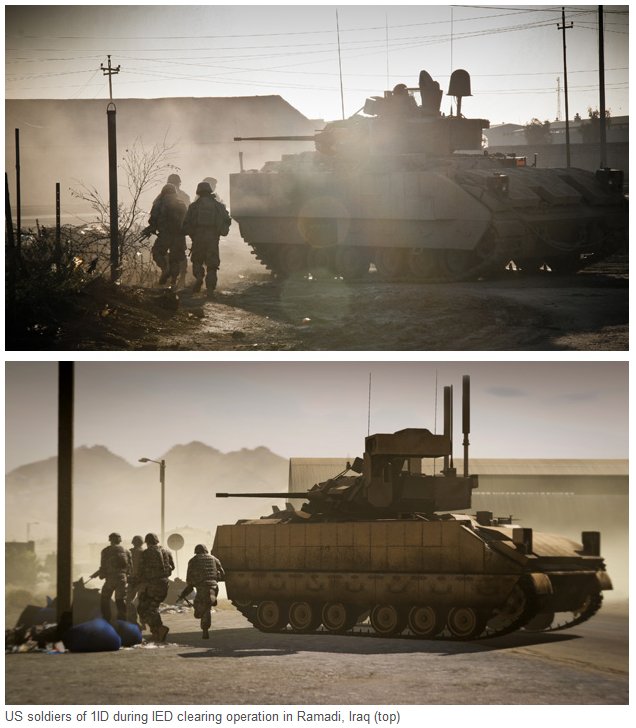
At the BBC website, Phil Coomes shows some side-by-side images of real events and modern FPS game images. The recent flap over clips from the game Arma 2 being cited as genuine film captured from the IRA is only the first of many incidents we should expect to encounter, as games get better (and advocates remain as dedicated to advancing their causes as ever):
Today we are used to seeing real time reports from across the globe, technology has advanced and anyone with an internet connection can travel to far-off places, even imaginary worlds, from their armchair.
The world of video games has progressed too. Some seem real, as highlighted by a recent Ofcom ruling that ITV misled viewers by airing footage claimed to have been shot by the IRA, which was actually material taken from a video game.
Labelled “IRA Film 1988”, it was described as film shot by the IRA of its members attempting to down a British Army helicopter in June 1988. However, the pictures were actually taken from a game called Arma 2.
[. . .]
So I went through my photos taken from various combat zones, and attempted to replicate them in a computer game.
The game Arma 2 was ideal — it’s more of a war simulation than an all-out blaster, with the correct uniforms, vehicles and weapons as well as varied terrains and bang-bang firefights.
Plenty of hours fiddling within the gaming environment, alongside Ivan who developed the game, produced some pretty remarkable results.
In some cases it is actually quite hard to tell the difference between my photographs and the computer version, which is deeply worrying. The level of detail is so precise that the virtual war zone is as convincing as the real thing.

January 27, 2012
January 26, 2012
What is really meant by the term “market failure”
Posting on the Institute of Economic Affairs blog, Tom Papworth tries to clarify what the term “market failure” actually means, in comparison to how it’s commonly used by politicians and journalists:
Firstly, it seems to blur the distinction between ‘the market’ and ‘the markets’ — a very common error in current discourse. The market is an economic concept that describes the myriad of choices and exchanges that take place between people every day; the markets are the very real institutions created for handling major financial transactions. It is not clear to me that this article acknowledges that distinction. This manifests itself primarily in the title and main theme: indeed, as Jan (and at least one commentator) does tacitly acknowledge, the financial markets are so shaped by government intervention that it would be a surprise if they did correspond to a model market.
And that brings me to the second problem: the suggestion that markets don’t fail when they ‘respond rationally, quickly and often brutally to conditions as they find them’. While that description is true, it has little bearing on the concept of market failure. Market failure typically refers to situations where the effects one would expect to see in a theoretical market economy do not in fact manifest themselves in real life. As the great man himself would be — and perhaps was — the first to point out (though without using these terms) markets fail because of factors such as monopoly and externality — monopolies undermine competition and so markets do not clear; externalities enable costs to be passed onto third parties and prevent all beneficiaries contributing to the production of goods. Information asymmetry is often presented as another source of market failure.
Now, to be fair to Jan, that precision of language is hardly prevalent among the politicians he is criticising. When they speak of market failure, it seems almost as though market success is defined by a number of uneconomic measures such as social justice, or even (that ultimate weasel-word) fairness.
The fate of London’s diesel locomotive plant
In the Toronto Star, Martin Regg Cohn (who claims he “is not an anti-globalization crusader”) does his level best to put forward a case for massive government intervention in a labour dispute between Caterpillar and the Canadian Auto Workers:
At the old locomotive plant now owned by U.S.-based multinational Caterpillar Inc., the Canadian Auto Workers union is not even on strike. The CAW has been locked out since New Year’s Day because it refused to sign its own death warrant by agreeing to slash wages in half for most workers from $34 an hour to $16.50.
When a powerful multinational negotiates in bad faith, it becomes a story that governments in Queen’s Park and Ottawa can no longer wash their hands of. To put it in language that resonates with Premier Dalton McGuinty: When a bully tries to humiliate people, you can’t just watch in silence.
When high-paying skilled local jobs can be shredded at the whim of a combative multinational giant, it dramatically undermines all the upbeat rhetoric we hear from McGuinty and Prime Minister Stephen Harper about Canada’s global appeal. It sends a signal that Ontario is not so much open for business as it is closed for unions.
We jump directly from Caterpillar’s demand for wage reductions to an assertion that the company is negotiating in bad faith (I guess, from the union’s point of view, anything other than a wage increase is proof). No indication whether the company’s demand is economically justifed — if sales of the plant’s railway locomotives are as bad as the wage offer implies, then the next step will be closing the plant — just straight over to bad-mouthing the company.
And, of course, it’s merely objective reporting to use pejorative descriptors when discussing the eeeeevil multinational firm. Not content merely to malign the company, he then calls on the Premier to support the union to the hilt:
So what can our anti-bullying premier do?
If I were McGuinty, I would ask myself a simple question: What would Bill Davis do?
The former Tory premier of Ontario wasn’t perfect, but he was always plugged in. He took labour seriously, listened closely to business and wooed foreign investors (remember Renault?). He knew how to leverage the power of the premier’s office to stand up for Ontario’s greater interests.
A phone call to Caterpillar’s corporate braintrust would show that Ontario’s premier is no pushover. If that didn’t work, a phone call to Harper — who is still trying to live down the tax breaks he gave the locomotive factory’s former owners a few years ago — might find a receptive ear.
And finally we get to a good point: the foolishness of governments in giving special tax breaks to certain industries or companies. If it’s in the company’s best interests to locate in your jurisdiction, they’ll probably do it. If you have to bribe them with tax breaks, low-interest or interest-free loans, or other special incentives, then once the incentive runs its course, the company has no further requirement to stay in your location.
Update: In the National Post, Kelly McParland has some suggestions for union leaders:
1. A lot of people (the membership figures suggest it’s the vast majority) think unions are concerned solely with their own members and couldn’t give a bird’s turd for anyone or anything else, including other working stiffs, members of other unions, the fortunes of the company they work for or the customers they deal with. When you display a total lack of interest in others, they generally adopt the same attitude towards you.
[. . .]
4. Union politics might consider moving out of the stone age. The world evolves over time, but unions persist in peddling the same trite bromides as if it’s still the dawn of the industrial revolution. The “us against them” mentality; the pretense that all employers exist to exploit workers and can never be trusted; the assumption that every contract must be succeeded by an even richer one no matter the health of the industry, the economy or the company; the fealty to leftwing political parties — all are symptoms of an exhausted, outdated perspective that has barely changed since “modern technology” meant the telephone.
If unions really want to save themselves, they might take a lesson from the market economy. If no one buys what you’re selling, it’s not because they buyers aren’t bright enough. It’s because people see no value in your product.
Update, 3 February: The plant is being closed. Here’s the official announcement:
Progress Rail Services has announced that it will close Electro-Motive Canada’s (EMC) locomotive production operations in London, Ontario.
Assembly of locomotives will be shifted from the London facility to the company’s other assembly plants in North and South America, which will ensure that delivery schedules are not impacted by the closing of the London facility.
All facilities within EMC, EMD and Progress Rail Services must achieve competitive costs, quality and operating flexibility to compete and win in the global marketplace, and expectations at the London plant were no different.
The collective agreement and cost structure of the London operation did not position EMC to be flexible and cost competitive in the global marketplace, placing the plant at a competitive disadvantage. While the company’s final offer addressed those competitive disadvantages, the gulf between the company and the union was too wide to resolve and as such, market conditions dictate that the company take this step.
January 25, 2012
January 24, 2012
Robert Fulford: Nietzsche’s inescapable shadow
Writing in the National Post, Robert Fulford traces all the ways we still live with a long-dead madman:
Friedrich Nietzsche is one of those philosophers you just can’t kill.
He’s been in his grave since 1900, having been silenced by insanity many years before. In 1898, The New York Times ran an article headed, “Interesting Revolutionary Theories from a Writer Now in the Madhouse.” He’s read, as he was then, only by a small minority, many of whom it would be flattering to call eccentric.
Nevertheless, he runs through our social bloodstream. Francis Fukuyama’s remark has the sound of truth: Whether we like it or not, “We continue to live within the intellectual shadow cast by Nietzsche.”
[. . .]
We don’t know it but Nietzsche scripted many of our conversations, putting words in our mouths. When we talk about culture (the culture of this, the culture of that) we echo him. Anyone who discusses “values” (instead of, say, ethics) is talking Nietzsche-talk.
People who claim to be in a state of “becoming” are Nietzscheans, knowingly or otherwise. He believed (now everyone believes) that we are all constantly reconstructing ourselves. In Nietzsche there’s no such thing as a permanently stable personality.
He was the original culture warrior. He laid the foundation for the struggle between traditionalism and modernism, an enduring battle. The more important a tradition, the more he wanted to see it challenged.
Scottish Americans: nostalgia compounded of Braveheart, whisky tours, and castles
The BBC looks at the views of Scotland held by Scottish Americans:
It’s the time of year when Americans everywhere get in touch with their Scottish roots, however tangled and distant they might be, as they celebrate Burns Night.
The concept of Scottish identity has recently been invigorated as plans for a referendum on independence take shape in Holyrood. So what do Americans with Caledonian ancestry make of the debate?
[. . .]
Their vision of Scotland is mostly taken from movies like Braveheart, Mel Gibson’s 1995 tale of Scottish rebel William Wallace, who leads an uprising against an English tyrant, says Mr Forbes.
Few have any idea what modern Scotland is like, he adds, and if they do it will have been picked up from dark and twisted tales like Trainspotting or Shallow Grave.
“There are elements of truth in what people believe the whole of Scotland to be but it is not the whole truth. If you look at the marketing of Scotland, you see these broad mountainous vistas, these sparkling lakes, these old castles.
“They don’t talk about the Silicon Glen, they don’t talk about the industry around the northern oil fields.”
[. . .]
Members of a Gaelic speaking society are, apparently, still smarting after their inquiries about promoting the language in Scotland were batted away by Scottish government officials, who told them that more people speak Farsi than Gaelic in modern Scotland.
John King Bellassai, former president of the DC St Andrews Society, says Scottish Americans tend to let romance cloud their judgement when it comes to an independent Scotland
January 22, 2012
“We don’t do kings”
Colby Cosh suggests that the long aversion to monarchy on the part of US policymakers may be hindering their long-term plans around the world:
Monarchies in the Middle East and North Africa have been stable relative to their republican neighbours; the replacement of a monarchy with a republic rarely if ever makes the people better off; and the monarchies in the region tend to be more liberal economically, even if they don’t have particularly liberal political structures.
In the ci-devant monarchies of the Arab and Persian world, nostalgia for overthrown Western-friendly regimes of the past seems fairly common. When the Libyans got rid of Gadhafi last year, for instance, they promptly restored the old flag of the Kingdom of Libya (1951-69), and some of the anti-Gadhafi protesters carried portraits of the deposed late king, Idris. From the vantage point of Canada, constitutional monarchy looks like a pretty good solution to the inherent problems of governing ethnically divided or clan-dominated places. And in most of the chaotic MENA countries, including Libya, there exist legitimist claimants who could be used to bring about constitutional restorations.
The most natural locale for such an experiment would have been Afghanistan, where republican governments have made repeated use of the old monarchical institution of the loya jirga or grand council.
January 21, 2012
A surprising admission in Conrad Black’s survey of the Muslim world
The surprise? The unexpectedly nice words for, of all people, former prime minister Jean Chrétien:
All this toing and froing begs the question of why the West has expended such time and resources in Afghanistan, where Pakistan is the chief backer of the main killer of NATO forces (the Haqqani faction), and the chief supplier of ammonium nitrate, the principal ingredient in anti-personnel bombs used against Western forces.
We all started into Afghanistan in 2001 in solidarity with the Americans after the terrorist attacks on New York and Washington. The Americans largely decamped to Iraq after a year, became mired in the quicksand of nation-building, and then in the even deeper and more hopeless morass of trying to make something out of the gigantic, murderous cesspool of Pakistan. It is time this country recognized its debt to Jean Chrétien for taking a pass on the Iraq debacle — and I was one who disagreed with him at the time (though I then had no idea the U.S. would try to take over the governance of the country and try to turn it into Oklahoma).
Although he may have been right in hindsight, he was right for the wrong reason. Prime minister Chrétien “volunteered” Canadian military support in Afghanistan to ensure that we could not be expected to help in Iraq (because in the parlous state of the Canadian Forces, it was impossible for us to support more than one overseas campaign). The Canadian troops did magnificent work in Afghanistan, and certainly raised Canada’s stock with our allies, but we were there — politically — to avoid being in Iraq.
January 20, 2012
Renewable energy: the ethanol scam writ even larger
Patrick J. Michaels looks at what he calls the “Great Renewable Energy Scam” and shows what happened with the ethanol fuel program which preceded the current programs:
… here in the U.S. there are some 30 different statewide “renewable portfolio standards” (RPSs) that also mandate pricey power, usually under the guise of fighting dreaded global warming.
RPSs command that a certain percentage of electricity has to come from wind, solar, geothermal, or biomass. Given that this power generally costs a lot more than what comes from a modern coal or gas plant, your local utility passes the cost on in the form of higher bills, which the various state utility commissions are only too happy to approve in the name of saving the planet.
[. . .]
One needs to look no further than ethanol as a motor fuel, mandated by the feds. Sold as “renewable” and reducing pernicious carbon dioxide emissions, it actually produces more in its life cycle than simply burning an equivalent amount of gasoline. It also — unconscionably — consumes 40% of U.S. corn production, and we are the by far the world’s largest producer of this important basic food.
The popular revulsion against ethanol has succeeded in cutting its massive federal subsidy, of $0.54 per gallon, which ran out on Dec. 31. But that doesn’t stop the federal mandate. Last year it was for roughly 14 billion gallons from corn and it will be nearly 15 billion in 2012. By 2022, up to 20 billion gallons will be required — all from corn — unless there is a breakthrough in so-called “cellulosic” ethanol, which, no matter how much money the government throws at it, hasn’t happened. Indeed, the largest cellulosic plant, Range Fuels, in Camilla, Ga., just went bankrupt. The loss to American taxpayers appears to be about $120 million, or about 25% of a Solyndra.
[. . .]
Having seen the ethanol debacle, will the states put solar and wind in their rightful (small) niches by repealing the RPSs? Increasing utility bills with renewable mandates is politically dangerous, and there is less and less political will to subsidize and otherwise prop up energy sources and technologies that cost too much.
January 19, 2012
In spite of the large number of petitioners, recalling Wisconsin’s governor may not be a done deal
Christian Schneider in City Journal on the efforts underway in Wisconsin to recall Governor Scott Walker:
One morning last February, Wisconsin governor Scott Walker called his staff into his office. “Guys,” he warned, “it’s going to be a tough week.” Walker had recently sent a letter to state employees proposing steps — ranging from restricting collective bargaining to requiring workers to start contributing to their own pension accounts — to eliminate the state’s $3.6 billion deficit. That day in February was when Walker would announce his plan publicly.
It turned out to be a tough year. The state immediately erupted into a national spectacle, with tens of thousands of citizens, led by Wisconsin’s public-employee unions, seizing control of the capitol for weeks to protest the reforms. By early March, the crowds grew as big as 100,000, police estimated. Protesters set up encampments in the statehouse, openly drinking and engaging in drug use beneath the marble dome. Democratic state senators fled Wisconsin to prevent a vote on Walker’s plan. Eventually, the Senate did manage to pass the reforms, which survived a legal challenge and became law in July.
The unions aren’t done yet: they’re now trying to recall Walker from office. To do so, they will try to convince Wisconsin voters that Walker’s reforms have rendered the state ungovernable. But the evidence, so far, contradicts that claim—and Wisconsinites seem to realize it.
The fight between the Governor and the public unions matters more than it may seem: Wisconsin was the first state to allow civil service workers to unionize and has traditionally been seen as a strong union (and therefore also Democratic) state ever since. If unions can have some of their power trimmed back there, it will hearten the efforts of other state governments to follow suit.


