
The thing that strikes me more and more — and it strikes a lot of other people, too — is the extraordinary viciousness and dishonesty of political controversy in our time. I don’t mean merely that controversies are acrimonious. They ought to be that when they are on serious subjects. I mean that almost nobody seems to feel that an opponent deserves a fair hearing or that the objective truth matters as long as you can score a neat debating point.
George Orwell, “As I Please”, Tribune, 1944-12-08.
June 24, 2019
QotD: Political dishonesty
Comments Off on QotD: Political dishonesty
June 23, 2019
They managed to get 7% approval? That’s surprising
Michael van der Galien reports on a recent poll of registered voters in the United States that will not be happy reading for many social media companies:

Only seven percent are happy with social media companies being able to harvest and sell data without permission or compensation.
Chart from Hill.TV – https://thehill.com/hilltv/what-americas-thinking/449576-poll-voters-overwhelmingly-want-more-regulations-on-personal
Thirty-six percent of those polled say there is no scenario imaginable to them in which it’s OK for companies to collect and sell such information. Read that again: one-third of those asked always oppose companies like Facebook, Twitter, Amazon, and Google collecting and selling such data. Another 36% said they can support the collection and selling of personal data if the individuals involved are compensated for it.
Only 21% say they believe companies should be able to collect and sell personal information of users if they’ve expressly asked for permission. As for selling and collecting it without permission:
Eight percent of Republicans and also Democratic respondents said that firms should be allowed to sell information without permission. Seven percent of independents agreed.
In other words, this is a bipartisan issue, which makes perfect sense. After all, this issue affects all of us, whether we are conservative or liberal.
Matthew Sheffield has more for Hill.TV:
On Monday, the Washington Post reported that the Federal Trade Commission has been investigating Google’s YouTube division for tracking child users, a practice allegedly in violation of a 1998 law which forbids tracking and targeting children under 13 years of age.
The poll found broad bipartisan agreement on what companies should be allowed to do with consumer data. Eight percent of Republicans and also Democratic respondents said that firms should be allowed to sell information without permission. Seven percent of independents agreed.
About the same number of Democrats and Republicans said that companies should not be able to sell data under any circumstance. Thirty-three percent of GOP respondents took this position, as did 35 percent of Democrats. Forty percent of independents agreed.
Younger voters were more willing to allow companies to sell consumer data than older ones although it was still a minority position. Fourteen percent of respondents who were between 18 and 34 said they supported letting companies compile and sell personal data without permission while only 2 percent of those 65 and above agreed.
Comments Off on They managed to get 7% approval? That’s surprising
June 22, 2019
Cuban socialism still gets good press from western progressives
Unlike most other socialist states that have fallen out of the good graces of western progressives, Cuba is still frequently treated as a kind of “true socialist state” by those who want western culture to move further in a socialist direction. Why has Cuba maintained its lustre? Kristian Niemietz discusses Cuba’s progressive halo for the IEA:

A billboard in Havana, showing Camilo Cienfuegos, Ernesto “Che” Guevara, and Fidel Castro, 4 November 2014.
Photo by Tumpatumcla~commonswiki via Wikimedia Commons.
Last week, Shadow Chancellor John McDonnell gave a speech at the Rail and Maritime Transport (RMT) Union’s “Garden Party for Cuba” event, attended, among other luminaries, by the Cuban ambassador. McDonnell made the following pledge:
“We’re here in solidarity with the Cuban revolution […] I want to say this to our Cuban comrades. When […] a Labour government is elected, not if, we will be your staunchest allies to support the Cuban revolution. And that means the support, the political support of course, but it means also the support, financial and on trade […] We stand with you comrades.”
This was greeted with chants of “Viva Cuba” and “Viva socialismo“. Just two weeks earlier, when asked about the poor track record of socialism in Cuba, Venezuela and the former Soviet Union, McDonnell had declared that “it was never socialism”.
So which one is it? Is Cuba socialist now, or not? Did it suddenly become socialist in the last two weeks, after 60 years of faux-socialism? Is it an on-and-off kind of socialism, which alternates between the real thing, and the fake version? Is it a Schrödinger’s socialism?
Comments Off on Cuban socialism still gets good press from western progressives
June 21, 2019
The PPC’s 2019 election platform on freedom of expression
Maxime Bernier’s People’s Party of Canada is posting the individual issues from their 2019 election platform online, and today’s addition was their position on freedom of expression:

The rights of Canadians to freely hold and express beliefs are being eroded at an alarming speed under the Trudeau government. Some of its recent decisions even require that Canadians renounce their most deeply held moral convictions and express opinions they disagree with.
[…]
Our Plan
What some people find politically incorrect, offensive or even hateful cannot serve as the legal basis for discrimination and censorship. Canadians should be able to enjoy maximum freedom of conscience and expression as guaranteed in Section 2 of the Charter.
A People’s Party Government will:
- Restrict the definition of hate speech in the Criminal Code to expression which explicitly advocates the use of force against identifiable groups or persons based on protected criteria such as religion, race, ethnicity, sex, or sexual orientation.
- Repeal any existing legislation or regulation curtailing free speech on the internet and prevent the reinstatement of section 13 of the Canadian Human Rights Act.
- Repeal C-16 and M-103.
- Ensure that Canadians can exercise their freedom of conscience to its fullest extent as it is intended under the Charter and are not discriminated against because of their moral convictions.
- Withhold federal funding from any post-secondary institution shown to be violating the freedom of expression of its students or faculty.
You can read the full policy statement here, or the whole platform here.
Comments Off on The PPC’s 2019 election platform on freedom of expression
June 20, 2019
The Centre for International Governance Innovation and the Transatlantic Commission on Elections Integrity for the Alliance of Democracies Federation
Did you read that headline? I certainly didn’t. And I wrote copy’n’pasted it. Have you ever heard of either of those organizational entities? I hadn’t until I read Colby Cosh’s article.
A wire story by The Canadian Press’s Joan Bryden arrives over the transom. Let me quote briefly from Bryden’s copy, as an exercise in describing how news sausage is sometimes ground. “An international report says Canada has taken ‘commendable’ steps to safeguard this fall’s federal election from foreign interference. But the report says this country needs to do more to regulate social media giants and should impose ‘major sanctions’ on those that fail to control fake news and other forms of disinformation on their platforms.”
An international report says Canada is vulnerable to fake news! Food for thought. But as I was mulling over this dread warning about sensationalistic information from questionable sources, a skeptical question came to mind: what is “an international report” exactly?
Bryden goes on to tell us, sort of: “The report,” she writes, “is part of a series of assessments conducted by the Centre for International Governance Innovation and the Transatlantic Commission on Elections Integrity for the Alliance of Democracies Federation.” Show of hands: how many of you found it possible to read that sentence without falling asleep? Don’t worry, you weren’t meant to read it — just to absorb its general miasma of seriousness.
Ottawans will know the Centre for International Governance Innovation: it is, essentially, a big pile of Jim Balsillie’s money, and ours. There is a CIGI Campus in Waterloo, Ont., built by Balsillie with matching funds from the provincial and federal governments, that contains the CIGI think-tank and collects rent from the U of W and Wilfrid Laurier U. The Transatlantic Commission on Election Integrity is another think-tank, an international one established amidst post-Trump panic by a range of institutions that includes Microsoft, BMW and other global companies and nonprofits.
Bill Gates didn’t write the “international report.” The report says it was “submitted to TCEI by Allan Rock, TCEI member.” Mr. Rock was, you may recall, a key figure in Jean Chrétien’s cabinet and then president of the University of Ottawa. He “submitted” the report … but did he write it? What the text says is that research and writing done by two University of Ottawa law students “were essential to the preparation of this report … Allan Rock expresses his sincere appreciation for their excellent work.”
So, yeah: it’s a jeremiad against fake news that is pretty much just a long op-ed written on contract by two underpaid young Canadians. After a few impressive-sounding (and foreign-funded) brand names are tacked on, this ends up in your newspaper as a distinguished “international report” justifying draconian regulation of social media.
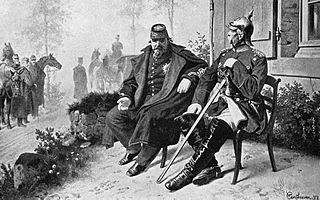
Otto von Bismarck talks with the captive Napoleon III after the Battle of Sedan in 1870.
The “news sausage” comment is a reference to a quote frequently (but apparently mistakenly) attributed to German Chancellor Otto von Bismarck, that laws and sausages are things you should never watch being made.
Comments Off on The Centre for International Governance Innovation and the Transatlantic Commission on Elections Integrity for the Alliance of Democracies Federation
QotD: Elizabeth Warren
Camille Paglia, “Prominent Democratic Feminist Camille Paglia Says Hillary Clinton ‘Exploits Feminism'”, Washington Free Beacon, 2017-05-15.
Comments Off on QotD: Elizabeth Warren
June 19, 2019
QotD: Working class “materialism”
When one thinks of all the people who support or have supported Fascism, one stands amazed at their diversity. What a crew! Think of a programme which at any rate for a while could bring Hitler, Petain, Montagu Norman, Pavelitch, William Randolph Hearst, Streicher, Buchman, Ezra Pound, Juan March, Cocteau, Thyssen, Father Coughlin, the Mufti of Jerusalem, Arnold Lunn, Antonescu, Spengler, Beverley Nichols, Lady Houston, and Marinetti all into the same boat! But the clue is really very simple. They are all people with something to lose, or people who long for a hierarchical society and dread the prospect of a world of free and equal human beings.
Orwell’s press card portrait, 1943
Behind all the ballyhoo that is talked about “godless” Russia and the “materialism” of the working class lies the simple intention of those with money or privileges to cling to them. Ditto, though it contains a partial truth, with all the talk about the worthlessness of social reconstruction not accompanied by a “change of heart”. The pious ones, from the Pope to the yogis of California, are great on the “change of heart”, much more reassuring from their point of view than a change in the economic system. Petain attributes the fall of France to the common people’s “love of pleasure”. One sees this in its right perspective if one stops to wonder how much pleasure the ordinary French peasant’s or working-man’s life would contain compared with Petain’s own.
The damned impertinence of these politicians, priests, literary men, and what-not who lecture the working-class socialist for his “materialism”! All that the working man demands is what these others would consider the indispensable minimum without which human life cannot be lived at all. Enough to eat, freedom from the haunting terror of unemployment, the knowledge that your children will get a fair chance, a bath once a day, clean linen reasonably often, a roof that doesn’t leak, and short enough working hours to leave you with a little energy when the day is done. Not one of those who preach against “materialism” would consider life livable without these things. And how easily that minimum could be attained if we chose to set our minds to it for only twenty years! To raise the standard of living of the whole world to that of Britain would not be a greater undertaking than the war we have just fought. I don’t claim, and I don’t know who does, that that wouldn’t solve anything in itself. It is merely that privation and brute labour have to be abolished before the real problems of humanity can be tackled.
The major problem of our time is the decay of the belief in personal immortality, and it cannot be dealt with while the average human being is either drudging like an ox or shivering in fear of the secret police. How right the working classes are in their “materialism”! How right they are to realize that the belly comes before the soul, not in the scale of values but in point of time! Understand that, and the long horror that we are enduring becomes at least intelligible. All the considerations are likely to make one falter — the siren voices of a Petain or of a Gandhi, the inescapable fact that in order to fight one has to degrade oneself, the equivocal moral position of Britain, with its democratic phrases and its coolie empire, the sinister development of Soviet Russia, the squalid farce of left-wing politics — all this fades away and one sees only the struggle of the gradually awakening common people against the lords of property and their hired liars and bumsuckers.
The question is very simple. Shall people […] be allowed to live the decent, fully human life which is now technically achievable, or shan’t they? Shall the common man be pushed back into the mud, or shall he not? I myself believe, perhaps on insufficient grounds, that the common man will win his fight sooner or later, but I want it to be sooner and not later — some time within the next hundred years, say, and not some time within the next ten thousand years. That was the real issue of the Spanish war, and of the last war, and perhaps of other wars yet to come.
George Orwell, “Looking back on the Spanish War”, New Road, 1943 (republished in England, Your England and Other Essays, 1953).
Comments Off on QotD: Working class “materialism”
June 18, 2019
Hong Kong protests
Colby Cosh tests Betteridge’s Law by asking if the protests in Hong Kong are the birth pangs of a new nation (commonsense and a slight knowledge of Chinese history militate against answering “yes”):

2019 Hong Kong anti-extradition law protest on 16 June, captured by Studio Incendo from Flickr.
Photo via Wikimedia Commons
For the past week, Hong Kong has been taking another step toward figuring out exactly what it is. In an unprecedented display of resistance to Chinese power, literally innumerable hordes have been taking to the streets of HK, protesting the Communist Party-anointed chief executive and her effort to introduce a law allowing for the extradition of citizens to the mainland.
To anyone who follows Hong Kong affairs, these protests seem different qualitatively from those of the past. Earlier, related demonstrations like the Umbrella Movement of 2014 could be dismissed as economic unrest acted out by the young and irresponsible — by people who had not yet entered into, or who feared being excluded from, the strange social bargain between mainland power and HK’s wealth. 2019’s mass action is new: now everyone is marching. The revolt against the extradition bill is led by students, but persons of all ages — in some cases, multiple generations of the same family — are taking to the streets. Business owners are displaying sympathy with the marchers by means of small gestures. Commuters, who would normally be as annoyed with chaos and delay as any Torontonian trying to manoeuvre around a human rights demo, are signalling solidarity. The Hong Kong legal profession, aware that unrestricted extradition would annihilate their distinct system and the freedoms China promised to preserve, staged its own silent protest march. Hongkongers abroad are joining in symbolically.
Is this the birth of a nation? Those who wanted to push Hong Kong in the direction of formal independence have always been politely outnumbered. But the challenging, explosive assertion that “Hong Kong is not China” has become a routine feature of Hong Kong life.
Hong Kong was relinquished to China in 1997 after Britain secured paper guarantees that its independent judiciary and Commonwealth-style legal procedures would survive at least until 2047. When the handover was executed, the number 2047 meant — to the British trying to extract themselves from their last imperial briar patch — “far enough in the future for mainland China to have liberalized a bit.” The advent of Xi Jinping has since shown that progress, alas, does not proceed in a predictable linear way.
Comments Off on Hong Kong protests
June 17, 2019
“We’ve reached peak identitarian bollocks”
Brendan O’Neill follows up on the disturbing story of two lesbians who were physically assaulted on a London bus:

Talk about ungrateful. Brits, and people around the world, offered empathy and solidarity to the two gay women who were battered by thugs on a London bus. And yet now one of the women has turned around and told us we only care about them because they are white. It’s only because they are “two attractive, white, cisgender women” that so many people and organisations gave a damn about them and tweeted about them, apparently. Thanks a bunch. We offer our human concern for your wellbeing and you tell us we’re being racist. We’ve reached peak identitarian bollocks.
The woman in question, who goes only by the name “Chris”, has written a piece for the Guardian. Natch. The intro lets us know what we’re in for: “The photo of me and my date went viral – but only as we’re white, feminine and cisgender.” Translation: you racist, transphobic idiots wouldn’t have cared half as much if this had been two bloodied and bruised black women or trans women. The “commodification” of “my face” came at the “expense of other victims whose constant persecution apparently does not warrant similar moral outrage”, says Chris.
What is most striking about her piece is that she flagellates herself for her privilege. Yes, this woman who last month was badly beaten allegedly on account of her sexuality is now beating herself up in the national press over her privileged identity. She says she has “evaded much of the violence and oppression imposed on so many others by our capitalist, white-supremacist, patriarchal system because of the privileges I enjoy by dint of my race, health, education, and conventional gender presentation”. What a strange, self-hating mindset it must take to be victimised for your sexuality and then to say: “God, I’m SO privileged.”
Chris even does us the service of providing a list of people who are far less privileged than her and who us phoney empathisers should finally start noticing. It is “open season”, she says, on “people of colour, indigenous people, transgender people, disabled people, queer people, poor people, women and migrants”. This is classic virtue-signalling. She is engaging in the Oppression Olympics while making it clear she doesn’t deserve any gold medals in said Olympics because she is white, educated, cisgender, etc. A masterclass in identitarian showboating.
Comments Off on “We’ve reached peak identitarian bollocks”
Britain’s Conservative Party – the Quisling Right
Sean Gabb outlines recent British history, with emphasis on “the project” — the gradual take-over of the educational and cultural power-centres of Britain by a self-styled new ruling class and the total melt-down of the Conservatives:

Boris Johnson, Secretary of State for Foreign and Commonwealth Affairs at an informal meeting of the Foreign Affairs Council on 15 February 2018.
Photo by Velislav Nikolov via Wikimedia Commons.
I will begin with what I believe has been a loose Project unfolding through my entire life. Since about the 1960s, we have seen the rise of a new ruling class, committed to the transformation of Britain into a new sort of country. Because I have discussed the Puritan Hypothesis at some length here and here, I will now give only a summary. In short, the new ruling class wants to reshape our thoughts into its own conception of The Good. This means a long-term project of securing cultural hegemony through control of education and the media, and a shorter-term project of compelling us to act as if we already believed in the new order of things. Though I will emphasise that it is in no meaningful sense either Marxist or socialist, the overall Project has been carried through by a careful use of what Louis Althusser called the ideological state apparatus and the repressive state apparatus.
One important element of this Project has been to maintain the appearance of political diversity. Because Britain — or at least England — is a rather conservative nation, this means ensuring a Conservative Party that makes conservative noises, but never does anything measurably conservative. I spent several years after 1997 grumbling about “the Quisling Right.” Though I have mostly fallen silent since then, here it is the idea of the Quisling Right briefly stated in a speech I gave in 2005 during a debate with Boris Johnson.
Though I will not call their predecessors real conservatives, the Conservative Party was taken over in 2005 by a small group headed by David Cameron. These people spent the next five years making vaguely conservative noises, without ever challenging the new order of things that had come fully into shape under the New Labour Governments. Because of this, they failed to win an election against Gordon Brown, but were able to form a coalition government with the Liberal Democrats, who were just as committed to the new order of things as Labour.
[…]
I think it a reasonable conclusion that the Conservative Party is the Quisling Right — and, or but, or both, that it is run by a clique of politicians unfit for any conceivable purpose. Theresa May will leave office with the label fixed to her of the worst Prime Minister in history. But the reason she was able to last so long is that she had no obvious replacement. As I write, her most likely replacement is Boris Johnson. He is lazy. He is unprincipled. He is a thug. He is an adulterer who paid for at least one of his mistresses to have an abortion. He was a ludicrous Mayor of London. He was the worst Foreign Secretary I can recall. This Conservative Government has landed us in a first-class national and international crisis. It has provoked the European Union into refusing to entertain any leaving terms short of the ruinous. It has made no good preparations for leaving without a deal. It has landed us in a position where the best exit involves throwing ourselves on the mercy of the Americans, and to hope that they will treat us no more ruthlessly than they did in 1940. The last person we should ask to navigate this crisis is Boris Johnson.
It seems the sheep in the Parliamentary Party have agreed he is their only hope of keeping their seats at the next election. Perhaps the Party membership will be taken in by his Churchillesque wind-baggery. But this will not do. He will be brushed aside by the Europeans. He will be taken for a ride by his fellow Americans. That is if, before then, he can avoid a general election in which he will by murdered by Jeremy Corbyn. I am told, in his defence, that only he who is without sin should cast the first stone. Well, I have never done what Boris Johnson so far has. So, if I am not the first to ask for one, hand me a stone, and make it a big one.
No conspiracy here. These people have failed us. But it was never their purpose to do otherwise. More importantly, they have failed the Project. For that, I suppose, we should feel minimal gratitude. Even so, their survival in office for so long raises a further question with no comforting answers. How could a clique of total incompetents have been allowed, without meaningful challenge, to take over and run into the ground one of our main parties of government? What does this say about us as a people?
Comments Off on Britain’s Conservative Party – the Quisling Right
June 16, 2019
QotD: Critical gender studies
But remember that the generic people we meaninglessly call “women” are beautiful and powerful and their arbitrary womanhood should be constantly celebrated. Women must band together and lift each other up. Women must be represented equally in all of our institutions. Women are truly wonderful, splendid, special creatures.
But there is nothing special about women. Literally anyone can be a woman. A woman is not anything in particular. A person with a penis can be a woman. A person with a vagina can be a woman. If a bucket of sand came to life and wanted to be a woman, it could be a woman. There is no aspect of womanhood that is ingrained or biological or inaccessible to males. And womanhood certainly has nothing at all to do with your body parts.
But if you don’t have a uterus then you shouldn’t be giving your opinion on women’s rights. No uterus, no opinion. That’s the motto. We’re tired of men making decisions about women’s bodies.
But there is no such thing as a woman’s body. Transwomen are women, too. A transwoman is just a much a woman as any other woman. There is absolutely no difference between the two and to suggest otherwise is the height of bigotry.
Matt Walsh, “Explaining Progressive Gender Theory To Right Wing Bigots”, The Daily Wire, 2019-05-14.
Comments Off on QotD: Critical gender studies
June 14, 2019
“[P]eople aren’t really arguing about the existence or logic of the Laffer Curve they just hate the empirical answer”
The Laffer Curve is one of those ideas that drives some people mad, because if it’s true (and empirically it appears to hold most of the time), it militates against raising taxes on the wealthy:
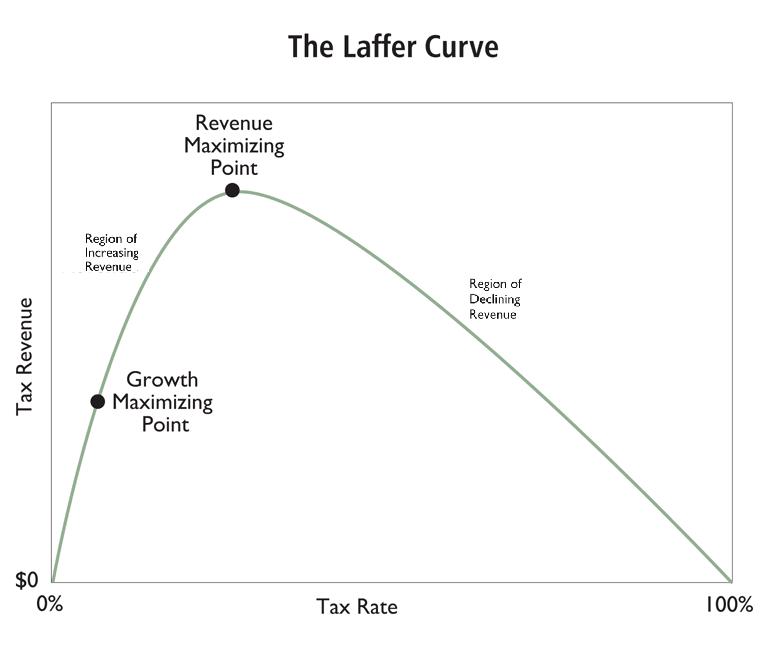
That working out where the peak of the Laffer Curve is is difficult is entirely true. That it’s going to be different for each tax in each different legal and societal set up is also true. But that doesn’t excuse drivel like this:
The ends of the curve are basic enough – at a tax rate of 0, the government will raise $0 in revenue, and at a tax rate of 100, the government will still raise $0 in revenue because people won’t work without take-home pay. At the extremes, the Laffer curve is correct, but that doesn’t tell us anything about the points in the middle. Laffer’s idea, however, was that a “tipping point” existed on the continuum in between, where people’s incentives to work and invest decreased because tax rates were too onerous.
If the end points are true – something admitted – then it’s a matter of simple, pure, and true logic that there are one or more revenue maximising points inbetween. For it’s simple enough for us to observe that there are tax rates which do raise revenue. And if we have tax rates which raise no revenue and tax rates which raise some then there are those one or more rates which raise the most.
So, please, can we stop the drivel?
Sure, Art Laffer himself is incorrect when stating that all tax cuts always pay for themselves through increased economic growth. But that doesn’t invalidate the logic of the curve, only the use to which it is put.
Fifty-four percent. That’s approximately it: the tax maximizing point on the curve when you include all of the taxes on income (including the things they often don’t call taxes — social security, unemployment insurance, and other non-tax taxes — but which are still withheld from paycheques or payable at tax deadline time). Go much above that and the government’s take begins to decrease, defeating the purpose of raising the tax rate in the first place. (Unless the real purpose is just to harm the rich … which might be true in a number of cases.)
Comments Off on “[P]eople aren’t really arguing about the existence or logic of the Laffer Curve they just hate the empirical answer”
June 13, 2019
American anarchism
Not all anarchists are bomb-throwers, as Christopher Schwarz explains:
The idea of pairing anarchism and design work seems – on its face – to be a ridiculous marriage. After all, design is about creating things from scratch, and anarchism is about burning everything down, right?
Well, no. Anarchism – particularly the American flavor of it – is woefully simplified and misunderstood by people on both the left and the right of the political spectrum. The truth is that most of the furniture designers and graphic designers I’ve worked with in my career possess strong anarchistic tendencies. They just don’t know what to call their urges and beliefs.
I’ve been an aesthetic anarchist for more than 25 years, after first encountering the concept in graduate school (thanks Noam Chomsky), then observing one of my cousins, Jessamyn West, an anarchist librarian. There’s a chance you might be one, too. And while I’m certain that you probably should be working on something far more pressing and billable for work at McCorp, reading this short article isn’t going to hurt anything….
The face of American anarchism. Josiah Warren is considered the father of American anarchism. Among his many accomplishments was the founding of the Cincinnati Time Store, where you traded your labor for goods. No money.
Photo via Wikimedia Commons.The Briefest Description Ever of American Anarchism
America’s individualist anarchism is not about the violent overthrow of the government and its institutions. Period. Full stop. Instead, it is a tendency to eschew the enormous organizations – churches, states and corporations – that we have created during the last 250 years.
Why do this? While working with others is generally a good thing, there is some threshold upon which an organization becomes so large that it is capable of inhumane behavior – war, slavery, environmental destruction, mass extinctions or even just failing to treat its employees and contractors fairly. These are things that individuals are (mostly) incapable of accomplishing.
Anarchists like myself avoid working with these massive and dehumanizing institutions. I don’t want to burn them down, but I also don’t want to prop them up by shopping in their stores, praying in their cathedrals or voting in their elections.
That doesn’t mean I’m opposed to making money, that I’m an atheist or that I’m uninvolved in my community. I just decline to work, pray and serve others via these institutions. Working with them gives them power, while working with the family architectural firm a few blocks away helps your neighbors in every way imaginable.

Comments Off on American anarchism
Americans “don’t really believe in foreigners”
A few days back, Sarah Hoyt wrote a long post about the actual differences between American culture and the many different cultures that most Americans have difficulty understanding:

I don’t think anyone who hasn’t actually acculturated between two countries understands how different cultures can be, deep down, at the bone level and the most basic reactions level, let alone what causes the difference, from inherited influences to just deep built in assumptions about climate/physical plant/fauna.
And some of the people who have acculturated, at that, might not be self-aware enough to see the difference, and just replace one set of assumptions with another and roll with it. (Or get caught somewhere between. Well, to some extent we all get caught somewhere between. The question is, what percentage is in the new country. I’d say for me, after being in Portugal recently, probably 95% American. There are things trained in before the age of 3 which I’ll never let go of, though some got truly weird with the acculturation, like how I react to “shame.”)
That experience this weekend was the “clicking in” of something that’s been bothering me for a long time. In our writers’ group I used to run across people who projected modern AMERICAN female back into the time of pharaohs. One of my best friends refused to believe me when I told her there was zero chance of an alien race having the same university system as the US since even Portugal (avowedly human) doesn’t. There were other things. You guys have heard me rant about several “historical” books that make the past exactly like the future only with different tech. The fact that they don’t understand that tech affects not just how people live but how they think, feel and react is another of those things I don’t get, as I think even within living memory we should be able to see how different things have gotten. See for instance not wearing of aprons, because the clothes are cheap enough and abundant enough that ruining a shirt is not a big deal, unless it’s a very good shirt.
Technological shifts in living memory have made ordinary life from before the new technology (like cheap, dependable cell phones) almost unimaginable. How many movies and TV shows from before the mobile phone became widely available depended as a plot point on the characters being unable to communicate with one another at key moments? Many mystery novels of the pre-mobile-phone era probably make no sense at all to modern readers because instant communication has become “baked in” to our world.
The clothing aspect has been less obviously important, yet only a couple of generations back, most people owned perhaps three changes of clothing, including one “good” suit/dress for church-going or special occasions. We’ve become so wealthy as a culture that almost everyone has more than enough clothes for any imagined need … although church-going has become almost exotic to urban and even suburban folks, and formal attire is becoming more and more rare. (But everyone has more T-shirts and shorts than they know what to do with.)
But until this weekend I didn’t realize how prevalent and universal it is, since the clash took place between two people from native anglophone cultures, both of which are denizens of the net and contact people of other countries, regularly. Okay, one of them didn’t know she was dealing with a foreigner […] This weekend I realized people don’t really believe in foreign countries either. They’re willing to accept that some things (and those usually conform to their mental picture of the generic “culture” or “region”) are different, but that the fundamentals and the cherished unexamined assumptions might be different is unthinkable — literally. And if we can think of them, we still assume the other country is somehow “wrong” or worse “pretending” to be different to be contrary.
This means, ultimately, that even an era of instant all over the world communication, human tribalism still wins. And with it, I suppose, nationalism.
The wave of populism in the west that has taken the establishment and the mainstream media by surprise is a predictable response to the globalist attitudes of the elites. If you work hard enough at it, you can provoke unpleasant responses from those who don’t agree with your worldview, and the transnational elites have been working very hard indeed.
There are other implications: since it’s virtually impossible to avoid faster communication and more widespread travel in the future, this is going to make the next couple/three centuries a series of epic clashes, until either some sort of understanding emerges or polarized cultures can immigrate to the stars and far far away from each other.
Mass immigration is a REALLY bad idea (‘mkay) not that this is a surprise to any of you. People inhabiting enclaves of “their kind” are slow to acculturate (three generations, if it happens at all.) And the number of people coming over the Southern border is like nothing we’ve ever experienced before. And trust me, in terms of functionality, you do NOT want to import any culture descended from 17th century Spain. There is a reason that the American countries South of us are in crisis on a more or less permanent basis, and that Brazil, screwed up though it is, is more functional than the others. No, just no.
I’m certainly not against immigration, but I strongly believe it is possible to have too much immigration, as Europe and the United States are being forced to confront. When people leave their native land to go somewhere else, be it for economic or political reasons, there’s a natural expectation that they will at least attempt to acculturate to their new country. To western elites, this is wrong (or at least, misguided) and “we” should encourage new immigrants to avoid acculturation and to embrace and celebrate the culture they came from. Because reasons. And a lot of immigrants are happy to avoid the hard work of learning how to fit in to the foreign culture they find themselves in — and it is hard work — leading to second or third generations who still can’t or won’t fit in and adapt to the culture.
Let me just say that is one more proof of “people don’t really believe in foreigners.”
Sure, a lot of American culture is triumphant and imitated. Only it’s more “spoofed” because what they imitate is what they see in movies, and proving that humans prefer narrative to lack there of, even when it makes no sense, the bad parts are often picked up first. And they’re often bad parts only seen in movies, btw. Like certain underclass behaviors being seen as glamorous.
But it’s an overlay. At a deep down level, these people dressing in jeans and t-shirts are still foreign and — THIS IS VERY IMPORTANT — don’t believe Americans software-in-the-head is different, which leads to cargo-cultish attempts to import American successes without getting what brings them about, from innovation, to social mobility to freedom of speech. Not really, not at a deep level.
[…]
This means the left’s project of “fighting nationalism” is not just doomed, but it’s stupid as eating rocks, and will cause only unending misery suffering and war. (So, SOP for Marxists. In fact, chalk this whole internationalism bullshit as something else Marx was wrong about. Workers of the world unite, my little sore feet.)
Comments Off on Americans “don’t really believe in foreigners”
QotD: Justice and Social Justice
Sam Duncan, in a comment posted to “Elsewhere (234)”, DavidThompson, 2017-06-01.
Comments Off on QotD: Justice and Social Justice


