
Open Culture posted this video which includes some of the oldest known footage of London:
May 16, 2015
May 14, 2015
QotD: The value of poetry
Once, after plowing through sixty or seventy volumes of bad verse, I described myself as a poetry-hater. The epithet was and is absurd. The truth is that I enjoy poetry as much as the next man — when the mood is on me. But what mood? The mood, in a few words, of intellectual and spiritual fatigue, the mood of revolt against the insoluble riddle of existence, the mood of disgust and despair. Poetry, then, is a capital medicine. First its sweet music lulls, and then its artful presentation of the beautifully improbable soothes and gives surcease. It is an escape from life, like religion, like enthusiasm, like glimpsing a pretty girl. And to the mere sensuous joy in it, to the mere low delight in getting away from the world for a bit, there is added, if the poetry be good, something vastly better, something reaching out into the realm of the intelligent, to wit, appreciation of good workmanship. A sound sonnet is almost as pleasing an object as a well-written fugue. A pretty lyric, deftly done, has all the technical charm of a fine carving. I think it is craftsmanship that I admire most in the world. Brahms enchants me because he knew his trade perfectly. I like Richard Strauss because he is full of technical ingenuities, because he is a master-workman. Well, who ever heard of a finer craftsman than William Shakespeare? His music was magnificent, he played superbly upon all the common emotions — and he did it magnificently, he did it with an air. No, I am no poetry-hater. But even Shakespeare I most enjoy, not on brisk mornings when I feel fit for any deviltry, but on dreary evenings when my old wounds are troubling me, and some fickle one has just sent back the autographed set of my first editions, and bills are piled up on my desk, and I am too sad to work. Then I mix a stiff dram — and read poetry.
H.L. Mencken, “The Poet and His Art”, Prejudices, Third Series, 1922.
Comments Off on QotD: The value of poetry
May 11, 2015
May 9, 2015
QotD: “Constructive” criticism
Upon the low practical value of so-called constructive criticism I can offer testimony out of my own experience. My books are commonly reviewed at great length, and many critics devote themselves to pointing out what they conceive to be my errors, both of fact and of taste. Well, I cannot recall a case in which any suggestion offered by a constructive critic has helped me in the slightest, or even actively interested me. Every such wet-nurse of letters has sought fatuously to make me write in a way differing from that in which the Lord God Almighty, in His infinite wisdom, impels me to write — that is, to make me write stuff which, coming from me, would ‘be as false as an appearance of decency in a Congressman. All the benefits I have ever got from the critics of my work have come from the destructive variety. A hearty slating always does me good, particularly if it be well written. It begins by enlisting my professional respect; it ends by making me examine my ideas coldly in the privacy of my chamber. Not, of course, that I usually revise them, but I at least examine them. If I decide to hold fast to them, they are all the dearer to me thereafter, and I expound them with a new passion and plausibility. If, on the contrary, I discern holes in them, I shelve them in a pianissimo manner, and set about hatching new ones to take their place. But constructive criticism irritates me. I do not object to being denounced, but I can’t abide being school-mastered, especially by men I regard as imbeciles.
H.L. Mencken, “Footnote on Criticism”, Prejudices, Third Series, 1922.
Comments Off on QotD: “Constructive” criticism
May 6, 2015
May 3, 2015
Charles Stross – “Vampires are not sexy. At least, not in the real world.”
He’s quite right … and he drives home the point in a recent blog post:
Desmodus rotundis isn’t sexy. (Except insofar as small furry rodents that carry rabies aren’t as un-sexy as some other obligate haemophages.) Bed bugs are really not sexy. But if you want maximally not-sexy, it’s hard to top Placobdelloides jaegerskioeldi, the Hippo Arse Leech.
The Hippo Arse Leech is a leech; it sucks blood. Like most leeches, its mouth parts aren’t really up to drilling through the armour-tough skin of a hippopotamus, so it seeks out an exposed surface with a much more porous barrier separating it from the juicy red stuff: the lining of the hippo rectum. When arse leeches find somewhere to feed, in due course happy fun times ensue — for hermaphrodite values of happy fun times that involve traumatic insemination. Once pregnant, the leeches allow themselves to be expelled by the hippo (it’s noteworthy that hippopotami spin their tails when they defecate, to sling the crap as far away as possible — possibly because the leeches itch — we’re into self-propelled-hemorrhoids-with-teeth territory here), whereupon in the due fullness of time they find another hippo, force their way through it’s arse crack, and find somewhere to chow down. Oh, did I mention that this delightful critter nurtures its young? Yep, the mother feeds her brood until they’re mature enough to find a hippo of their own. (Guess what she feeds them with.)
Here ‘s a video by Mark Siddall, professor of invertebrate zoology at the American Natural History Museum, a noted expert on leeches, describing how he discovered P. Jaegerskioeldi, just in case you think I’m making this up.
By the end of my description Jim and Freda were both … well, I wish I’d thought to photograph their faces for posterity. So were the audience. And that’s when I got to the money shot: the thing about fictional vampires is, vampires are only sexy when they’re anthropomorphic.
Comments Off on Charles Stross – “Vampires are not sexy. At least, not in the real world.”
May 2, 2015
QotD: The nihilism of modern art
One of my earliest blog essays (Terror Becomes Bad Art) was about Luke Helder, the pipe-bombing “artist” who created a brief scare back in 2002. Arguably more disturbing than Helder’s “art” was the fact that he genuinely thought it was art, because none of the supposed artists or arts educators he was in contact with had ever taught him any better and his own talent was not sufficient to carry him beyond their limits.
I am not the first to observe that something deeply sick and dysfunctional happened to the relationship between art, popular culture, and technology during the crazy century we’ve just exited. Tom Wolfe made the point in The Painted Word and expanded on it in From Bauhaus To Our House. Frederick Turner expanded the indictment in a Wilson Quarterly essay on neoclassicism which, alas, seems not to be available on line.
If we judge by what the critical establishment promotes as “great art”, most of today’s artists are bad jokes. The road from Andy Warhol’s soup cans to Damien Hirst’s cows in formaldehyde has been neither pretty nor edifying. Most of “fine art” has become a moral, intellectual, and esthetic wasteland in which whatever was originally healthy in the early-modern impulse to break the boundaries of received forms has degraded into a kind of numbed-out nihilism.
[…]
To see these craft objects, unashamedly made for money (that’ll be $40 extra for molecular-surface etching, thank you), is to have your nose rubbed in the desperate poverty of most modern art, to be reminded of the vacuum at its core and the pathetic Luke Helders that the vacuum spawns. It’s a poverty of meaning, a parochialism that insists that the only interesting things in the universe are the artist’s own psychological and political quirks.
Bathsheba Grossman’s art reminds us that exploration of the narrow confines of an artist’s head is a poor substitute for artistic exploration of the universe. It reminds us that what the artist owes his audience is beauty and discovery and a sense of connection, not alienation and ugliness and neurosis and political ax-grinding.
Forgetting this value rotted the core out of the fine arts and literary fiction of the 20th century. We can hope, though, that artists like her and Arthur Ganson will show the way forward to remembering it. Only in that way will the unhealthy chasm between popular and fine art be healed, and fine art be restored to a healthy and organic relationship with culture as a whole.
Eric S. Raymond, “The Art of Science”, Armed and Dangerous, 2004-09-21.
Comments Off on QotD: The nihilism of modern art
May 1, 2015
Statistical myths in California’s water shortage
Devin Nunes debunks the common claim that California’s farmers use “80 percent” of the available water in the state:
As the San Joaquin Valley undergoes its third decade of government-induced water shortages, the media suddenly took notice of the California water crisis after Governor Jerry Brown announced statewide water restrictions. In much of the coverage, supposedly powerful farmers were blamed for contributing to the problem by using too much water.
“Agriculture consumes a staggering 80 percent of California’s developed water, even as it accounts for only 2 percent of the state’s gross domestic product,” exclaimed Daily Beast writer Mark Hertsgaard in a piece titled “How Growers Gamed California’s Drought.” That 80-percent statistic was repeated in a Sacramento Bee article titled, “California agriculture, largely spared in new water restrictions, wields huge clout,” and in an ABC News article titled “California’s Drought Plan Mostly Lays Off Agriculture, Oil Industries.” Likewise, the New York Times dutifully reported, “The [State Water Resources Control Board] signaled that it was also about to further restrict water supplies to the agriculture industry, which consumes 80 percent of the water used in the state.”
This is a textbook example of how the media perpetuates a false narrative based on a phony statistic. Farmers do not use 80 percent of California’s water. In reality, 50 percent of the water that is captured by the state’s dams, reservoirs, aqueducts, and other infrastructure is diverted for environmental causes. Farmers, in fact, use 40 percent of the water supply. Environmentalists have manufactured the 80 percent statistic by deliberately excluding environmental diversions from their calculations. Furthermore, in many years there are additional millions of acre-feet of water that are simply flushed into the ocean due to a lack of storage capacity — a situation partly explained by environmental groups’ opposition to new water-storage projects.
Comments Off on Statistical myths in California’s water shortage
April 30, 2015
When Dungeons and Dragons met LEGO
A picture really can convey a thousand words:
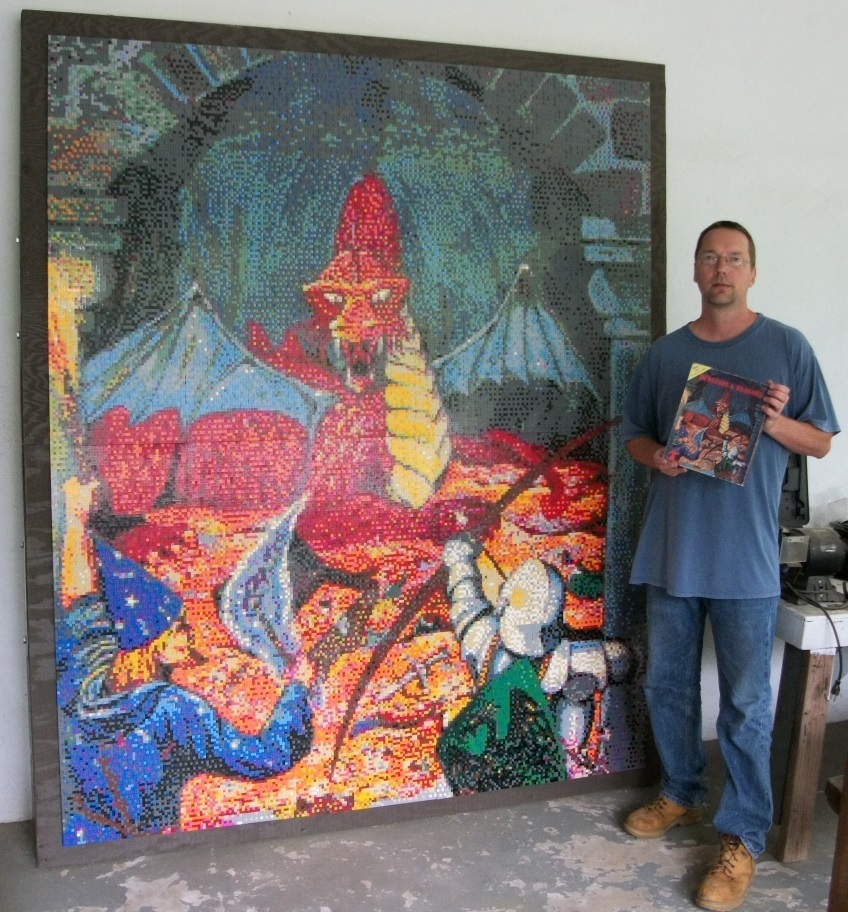
I’ve often contend that three of the most significant influences on my adolescent years were: LEGO building, computer programming, and playing Dungeons & Dragons. With this latest mosaic project, I more or less bring all of those things together (the LEGO and D&D are obvious, while behind the scenes I have the software program I wrote to help me map out the whole mural).
For those not quite as nerdy as myself, here’s the background on this image. It is the cover to the boxed set of the 1977 version on the game Dungeons & Dragons. This was the first version of the game released as the “Basic” set. It was the first set that my brother and I owned and played with. Obviously, the countless hours I spent reading the rulebook and perusing the illustrations made a pretty big impression on me. In fact, I still run a Basic D&D campaign semi-regularly using this very set.
Comments Off on When Dungeons and Dragons met LEGO
April 28, 2015
Tax credits that benefit almost nobody
Last week, Michael Geist pointed out that the tax credits and other inducements offered by state and provincial governments to attract TV and movie business are a bad deal for everyone except the media companies:
The widespread use of film and television production tax subsidies dates back more than two decades as states and provinces used them to lure productions with the promise of new jobs and increased economic activity. The proliferation of subsidies and tax credits created a race to the bottom, where ever-increasing incentives were required to distinguish one province or state from the other.
In recent years, governments have begun to rethink the strategy. States such as Arizona, Michigan, New Mexico, and Iowa suspended or capped their programs. Louisiana found that it lost $170 million in tax revenue in a single year. In Canada, the Quebec government’s taxation review committee recently admitted that its provincial film production tax credit was not profitable and that numerous studies find that there is little economic spinoff activity.
But the most notable Canadian study on the issue has never been publicly released and is rarely discussed. The Ontario government’s Ministry of Finance conducted a detailed review of the issue in 2011, delivering a sharply negative verdict on the benefits associated with spending hundreds of millions of dollars each year in tax credits. It recommended eliminating a 25 per cent tax credit for foreign and non-certified domestic productions that would have saved $155 million per year.
Comments Off on Tax credits that benefit almost nobody
April 27, 2015
QotD: Where to use trigger warnings
The strongest argument against trigger warnings that I have heard is that they allow us to politicize ever more things. Colleges run by people on the left can slap big yellow stickers on books that promote conservative ideas, saying “THIS BOOK IS RACIST AND CLASSIST”, and then act outraged if anyone requests a trigger warning that sounds conservative – like a veteran who wants one on books that vilify or mock soldiers, or a religious person who wants one on blasphemy. Then everyone has to have a big fight, the fight makes everyone worse off than either possible resolution, and it ends with somebody feeling persecuted and upset. In other words, it’s an intellectual gang sign saying “Look! We can demonstrate our mastery of this area by only allowing our symbols; your kind are second-class citizens!”
On the other hand, this is terribly easy to fix. Put trigger warnings on books, but put them on the bullshytte page. You know, the one near the front where they have the ISBN number and the city where the publishers’ head office is and something about the Library of Congress you’ve never read through even though it’s been in literally every book you’ve ever seen. Put it there, on a small non-colorful sticker. Call it a “content note” or something, so no one gets the satisfaction of hearing their pet word “trigger warning”. Put a generally agreed list of things – no sense letting every single college have its own acrimonious debate about it. The few people who actually get easily triggered will with some exertion avoid the universal human urge to flip past the bullshytte page and spend a few seconds checking if their trigger is in there. No one else will even notice.
Or if it’s about a syllabus, put it on the last page of the syllabus, in size 8 font, after the list of recommended reading for the class. As a former student and former teacher, I know no one reads the syllabus. You have to be really devoted to avoiding your trigger. Which is exactly the sort of person who should be able to have a trigger warning while everyone else goes ahead with their lives in a non-political way.
Scott Alexander, “The Wonderful Thing About Triggers”, Slate Star Codex, 2014-05-30.
Comments Off on QotD: Where to use trigger warnings
April 25, 2015
QotD: Political speech and political thinking
In our time it is broadly true that political writing is bad writing. Where it is not true, it will generally be found that the writer is some kind of rebel, expressing his private opinions and not a “party line.” Orthodoxy, of whatever color, seems to demand a lifeless, imitative style. The political dialects to be found in pamphlets, leading articles, manifestoes, White papers and the speeches of undersecretaries do, of course, vary from party to party, but they are all alike in that one almost never finds in them a fresh, vivid, homemade turn of speech. When one watches some tired hack on the platform mechanically repeating the familiar phrases — bestial atrocities, iron heel, bloodstained tyranny, free peoples of the world, stand shoulder to shoulder — one often has a curious feeling that one is not watching a live human being but some kind of dummy: a feeling which suddenly becomes stronger at moments when the light catches the speaker’s spectacles and turns them into blank discs which seem to have no eyes behind them. And this is not altogether fanciful. A speaker who uses that kind of phraseology has gone some distance toward turning himself into a machine. The appropriate noises are coming out of his larynx, but his brain is not involved as it would be if he were choosing his words for himself. If the speech he is making is one that he is accustomed to make over and over again, he may be almost unconscious of what he is saying, as one is when one utters the responses in church. And this reduced state of consciousness, if not indispensable, is at any rate favorable to political conformity.
In our time, political speech and writing are largely the defense of the indefensible. Things like the continuance of British rule in India, the Russian purges and deportations, the dropping of the atom bombs on Japan, can indeed be defended, but only by arguments which are too brutal for most people to face, and which do not square with the professed aims of the political parties. Thus political language has to consist largely of euphemism, question-begging and sheer cloudy vagueness. Defenseless villages are bombarded from the air, the inhabitants driven out into the countryside, the cattle machine-gunned, the huts set on fire with incendiary bullets: this is called pacification. Millions of peasants are robbed of their farms and sent trudging along the roads with no more than they can carry: this is called transfer of population or rectification of frontiers. People are imprisoned for years without trial, or shot in the back of the neck or sent to die of scurvy in Arctic lumber camps: this is called elimination of unreliable elements. Such phraseology is needed if one wants to name things without calling up mental pictures of them.
George Orwell, “Politics and the English Language”, 1946.
Comments Off on QotD: Political speech and political thinking
April 23, 2015
Adult Wednesday Addams: Job Interview [S1, Ep 2]
Published on 3 Apr 2015
Wednesday interviews at a cutthroat Hollywood agency.
Comments Off on Adult Wednesday Addams: Job Interview [S1, Ep 2]
April 22, 2015
SpaceX Launch You Up (Uptown Funk Parody)
Published on 15 Apr 2015
THIS VIDEO IS A PARODY OF THE ORIGINAL “UPTOWN FUNK” by Mark Ronson feat. Bruno Mars and does not infringe on the copyright of Sony Music Entertainment (SME).
This video was created by fans of SpaceX and does not reflect the views of SpaceX or its partners.
You Elon MUST share this SpaceX music video, and help promote the future of science and space exploration! #GoBold (Lyrics at the bottom!)
H/T to Boing Boing for the link.
Comments Off on SpaceX Launch You Up (Uptown Funk Parody)


