
ScreenPrism
Published on 19 Dec 2016We all know Casablanca is a great movie — but what makes it great? We talked to film professor Julian Cornell about why Casablanca is one of the classic love stories in cinema.
August 10, 2018
What’s So Great About Casablanca? Ask a Film Professor.
Comments Off on What’s So Great About Casablanca? Ask a Film Professor.
August 9, 2018
Robert Heinlein – Rise – Extra Sci Fi – #1
Extra Credits
Published on 7 Aug 2018Before we delve into Robert Heinlein’s famous works, let’s look at an overview of his writing career and the philosophical ideals he was known for: particularly his libertarian worldview, although even this is still hotly debated.
Comments Off on Robert Heinlein – Rise – Extra Sci Fi – #1
QotD: Gandhi the man
Gandhi rose early, usually at three-thirty, and before his first bowel movement (during which he received visitors, although possibly not Margaret Bourke-White) he spent two hours in meditation, listening to his “inner voice.” Now Gandhi was an extremely vocal individual, and in addition to spending an hour each day in vigorous walking, another hour spinning at his primitive spinning wheel, another hour at further prayers, another hour being massaged nude by teenage girls, and many hours deciding such things as affairs of state, he produced a quite unconscionable number of articles and speeches and wrote an average of sixty letters a day. All considered, it is not really surprising that his inner voice said different things to him at different times. Despising consistency and never checking his earlier statements, and yet inhumanly obstinate about his position at any given moment, Gandhi is thought by some Indians today (according to V.S. Naipaul) to have been so erratic and unpredictable that he may have delayed Indian independence for twenty-five years.
For Gandhi was an extremely difficult man to work with. He had no partners, only disciples. For members of his ashrams, he dictated every minute of their days, and not only every morsel of food they should eat but when they should eat it. Without ever having heard of a protein or a vitamin, he considered himself an expert on diet, as on most things, and was constantly experimenting. Once when he fell ill, he was found to have been living on a diet of ground-nut butter and lemon juice; British doctors called it malnutrition. And Gandhi had even greater confidence in his abilities as a “nature doctor,” prescribing obligatory cures for his ashramites, such as dried cow-dung powder and various concoctions containing cow dung (the cow, of course, being sacred to the Hindu). And to those he really loved he gave enemas — but again, alas, not to Margaret Bourke-White. Which is too bad, really. For admiring Candice Bergen’s work as I do, I would have been most interested in seeing how she would have experienced this beatitude. The scene might have lived in film history.
There are 400 biographies of Gandhi, and his writings run to 80 volumes, and since he lived to be seventy-nine, and rarely fell silent, there are, as I have indicated, quite a few inconsistencies. The authors of the present movie even acknowledge in a little-noticed opening title that they have made a film only true to Gandhi’s “spirit.” For my part, I do not intend to pick through Gandhi’s writings to make him look like Attila the Hun (although the thought is tempting), but to give a fair, weighted balance of his views, laying stress above all on his actions, and on what he told other men to do when the time for action had come.
Richard Grenier, “The Gandhi Nobody Knows”, Commentary, 1983-03-01.
Comments Off on QotD: Gandhi the man
August 4, 2018
Violence against women
Joanna Williams on the problem that well-established, well-paid, financially secure women — at least the professional feminists fitting those criteria — are having to work very hard to maintain their air of victimhood:
Being a feminist must be hard work. Perhaps you’ve got a newspaper column to fill with your hot take on the latest sexist outrage. Or perhaps you have a university sexual-harassment policy to write. Or a government minister to consult about a proposed new law. Or a hefty budget to administer. You’ve got the salary, a platform for your views, and the capacity to influence what happens in almost every institution in the country. And yet the entire basis for you being in this fortunate position, for walking the corridors of power, is your powerlessness. The bind for today’s professional feminist is the more power and influence she gains, the harder she needs to work to show that women are still oppressed.
[…]
As feminists increasingly take positions of power, tackling violence against women drives their agenda. The World Health Organisation tells us that violence against women ‘is a major public-health problem’. The United Nations tells us it is ‘a grave violation of human rights’. The British government describes violence ‘against women and girls’ as a serious crime that has ‘a huge impact on our economy, health services, and the criminal-justice system’.
Of course, violence against women and girls deserves to be taken seriously and perpetrators should be severely punished. But the lives of women in poverty-stricken and wartorn countries are very different to those of women in England. Likewise, adult women have far more agency and control over their lives than girls. Conflating the experiences of women all around the world, and of adult women with children, allows professional feminists to claim suffering by proxy.
At the same time, the definition of violence seems to broaden by the day. The internationally agreed definition of violence against women and girls is: ‘Any act of gender-based violence that results in, or is likely to result in, physical, sexual or psychological harm or suffering to women [or girls], including threats of such acts.’ In the UK and the US, violence encompasses sexual harassment – which includes winking, whistling and looking at someone for too long. Amnesty International describes women’s experiences of ‘violence and abuse on Twitter’. In 2017, the organisers of a women’s strike against President Trump described ‘the violence of the market, of debt, of capitalist property relations, and of the state; the violence of discriminatory policies against lesbian, trans and queer women’.
This is not violence as a physical act, but violence as metaphor. No wonder it is experienced everywhere. The World Health Organisation describes violence against women as an ‘epidemic’. We are told that over a third of girls have been sexually harassed at school and that more than a third of women have experienced sexual harassment at work. But then we also learn that two women are killed each week by a current or former partner. And here, immediately, is the problem with violence as metaphor. Real violence becomes relativised. When winking and nasty tweets are described as acts of violence, the word is no longer enough to describe acts of physical brutality and murder. Violence has become nothing more than a badge permitting membership of an inclusive feminist club, and this does little to support women who really are in need of help.
Comments Off on Violence against women
August 1, 2018
Isaac Asimov – Foundation & Empire – Extra Sci Fi – #3
Extra Credits
Published on 31 Jul 2018Asimov’s Foundation stories were absolutely foundational for science fiction — they introduced the concept of a space empire, bringing along analogies from historical civilizations to the social issues of advanced technology and humanity’s future.
Comments Off on Isaac Asimov – Foundation & Empire – Extra Sci Fi – #3
Farewell to Canada’s best trio … and this time, they mean it
Colby Cosh, clearly a fellow long-time Rush fan, heaves a sigh and writes the musical epitaph:
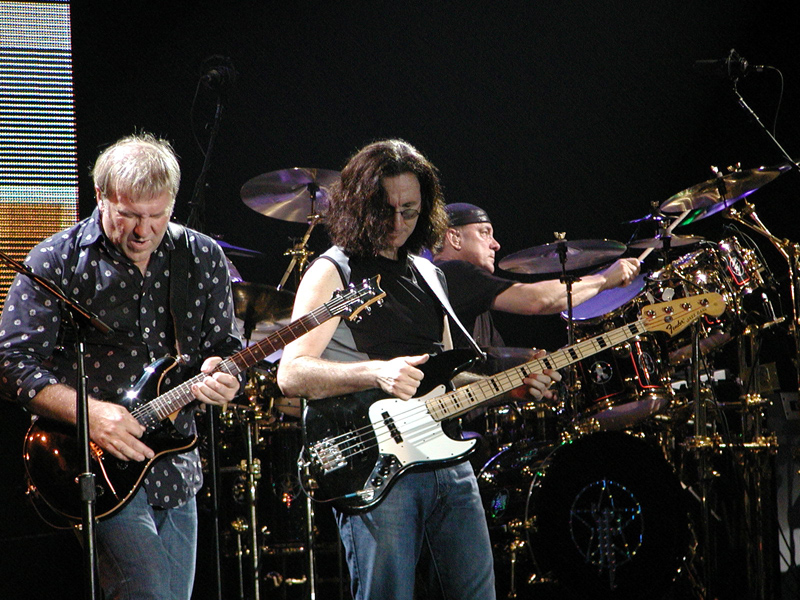
Rush in concert, Milan 2004.
Photo by Enrico Frangi, via Wikimedia Commons
All of this — even Neil Peart’s remorseless flintiness — reflects the distinctive, endearing characteristics of Rush: the band has now ceased to exist for some of the same reasons it attracted adoring generations of listeners. As a commercial proposition, Rush remains a potential superpower. Other groups of similar magnitude have always been able to find ways to push on when important members, or even every member that anyone might recognize, came to the end of the road. (In a rock group there is usually at least one person who could really use the cash from a tour.)
Could Geddy Lee and Alex Lifeson find some young drummer with healthy wrists and ankles, take “Rush” to the casino circuit, and sell mountains of $75 tickets? They probably could, and they would probably put on a wonderful show. But it is unthinkable (he wrote, knocking on the wood of his desk) for them to do such a thing under the Rush name.
They could probably even devise a low-stress acoustic-heavy setlist, with slowed-down versions of the hits, that they could take to small venues with Peart in tow. Tempting as such schemes must be — Lee was publicly in denial about Peart’s second retirement for ages, and Lifeson says he would go on if it were entirely up to him — they do not suit the nature of Rush.
The group is a three-piece in which every piece counts more or less equally. And part of what their fans pay to see is physical effort of the highest intricacy. I hope it will not offend my fellow Rush fans if I compare it to juggling or acrobatics, or at least suggest that it has such an aspect. Rush songs are full of unpredictable, shifting time signatures and difficult cues. The band’s numerical paucity leaves nowhere to hide dropped chords or melodic clangers. Unlike most three- and four-piece groups, Rush has almost always refused to ever bring a hired sideman onto the live stage, even though this requires Lee to operate sequencers with foot pedals while playing what are often ludicrously difficult bass lines — AND singing like, well, like Geddy Lee.
This, I say as someone who loves Geddy like a family member, is truculence bordering on absurdity. If Rush could approach fans individually and talk it out with them, they could probably persuade them that it made sense to bring a keyboardist, or even a rhythm guitarist, along on the road. (Some groups even sneak in a second percussionist!) It may even be a bit sad that we were denied a more collegial Rush, one that participated in the life of its musical generation, strayed occasionally from its triune purity, and did fun crossovers with other groups (such as 1980’s “Battle Scar”, recorded with fellow Torontonians Max Webster for the Universal Juveniles LP).
Comments Off on Farewell to Canada’s best trio … and this time, they mean it
July 31, 2018
The anti-Brexit propaganda machine of “Project Fear”
Brendan O’Neill on the never-ending whinge by the Remoaners emphasizing the potential negatives of Brexit:
I can’t remember a time when the elitist politics of fear has been as cynically wielded as it has been over the past week. It wasn’t even this bad when schoolkids of my generation were made to watch The Day After, a nuclear-disaster movie in which a wholesome American family slowly die from radiation after the Soviets go mental and bomb the US. Also, at least that dread-laden propaganda was only designed to make us fear the Ruskies – the even more unhinged Project Fear of elitist Remoaners is an attempt to make us fear ourselves and our friends and family and our collective electoral stupidity that has allegedly propelled Britain to the brink of ‘self-immolation’, in the words of the increasingly bizarre figure of David Lammy, the Member of Parliament for Brussels.
Every day the fearful propaganda intensifies. One wakes wondering what unearthly horror our vote against the EU 25 months ago might now have unleashed. Gonorrhoea is the latest. If we leave the EU with No Deal, Britain will apparently become a 15th-century-style hotbed of such sexual malaise. ‘Brexit could lead to spread of infectious diseases such as super-gonorrhoea’, says a headline in the London Evening Standard, which was once a newspaper but is now a score-settling sheet for its current editor: arch Remainer and former chancellor George Osborne, who we turfed out of office with our vote for Brexit. Medical officials fear that a shortage of medicine in the event of No Deal will mean we won’t be able to treat knob rot. It’s almost Biblical. ‘Defy me and your genitals shall wither.’ Up next: plagues of locusts? Floods?
Yes, floods. Brexit could ‘water down [the UK’s] environment laws’, says a piece in the Guardian, complete with a photo of a flooded English village. We could see more ‘severe flash floods’ if we leave the EU without boosting eco-laws. Perhaps we should build arks, get some animals on board? If you don’t drown, you might be poisoned. If there’s No Deal, Britain will become a ‘dumping ground for chemicals’, claim green groups. There won’t be much food, either. Remoaners are stoking up fears of food shortages if we change our trade arrangements with the EU. Because we will struggle to import ingredients and therefore won’t be able to make bread and other essentials. Why won’t be able to do this? They never say. They just know starvation is on the cards.
In the words of chief Remoaner Alastair Campbell, ‘No deal Brexit means no food Brexit and no medicines Brexit…’. Imagine being Alastair Campbell. Imagine giving the green light to the destruction of a foreign country and the deaths of tens of thousands of people in the name of delivering democracy, only to decide 15 years later that you don’t believe in democracy after all and so you devote your entire life to overthrowing the largest democratic vote in British history. Scientists should study Mr Campbell to discover how such a human being manages to sleep at night. Also, no one is saying there will be ‘no food’ after Brexit. Campbell is lying now as surely as he was when he said Saddam could bomb Britain in 45 minutes.
Comments Off on The anti-Brexit propaganda machine of “Project Fear”
July 28, 2018
July 27, 2018
Toronto’s proposed handgun ban is a feelgood/do nothing distraction
Every time there’s a tragedy, there are calls from the local media for politicians to “do something”. Politicians are hard-wired to want to “do something” even without prompting. They want (and need, for electoral purposes) to be seen to be “doing something”, if only to divert any blamecasting away from themselves. The most recent tragedy was a senseless shooting on Toronto’s Danforth in the Greektown district. The shooter, who was either killed by police or committed suicide shortly after the attack, was apparently not a legal gun owner, and under current gun laws would not have been able to obtain a handgun. So, in the wake of the tragic deaths and injuries, Toronto city council jumped into action to be seen “doing something”. Chris Selley explains why the proposed ban of handgun and ammunition sales in the city will not make a difference, except to punish non-criminals:
The whiz-bang solution on everyone’s lips — from Mayor Tory to city councillors to the Toronto Star’s and Globe and Mail’s editorial boards and the usual activists — is to ban handguns. Tory admits there is no “magic wand” that will solve Toronto’s gun problem. But still he asks: “Why does anyone in this city need to have a gun at all?”
The idea has a very superficial appeal. We all wish the Danforth shooter hadn’t managed to get a hold of a gun. Toronto is having a bad year for shootings — not much worse than last year, but at the wrong end of a distinct and steady five-year-trend. (At this point in 2014 there had been 101 shootings and 127 fatalities; so far in 2018 there have been 228 shootings and 308 fatalities.) It is understandable (if not entirely creditable) that the Danforth shooting would have rapidly intensified demands for something to be done: the victim count was high, and it happened in a wealthy part of town where it would have been easy to pretend there wasn’t a problem at all.
Still, the limitations of a “handgun ban” are both many and obvious. When Canadian police forces occasionally report on the sources of crime guns, they often find the vast majority have been smuggled across the border. In Toronto nowadays, the number is reportedly more like 50 per cent; the rest of the supply comes from licensed handgun owners who sell them on illegally — a spectacularly risky thing to do, as any used in crimes would be instantly traced back to the registered owner, but apparently worth it to some.
But we all know how permeable the Canada-U.S. border is. If we made it impossible to own a handgun legally in Canada, is there any reason to suspect the cross-border flow couldn’t regain its market share? Furthermore, CTV reported Wednesday that the Danforth shooter’s handgun was prohibited — i.e., it could never have been licensed in Canada — and that he had obtained it from some gang associates. If true, his carnage illustrates the limitations of handgun bans better than it does their efficacy.
Comments Off on Toronto’s proposed handgun ban is a feelgood/do nothing distraction
July 26, 2018
Isaac Asimov – Laws of Robotics – Extra Sci Fi – #2
Extra Credits
Published on 24 Jul 2018Asimov is famous for coining the Three Laws of Robotics, but to him they weren’t the “answer” to how robots could be used in the future — they were an intentional reflection of humanity’s potential failings.
Comments Off on Isaac Asimov – Laws of Robotics – Extra Sci Fi – #2
The life and strange death of Godfrey Elfwick
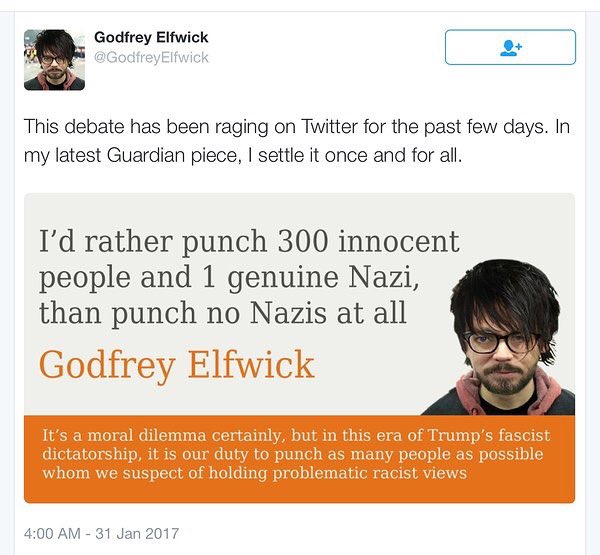
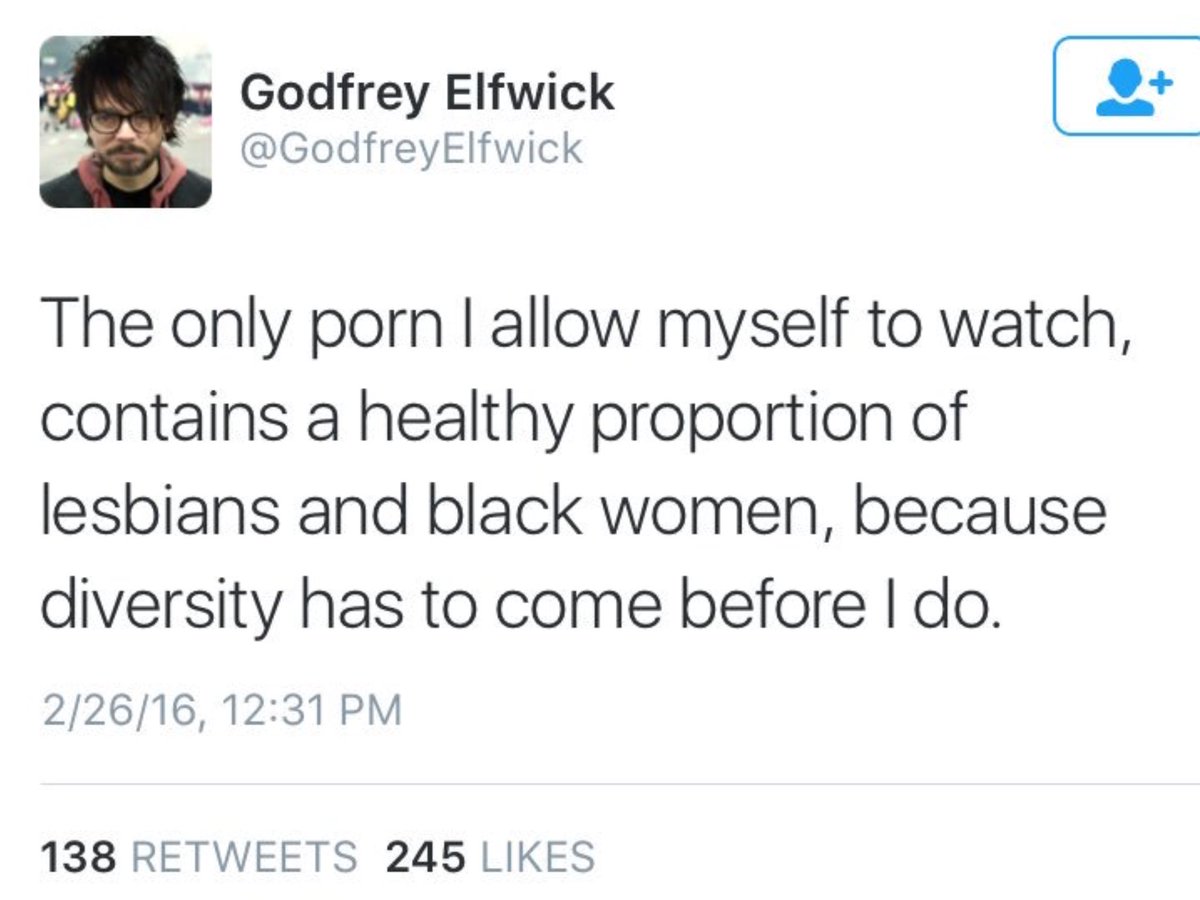
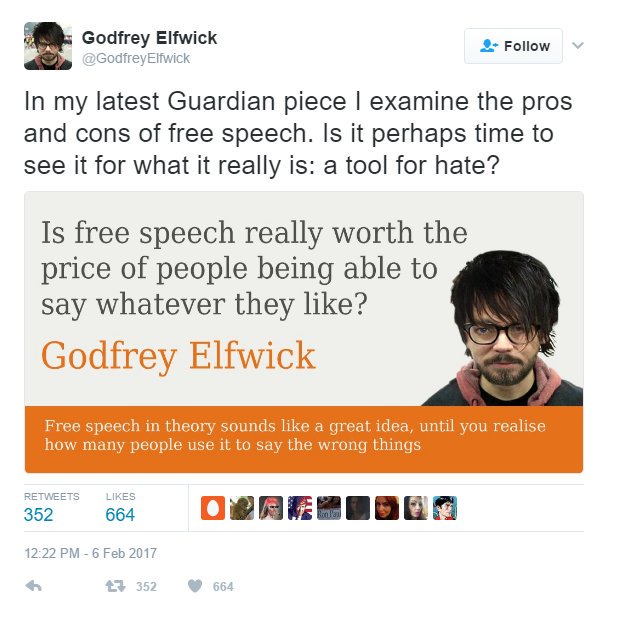
Poor old Godfrey has been taken from us by the Grim Twit-Reaper, felled in his Xirs prime in the midst of Twitter’s most recent mass-banning. At Spiked, Andrew Doyle pays tribute to the late Arch-Ubertroll of social media:
In November 2016, the Guardian published a comment piece in which the anonymous writer described how he was radicalised into the ‘alt-right’. It started when he watched a few ostensibly harmless videos by the American liberal Sam Harris. From there, he graduated to material of an anti-SJW (Social Justice Warrior) and anti-feminist disposition, before eventually becoming a fan of the dreaded Milo Yiannopoulos. As the writer dramatically put it: ‘The indoctrination was complete.’
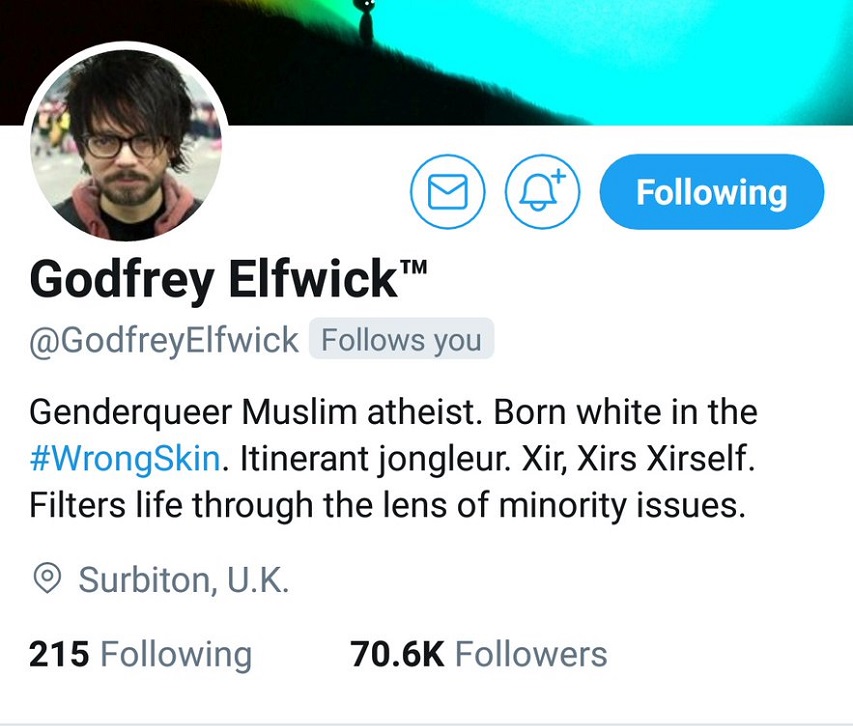
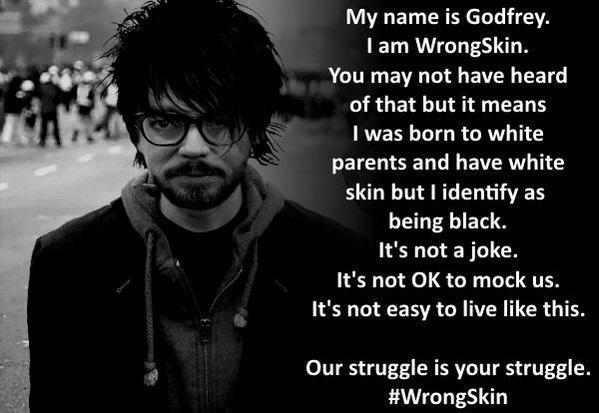
Soon after, a well-known Twitter troll called Godfrey Elfwick claimed to be the author. It made complete sense, even though it wasn’t true. Elfwick was a brilliant caricature of the excesses of the liberal-left. He, or rather xe, identified as a ‘genderqueer Muslim atheist’ who was ‘born white in the #WrongSkin’. His ‘transblack’ status began as a satire of Rachel Dolezal, the US civil-rights activist who was born to white parents but identifies as black. ‘I have light skin’, he tweeted, ‘yet I know in my heart I am black and act accordingly’. Elfwick’s #WrongSkin hashtag soon began to trend worldwide on Twitter, fooling many in the process. Even the Mirror and the BBC published articles which did not rule out the possibility that the campaign might be authentic.
Similarly, Elfwick’s claim to have penned the Guardian comment piece was effective precisely because it was so feasible. The satire was double-edged. On the one hand, Elfwick had accentuated the inherent absurdities of the article in question, exposing the self-parodic nature of the Guardian. On the other, he had successfully duped public figures such as Sam Harris, Maajid Nawaz, and leading Gamergater Ethan Ralph, all of whom had been so quick to take his tweets at face value. The hoax claim was in itself a hoax.
Elfwick’s brand of satire depended on this kind of ambiguity. Those who took his posts seriously were inadvertently enhancing the impact of the joke, especially when they expressed such boiling outrage. It is no coincidence that objections to Elfwick tend to come from po-faced peddlers of identity politics who are unhappy about being ridiculed. The same goes for the ideologues of Twitter, who have an established record of deleting accounts for political reasons and have now permanently banned Elfwick from their platform.
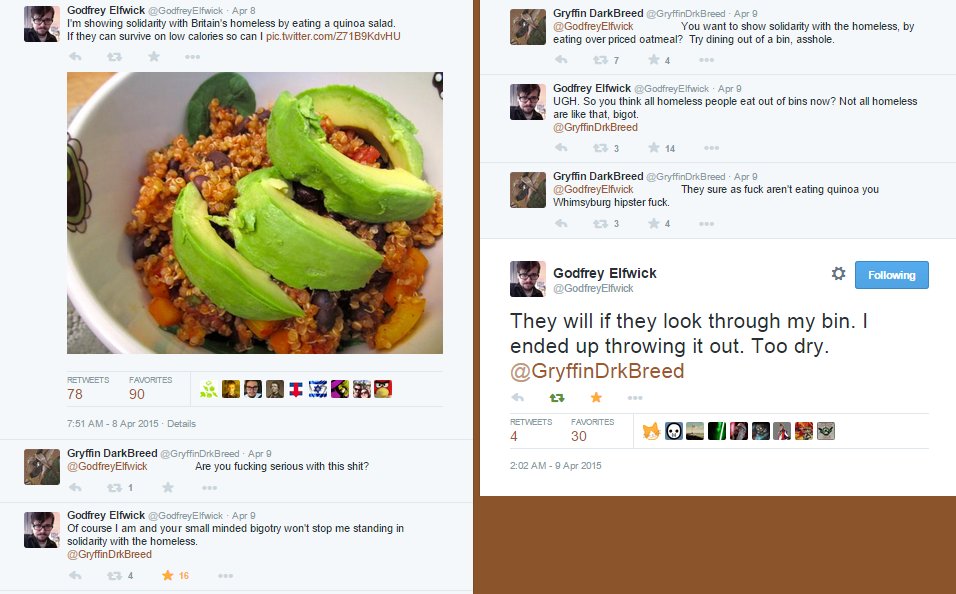
A few gems from the Trolling Hall of Fame:
Comments Off on The life and strange death of Godfrey Elfwick
July 24, 2018
Ayn Rand and the Hollywood blacklist
In the August/September issue of Reason, Jesse Walker discusses the role Ayn Rand played in the House Committee on Un-American Activities’ anti-Communist hearings on Tinseltown’s great and good:
Ayn Rand was a blacklist truther. The novelist and screenwriter had been a friendly witness during the House Committee on Un-American Activities’ 1947 hearings on Hollywood subversion — the probe that prompted the studios to announce that they would not hire Communists. But when she was asked about her testimony two decades later, she claimed that the blacklist was a myth.
“I do not know of any red blacklisted in Hollywood,” Rand told a Boston audience in 1967.
“I do know, if the newspaper stories can be trusted, that many of those ‘blacklisted’ people … were working in Hollywood thereafter under assumed names.” The real victims, she insisted, were the hearings’ friendly witnesses. “You talk about the blacklisting of reds. I don’t know of one leftist who has suffered for his views, and conversely, I don’t know of one pro-capitalist who in one form or another did not have to suffer for his views.”
This was misleading, to put it mildly. The blacklist really did exist. It was an organized effort to remove people from the movie industry for their political opinions, and the federal government played a major role in launching it. Anyone who cares about free expression should object to that sort of censorship by proxy, both as it manifested itself in the early days of the Cold War and as it threatens to re-emerge in social media today.
Yes, some of the more talented blacklisted writers continued to find work under assumed names or behind fronts. Dalton Trumbo knew how to write a movie that audiences would pay to see, and so Trumbo’s screenplays remained in demand. But others didn’t do studio work for a long time or left the industry altogether. (Blacklistee Alvah Bessie wound up taking a job as stage manager in a San Francisco nightclub and writing novels on the side.) And even folks like Trumbo found themselves getting paid a lot less. The blacklist eventually dissolved, but that took years. It is simply untrue that no Communists, real or alleged, lost work because of it.
On the other hand, it is true that some of the friendly witnesses of ’47 fared pretty badly. Rand mentioned a few examples at that Boston speech, among them Morrie Ryskind, who worked for those other Marxes when he scripted three Marx Brothers movies. “In Hollywood, he was getting $3,000 a week, which at the time was top money for writers,” she said. But “he has not worked as a writer one day since appearing as a friendly witness.” In Show Trial (Columbia University Press), his engrossing new book about those hearings, the Brandeis historian Thomas Doherty lists several examples of his own, from Jack Moffitt, who stopped getting hired to write motion pictures and fell back on reviewing movies for The Hollywood Reporter, to Fred Niblo Jr., who wound up leaving Hollywood to write religious films for television and documentaries for the State Department. In risk-averse Hollywood, anyone who stuck his head out might lose work for his trouble, especially if he came from the low end of the industry’s totem pole.
But this should not be equated, Doherty writes, “with the state-coerced, institutionally enforced blacklist of Communists, fellow travelers, and stubborn liberals.” That was a more fearsome and intrusive beast.
Comments Off on Ayn Rand and the Hollywood blacklist
July 23, 2018
Jeremy Clarkson is a maniac
Ove Bakken
Published on 19 Oct 2017
Comments Off on Jeremy Clarkson is a maniac
July 22, 2018
Trump and Putin … with all this smoke, there has to be a smoking gun, right?
Colby Cosh pours cold water on the still-smouldering hopes of the “smoking gun” enthusiasts:
If the president can be found guilty of “Treason, Bribery, or other High Crimes and Misdemeanors” that is another thing, but that would require courtroom-worthy evidence of action, as opposed to indications of presidential doctrine or feeling or even strong hints of compromised personal interest. Trump did behave in Helsinki like someone who is beholden to Russia, or who is anxious for a rapprochement with Putin’s state. Yet he was, and this could not have come as a surprise, quick to try reversing himself later — emphasizing how tough he has been with Russia and how tough he is prepared to continue to be. Grrr!
Since I’m not on a diet of television news, I tend to interpret this as Trumpian “leadership” technique. They are the actions of someone who is convinced that anything can be accomplished by means of erratic emotional style and business-literature verbal tactics. These include cheap personal praise for negotiating opponents, which has become a perfectly foreseeable theme of Trump as a diplomat. (The tactical corollary is that very popular or highly esteemed people are especially vulnerable to outbursts of surprise criticism, and that has been a feature of Trump, too.)
It does not really cost the United States anything for Trump to praise Putin as skilled and strong (as a tyrant, he has been effective at maintaining domestic moral legitimacy, even if judged by the cost in shed blood) or to portray Kim Jong Un as a young man coping with terrible responsibilities. (Trump’s distaste for NATO is more dangerous as rhetoric, but did the other member nations forget for a while that political legitimacy within the United States is a prerequisite for the organization’s existence? If in the long run we devote a little more attention to the necessary housekeeping, Trump may have done the world a service.)
[…] The midterm congressional elections will be held with a long-forgotten fact re-emerging in the American popular consciousness: that much of the president’s power to set foreign policy and foul up trade is actually the property of Congress, and could be reclaimed after a century of careless delegation.
Perhaps some Americans are beginning to consider that it does not matter most whether you are with the good guys in the Trump/anti-Trump drama. Which is not to say you do not want to be one of the good guys. But the opportunity for American millennials, considered as a generation on the cusp of electoral dominance, is not just to kick Trump out, but to renovate the presidency so that the republic can survive having an unsuitable or even compromised person as president. Everybody got that? Are we good? Eyes on the ball, people.
Comments Off on Trump and Putin … with all this smoke, there has to be a smoking gun, right?


