
The Great War
Published 9 Dec 2022The Spanish-American War (fought in Cuba and the Philippines) kickstarted US global ambitions and expanded their influence far beyond the borders of the United States. At the same time the war marked the endpoint of the decline of Spain as a global power.
(more…)
December 10, 2022
United States Empire – The Spanish-American War
Comments Off on United States Empire – The Spanish-American War
December 9, 2022
QotD: Computer models of “the future”
The problem with all “models of the world”, as the video puts it, is that they ignore two vitally important factors. First, models can only go so deep in terms of the scale of analysis to attempt. You can always add layers — and it is never clear when a layer that is completely unseen at one scale becomes vitally important at another. Predicting higher-order effects from lower scales is often impossible, and it is rarely clear when one can be discarded for another.
Second, the video ignores the fact that human behavior changes in response to circumstance, sometimes in radically unpredictable ways. I might predict that we will hit peak oil (or be extremely wealthy) if I extrapolate various trends. However, as oil becomes scarce, people discover new ways to obtain it or do without it. As people become wealthier, they become less interested in the pursuit of wealth and therefore become poorer. Both of those scenarios, however, assume that humanity will adopt a moral and optimistic stance. If humans become decadent and pessimistic, they might just start wars and end up feeding off the scraps.
So, interestingly, what the future looks like might be as much a function of the music we listen to, the books we read, and the movies we watch when we are young as of the resources that are available.
Note that the solution they propose to our problems is internationalization. The problem with internationalizing everything is that people have no one to appeal to. We are governed by a number of international laws, but when was the last time you voted in an international election? How do you effect change when international policies are not working out correctly? Who do you appeal to?
The importance of nationalism is that there are well-known and generally-accepted procedures for addressing grievances with the ruling class. These international clubs are generally impervious to the appeals (and common sense) of ordinary people and tend to promote virtue-signaling among the wealthy class over actual virtue or solutions to problems.
Jonathan Bartlett, quoted in “1973 Computer Program: The World Will End In 2040”, Mind Matters News, 2019-05-31.
Comments Off on QotD: Computer models of “the future”
December 8, 2022
Orwell wrote about the dangers of letting well-worn phrases do most of your writing for you back in 1946 – it’s still valid today
I posted a short paragraph from Orwell’s brilliant “Politics and the English Language” essay as a QotD entry earlier this year:
A scrupulous writer, in every sentence that he writes, will ask himself at least four questions, thus: What am I trying to say? What words will express it? What image or idiom will make it clearer? Is this image fresh enough to have an effect? And he will probably ask himself two more: Could I put it more shortly? Have I said anything that is avoidably ugly? But you are not obliged to go to all this trouble. You can shirk it by simply throwing your mind open and letting the ready-made phrases come crowding in. They will construct your sentences for you — even think your thoughts for you, to a certain extent — and at need they will perform the important service of partially concealing your meaning even from yourself.
As Chris Bray shows, things are, if possible, even worse today than in Orwell’s day:
We do not advance. The dominion of the ready-made phrase doesn’t provide a path for advancement. It provides a locked language for a long stalemate that edges into steady decline.
(Stella Morabito covers this ground in a new book, The Weaponization of Loneliness: How Tyrants Stoke Our Fear of Isolation to Silence, Divide, and Conquer, excerpted here in a short package of tremendously useful ideas about the way we shape ourselves to the prevailing discourse to avoid the feeling of isolation.)
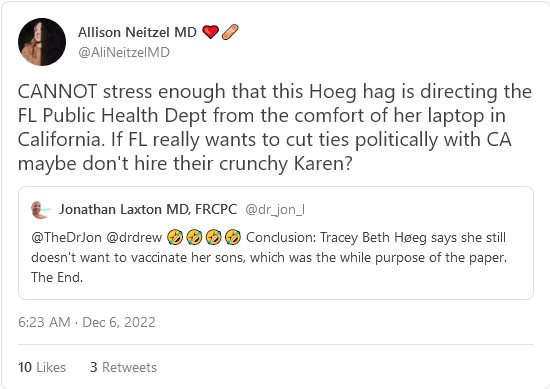
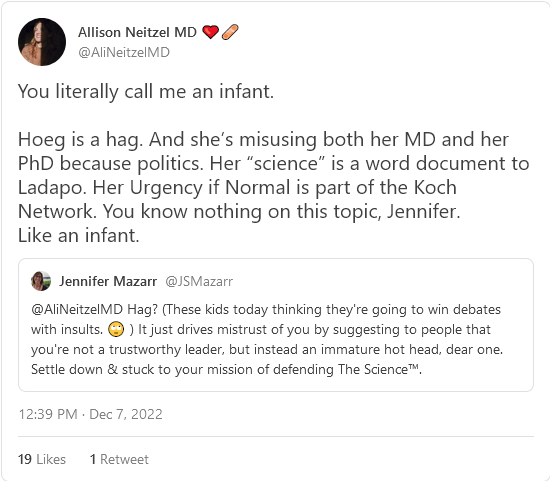
So Tracy Beth Høeg graduated from medical school in 2006, and later completed a PhD in epidemiology, then a medical residency. She does medical research and treats patients; you can go to her clinic and get medical help. Another person who went to medical school but then decided not to complete a residency or treat patients or publish peer-reviewed research casually dismisses her as “this Hoeg hag”.
In the dominion of the ready-made phrase, the many prevailing and easily grasped terms of social disapprobation provide comfort. The well-known denunciatory words and phrases give credentialed but unaccomplished people who live with social panic and status anxiety a way to elevate themselves by standing on someone else. That fucking hag, that anti-vaxxer bitch! Something something Koch Brothers something something! This ritual use of social denunciation as a status signal is precisely the dynamic Milan Kundera described in a series of novels about the social practices of late communist societies. The grab bag of social ruin trigger terms is easy for mediocre minds, which are empowered by the ability to shit on people for status without having to do much work.
It’s a psychological wall: white nationalism Fox News anti-vaxxers Koch brothers! You can be important and powerful without doing anything, by performing the degradation of someone who has — using the useful shortcut of the ready-made phrases. You don’t have to do or be; you can signal and display. Status is a performance of familiar words directed at the usual and useful targets. It’s lazy, it’s mindless, and it gets a good number of people through their days. Imagine being the 34,567th public intellectual to slam a Covid vaccine critic on Twitter. So fresh! So brave!
Comments Off on Orwell wrote about the dangers of letting well-worn phrases do most of your writing for you back in 1946 – it’s still valid today
Meta (the artist formerly known as Facebook) moves to clamp down on political discussions in the workplace
Tom Knighton on an uncharacteristic corporate move by the artist formerly known as Facebook:

My favourite reaction to Facebook rebranding as “Meta”.
It seems there are certain words employees aren’t really supposed to bring up in the workplace.
Meta (formerly Facebook) has reportedly told its employees not to discuss sensitive issues like abortion, gun control, pending legislation and vaccine efficacy at workplace.
According to a report in Fortune, citing a leaked internal memo, Meta has banned employees from discussing “very disruptive” topics, including abortion, gun rights, and vaccines as part of new “community engagement expectations”.
“As Mark mentioned recently, we need to make a number of cultural shifts to help us deliver against our priorities,” read the company memo.
“We’re doing this to ensure that internal discussions remain respectful, productive, and allow us to focus. This comes with the trade-off that we’ll no longer allow for every type of expression at work, but we think this is the right thing to do for the long-term health of our internal community,” it added.
Unfortunately for Meta, employees hammered them on the fact that they could talk about Black Lives Matter, immigration, and trans rights.
Now, they’re not really wrong to call out the hypocrisy, but this sounds like just a first move, and it’s a step in the right direction.
What would have been a better move is simply prohibiting discussing politics with your coworkers unless it directly pertains to your job. For example, if you are responsible for content moderation and a new bill will impact how you conduct that moderation, that’s one thing.
But topics ranging from Black Lives Matter to gun control are all contentious issues, and while Meta might have allowed that discussion in the past, they probably won’t indefinitely.
This is interesting to me, in part because we’ve seen the woke in the technology sector essentially bully employers into following along with the left’s agenda. Yet when they tried that with Netflix, the streaming giant basically told them to suck it up.
That was in May, but it may have triggered companies to realize that they didn’t have to play the woke game.
Last week, in the weekly wrap-up, I included this story about how Disney’s returning CEO Bob Iger is trying to have the company step back from the political ledge. Iger is far from a conservative, mind you, but he’s come to realize that his personal political agenda isn’t going to sell.
Granted, he started them along that path, but he’s recognized it’s not a great road to go down.
Now, we have Meta that may be venturing on a similar path to Netflix, setting the stage for what’s appropriate and what isn’t.
Comments Off on Meta (the artist formerly known as Facebook) moves to clamp down on political discussions in the workplace
QotD: Politicians’ public displays of sorrow
Theodore Dalrymple, “Tears of a Tyrant”, Taki’s Magazine, 2018-04-28.
Comments Off on QotD: Politicians’ public displays of sorrow
December 7, 2022
Facebook’s strategy for collapse
Ted Gioia clearly isn’t a Facebook fan — and I sympathize, having lost access to my Facebook account a few years ago — but it’s not just people like us that have contributed to Facebook’s epic decline:

Most companies fail because of competition. They simply aren’t fast enough or smart enough to keep up with the marketplace.
But the big web platforms aren’t like that.
In many instances, they are quasi-monopolies. They are so big and powerful that they hardly need to worry about competition.
After all, who can match Google for search? Who can beat Amazon for online shopping? Who does more to keep you connected with family and friends than Facebook? Who helps you clean out the junk in your garage better than eBay?
But even the most dominant players can falter. There was a point in living memory when Sears controlled 30% of all retail spending in the US. I’m not exaggerating: three out of every ten dollars were spent at Sears.
Sears once operated 3,500 stores. Today only 22 are left. Many of my readers have never seen the inside of a Sears store.
This happened because Sears was so big that it didn’t need to worry about competitors.
That sounds impossible. How can you fail by being too powerful? But this has happened in many instances, even on the web. There was a day when Yahoo was the leader in search. There was a day when MySpace was the dominant social network. There was a day when Tumblr was the place to share photos.
There was even a day when the two companies in total control of your access to the Internet were called Netscape and America Online.
Not anymore.
This has happened before and will happen again. The bigger they are, the harder they fall.
[…]
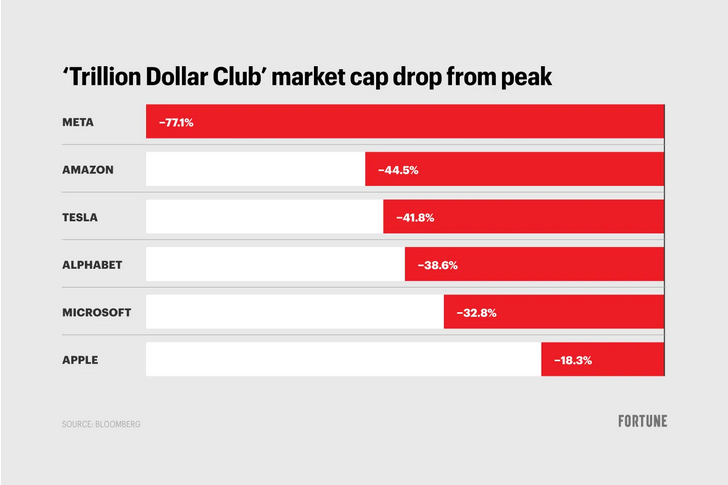
The situation at Facebook is now uglier than MC Hammer’s wardrobe closet. Meta is the worst performing stock in the S&P 500 this year. In other words, there were 499 other companies in the composite that did better — and this was a tough year all around in financial markets.
Mark Zuckerberg has personally lost more than $100 billion. In fact, he lost $11 billion in a single day. Has that ever happened before in human history? Almost exactly 12 months earlier, I’d written an article entitled “Meta Is for Losers” — but even I never envisioned losses on this scale,
Of course, there are many losers in this story — including the 11,000 workers who got fired a few days ago.
What’s going on?
You probably think that this is the result of Zuckerberg’s fool’s bet on the Metaverse. That’s what everybody is saying. But as we shall see, the Metaverse is just a symptom not a cause.
I can actually explain the problem in one sentence:
Instead of serving users, the dominant company decides it’s better to control them.
This would never occur to a small business. The owner of your neighborhood deli or gas station has no grand plans to control people — for the simple reason that this is an impossible dream.
That’s the reason why they say: “The customer is always right.” It’s not because the customer isn’t often wrong. Customers are frequently wrong — go listen to them sometimes and cringe at the stuff they demand. But if you’re in business, you must act as if they’re right even when they aren’t. And you do learn things by listening, even (or especially) when their demands are excessive.
By the way, you succeed by listening in every sphere of your life — starting at home.
There’s a good reason why students at hospitality school are told never to use the word never — or “no” or “can’t” or “impossible” — when talking to clientele. Instead of saying: “No way, dude, we’re not putting mayonnaise on your pizza, that’s disgusting”, you offer something positive:
I wish we could do that, dude, because it does sound super tasty — but I will put extra mozzarella on your slice, and our high temperature oven will give it a kind of mayo texture.
That’s how you roll in retail.
But at Facebook, the customer is always wrong.
Comments Off on Facebook’s strategy for collapse
The media: they hate you, they really hate you
In a follow-up to yesterday’s post at Thank You Truckers!, Donna Laframboise provides more details on one of the individual cases highlighted by Douglas Murray in the Munk Debates last week:
Collectively, those examples demonstrate three things: Egregious journalistic bias. A frightening inability to empathize with the working class. And a bizarre eagerness to slander and dismiss fellow human beings.
Because the examples cited by Murray are vile, I didn’t amplify them. But those of you who watched the three-minute clip heard about them. On further reflection, therefore, I’m going to highlight one of them. Simply to make the point that Murray wasn’t exaggerating. When he used the words rancid and corrupt to describe our current media environment, he was wholly on target. Here’s a small portion of Murray’s remarks, including some third party profanity:
You had a Toronto Star columnist saying, quote (sorry for the language), it’s a homegrown hate farm that was then jet-fuelled by an American right-funded rat-fucking operation …
Yup, that was a real tweet from Bruce Arthur, who earns his living as a sports writer, currently for the Toronto Star. Below is his full reply to comments made by another Canadian journalist, Jeet Heer, who writes for The Nation, a far-left US publication:
I worked with both these gentlemen 20 years ago, in the earliest days of the National Post. It was a large newsroom. I didn’t get to know either of them.
The day after they catapulted these deluded, venomous tweets into the world, I arrived in Ottawa. I spent a week there, taking photos and actually talking to people. The Freedom Convoy protesters I met were supremely decent human beings. Since then, I’ve formally interviewed many of them. I’ve learned about their lives, their triumphs, their troubles, their sorrow.
My conclusion? If I were stranded on a desert island — or if a nuclear bomb detonated anywhere near me — I’d be sticking close to folks like these. People who know how to fix things, how to build things, and how to get things done. People sufficiently concerned about right and wrong to put themselves at risk. People of faith, many of them, who show us religion at its finest — a stable, calming force. A source of courage, strength, and big picture perspective.
Those who protested in Ottawa were human beings, not saints. That’s true of every large gathering. But overwhelmingly, they were decent, salt-of-the-earth people.

Even the members of the Canadian media still trying to be more even-handed in their coverage felt obligated to go looking for the red-hatted Trump supporters, the “hard men”, and the potential trouble-makers to the point that those relatively few people seemed disproportionally represented in the published articles. Of course, all of them spent a lot of time and effort desperately searching for more idiots like that paid government agent who’d briefly been able to get on-camera waving his Nazi flag …
Comments Off on The media: they hate you, they really hate you
QotD: Career path from recent B.A. to being “an expert” on national TV
Just for giggles, I clicked on the bio of the cutest contributor — called, hilariously, “analysts and associates” — a
womangirlpersyn named Karolina Hird. Here’s her official bio, in full:
Karolina is a Russia Researcher on the Russia/Ukraine portfolio at ISW. She graduated from George Washington University in December of 2021 with a B.A. in International Affairs and a concentration in Security Studies. Karolina’s undergraduate research examined aspects of international law and Eastern European security with a special focus on the rise of Polish populism. She has also conducted research pertaining to Russian objectives and geopolitical strategies on NATO’s Southern periphery.
Did everyone catch that? A Bachelor’s Degree. In December 2021. This gal is all of nine months out of college.
I’ve read my share of undergraduate research. Some of it is decent. There are some undergrads I’d trust to hit the archives for limited purposes. But there are no 21 year old kids on this earth whose judgments I’d trust, because I’ve taught a LOT of college kids, and y’all …But of course she’s not doing anything policy-related. You know how this kid’s career trajectory will go: A few years at ISW, in which she’ll start appearing as a guest on the “news” as a “Ukrainian affairs expert” — and you can tell she’s an expert, because she’s an “analyst” at the “Institute for the Study of War”. Once her looks start going, she’ll move over to a staff job for some politician, then off to a think tank, then maybe a run for office in her own right, then back to the Media as a “senior analyst”. I’d wager many crisp stacks of Crispus Attucks that this lady couldn’t tell the difference between a MiG-31 and a Mazda Miata, but we’re a year or two away from putting her on national TV as an “expert” on war and peace.
How do you stop that kind of thing? How would you even start?
Severian, “Slipping the Leash”, Founding Questions, 2022-08-27.
Comments Off on QotD: Career path from recent B.A. to being “an expert” on national TV
December 6, 2022
Elizabeth Nickson on Prime TV’s new mystery series, Three Pines
I don’t watch much TV myself, aside from Minnesota Vikings football games, so what little I know about current TV offerings is pretty much all second-hand … and as Elizabeth Nickson‘s review shows, I don’t think I’m missing much at all:
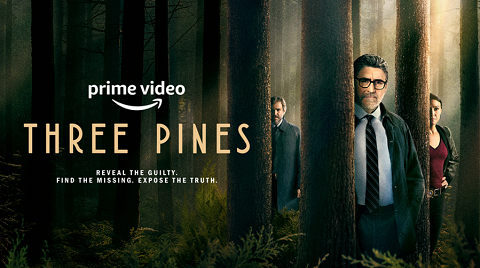
I had the distinct unpleasure this week of watching Prime TV’s new mystery series, Three Pines, set in the village I grew up in, Knowlton, Quebec, where the author now lives and the geography within which she sets her series. I have a rule of not watching anything violent (except Yellowstone) but to catch a glimpse of the village I ranged through as a kid, I sucked it up.
Of course, I was immediately insulted, as the first scene had a white-blond beefy Anglo (Nazi Alert!) cop in Quebec City (an Anglo cop in Quebec City is vanishingly rare) beating up an Indian woman. The thing marched on, hitting every nasty leftie trope, through an increasing ugly physical landscape. The writer, Louise Penny, is very successful, top of the NYTimes bestseller list with every book and much loved by women of a certain age. Penny’s work is a look inside their heads. Hillary Clinton and she are friends, ’nuff said.
The show is like a beautiful painting over which an angry adolescent has thrown red and black paint in order to “show reality”. A friend who who lives across the street from Penny’s palatial residence states that, contra her reality, there has been one murder in the village in the last 80 years and that was an argument over a pig.
Penny has populated my village with killers, bigots, madmen and women, noble Indians, and noble artistes who wrestle with evil normals, all of whom are unhappy because they are so unethical, bigoted, homophobic and racist. There is also a former residential school in situ, which there was not. There are literally no children in the show. No children, no families. (Penny is childless like most of her generation of Canadian artists) Just noble artistes, hard-done-by-noble Indians and noble French policemen.
Oh wait, there is one 12 year old. She murders her mother.
An unrelated thematic undercurrent about Canada’s maltreatment of its native peoples clubs the viewer, so of course that gives Penny permission to trash the culture she exploits. There is, apparently, no wound that she will not scrape at, making it bigger, more dramatic, more focused on her hatred for white Anglo men.
And women. The villain, like all her villains, is a sick, entitled, white woman. Basically Penny loathes rich white people of any sex, while living a lush life in the place they created. Because Knowlton was the summer and weekend place of Canada’s then corporate elite. A village of 500 bulked out to 1500, as the interlocking network of the people who built the infrastructure of modern Canada came to summer. Penny profits off the product of bitterly hard generational labor, while trashing it. Which is a metaphor for our arts.
I went to the local school for seven years so was friends with both parts of the community. My father was on every committee in the village, and he and his fellows made sure there was not one fallen sparrow in the region. The only way anyone fell out of the network of care that used to exist in every small town in Canada and the US, was through alcoholism. Aside from crime caused by that sickness, there was virtually none. And for the fallen, there were halfway houses and treatment. Unlike Penny’s implication of hate and neglect, Indians in the area were, to the extent they allowed, helped, funded, cared for. Like almost every early settler family, my father’s family had married into two Indian tribes, and in the case of my father, given his cousinage, were understood.
Because that’s what Christians do, and at the time, everyone was Christian.
That job now falls to bureaucrats who, like Penny, see everyone as unreconstructed bigots, walking beasts capable of sudden mayhem, and treats them accordingly. The village, if my eyes are telling me true, is no longer beautiful. At least the filmmakers don’t see any beauty in it. Setting it there, like Penny, they hope to capitalize on the mythical small town’s history as a place where happiness and safety were possible. And then they can destroy its memory as a place where goodness reigned.
Comments Off on Elizabeth Nickson on Prime TV’s new mystery series, Three Pines
The outcome of the latest Munk Debates
Donna Laframboise summarizes what happened last week in the Munk Debates as Matt Taibbi and Douglas Murray spoke in favour of the proposition “Be it resolved, don’t trust mainstream media” while Malcolm Gladwell and Michelle Goldberg argued against:
Last week, an old fashioned public debate took place here in Canada. The topic:
Be it resolved, don’t trust mainstream media.
Journalists Douglas Murray (UK) and Matt Taibbi (US) argued the pro/agree side.
Journalists Malcolm Gladwell (Canada) and Michelle Goldberg (US) argued the con/disagree side.
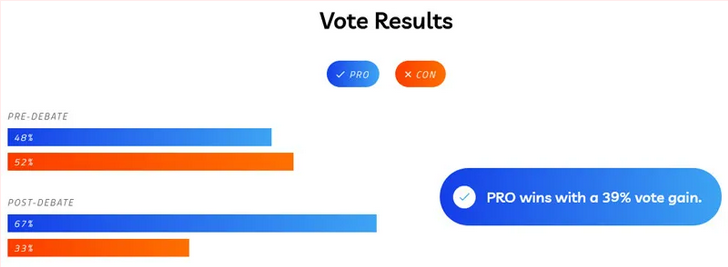
The event was sponsored by Munk Debates, which has been holding these events since 2008. Before the debate commences, audience members vote. Two hours later, they vote again.
On this occasion, the opinion swing was dramatic. The “don’t trust” side grew by 39% — apparently the largest swing ever in a Munk debate. At the beginning, slightly less than half of the in-house audience held this opinion (48%). Afterward, it was two-thirds (67%).
(When two-thirds of a population agrees on anything, you’re in supermajority territory — a number large enough to change constitutions.)
Here’s the key point: the winning side of the debate placed great emphasis on the scandalous manner in which Canada’s mainstream media covered the Freedom Convoy. Residing as he does in Britain, Douglas Murray had no trouble cutting through the nonsense. In the 3-minute video clip at the top of this post, he says our Prime Minister started by calling protesters names, and ended by invoking the Emergencies Act. Here’s what he says next:
At such a time, what would the mainstream media do? It would question it. It would question it. The Canadian mainstream media did not.
The Canadian mainstream media acted as an Amen chorus of the Canadian government. I will give you a couple of examples, but ladies and gentlemen I could go on for hours with examples of this. You had a CBC host describing the Freedom Convoy as a quote feral mob …
Why is this so rancid? Utterly, utterly rancid and corrupt. Because in this country, your media, your mainstream media is funded by the government. A totally corrupted system.

Comments Off on The outcome of the latest Munk Debates
December 5, 2022
“… when confronted, our self-proclaimed warriors against fake news and misinformation are just lying about what they’re doing”
From the free-to-cheapskates excerpt from this weekend’s dispatch from The Line:

A typical haul of weapons confiscated by Toronto Police Services in 2012. Most of these guns are in the “restricted” or “prohibited” category of Canadian firearms and would not be available for legal purchase by anyone who had not gone through a rigorous RCMP background check and passed multiple training courses. Almost certainly none of them came from a legal owner.
We hate this as much as you do, but we must discuss guns with you again. We think the Liberals have screwed up, and we aren’t sure yet they realize it. (But they’re probably clueing in.)
You know why we’re suspicious? The Liberals are extremely good at marketing. A depressing amount of the time, it’s all they’ve got. They can take the smallest morsel of accomplishment and make it the centrepiece of a coordinated nation-wide grassroots mobilization campaign and fundraising drive. They have memes and other social shareables ready to go. Cabinet ministers release cringe videos captured by staffers who probably realize, in the very moment of their filming, that they’ve wasted their God-given potential on … this.
Outcomes? The hell with those. Let’s talk about those inputs, baby! In both official languages.
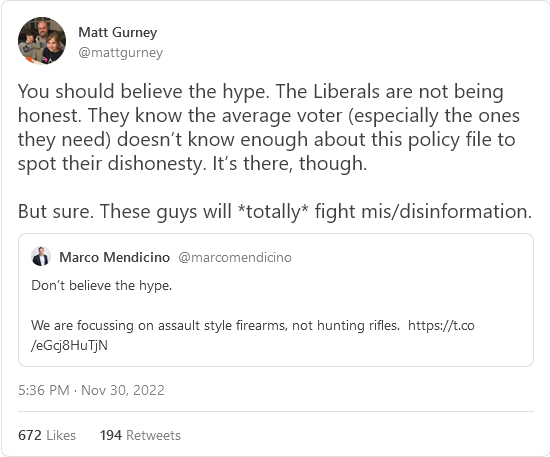
But this time? When the Liberals have actually embarked on what would be the most significant overhaul of our firearms laws in a generation? Not only have they not said boo. They’re going out of their way to deny that they’ve done anything. Or, when confronted, our self-proclaimed warriors against fake news and misinformation are just lying about what they’re doing.
So either they don’t know what they’re doing (very possible), regret what they’ve done (also very possible) or it’s a confused mix of both (our working theory).
But let us explain. And forgive us, but things will get a bit technical. (We’ll keep it as simple as possible, but guns are complicated.)
Canadian firearms policy has generally tried to classify firearms by their technical specifications. Three broad categories were created by the major reforms of the 1990s. “Prohibited” firearms essentially were machine guns, automatic assault rifles of the kind used by modern militaries, and easily concealed short-barrelled handguns; prohibited licences were issued in the 1990s to a relatively small number of individuals who already owned such firearms and their immediate descendants (to cover family heirlooms), but prohibited firearms otherwise are not available to the public. “Non-restricted” firearms were the very common rifles and shotguns suited (and frequently used) for hunting or target shooting sports, and require the least onerous level of licensing (but still, you do need a licence that involves background checks and vetting). In the middle we had “restricted” firearms — mostly handguns — that require a special licence beyond the normal licence, requiring extra training and conditions.
These broad categories do not always reflect the reality of how the laws actually shaped up. The prohibited and restricted categories were often stretched by meddling politicians to apply more broadly than they ought to have, so that politicians (mainly Liberals) could claim to be “tough on guns” in particular instances. But these three categories have been generally stable for a generation, and functioned well, more or less. Perfectly? No. But our gun-control laws worked for the public at large, which is why violent gun crime by licensed individuals is rare despite a relatively high rate of firearms ownership in Canada.
You wouldn’t think it given all the political controversy, but Canadian gun control has been a fundamentally successful public-policy program, for decades. The very real problem we have with gun violence in this country is overwhelmingly committed with illegal guns smuggled in from the United States, and fall outside the scope of our gun-control system, which works well doing what it is supposed to do: licensing lawful gun owners, regulating the legal uses of guns and regulating, as well, the lawful hunting and shooting sports industry.
For all its success as public policy, though, the system didn’t work for the Liberals politically. So they decided to get cute. And that’s where their problems began.
Comments Off on “… when confronted, our self-proclaimed warriors against fake news and misinformation are just lying about what they’re doing”
December 3, 2022
“The Valley of Death” – The Battles of Doiran – Sabaton History 115
Sabaton History
Published 1 Dec 2022The Bulgarian defenses in the Lake Doiran region were pretty much the best defenses any country had anywhere in the Great War, which the Entente forces discovered as they tried time and again and failed time and again — to break the front.
(more…)
Comments Off on “The Valley of Death” – The Battles of Doiran – Sabaton History 115
December 2, 2022
Matt Taibbi – “This is not journalism. It’s political entertainment, and therefore unreliable.”
Matt Taibbi posted his opening remarks for the Munk Debate on the topic “Be it resolved: Do not trust the mainstream media”:
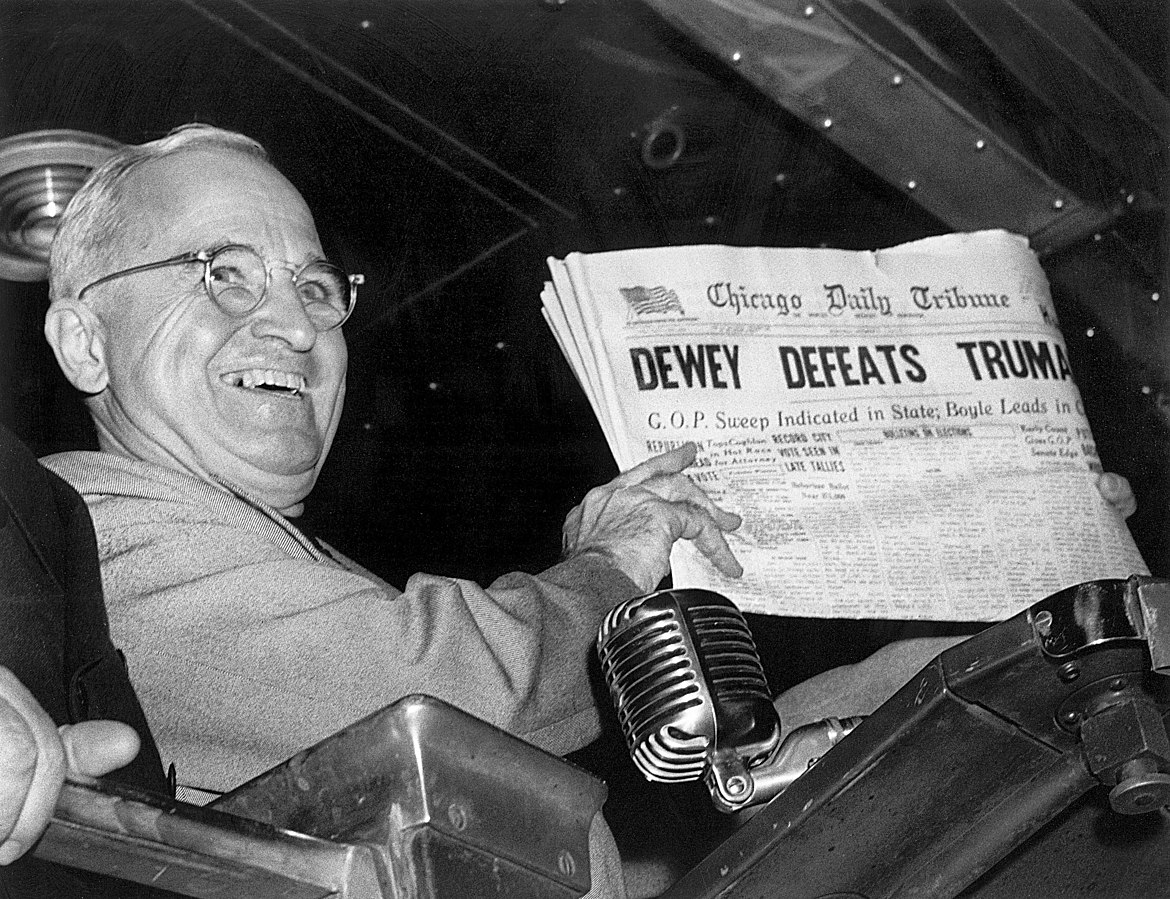
President Harry S. Truman holds up an election day edition of the Chicago Daily Tribune, which – based on early results – mistakenly announced “Dewey Defeats Truman.”
AP Photo/Byron Rollins from November 4, 1948, via Wikimedia Commons
I love the news business. It’s in my bones. But I mourn for it. It’s destroyed itself.
My father had a saying: “The story’s the boss.” In the American context, if the facts tell you the Republicans were the primary villains in this or that disaster, you write that story. If the facts point more at Democrats, you go that way. If it turns out they’re both culpable, as was often the case for me across nearly ten years of investigating Wall Street and the causes of the 2008 crash for Rolling Stone, you write that. We’re not supposed to nudge facts one way or another. Our job is to call things as we see them and leave the rest up to you.
We don’t do that now. The story is no longer the boss. Instead, we sell narrative, as part of a new business model that’s increasingly indifferent to fact.
When there were only a few channels, the commercial strategy of news companies was to aim for the whole audience. A TV news broadcast aired at dinnertime and was designed to be consumed by the whole family, from your crazy right-wing uncle to the sulking lefty teenager. This system had its flaws. However, making an effort to talk to everybody had benefits, too. For one, it inspired more trust. Gallup polls twice showed Walter Cronkite of CBS to be the most trusted person in America. That would never happen today.
[…]
Our colleagues on the other side tonight represent two once-great media organizations. Michelle, the Pew survey says the audience for your New York Times is now 91% comprised of Democrats. Malcolm, the last numbers I could find for the New Yorker were back in 2012, and even then, only 9% of the magazine’s readers were Republicans. I imagine that number is smaller now.
This bifurcated system is fundamentally untrustworthy. When you decide in advance to forego half of your potential audience, to fulfill the aim of catering to the other half, you’re choosing in advance which facts to emphasize and which to downplay. You’re also choosing which stories to cover, and which ones to avoid, based on considerations other than truth or newsworthiness.
This is not journalism. It’s political entertainment, and therefore unreliable.
With editors now more concerned with retaining audience than getting things right, the defining characteristic across the business — from right to left — is inaccuracy. We just get a lot of stuff wrong now. It’s now less important for reporters to be accurate than “directionally” correct, which in center-left “mainstream” media mostly comes down to having the right views, like opposing Donald Trump, or anti-vaxxers, or election-deniers, or protesting Canadian truckers, or any other people deemed wrongthinkers.
In the zeal to “hold Trump accountable”, or oppose figures like Vladimir Putin, ethical guardrails have been tossed out. Silent edits have become common. Serious accusations are made without calling people for comment. Reporters get too cozy with politicians, and as a result report information either without attribution at all or sourced to unnamed officials or “people familiar with the matter”. Like scientists, journalists should be able to reproduce each other’s work in the lab. With too many anonymous sources, this becomes impossible.
Comments Off on Matt Taibbi – “This is not journalism. It’s political entertainment, and therefore unreliable.”
The whole music culture, it seems, is now under the sway of a chipmunk aesthetic
Ted Gioia explores the oddity of musical tastes on TikTok:
When I was a child, a band called Alvin and the Chipmunks enjoyed a brief taste of fame. Hot bands come and go, but this one had a bizarre back story.
First of all, it didn’t really exist. The band consisted of cartoon chipmunks. In this regard, Alvin and his rodent colleagues get credit for anticipating the anime pop stars of the current day.
Second, these singing chipmunks were more a brand than a band. Because these animals were make-believe, they couldn’t go on tour — but they could sell boatloads of merchandise, from lunch boxes to comic books. This, too, anticipated much of our current music industry — where the side deals often make more money than concerts and records.
But even stranger, this group aimed to imitate the sound of singing chipmunks by speeding up recordings of human vocalists. The end result was arguably the most annoying sound in 20th century music (a rare distinction, that). I can’t stand listening to these tracks, but they somehow won five Grammy Awards. Alvin and the Chipmunks actually enjoyed two number-one singles.
That’s two more than Bob Dylan can claim.
In all fairness, these same tracks sound even worse when slowed down. So maybe there’s something to be said for getting to the end of the song as fast as possible.
But here’s the most surprising part of the story. This sped-up sound also anticipated the contemporary music of our own time — it’s actually one of the hottest trends on TikTok.
The whole music culture, it seems, is now under the sway of a chipmunk aesthetic. This, to my way of thinking, is even more foreboding than all those people who want us to eat bugs and compost our deceased loved ones.
I’m starting to think that Alvin and the Chipmunks belong in the Rock and Roll Hall of Fame. Maybe I can’t stand listening to the stuff, but these cartoon critters clearly pointed the way to the future. A dark dystopian future, perhaps, but I guess that’s what happens when you treat rodents as role models.

December 1, 2022
Crisis? Which crisis?
In The Line, Matt Gurney makes the case that was NATO (and western governments in general) needs is something called “deliverology”:

I couldn’t have asked for a more topical example of exactly what I’m talking about here: the lull between realization and reaction. There were no problems with “expectations” at the top of the federal government in February [during the Freedom Convoy 2022 protests]. Everyone in a position of authority was seized with the urgency of the situation and the need for rapid action. There wasn’t any denial, doubt or incomprehension, which are the usual enemies when I write about our expectations being a problem.
February was an example of a different issue: realizing there was a crisis but not really knowing what to do about it, or whose job it was to do it, and wasting a lot of precious time trying to figure it all out. When days and even hours count, governments can’t spend weeks or months figuring out what to do. But that’s what happened during the convoys, and during COVID, and other incidents I could rattle off. Does anyone think it won’t happen again next time, whatever that threat may be?
And some version of that concern came up over and over in Halifax [at the Halifax International Security Forum]. And not just among Canadians. The world is changing very quickly and even when we recognize a problem, we aren’t moving fast enough to keep up. So on top of our expectations, we’ve got another challenge: response times. They’re just too damned long.
I hope the readers will forgive me for being a little vague in this next section; some of the conversations I’m thinking of here were in off-the-record sessions. Rather than trying to splice together any specific quote or anecdote, I’ll just wrap it all up under the theme of “There are things we should be doing now that we weren’t, and things we should have been doing a long time ago that we only started on way too late.”
An obvious example? The rush to get Europe off of Russian fossil fuels and on to either locally generated renewables or energy imports from allies and friendly nations. (If only there was a “business case” for Canada doing more. Sigh.) Another fascinating example that came up was air defences. Two decades of post-Cold-War-style thinking among the allies has led to widespread neglect among the NATO countries of air-defence weapons. Why bother? The Taliban didn’t have an air force, right?
Most countries have fighter jets and inventories of air-to-air missiles suitable for their planes. However, across the alliance, there are very few ground-based air-defence systems suited to shooting down not just attacking aircraft, but incoming cruise missiles and drones.
Drones pose a particular challenge. They fly slow and low and are highly manoeuvrable, plus they are so cheap that they can be a true asymmetrical weapon: you’ll go broke real quick firing million-dollar missiles at a drone that costs your enemy $50,000 or so. And your enemy may send a few hundred at once in a swarm that simply overwhelms your defences. It’s not that drones are unbeatable. The opposite is true: drones are easily destroyed, if you have the right defences available.
We don’t, though. Oops.
The NATO powers actually had a preview of this element of the ongoing war between Ukraine and Russia during the 2020 conflict between Azerbaijan and Armenia, where drones were used to devastating effect. Every military affairs watcher I know sat up a bit straighter after watching what the Azeris did to Armenia, with shocking speed. Swarms of drones first killed Armenia’s air defences and then went to work on Armenian ground forces. The U.S. and NATO allies have been studying that conflict, and considering how to adapt our own strategies, for both offence and defence. But right now, nine months into the Ukraine war and two years after the conflict in the Caucasus, there still aren’t enough NATO systems available even for our own needs, let alone to share with Ukraine. Russia keeps hammering away at critical Ukrainian civilian infrastructure and the Ukrainians keep begging for help, but we have nothing to send. To be clear, a few systems have been sent to Ukraine, which include not just the weapons but the radars and computers necessary to detect and engage targets. But they can only be delivered as fast as they can be built. There is no real production pipeline here, and certainly no pre-stocked inventories in NATO armouries.
Comments Off on Crisis? Which crisis?


