Quotulatiousness

August 19, 2019

The Peterloo Massacre

Filed under: Britain, History, Liberty, Military, Politics — Tags: , , , — Nicholas @ 05:00

In Spiked on Friday, Brendan O’Neill marked the 200th anniversary of a brutal suppression of thousands of protestors demanding the right to vote in Britain:

The Peterloo Massacre by Richard Carlile (1790-1843)
To Henry Hunt, Esq., as chairman of the meeting assembled in St. Peter’s Field, Manchester, sixteenth day of August, 1819, and to the female Reformers of Manchester and the adjacent towns who were exposed to and suffered from the wanton and fiendish attack made on them by that brutal armed force, the Manchester and Cheshire Yeomanry Cavalry, this plate is dedicated by their fellow labourer, Richard Carlile: a coloured engraving that depicts the Peterloo Massacre (military suppression of a demonstration in Manchester, England by cavalry charge on August 16, 1819 with loss of life) in Manchester, England.

All the poles from which banners are flying have Phrygian caps or liberty caps on top. Not all the details strictly accord with contemporary descriptions; the banner the woman is holding should read: Female Reformers of Roynton — “Let us die like men and not be sold like slaves”.
Manchester Library Services via Wikimedia Commons.

Today is the 200th anniversary of the Peterloo Massacre, when working people in Manchester were attacked and murdered by cavalry forces for daring to demand the right to vote. And what is our political class doing on this anniversary of such an important event in British political history? They are plotting, tirelessly, to overthrow something that millions of working-class people, and others, voted for: Brexit. They are doing what the Peterloo butchers did, only by political means and court cases rather than with bayonets and sabres. Our current political rulers may not physically attack the masses for having the temerity to use their democratic voices — not yet, anyway — but they view us with the exact same seething, elitist contempt as those who did attack the masses in St Peter’s Field on 16 August 1819.

Around 60,000 men, women and children gathered in St Peter’s Field in Manchester 200 years ago to demand parliamentary representation. They wanted that most basic and essential democratic right: the right to vote. The teeming industrial city of Manchester had no elected MPs in parliament. The old “rotten boroughs” system meant that often sparsely populated rural areas sent MPs to the Commons, involving much patronage and sometimes even the buying of votes by wealthy aspiring politicians, while newly industrialised cities full of the growing urban working classes had little to no political representation. Against a background of post-Napoleonic Wars economic depression and a fast-spreading radical desire for meaningful democratic change, the tens of thousands of marchers arrived in St Peter’s Field with a clear demand: let us vote, let us speak.

What happened next is well known. They were attacked by cavalry forces. Troops on horseback wielded sabres against the democratic crowd. They slashed and stabbed, killing 18 people. Around 500 were injured. The slaughter was given the name “Peterloo” as an ironic comparison to the Battle of Waterloo that took place four years earlier, in 1815. The bourgeoisie’s assault on the working-class democrats of Manchester had a deep impact on the radical psyche. New movements emerged in subsequent years, including the Chartists, the working-class movement for democratic representation. But it would be decades before the right to vote had been established across society. In 1867 some working-class men got the right to vote. In 1918, all men and some women got the right to vote. In 1928, finally all women got the vote. The General Election of 1929, 110 years after the march to St Peter’s Field, was the first election in which all adults had the right to vote.

The 200th anniversary of this bloody assault on working-class democrats ought to be a major occasion. It should be a reminder of the incredible, heroic sacrifices earlier generations made to secure people’s right to express themselves, to vote, and to see their votes be enacted. And yet while some in the political and media class will today pay lip service to the heroes of St Peter’s Field and express regret about the massacre of 18 of them, most of the elites will be too busy to do anything of the kind. Busy doing what? Trying to override and crush the votes of 17.4million people, which includes millions of working-class people and eight million women. It is a genuinely alarming and revealing moment: the 200th anniversary of the Peterloo Massacre arrives and the political set is engaged in an effective coup against the people; in a war against “No Deal Brexit” (which really just means a war against Brexit); in a concerted effort to force the ignorant public, as they see us, to vote for a second time and to give the “right” answer on this occasion.

August 14, 2019

Hong Kong’s struggle with the Chinese government

Filed under: China, Government, Law, Liberty — Tags: , , , , — Nicholas @ 03:00

Andrew Coyne on the desperate situation of the Hong Kong protests:

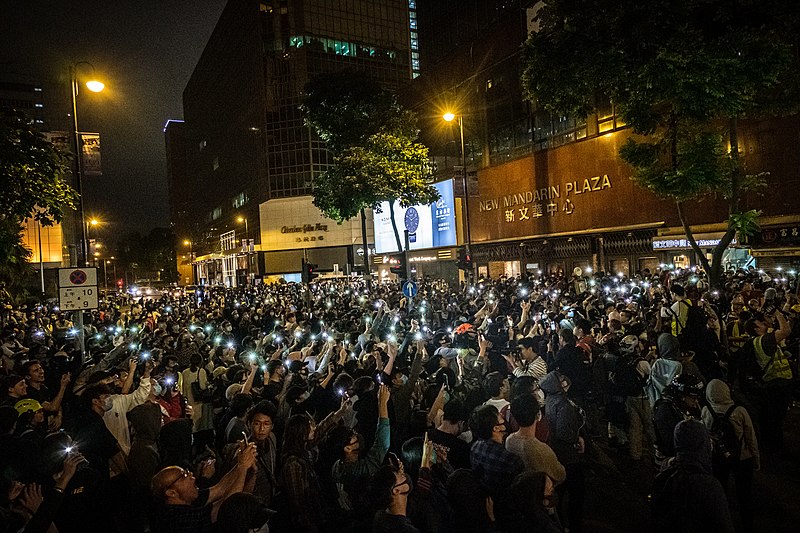
2019 Hong Kong anti-extradition law protest on 16 June, captured by Studio Incendo from Flickr.
Photo via Wikimedia Commons

A sickening pall of inevitability hangs over the protests in Hong Kong, now in their tenth week. Neither side can afford to back down – the protesters, because their way of life, indeed their very lives, are at stake; the Beijing-backed government, for the precedent it would set, and the hope it would inspire.

As the violence mounts — most of it, to date, on the part of the police, or in some cases the Triad gangs hired to beat and intimidate the protesters — so does the likelihood of mass bloodshed, a reprise of the Tienanmen massacre of 30 years ago. Some of the protesters may indeed hope to tempt Beijing into such an appalling overstep; however horrific the prospect, or improbable their chances, it is difficult to blame them.

For as the people of the world’s freest city fend off being swallowed by one of the world’s most repressive dictatorships, they do so largely alone. Fifty-six years ago, when West Berlin faced a similar threat from the Eastern Bloc, the democratic world rallied to its cause – because its cause, they knew, was their cause. President John F. Kennedy went to Berlin to give his great, moving “ich bin ein Berliner” speech, declaring before the world that “all free men, wherever they may live, are citizens of Berlin.” These were not just words — it was NATO policy to defend the city with arms, if necessary.

And today? The president of the United States refers to the protesters as “rioters,” the Beijing-approved term. Should President Xi Jinping decide to suppress the unrest in Hong Kong by force, he seems to be signalling, he would be willing to look the other way — perhaps for reasons of state (what are a few hundred or even thousand lives if it helps close a trade deal?), or perhaps just out of his habitual admiration for dictators. But the government of Canada — 300,000 of whose citizens, let us remember, live in the city — has been scarcely more robust in their defence; neither have most western governments.

QotD: Proto-progressive thought

Filed under: Government, History, Liberty, Politics, Quotations — Tags: , — Nicholas @ 01:00

[Robert Southey] conceives that the business of the magistrate is not merely to see that the persons and property of the people are secure from attack, but that he ought to be a jack-of-all-trades, architect, engineer, schoolmaster, merchant, theologian, a Lady Bountiful in every parish, a Paul Pry in every house, spying, eavesdropping, relieving, admonishing, spending our money for us. His principle is, if we understand it rightly, that no man can do anything so well for himself as his rulers, be they who they may, can do it for him, and that a government approaches nearer and nearer to perfection in proportion as it interferes more and more with the habits and notions of individuals.

Thomas Babington Macaulay, “Southey’s Colloquies on Society”, 1830.

August 13, 2019

QotD: Karl Popper on the paradox of tolerance

Filed under: Books, Liberty, Politics, Quotations — Tags: , , — Nicholas @ 01:00

It’s very unlikely that the violent communists using the paradox of tolerance as a defense have actually read what Karl Popper said in full. They will cite a general summary and ignore the full context of what was actually written.

In note 4 of volume 1, chapter 7, of Popper’s The Open Society and Its Enemies, he clarifies his position on how best to deal with intolerant philosophies:

    … I do not imply, for instance, that we should always suppress the utterance of intolerant philosophies; as long as we can counter them by rational argument and keep them in check by public opinion, suppression would certainly be unwise. But we should claim the right to suppress them if necessary even by force; for it may easily turn out that they are not prepared to meet us on the level of rational argument, but begin by denouncing all argument; they may forbid their followers to listen to rational argument, because it is deceptive, and teach them to answer arguments by the use of their fists or pistols. We should therefore claim, in the name of tolerance, the right not to tolerate the intolerant.

It is clear from Popper’s writing that it would be unwise to resort to violence against an intolerant group that is willing to discuss and debate their ideas. So long as the intolerant group is tolerant enough to agree to debate and discuss their intolerant ideas rather than resort to violence, it is better to handle them with words.

The problem is, some groups, like Antifa, respond to arguments with violence. And it is these sorts of groups that Popper claims must not be tolerated. If a group is so intolerant that they are unwilling to discuss ideas and instead rely entirely on violence, then they must be met with violence. In other words, Popper is simply saying that a nonviolent society must, at the very least, believe in a right to use violence as a form of self-defense.

Nathan Kreider, “Misconceptions of the Paradox of Tolerance”, Being Libertarian, 2019-05-31.

August 10, 2019

QotD: Progressives and spontaneous order

I suspect that the single biggest factor that distinguishes “Progressives” from libertarians and free-market conservatives is the simple fact that “Progressives” do not begin to grasp the reality of spontaneous order. “Progressives” seem unable to appreciate the reality that productive and complex economic and social orders not only can, but do, emerge unplanned from the countless local decisions of individuals each pursuing his or her own individual plans. Therefore, “Progressives” naturally adopt a creationist view of society and of the economy: without a conscious and visible (and well-intentioned) guiding hand, society and the economy cannot possibly work very well. Indeed, it seems that for many (most?) “Progressives,” the idea that a spontaneously ordered economy can work better than one directed consciously from above – or, indeed, that a spontaneously ordered economy can work at all – is so absurd that when “Progressives” encounter people who oppose “Progressive” schemes for regulating the economy, “Progressives” instantly and with great confidence conclude that their opponents are either stupid or, more often, evil cronies for the rich and the powerful.

Conduct an on-going experiment: whenever well-meaning “Progressives” (of which there are very many) propose this government intervention or oppose that policy of reducing government’s role in the economy, ask if these “Progressives'” stated reasons can be understood to be nothing more than a reflection of a failure to understand the power and range of spontaneous-ordering forces in private-property settings. The answer will almost always be “yes.” Very often, no further explanation for “Progressives'” policy stances is necessary.

“Progressives” simply don’t “get” spontaneous order in human society. They see a problem and leap to the only conclusion that for them is sensible – namely, that that problem’s only realistic “solution” is that it be directly addressed by government officials. Indeed, even “Progressives'” frequent misdiagnoses of the results of trade-offs as being “problems” (or “market failures”) reflect a failure to understand spontaneous-ordering processes. Many phenomena and patterns that “Progressives” assume to be problems – for example, increasing inequality of monetary incomes – are often the benign results of the countless and nuanced individual trade-offs made by individuals. For “Progressives,” though, these “outcomes” are often assumed to be the consequence of sinister designs.

Don Boudreaux, “Bonus Quotation of the Day…”, Café Hayek, 2017-06-24.

July 31, 2019

All Art Is Propaganda: Christopher Hitchens on George Orwell – George Packer Interview (2009)

Filed under: Books, Britain, History, Liberty, Politics — Tags: , , , , — Nicholas @ 04:00

The Film Archives
Published on 27 Jan 2014

George Packer (born August 13, 1960) is an American journalist, novelist, and playwright.

He is perhaps best known for his writings for The New Yorker about U.S. foreign policy and for his related book The Assassins’ Gate: America in Iraq.

Packer was born in Santa Clara, California. Packer’s parents, Nancy (née Huddleston) and Herbert Packer, were both academics at Stanford University; his maternal grandfather was George Huddleston, a congressman from Alabama. His sister, Ann Packer, is also a writer. His father was Jewish and his mother was from a Christian background. Packer graduated from Yale College, where he lived in Calhoun College, in 1982, and served in the Peace Corps in Togo. His essays and articles have appeared in Boston Review, The Nation, World Affairs, Harper’s, The New York Times, and The New Yorker, among other publications. Packer was a columnist for Mother Jones and has been a staff writer for The New Yorker since May 2003.

Packer was a Holtzbrinck Fellow Class of Fall 2009 at the American Academy in Berlin.

His book The Assassins’ Gate: America in Iraq analyzes the events that led to the 2003 invasion of Iraq and reports on subsequent developments in that country, largely based on interviews with ordinary Iraqis. He was a supporter of the Iraq war. He was a finalist for the 2004 Michael Kelly Award.

He is married to Laura Secor and was previously married to Michele Millon.

Books

The Village of Waiting (1988). New York: Farrar, Straus and Giroux (1st Farrar edition, 2001). Pb. ISBN 0-374-52780-6
The Half Man (1991). Random House ISBN 0-394-58192-X
Central Square (1998). Graywolf Press ISBN 1-55597-277-2
Blood of the Liberals (2000). Farrar, Straus and Giroux ISBN 0-374-25142-8
The Fight is for Democracy: Winning the War of Ideas in America and the World (2003, as editor). Harper Perennial. Pb. ISBN 0-06-053249-1
The Assassins’ Gate: America in Iraq (2005) Farrar, Straus and Giroux 2005 ISBN 0-374-29963-3
Betrayed: A Play (2008) Faber & Faber
Interesting Times: Writings from a Turbulent Decade (2009). ISBN 978-0-374-17572-6
The Unwinding: An Inner History of the New America (2013). ISBN 978-0-374-10241-8

Articles

Packer, George (28 September 2009). “A Reporter at Large: The Last Mission”. The New Yorker 85 (30): 38-55. [Richard Holbrooke’s plan to avoid the mistakes of Vietnam in Afghanistan].
Packer, George (15 March 2010). “A Reporter at Large: Obama’s Lost Year”. The New Yorker 86 (4): 40-51.
Packer, George (12 September 2011). “A Reporter at Large: Coming Apart”. The New Yorker. [An assessment of the post 9/11 decade]
Packer, George (27 May 2013). “A Reporter at Large: Change the World”. The New Yorker.

http://en.wikipedia.org/wiki/George_P…

July 25, 2019

In British Columbia, “butthurt” damages can exceed $75,000 under Human Rights legislation

Filed under: Cancon, Law, Liberty — Tags: , , , — Nicholas @ 05:00

In the Post Millennial, Jordan Schroeder illustrates how BC human rights rules have created a new class of tort:

I would argue that the issue is not with the BC Human Rights Tribunal itself, but with the perverse incentive of litigating for profit that is created by the BC Human Rights Code. The BC Human Rights Code creates this incentive through a type of damages called “injury to dignity, feelings, and self-respect.”

This head of damages is harmful to human rights law in BC. It is unfair to the defendants, and it incentivizes predatory litigation. All of this causes British Columbians to lose trust in the important role that the tribunal can play in redressing wrongs.

Section 37 of the BC Human Rights Code allows the tribunal to make an award of damages to a complainant for “injury to dignity, feelings, and self-respect”. The tribunal is permitted to award any amount for this that it sees fit.

By the admission of the Human Rights Tribunal [PDF], the awards for this type of damages is high and is “trending upwards.” For example, in the Oger v Whatcott case, Whatcott was ordered to pay $35,000 for discriminatory speech against Morgane Oger. Whatcott had made critical comments about Oger based Oger’s transgender identity. In the same case, the tribunal cited $5,000 awards as “lower” awards. Other cases have seen awards of up to $75,000.

Awards for hurt feelings are unique to human rights law. Damages awarded in every other area of law are based on the principle that the award should only make the complainant whole. A complainant should never be better off after receiving the damages award.

For example, consider if a company leased a concert hall to a business that wanted to use the space to put on a production. Imagine that business stood to make $50,000 in profit from a sold-out production.

If the rental was cancelled by the company leasing the concert hall in breach of the contract, that company would have to pay the other party $50,000, representing all of the profit the other party could have made. The other party is not better off after the award. They are only made whole.

In contrast, awards for hurt feelings undoubtedly put the complainant better off than they would have been had the human rights violation not occurred in the first place. It is self-evident that an award in the tens of thousands of dollars outweighs any injury to feelings caused by the discriminatory speech or action.

Why is it a problem to have an award that amounts to more than what the complainant actually lost? Obviously, there is the problem that it saddles a defendant with a massive financial burden that doesn’t reflect the damage that they caused. A woman starting a small business who is ordered to pay a “small” award of $5,000 dollars would likely find it ruinous.

July 24, 2019

Wait, you mean there might be a downside to cannabis legalization?

Filed under: Cancon, Health, Law, Liberty, USA — Tags: , , , , — Nicholas @ 05:00

As a libertarian of long standing, I’m on the record as being in favour of legalizing cannabis since long before it was cool (geeky and perpetually uncool libertarians probably helped keep it from being cool for at least a few years longer). I’m not enthused to hear that we may have been undersold on the risks of cannabis use … not that the government didn’t try telling is it was deadly, deadly poison (they did, repeatedly, and at great length), but they institutionalized the role of the boy who cried wolf, and every illegal narcotic got basically the same description. I’m actually not kidding here: the first health class I got in middle school included a lecture and a pamphlet on the dangers of pot; the second class covered the dangers of cocaine; the third warned against LSD; and so on … but they used a copy/paste to discuss the physical and mental risks of the different drugs, and they all read the same way. All those evil drugs are evil, bad, and rot your brain. Knowing that the pothead (“Hi, Gary!”) at the back of the class hadn’t suddenly had a psychotic break and tried to fly off the top of the school was the first hint that we were being oversold on the real world risks of (some) illegal drug use. The declared fact that some illegal narcotics actually are deadly, deadly poison ran up against the observed fact that a significant majority of people over the age of fifteen had tried cannabis and found it somewhat less scary than advertised.

Along with the beginnings of doubt that the government was being honest with us, and the clear understanding that even if using drugs wasn’t as dangerous as we were told, we shared a growing awareness that being caught with drugs by the police was significantly more dangerous and possibly deadly. Officer Friendly would shoot you down like a mad dog if he thought you were one’o’them drug-crazed hippies. It certainly changed the social dynamics of any interaction with Officer Friendly’s fellow heavily armed co-workers…

In the National Post, Barbara Kay suggests that not all the dangers of cannabis use were mere government propaganda:

Some years ago, in conversation with his wife, a forensic psychiatrist specializing in mentally ill criminals, former New York Times reporter Alex Berenson observed that the perpetrator of a recent violent crime had been high at the time, and had smoked pot regularly all his life. Her response — “Yeah, they all do” — jolted him. The result was his book, Tell Your Children: The Truth About Marijuana, Mental Illness and Violence.

Much of the referenced material in Berenson’s book had not yet been published a decade ago. But more recent studies only confirm what a few intrepid researchers were already warning about then.

Indeed, as I noted in a 2008 column, the head of the Medical research Council in the U.K., Professor Colin Blakemore, who in 1997 had been the moral authority behind a pot-legalization campaign, unequivocally reversed his pot-friendly stance in 2007, stating: “The link between cannabis and psychosis is quite clear now; it wasn’t 10 years ago.”

If you haven’t energy for a whole book, but would invest in 16 pages on the subject, you will be well rewarded by Steven Malanga’s in-depth article, “The Marijuana Delusion,” in City Journal‘s June issue. Here you will find debunked the blithe claim, still received as gospel by progressives and libertarians, that pot is virtually harmless and even therapeutic.

Unlike marijuana, real medications are deeply researched before coming on the market, and may attest to proven benefits, but are obligated to admit potential harms. Is pot a medicinal drug or a placebo? Nobody really knows. One may argue “who cares, as long as it works” (anecdotally I hear that pot works, and also that it doesn’t work), but that isn’t the point, since the legalization movement made medical claims for pot in order to bring the public onside politically. There was no will on the movement’s side to discover even radically fortified pot’s downsides.

The knowledge was out there for those interested. In 1987 a study of nearly 50,000 Swedish military conscripts followed for drug use over 15 years found that frequent pot use in teenhood was linked to a six-fold risk of schizophrenia as compared with non-usage. A 2004 meta-analysis of studies on pot use came to a similar conclusion. These studies, and others, are suggestive that heavy marijuana consumption, particularly in youth, may cause serious mental health problems. Yes, it is possible that the link isn’t entirely causal; people with mental health issues may be more likely to use marijuana heavily. But at the very least, this ought to be an issue of ongoing concern, particularly now that marijuana is legal in Canada and in an increasing number of U.S. states.

July 13, 2019

Piling on the charges to encourage plea bargaining – modern policing at work

Filed under: Cancon, Law, Liberty, USA — Tags: , , , , , — Nicholas @ 03:00

A recent local crime story included the following laundry list of charges for one of the accused:

Shaquille Lovell, 21, of Ritson Road South in Oshawa is charged with careless carry of a prohibited firearm, contravention of storage regulations, unauthorized possession of a firearm, possession of a firearm knowing its possession is unauthorized, possession of a loaded prohibited firearm, and possession of a controlled substance for the purpose of trafficking (cocaine).

He was found to be carrying a prohibited weapon (a handgun) and a controlled substance (cocaine). Those two offences should be more than enough to prosecute with strong chance of conviction. All the rest of the bafflegab charges appear to be piled on to encourage plea bargaining, because they’re literally peripheral to the main criminal activity the accused has been charged with.

Lawyers, especially legal aid lawyers, will encourage the accused to “bargain down” the charges — one of the reasons for so many separate charges being applied — to avoid the cost and delay of a full trial … and the risk of facing the full potential sentence. Even relatively well-to-do middle class people will be more likely to want to avoid a long, drawn-out legal battle because it might well cost them everything they own. Poor people don’t even have that much of an option.

Canadian law enforcement is continuing to follow down the path of the United States, where a 90% conviction rate is considered low. According to Statistics Canada, “In 2013/2014, 63% of all cases completed in adult criminal court resulted in a finding of guilt”, but also “The extent to which plea negotiations are utilized in Canada currently remains unknown.”

July 8, 2019

Ottawa defends intrusive impaired driving rules against Maxime Bernier’s criticism

Filed under: Cancon, Law, Liberty — Tags: , , , , , — Nicholas @ 05:00

Ali Taghva reports on the contretemps over federal impaired driving rules that PPC leader Maxime Bernier slagged on Twitter:

Earlier today the official Twitter account for the Department of Justice had to issue a clarification after Maxime Bernier, the leader of the People’s Party of Canada, called the organization out for posting a worrying public announcement in both English and French.

In their original announcement, the Justice Canada account clearly stated that you could be arrested if you were to enjoy a drink after driving. The statement seemed to include summer time drinking on your own patio, noting that “It’s summertime and the living is easy! Whether you’re sitting on a patio or having a backyard #BBQ, remember it’s against the #law to have a blood alcohol concentration over prohibited levels within two hours of driving.”

The clarification posted since then pointed to a section in the law that prohibits conviction for those who decide to drink after arriving home safely.

I’d laugh at the awkward tweets if the actual law and the potential repercussions weren’t so damn serious.

While Justice Canada has issued a clarification, their mistake only highlights the tip of the iceberg when it comes to problems with the recent legal changes brought forward through the adoption of Bill C-46 and its cousin C-45.

July 5, 2019

QotD: The paradox of tolerance

Filed under: Books, Liberty, Politics, Quotations — Tags: , , — Nicholas @ 01:00

In 1945, the philosopher Karl Popper wrote in his book, The Open Society and Its Enemies that “in order to maintain a tolerant society, the society must be tolerant of intolerance.”

This is now referred to as “the paradox of tolerance.”

Popper argues that unlimited tolerance is self-defeating. If a tolerant society is tolerant of the intolerant, the intolerant will defeat the tolerant. Therefore, tolerance is all well and good, but to defend itself, it must maintain a certain degree of intolerance towards the intolerant.

It it this defense of intolerance that radicals use to justify violence against their political opponents.

If one dares to question the legitimacy of “direct action” from communist groups against their political opponents, these groups will quickly cite this paradox of tolerance. When fascists are shooting up mosques and synagogues, it’s difficult to defend them against mere milkshakes.

Which is why the paradox of tolerance is constantly brought up to defend violence: It’s hard to argue against. Only the most strict pacifist will argue against violence in (the name of) self-defense. Karl Popper was right to point out that a tolerant society that is tolerant toward its enemies will be destroyed.

Nathan Kreider, “Misconceptions of the Paradox of Tolerance”, Being Libertarian, 2019-05-31.

June 30, 2019

Chipping away at Martin Luther King’s reputation with new FBI surveillance revelations

Filed under: History, Liberty, Politics, USA — Tags: , , , , , — Nicholas @ 03:00

Stephen Smith discusses the struggle of scholars specializing in the life and works of Martin Luther King, Jr. to cope with new revelations about the civil rights leader:

President Lyndon B. Johnson meets with Martin Luther King, Jr. in the White House Cabinet Room, 18 March 1966.
Photo by Yoichi Okamoto via Wikimedia Commons.

These are difficult days for students of Martin Luther King, Jr. The man many of us have dedicated long months and years to researching, often out of a profound sense of respect, is facing an allegation of laughing and even offering advice while a fellow Baptist minister raped a woman in a Washington, D.C. hotel room in January 1964.

The source of this explosive claim is a trove of newly released FBI surveillance documents unearthed by the dean of MLK historians himself, David J. Garrow, author of The FBI and Martin Luther King: From “Solo” to Memphis and the Pulitzer Prize-winning biography on King, Bearing the Cross.

Since the article detailing Garrow’s new findings came out at the end of May in the British magazine Standpoint, Garrow has taken more of a pounding in the press than King. No surprises there, perhaps. Like those now criticizing Garrow, I desperately want to believe that the 55-year-old allegation is a trumped-up product of the FBI’s “viciously negative attitude” toward King, as Garrow described it in “Solo” to Memphis — a book that earned him the Bureau’s enmity prior to its publication in 1981.

The record, however, is also pretty clear that King relieved the crushing stress of daily death threats and the insatiable demands of the civil rights movement with women and liquor. To his credit, King was the first to admit he was far from perfect as America’s “moral leader” — but this far?

Much of the criticism that Garrow is now facing over the article is focused on the validity of FBI evidence concerning King’s sexual activities, namely the bombshell assertion made by FBI agents spying on King in 1964 that he “looked on, laughed and offered advice” during the reported sexual assault (which, as Garrow has since underscored, the agents listening in did nothing to stop). This allegedly took place in two Washington, D.C. hotel rooms rented to King and four other Baptist ministers, although the controversial claim is made in a handwritten note appended to a summary of the FBI’s microphone surveillance.

Garrow argues that “without question” the handwritten annotation would have been added with both the original surveillance recording and a full transcript of the recording at hand. He adds that Justice Department investigators who reviewed both the tapes and transcripts in 1977 confirmed the accuracy of the FBI’s claims. The tapes and transcripts, along with the rest of the fruits of the FBI’s intensive electronic surveillance of King, were subsequently sealed by a court order until Jan. 31, 2027.

I know Garrow and I know his respect for the man he calls “Doc” runs deep, and this is not an allegation he would carelessly report. Some of his detractors have called him “irresponsible” for running with it without access to the original tapes and transcripts, but Garrow has at least 40 years of experience working with primary sources produced by the FBI’s intensive surveillance of King. If anyone can tell what smells off and what doesn’t, it’s him.

June 26, 2019

Social media giants can be publisher or platform, but not both

Filed under: Business, Law, Liberty, Media, Politics, USA — Tags: , , , , — Nicholas @ 06:00

At Ace of Spades H.Q., Ace explains why Facebook, Google, and the other social media companies have been playing fast and loose with the rules, sometimes using the rules that apply to publishers and sometimes the ones that apply to platforms, depending on their whim:

Only a speaker or publisher of claimed defamatory content can be sued.

Not being a speaker or publisher of a defamatory statement gives you total immunity from suit. You’re just a guy, you had nothing to do with the tort alleged.

Section 230 [of the Community Decency Act] specifically says that “neutral content platforms” shall not be deemed to be the “speaker or publisher” of a claimed defamatory statement made by a third party using their service — hence, the complete immunity from suit. You can’t be sued for something someone else said, obviously.

Now newspapers can be sued for the defamatory remarks of, say, an interview subject. They are publishers of that defamatory statement — they chose to publish it. The interview subject made the statement, but then they chose to publish it themselves, becoming another “speaker” of the defamation.

Now, “neutral content platforms” are never considered “speakers” of third-party defamations (or any third-party crime involving speech, such as offering to sell contraband or conspiring to commit a crime). But a newspaper or media company — or this blog — could be.

The corporate cucks claim that you cannot put restrictions on Google, Facebook, or Twitter as regards their right to censor opinions they disagree with because that constitutes “compelled speech.” You’re compelling them to speak things they do not believe, the cucks’ argument goes.

But… section 230 states that, as a legal matter, they are not considered the “speakers” of any statement made on their “neutral content platforms.”

So which is it? Are they the speakers of these words — in which case, like a newspaper or tv station, they’d have every right to exercise editorial judgment and decide what they wish their company to say — or are they not the speakers of these words, which is their claim whenever someone tries to sue them?

As it stands, they are speakers when it comes to their power to block people from speaking on their platforms — and thus can indulge in the vice of censorship — but not speakers when it comes to people suing them for what other people said on their platforms.

Choose one or the other: Either you are a speaker of other people’s words or you’re not. You can’t forever choose one and then the other when it’s in your interest to have the Clown Nose On or the Clown Nose Off.

June 25, 2019

Barbara Kay on the rise of Maxime Bernier’s People’s Party of Canada

Filed under: Cancon, Liberty, Politics — Tags: , , , — Nicholas @ 05:00

In The Post Millennial, Barbara Kay explains why there may be a good opportunity for Maxime Bernier to attract votes from disaffected Canadians who don’t feel the other parties represent their interests and concerns:

The nationalist Brexit Party, led by outspoken euroskeptic Nigel Farage, came into existence last January. Four months later, it boasts 29 MEPs (Members of the European Parliament). By contrast, this past May, Canada’s Green Party elected its second member of parliament after 36 years of existence.

There’s a message here. The Green Party is not a “disruptor” of the status quo, and it doesn’t represent a groundswell of voices who feel left out of the conversation. It’s just a more fibrously left wing form of the same political granola served up by the NDP and the Liberal Party. It’s not really needed. But the Brexit Party’s success is a genuinely organic statement of anger directed at traditional parties by great swaths of citizens who not only felt disrespected and ignored, they actually were, by any objective standards, disrespected and ignored. It was needed.

Forty percent of Canadians routinely choose not to vote. A certain number are politically indifferent, but another number don’t vote because they don’t feel any of the parties represent their views. Normally, they don’t feel worried enough to bestir themselves. Will the pattern hold in October?

Or is this Maxime Bernier’s “disruptor” moment? His People’s Party of Canada was officially launched in January, and it presently has more members than the Green Party. The PPC is fielding candidates in all 338 ridings, an impressive accomplishment given the time constraints. Their basic platform, which includes tax simplification, the abolition of supply management, as well as long-overdue abolition of inter-provincial tariffs, indicates commitment to fundamental conservative principles.

But those issues speak to the mind, not the heart, and a slew of anxious Canadian hearts are what is presently up for grabs. One of Bernier’s great strengths is that in spite of years of political experience, he has not become jaded or cynical. He wears his own heart on his sleeve. Not a thespian, mantra-driven, lachrymose, pre-programmed “heart” of the kind Trudeau is so famous for, but an unsentimental heart full of deeply-considered convictions that beat, like ruggedly-manned boats, against the progressive current upon which Justin Trudeau is a dreamily bobbing twiglet.

One of those convictions is that chronic breast-beating about the sins of the past and suppression of pride in Canadians’ national identity is creating an unhealthy social and cultural environment, dominated by grievance-mongering special-interest activism that corrodes national confidence and unity of purpose.

Another related, perhaps pivotal strength is Bernier’s passion for freedom of speech.

June 23, 2019

They managed to get 7% approval? That’s surprising

Filed under: Business, Law, Liberty, Politics, Technology, USA — Tags: , , , , , — Nicholas @ 05:00

Michael van der Galien reports on a recent poll of registered voters in the United States that will not be happy reading for many social media companies:

Only seven percent are happy with social media companies being able to harvest and sell data without permission or compensation.
Chart from Hill.TV – https://thehill.com/hilltv/what-americas-thinking/449576-poll-voters-overwhelmingly-want-more-regulations-on-personal

Thirty-six percent of those polled say there is no scenario imaginable to them in which it’s OK for companies to collect and sell such information. Read that again: one-third of those asked always oppose companies like Facebook, Twitter, Amazon, and Google collecting and selling such data. Another 36% said they can support the collection and selling of personal data if the individuals involved are compensated for it.

Only 21% say they believe companies should be able to collect and sell personal information of users if they’ve expressly asked for permission. As for selling and collecting it without permission:

    Eight percent of Republicans and also Democratic respondents said that firms should be allowed to sell information without permission. Seven percent of independents agreed.

In other words, this is a bipartisan issue, which makes perfect sense. After all, this issue affects all of us, whether we are conservative or liberal.

Matthew Sheffield has more for Hill.TV:

On Monday, the Washington Post reported that the Federal Trade Commission has been investigating Google’s YouTube division for tracking child users, a practice allegedly in violation of a 1998 law which forbids tracking and targeting children under 13 years of age.

The poll found broad bipartisan agreement on what companies should be allowed to do with consumer data. Eight percent of Republicans and also Democratic respondents said that firms should be allowed to sell information without permission. Seven percent of independents agreed.

About the same number of Democrats and Republicans said that companies should not be able to sell data under any circumstance. Thirty-three percent of GOP respondents took this position, as did 35 percent of Democrats. Forty percent of independents agreed.

Younger voters were more willing to allow companies to sell consumer data than older ones although it was still a minority position. Fourteen percent of respondents who were between 18 and 34 said they supported letting companies compile and sell personal data without permission while only 2 percent of those 65 and above agreed.

« Newer PostsOlder Posts »

Powered by WordPress